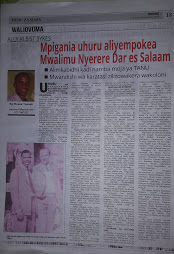
Ally Kleist Sykes mpigania uhuru aliyempokea Mwalimu Nyerere Dar es salaam

Ally Kleist Sykes mpigania uhuru aliyempokea Mwalimu Nyerere Dar es salaam

Mohamed Said

JF-Expert Member
Joined
Nov 2, 2008
Posts
21,967
Reaction score
32,074


Uhuru, Jumanne Februari 6, 2018

ALLY KLEIST SYKES

Mpigania uhuru aliyempokea Nyerere Dar es Salaam

L Alimkabidhi kadi namba moja ya TANU

L Mwandishi wa karatasi zilizowakera Wakoloni

NA MUSSA YUSUPH

UHURU wa Tanganyika haukuwa kazi rahisi kupatikana kama ambavyo wengi wanadhania.

Ili kuwa ni shughuli pevu iliyohitaji kujitoa kwa hali na mali ili kuhakikisha Waafrika kutoka Tanganyika ambalo lilikuwa koloni la Uingereza, wanajitawala.

Jitihada hizo zilifanywa na wapigania uhuru mbalimbali waliounganishwa kupitia chama cha Tanganyika National Unioni (TANU), kilichoundwa na na watu waliojawa na shauku la kujitoa kwenye makucha ya kikoloni.

Ally Kleist Sykes mzaliwa wa Mtaa wa Gerezani, Kariakoo Dar es Salaam, ni miongoni mwa waasisi waliopigania uhuru wa Tanganyika ambaye ana mengi ya kukumbukwa.

Mzee huyo aliyezaliwa Oktoba 10 mwaka 1926 kisha kufariki Dunia Mei 19 mwaka 2013 alikuwa mzalendo aliyeanza harakati za kisiasa kwenye miaka ya 1950.

Ally Sykes ndiye aliyemwandikia na kumkabidhi Hayati Mwalimu Julius Nyerere kadi ya TANU namba moja.

Pia alikuwa miongoni mwa waasisi wa TANU, kati ya wazee watu saba waliokuwa katika kamati ya TAA iliyounda TANU.

Alikuwa miongoni mwa wafadhili wakuu wa TANU, huku akiwa tegemeo la chama hicho katika kutekeleza mikakati hatari dhidi ya utawala wa Uingereza.

Katika siasa za sasa Mzee Ally Sykes anaweza akaelezewa kama "Mzee wa fitna" kwani alikuwa majukumu ya kuwagombanisha wananchi dhidi ya serikali ya kikoloni.

Majukumu hayo aliyatelekeza kwa kuchapa karatasi ambayo Waingereza waliyaita ya kuchochea ghasia kwani majasusi wa serikali ya kikoloni walimfahamu kwa uhodari wa kutengeneza mambo.

Waingereza walipata wakati mgumu kumkabili kwani licha ya uhodari wa kisiasa aliokuwa nao, Ally Sykes pia alikuwa na medali ya mlenga shabaha mahiri, aliyopata kwenye Vita Kuu vya Pili ya Dunia.

Kwenye vita hiyo Ally Sykes alikuwa kwenye bataliani ya sita (Battalion 6 Burma Infantry) King's African Rifles (KAR)

Hakika Ally Sykes alikuwa mzalendo, mweledi wa mambo na miongoni mwa waasisi muhimu wa TANU ambaye sahihi yake ndio iko katika kadi ya TANU ya Mwalimu Nyerere.

Umaarufu wake ni kama aliurithi kutoka kwa Baba yake Mzee Kleist Sykes aliyekuwa watu mashuhuri Dar es Salaam katika miaka ya 1900 hadi alipofariki mwaka 1949.

Baba yake alikuwa maarufu kwa kuwa alilelewa na Affande Plantan aliyekuwa askari kiongozi katika jeshi la Wajerumani lilokuja Tanganyika na Herman Von Wissman.

Kleist alikuwa ndiye katibu muasisi wa African Association mwaka 1929 chama kilichokuja baadae kujibadili na kuwa TANU ambacho Ally Sykes akiwa mmoja wa waasisi.

Pia baba yake aliasisi Al Jamiatul Islamiyya Fi Tanganyika (Umoja wa Waislam wa Tanganyika) na kupitia jumuia hiyo akajenga shule ya kwanza ya Kiiislam Dar es Salaam, ambayo ilisomesha Qur’an pamoja na elimu ya kimagharibi.

Jumuiya hiyo ilichangia vijana wengi wa kiislamu kuingia kwenye siasa za TAA na TANU katika harakati za kudai uhuru.

AKUTANA NA NYERERE

Ally Sykes na kaka yake Abdulwahid Sykes ndio watu wa mwanzo kumpokea Mwalimu Nyerere alipokuja Dar es Salaam mwaka 1952.

Nyerere alifika nyumbani kwa akina Sykes na ilijenga urafiki ambao ulipitiliza na kuwa udugu mkubwa wa mapenzi ya dhati si baina yao tu bali hata kwa wake na mama zao.

Mama yake Nyerere, Bi. Mugaya mara kwa mara alipenda kumtembelea nyumbani Bi Mruguru biti Mussa ambaye ndiye mama wa Sykes.

Pia Mama Maria Nyerere alikuwa mwenye urafiki wa karibu na Bi. Zainab ambaye ni mke wa Ally Sykes aliyekuwa akiishi Mtaa wa Kipata.

Wakati huo harakati za kuanzisha TANU zilikuwa zimepamba moto huku fitna za Waingereza kuwatokomeza viongozi shupavu wa TAA kama Hamza Mwapachu, Dk. Vedast Kyaruzi, Dk. Wilbard Mwanjisi, zilikivunja nguvu chama hicho.

Ndio maana TANU ilipokuja kuasisiwa mwaka 1954 Ally Sykes kadi yake ya TANU ikawa namba mbili, Nyerere namba moja, Abdulwahid Sykes kadi yake namba tatu, Dossa Aziz kadi namba nne na John Rupia kadi yake ilikuwa namba saba.

Kipindi hicho Ally Sykes alikuwa Katibu wa Tanganyika African Government Servants Association (TAGSA) na vilevile alikuwa mwakilishi wa chama hicho katika Kamati ya Uajiri ya Serikali (Government Establishment Committee).

Thomas Marealle ndiye alikuwa rais wa TAGSA na Rashid Kawawa alikuwa mwanakamati.

Wanasiasa hao walijipa jina la ‘’Wednesday Tea Club’’ wakikutana kila siku ya Jumatano kunywa chai pamoja na kupanga mikakati ya kuwang’oa Waingereza katika ardhi ya Tanganyika.

Kupitia Ally, Abdulwahid na Dossa Aziz, Nyerere aliweza kujuana na wenyeji wa Dar es Salaam maarufu baadhi yao ni Sheikh Hassan bin Amir, Mshume Kiyate, Jumbe Tambaza, Sheikh Suleiman Takadir, Clement Mtamila, Titi Mohamed na Tatu biti Mzee.

NYARAKA ZA HISTORIA YAKE

Baadhi ya nyaraka za historia alizozitunza nyumbani pake na kumpatia Mohamed Said, mpaka Ally Sykes, anafariki dunia zinadaiwa bado zilikuwa kwenye mikono ya Mohamed Said.

Ally Sykes aliwahi kumlalamikia kuwa nyaraka hizo ni mali ya taifa na lazima azikabidhi serikalini kwa kuhifadhiwa na kuwekwa kama urithi wa kizazi kijacho.

Inadaiwa kuwa nyaraka za Ally Sykes zinakwenda zimeelezea historia tangu babu yake Sykes Mbuwane alipoingia Tanganyika kutoka meli ya kivitia ya Wajerumani iliyotia nanga Pangani akitokea Msumbiji.

Nyaraka hizo zinadaiwa kuwa na barua za wanasiasa wa mwanzo katika Tanganyika mbali historia ya baba yake.

Inasemekama zimeelezea habari kuhusu wazalendo na machifu, wanasiasa wenye asili ya Kiasia na Waingereza wenyewe waliokuwa watawala.

Ally Sykes ameelezea harakati za Dk Joseph Mutahangarwa, Chifu Abdieli Shangali wa Machame, Paramount Chief Thomas Marealle wa Marangu, Chifu Adam Sapi Mkwawa wa Wahehe, Chifu Harun Msabila Lugusha na Dk. Wilbard Mwanjisi.

Wengine ni Abdulkarim Karimjee, Dk. Vedas Kyaruzi, Liwali Juma Mwindadi, H.K. Viran, Stephen Mhando, Dossa Aziz, Ivor Bayldon, Yustino Mponda, Ivor Bayldon, Rashid Mfaume Kawawa, Bhoke Munanka, Rashid Kheri Baghdelleh na Robert Makange.

Wanasiasa wengine aliowaelezea ni Saadani Abdu Kandoro, Malkia Elizabeth, Chief Secretary Bruce Hutt, Gavana Edward Twining, Gavana Ronald Cameron, Mwalimu Thomas Plantan na ndugu zake Schneider Abdillah Plantan na Ramadhani Plantan.

Pia wapo wakina Mwalimu Mdachi Shariff, Mwalimu Nicodemus Ubwe, Kassela Bantu, John Rupia, Hamza Kibwana Mwapachu, Othman Chande, Leonard Bakuname, Stephen Mhando, Oscar Kambona, Peter Colmore, Albert Rothschild, Ali Mwinyi Tambwe, Alexander Thobias, Japhet Kirilo, Joseph Kimalando, Ian Smith, Roy Welensky, Jim Bailey na Kenneth Kaunda.

Ally Sykes kwenye nyaraka hizo zinadaiwa amewaelezea wakina, Meida Springer, John Hatch, Gretton Bailey, Brig. Scupham, Dome Okochi Budohi, Annur Kassum, Nesmo Eliufoo, Yusuf Olotu, Joseph Kimalando na Mwalimu Julius Nyerere kwa nyadhifa walizokuja kuzishika kwenye Tanganyika huru.
 
Ukiingia deeep ktk historia kama hizi ndio unapata chimbuko la BAKWATA sasa. Hongera mleta mada, nitaeleweka na wachache sana.
 
Kupanga ni kuchagua.., shida inakuja nani wa kumfunga Paka Kengele!!!
 
Ndugu zangu Nyaraka za Sykes mimi nilikuwanazo kipindi cha utafiti tu na baada ya hapo nilizirejesha.
 
Mohamed Said: TRACING THE FOOTSTEPS OF MWALIMU JULIUS KAMBARAGE NYERERE The Early Years in Dar es Salaam of 1950s

It is a pity that Mwalimu Julius Nyerere did not reveal much of his early life in Dar es Salaam of 1950s of which he came to as a budding young politician fresh from Edinburgh University aged about 30 years old. Why Mwalimu Nyerere was secretive about his early days during the transformation of Tanganyika African Association (TAA) to Tanganyika African National Union (TANU) is now a rhetoric question because we can only speculate. Was Mwalimu trying to conceal something on his past or was that an innocent omission? The only time Mwalimu walked down memory lane was in 1985 at the Diamond Jubilee Hall where in an emotional farewell speech before he stepped down from the presidency he addressed Elders of Dar es Salaam who supported him during the struggle for independence. In that memorable speech flavored with Mwalimu’s oratory skills he walked back into history and paid tribute to Wazee wa Dar es Salaam (Dar es Salaam Elders) who supported him from day one since the founding of TANU in 1954. In his revelations Mwalimu Nyerere for the first time in public mentioned two other patriots forgotten in the history of Tanganyika. He said that in those difficult days the other young men with him were Abdulwahid Sykes and Dossa Aziz. Abdulwahid was TAA president in 1953 and was among the the four financiers of the movement along with his young brother Ally, Dossa and John Rupia. Abdulwahid died young in 1968 but Dossa went on to old age but both of them died the fruits of independence of which they had worked so hard having passed them by their names hardly associated with TANU, Nyerere or the independence movement. Dossa died a poor and lonely man at Mlandizi in 1997. One can write passages and passages on contributions and sacrifices made by the two Sykes brothers – Abdulwahid and Ally and Dossa; and the elders like - Mwinjuma Mwinyikambi, Kiyate Mshume, Jumbe Tambaza, Sheikh Hassan bin Amir, Sheikh Suleiman Takadir to mention only a few. In those days these names made up ‘who is who’ of the municipality. These were the rich and the famous of the town. But to understand the town, its elite and politics one has to revisit how colonialists demarcated Dar es Salaam.
Dar es Salaam was divided into four areas: Kariakoo, Gerezani, Kisutu and Mission Quarter. The oldest centre of the locality was Kisutu. It had the oldest mosque in Dar es Salaam, the Mwinyikheri Akida Mosque which is more than a hundred years. The mosque is opposite College of Business Education. Kisutu sprawled from where now is the Libya Post Office up to Mzizima Secondary School to the west and to the east Kisutu went up to where now is the Tanzania Library to the north and to the south up to Morogoro Road. Across Morogoro Road is Kariakoo which still exists and the first street stretching from the north to the south parallel to Mnazi Mmoja was a narrow road - New Street where the headquarters of the African Association (AA) stood, a building of stone and lime built in 1930s through self help during the leadership of Mzee Bin Sudi and Kleist Sykes president and secretary respectively. It was in this building that Tanganyika African National Union (TANU) was born in 1954. The building was situated where Kariakoo Street and New Street cross each other. The house exists today.

To the west of Kariakoo was the Mission Quarter which was an exclusive African mission area set aside by the British to alienate the Christian minority from the Muslim majority in the town. Even street names at Mission Quarter had names of settlements in Tanganyika where missionaries had managed to penetrate and establish themselves. Street names such as Masasi, Likoma, Ndanda, Muhonda, Muheza and Magila have survived to this day. This was the only area in Dar es Salaam where missionaries had managed to build a chapel. African Christians were confined to this area. And if it happens that a Christian ventures to Kariakoo, a majority Muslim area to ask for a room to rent he would politely be advised to try his luck at Mission Quarter. Mwalimu Nyerere arrived in a town which was structured along such prejudices.

Among prominent personalities from Kariakoo who came into contact with the young Nyerere were Mzee Mshume Kiyate, Sheikh Hassan bin Ameir, Sheikh Suleiman Takadir, Idd Faizi, Idd Tosiri, Abdulwahid Sykes and Dossa Aziz. Abdulwahid Sykes was 28 years two years younger than Julius Nyerere when one afternoon Nyerere came to Abdulwahid’s house at Stanley Street (now Max Mbwana Street) accompanied by Bantu Kasella Bantu. It is said Mwalimu Nyerere had a letter of introduction from Hamza Mwapachu (who was still in Britain studying) to Abdulwahid Sykes. At that time Sykes was the President of the Tanganyika African Association (TAA). The fact that Abdulwahid Sykes preceded Nyerere on the presidency of the TAA is a point often not mentioned even by Chama Cha Mapinduzi (CCM).This denies the history of nationalist politics in Tanganyika of a very interesting story of ‘friendly silent power struggle’ between the incumbent and well established townsman Abdulwahid Sykes, son of a prosperous businessman and founder member of AA, Kleist Sykes and the unassuming challenge from an unknown school teacher from Butiama, Julius Nyerere within the association. It denies the young generation inside information of what TAA did to outsmart the British and send Mwalimu Nyerere to United Nations to address the Trusteeship Council. Most importantly it denies them of the burning issues which were discussed at the ‘Sunday Baraza.’

It was at either at Dossa’s house at Congo Street or at Abdulwahid’s house at Stanley Street (now Max Mbwana), where Nyerere used to come every Sunday to meet the TAA leadership and discuss politics of the day. The planning, the plots and the schemes against the British were hatched from these two houses out of their ‘Sunday Baraza’ as they used to call the gathering. The meetings at TAA headquarters New Street now Lumumba was merely to rubber stamp. Any student of Tanganyika’s nationalist politics wishing to trace the early life of Mwalimu Nyerere’s formative years needs to walk down this path. It is saddening that this vital path has not been trodden by researchers.

Two prominent Africans and members of the African Association who lived in Mission Quarter during the emergence of nationalist politics was Thomas Plantan son of a Zulu mercenary, Affande Plantan. At one time Thomas Plantan was elected president of the AA. His father, Affendi Plantan came into Tanganyika from Imhambane in Mozambique with Von Wissman, Commander of German Forces in East Africa to quell the Abushiri uprisings which began in Pangani. The other prominent African living in Mission Quarter was John Rupia a rich African businessman. His house situated at Likoma Street and Magila is where the AA was founded in 1929. The house still stands today though not in its original structure. An interesting fact about Mission Quarter is that it had the only printing press owned by an African – Mashado Plantan from which the pro-African Association newspaper Zuhra was published. This paper came to be TANU and Nyerere’s first ever mouth piece.

On the west of Kariakoo was Gerezani home of Omari Londo, Ally Sykes, Zuberi Mtemvu, Mashado Plantan, Muhsin Mende and Dossa Aziz. These were the first patriots from Gerezani to come into contact with Nyerere. Zuberi Mtemvu, Mashado Plantan and Muhsin Mende were later to resign from TANU to form an opposition party the Tanganyika African Congress and the two became bitter opponents of TANU and Nyerere. But equally important in tracing Mwalimu’s steps from Butiama particularly after the founding of TANU in 1954 is the house of veteran politician and former secretary of the TAA Mzee Clement Mtamila who was overthrown from TAA leadership along with the president Thomas Plantan in a coup de grace led by Abdulwahid Sykes and Hamza Mwapachu in 1949. The house of Mtamila was, situated at the junction of Kipata, (now Kleist Sykes Street) and Sikukuu Street now Zaramo Street. In those days the president of the party was not necessarily the chairman of the executive committee. In 1954 Clement Mtamila was the chairman of the executive committee of TANU. It was in this house Nyerere then president of TANU presented the letter from Father Walsh in which he was given the ultimatum of either to continue to teach at the Catholic school in Pugu or resign to pursue politics. This important meeting in which Mwalimu Nyerere decided to resign from teaching and work for TANU was chaired by Clement Mtamila in this house. Other members of the TANU Executive Committee present at that meeting were: John Rupia, Oscar Kambona, Bibi Tatu Binti Mzee and Bibi Titi Mohamed. The sitting room in Mzee Mtamila’s up to late 1960s had many black and white photographs depicting Tanganyika’s history. The photographs depicted Nyerere’s early days in TANU showing him addressing the people from a make shift platform at Mnazi Mmoja Grounds overlooking where now stands the Adult Education Centre. The open space opposite Mnazi Mmoja Grounds was John Rupia’s plot which he later donated to TANU to build the centre. Mzee Mtamila’s house is no more. It has given way to a high rise building now common in Gerezani, Mwalimu’s history buried with it in the rubble of stones, lime, dust and rusted corrugated iron sheets.
Another place which Mwalimu Nyerere frequented during those early days was the Kariakoo Market. Kariakoo Market building housing the market resembled a huge shack made of steel, concrete and corrugated iron sheets. The market was busy around the clock with all kind of business being carried inside the market and within its environs. One could tell the tribe of the traders from the kind of trade he or she was engaged in. The Mashomvi were selling fish, the Zaramo were into coconut business, the Nyamwezi particularly women confined themselves to selling dried tobacco leaves and snuff, and their men were selling yams grown in Kigamboni. The Luguru were into oranges and vegetables. Arabs owned butchers and sold flour, cereals and spices. This retail business Arabs were in competition with Indians. Kariakoo Market was a fertile place for TANU to recruit members and Abdulwahid did not lose that opportunity. Among the traders to support TANU from Kariakoo Market was Mzee Mshume Kiyate.

At that time in 1952 when Abdulwahid Sykes met Mwalimu Julius Nyerere he was working as Market Master of Karikoo Market. His office was at the junction of Tandamti Street (now Mshume Kiyate) and Swahili Street. The afternoon after resigning from teaching Mwalimu Nyerere took a bus from Pugu and got off at Kariakoo which was the main stand and went straight to Abdulwahid’s office to give him the news. Abdulwahid accommodated Mwalimu Nyerere at his house at Stanley Street until when Mwalimu left for to Butiama to get married to Mama Maria. This house exists today but has undergone massive renovations altering its original look. Shariff Attas who was working as market auctioneer recalls that he used to escort Mwalimu Nyerere from Abdulwahid’s office to Sykes’ house for lunch wait for him and come back together. Mwalimu would sit in Abdulwahid’s office reading The Tanganyika Standard. After closing of business at 4.30 Abdulwahid and Nyerere would come back home together. Many people in Dar es Salaam first saw and therefore came to know Mwalimu Nyerere during that time. During this period Abdulwahid nearly lost his job as Market Master when Nyerere and TANU’s message began to be understood by the people. Abdulwahid was accused of selling TANU cards in Her Majesty’s Office. Shariff Attas recalls the thrilling shouting match between Abdulwahid Sykes and the white colonial officer inside Sykes’s office when Abdulwahid in his impeccable English and without fear took out his TANU card and challenged the mzungu to take him to court if he feels he has contravened any law and TANU was not a legally registered party. The veranda which used to be a meeting place where TANU leadership used to hold its meeting and where many people came to know Mwalimu Julius Nyerere is now a bazaar, the people who come to the place to buy and sell completely unaware of its rich history.

scan0027-1.jpg

Nyerere addressing a TANU meeting at Jangwani Grounds in early 1950s
But the liveliest meeting place – Mwalimu Nyerere frequented outside the ‘Sunday Baraza’ at Congo and Stanley Street at Dossa’s house and Sykes’ place was at Sheikh Suleiman Takadir’s auction mart. Sheikh Takadir was the Chairman of the TANU Elders Council the powerful body which had people like Mshume Kiyate, Mwinjuma Mwinyikambi, Jumbe Tambaza and others as members. Sheikh Takadir was an auctioneer and was conducting his business from a house situated at Nyamwezi Street belonging to Mwinjuma Digosi, a jumbe appointed by the government. The auction used to be the meeting place of TANU members. TANU members used to meet at Sheikh Takadir’s premises to drink coffee discuss politics and while away the time. When Digosi, the landlord realised that Nyerere was visiting Sheikh Takadir at his place of business, he asked Takadir to seek accommodation elsewhere. He told Sheikh Takadir that he could no longer have him as a tenant because he as a jumbe appointed by the government cannot allow his house to be a meeting place of ‘troublemakers’ like Nyerere and other riff - raffs. Sheikh Takadir had no choice but to shift his business to Msimbazi Street. Sheikh Suleiman Takadir was to oppose Nyerere’s decision to participate in the controversial tripartite election of 1958 and the two became bitter enemies never to reconcile resulting into expulsion of Sheikh Takadir from TANU.
But one the most touching story of sacrifice, love and commitment to Mwalimu Nyerere, TANU and the struggle is that of Mzee Mshume Kiyate. Mwalimu Nyerere was to call Mshume’s commitment to the struggle – the TANU spirit. This story was retold to the author by Ahmed Rashad Ali who said he was at Msasani, Mwalimu’s residence on that day with Dossa Aziz and Lucy Lameck when Nyerere told them the level of commitment which members of TANU had for the struggle. There is a story of Said Chamwenyewe one of the earliest members to have joined TANU who mobilized the first members for TANU from Rufiji his home town when it was difficult to have a full register of members to fulfill a condition which would have made TANU qualify as a party and hence be registered. Chamwenyewe used to ride a bicycle from Dar es Salaam to Rufiji to mobilize membership for TANU travelling through a forest infested with lions and other wild animals. But Mwalimu Nyerere had no fitting story to tell than that of Mzee Mshume Kiyate.

Mzee Mshume Kiyate was a fishmonger at Kariakoo Market. One day Mwalimu Nyerere was on his way to Kariakoo Market walking from Magomeni Majumba Sita where he was residing. Upon reaching Mwembe Togwa (now known as Fire) at the junction of (Ronald Cameroon Road (now United Nations Road) and Morogoro Road Mwalimu Nyerere met Mshume Kiyate.

Mwalimu Nyerere told Mshume Kiyate that he was going to Kariakoo Market to buy provisions but he did have a single sent in his pocket. Mshume Kiyate dipped his hand into his pocket and gave Mwalimu Nyerere two hundred shillings. At that time with two hundred shillings one could purchase a six bedroom house at Kariakoo. Mshume Kiyate from that day volunteered to provide food for Mwalimu’ family and he did this until 1961 when Tanganyika achieved its independence and Mwalimu Nyerere became Prime Minister.

There is a very famous photograph of Mwalimu Nyerere with an old man in coat, kanzu and Muslim cap taken in 1958 during the tripartite elections. The photograph shows Mwalimu at Arnautoglo Hall going to cast his vote. That old man in the photograph with Mwalimu Nyerere escorting him to cast his vote is Mzee Mshume Kiyate. The ruling party Chama Cha Mapinduzi (CCM) has used this photograph in its mobilization effort urging people to vote. Unfortunately for almost five decades the photograph has been published without caption and Mshume Kiyate remains unrecognized to this day. Not many people know who Mshume Kiyate was or of his contribution to the struggle. In 1995 when Mayor Kitwana Kondo honoured Mzee Mshume Kiyate by changing the name of the street Tandamti which he lived to Kiyate Mshume the press protested asking who Mshume Kiyate was. Likewise the new street names in honour of Tatu Binti Mzee, Max Mbwana, Omari Londo were equally disputed. Strangely Mwalimu Nyerere did not utter a word. It is interesting that with these changes of street names Mwalimu Nyerere was also honoured. Pugu Road was changed to Nyerere Road. The reason was that this was the road which Mwalimu Nyerere used to travel to Dar es Salaam during the struggle either riding a bicycle or walking on foot. When called by the press to comment on this change Mwalimu was quoted to have said that he should not be associated with those new developments.

WAZEE+WA+TANU.jpg

Baraza la Wazee wa TANU
Why Mwalimu Julius Nyerere did not reveal much of his early life in Dar es Salaam of 1950s and about the people who were with him. Why Mwalimu Nyerere took this position now remains a rhetoric question. Was Mwalimu Nyerere trying to conceal something or is this an innocent omission? Mwalimu Nyerere however talked to Lady Judith Listowel in 1963 who had come to Tanganyika to research on a book (The Making of Tanganyika) she was writing. Judith Listowel was the wife of the last governor of Gold Coast (Ghana). She was put in contact to Ally Sykes by Peter Colmore in Nairobi. Lisowel came to Dar es Salaam and interviewed Abdulwahid and Ally Sykes and Julius Nyerere. In that book Mwalimu paid a glowing tribute to fellow nationalists who had preceded him in the political arena. The Making of Tanganyika published in London in 1965 is now out of print book. In Tanzania there are only two copies in existence, one is at the University of Dar es Salaam Library and the other one is with Ally Sykes.

There are reports that Mwalimu Nyerere was under tremendous pressure from friends, supporters as well as from cronies to write his memoir but flatly refused. It is reported that Mwalimu even refused to meet an Oxford University Press representative who wanted to discuss about writing of his memoir. Was Mwalimu Nyerere through his silence sending a terse message? It was only when Mwalimu Nyerere was severely criticized in two books: Conflict and Harmony in Zanzibar by Ali Muhsin Barwan andThe Life and Times of Abdulwahid Sykes 1924 -1968 by Mohamed Said that it is said Mwalimu Nyerere succumbed to that pressure and told his confidants to form a committee which he would talk to about his life and from that interaction they would be able to write his biography. But although the committee was formed it never got off the ground as Mwalimu was in failing health and soon died on 14 th October 1999.

Mohamed Said
29 September 2008
 
kiuchumi haikusaidii lkn kihistoria inamchango, maisha siyo uchumi tuu ingawa uchumi ni muhimu lkn mambo mengine nayo yana nafasi yake,jioni njema mkuu.
Mkuu achana na huyo poyoyo sio kila mtu wa kumuelekeza
 
Familia ya wakina Sykes kumbe walikuwa wengi. Kuna yule akifariki mwanzoni mwa miaka 1970 na yule aliyewahi kuwa Mea wa jiji la Dar.
 
Back
Top Bottom