Tanzania prisoner gets law degree
By Vicky Ntetema
BBC News, Dar es Salaam
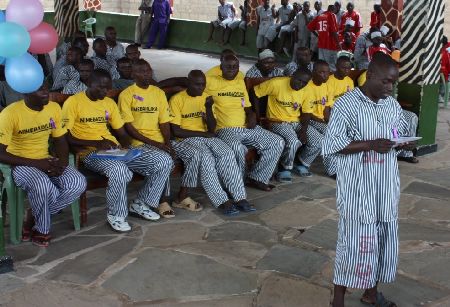
A man doing time in an overcrowded jail has become the first prisoner in Tanzania to be awarded a degree.As Harun Pembe Gombela was unable to go to last weekend's graduation, the Open University's chancellor went to the Dar es Salaam prison to hand it over.
Wearing a black and purple robe and a black cap, Gombela said he was over the moon to get his law degree.
"I chose law because I want to assist - as many prisoners are convicted because the prosecution framed them," he said.
" They call him saviour because his main responsibility in prison is to write appeals for his fellows "
Daphina Labenta Mabagala,
Open University tutor
Equally overwhelmed were Gombela's two daughters, who were allowed to attend the ceremony in the officers' mess of Ukonga Prison.
"I want to be like my father, I want to graduate," said his 23-year-old daughter, who was seven when her father was jailed.
No-one was prepared to reveal the nature of Gombela's crime or the length of his sentence, which he started 16 years ago.
'Role model'
For the university's vice-chancellor, Tolly Mbwete, it was a memorable day.
"I must admit, at the beginning the management at the university wasn't even aware he was a prisoner," he said.
"Until he wrote a letter to us telling us about the difficulty he had in getting materials and where he was."
Lecturer Daphina Labenta Mabagala said her former and unlikely student was "a role model to other prisoners".
"They call him 'mkombozi', which means saviour, because his main responsibility in prison is to write appeals for his fellows," she said.
"Up to now he's succeeded to write about 90 appeals and his colleagues have been freed from prison."
University officials said the prison gave Gombela support during his studies.
"The prison officials were very positive and we didn't face any difficulty," Mrs Mabagala said.
Tanzania's Open University, which opened in 1994, has decided to start a library for the Ukonga Prison as an incentive to get more students from all walks of life to take up distance learning.
Story from BBC NEWS:
BBC NEWS | Africa | Tanzania prisoner gets law degree
Published: 2007/11/01 19:12:26 GMT
© BBC 2014 waltham
hapo safi sana geza ulole.inatia moyo sana
[h=1]Kenyan prisoners take the law into their own hands[/h] By Catherine Fellows BBC Africa, Kenya
Continue reading the main story
In Kenya, prisoners are taking the law into their own hands and using it to get out of jail.
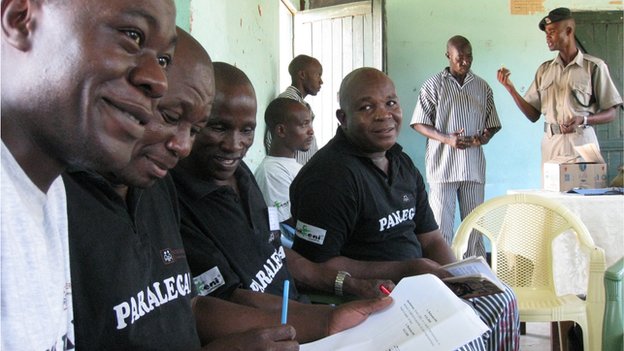
"Last week Abdi's sentence was reduced from death to seven years. We also helped another inmate win his appeal, and he has already left," says Douglas Owiyo, one of a team of prisoner paralegals at Shimo La Tewa maximum security prison in Mombasa.
Since 2007, when he and a dozen other inmates were trained in the law, they have launched more than 3,000 successful appeals, even though they are not fully qualified lawyers
Abdi Moka (L) says he owes the paralegals, like Douglas Owiyo (R), his life
In Kenya, the majority of people accused of committing a crime face court without a lawyer.
Abdi Moka was one of these.
When he found himself before a judge facing a charge of robbery with violence, he had no idea what to plead or how to defend himself.
Robbery with violence carries a mandatory death sentence in Kenya, and before he knew what was happening, Moka was on death row.
Owiyo and the other prisoner paralegals drafted a written submission which Moka presented at his appeal. They won.
The appeal judge agreed that Moka should have been charged with a lesser crime and given a much lighter sentence.
"When I was sentenced to death I thought I would lose my mind," Moka remembers.
"But now, thanks to the paralegals, I have hope again."
'Intelligent questions'
Continue reading the main story [h=2]Dismas Omondi's story[/h]
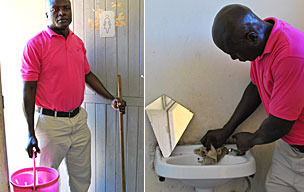
One of the first prisoners to be trained as a paralegal, Dismas Omondi headed the team at Shimo La Tewa and is personally credited with securing the freedom of 250 inmates until his release after 13 years inside. Now he cleans toilets at Mombasa's High Court:
I was arrested and accused of robbery with violence which carries a death sentence. I was found guilty and [for] around nine years was in a segregation block. It was very challenging. Us Christians were reading [the] Bible, singing hymns and concentrating on our court files. I had books given to me by a missionary containing the laws and past judgements. The officer in charge allowed me access to them because he knew I was helping others. I can perform well, more than other lawyers, because I've been doing them practically and people have been acquitted.
The government should consider supporting those who come out of prison - the majority after serving long sentences do reform but cannot manage outside. Like me, when I was released I was given 200 shillings ($2.30; £1.50) which is not enough to take me from Shimo to [my home in] Likoni. A chief magistrate decided to give us [janitor jobs] at this [toilet] facility to assist us for the time being. [People pay] 10 shillings for both short and long calls. We get around 600 shillings a day - shared with my colleague, an ex-prisoner. I could not have imagined this, when in prison I could not even think of washing the toilets.
I'd like to pursue further studies, because I have enough basic skills and knowledge regarding the law. In the court where I work I go and read the judgements… [often of those] I helped. I am very much happy when I meet them in the street, they say: 'Ah Dismas, thank you!'
Mombasa's chief magistrate, Stephen Riech, admits that the lack of legal representation for defendants leads to injustice.
"There is a lot of it because, for instance, if someone is charged with being in possession of a weapon with intent to steal, he may say: 'Yes, I was found in possession of a weapon,' and admit [that].
"But the catch is he had no intention of stealing. If he knew some basics he could not have done that."
He says the impact of the prisoner paralegals can really be seen when defendants come to court.
"Once they have exposure to the paralegals they know their rights," he says.
"They ask for the statements of the witnesses, they sometimes ask for adjournments so they can prepare their defence.
"I can see them asking intelligent questions to the witnesses who are testifying against them.
"Some even make submissions on points of law, which to my mind is a great improvement."
The organisation responsible for the training of prisoner paralegals in Kenya is Kituo Cha Sheria.
Set up in 1973 by a group of Kenyan lawyers concerned by the lack of legal help available to the poor, Kituo Cha Sheria has now evolved into a multi-faceted legal aid and advocacy group.
It campaigns on issues such as abolishing the death penalty, which is still in place in Kenya, although no-one has been executed since 1987.
Following the success of the original prisoner paralegal training in Mombasa, Kituo Cha Sheria has now trained teams in Kamiti Maximum Security Prison and Langata Women's Prison in the capital, Nairobi.
Lifer Joseph Karanja, who heads the paralegals at Kamiti, says that in the first nine months since the training, his team won 120 appeals.
This is confirmed by prison officer Senior Sergeant Benson Ngui, who adds that, prior to the training, he would have expected no more than one or two successful appeals in a year.
'Better than lawyers'
Continue reading the main story [h=2]"Start Quote[/h]
We don't mind if you committed it or not, we are trying to argue with the evidence the court adduced"
Denga John Lenda Kamiti paralegal
So how do the prisoner paralegals manage to win so many appeals?
They told me they used the failings of the system, exposing shoddy investigations by the police and incompetent rulings by magistrates.
"We try to prove the trial wasn't safe, for instance in a case of defilement [child sexual abuse], the victim was never examined by a doctor, and the only evidence was the testimony of the mother who may have a grudge against the accused," said Denga John Lenda, the deputy head of the paralegal team at Kamiti.