
Informer
JF-Expert Member
- Jul 29, 2006
- 1,606
- 6,672
WASHINGTONThe Supreme Court dramatically advanced gay rights Wednesday (June 26, 2013) in rulings that direct the federal government to provide equal treatment to same-sex spouses and allow the resumption of gay marriages in California.
In a pair of 5-4 rulings on the final day of the court's term, the justices struck down the 1996 Defense of Marriage Act, which denied federal benefits to gay couples married under state law, and let stand a ruling that found Proposition 8, a 2008 voter initiative that ended same-sex marriage in California, unconstitutional.
In striking down DOMA, Justice Anthony Kennedy said Congress had no business undermining a state's decision to extend "the recognition, dignity and protection" of marriage to same-sex couples.
By excluding such couples from the rights and responsibilities of marriage contained in more than 1,000 provisions of federal law, "DOMA writes inequality into the entire United States Code," Justice Kennedy wrote.
The DOMA ruling had immediate effects. The Obama administration said it would move swiftly to ensure same-sex married couples get the same tax and other benefits as heterosexual couples, although the process for doing so is uncertain for same-sex couples who marry in one state, then move to a state that doesn't recognize gay marriage.
Meantime, noncitizens who are married to American same-sex partners likely would qualify for permanent resident status, lawyers said.
In California, Attorney General Kamala Harris said she would order that marriage licenses be granted to same-sex couples statewide as soon as a U.S. appeals court takes a procedural step, which could come within a month.
The Supreme Court's rulings didn't say whether there is a federal constitutional right to same-sex marriage, ensuring years of battles in states that bar it. Groups that believe marriage is between a man and woman said they would fight state by state to defend that definition, while the American Civil Liberties Union tapped veteran GOP strategists as part of a $10 million campaign seeking to convert Republican-led states to the gay-marriage cause.
The DOMA opinion by Justice Kennedyjoined by liberal Justices Ruth Bader Ginsburg, Stephen Breyer, Sonia Sotomayor and Elena Kagansparked three separate dissents from four conservative justices.
Justice Antonin Scalia read his dissent from the bench. He and othersChief Justice John Roberts and Justices Samuel Alito and Clarence Thomascontended the court had no jurisdiction to even hear the case, because the Obama administration already had concluded the 1996 law was unconstitutional and thus there was no dispute for the court to resolve.
As for the merits of the law, Justice Scalia said it should stand. "Favoring man-woman marriage no more 'demeans' and 'humiliates' other sexual relationships than favoring our Constitution demeans and humiliates the governmental systems of other countries," he said.
President Barack Obama applauded the outcome. "The laws of our land are catching up to the fundamental truth that millions of Americans hold in our hearts: When all Americans are treated as equal, no matter who they are or whom they love, we are all more free," he said.
Front-line opponents of gay marriage blasted the decisions.
"There's a stench coming from these cases that has now stained the Supreme Court," said Brian Brown, president of the National Organization for Marriage. "It's imperative that Congress continue to protect the right of states to not recognize faux marriages in their state."
The ruling left intact a separate DOMA provision that states need not recognize same-sex marriages performed by other states.
Justice Scalia predicted the majority had provided a blueprint for extending gay marriage nationwide. If DOMA unconstitutionally robbed same-sex couples of "personhood and dignity" in states that permitted the practice, he said, quoting from the majority opinion, courts might find that laws in 35 anti-gay-marriage states also must fall. "It is just a matter of listening and waiting for the other shoe to drop," Justice Scalia said.
While the DOMA opinions prompted passion from the court's majority and dissenters alike, the Proposition 8 ruling was as dry as a law school text.
The court's traditional ideological lineup was scrambled over the question of the court's jurisdiction to hear the case.
Chief Justice Roberts, joined by Justices Scalia, Ginsburg, Breyer and Kagan, said the case should have ended in 2010, when a federal district judge in San Francisco struck down Proposition 8 for violating the 14th Amendment's equal-protection and due-process clauses.
The court didn't endorse the district judge's viewsrather, the chief justice found, California's failure to appeal that ruling left nothing for appellate courts to consider.
Citizens who sponsored Proposition 8, which withdrew a right of gay marriage the California Supreme Court had recognized under the state constitution, appealed to defend their initiative. The Ninth U.S. Circuit Court of Appeals, in San Francisco, permitted their appeal to proceed, and then concluded Proposition 8 was unconstitutional.
Chief Justice Roberts wrote that, despite the California Supreme Court's own view that initiative sponsors are entitled to defend their legislation in court, the case must be dismissed. Under federal precedents, he said, the initiative sponsors were merely "bystanders" with no standing to appear in court.
"We have never before upheld the standing of a private party to defend the constitutionality of a state statute when state officials have chosen not to," he wrote. "We decline to do so for the first time here."
In dissent, Justice Kennedy wrote that the majority failed to understand "the basic premise of the initiative process" that has long shaped public policy in his home state. The California initiative process gives legislating power directly to the people, and with it should come the standing to defend that power in court, he wrote, joined by Justices Thomas, Alito and Sotomayor.
Given their views on the Defense of Marriage Act case, there was little reason to believe the justices' lineup on the Proposition 8 suit would have been the same had they ruled on the case's merits. The legal precedent, then, speaks more to future appellate litigation involving state initiatives, rather than anything related to gay marriage.
But the practical impact in California likely will be similar to what would have happened had the court agreed with the Ninth Circuit in striking down the proposition. Gov. Jerry Brown said he had directed state officials to ensure that the original district-court ruling striking down Proposition 8 was implemented.
It was Justice Kennedy's opinion in the DOMA case, U.S. v. Windsor, that plowed new ground.
Justice Kennedy wrote both of the court's major gay-rights precedents, in 1996 and 2003, and like them Wednesday's opinion was grounded in his view that the Constitution protects an individual's "moral and sexual choices."
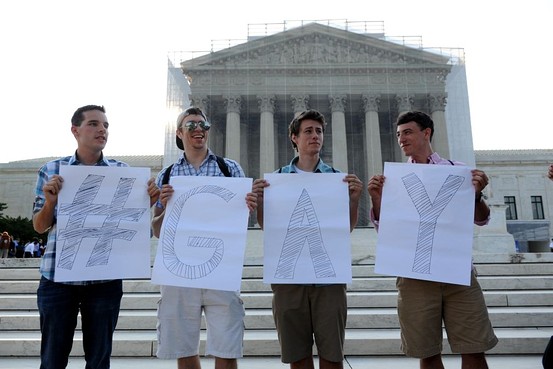
Casey Oakes, 26, of Monroe, N.J., left, Dan Choyce, 21, of Sicklerville, N.J., center left, Zach Wulderk, 19, of Hammonton, N.J., and his brother Dylan Wulderk, 22, right, wait for a ruling on same sex marriage at the Supreme Court in Washington on Wednesday.
But it went further, turning on its head the argument by opponents of same-sex marriage, including Proposition 8's proponents, that extending the institution to gays and lesbians would harm children.
To the contrary, Justice Kennedy wrote, it was DOMA that injured children, and not only financially by denying their families certain insurance benefits. "It humiliates tens of thousands of children now being raised by same-sex couples," he found, making it "even more difficult for the children to understand the integrity and closeness of their own family and its concord with other families in their community and in their daily lives."
Justice Scalia was unmoved. The Constitution doesn't forbid the government to enforce traditional moral and sexual norms, he wrote.
Besides, he said, there were "downright boring" justifications for DOMA. He offered an example: Denying federal recognition to all same-sex marriages avoided the "uncertainty" of adjudicating such complicated questions as whether two women lawfully married in Albany, N.Y., lose federal spousal benefits if they move to Alabama, where state law only recognizes heterosexual marriages.
Brent Kendall, Geoffrey A. Fowler and Tamara Audi contributed to this article.
Write to Jess Bravin at jess.bravin@wsj.com
In a pair of 5-4 rulings on the final day of the court's term, the justices struck down the 1996 Defense of Marriage Act, which denied federal benefits to gay couples married under state law, and let stand a ruling that found Proposition 8, a 2008 voter initiative that ended same-sex marriage in California, unconstitutional.
In striking down DOMA, Justice Anthony Kennedy said Congress had no business undermining a state's decision to extend "the recognition, dignity and protection" of marriage to same-sex couples.
By excluding such couples from the rights and responsibilities of marriage contained in more than 1,000 provisions of federal law, "DOMA writes inequality into the entire United States Code," Justice Kennedy wrote.
The DOMA ruling had immediate effects. The Obama administration said it would move swiftly to ensure same-sex married couples get the same tax and other benefits as heterosexual couples, although the process for doing so is uncertain for same-sex couples who marry in one state, then move to a state that doesn't recognize gay marriage.
Meantime, noncitizens who are married to American same-sex partners likely would qualify for permanent resident status, lawyers said.
In California, Attorney General Kamala Harris said she would order that marriage licenses be granted to same-sex couples statewide as soon as a U.S. appeals court takes a procedural step, which could come within a month.
The Supreme Court's rulings didn't say whether there is a federal constitutional right to same-sex marriage, ensuring years of battles in states that bar it. Groups that believe marriage is between a man and woman said they would fight state by state to defend that definition, while the American Civil Liberties Union tapped veteran GOP strategists as part of a $10 million campaign seeking to convert Republican-led states to the gay-marriage cause.
The DOMA opinion by Justice Kennedyjoined by liberal Justices Ruth Bader Ginsburg, Stephen Breyer, Sonia Sotomayor and Elena Kagansparked three separate dissents from four conservative justices.
Justice Antonin Scalia read his dissent from the bench. He and othersChief Justice John Roberts and Justices Samuel Alito and Clarence Thomascontended the court had no jurisdiction to even hear the case, because the Obama administration already had concluded the 1996 law was unconstitutional and thus there was no dispute for the court to resolve.
As for the merits of the law, Justice Scalia said it should stand. "Favoring man-woman marriage no more 'demeans' and 'humiliates' other sexual relationships than favoring our Constitution demeans and humiliates the governmental systems of other countries," he said.
President Barack Obama applauded the outcome. "The laws of our land are catching up to the fundamental truth that millions of Americans hold in our hearts: When all Americans are treated as equal, no matter who they are or whom they love, we are all more free," he said.
Front-line opponents of gay marriage blasted the decisions.
"There's a stench coming from these cases that has now stained the Supreme Court," said Brian Brown, president of the National Organization for Marriage. "It's imperative that Congress continue to protect the right of states to not recognize faux marriages in their state."
The ruling left intact a separate DOMA provision that states need not recognize same-sex marriages performed by other states.
Justice Scalia predicted the majority had provided a blueprint for extending gay marriage nationwide. If DOMA unconstitutionally robbed same-sex couples of "personhood and dignity" in states that permitted the practice, he said, quoting from the majority opinion, courts might find that laws in 35 anti-gay-marriage states also must fall. "It is just a matter of listening and waiting for the other shoe to drop," Justice Scalia said.
While the DOMA opinions prompted passion from the court's majority and dissenters alike, the Proposition 8 ruling was as dry as a law school text.
The court's traditional ideological lineup was scrambled over the question of the court's jurisdiction to hear the case.
Chief Justice Roberts, joined by Justices Scalia, Ginsburg, Breyer and Kagan, said the case should have ended in 2010, when a federal district judge in San Francisco struck down Proposition 8 for violating the 14th Amendment's equal-protection and due-process clauses.
The court didn't endorse the district judge's viewsrather, the chief justice found, California's failure to appeal that ruling left nothing for appellate courts to consider.
Citizens who sponsored Proposition 8, which withdrew a right of gay marriage the California Supreme Court had recognized under the state constitution, appealed to defend their initiative. The Ninth U.S. Circuit Court of Appeals, in San Francisco, permitted their appeal to proceed, and then concluded Proposition 8 was unconstitutional.
Chief Justice Roberts wrote that, despite the California Supreme Court's own view that initiative sponsors are entitled to defend their legislation in court, the case must be dismissed. Under federal precedents, he said, the initiative sponsors were merely "bystanders" with no standing to appear in court.
"We have never before upheld the standing of a private party to defend the constitutionality of a state statute when state officials have chosen not to," he wrote. "We decline to do so for the first time here."
In dissent, Justice Kennedy wrote that the majority failed to understand "the basic premise of the initiative process" that has long shaped public policy in his home state. The California initiative process gives legislating power directly to the people, and with it should come the standing to defend that power in court, he wrote, joined by Justices Thomas, Alito and Sotomayor.
Given their views on the Defense of Marriage Act case, there was little reason to believe the justices' lineup on the Proposition 8 suit would have been the same had they ruled on the case's merits. The legal precedent, then, speaks more to future appellate litigation involving state initiatives, rather than anything related to gay marriage.
But the practical impact in California likely will be similar to what would have happened had the court agreed with the Ninth Circuit in striking down the proposition. Gov. Jerry Brown said he had directed state officials to ensure that the original district-court ruling striking down Proposition 8 was implemented.
It was Justice Kennedy's opinion in the DOMA case, U.S. v. Windsor, that plowed new ground.
Justice Kennedy wrote both of the court's major gay-rights precedents, in 1996 and 2003, and like them Wednesday's opinion was grounded in his view that the Constitution protects an individual's "moral and sexual choices."
But it went further, turning on its head the argument by opponents of same-sex marriage, including Proposition 8's proponents, that extending the institution to gays and lesbians would harm children.
To the contrary, Justice Kennedy wrote, it was DOMA that injured children, and not only financially by denying their families certain insurance benefits. "It humiliates tens of thousands of children now being raised by same-sex couples," he found, making it "even more difficult for the children to understand the integrity and closeness of their own family and its concord with other families in their community and in their daily lives."
Justice Scalia was unmoved. The Constitution doesn't forbid the government to enforce traditional moral and sexual norms, he wrote.
Besides, he said, there were "downright boring" justifications for DOMA. He offered an example: Denying federal recognition to all same-sex marriages avoided the "uncertainty" of adjudicating such complicated questions as whether two women lawfully married in Albany, N.Y., lose federal spousal benefits if they move to Alabama, where state law only recognizes heterosexual marriages.
Brent Kendall, Geoffrey A. Fowler and Tamara Audi contributed to this article.
Write to Jess Bravin at jess.bravin@wsj.com