History of Tanganyika

History of Tanganyika

MaxShimba

JF-Expert Member
Joined
Apr 11, 2008
Posts
35,771
Reaction score
4,065
Chronological History of man in Tanganyika
(now Tanzania)


1st Century B.C.Cushites from Ethiopia settle in Tanganyika.
2nd Century A.D.Agriculturists from Cameroun and Nigeria settle in Tanganyika and Iron Age Civilization develop.
7th Century A.D.Arabian merchants settle on the island of Zanzibar off the Tangayikan coast.
10th Century A.D.Traders from China and India visit Tanganyika in boats on a regular basis.
10th Century A.D.About this time the fabled emigration of Fijians from Tanaganyika takes place.
12th Century A.D.Swahili Civilization established in Zanzibar and Coastal Area of Mainland Tanganyika.
15th Century A.D.Organized Kingdoms and Chiefdoms established in various regions of Tanganyika.
1866-1873European adventure trips to Tanzania including the visit of Dr.David Livingstone.
1880German Colonization of Tanganyika.
1885Partition of Africa; German Rule of Tanganyika recognized by European powers.
1885-1905Wars of Resistance by African tribes against the Germans.
1890British Rule in Zanzibar recognized by major powers.
1914-1918British Allies over-run Tanganyika taking the country from the Germans.
1919League of Nations decide to place Tanganyika under British Rule.
1946Tanganyika becomes UN Trust Territory under British Administration.
1961Independence of Tanganyika.
1962Tanganyika becomes a Republic.
1963Zanzibar becomes independent.
1964Union of Tanganyika and Zanzibar to form the United Republic of Tanzania.
1985President Nyerere retires from Office; President Ali Hassan Mwinyi takes over.
1992Multiparty-politics re-established.
1995President Ali Hassan Mwinyi retires and President Benjamin William Mkapa takes over.
 
[TABLE="width: 100%"]
[TR]
[TD][h=3]History of Tanganyika:[/h][/TD]
[/TR]
[TR]
[TD]Tanganyika (now Tanzania) is the cradle of mankind. In 1959 in the north of the country, in the Olduvai Gorge, Dr. Louis Leakey discovered the fossilized remains of Zinjanthropus calculated to be 1.75 million years old, the forerunner of modern man. South of Olduvai Gorge, a trail of hominid foot prints 3,600,000 years ago were discovered at Laoteli only 30 kilometers from Olduvai Gorge.

Tanzania is home of about 126 African tribes, the majority being of Bantu origin who migrated into Tanzania from West and Central Africa. While in Tanzania, they assimilated most of the people of Khoisan and Cushitic origin who had been there since the 3rd and 1st centuries BC respectively. Very few groups of people of these origins (Khoisan and Cushitic) remain in Tanzania today.

Besides peoples of Bantu, Cushitic and Khoisan origin, there are also groups of Nilotic origin the most famous being the Maasai. These are said to have settle in Tanzania in the 1st century AD. On the other hand, the Ngoni tribe, fleeing from "mfecane" (the times of troubles) brought about by the Zulu expansion under their famous King, Shaka, entered southwestern Tanzania in 1840 and defeated the Fipa who moved to northwestern Tanzania.

arrow1.jpg
cutter1.jpg
arrow2.jpg
Arrow Head
Skin Cutter
Arrow Head
cutter2.jpg
Cleaning Stone
Stone age stones from Olduvai Gorge in the Balson Holdings Family Trust collection
Arabian merchants visited the Tanzanian Coast 2000 years ago and later settled in Zanzibar around 7th century AD. They established trade routes into the interior and in so doing helped to spread the Arab influenced culture and language of the coast : Swahili culture and language.
From 1000 A.D., a considerable amount of trade went on between China, Persia and Tanzania Coastal Areas. Much exchange took place with India until after 1500 A.D. when Chinese merchant ships reached East African Coast. Chinaware of 700 years ago have been excavated in Kilwa, Tanzania bearing evidence that the Tanzania Coast was once part of a developed culture that boomed along the Indian Ocean Coast. As stated above, ivory from Tanzania was also exported to Japan around this period.
It is fabled that about this time the powerful chief Lutunasobasoba and his people followed the traders across the Indian Ocean - travelling south east of Asia and settled Fiji.
[/TD]
[/TR]
[/TABLE]
 
[h=3]Beyond coincidence....[/h]Interestingly, the flowering tree seen in the images below is common to both Tanganyika and Fiji. In Fiji it is called the Fijian Tulip and is found all over Viti Levu - it is clear that the tree has been there for hundreds of years - before the white man came. Who brought it from Tanganyika to Fiji? I think I know!
The Fijian Tulip - images taken near Koro Levu on the Coral Coast
Witch Doctors and Death Masks
During these times witch craft became a real part of African village life with witch doctors having the power to cast spells on people who would then die. The masks below are original death masks acquired in northern Mozambique by a white hunter in the 1940s in exchange for cigarettes. They are now held in theBalson Holdings Family Trust collection. Each death mask is carved out of the softwood of the baobab tree with animal hair (normally buck) placed as hair. The carvings are beautifully done and created as realistically as possible in the likeness of the man or woman who the spell has been cast on.

Indian
Portuguese
Negro
Portuguese
West African
Click on thumbnail image below for larger image

The Portuguese established temporary settlements in the 16th century, and a relic of a Portuguese Fort, "Geresa" built in 1505 is in Kilwa (remains right). In the late 17th century, however, the Portuguese were supplanted by the Omanis who established trade in ivory and slaves. Ivory was in great demand in India, where married women were expected to wear ivory bangles which were buried with them when they died. Ivory trade was also established in the 18th century with Japan where it was required for production of "netsukes" (ivory buttons used to suspend objects from a belt). Slaves were used to carry ivory to the coast but were also required for clove plantations in Zanzibar and in sugar plantations in Mauritius. Other slaves were exported to the Persian Gulf, Europe and Americas.

The scramble for Africa by the European powers at the end of the 19th century led to the occupation of the mainland by Germany despite resistance by leaders such as Abushiri of Pangani, Mkwawa of Iringa, and Kinjeketile of Rufiji. The latter led the famous Maji maji uprising of July 1905. Zanzibar became a British Protectorate. After World War I, Germany was forced to surrender mainland Tanzania to British rule. The mainland (then known as Tanganyika) became independent in 1961 and Zanzibar in 1963. In 1964, Tanganyika and Zanzibar united to form United Republic of Tanzania.

Ancestral Pipe - made of human bones
On the other side of Africa, in the north west of the Congo the bonesaka / bonesandi people had some unique traditions like this ancestral pipe (below) which is literally constructed out of the bones of the loved one who passed away. The large bowl similar to a gourd joining the two leg bone pipes and covered in pitch could be the skull of the ancestor or a primate. It was an honour for the family to smoke the pipe made from the bones of their deceased family member.
The pipe weighs 1.5 kilos and is 48cm long by 26cm high. The two thigh bones are crudely carved to represent the likeness of the ancestor and the main body of the pipe sparcely decorated with shells and small copper studs while the pieces are bound together with tightly wrapped copper braid and pitch.
Today the Bonesaka and Ngabandi people are Christian and no longer practice this sort of ritual activity.


Ancestral Pipe in the Balson Holdings Family Trust c1850
 
137348.jpg


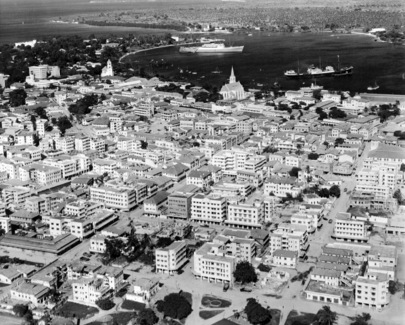
[h=2]Trust Territory of Tanganyika: Port Development[/h]Tanganyika, under British administration, is the largest and most populous of the 11 Trust Territories, and is situated south of the Equator, between the Great Lakes of Central Africa and the Indian Ocean. Major improvements in communications are being undertaken to enable the country's natural resources to find new markets at home and abroad. Among these are port extensions at Tanga, a new international airport, a deep-water berth at Mitwara and three deep-water berths under construction at Dar es Salaam the capital of the country and largest town in the territory.

An aerial view of Dar es Salaam and a section of the harbor. 1954.

01 January 1954
Dar es Salaam, Tanganyika
Photo # 137348
 
Chronological History of man in Tanganyika

1st Century B.C. Cushites from Ethiopia settle in Tanganyika
"1st Century B.C. Cushites from Ethiopia settle in Tanganyika,"

who was in Tanganyika before Cushites from Ethiopia settle in Tanganyika???

Tusiwe tunakubali kuandikiwa andikiwa historia na wazungu wa Wikipedia na watu ambao hawajui chochote kuhusu nchi zetu. Cushites settle in Tanganyika, halafu wakaenda wapi, wako wapi hao cushites leo hii? Mimi sio M-cushite utanambiahe historia ya nchi yangu inaanza na wa-ku shit from Ethiopia???

Na kwa nini historia ianze na 1st Century B.C., kulikuwa na nini Tanganyika kabla ya
hapo, misitu na twiga?
 
"1st Century B.C. Cushites from Ethiopia settle in Tanganyika,"

who was in Tanganyika before Cushites from Ethiopia settle in Tanganyika???

Tusiwe tunakubali kuandikiwa andikiwa historia na wazungu wa Wikipedia na watu ambao hawajui chochote kuhusu nchi zetu. Cushites settle in Tanganyika, halafu wakaenda wapi, wako wapi hao cushites leo hii? Mimi sio M-cushite utanambiahe historia ya nchi yangu inaanza na wa-ku shit from Ethiopia???

Na kwa nini historia ianze na 1st Century B.C., kulikuwa na nini Tanganyika kabla ya
hapo, misitu na twiga?

Mkuu, instead and place ya kulalamika, lete baada ya 1st Century Before Christ, that is the way to go. So far hatuna data kabla ya 1st BC, Oooops "Oldivai Gorge" Olduvai Gorge — Infoplease.com
 
kabla ya 1st centure bc historia inaonyesha kulikuwa na ukoo wa kina RINGO hapa tanganyika.
kama kuna mtu anabisha awasiliane na mimi nimwonyeshe ushahidi.
 
lete baada ya 1st Century Before Christ
Historia ya baada ya 1st Century BC wewe umeshaileta, nadai historia ya kabla ya 1st Century B.C.

"Cushites from Ethiopia settle in Tanganyika".... who was in Tanganyika before that Ku shit from Ethiopia settled in Tanganyika?

Wazungu wanasema Africa produced no history halafu na sisi, kwa sababu ya mfumo wa elimu mbovu, tunakubali, mtu anaandika historia ya nchi yake anaanzia na "Cushites in Ethiopia settle in Tanganyika." We una asili ya mku-shit? Historia ya Tanganyika is deeper than that, haianzii na "1st Century Ku shits from Ethiopia settle in Tanganyika"!!!

kabla ya 1st centure bc historia inaonyesha kulikuwa na ukoo wa kina RINGO hapa tanganyika.
kama kuna mtu anabisha awasiliane na mimi nimwonyeshe ushahidi.
And I tip my hat to you, an erudite proudful African bucking a warped version of his history, written by others.
 
Mbuzi mzee, Tanganika ilikuja baada ya vita kuu ya kwanza.
 
"1st Century B.C. Cushites from Ethiopia settle in Tanganyika,"

who was in Tanganyika before Cushites from Ethiopia settle in Tanganyika???

Tusiwe tunakubali kuandikiwa andikiwa historia na wazungu wa Wikipedia na watu ambao hawajui chochote kuhusu nchi zetu. Cushites settle in Tanganyika, halafu wakaenda wapi, wako wapi hao cushites leo hii? Mimi sio M-cushite utanambiahe historia ya nchi yangu inaanza na wa-ku shit from Ethiopia???

Na kwa nini historia ianze na 1st Century B.C., kulikuwa na nini Tanganyika kabla ya
hapo, misitu na twiga?

Umesema kweli mkuu. Mimi pia nina matatizo na hii 'doctored history'. Tunarudia-rudia tu bila ya kutathmini hatujui kuwa wazungu wameweka vijivitu humo kwa malengo yao. No wonder kwa nini mtu mweusi hadi sasa hana confidence na hii ndiyo moja ya sababu kubwa ya kutoendela kwetu na kuzaliwa watu kama JK wanaoona bila ya Mzungu hakuna maendeleo. Hebu tathmini hii: [ until after 1500 A.D. when Chinese merchant ships reached East African Coast. Chinaware of 700 years ago have been excavated in Kilwa, Tanzania bearing evidence that the Tanzania Coast was once part of a developed culture.
Kwa nini mtu hajiulizi: ikiwa hivi vyombo vya Chinaware vimefika pwani, kwa nini haiwi Waswahili ndio waliokwenda China na kuvileta? Kwa nini ni Wachina tu ndio 'walioweza' kutuletea?
Sasa ukija katika masuala ya biashara ya utumwa...hoohooo, ndiyo utaona tulivyochezewa akili na kile kinachoitwa historia hadi kutujaza chuki isiyoshikika dhidi ya Waarabu kana kwamba ni Waarabu PEKEE ndio walioendesha biashara hiyo. Katika shule zetu twasomeshwa Mwarabu alikuja kununua watumwa, lakini hukuti mzungu akitajwa. Infact, hata majina ya biashara hiyo wameyageuza: ile iliyokuwa yafanywa na Waarabu inaitwa moja kwa moja 'Arab slave trade' ama ile iliyokuwa yafanywa na Wazungu inaitwa:'Atlantic Slave trade' au tu 'Atlantic trade' hawajitaji hapo!
 
Historia ya baada ya 1st Century BC wewe umeshaileta, nadai historia ya kabla ya 1st Century B.C.

"Cushites from Ethiopia settle in Tanganyika".... who was in Tanganyika before that Ku shit from Ethiopia settled in Tanganyika?

Wazungu wanasema Africa produced no history halafu na sisi, kwa sababu ya mfumo wa elimu mbovu, tunakubali, mtu anaandika historia ya nchi yake anaanzia na "Cushites in Ethiopia settle in Tanganyika." We una asili ya mku-shit? Historia ya Tanganyika is deeper than that, haianzii na "1st Century Ku shits from Ethiopia settle in Tanganyika"!!!

And I tip my hat to you, an erudite proudful African bucking a warped version of his history, written by others.

Thanks for your good reply. That is what we need to find, who was in Tanganyika prior to "1st Century Before Christ." It is hard if not impossible to get a clear answer with empirical evidence.
 
until after 1500 A.D. when Chinese merchant ships reached East African Coast. Chinaware of 700 years ago have been excavated in Kilwa, Tanzania bearing evidence that the Tanzania Coast was once part of a developed culture.

I did not know that, wooow. I am aware that the Chinese were in Madagascar. Can you give us any links and or sources to support your post, that "Chinaware were found in Kilwa"?. Thanks in advance.
 
This is the first comprehensive and fully documented history of modern Tanganyika (mainland Tanzania). After introductory chapters on the nineteenth century, Dr Iliffe concentrates on the colonial period, and especially on economic, social and intellectual change among Africans as the core of their colonial experience and the basis of their political behaviour. Particularl attention is paid to the consequences for small-scale societies of their incorporation into the international order; the impact of capitlaism and the emergence of capitalist relationships and attitudes; African attempts to defend or reform indigenous institutions and to organise movements of protest or revolt against European control; the successive formation and dissolution of a specifically colonial society; and the effects of economic change on Tanganyika's ecology in modern times. The book brings together the research which scholars of many nationalities have carried out in Tanzania over the last twenty years, and attempts to synthesise their findings with the evidence available from African and European records in Tanzania, Britain and Germany.

A Modern History of Tanganyika


http://books.google.com/books?id=
m0dalboHfXgC&pg=PA552&source=gbs_toc_r&cad=4#v=onepage&q&f=false

Click the link above, and/or (Copy and paste on the web browser) it is a book about Tanganyika
 
Duh,

Fanyeni utafiti. Sio kila kitu kilichopo kwenye mitandao kina ukweli. waSandwe wameishi katika nchi hiyo toka enzi na enzi.
 
Chronological History of man in Tanganyika
(now Tanzania)


[TABLE="width: 100%"]
[TR]
[TD]
[TABLE="width: 100%"]
[TR="bgcolor: #FFFFFF"]
[TD]1st Century B.C.
[/TD]
[TD]Cushites from Ethiopia settle in Tanganyika.
[/TD]
[/TR]
[TR="bgcolor: #FFFFFF"]
[TD]2nd Century A.D.
[/TD]
[TD]Agriculturists from Cameroun and Nigeria settle in Tanganyika and Iron Age Civilization develop.
[/TD]
[/TR]
[TR="bgcolor: #FFFFFF"]
[TD]7th Century A.D.
[/TD]
[TD]Arabian merchants settle on the island of Zanzibar off the Tangayikan coast.
[/TD]
[/TR]
[TR="bgcolor: #FFFFFF"]
[TD]10th Century A.D.
[/TD]
[TD]Traders from China and India visit Tanganyika in boats on a regular basis.
[/TD]
[/TR]
[TR="bgcolor: #FFFFFF"]
[TD]10th Century A.D.
[/TD]
[TD]About this time the fabled emigration of Fijians from Tanaganyika takes place.
[/TD]
[/TR]
[TR="bgcolor: #FFFFFF"]
[TD]12th Century A.D.
[/TD]
[TD]Swahili Civilization established in Zanzibar and Coastal Area of Mainland Tanganyika.
[/TD]
[/TR]
[TR="bgcolor: #FFFFFF"]
[TD]15th Century A.D.
[/TD]
[TD]Organized Kingdoms and Chiefdoms established in various regions of Tanganyika.
[/TD]
[/TR]
[TR="bgcolor: #FFFFFF"]
[TD]1866-1873
[/TD]
[TD]European adventure trips to Tanzania including the visit of Dr.David Livingstone.
[/TD]
[/TR]
[TR="bgcolor: #FFFFFF"]
[TD]1880
[/TD]
[TD]German Colonization of Tanganyika.
[/TD]
[/TR]
[TR="bgcolor: #FFFFFF"]
[TD]1885
[/TD]
[TD]Partition of Africa; German Rule of Tanganyika recognized by European powers.
[/TD]
[/TR]
[TR="bgcolor: #FFFFFF"]
[TD]1885-1905
[/TD]
[TD]Wars of Resistance by African tribes against the Germans.
[/TD]
[/TR]
[TR="bgcolor: #FFFFFF"]
[TD]1890
[/TD]
[TD]British Rule in Zanzibar recognized by major powers.
[/TD]
[/TR]
[TR="bgcolor: #FFFFFF"]
[TD]1914-1918
[/TD]
[TD]British Allies over-run Tanganyika taking the country from the Germans.
[/TD]
[/TR]
[TR="bgcolor: #FFFFFF"]
[TD]1919
[/TD]
[TD]League of Nations decide to place Tanganyika under British Rule.
[/TD]
[/TR]
[TR="bgcolor: #FFFFFF"]
[TD]1946
[/TD]
[TD]Tanganyika becomes UN Trust Territory under British Administration.
[/TD]
[/TR]
[TR="bgcolor: #FFFFFF"]
[TD]1961
[/TD]
[TD]Independence of Tanganyika.
[/TD]
[/TR]
[TR="bgcolor: #FFFFFF"]
[TD]1962
[/TD]
[TD]Tanganyika becomes a Republic.
[/TD]
[/TR]
[TR="bgcolor: #FFFFFF"]
[TD]1963
[/TD]
[TD]Zanzibar becomes independent.
[/TD]
[/TR]
[TR="bgcolor: #FFFFFF"]
[TD]1964
[/TD]
[TD]Union of Tanganyika and Zanzibar to form the United Republic of Tanzania.
[/TD]
[/TR]
[TR="bgcolor: #FFFFFF"]
[TD]1985
[/TD]
[TD]President Nyerere retires from Office; President Ali Hassan Mwinyi takes over.
[/TD]
[/TR]
[TR="bgcolor: #FFFFFF"]
[TD]1992
[/TD]
[TD]Multiparty-politics re-established.
[/TD]
[/TR]
[TR="bgcolor: #FFFFFF"]
[TD]1995
[/TD]
[TD]President Ali Hassan Mwinyi retires and President Benjamin William Mkapa takes over.
[/TD]
[/TR]
[/TABLE]
[/TD]
[/TR]
[/TABLE]

Chronological History of Tanganyika (Tanzania)

mwinyi ana umuhimu gani kuliko watawala wengine? halafu kwa nini wanachomeka mambo ya znz ktk history ya tz?
 
Back
Top Bottom