Kitila Mkumbo
JF-Expert Member
- Feb 25, 2006
- 3,355
- 1,956
There has been a serious contention regarding the authenticity of the recently announced 2013 Certificate of Secondary Education Examination (CSEE) results. While the Government and NECTA officials unanimously pronounce that the performance rate in the 2013 results has improved significantly by almost 15 percent compared to the 2012 results, many academics, politicians and the public in generally do not believe that there is any improvement in these results.
Of course the apparent public scepticism on the authenticity of these results is readily explainable. The decision of the Government to change the CSEE grading system last year was heavily criticised by the public and all leading academics, as well as politicians of all divides. Indeed, the change in the grading system was criticised even by some of the very senior officials in the Ministry of Education and Vocational Training and in the Government in general. Former President Benjamin Mkapa, on a very rare such occasion, is on record having publicly queried the intention of the Government decision to change the grading system. He categorically stated that the bad state of our education system could not be fixed by changing grading system but by improving on teaching and learning conditions. Despite the wide spread criticism of the new grading system, the Government went ahead and changed the grading system for political convenience. This is how deaf our government has become such that it can no longer hear even its own voice!
Thus, it was clear that Government changed the grading system after being convinced that it was incapable of improving the education standards in the country, and yet it was not ready to continue with the embarrassment that comes with bad CSEE results. As such, the decision to change the grading system in the CSEE was an expression of the Governments political eagerness to achieve big results without big efforts. In the same vein, the wide spread scepticism of these results is an expression of the lack of confidence that people have on their Governments ability to address the malaise in our education system.
The question that needs to be answered, therefore, is: Is the performance in the 2013 CSSEE better than in the 2012 CSEE? And is the public scepticism of the 2013 CSEE results justified? This article is an attempt to answer these questions and to draw broad implications of the CSEE results in our education system.
A comparative analysis of the performance in the CSEE between 2012 and 2013
A total of 403,789 eligible candidates sat for the 2013 CSEE compared to 431,650 of the candidates who sat in the 2012 CSEE, a 12 percent decrease. This implies that enrolment in secondary schools might be decreasing in recent years. Of all the eligible candidates who sat for the 2013 CSEE, 7,587 candidates (2%) scored at Division One, which is double the proportion of candidates scoring in this division in the 2012 CSEE. Again, as Figures 1 and 2 show, the proportion of candidates scoring at Divisions II and III more than doubled in the 2013 CSEE compared to the 2012. There has also been a significant decrease in the proportion of failing candidates from 57 percent in the 2013 CSEE to 42 percent in the 2012 CSEE, a 15 percent decrease in the failure rate. In the 2012 CSEE, 92 percent of the candidates either scored at Division IV or failed, compared to 81 percent of the candidates scoring at these Divisions in the 2013 CSEE, a decrease of 11 percent.

Figure 1: A comparison of the performance in the CSEE in 2012 and 2013

Figure 2: Proportion of candidates who passed at various levels in the 2012 and 2013 CSEE
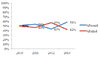
Clearly, therefore, descriptively speaking, the performance in the 2013 CSEE appears to have posted an improvement over the one in the 2012 CSEE. Indeed, descriptively speaking, the performance in the 2013 CSEE could be said to be the best in the past three years since 2010. One may recall that the performance in the CSEE began being chaotic in 2010 where almost half (49.6%) of the candidates failed, reaching a climax in 2012 where 57 percent of the candidates failed (see Figure 3)-and this figure was actually worse before the results were politically standardised.

Figure 3: Percentage of candidates passing and failing in the CSEE between 2010 and 2013
Is the performance in the CSEE better in 2013 than in 2012 in real terms?
The 2013 CSEE results should be interpreted with a background that they are a product of a new grading system. The grading system has been changed at two levels. First, there has been an addition of two new grades-B+ and E. Secondly, the pass mark has been lowered from 35 to 30. While in the previous years candidates who scored below 35 would be graded to have failed, candidates scoring between 30 and 34 in the 2013 CSEE would have scored a D grade, a four point change in the grading system for this level. This means that a substantial proportion of candidates were lifted up thereby naturally escaping scoring the F grade.
Consequently, a substantial proportion of candidates have been saved from failing in these examinations, not because of their hard working but because the grading system has been made more generous for them. This explains the sharp decrease in the failure rate this year because many candidates must have benefited from the lowering of the pass marks at D grade. The change in the grading system for other grades (A, B and C), however, does not make a significant relief to candidates. While, for example, in previous years a score range of 50-64 would translate into C, this score translates into B and B+. Nevertheless, B in this case is typically the same in weighting as C in the previous years because they both earn 3 points in the calculation of the division level and grade point average.
Thus, the real saving in this regard concerns candidates who scored Division IV and those scoring Division III. As such, candidates scoring at Divisions I and II are largely reflective of their academic abilities rather than beneficiaries of the new grading system, while the opposite is indeed true for the majority of candidates scoring at Division IV and a substantial proportion of those scoring at Division III.
Conclusively, the claim that the performance in the 2013 CSEE is better than in the 2012 CSEE is fallacious, disillusional and indeed cheating. This is because students sitting for the two examinations were assessed on two different scales, and as such their outcomes are incomparable. It was therefore wrong, misleading and a political gimmick for the NECTA to have declared the performance in the 2013 CSEE as better than those in the 2012. These results should be assessed on their own merit and they should not be compared to those of the previous years because of the different assessment attributes explained above.
What are the implications of the 2013 CSEE results?
Three broad implications can be drawn on the 2013 CSEE results. First, despite the apparent improvement in performance, the 2013 CSEE results, though less chaotic than the 2012 ones, are bad. This is particularly the case when one closely examines the subject performance. In all core subjects except Kiswahili, less than half of the candidates passed by scoring grades A to D. Contrary to popular belief that students do better in arts subjects than in science subjects, the performance is especially poor for Arts subjects such as History and Civics (see Figure 4). For example, just a third of the candidates passed in Civics (36%) and History (32%) subjects. Indeed, of the 352,130 candidates who sat for the Civics examination, only three (3) got an A grade! As was the case last year, the performance is particularly chaotic in Basic Mathematics whereas less than a quarter (18%) of the candidates passed in this subject.

Figure 4: Subject performance in the 2013 CSEE
Secondly, there is no short cut to big results. Big results will need big efforts. As part of implementing its Big Results Now initiative, the Government ambitiously put a target of raising the performance in the CSEE to 60 percent in less than a year. But, regrettably, it did not invest any meaningful efforts to achieve this ambition. Instead, it spent half a year massaging the grading system at the dissatisfaction of the majority of the education stakeholders. Therefore, the apparent improvement in the CSEE performance is not an outcome of an improvement in the teaching and learning conditions in our schools, or of students having worked harder. Rather, it is the outcome of the manipulation of grading system for political convenience.
Thirdly, assuming that all candidates with Divisions I to III will qualify to join Form V later this year, 66,996 candidates would qualify for admission into advanced certificate of secondary education, which is double the number of qualifying candidates in 2012 (which was 33,683). This means that this year all Form V available slots will be filled unlike last year where 10,000 slots went unfilled. Nevertheless, this might not be the case given the dismal performance in arts subjects, which take the largest share of advanced secondary education subject combinations. In any case, candidates with Division III joining Form V this year will struggle in their studies because of the poor academic background given that their apparent grade is indeed a fabricated one. Consequently, performance in future Advanced Certificate of Secondary Education Examinations (ACSEE) looks gloomy, unless the Government also changes the grading system at this level.
Dr Kitila Mkumbo is Senior Lecturer in Psychology and Education at the University of Dar es Salaam. Email: kitilam@yahoo.com
Of course the apparent public scepticism on the authenticity of these results is readily explainable. The decision of the Government to change the CSEE grading system last year was heavily criticised by the public and all leading academics, as well as politicians of all divides. Indeed, the change in the grading system was criticised even by some of the very senior officials in the Ministry of Education and Vocational Training and in the Government in general. Former President Benjamin Mkapa, on a very rare such occasion, is on record having publicly queried the intention of the Government decision to change the grading system. He categorically stated that the bad state of our education system could not be fixed by changing grading system but by improving on teaching and learning conditions. Despite the wide spread criticism of the new grading system, the Government went ahead and changed the grading system for political convenience. This is how deaf our government has become such that it can no longer hear even its own voice!
Thus, it was clear that Government changed the grading system after being convinced that it was incapable of improving the education standards in the country, and yet it was not ready to continue with the embarrassment that comes with bad CSEE results. As such, the decision to change the grading system in the CSEE was an expression of the Governments political eagerness to achieve big results without big efforts. In the same vein, the wide spread scepticism of these results is an expression of the lack of confidence that people have on their Governments ability to address the malaise in our education system.
The question that needs to be answered, therefore, is: Is the performance in the 2013 CSSEE better than in the 2012 CSEE? And is the public scepticism of the 2013 CSEE results justified? This article is an attempt to answer these questions and to draw broad implications of the CSEE results in our education system.
A comparative analysis of the performance in the CSEE between 2012 and 2013
A total of 403,789 eligible candidates sat for the 2013 CSEE compared to 431,650 of the candidates who sat in the 2012 CSEE, a 12 percent decrease. This implies that enrolment in secondary schools might be decreasing in recent years. Of all the eligible candidates who sat for the 2013 CSEE, 7,587 candidates (2%) scored at Division One, which is double the proportion of candidates scoring in this division in the 2012 CSEE. Again, as Figures 1 and 2 show, the proportion of candidates scoring at Divisions II and III more than doubled in the 2013 CSEE compared to the 2012. There has also been a significant decrease in the proportion of failing candidates from 57 percent in the 2013 CSEE to 42 percent in the 2012 CSEE, a 15 percent decrease in the failure rate. In the 2012 CSEE, 92 percent of the candidates either scored at Division IV or failed, compared to 81 percent of the candidates scoring at these Divisions in the 2013 CSEE, a decrease of 11 percent.
Figure 1: A comparison of the performance in the CSEE in 2012 and 2013
Figure 2: Proportion of candidates who passed at various levels in the 2012 and 2013 CSEE
Clearly, therefore, descriptively speaking, the performance in the 2013 CSEE appears to have posted an improvement over the one in the 2012 CSEE. Indeed, descriptively speaking, the performance in the 2013 CSEE could be said to be the best in the past three years since 2010. One may recall that the performance in the CSEE began being chaotic in 2010 where almost half (49.6%) of the candidates failed, reaching a climax in 2012 where 57 percent of the candidates failed (see Figure 3)-and this figure was actually worse before the results were politically standardised.
Figure 3: Percentage of candidates passing and failing in the CSEE between 2010 and 2013
Is the performance in the CSEE better in 2013 than in 2012 in real terms?
The 2013 CSEE results should be interpreted with a background that they are a product of a new grading system. The grading system has been changed at two levels. First, there has been an addition of two new grades-B+ and E. Secondly, the pass mark has been lowered from 35 to 30. While in the previous years candidates who scored below 35 would be graded to have failed, candidates scoring between 30 and 34 in the 2013 CSEE would have scored a D grade, a four point change in the grading system for this level. This means that a substantial proportion of candidates were lifted up thereby naturally escaping scoring the F grade.
Consequently, a substantial proportion of candidates have been saved from failing in these examinations, not because of their hard working but because the grading system has been made more generous for them. This explains the sharp decrease in the failure rate this year because many candidates must have benefited from the lowering of the pass marks at D grade. The change in the grading system for other grades (A, B and C), however, does not make a significant relief to candidates. While, for example, in previous years a score range of 50-64 would translate into C, this score translates into B and B+. Nevertheless, B in this case is typically the same in weighting as C in the previous years because they both earn 3 points in the calculation of the division level and grade point average.
Thus, the real saving in this regard concerns candidates who scored Division IV and those scoring Division III. As such, candidates scoring at Divisions I and II are largely reflective of their academic abilities rather than beneficiaries of the new grading system, while the opposite is indeed true for the majority of candidates scoring at Division IV and a substantial proportion of those scoring at Division III.
Conclusively, the claim that the performance in the 2013 CSEE is better than in the 2012 CSEE is fallacious, disillusional and indeed cheating. This is because students sitting for the two examinations were assessed on two different scales, and as such their outcomes are incomparable. It was therefore wrong, misleading and a political gimmick for the NECTA to have declared the performance in the 2013 CSEE as better than those in the 2012. These results should be assessed on their own merit and they should not be compared to those of the previous years because of the different assessment attributes explained above.
What are the implications of the 2013 CSEE results?
Three broad implications can be drawn on the 2013 CSEE results. First, despite the apparent improvement in performance, the 2013 CSEE results, though less chaotic than the 2012 ones, are bad. This is particularly the case when one closely examines the subject performance. In all core subjects except Kiswahili, less than half of the candidates passed by scoring grades A to D. Contrary to popular belief that students do better in arts subjects than in science subjects, the performance is especially poor for Arts subjects such as History and Civics (see Figure 4). For example, just a third of the candidates passed in Civics (36%) and History (32%) subjects. Indeed, of the 352,130 candidates who sat for the Civics examination, only three (3) got an A grade! As was the case last year, the performance is particularly chaotic in Basic Mathematics whereas less than a quarter (18%) of the candidates passed in this subject.
Figure 4: Subject performance in the 2013 CSEE
Secondly, there is no short cut to big results. Big results will need big efforts. As part of implementing its Big Results Now initiative, the Government ambitiously put a target of raising the performance in the CSEE to 60 percent in less than a year. But, regrettably, it did not invest any meaningful efforts to achieve this ambition. Instead, it spent half a year massaging the grading system at the dissatisfaction of the majority of the education stakeholders. Therefore, the apparent improvement in the CSEE performance is not an outcome of an improvement in the teaching and learning conditions in our schools, or of students having worked harder. Rather, it is the outcome of the manipulation of grading system for political convenience.
Thirdly, assuming that all candidates with Divisions I to III will qualify to join Form V later this year, 66,996 candidates would qualify for admission into advanced certificate of secondary education, which is double the number of qualifying candidates in 2012 (which was 33,683). This means that this year all Form V available slots will be filled unlike last year where 10,000 slots went unfilled. Nevertheless, this might not be the case given the dismal performance in arts subjects, which take the largest share of advanced secondary education subject combinations. In any case, candidates with Division III joining Form V this year will struggle in their studies because of the poor academic background given that their apparent grade is indeed a fabricated one. Consequently, performance in future Advanced Certificate of Secondary Education Examinations (ACSEE) looks gloomy, unless the Government also changes the grading system at this level.
Dr Kitila Mkumbo is Senior Lecturer in Psychology and Education at the University of Dar es Salaam. Email: kitilam@yahoo.com