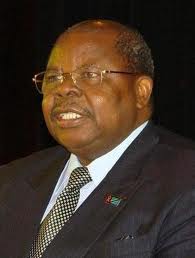
Mramba, baada ya kifungo, kwa nchi hii unaweza tu kurudi kwenye siasa na ukakubalika

Mramba, baada ya kifungo, kwa nchi hii unaweza tu kurudi kwenye siasa na ukakubalika

Salary Slip

Platinum Member
Joined
Apr 3, 2012
Posts
49,390
Reaction score
152,301
Former two senior ministers Basil Mramba and Daniel Yona, who were in February released from prison and ordered to do community service for the remaining period of their jail term, finished their sentence on Thursday.

They were assigned to do community work at the Sinza Palestine Hospital.

Hospital’s nursing unit head Lucas Felix told The Citizen on Sunday yesterday that according to the ruling, the two, who served in ministries of Finance as well as Energy and Mineral respectively, were supposed to report at the hospital for community work from Mondays to Thursdays. “Normally on Friday they were supposed to go to court,” he said noting that the two former senior public servants reported for work for the last time on Thursday.

“When they reported for work they used to do cleanness like sweeping and cutting grasses, but on Thursday they completed their sentence according to instructions from the court,” he said.

Asked to give assessment of the performance of the two former ministers, Mr Felix noted that they performed their duty judiciously.

“They used to report for work at around 8am and worked until 10am,” he said noting that they never missed a day without a valid reason.

The two served as ministers under President Benjamin Mkapa administration and were charged in November 2008 along with Mr Gray Mgonja, the former permanent secretary in the Finance ministry, with eleven counts of abuse of office and occasioning loss to the government.

In July last year Mramba, 75, and Yona, 76, were found guilty of abuse office and occasioning a Sh11.75 billion loss in government taxes. They were subsequently sentenced to a three-year jail term.

Reached for comment, the chairman of the National Parole Board, Mr Augustine Mrema, congratulated Yona and Mramba for finishing their sentence without problems.

“Basically, they’re no longer a prisoners. They are now free again and can continue with other activities,” said Mr Mrema who is also the national Chairman for Tanzania Labour Party (TLP).


Source: The citizen

Pia,Ibara ya 67-1(d) ya Katiba ya Jamuhuri ya Muungano wa Tanzania inakulinda.
 
Haya mambo si mazuri sana ila watanzania navyowajua wao hawana hiana kabisa.
 
Ukila kifungo kinachoanzia miezi na kuendelea kwa kesi ya jinai,ni ngumu sana kupenya kisiasa hata kwenye uongozi wa kuchaguliwa,labda chama cha wapiga mchiriku
 
Mwenyekiti wa bodi naye ana mbwembwe. Hivi ile ziara yake ya kutembeleza magereza nchi nzima ameshaifanya?
 
Ukila kifungo kinachoanzia miezi na kuendelea kwa kesi ya jinai,ni ngumu sana kupenya kisiasa hata kwenye uongozi wa kuchaguliwa,labda chama cha wapiga mchiriku
Kwani kuna katazo la kikatiba/?
Kama hakuna,watu wakikukubali unaingia Bungeni.
 
Ukila kifungo kinachoanzia miezi na kuendelea kwa kesi ya jinai,ni ngumu sana kupenya kisiasa hata kwenye uongozi wa kuchaguliwa,labda chama cha wapiga mchiriku
Ibara ya 67-1(d) inayozungumzia kutiwa hatiani na mahakama katika kipindi cha miaka 5 kabla ya tarehe ya uchaguzi hapa haimlindi?Yeye tangu atiwe hatiani Miaka 5 siitakuwa imeshapita ikifika mwaka 2020?

Ibara unayatumia wewe ni ibara ya 67-1(c) lakini hiyo ibara ndogi niliyoitaja hapo juu umeisoma?

Mimi naona vifungu hivi viwili kama vinaji-contradict!

Nadhdani ibara ya 67-1(c) ina manisha kama tangu uhukumiwe imetima(imepita) miaka 5 na zaidi mpaka mpaka tarehe ya uchaguzi,basi unakuwa na haki ya kugombea.

Tukumbuke Katiba inaongelea muda wa mtu kutiwa hatiani na si muda wala tarehe ya mtu kumaliza kifungo.
 
Kwani kuna katazo la kikatiba/?
Kama hakuna,watu wakikukubali unaingia Bungeni.
Lipo ukifungwa kwa jinai zaidi ya miezi 6,huruhusiwi kugombea udiwani wala ubunge,I stand to be corrected
 
Ibara ya 67-1(d) inayozungumzia kutiwa hatiani na mahakama katika kipindi cha miaka 5 kabla ya tarehe ya uchaguzi hapa hakimlindi?Yeye alitiwa hatiani?Miaka 5 si imeshapita?

Ibara unayatumia wewe ni ibara ya 67-1(c) lakini hicho ibara niliyoitaja hapo juu umeisoma?

Mimi naona vifungu hivi viwili kama vinaji-contradict!
hebu zishushe ibara zote mbili kwa urefu wake tuzijadili
 
Former two senior ministers Basil Mramba and Daniel Yona, who were in February released from prison and ordered to do community service for the remaining period of their jail term, finished their sentence on Thursday.

They were assigned to do community work at the Sinza Palestine Hospital.

Hospital’s nursing unit head Lucas Felix told The Citizen on Sunday yesterday that according to the ruling, the two, who served in ministries of Finance as well as Energy and Mineral respectively, were supposed to report at the hospital for community work from Mondays to Thursdays. “Normally on Friday they were supposed to go to court,” he said noting that the two former senior public servants reported for work for the last time on Thursday.

“When they reported for work they used to do cleanness like sweeping and cutting grasses, but on Thursday they completed their sentence according to instructions from the court,” he said.

Asked to give assessment of the performance of the two former ministers, Mr Felix noted that they performed their duty judiciously.

“They used to report for work at around 8am and worked until 10am,” he said noting that they never missed a day without a valid reason.

The two served as ministers under President Benjamin Mkapa administration and were charged in November 2008 along with Mr Gray Mgonja, the former permanent secretary in the Finance ministry, with eleven counts of abuse of office and occasioning loss to the government.

In July last year Mramba, 75, and Yona, 76, were found guilty of abuse office and occasioning a Sh11.75 billion loss in government taxes. They were subsequently sentenced to a three-year jail term.

Reached for comment, the chairman of the National Parole Board, Mr Augustine Mrema, congratulated Yona and Mramba for finishing their sentence without problems.

“Basically, they’re no longer a prisoners. They are now free again and can continue with other activities,” said Mr Mrema who is also the national Chairman for Tanzania Labour Party (TLP).


Source: The citizen

Pia,Ibara ya 67-1(d) ya Katiba ya Jamuhuri ya Muungano wa Tanzania inakulinda.

Hawa wahariri wa haya magazeti sijuwi wanapataje kazi. Kingereza kibovu kabisa halafu kimehitimishwa na hiyo sentensi yenye lugha mbovu kabisa.

Kajifunzeni lugha kwa Mkapa. Hajasomea uandishi wa habaru lakini ni mzuri sana katika kuandika na kuongea Kingereza.

Hebu jisomeeni hii "article" ya Mkapa, mpaka mtu unaona raha kuisoma kwa ile lugha tu ilivyokaa sawa:

ARTICLE OF THE WEEK- BY BENJAMIN MKAPA


Leadership: An African viewpoint and experience
from - Gazeti la Thisday 2007-04-26 09:38:11
By Benjamin William Mkapa


The connection between leadership and governance on the one hand, and outcomes in terms of economic growth, development and poverty reduction on the other hand, is not too difficult to discern. What are not so easy to determine, and what are not receiving adequate attention in the development debate, are the circumstances that can produce the kind of leadership qualities in an African context (historical, cultural, and sociological) that are necessary to positively impact on the continent`s development. It does not matter how much the mainstream debate on African development tries to ignore or underplay the significance of Africa`s history and experience of slavery, colonialism, the Cold War and an exploitative global economic order in explaining the continent`s incidences of misgovernance, as well as current poverty levels and economic woes.

I believe that a discussion of leadership and governance in Africa will be seriously deficient if it fails to put previous and current leadership, and the developmental challenges they faced and continue to face, in their proper historical, cultural and sociological context. I hold no brief for those African leaders who looted or tyrannized their countries. Africa’s historical legacy is not an excuse for such things; but it provides an explanation. For instance, there is no doubt that the mess that is beginning to be sorted out in the DRC is the direct consequence of King Leopold II, of Belgian colonialism and of the Cold War. Likewise, the 1994 genocide in Rwanda was a direct consequence of certain aspects of Belgian colonialism.

However, I also believe that Africa cannot forever hold its history responsible for its current levels of poverty, or as an excuse for bad governance and lack of reform. Africa must not forget its history, but African resolve and African spirits must not be imprisoned by it. Fifty years after Ghana’s independence, Africa can and should now seek to conquer the negative legacies of its history, and engender a new trajectory of its development towards a more prosperous era.

Colonial Legacy
There has been considerable debate about how much European colonial legacy has impacted on post-colonial Africa; and what influence, if any, this legacy continues to have on the African continent. More to the point, how helpful and constructive, or unhelpful and destructive was the colonial legacy in terms of the development of post-colonial Africa. How responsible was this legacy for the quality and character of post-colonial Africa leadership. European colonial powers ruled most of Africa from 1885 to 1960, a period of 75 years. Ghana, the first sub-Saharan African country to become independent, celebrated its 50th year as an independent nation only this year, 2007.

So, for the majority of African countries, the period they spent under colonial rule is still far longer than the period they have since enjoyed independence and self-rule, and its influence endures.
The democratic values,
which were maturing in Europe in the 19th century, were not spread to Africa; and any efforts by Africans to demand democratic rule and civil rights were ruthlessly suppressed. Should we have been surprised when post-colonial leaders also incarcerated their opponents? They learnt from colonialism that this was the way to deal with dissent and opponents. Mobutu was King Leopold II redux, not only in terms of dealing with dissent, but especially in treating the Congo as a personal fiefdom.

The paper I prepared for this workshop has attempted to answer the following questions: What preparation for leadership did the first generation of African leaders have that would have given them the capacity, the ability and the skills to produce better results? What tools and resources financial, human and institutional did they have at their disposal to design and implement policies? How supportive or obstructive was the internal and external policy and operational environment? And, finally, where do we go from here?
The paper has presented the context in which most African countries became independent, which includes:
.Very low levels of education, and hardly any preparation for leadership, whether political or economic.
.Very low governance resources, financial and human; and weak, if any, institutions of independent governance and economic development.
.A hostile external environment, as clearly the colonial powers were not happy to leave their ``possessions.``

The domestic environment, especially with regard to the settler and colonial commercial interests, were equally obstructive, if not outright hostile. Africa`s colonial legacy is not the only reason for Africa`s poor economic performance, but it is an important one. These realities have to be factored in any objective analysis of Africa`s leadership of development and poverty reduction during the early years of independence. It is not enough to look at economic statistics.

The First Challenges
Encumbered thus, the new African leaders had to contend with the following immediate challenges. First, they had to move quickly to ensure national unity. Independence had removed colonialism, the one thing that united African people of diverse ethnic and religious affiliations. Something else had to be found to hold them together.


Second, they had to move quickly to prove to their people and the outside world that they were leaders of truly independent countries, at a time when some ex-colonial powers were waiting for them to fail, or actually plotting to make sure they fail. Two examples are particularly striking: Belgian Congo and French Guinea. Third, the new independence leaders had to address the immediate expectations of the people, many of whom wanted immediate improvements in their welfare.

But, at independence, hardly any African country had a viable indigenous economy to speak of. Whatever interaction in economic terms they had with the outside world it was as appendages or extensions of the metropolitan powers. Basil Davidson, the acknowledged writer on African history, puts the situation in the following terms: ``? What the new governments were obliged to take over was not a prosperous colonial business, but, in many ways, a profound colonial crisis.`` Writing only a week after the then Tanganyika’s independence, TIME Magazine described the economic challenges facing the country in the following terms: ``? (The) biggest immediate problem facing Nyerere is Tanganyika\'s economic malnutrition?`` The British historian, Thomas Pakenham, described the newly independent mandates and colonies as nothing but ``prisoners of the world economy.`` This legacy meant that independent African states were destined from the beginning to remain small, fragile, unstable and beholden to the departing colonial powers.

The Challenge of Nation Building
One of the first challenges faced by the new leaders was how to build nation states. What the first generation of African leaders inherited at independence were not nations. They were only an amalgamation of diverse and often antagonistic tribes bundled together within ridiculous borders drawn by colonial powers in Berlin in 1884-85.

`It does not matter how much the mainstream debate on African development tries to ignore or underplay the significance of Africa?s history and experience of slavery, colonialism, the Cold War and an exploitative global economic order in explaining the continent?s incidences of misgovernance, as well as current poverty levels and economic woes. I believe that a discussion of leadership and governance in Africa will be seriously deficient if it fails to put previous and current leadership, and the developmental challenges they faced and continue to face, in their proper historical, cultural and sociological context. `


The challenge of nation building also required strong leadership, and other unifying forces. It is easy today to accuse the first leaders of having been autocratic, or in other ways deficient in their democratic credentials. Perhaps some were. However, this criticism has to be weighed against the imperative to literary hold the new ``nations`` together. The one-party political system was an important unifying factor for newly independent African countries. However, if the one-party system is sustained for too long it has its own risks. Tanzania is a good example of a country that used a democratic single-party system for about twenty years, and then switched to a multi-party system when it was confident that the foundation of the post-colonial state had been built and strengthened sufficiently to withstand the potentially divisive politics of a multi-party political dispensation. It is generally believed that the pursuit of the different variations of African socialism was somehow partly responsible for Africa’s poor economic record. But, the value of African socialism should not be seen only in economic terms. In the case of Tanzania, the policy of Socialism and Self Reliance played an important role in building a sense of nationhood and unity. Its central message of justice and equality was especially helpful in that regard.

Post-Cold War Era
The end of the Cold War was Africa`s second phase of independence, making, as it did, African introspection possible. The New Partnership for African Development (NEPAD) and especially the African Peer Review Mechanism (APRM) would not have been possible under the cloud of the Cold War. By focusing internally, it has now become possible for African leaders, under the auspices of the African Union (AU), to agree on a set of core principles, guidelines and values that can guide African governments towards improved leadership and governance for development, without the resentment that such a framework would have elicited if it were prescribed for Africa by developed countries. African ownership of the governance agenda is paramount; it is an important component in the fulfillment of the independence agenda. It is an inalienable expression of sovereignty and democratic legitimacy.

In terms of political governance, economic governance, regional integration and cooperation, as well as results in terms of stability and economic performance, Africa has much to show following the end of the Cold War. While the 1980s were literally a lost decade for Africa, beginning in the 1990s the continent changed in very profound ways-politically, economically and socially-albeit from very low levels. The facts, as presented in the main paper, and as are generally known, speak for themselves.


Way Forward

This optimism has dominated the debate on Africa in recent years. The challenge now is where we go from here, for it remains a fact that, despite positive trends, sustainability is not yet assured, and whether Africa will meet the Millennium Development Goals remains doubtful for a good number of countries. As more African countries stabilize politically, socially and economically, the time has come for the leadership to think in a more structured and strategic way, focusing on long-term and sustainable growth strategies. Africa must think beyond survival, and move from social and economic crisis management to strategic planning. Strategic thinking is about making choices, and at Africa`s level of development, the choices are very difficult. Yet they have to be made. The Report of the World Commission on the Social Dimension of Globalization recommends that African countries begin at home to try and get a fairer outcome out of globalization.

Beginning at home brings to focus three critical issues. The first is developing national capabilities and policies especially in relation to governance (both political and economic), economic liberalization and the role of the state. It also includes strengthening economic capabilities, addressing the special needs of agriculture and the informal sector (which predominates the economies of most African countries), enabling and empowering people through education and skills, work and employment, as well as sustainable development and resource productivity.

Secondly, it is about empowering people and institutions at the local level, including strengthening participatory local government, strengthening the local economic base and using and protecting local values and cultural heritages that are helpful in strengthening accountable government and participation. Thirdly, it is about regional integration and cooperation as a stepping-stone for profitable engagement at the global level.

Beginning at home also requires strategic economic leadership that not only better positions a country nationally and regionally, but also engages the outside world in a strategic compact for growth and development. On one hand, this involves a nationally determined strategic engagement with bilateral and multilateral development partners. On the other hand, it involves determining parameters of a mutually rewarding engagement with international private capital. This calls for a big push in terms of external support to what Africa is doing. For, no matter how much the new generation of African leaders focus on the priority issues, and no matter how clear their strategic choices are, they do not on their own have at their disposal the wherewithal to see them through. Good governance is important, but alone it will not lead to growth, development and poverty reduction.


Foreign Direct Investment
African leaders must now accept that attracting and retaining FDI into their countries and continent has to be an integral part of efforts and policies to engender economic growth, social development and poverty reduction. The attraction of FDI must, however, go hand in hand with deliberate efforts to build domestic productive capacities and an indigenous middle class.
At the current level of African development, especially its low capacity for manufactured exports, it is equally important for African leaders to create the policy framework and guidelines that will ensure FDI is better integrated into the local economy, not only in terms of technology transfer, skills development, and managerial know how but equally important in terms of forward and backward linkages to the domestic economy. If this is not achieved, efforts to attract FDI, especially in the natural resources sector, will not be politically sustainable in the long-term, in a democratic and democratizing continent. Legal and Economic Empowerment of the Poor
Linking FDI with the local economy is one aspect. The other is linking the small, formal, legal domestic economy with the large, informal and extra-legal economy.

As we look forward, and as African economies are increasingly becoming market economies, we need the hardware of the market (physical infrastructure etc) and the software of the market (macroeconomic fundamentals, business environment, entrepreneurship, saving culture and a legal system etc) to make the market system work and produce growth and development.
Moreover, if the goal is poverty reduction you have to find ways to bring the majority poor into the market, not to be exploited but to participate and benefit, and to make the legal system an accessible asset working for them, rather than an obstacle to their economic emancipation.

For me, of equal if not greater importance to giving African people the right to democratic participation is the importance of giving them the right to economic participation. Income inequalities are increasing across Africa. We are giving people political power over an economic system in which they have no personal stake. They are politically included, but economically excluded. This is political dynamite, and it has to be addressed as a matter of urgency.

Corruption
Although it is not always reflected in the international media, there is no doubt that the vice of corruption and bribery is not the monopoly of Africa and other developing countries. The motivation and methods for corrupt behavior may be different. How governments react to corruption may differ. Capacities to prevent investigate and prosecute corruption and bribery cases may differ. Nevertheless, there are no saints. There is also some exaggeration as to how much corruption, especially in the post-Cold War era, is responsible for the continued underdevelopment of Africa. Attributing Africa`s misery to bad governance and corruption is only true to a point.


`I hold no brief for those African leaders who looted or tyrannized their countries. Africa?s historical legacy is not an excuse for such things; but it provides an explanation. For instance, there is no doubt that the mess that is beginning to be sorted out in the DRC is the direct consequence of King Leopold II, of Belgian colonialism and of the Cold War. Likewise, the 1994 genocide in Rwanda was a direct consequence of certain aspects of Belgian colonialism.`


It is an oversimplification of very complex phenomena, which may have the effect of removing the incentive to look for other equally important causes of poverty. We need a better balance between an appreciation of the harmful effects of corruption and bad governance, and the extent to which we can hold bad governance and corruption responsible for the development problems of different countries around the world. And, we have to ask: what examples do the rich industrialized countries provide Africa with? In 1999 Transparency International (TI) developed the Bribe Payers Index (BPI) but it is far less known than the Corruption Perception Index (CPI); and while the CPI comes out yearly, the BPI has come out only three times in eight years.
The following comments by TI leaders expose a weak link in the war on corruption and bribery. Transparency International Chair Huguette Labelle, said,`` Bribing companies are actively undermining the best efforts of governments in developing nations to improve governance?`` David Nussbaum, Chief Executive of TI, on his part, said, ``It is hypocritical that OECD-based companies continue to bribe across the globe, while their governments pay lip-service to enforcing the law.``


Theory of Leadership
Just as we could not discern a single theory of reformist leadership for development in the first 3-5 decades of Africa`s independence, we cannot prescribe a single theory of reformist leadership for development in the years ahead. But as in the past, so will it be necessary in the future to keep in mind the centrality of:

.A strong sense of nationhood and shared destiny.
.Good democratic governance, preferably with constitutional term limits. Some military coups in Africa were precipitated by the fact that no one knew when the incumbent would leave office.

.Good economic governance, especially in terms of macro economic fundamentals as well as strong, capable and facilitative regulatory institutions, and a strong financial sector, and promotion of entrepreneurship.

.Greater investment in infrastructure.
.Human resource capacity building, including health, education and skills for contemporary Africa.

.The advocacy and institutional promotion of a savings and investment culture.

Lastly, Africa needs strong, bold, capable and effective states. We cannot on the one hand lament ``failed``or ``dysfunctional`` states while on the other hand we impose or pursue policies whose ultimate result is the weakening of what are already very weak states.

It is naﶥ to see African democracy with the lenses of western democracy. Italy can afford to change governments almost on a yearly basis. It does not undermine the state. In Africa, a similar scenario would be the recipe for ``failed`` or ``dysfunctional`` states.

As I look back over our recent history, I am convinced that Africa needs a home-grown new democracy, focussed on development. (Meles Zenawi, the Ethiopian Prime Minister, calls it a `developmental state`). After almost half a century of independence, and bearing in mind our pre-colonial and colonial experience, we should now know enough of what works and what does not work in Africa to be able to develop a synthesis based on our history, our experience, and on global realities. Such a synthesis has to revolve around the following issues: education for capacity building and informed political choices; capable and sustainable institutions and systems for good democratic governance that are strong, bold, resilient and capable of outliving current leaders; tolerance and inclusion to overcome the colonial legacy of ``divide and rule``; economic inclusion to address widening income inequalities across Africa that are a recipe for instability; participation in its broad sense; and transparency and accountability as pillars of legitimacy.
An important aspect is constitutionalism, and the rule of law. Governments and especially leaders must respect their oaths of office. I am concerned, though, that too many people in Africa cannot access the law and benefit from its protection. Justice for only the privileged few is not only discriminatory, it is inherently unjust. And certainly, the latent entrepreneurial spirit of Africans cannot be fully harnessed for development until their property rights are recognised and protected, within the legal system.

Conclusion
My own leadership experience, as well as that of my country, convinces me that the following ten issues are critical for leadership in Africa if the continent is to make greater headway in growth, development and poverty reduction:

1. The leadership capacity and ability to create and/or sustain politically stable and peaceful states.

2. The leadership capacity and ability to create and/or sustain stable and viable economies, in terms of their internal capacity for survival, as well as their external capacity for significance and relevance. This includes capacity for regional integration and significance in a global economy.

3. The political will to create and sustain democratic, responsive and accountable governments - both national and local - that bestow legitimacy upon any government.

4. The imperative to focus on agriculture, food security and rural development as a cornerstone of poverty reduction efforts.

5. Human development, including education and health (especially diseases such as HIV/AIDS, Malaria and TB).

6. Constituting strong governments with effective, efficient and capable institutions, including regulatory ones.

7. Leadership to develop and facilitate skills for contemporary Africa, business environment, local entrepreneurship, and guarantees for the property rights of the poor.

8. Investment in integrative market and economic infrastructure.
9. Economic and financial market facilitation and intermediation.

This includes the advocacy and institutional promotion of a savings and investment culture of which there is much too little in our countries.

10. Leadership that ensures participation and sharing, not only of political power, but of economic prosperity as well.

The new environment in Africa now, with initiatives such as NEPAD and APRM, taken together with declining incidences, levels and intensity of conflicts on the continent, makes it possible for African leaders to focus on these ten core African leadership challenges of the future.
Sustainable good governance in Africa will happen and endure because Africans want it, not because, as some have said, of external pressure certainly not of the negative sort.
However, outcome, in terms of growth, development and poverty reduction will require much more than good leadership at the national level. It will also require a conducive regional context, in terms of peace, security and stability. It will also depend on the response of the bilateral and multilateral development partners along the recommendations of the Report of the Commission for Africa, and various G8 Summit declarations from the 2002 Kananaskis summit onwards.

Likewise, it will depend on the outcome of the Doha round of global trade negotiations, as well as EU-ACP negotiations for Economic Partnership Agreements (EPA). The Doha round of trade negotiations was meant to be a ``development round.`` It is not one yet. With political will it still can be. As Mwalimu Nyerere used to say, ``It can be done, play your part.`` Ad with more political will in Africa and outside, the global scar of African poverty can be history, under a new leadership, in our children?s lifetime.

*On April 10, 2007, former President Benjamin Mkapa gave this speech in New York, which will form part of the World Bank`s Growth and Development Report. The retired president dwelt on the challenges of leadership in Africa in relation to historical realities.
· SOURCE: GUARDIAN
 
Nakubaliana kabisa na title ya uzi huu.

Nchi hii, majinga bado yapo mengi mno!

-Kaveli-
 
Kwa mfano yanamtuhumu Lowasa kwa ufisadi halafu yanamsimamisha kuwa mgombea wa urais. Na wafuasi wanazungusha mikono na kupiga deki barabara. Ha ha ha.
Wao waliangalia wapiga kura wanamtaka nani na ikawabidi wa-act accordingly na kumbuka lengo la chama chochote cha siasa ni kushika dola pia usisahau kura alizopata dio ujue kama walikosea au laa.
 
Hawa wahariri wa haya magazeti sijuwi wanapataje kazi. Kingereza kibovu kabisa halafu kimehitimishwa na hiyo sentensi yenye lugha mbovu kabisa.

Kajifunzeni lugha kwa Mkapa. Hajasomea uandishi wa habaru lakini ni mzuri sana katika kuandika na kuongea Kingereza.

Hebu jisomeeni hii "article" ya Mkapa, mpaka mtu unaona raha kuisoma kwa ile lugha tu ilivyokaa sawa:

ARTICLE OF THE WEEK- BY BENJAMIN MKAPA


Leadership: An African viewpoint and experience
from - Gazeti la Thisday 2007-04-26 09:38:11
By Benjamin William Mkapa


The connection between leadership and governance on the one hand, and outcomes in terms of economic growth, development and poverty reduction on the other hand, is not too difficult to discern. What are not so easy to determine, and what are not receiving adequate attention in the development debate, are the circumstances that can produce the kind of leadership qualities in an African context (historical, cultural, and sociological) that are necessary to positively impact on the continent`s development. It does not matter how much the mainstream debate on African development tries to ignore or underplay the significance of Africa`s history and experience of slavery, colonialism, the Cold War and an exploitative global economic order in explaining the continent`s incidences of misgovernance, as well as current poverty levels and economic woes.

I believe that a discussion of leadership and governance in Africa will be seriously deficient if it fails to put previous and current leadership, and the developmental challenges they faced and continue to face, in their proper historical, cultural and sociological context. I hold no brief for those African leaders who looted or tyrannized their countries. Africa’s historical legacy is not an excuse for such things; but it provides an explanation. For instance, there is no doubt that the mess that is beginning to be sorted out in the DRC is the direct consequence of King Leopold II, of Belgian colonialism and of the Cold War. Likewise, the 1994 genocide in Rwanda was a direct consequence of certain aspects of Belgian colonialism.

However, I also believe that Africa cannot forever hold its history responsible for its current levels of poverty, or as an excuse for bad governance and lack of reform. Africa must not forget its history, but African resolve and African spirits must not be imprisoned by it. Fifty years after Ghana’s independence, Africa can and should now seek to conquer the negative legacies of its history, and engender a new trajectory of its development towards a more prosperous era.

Colonial Legacy
There has been considerable debate about how much European colonial legacy has impacted on post-colonial Africa; and what influence, if any, this legacy continues to have on the African continent. More to the point, how helpful and constructive, or unhelpful and destructive was the colonial legacy in terms of the development of post-colonial Africa. How responsible was this legacy for the quality and character of post-colonial Africa leadership. European colonial powers ruled most of Africa from 1885 to 1960, a period of 75 years. Ghana, the first sub-Saharan African country to become independent, celebrated its 50th year as an independent nation only this year, 2007.

So, for the majority of African countries, the period they spent under colonial rule is still far longer than the period they have since enjoyed independence and self-rule, and its influence endures.
The democratic values,
which were maturing in Europe in the 19th century, were not spread to Africa; and any efforts by Africans to demand democratic rule and civil rights were ruthlessly suppressed. Should we have been surprised when post-colonial leaders also incarcerated their opponents? They learnt from colonialism that this was the way to deal with dissent and opponents. Mobutu was King Leopold II redux, not only in terms of dealing with dissent, but especially in treating the Congo as a personal fiefdom.

The paper I prepared for this workshop has attempted to answer the following questions: What preparation for leadership did the first generation of African leaders have that would have given them the capacity, the ability and the skills to produce better results? What tools and resources financial, human and institutional did they have at their disposal to design and implement policies? How supportive or obstructive was the internal and external policy and operational environment? And, finally, where do we go from here?
The paper has presented the context in which most African countries became independent, which includes:
.Very low levels of education, and hardly any preparation for leadership, whether political or economic.
.Very low governance resources, financial and human; and weak, if any, institutions of independent governance and economic development.
.A hostile external environment, as clearly the colonial powers were not happy to leave their ``possessions.``

The domestic environment, especially with regard to the settler and colonial commercial interests, were equally obstructive, if not outright hostile. Africa`s colonial legacy is not the only reason for Africa`s poor economic performance, but it is an important one. These realities have to be factored in any objective analysis of Africa`s leadership of development and poverty reduction during the early years of independence. It is not enough to look at economic statistics.

The First Challenges
Encumbered thus, the new African leaders had to contend with the following immediate challenges. First, they had to move quickly to ensure national unity. Independence had removed colonialism, the one thing that united African people of diverse ethnic and religious affiliations. Something else had to be found to hold them together.


Second, they had to move quickly to prove to their people and the outside world that they were leaders of truly independent countries, at a time when some ex-colonial powers were waiting for them to fail, or actually plotting to make sure they fail. Two examples are particularly striking: Belgian Congo and French Guinea. Third, the new independence leaders had to address the immediate expectations of the people, many of whom wanted immediate improvements in their welfare.

But, at independence, hardly any African country had a viable indigenous economy to speak of. Whatever interaction in economic terms they had with the outside world it was as appendages or extensions of the metropolitan powers. Basil Davidson, the acknowledged writer on African history, puts the situation in the following terms: ``? What the new governments were obliged to take over was not a prosperous colonial business, but, in many ways, a profound colonial crisis.`` Writing only a week after the then Tanganyika’s independence, TIME Magazine described the economic challenges facing the country in the following terms: ``? (The) biggest immediate problem facing Nyerere is Tanganyika\'s economic malnutrition?`` The British historian, Thomas Pakenham, described the newly independent mandates and colonies as nothing but ``prisoners of the world economy.`` This legacy meant that independent African states were destined from the beginning to remain small, fragile, unstable and beholden to the departing colonial powers.

The Challenge of Nation Building
One of the first challenges faced by the new leaders was how to build nation states. What the first generation of African leaders inherited at independence were not nations. They were only an amalgamation of diverse and often antagonistic tribes bundled together within ridiculous borders drawn by colonial powers in Berlin in 1884-85.

`It does not matter how much the mainstream debate on African development tries to ignore or underplay the significance of Africa?s history and experience of slavery, colonialism, the Cold War and an exploitative global economic order in explaining the continent?s incidences of misgovernance, as well as current poverty levels and economic woes. I believe that a discussion of leadership and governance in Africa will be seriously deficient if it fails to put previous and current leadership, and the developmental challenges they faced and continue to face, in their proper historical, cultural and sociological context. `


The challenge of nation building also required strong leadership, and other unifying forces. It is easy today to accuse the first leaders of having been autocratic, or in other ways deficient in their democratic credentials. Perhaps some were. However, this criticism has to be weighed against the imperative to literary hold the new ``nations`` together. The one-party political system was an important unifying factor for newly independent African countries. However, if the one-party system is sustained for too long it has its own risks. Tanzania is a good example of a country that used a democratic single-party system for about twenty years, and then switched to a multi-party system when it was confident that the foundation of the post-colonial state had been built and strengthened sufficiently to withstand the potentially divisive politics of a multi-party political dispensation. It is generally believed that the pursuit of the different variations of African socialism was somehow partly responsible for Africa’s poor economic record. But, the value of African socialism should not be seen only in economic terms. In the case of Tanzania, the policy of Socialism and Self Reliance played an important role in building a sense of nationhood and unity. Its central message of justice and equality was especially helpful in that regard.

Post-Cold War Era
The end of the Cold War was Africa`s second phase of independence, making, as it did, African introspection possible. The New Partnership for African Development (NEPAD) and especially the African Peer Review Mechanism (APRM) would not have been possible under the cloud of the Cold War. By focusing internally, it has now become possible for African leaders, under the auspices of the African Union (AU), to agree on a set of core principles, guidelines and values that can guide African governments towards improved leadership and governance for development, without the resentment that such a framework would have elicited if it were prescribed for Africa by developed countries. African ownership of the governance agenda is paramount; it is an important component in the fulfillment of the independence agenda. It is an inalienable expression of sovereignty and democratic legitimacy.

In terms of political governance, economic governance, regional integration and cooperation, as well as results in terms of stability and economic performance, Africa has much to show following the end of the Cold War. While the 1980s were literally a lost decade for Africa, beginning in the 1990s the continent changed in very profound ways-politically, economically and socially-albeit from very low levels. The facts, as presented in the main paper, and as are generally known, speak for themselves.


Way Forward

This optimism has dominated the debate on Africa in recent years. The challenge now is where we go from here, for it remains a fact that, despite positive trends, sustainability is not yet assured, and whether Africa will meet the Millennium Development Goals remains doubtful for a good number of countries. As more African countries stabilize politically, socially and economically, the time has come for the leadership to think in a more structured and strategic way, focusing on long-term and sustainable growth strategies. Africa must think beyond survival, and move from social and economic crisis management to strategic planning. Strategic thinking is about making choices, and at Africa`s level of development, the choices are very difficult. Yet they have to be made. The Report of the World Commission on the Social Dimension of Globalization recommends that African countries begin at home to try and get a fairer outcome out of globalization.

Beginning at home brings to focus three critical issues. The first is developing national capabilities and policies especially in relation to governance (both political and economic), economic liberalization and the role of the state. It also includes strengthening economic capabilities, addressing the special needs of agriculture and the informal sector (which predominates the economies of most African countries), enabling and empowering people through education and skills, work and employment, as well as sustainable development and resource productivity.

Secondly, it is about empowering people and institutions at the local level, including strengthening participatory local government, strengthening the local economic base and using and protecting local values and cultural heritages that are helpful in strengthening accountable government and participation. Thirdly, it is about regional integration and cooperation as a stepping-stone for profitable engagement at the global level.

Beginning at home also requires strategic economic leadership that not only better positions a country nationally and regionally, but also engages the outside world in a strategic compact for growth and development. On one hand, this involves a nationally determined strategic engagement with bilateral and multilateral development partners. On the other hand, it involves determining parameters of a mutually rewarding engagement with international private capital. This calls for a big push in terms of external support to what Africa is doing. For, no matter how much the new generation of African leaders focus on the priority issues, and no matter how clear their strategic choices are, they do not on their own have at their disposal the wherewithal to see them through. Good governance is important, but alone it will not lead to growth, development and poverty reduction.


Foreign Direct Investment
African leaders must now accept that attracting and retaining FDI into their countries and continent has to be an integral part of efforts and policies to engender economic growth, social development and poverty reduction. The attraction of FDI must, however, go hand in hand with deliberate efforts to build domestic productive capacities and an indigenous middle class.
At the current level of African development, especially its low capacity for manufactured exports, it is equally important for African leaders to create the policy framework and guidelines that will ensure FDI is better integrated into the local economy, not only in terms of technology transfer, skills development, and managerial know how but equally important in terms of forward and backward linkages to the domestic economy. If this is not achieved, efforts to attract FDI, especially in the natural resources sector, will not be politically sustainable in the long-term, in a democratic and democratizing continent. Legal and Economic Empowerment of the Poor
Linking FDI with the local economy is one aspect. The other is linking the small, formal, legal domestic economy with the large, informal and extra-legal economy.

As we look forward, and as African economies are increasingly becoming market economies, we need the hardware of the market (physical infrastructure etc) and the software of the market (macroeconomic fundamentals, business environment, entrepreneurship, saving culture and a legal system etc) to make the market system work and produce growth and development.
Moreover, if the goal is poverty reduction you have to find ways to bring the majority poor into the market, not to be exploited but to participate and benefit, and to make the legal system an accessible asset working for them, rather than an obstacle to their economic emancipation.

For me, of equal if not greater importance to giving African people the right to democratic participation is the importance of giving them the right to economic participation. Income inequalities are increasing across Africa. We are giving people political power over an economic system in which they have no personal stake. They are politically included, but economically excluded. This is political dynamite, and it has to be addressed as a matter of urgency.

Corruption
Although it is not always reflected in the international media, there is no doubt that the vice of corruption and bribery is not the monopoly of Africa and other developing countries. The motivation and methods for corrupt behavior may be different. How governments react to corruption may differ. Capacities to prevent investigate and prosecute corruption and bribery cases may differ. Nevertheless, there are no saints. There is also some exaggeration as to how much corruption, especially in the post-Cold War era, is responsible for the continued underdevelopment of Africa. Attributing Africa`s misery to bad governance and corruption is only true to a point.


`I hold no brief for those African leaders who looted or tyrannized their countries. Africa?s historical legacy is not an excuse for such things; but it provides an explanation. For instance, there is no doubt that the mess that is beginning to be sorted out in the DRC is the direct consequence of King Leopold II, of Belgian colonialism and of the Cold War. Likewise, the 1994 genocide in Rwanda was a direct consequence of certain aspects of Belgian colonialism.`


It is an oversimplification of very complex phenomena, which may have the effect of removing the incentive to look for other equally important causes of poverty. We need a better balance between an appreciation of the harmful effects of corruption and bad governance, and the extent to which we can hold bad governance and corruption responsible for the development problems of different countries around the world. And, we have to ask: what examples do the rich industrialized countries provide Africa with? In 1999 Transparency International (TI) developed the Bribe Payers Index (BPI) but it is far less known than the Corruption Perception Index (CPI); and while the CPI comes out yearly, the BPI has come out only three times in eight years.
The following comments by TI leaders expose a weak link in the war on corruption and bribery. Transparency International Chair Huguette Labelle, said,`` Bribing companies are actively undermining the best efforts of governments in developing nations to improve governance?`` David Nussbaum, Chief Executive of TI, on his part, said, ``It is hypocritical that OECD-based companies continue to bribe across the globe, while their governments pay lip-service to enforcing the law.``


Theory of Leadership
Just as we could not discern a single theory of reformist leadership for development in the first 3-5 decades of Africa`s independence, we cannot prescribe a single theory of reformist leadership for development in the years ahead. But as in the past, so will it be necessary in the future to keep in mind the centrality of:

.A strong sense of nationhood and shared destiny.
.Good democratic governance, preferably with constitutional term limits. Some military coups in Africa were precipitated by the fact that no one knew when the incumbent would leave office.

.Good economic governance, especially in terms of macro economic fundamentals as well as strong, capable and facilitative regulatory institutions, and a strong financial sector, and promotion of entrepreneurship.

.Greater investment in infrastructure.
.Human resource capacity building, including health, education and skills for contemporary Africa.

.The advocacy and institutional promotion of a savings and investment culture.

Lastly, Africa needs strong, bold, capable and effective states. We cannot on the one hand lament ``failed``or ``dysfunctional`` states while on the other hand we impose or pursue policies whose ultimate result is the weakening of what are already very weak states.

It is naﶥ to see African democracy with the lenses of western democracy. Italy can afford to change governments almost on a yearly basis. It does not undermine the state. In Africa, a similar scenario would be the recipe for ``failed`` or ``dysfunctional`` states.

As I look back over our recent history, I am convinced that Africa needs a home-grown new democracy, focussed on development. (Meles Zenawi, the Ethiopian Prime Minister, calls it a `developmental state`). After almost half a century of independence, and bearing in mind our pre-colonial and colonial experience, we should now know enough of what works and what does not work in Africa to be able to develop a synthesis based on our history, our experience, and on global realities. Such a synthesis has to revolve around the following issues: education for capacity building and informed political choices; capable and sustainable institutions and systems for good democratic governance that are strong, bold, resilient and capable of outliving current leaders; tolerance and inclusion to overcome the colonial legacy of ``divide and rule``; economic inclusion to address widening income inequalities across Africa that are a recipe for instability; participation in its broad sense; and transparency and accountability as pillars of legitimacy.
An important aspect is constitutionalism, and the rule of law. Governments and especially leaders must respect their oaths of office. I am concerned, though, that too many people in Africa cannot access the law and benefit from its protection. Justice for only the privileged few is not only discriminatory, it is inherently unjust. And certainly, the latent entrepreneurial spirit of Africans cannot be fully harnessed for development until their property rights are recognised and protected, within the legal system.

Conclusion
My own leadership experience, as well as that of my country, convinces me that the following ten issues are critical for leadership in Africa if the continent is to make greater headway in growth, development and poverty reduction:

1. The leadership capacity and ability to create and/or sustain politically stable and peaceful states.

2. The leadership capacity and ability to create and/or sustain stable and viable economies, in terms of their internal capacity for survival, as well as their external capacity for significance and relevance. This includes capacity for regional integration and significance in a global economy.

3. The political will to create and sustain democratic, responsive and accountable governments - both national and local - that bestow legitimacy upon any government.

4. The imperative to focus on agriculture, food security and rural development as a cornerstone of poverty reduction efforts.

5. Human development, including education and health (especially diseases such as HIV/AIDS, Malaria and TB).

6. Constituting strong governments with effective, efficient and capable institutions, including regulatory ones.

7. Leadership to develop and facilitate skills for contemporary Africa, business environment, local entrepreneurship, and guarantees for the property rights of the poor.

8. Investment in integrative market and economic infrastructure.
9. Economic and financial market facilitation and intermediation.

This includes the advocacy and institutional promotion of a savings and investment culture of which there is much too little in our countries.

10. Leadership that ensures participation and sharing, not only of political power, but of economic prosperity as well.

The new environment in Africa now, with initiatives such as NEPAD and APRM, taken together with declining incidences, levels and intensity of conflicts on the continent, makes it possible for African leaders to focus on these ten core African leadership challenges of the future.
Sustainable good governance in Africa will happen and endure because Africans want it, not because, as some have said, of external pressure certainly not of the negative sort.
However, outcome, in terms of growth, development and poverty reduction will require much more than good leadership at the national level. It will also require a conducive regional context, in terms of peace, security and stability. It will also depend on the response of the bilateral and multilateral development partners along the recommendations of the Report of the Commission for Africa, and various G8 Summit declarations from the 2002 Kananaskis summit onwards.

Likewise, it will depend on the outcome of the Doha round of global trade negotiations, as well as EU-ACP negotiations for Economic Partnership Agreements (EPA). The Doha round of trade negotiations was meant to be a ``development round.`` It is not one yet. With political will it still can be. As Mwalimu Nyerere used to say, ``It can be done, play your part.`` Ad with more political will in Africa and outside, the global scar of African poverty can be history, under a new leadership, in our children?s lifetime.

*On April 10, 2007, former President Benjamin Mkapa gave this speech in New York, which will form part of the World Bank`s Growth and Development Report. The retired president dwelt on the challenges of leadership in Africa in relation to historical realities.
· SOURCE: GUARDIAN
Weka pia na maandishi ya Juma Paschal Mapumba, maana inaweza kuwa bora hao waashindi WA habar makanjanja kuliko huyo jamaa
 
Wao waliangalia wapiga kura wanamtaka nani na ikawabidi wa-act accordingly na kumbuka lengo la chama chochote cha siasa ni kushika dola pia usisahau kura alizopata dio ujue kama walikosea au laa.
Hawakushika dola. Sasa sijui kama lengo lao lilitimia au la.
 
Nakubaliana kabisa na title ya uzi huu.

Nchi hii, majinga bado yapo mengi mno!

-Kaveli-
Wadau,
Asalam aleikhoum.
Faiza Foxy na wewe kaveli, kama baba zenu wapo muwafate mkawawashukuru kwa kuwapeleka shule au mtu yeyote aliefanya hivyo.
Mnaelewa kabisa kabisa ni nani anatumia taaluma yake kama alivyoipokea au ni nani hawezi.
Hawa waandishi wa habari wanaandika kiswahili katika maneno ya kigeni sijui nani aliwaambia watakuwa wanafanya hivyo.
Wana jamvi wengi tena sana hawajaenda shule wanarukia nyuzi tu either wakitafuta kufundishwa au basi tu wanapenda Ku disclose ujinga wao unknowingly. Nani katika Commonwealth laws anaweza kuruhusiwa kugombea uongozi akiwa amekwisha hukumiwa kosa la jinai?
Sentensi; wanaweza kurudia shughuli zao kama kawaida, ni zile za kuuza machungwa na kufuga ng'ombe Kule Rombo na Mwanga sio kuonyesha pua zao kwenye uongozi!
When it is pronounced conviction even an hours conviction is enough to assasinate your character henceforth forbid you from any leadership contestance. at times even employment. Tuache kujazana upumbafuuuu!
 
Back
Top Bottom