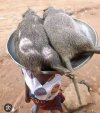
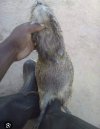
Natafuta hawa 'Grass cutter' hapa Tanzania

Natafuta hawa 'Grass cutter' hapa Tanzania

Xi jiping

JF-Expert Member
Joined
May 7, 2021
Posts
628
Reaction score
920
Natafuta hawa viumbe niwafuge, naona wanaigeria wanakazana kuwafuga, nami nimevutiwa.

Anaewajua jina kwa kiswahili anaweza anasema.

1785A37B-75F8-4033-95CF-83AFCB9C1799.jpeg
 
”Wee ndezi nini?”

Ni kauli mtu huambiwa anapokuwa amefanya kitu kisichokuwa cha kawaida,nahisi hawa ni viumbe wenye mushkeri fulani labda mleta mada unaweza kutuambia wamekuvutia nini hadi utake kuwafuga?
 
”Wee ndezi nini?”

Ni kauli mtu huambiwa anapokuwa amefanya kitu kisichokuwa cha kawaida,nahisi hawa ni viumbe wenye mushkeri fulani labda mleta mada unaweza kutuambia wamekuvutia nini hadi utake kuwafuga?
Walivowakubwa na wamenona
 
inaonekana watu wanawafuga picha za google hizo
 

Attachments

  • E26802E5-B224-4965-9CF1-EB6D3F4A1D7D.jpeg
    E26802E5-B224-4965-9CF1-EB6D3F4A1D7D.jpeg
    1.2 MB · Views: 6
  • 5C5F21EB-61C1-4B7B-BFD5-A03A39F94E72.jpeg
    5C5F21EB-61C1-4B7B-BFD5-A03A39F94E72.jpeg
    995.9 KB · Views: 8
[https://en]

Search

Africa Creates! Now Open! Enter your photos, video and audio in the annual celebration of Africa!

[https://upload]

Guinea pig

Article


Talk

Language

Download PDF

Watch

View source

This article is about the small species of Rodent. For the domestic pig breed, see Guinea hog. For various guinea pig species, see Cavia. For other uses, see Guinea pig (disambiguation).

The guinea pig or domestic guinea pig (Cavia porcellus), also known as the cavy or domestic cavy (/ˈkeɪvi/ KAY-vee), is a species of rodent belonging to the genus Cavia in the family Caviidae. Breeders tend to use the name "cavy" for the animal, but "guinea pig" is more commonly used in scientific and laboratory contexts.[1] Despite their name, guinea pigs are not native to Guinea, nor are they closely related to pigs. They originated in the Andes region of South America. Studies based on biochemistry and hybridization suggest they are domesticated animals that do not exist naturally in the wild, descendants of a closely related cavy species such as C. tschudii.[2][3] They were originally domesticated as livestock for a source of meat, and are still consumed in some parts of the world.

Domestic guinea pig[https://upload]

Conservation status

Domesticated

Scientific classification[https://upload]Domain:EukaryotaKingdom:AnimaliaPhylum:ChordataClass:MammaliaOrder:RodentiaFamily:CaviidaeGenus:CaviaSpecies:

C. porcellus

Binomial nameCavia porcellus

(Linnaeus, 1758)

Synonyms

Mus porcellus Linnaeus, 1758

Cavia cobaya Pallas, 1766

Cavia anolaimae J. A. Allen, 1916

Cavia cutleri Bennett, 1836

Cavia leucopyga Cabanis, 1848

Cavia longipilis Fitzinger, 1879

Duration: 6 seconds.0:06Guinea pig defense sound

In Western society, the guinea pig has enjoyed widespread popularity as a pet since its introduction to Europe and North America by European traders in the 16th century. Their docile nature, friendly responsiveness to handling and feeding, and the relative ease of caring for them have continued to make guinea pigs a popular choice of household pet. Organizations devoted to the competitive breeding of guinea pigs have been formed worldwide. Many specialized breeds, with varying coat colors and textures, are selected by breeders.

Livestock breeds of the guinea pig play an important role in folk culture for many indigenous Andean peoples, especially as a food source.[4] The animals are also used in folk medicine and in community religious ceremonies.[5] They are raised for their meat and are a culinary staple in the Andes Mountains, where they are known as cuy. In the 1960s a modern breeding program was started in Peru that resulted in large breeds known as cuy mejorados (improved cuy). Marketers tried to increase consumption of the animal outside South America.[6]

Biological experimentation on domestic guinea pigs has been carried out since the 17th century. The animals were used so frequently as model organisms in the 19th and 20th centuries that the epithet guinea pig came into use to describe a human test subject. Since that time, they have been largely replaced by other rodents, such as mice and rats. However, they are still used in research, primarily as models to study such human medical conditions as juvenile diabetes, tuberculosis, scurvy (like humans, they require dietary intake of vitamin C), and pregnancy complications.

History

Characteristics

Nomenclature

Diet

Reproduction

Health problems

As pets

In popular culture and media

As food

In scientific research

See also

References

Sources

External links

Last edited 3 days ago by Chubbles

[https://en]

Content is available under CC BY-SA 4.0 unless otherwise noted.

Privacy policy


Terms of Use

Desktop
 
Back
Top Bottom