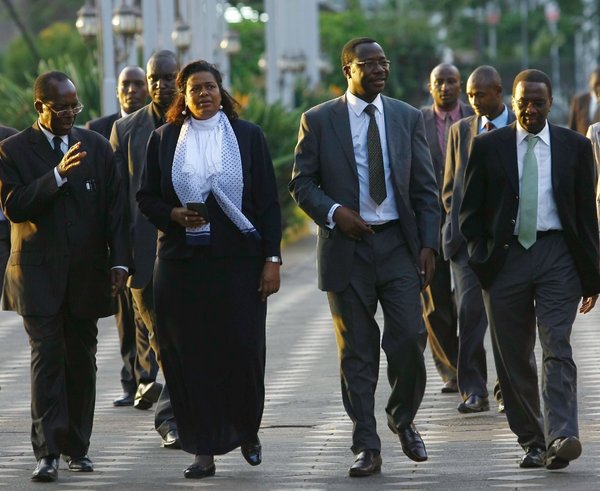
Supreme Court was 'loser' in Kenya election, forum told

Supreme Court was 'loser' in Kenya election, forum told

Kashishi

JF-Expert Member
Joined
Apr 11, 2010
Posts
1,142
Reaction score
635
Supreme Court was 'loser' in Kenya election, forum told


judges.jpg
Chief Justice Willy Mutunga (centre) hands a copy of the judgment on the presidential election petition to an official at the Supreme Court in Nairobi April 16, 2013. Kenyan activist Maina Kiai and US scholar Prof. Joel Barkan said the Court was loser in the March 4 election. Photo/ STEPHEN MUDIARI Nation Media Group
By KEVIN J KELLY
Posted Wednesday, April 24 2013 at 07:05

IN SUMMARY

  • The court made a political decision” in its ruling that a runoff was not required, Prof Barkan said. Calling its unanimous opinion “very shallow,” Prof Barkan said “the court itself was the big loser” and had “essentially undermined its own authority, going forward.”
  • There is “no way we can change the fact that Uhuru Kenyatta is president of Kenya,” Mr Kiai said.


NEW YORK - The election decision rendered by the Supreme Court is damaging to its credibility, a Kenyan activist and a US scholar declared at a forum held in Washington on Tuesday.

Maina Kiai, head of a civil society organisation in Nairobi, and Joel Barkan, a US think tank expert on African governance issues, both suggested that the court should have ordered a runoff between Uhuru Kenyatta and Raila Odinga.

The two commentators agreed that while Mr Kenyatta clearly won a larger share of the vote than Mr Odinga did on March 4, there was reason to suspect that Mr Kenyatta’s actual tally did not exceed 50 percent.

The court made a political decision” in its ruling that a runoff was not required, Prof Barkan said. Calling its unanimous opinion “very shallow,” Mr Barkan said “the court itself was the big loser” and had “essentially undermined its own authority, going forward.”

Mr Kiai used similar language in criticising the court’s performance, characterising its election ruling as “one of the most shallow judgments I have ever seen.”

“As civil society,” Mr Kiai added in his remarks at the National Endowment for Democracy, “we’re not challenging the results — we’re challenging the process. It’s important to set the bar higher for future elections.”

There is “no way we can change the fact that Uhuru Kenyatta is president of Kenya,” Mr Kiai said.

But he pointed to what he said were many small-scale manipulations of voting results that, taken together, enabled Mr Kenyatta’s reported tally to exceed the 50 percent threshold.

Prof Barkan did not offer as firm a conclusion in his assessment of the election results.

“I don’t think we’ll ever know whether they won 50 percent plus one,” he said in regard to Mr Kenyatta and Deputy President William Ruto. “My own sense is they did not, but they did win a plurality.

I don’t think the vote was stolen, but the election was a highly incompetent one.”

Mr Kiai added that the focus should now be on how Mr Kenyatta and Mr Ruto respond in the coming months to the cases brought against them in The Hague.

“The ICC is the only game in town in terms of accountability,” Mr Kiai said.

Prof Barkan offered a different view, saying, “The ICC did itself a disservice” in its handling of the Kenyatta/Ruto cases. He cited lengthy delays in the court’s process, suggesting that former Chief Prosecutor Luis Moreno Ocampo did not serve the court well.

In considering where advocates of democracy in Kenya should place their attention, Prof Barkan said, “I wouldn’t focus so much on the ICC case. I would focus on whether Uhuru will stick to the very admirable markers he laid out in his inauguration speech."
Source: Nation Newspaper


Kiai is always a sore loser, he tried to influence the proceedings and when he failed this is what he has to resort to for him to maintain relevance.
 
I neither had the details, nor inclination to scrutinize (let alone the requisite legal training) but I knew and stated here beforehand that there was no way the court was going to overturn the Uhuru "win".

Now, regardless of whether Uhuru won or not, when the outcome of such a controversially contentious case is that obvious to untrained laymen like myself, with barely a look at the finer details, the court is reduced to a rubber stamp and consequently it becomes a loser as a matter of course.
 
Kiai is always a sore loser, he tried to influence the proceedings and when he failed this is what he has to resort to for him to maintain relevance.

Question is, what could he have done differently were he on Mutunga's shoes? Yes there were anomalies in the poll, but these were not enough to render the whole exercise null. Indeed there are always bottlenecks in elections the world over and results are always up held if they meet the general set criteria. Nothing can be 100% even for mighty USA.
 
Question is, what could he have done differently were he on Mutunga's shoes? Yes there were anomalies in the poll, but these were not enough to render the whole exercise null. Indeed there are always bottlenecks in elections the world over and results are always up held if they meet the general set criteria. Nothing can be 100% even for mighty USA.

Lets not distort the facts! He never suggested that the "whole exercise" be rendered null, did you read this part
The two commentators agreed that while Mr Kenyatta clearly won a larger share of the vote than Mr Odinga did on March 4, there was reason to suspect that Mr Kenyatta’s actual tally did not exceed 50 percent.
Where they all agree that Mr Kenyatta clearly won a larger share.
Or this
But he pointed to what he said were many small-scale manipulations of voting results that, taken together, enabled Mr Kenyatta’s reported tally to exceed the 50 percent threshold.

The contention is with the 50%+1 not the entire exercise.
It is clearly expressed in this other paragraph

“As civil society,” Mr Kiai added in his remarks at the National Endowment for Democracy, “we’re not challenging the results — we’re challenging the process. It’s important to set the bar higher for future elections.”
 
Verdict on Kenya’s presidential election petition: Five reasons the judgment fails the legal test.


maina.jpg


By Wachira Maina
Posted Saturday, April 20 2013 at 12:37

In Summary

This article offers five reasons for this conclusion:

  • Supreme Court’s reliance on backward looking, mean-spirited, cramped Nigerian precedent.
  • Tolerant and uncritical acceptance of the IEBC’s explanations on the voter registers.
  • Lack of clarity about IEBC’s duty to ensure that final results could be verified against provisional results.
  • The Court’s use of subsidiary legislation to limit the meaning of “votes cast,” an unambiguous phrase in the Constitution.
  • The evidential foreclosure that the Court imposes on itself by taking judicial notice of technology failures instead of treating IEBC as spurious.

Sadly, as the saying is, in this judgment, the Supreme Court has only given us reasons that sound good, not good, sound reasons.


Justice Robert H. Jackson once said of the US Supreme Court: “We are not final because we are infallible, but we are infallible only because we are final.”

The infallibility that finality brings may, in the long view, be one of the few merits of the Supreme Court’s much awaited judgment on the presidential petitions.

Sixty per cent of the judgment, by length, is a leisurely rehash of the facts and arguments made by the parties in court. Everything else is given short shrift: Seven paragraphs are spent on reviewing and resolving the issue of the failed technology; another nine paragraphs dispose of the IEBC’s discretion to do manual tallies; 11 paragraphs are dedicated to the voters register and, astonishingly for a court given to brevity, 27 paragraphs are set aside to explain why rejected votes must not count in computing presidential percentages.

To paraphrase an old cynic’s quip, this judgment is both detailed and important, but the parts that are detailed are not important and those that are important are not detailed.

This article offers five reasons for this conclusion:

First, there is the Court’s reliance on extremely backward Nigerian authorities urged on it by the Attorney General, Prof Githu Muigai, acting as amicus curiae. Second, there is its tolerant and uncritical acceptance of the IEBC’s explanations about the ever-fluid totals in multiple voters’ registers and what this means in practice. Third, there is the question of tallying and especially, what the Court’s own tallies show but is not properly reflected in the judgment. Fourth, there is the Court’s use of subsidiary legislation to limit the meaning of “votes cast,” an unambiguous phrase in the Constitution. Finally, there is evidential foreclosure that the Court imposes on itself by taking judicial notice of technology failures instead of treating IEBC as spurious, as urged by petitioners.

Backward looking, mean-spirited, cramped Nigerian precedent

Let us start at the beginning. Central to the Court’s judgment is what the petitioners needed to prove and to what standard they should have proved it in order to get a remedy. The Court says that the answer to that question is “well exemplified” in Nigerian case law.

Apropos of Nigerian inspiration, it concludes that a petitioner must prove that the law was not complied with and also that the failure to comply affected the validity of the elections. That is the legal burden. What is the standard of proof needed? The court seems unsure.

In principle, it says, this should be above a “balance of probability” but below “beyond reasonable doubt.” This means a place in-between the standard in a civil case and that in a criminal case.

But the Supreme Court has also invented a dramatic new standard for the presidential election. A petitioner challenging a president-elect who has won in a first round election, as President Uhuru Kenyatta did, must provide proof beyond reasonable doubt. But what constitutional principle is the court vindicating here? None that one can readily see.

All election results are about data. There are no gradations of winning. Why, then, in principle, should exactness in electoral thresholds, say 50 per cent plus one and 25 per cent in at least half the counties impose on a presidential petitioner the duty to discharge a higher standard of proof – than say an MP challenging a victor chosen on the basis of “a majority of votes cast?”

Or maybe this is the Court’s method of radically curtailing the number of petitions that can be brought against the president-elect. Since most of the evidence of wrongdoing will be in the hands of the IEBC — or a similar body — it is extremely difficult to see how a petitioner could ever succeed.

This cannot be what Kenyans thought a new Constitution was meant to do, shield an elected leader from being subject to an election petition. In fact, it seems more likely than not, that Kenya will never have a run-off election so long as a candidate can, by hook or crook, get himself declared elected. The onerous standard of proof would be incredibly difficult to discharge.

The effect of this new standard is that a petitioner who questions the IEBC’s maths, as Raila Odinga and Gladwell Otieno did, is then subject to the same standard of proof as a person who says that a president-elect has won by corruption, bribery and conmanship.


MORE.....
 
Supreme Court Ruling Shameful

supreme-court-justices.jpg


Saturday, April 20, 2013 - 00:00 -- BY SAM OMWENGA

When the Supreme Court dismissed former Prime Minister Raila Odinga's and Africog's petitions on March 30, 2013, more than half of the country went into shock hoping to recover after the court issues a written explanation for the decision.

The written decision has now been issued. It is, however, a disappointment, for those who anticipated a cogent, well-reasoned, sound judgment.

What the public has instead been served is an intellectually shallow, poorly reasoned,10 page attempt to disguise the truth of the matter. That the highest court in the land could not come up with cogent reasons to back up its decision is shocking indeed.

The decision is so full of internal inconsistencies and contradictions that one wonders whether the Justices themselves are not ashamed of the product they have put out for it clearly must beckon ridicule from the legal fraternity within and outside our borders. The opinion is certainly an embarrassment to the court and by extension to our country for many reasons.

For example, instead of analysing what little evidence the court allowed to come in, the court simply gave us 100 pages of a detailed summary of arguments put forth by the lawyers representing the petitioners and respondents.

Any good first year law school student with ability to listen carefully or read a transcript could have given us a similar summary of what was argued at trial.

In summarising an argument by one of the lawyers representing one of the respondents, the court noted that the lawyer "proceeded from the following foundation of fact: the presidential election took place in a context of perfect peace; as many as 86% of the electorate--a high turnout by any standards did vote..."

Here is what is problematic with this and is symptomatic of everything else that's wrong with this ruling and the reason the ruling beckons condemnation and ridicule. It's not a fact that as many as 86% of the electorate voted.

Indeed, Raila's entire case was predicated on his and Cord's belief that the elections we rigged such that there was inflation of votes in Jubilee strongholds and deflation of votes in Cord strongholds, a contention that actually finds support in the Court's own ordered re-tallying of results from 22 polling stations that clearly showed evidence of inflation and deflation of votes.

By assuming as fact something that was in contention, namely, the high turn-out even in places like Mandera where the electorate hardly ever shows up to vote beyond just over 50 per cent, the court perhaps unintentionally has shown us its hand in what many believe to be the case and finds collaboration elsewhere in the opinion. The decision was a sham as it was already pre-determined that Uhuru won and therefore he was to be sworn in as our next president.

If the court was not assuming facts that were in contention, it was busy dismissing Raila's contentions as not backed with any evidence when, in fact, the court conveniently tossed a nearly 900 page affidavit setting forth evidence of the massive rigging Raila still contends took place.

The reasons the court gave for tossing the evidence simply don't fly, especially given the nature and magnitude of the case. The court ruled that the evidence could not be admitted because it would be unfair to the respondents to accept it as they won't have enough time to respond under the strict timelines everyone including the court had to adhere to.

In other words the court was telling a prosecutor in a murder trial "sorry; the witness you have who witnessed the murder can't be allowed to testify because the defense counsel has no time to prepare against his testimony as we must render a verdict by 5pm."

Now; to whom will that make sense other than the accused murderer and his defense counsel, yet that's the equivalent of exactly what happened Raila's petition.

The constitution itself provides that courts cannot sacrifice justice for the sake of technicalities such as the one the court relied on in this case to toss Raila's evidence. The court even acknowledged as much but nonetheless ignored this important check on the court not getting carried away with technicalities.

When the court was not busy strictly enforcing technicalities to Raila's detriment, it was busy putting blinds on and plugging its ears not to see or hear anything that would rock the boat under the guise of "judicial restraint."

While judicial restraint-the notion that judges should limit the exercise of their power-while this is an important doctrine, it is wholly inapplicable in this case.

Indeed, while the court did not expressly state that it was restraining itself under this notion of judicial restraint, it is obvious from reading the opinion the court bought the bogus argument from respondents' counsel that it should let the politicians do as they please and may the one who out-sharks the others win as the court watches from a distance.

Never mind if that's at the expense of the will of the people or the fact that there isn't an even playing ground as one or more may have the full force and might of the government behind them with the rest haplessly pitted against the same.
That's simply tragic.

There are many more reasons why the Supreme Court's judgment is intellectually shallow and an embarrassment to the country and the court itself. But if there are any lingering doubts as to this fact, all one has to do is to note the court essentially found there was criminality in the electoral process and even went as far as unusually recommending that IEBC officials so involved be investigated and criminally prosecuted.

The simple question to ask is, how would a system where such criminality occurred be said to also have been used to conduct an election that is free, open and transparent?

This is the mother of all contradictions in the court's judgment and there are many others that I don't need to delve into.
Nearly everyone who disagreed with the court's ruling on March 30 starting from Raila himself accepted the decision as we all should have for the sake of peace in the country.

With this poorly reasoned and supported explanation as to why the court ruled as it did, there is no doubt in the minds of many that there were significant irregularities. The court has tarnished its image and in one get-go vanquished any goodwill it had going into this case.

Of course there are those who would beg to differ with this simple fact starting from our new President down to those who supported him but in the end, this has not been and should never have been about President Uhuru Kenyatta and former Prime Minister Raila; it's about our beloved country.

That's a sad testament for our country and one can only hope there is hope somewhere down the road to make this country what it should be.


Supreme Court Ruling Shameful | The Star
 
Supreme Court too casual in ‘Raila Vs IEBC & Others'

By Elisha Ongoya

On 30th March 2013, the Supreme Court delivered its unanimous decision in what had been billed as "the most important case of our time". This was the very last day that the Supreme Court had, in law, to decide matter.

The Court then ordered that "the detailed judgment containing the reasons for decision of the Court will be issued within two weeks from today." This latter aspect was part of the orders of the court.

On 16th April 2013, the 16th day from the date of the decision, the court sat to deliver the decision. No explanation was given for the delivery of the decision outside the timelines set by the court. This omission, to an observer of the judiciary's recent investment in courtesy, was telling. This was casual.

The practice of court is that when the court summons parties in open court as it did, it reads its judgment, dates and signs it. Again, the judgment was never read. The Chief Justice pronounced the manner in which the decision was to be disseminated and the process ended up being a witnessing of the "signing ceremony" of the decision.

This, for what had been billed as "the most important case of our time", was casual.

The content of the judgment will definitely be a subject of detailed inquiry by the general public. This space is scarcely sufficient for such detailed inquiry. However, certain snippets from the judgment would give us the degree of seriousness with which the judges treated the matter that was before them.

One of the instruments of implementation of the mandate of the Supreme Court in Kenya is the Supreme Court Act. At Section 3, the Act sets out its objectives and therefore the objectives of the Court.

I suggest that a sound detailed inquiry of the soundness or otherwise of the decision of the Court in this matter should be reflected against this very sound statutory objectives of the institution.

The judgment reveals lots of material internal inconsistencies in the reasoning. I have selected a few aspects for this contention. On whether rejected votes ought to have been included in determining the final tally of votes in favour of each of the candidates by the IEBC, the court restated the express provisions of article 138 of the constitution which requires that for a person to be declared president-elect, such person must, among other things have received "more than half of all the votes cast in the election".
The court proceeded to reason at paragraph 260 of the judgment: "What are "all votes cast?" Do these include even the "rejected votes" which, of course were cast? Or are they limited to the properly marked ballots which figured in the vote tally for the individual candidates?

It is apparent that the court had acknowledged that in respect of the so called rejected votes, they "of course were cast". Yet the constitution talks of "all votes cast". Against this background, the court concluded at paragraph 285. This of course begs the question, when are some "cast votes" not "votes cast"?

What will interest analysts is the court's reliance on the decision from Seychelles to reach the above conclusion from the Constitutional Court of Seychelles in Popular Democratic Movement Vs Electoral Commission (see para 266).

What will confound many students of law is that Burhan J was actually a dissenting judge at the Seychelles Constitutional Court in the quoted decision. Can a decision of a dissenting judge be taken as the decision of the court from which it is cited? This too was casual.

Original record

Other matters that will interested analysis in this case is whether the court ever complied with its own order or scrutiny and re-tally of votes that it had made on its own motion in the matter.

Such failure of the court to observe its own orders without any explanation comes across as casual.

The court further found that from the 33,400 polling stations in the country, only 18,000 polling stations were scrutinised. The question the court never answered was why didn't IEBC avail the other about 15,000 forms for scrutiny? How verifiable were the results in light of the missing forms? Such lack of interrogation was casual.

Equally the court found that "In addition, the aggregate results of Form 36 votes from 75 constituencies were missing."

If aggregate results in the final results-declaration forms in 75 constituencies were missing, in the court's own scrutiny of the documents, the court ought to have asked "so what did the Commission declare in respect of those constituencies?" Such a lack of interrogation too was casual.

And what with the court's finding that the "Green Book", though not provided for in law, it is not apparent that such an original record required to be provided for by law? Was the court approving of the conduct of the elections with instruments outside the law? Does that promote the rule of law of arbitrariness? This too was casual.

From the foregoing it would appear that the judgment of the Supreme Court in Kenya in Raila Odinga Vs The Independent Electoral and Boundaries Commission and Others is a sad commentary on a number of aspects.

It is a sad commentary on how not to evolve jurisprudence. It is a sad commentary on how not to entrench a culture of constitutional accountability in governance. It is a sad commentary on how not to portray judicial honesty.

It is a bad example to courts subordinate to the Supreme Court. It is a sad commentary on how not to enhance the confidence of the citizens in the electoral system.

Writer is an Advocate and Law Lecturer Kabarak University School of Law.

Standard Digital News - Kenya : Opinion : Supreme Court too casual in ?Raila Vs IEBC & Others?
 
So Dr. Mutunga is feeling the heat of people criticizing the Supreme Court of KE that he comes out blazing on his twitter account"
Now surely, how are we supposed to read into this?

Need for mental shift! The Supreme Court is neither Mutunga's Court nor am I the Supreme Court!

https://twitter.com/WMutunga
 
So Dr. Mutunga is feeling the heat of people criticizing the Supreme Court of KE that he comes out blazing on his twitter account"
Now surely, how are we supposed to read into this?


https://twitter.com/WMutunga

What did you expect when every Raila supporter is fixated on demonising every institution that went contrary to their wish? they have called for sacking of commissioners and supreme court judges as if the institutions were put in place to massage their egos.
 
Next election, the riggers will still be in place.They will even have supreme court precedents to go by like the Itumbi Petition..Outrightly bogus which states that if a vote is spoilt, alll records of it are expunged.So if you can get a way of spoiling votes in your opponents stronghold you are through..Then they have legalised extra registers like the green book so God knows what the voter register will be like..surely,this was sad...whether or not they were blackmailed Only God knows..


More importantly will the looser who refuses to concede go to the supreme court again...Like in 2007 No,then what will be the result..Phillip Rainsley had pointed out...Haiya!
 
The supreme court did what was right and did not do what pleased any politician. That is the brightest beggining for any supreme court where judiciary excercises its independence.
Why choke when the supreme court is showing its independence
 
Supreme Court was 'loser' in Kenya election, forum told


judges.jpg
Chief Justice Willy Mutunga (centre) hands a copy of the judgment on the presidential election petition to an official at the Supreme Court in Nairobi April 16, 2013. Kenyan activist Maina Kiai and US scholar Prof. Joel Barkan said the Court was loser in the March 4 election. Photo/ STEPHEN MUDIARI Nation Media Group
By KEVIN J KELLY
Posted Wednesday, April 24 2013 at 07:05

IN SUMMARY

  • The court made a political decision” in its ruling that a runoff was not required, Prof Barkan said. Calling its unanimous opinion “very shallow,” Prof Barkan said “the court itself was the big loser” and had “essentially undermined its own authority, going forward.”
  • There is “no way we can change the fact that Uhuru Kenyatta is president of Kenya,” Mr Kiai said.


NEW YORK - The election decision rendered by the Supreme Court is damaging to its credibility, a Kenyan activist and a US scholar declared at a forum held in Washington on Tuesday.

Maina Kiai, head of a civil society organisation in Nairobi, and Joel Barkan, a US think tank expert on African governance issues, both suggested that the court should have ordered a runoff between Uhuru Kenyatta and Raila Odinga.

The two commentators agreed that while Mr Kenyatta clearly won a larger share of the vote than Mr Odinga did on March 4, there was reason to suspect that Mr Kenyatta’s actual tally did not exceed 50 percent.

The court made a political decision” in its ruling that a runoff was not required, Prof Barkan said. Calling its unanimous opinion “very shallow,” Mr Barkan said “the court itself was the big loser” and had “essentially undermined its own authority, going forward.”

Mr Kiai used similar language in criticising the court’s performance, characterising its election ruling as “one of the most shallow judgments I have ever seen.”

“As civil society,” Mr Kiai added in his remarks at the National Endowment for Democracy, “we’re not challenging the results — we’re challenging the process. It’s important to set the bar higher for future elections.”

There is “no way we can change the fact that Uhuru Kenyatta is president of Kenya,” Mr Kiai said.

But he pointed to what he said were many small-scale manipulations of voting results that, taken together, enabled Mr Kenyatta’s reported tally to exceed the 50 percent threshold.

Prof Barkan did not offer as firm a conclusion in his assessment of the election results.

“I don’t think we’ll ever know whether they won 50 percent plus one,” he said in regard to Mr Kenyatta and Deputy President William Ruto. “My own sense is they did not, but they did win a plurality.

I don’t think the vote was stolen, but the election was a highly incompetent one.”

Mr Kiai added that the focus should now be on how Mr Kenyatta and Mr Ruto respond in the coming months to the cases brought against them in The Hague.

“The ICC is the only game in town in terms of accountability,” Mr Kiai said.

Prof Barkan offered a different view, saying, “The ICC did itself a disservice” in its handling of the Kenyatta/Ruto cases. He cited lengthy delays in the court’s process, suggesting that former Chief Prosecutor Luis Moreno Ocampo did not serve the court well.

In considering where advocates of democracy in Kenya should place their attention, Prof Barkan said, “I wouldn’t focus so much on the ICC case. I would focus on whether Uhuru will stick to the very admirable markers he laid out in his inauguration speech."
Source: Nation Newspaper


So,,,,what are they going to do,,about it,,,,almost nothing,,and just wasting some
of their precious,,,,, time.

I do not mind,,about Kiai,,,,he is in the business of making a few dollars,,,but, what
about,,that,,sijui,,,think tank of African affairs,,,,,,mmmmm,,,total rubbish.

If,,they have not,,yet,,,, gotten used to seeing their preferred candidate
languishing in the cold,,,and trying to come back to the limelight through
some panya route,,,then,,they are in,,fpr a long and painful moment.

Can't mr Kiai find another topic,,which will,,equally make more dollars????
He has to be more inventive if he has to survive in that trade of his.:nono:

Too bad,,,mr Kiai and your masters,,,in the west,,,if you cannot survive
without having Raila Odinga in the government.

It is human to shift the blame on somebody,,when things goes wrong,,
but too bad,, i sympathies with you,,,,,,for mr Raila is out and kaput,,
kabisa and i do not even,,see him (Raila) making a come back,,in
2017.

Very sorry,,sirs.
 
Raila will be there in 2017 i can bet on that. For those saying that the spoilt vote rule will be a bad precedent why should a whole nation be subjected to a repeat poll just because a voter voted for all the candidates or for no candidate in his ballot? Why should the spoilt votes be the extra candidate in the presidential election?
 
Terrible Judgement, Perharps the ICC may not share their views on justice..I think it is a hard baattle for UHuru and Ruto...I wish them well
 
The good will and trust that the people had in Mutunga is lost. For his court to insist that an election ought to be "good enough" is the greatest insult to the history of the republic.

The implications of the ruling are far-reaching and baffling to say the least. Mediocrity has been sanctioned, lack of transparency tolerated and the clock of reform rewound back to early nineties. The independent institutions envisioned by the new constitution will remain a brilliant idea on paper.
 
The good will and trust that the people had in Mutunga is lost. For his court to insist that an election ought to be "good enough" is the greatest insult to the history of the republic.

The implications of the ruling are far-reaching and baffling to say the least. Mediocrity has been sanctioned, lack of transparency tolerated and the clock of reform rewound back to early nineties. The independent institutions envisioned by the new constitution will remain a brilliant idea on paper.

The implications of the KSC's ruling on the disputed 2013 Kenya presidential election petition shall bear very heavy political consequences in the near future of our EA region which when will start to emerge the six judges of the KSC shall no less than appear to have had hidden political agenda for the reasons I see below:-
1: It being the first experience under the new constitution following the 2007/8 fracas in which thousands lost lives; common people had hope for a fair election results from voter point of view.
2: From the common voter point of view the anomalies revealed by the court and made public to them those were the root causes of the 2007/8 event which caused thousands of deaths;
3: The court's admission that there were anomalies although not enough to warrant different ruling; when the same court rejected two petitions which had enough evidence to reveal corruption in the election process leaves a lot to be desired as is ridiculous to a common voter who kept watching the whole case process from the start to the end.
4: For the neighboring states struggling to learn from the Kenya scenario for benefits of the new constitution; the lesson is that even with the new set up problems of disputed/corruptions elections are there to stay because our set allow that; from KSC rulling-which is very unfortunate indeed; .
5: Lawyers/courts and voter interpretation of election vote rigging by this event appear to be two things remotely far apart; which shall manifest in voter apathy and low turn outs as a result. In this connection the KSC has killed voter morale for the next elections turnout; unless corrective measures to put back things in order take place; otherwise it will to be a very big shame on the six KSC judges.
6: I concur with the introduce r of this thread and call for more analysis from both law technocrats and voter implication analysts on the voter turnout implications, for the benefit of our EA partner states' future building of political/democratic institutions for the rule of law.
 
Back
Top Bottom