Tanzania to become a top producer of graphite

Tanzania to become a top producer of graphite

Geza Ulole

JF-Expert Member
Joined
Oct 31, 2009
Posts
65,136
Reaction score
91,917
Tanzania to become a top producer of graphite
TanzaniaEnergy
Economic News

26 Feb 2018
Ongoing foreign investment is setting Tanzania up to become one of the largest graphite producers worldwide, despite concerns over the new mining law.

Tanz%20banner.png


In mid-January Volt Resources, an Australian flake graphite development firm focused on Tanzania, raised $4.7m in capital to help fast-track the initial stage of its flagship Bunyu graphite project.

The funds – raised through a structured bond issue on the Dar es Salam Stock Exchange – will be used in the first production phase of the project, whose output is expected to reach 400,000 tonnes per annum (tpa) of ore and 20,000 tpa of graphite products. The graphite extracted from Bunyu will be used to make battery anodes as well as flame-retardant building materials.

Soon after raising the capital, Volt Resources submitted an environmental and social impact statement for the project. First-stage feasibility studies are expected to finish in the first quarter of 2018, and the company is currently preparing its mining licence application, which marks the last step before works can begin.

Multiple graphite projects under development following 2015-16 discovery
Bunyu is the largest of several graphite projects to launch in Tanzania in recent years, following the discovery in 2015-16 of substantial graphite deposits in the country’s south-east by mainly Australia-based developers.

In addition to the Bunyu project, Volt Resources is developing the Namangale project, which has the capacity to produce 100,000 tpa of graphite.

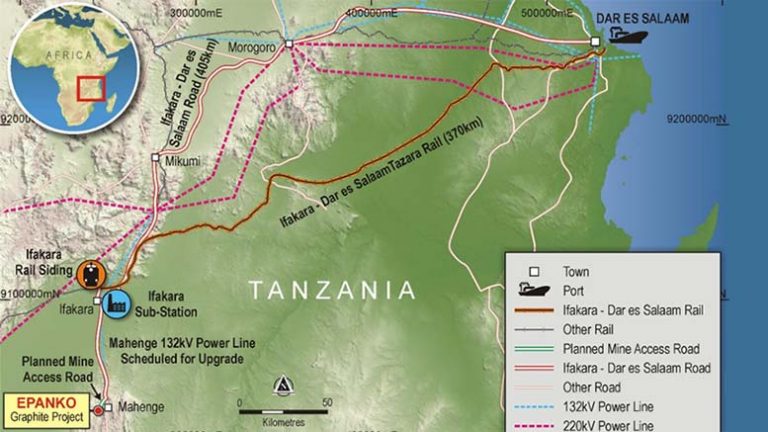
Magnis Resources, meanwhile, is developing the Nachu project, which has a 240,000-tpa capacity and a lifespan of 15 years, while Kibaran Resources is developing the Epanko project, with the capacity to produce 44,000 tpa.

Once fully operational, the projects should position Tanzania one of the top-three graphite producers in the world.

The global graphite market was worth $15.8bn in 2016, according to market research firm Future Market Insights, and is forecast to see a compound annual growth rate of 6.7% through to 2027, driven in part by demand for Lithium-ion batteries, which are used in a range of products, including electric cars. In 2016 China was the largest producer of graphite, at 780,000 tpa, while India came in second, with 170,000 tpa, and Brazil third, with 80,000 tpa.

Developing downstream graphite
Volt also has initiatives in the pipeline to advance its downstream capabilities. In May 2017 it revealed plans to process graphite from the Namangale site, and production is slated to come on-line in the middle of this year. In the mine’s first production phase, between 10,000 and 20,000 tpa of graphite will be processed for export, mainly to China and the US.

Volt is not the only company to ramp up operations in refining and processing graphite. In 2015 Magnis Resources, another Australian firm, became the first company outside of the special export zones (SEZs) to be granted a special mining licence to develop an advanced graphite processing plant with SEZ status.

The plant, operated by subsidiary Magnis Technologies Tanzania, will process 200,000 tonnes of graphite concentrate per year from the Nachu project in south-east Tanzania.

Benefits of SEZ status include a 10-year exemption from corporate tax, and levies on machinery, equipment and construction materials for the development of SEZ infrastructure, in addition to exemption from payment of withholding tax on rent, dividends and interest for 10 years.

Concerns over new mining law eased
The recent acceleration of activity both upstream and downstream will come as welcome news to the investment community following concerns over new mining legislation that came into effect in mid-July.

The bill stipulates that the government will have a 16% stake in all mining projects – a move President John Magufuli said was an attempt to “safeguard natural resource wealth” and crack down on tax evasion. Royalties on revenue were also increased from 4% to 6%.

With the acquired right for the government to renegotiate project contracts, and temporary halts imposed on new mining licences, the law introduced uncertainty into the sector and stoked concerns that planned projects could see delays.

Many initiatives in the graphite sector – notably the Bunyu project – have nonetheless resumed according to plan.

Graphite projects to promote broader economic growth
Planned and ongoing projects to develop the sector’s entire value chain are key to the government’s plans to develop the extractive sector and drive broader economic growth.

The new projects coming on-line both in the field and at smelters are expected to boost employment and increase mining’s contribution to GDP, which accounted for 3.7% in 2014, or $1.78bn, according to the latest available data. Under its Tanzania Development Vision 2025 blueprint, the government aims to increase this to 10%.

Tanzania to become a top producer of graphite
 
The next oil

hahahahaha i've never met a bigger Know it all idiot.. if u knew anything about energy you would know that the next frontier in energy is the storage of energy.. to an idiot like you batteries more so Lithium batteries used in all electric cars, power back up and storage of energy in renewable energy.. from all that i have read up there has got nothing to do with lithium.. just a stupid goat trying to prove his country is on the "rise".. go read an actual book not some stupid blogger

Lithium: The Oil of the 21st Century
 
Niksta254 Ficha ujinga u know nothing about rechargeable hybrid cars! The main precious thing is graphite that can conduct n store energy for longer time. BTW plenty of lithium in central Tanzania.


Liontown Resources discovers lithium zone in Tanzania
2017-04-05 13:30:00
Assays of up to 3.3% lithium identified from rock chip sampling.
600z371_1-shutterstock_226535503.jpg

Liontown is planning additional trenching and soil sampling

Liontown Resources (ASX:LTR) has identified high-grade, spodumene-related lithium mineralisation at its Mohanga Lithium-Tantalum Project in Tanzania.

The Mohanga Project, which Liontown acquired in late 2015, covers a total area of 177 square kilometres and is located circa 40 kilometres from Tanzania’s capital Dodoma.

The anomalous results come from the Tresor prospect, where rock chip sampling has recorded high grade lithium assays up to 3.3% lithium and >100 ppm tantalum.

The pegmatite zone is interpreted to be up to 90 metres wide and at least 500 metres long, with the trend open along strike beneath transported cover.

The high-grade (>1%) lithium zone is up to 30 metres thick and at least 150 metres long; however, its full extent is unknown due to limited outcrop.

The latest results have given Liontown the confidence to progress exploration activities including additional trenching and soil sampling.

A maiden drilling program will be designed based on the results of this work.

In addition to targeting lithium mineralisation, further work will also be undertaken to assess the potential of the Mohanga Project to host Archaean greenstone-hosted gold mineralisation.

Previous soil sampling has recorded up to 120 ppb gold at the Halo prospect.

Liontown’s shares were last trading 5.26% higher intra-day on Wednesday, at $0.02.

Liontown Resources discovers lithium zone in Tanzania
 
Tanzania Epanko Graphite Suitable for Lithium-Ion Batteries TOPICS:Graphite FEBRUARY 24, 2017

epanko-graphite-project-768x432.jpg


Australian graphite developer Kibaran Resources (ASX:KNL) announced that recent industrial scale tests have confirmed the excellent suitability for use in lithium-ion batteries of the graphite produced from its Epanko project in southeast Tanzania.

The results of the tests show that the Epanko graphite has the requisite physical and chemical properties for use in high quality lithium-ion batteries (graphite is used in lithium-ion battery as the anode).

Kibaran notes that key properties of the Epanko graphite including particle size distribution, tap density and impurity levels are in-line and meet leading battery anode manufacturer specifications.

Andrew Spinks, Managing Director of Kibaran, commented: “We continue to be encouraged by positive feedback from leading battery anode manufacturers as we advance through the negotiation process. Our spherical graphite was produced from large scale industrial-sized facilities, rather than lab-scale testwork, thereby allowing battery anode manufacturers to determine real world performance and replicability of the material. Kibaran is well positioned to become a leading producer of graphite products with all requisite mining studies completed for Epanko, a granted mining licence and attracted “blue chip” offtake partners […]”

Kibaran recently started studies on expanding the production capacity of the Epanko Graphite Project by 50% from 40,000 tons per annum (tpa) of graphite concentrate to 60,000tpa.

Read more at: Tanzania Epanko Graphite Suitable for Lithium-Ion Batteries - TanzaniaInvest and follow us on www.twitter.com/tanzaniainvest
 
Tanzania Epanko Graphite Suitable for Lithium-Ion Batteries TOPICS:Graphite FEBRUARY 24, 2017 Australian graphite developer Kibaran Resources (ASX:KNL) announced that recent industrial scale tests have confirmed the excellent suitability for use in lithium-ion batteries of the graphite produced from its Epanko project in southeast Tanzania. The results of the tests show that the Epanko graphite has the requisite physical and chemical properties for use in high quality lithium-ion batteries (graphite is used in lithium-ion battery as the anode). Kibaran notes that key properties of the Epanko graphite including particle size distribution, tap density and impurity levels are in-line and meet leading battery anode manufacturer specifications. Andrew Spinks, Managing Director of Kibaran, commented: “We continue to be encouraged by positive feedback from leading battery anode manufacturers as we advance through the negotiation process. Our spherical graphite was produced from large scale industrial-sized facilities, rather than lab-scale testwork, thereby allowing battery anode manufacturers to determine real world performance and replicability of the material. Kibaran is well positioned to become a leading producer of graphite products with all requisite mining studies completed for Epanko, a granted mining licence and attracted “blue chip” offtake partners […]” Kibaran recently started studies on expanding the production capacity of the Epanko Graphite Project by 50% from 40,000 tons per annum (tpa) of graphite concentrate to 60,000tpa.

Read more at: Tanzania Epanko Graphite Suitable for Lithium-Ion Batteries - TanzaniaInvest and follow us on www.twitter.com/tanzaniainvest
img5670703c05ee6.jpg
 
Tanzania Epanko Graphite Suitable for Lithium-Ion Batteries TOPICS:Graphite FEBRUARY 24, 2017 Australian graphite developer Kibaran Resources (ASX:KNL) announced that recent industrial scale tests have confirmed the excellent suitability for use in lithium-ion batteries of the graphite produced from its Epanko project in southeast Tanzania. The results of the tests show that the Epanko graphite has the requisite physical and chemical properties for use in high quality lithium-ion batteries (graphite is used in lithium-ion battery as the anode). Kibaran notes that key properties of the Epanko graphite including particle size distribution, tap density and impurity levels are in-line and meet leading battery anode manufacturer specifications. Andrew Spinks, Managing Director of Kibaran, commented: “We continue to be encouraged by positive feedback from leading battery anode manufacturers as we advance through the negotiation process. Our spherical graphite was produced from large scale industrial-sized facilities, rather than lab-scale testwork, thereby allowing battery anode manufacturers to determine real world performance and replicability of the material. Kibaran is well positioned to become a leading producer of graphite products with all requisite mining studies completed for Epanko, a granted mining licence and attracted “blue chip” offtake partners […]” Kibaran recently started studies on expanding the production capacity of the Epanko Graphite Project by 50% from 40,000 tons per annum (tpa) of graphite concentrate to 60,000tpa.

Read more at: Tanzania Epanko Graphite Suitable for Lithium-Ion Batteries - TanzaniaInvest and follow us on www.twitter.com/tanzaniainvest

http://www.thinkgeoenergy.com/some-background-on-lithium-mining-and-extraction/
 
Tanzania Epanko Graphite Suitable for Lithium-Ion Batteries TOPICS:Graphite FEBRUARY 24, 2017 Australian graphite developer Kibaran Resources (ASX:KNL) announced that recent industrial scale tests have confirmed the excellent suitability for use in lithium-ion batteries of the graphite produced from its Epanko project in southeast Tanzania. The results of the tests show that the Epanko graphite has the requisite physical and chemical properties for use in high quality lithium-ion batteries (graphite is used in lithium-ion battery as the anode). Kibaran notes that key properties of the Epanko graphite including particle size distribution, tap density and impurity levels are in-line and meet leading battery anode manufacturer specifications. Andrew Spinks, Managing Director of Kibaran, commented: “We continue to be encouraged by positive feedback from leading battery anode manufacturers as we advance through the negotiation process. Our spherical graphite was produced from large scale industrial-sized facilities, rather than lab-scale testwork, thereby allowing battery anode manufacturers to determine real world performance and replicability of the material. Kibaran is well positioned to become a leading producer of graphite products with all requisite mining studies completed for Epanko, a granted mining licence and attracted “blue chip” offtake partners […]” Kibaran recently started studies on expanding the production capacity of the Epanko Graphite Project by 50% from 40,000 tons per annum (tpa) of graphite concentrate to 60,000tpa.

Read more at: Tanzania Epanko Graphite Suitable for Lithium-Ion Batteries - TanzaniaInvest and follow us on www.twitter.com/tanzaniainvest

KenGen eyes sale of valuable minerals in geothermal fluids

KenGen managing director Albert Mugo said the firm is turning to innovation to exploit the minerals found in geothermal fluids which come from rocks below the earth’s surface.
KenGen says brine from its Olkaria fields contains about 600-800 milligrammes (mg) of silica per kilogramme of the fluid and 1.5 and 2mg per kilogramme of lithium in its geothermal springs.
 
Niksta254 Ficha ujinga u know nothing about rechargeable hybrid cars! The main precious thing is graphite that can conduct n store energy for longer time. BTW plenty of lithium in central Tanzania.


Liontown Resources discovers lithium zone in Tanzania
2017-04-05 13:30:00
Assays of up to 3.3% lithium identified from rock chip sampling.
600z371_1-shutterstock_226535503.jpg

Liontown is planning additional trenching and soil sampling

Liontown Resources (ASX:LTR) has identified high-grade, spodumene-related lithium mineralisation at its Mohanga Lithium-Tantalum Project in Tanzania.

The Mohanga Project, which Liontown acquired in late 2015, covers a total area of 177 square kilometres and is located circa 40 kilometres from Tanzania’s capital Dodoma.

The anomalous results come from the Tresor prospect, where rock chip sampling has recorded high grade lithium assays up to 3.3% lithium and >100 ppm tantalum.

The pegmatite zone is interpreted to be up to 90 metres wide and at least 500 metres long, with the trend open along strike beneath transported cover.

The high-grade (>1%) lithium zone is up to 30 metres thick and at least 150 metres long; however, its full extent is unknown due to limited outcrop.

The latest results have given Liontown the confidence to progress exploration activities including additional trenching and soil sampling.

A maiden drilling program will be designed based on the results of this work.

In addition to targeting lithium mineralisation, further work will also be undertaken to assess the potential of the Mohanga Project to host Archaean greenstone-hosted gold mineralisation.

Previous soil sampling has recorded up to 120 ppb gold at the Halo prospect.

Liontown’s shares were last trading 5.26% higher intra-day on Wednesday, at $0.02.

Liontown Resources discovers lithium zone in Tanzania

goatsweat10.jpg
 
KenGen eyes sale of valuable minerals in geothermal fluids

KenGen managing director Albert Mugo said the firm is turning to innovation to exploit the minerals found in geothermal fluids which come from rocks below the earth’s surface.
KenGen says brine from its Olkaria fields contains about 600-800 milligrammes (mg) of silica per kilogramme of the fluid and 1.5 and 2mg per kilogramme of lithium in its geothermal springs.
FYI Tanzania has more geothermal sources than Kenya! 2 branches of rift Valley passes in Tanzania n if u take a combined volcanic, hot fountains n geysers activities u will get to know what I mean. So go now sleep fool!
 
graphite for
1.lubricants manufacture especially additives
2.pencil because of its color
3.nk
 
Tanzania planning to reach up to 200 MW of geothermal capacity by 2025
LakeNgozi_Mbeya_Tanzania.jpeg
Lake Ngozi, Mbeya, Tanzania (source: flickr/ Sara&Joachim, creative commons)


Alexander Richter
12 Apr 2017
Tanzania Geothermal Development Company (TGDC) is planning with a start of exploration at its Lake Ngozi geothermal prospect in the next fiscal year and an overall geothermal power generation capacity of 200 MW by 2025.

With feasibility studies in Songwe, Mbaka Kiejo and Ngozi concluded, the Tanzania Geothermal Development Company (TGDC) is hopeful it can start work on a geothermal project at Lake Ngozi in Mbeya in the next fiscal year.

Speaking with The Citizen, the manager planning and projects for the Tanzania Geothermal Development Company, Mr Shakiru Kajungus said that Tanzania expects up to 200 MW of geothermal power generation capacity by 2025.

Tanzania faces constant electricity shortages and currently relies heavily on hydropower as well as gas. TGDC is currently working with foreign development partners to raise further funds required to push the project forward.

With about 50 areas defined as having a geothermal development potential, Tanzania hopes to develop geothermal resources for power generation in a similar fashion as its neighbour to the south, Kenya.

http://www.thinkgeoenergy.com/tanza...-up-to-200-mw-of-geothermal-capacity-by-2025/
 
I am not urgent level small boy! U know nothing on this
same way you know nothing of Kenya stupid Tanzanian fool.. go back and listen to Maghu-FOOL-i speeches.. grown ass man constantly playing my daddy has a bigger car than yours... kalale.. u know nothing ever.. kuongea upuzi kama mbuzi
 
Tanzania planning to reach up to 200 MW of geothermal capacity by 2025
LakeNgozi_Mbeya_Tanzania.jpeg
Lake Ngozi, Mbeya, Tanzania (source: flickr/ Sara&Joachim, creative commons)


Alexander Richter
12 Apr 2017
Tanzania Geothermal Development Company (TGDC) is planning with a start of exploration at its Lake Ngozi geothermal prospect in the next fiscal year and an overall geothermal power generation capacity of 200 MW by 2025.

With feasibility studies in Songwe, Mbaka Kiejo and Ngozi concluded, the Tanzania Geothermal Development Company (TGDC) is hopeful it can start work on a geothermal project at Lake Ngozi in Mbeya in the next fiscal year.

Speaking with The Citizen, the manager planning and projects for the Tanzania Geothermal Development Company, Mr Shakiru Kajungus said that Tanzania expects up to 200 MW of geothermal power generation capacity by 2025.

Tanzania faces constant electricity shortages and currently relies heavily on hydropower as well as gas. TGDC is currently working with foreign development partners to raise further funds required to push the project forward.

With about 50 areas defined as having a geothermal development potential, Tanzania hopes to develop geothermal resources for power generation in a similar fashion as its neighbour to the south, Kenya.

Tanzania planning to reach up to 200 MW of geothermal capacity by 2025

as ALWAYS!!!!!! TANZANIA IS PLANNING... TANZANIA IS ON FEASIBILITY STUDY!!!! all pathetic copy cat projects of fully completed and functioning projects...

maghufuli 2.png
 
Tanzania planning to reach up to 200 MW of geothermal capacity by 2025
LakeNgozi_Mbeya_Tanzania.jpeg
Lake Ngozi, Mbeya, Tanzania (source: flickr/ Sara&Joachim, creative commons)


Alexander Richter
12 Apr 2017
Tanzania Geothermal Development Company (TGDC) is planning with a start of exploration at its Lake Ngozi geothermal prospect in the next fiscal year and an overall geothermal power generation capacity of 200 MW by 2025.

With feasibility studies in Songwe, Mbaka Kiejo and Ngozi concluded, the Tanzania Geothermal Development Company (TGDC) is hopeful it can start work on a geothermal project at Lake Ngozi in Mbeya in the next fiscal year.

Speaking with The Citizen, the manager planning and projects for the Tanzania Geothermal Development Company, Mr Shakiru Kajungus said that Tanzania expects up to 200 MW of geothermal power generation capacity by 2025.

Tanzania faces constant electricity shortages and currently relies heavily on hydropower as well as gas. TGDC is currently working with foreign development partners to raise further funds required to push the project forward.

With about 50 areas defined as having a geothermal development potential, Tanzania hopes to develop geothermal resources for power generation in a similar fashion as its neighbour to the south, Kenya.

http://www.thinkgeoenergy.com/tanza...-up-to-200-mw-of-geothermal-capacity-by-2025/

geothermal-energy-18-638.jpg
 
FYI Tanzania has more geothermal sources than Kenya! 2 branches of rift Valley passes in Tanzania n if u take a combined volcanic, hot fountains n geysers activities u will get to know what I mean. So go now sleep fool!
global-geothermal-energy.png

I dont see Tanzania any where...

Difference between talkers /planners and people who DO things
DSC0346_121-copy-1024x650.jpg
plant210814.jpg
OlkariaIII_Kenya_Ormat.png
 
Back
Top Bottom