
Dr. Job
JF-Expert Member
- Jan 22, 2013
- 813
- 220
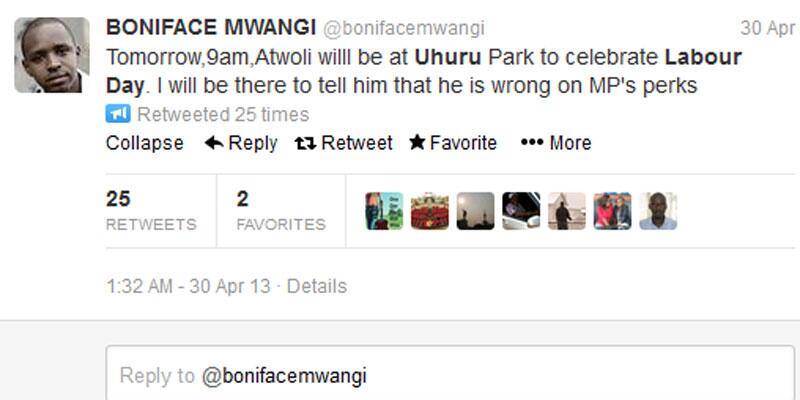
Watch this video and listen to Atwoli issuing threats that are carried out against Boniface Mwangi while the freakin President is watching!

Boniface Mwangi (born July 10, 1983) is an award-winning Kenyan photojournalist making a name for his social-political activism under the banner, Kenya Ni Kwetu (Kenya is our Home). The Nairobi-based lobby strives to enable a patriotic citizens' movement to take bold and effective actions in building a new Kenya. He is popular for his stunning images on the post-election violence that hit Kenya in 2007-2008. He is also the founder of Picha Mtaani, a youth-led peace initiative that primarily seeks to create space for young people to reconcile and become agents of reconciliation to their respective communities.
Mwangi was born in Taveta, on the Kenya-Tanzania border. His mother was a businesswoman who traded across the border. Mwangi was moved to live with his grandparents home in Nyeri, Central Kenya, when he was six years old. He would encounter linguistic challenges, having mastered Kiswahili at birth – the country's national language that's widely spoken across East and Central Africa – although Gikuyu is the language most spoken in Central Kenya.
Mwangi later moved with his mother to live in Nairobi's low-income suburb of Ngara, then Highrise in Majengo, Githurai 45, before finally settling in Pangani. Mwangi dropped in and out of school during this period and helped his mother vend books to raise money for basic needs.
When his mother died in 2000, Mwangi, then 17, reviewed his life and decided he had to change his ways if he was to survive the vicissitudes of life. He joined a Bible school and secured a diploma in Bible Studies. It was while at the school that he would discover he had an interest in photography. One of his teachers, having noticed Mwangi's interest in photography, gave him two texts that would alter the direction of his life. These were the biographies of Mohamed Amin, the Kenyan photographer hailed as one of the greatest photojournalists of the 20th century.
Mwangi joined the East African School of Journalism, he was studying in the morning while rushing back to the streets to sell books in the streets at night so that he could pay his fees. The school had no cameras to train students and the photography class was a mere two hours of theory class twice a week. He hired a camera and started practicing what he learned in class. He focused his work on the poverty and the deprivation in Kenyan slums, the resilience of the vendors on the streets, the brutality of policemen and women on ordinary citizens.
Mwangi started contributing to The Standard newspaper on a freelance level before he eventually secured employment at the newspaper, which is the oldest newspaper in Kenya.
The next few years was a productive period for Mwangi. He tracked a police crackdown on the unlawful gang, Mungiki, winning his first, and Kenya's CNN African Photojournalist of the Year Award in 2008.
In the event, the Mungiki pictures[8] proved to be only a dress rehearsal for the chaos that followed in the aftermath of the disputed Kenyan presidential election, 2007. Gang warfare in the slums, as well as their clashes with the police – with innocent Kenyans caught in the crossfire – transformed the impoverished hamlets into rivers of blood. Mwangi captured the horrific scenes on film, as well as the pogrom in other restive parts caught in post-poll mayhem.
The images shocked and troubled the world, from Europe to North America, where leading media houses splashed Mwangi's images. Mwangi's own newspaper used his images selectively, a form of self-censorship that motivated Mwangi's next course of action.
Mwangi is married with three children – two boys and one girl – to whom he has given pan-African names that celebrate humanity, and thankfulness for surviving thus far.
SOURCE: Wikipedia
Boniface Mwangi (born July 10, 1983) is an award-winning Kenyan photojournalist making a name for his social-political activism under the banner, Kenya Ni Kwetu (Kenya is our Home). The Nairobi-based lobby strives to enable a patriotic citizens' movement to take bold and effective actions in building a new Kenya. He is popular for his stunning images on the post-election violence that hit Kenya in 2007-2008. He is also the founder of Picha Mtaani, a youth-led peace initiative that primarily seeks to create space for young people to reconcile and become agents of reconciliation to their respective communities.
Mwangi was born in Taveta, on the Kenya-Tanzania border. His mother was a businesswoman who traded across the border. Mwangi was moved to live with his grandparents home in Nyeri, Central Kenya, when he was six years old. He would encounter linguistic challenges, having mastered Kiswahili at birth – the country's national language that's widely spoken across East and Central Africa – although Gikuyu is the language most spoken in Central Kenya.
Mwangi later moved with his mother to live in Nairobi's low-income suburb of Ngara, then Highrise in Majengo, Githurai 45, before finally settling in Pangani. Mwangi dropped in and out of school during this period and helped his mother vend books to raise money for basic needs.
When his mother died in 2000, Mwangi, then 17, reviewed his life and decided he had to change his ways if he was to survive the vicissitudes of life. He joined a Bible school and secured a diploma in Bible Studies. It was while at the school that he would discover he had an interest in photography. One of his teachers, having noticed Mwangi's interest in photography, gave him two texts that would alter the direction of his life. These were the biographies of Mohamed Amin, the Kenyan photographer hailed as one of the greatest photojournalists of the 20th century.
Mwangi joined the East African School of Journalism, he was studying in the morning while rushing back to the streets to sell books in the streets at night so that he could pay his fees. The school had no cameras to train students and the photography class was a mere two hours of theory class twice a week. He hired a camera and started practicing what he learned in class. He focused his work on the poverty and the deprivation in Kenyan slums, the resilience of the vendors on the streets, the brutality of policemen and women on ordinary citizens.
Mwangi started contributing to The Standard newspaper on a freelance level before he eventually secured employment at the newspaper, which is the oldest newspaper in Kenya.
The next few years was a productive period for Mwangi. He tracked a police crackdown on the unlawful gang, Mungiki, winning his first, and Kenya's CNN African Photojournalist of the Year Award in 2008.
In the event, the Mungiki pictures[8] proved to be only a dress rehearsal for the chaos that followed in the aftermath of the disputed Kenyan presidential election, 2007. Gang warfare in the slums, as well as their clashes with the police – with innocent Kenyans caught in the crossfire – transformed the impoverished hamlets into rivers of blood. Mwangi captured the horrific scenes on film, as well as the pogrom in other restive parts caught in post-poll mayhem.
The images shocked and troubled the world, from Europe to North America, where leading media houses splashed Mwangi's images. Mwangi's own newspaper used his images selectively, a form of self-censorship that motivated Mwangi's next course of action.
Mwangi is married with three children – two boys and one girl – to whom he has given pan-African names that celebrate humanity, and thankfulness for surviving thus far.
SOURCE: Wikipedia
Last edited by a moderator:


