Ab-Titchaz
JF-Expert Member
- Jan 30, 2008
- 14,630
- 4,253
Profile: General Laurent Nkunda

Rebel commander Laurent Nkunda studied psychology at university
Democratic Republic of Congo rebel commander General Laurent Nkunda sees himself as a guardian of the peace and the only man who can protect his Tutsi community.
But others see him as a Rwandan stooge and the biggest reason why DR Congo is yet to benefit from landmark elections in 2006 intended to draw a line under decades of conflict and mismanagement.
The government issued an international arrest warrant against him for alleged war crimes in 2005.
Human Rights Watch says his troops have been implicated in numerous killings, torture and rapes.
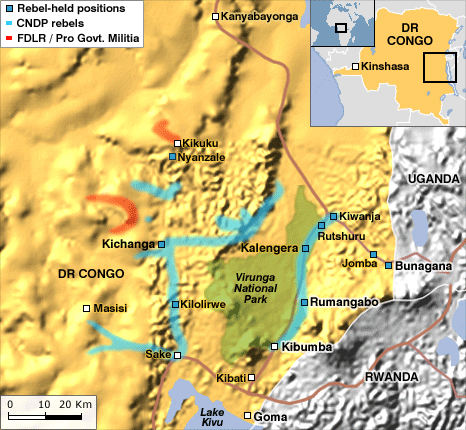
Gen Nkunda says there is a "state of war" in eastern DR Congo and especially his home region of North Kivu.
Up to a million people have fled three-way clashes between Gen Nkunda's forces, ethnic Hutu Rwandan rebels and the Congolese army over the last year.
Although a peace deal officially ended DR Congo's war in 2002, and a subsequent deal in January to disarm rebel groups in the east, Gen Nkunda and his men have not joined the army, as former rebel units were supposed to.
His force, estimated to be several thousand strong has remained in Goma, always a potential threat to DR Congo's precarious peace.
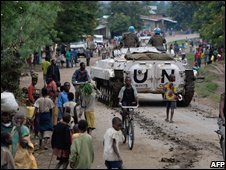
The 17,000 UN peacekeepers in the country have never tried to move against his force, aware that disarming so many troops would not be easy.
'Protecting Tutsis'
He fought in both the Rwandan and Congolese conflicts but first came to widespread notice when he led his forces into the Congolese town of Bukavu in 2004.
He said he was protecting Congolese Tutsis, known as the Banyamulenge, from "genocide" - an emotive word following the slaughter by Hutu extremists of some 800,000 Tutsis and moderate Hutus in Rwanda 10 years earlier.
Independent investigations confirmed that there had been some attacks on Banyamulenge in Bukavu, but not to the extent the general claimed.
Most local people believed it was all a pretext - his real objective was not the protection of the Banyamulenge - it was power.
Laurent Nkunda studied psychology at university, even today the gaunt 40-year-old looks studious with glasses perched on the end of his nose.
He is also a farmer. Tutsis traditionally keep cows and Gen Nkunda has a family farm in the Masisi area north of Goma, where his workers make cheese from cows milk.
But for the past 14 years he has been a soldier.
Although he was born in DR Congo, he fought with the Rwandan Patriotic Front, the rebel movement formed by Rwandan Tutsi exiles, which took control of Rwanda in 1994, ending the genocide.
After that Laurent Nkunda returned home to join Rwanda's adventures in DR Congo.
He was a commander in the Rwandan-backed Rally for Congolese Democracy (RCD) - the main rebel group which controlled most of eastern DR Congo during the five-year civil war.
He was accused of committing atrocities in 2002 as a commander in the diamond-rich town of Kisangani.
Similar charges were also made after his forces captured Bukavu.
After the RCD joined the transitional government in 2003, it looked like Gen Nkunda would have a chance to spend more time with his wife and four children.
But while other rebel units joined the newly integrated national army, he refused.
Following orders?
It was only in 2007 that he agreed for his forces to set up "mixed brigades" with the Congolese army and then only to pursue the remnants of the Hutu Interahamwe militias who had committed the genocide in Rwanda and then fled into DR Congo, after the RPF seized power in Kigali.
Rwanda has twice invaded DR Congo, saying it wants to stop these rebel groups from staging cross-border attacks.
Some accuse Gen Nkunda of still following orders from his former comrades-in-arms in Kigali.
He, however, says that the Rwandans are only his allies.
But some observers say that Gen Nkunda's real purpose is to remind DR Congo that until it disarms the Rwandan Hutu rebels, it will not enjoy true peace.
BBC NEWS | Africa | Profile: General Laurent Nkunda