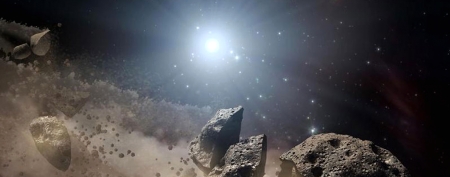
Asteroid headed to heat the earth

Asteroid headed to heat the earth

Candid Scope

JF-Expert Member
Joined
Nov 8, 2010
Posts
11,897
Reaction score
6,925
31ab260f9a5adb04280f6a7067001435.jpg
954791909adfdd04280f6a70670014b2.jpg
asteroid-reuters-ipad_uni_1360283657.jpg


  • If it hit, the asteroid would release a 2.4-million-ton explosion and wipe out 750 square miles
150-foot asteroid will buzz Earth, no need to duck

CAPE CANAVERAL, Fla. (AP) -
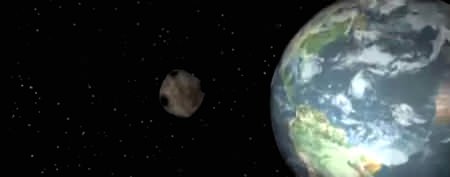
A 150-foot-wide asteroid will come remarkably close to Earth next week, even closer than high-flying communication and weather satellites. It will be the nearest known flyby for an object of this size.But don't worry. Scientists promise the megarock will be at least 17,100 miles away when it zips past next Friday. "No Earth impact is possible," Donald Yeomans, manager ofNASA's Near-Earth Object program at Jet Propulsion Laboratory in Pasadena, Calif., said Thursday.


Even the chance of an asteroid-satellite run-in is extremely remote,Yeomans and other scientists noted. A few hundred satellites orbit at 22,300 miles, higher than the asteroid's path, although operators are being warned about the incoming object for tracking purposes. "No one has raised a red flag, nor will they," Yeomans told reporters. "I certainly don't anticipate any problems whatsoever."


Impossible to see with the naked eye, the asteroid is considered small as these things go. By contrast, the one that took out the dinosaurs 65 million years ago was 6 miles wide. Yet Asteroid 2012 DA14, as it's known for its discovery date, still could pack a wallop.


If it impacted Earth - which it won't, scientists were quick to add Thursday - it would release the energy equivalent of 2.4 million tons of TNT and wipe out 750 square miles. That's what happened in Siberia in 1908, when forest land around the Tunguska River was flattened by a slightly smaller asteroid that exploded about five miles above ground.


The likelihood of something this size striking Earth is once in every 1,200 years. A close, harmless encounter like this is thought to occur every 40 years. The bulk of the solar system's asteroids are located between the orbits of Mars and Jupiter, and remain stable there for billions of years. Some occasionally pop out, though, into Earth's neighborhood


The closest approach of this one will occur next Friday afternoon, Eastern time, over Indonesia. There won't be much of a show. The asteroid will zip by at 17,400 mph. That's roughly eight times faster than a bullet from a high-speed rifle. The asteroid will be invisible to the naked eye and even with binoculars and telescopes will appear as a small point of light. The prime viewing locations will be in Asia, Australia and eastern Europe.

Observers in the U.S. can pretty much forget it. Astronomers using NASA's deep-space antenna in California's Mojave Desert will have to wait eight hours after the closest approach to capture radar images. Scientists welcome whatever pictures they get. The asteroid offers a unique opportunity to observe something this big and close, and any new knowledge will help if and when another killer asteroid is headed Earth's way.
The close approach also highlights the need to keep track of what's out there, if for no other reason than to protect the planet.


NASA's current count of near-Earth objects: just short of 10,000, the result of a concentrated effort for the past 15 years. That's thought to represent less than 10 percent of the objects out there. No one has ruled out a serious Earth impact, although the probability is said to be extremely low.
"We don't have all the money in the world to do this kind of work" for tracking and potentially deflecting asteroids, said Lindley Johnson, an executive with the Near-Earth Object observations program in Washington.


Indeed, when asked about NASA's plans to send astronauts to an asteroid in the decades ahead, as outlined a few years ago by President Barack Obama, Johnson said the space agency is looking at a number of options for human explorations.


One of the more immediate steps, planned for 2016, is the launch of a spacecraft to fly to a much bigger asteroid, collect samples and return them to Earth in 2023.As for Asteroid 2012 DA14 - discovered last year by astronomers in Spain - scientists suspect it's made of silicate rock, but aren't sure. Its shape and precise size also are mysteries.


What they do know with certainty:

"This object's orbit is so well known that there's no chance of a collision," Yeomans repeated during Thursday's news conference.
Its close approach, in fact, will alter its orbit around the sun in such a way as to keep it out of Earth's neighborhood, at least in the foreseeable future, Yeomans said. Johnson anticipates no "sky is falling thing" related to next week's flyby.


He and other scientists urged journalists to keep the close encounter in perspective. "Space rocks hit the Earth's atmosphere on a daily basis. Basketball-size objects come in daily. Volkswagen-size objects come in every couple of weeks," Yeomans said.
The grand total of stuff hitting the atmosphere every day? "About 100 tons," according to Yeoman, though most of it arrives harmlessly as sand-sized particles.

___

Online:
NASA: NASA - Asteroid 2012 DA14 ? Earth Flyby Reality Check
University of Arizona: The OSIRIS-REx Mission - An Asteroid Sample Return Mission
asteroid_uni_1360605827.jpg


Bofya link ifuatayo kuona video ya picha hii
[h=3]Asteroids 'playing roulette with the Earth'[/h]
 
Evidence of dino-killing asteroid found

asteroid_uni_1360276593.jpg


Asteroid Impact That Killed the Dinosaurs: New Evidence
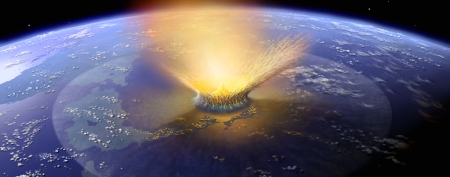
The idea that a cosmic impact ended the age of dinosaurs in what is now Mexico now has fresh new support, researchers say.The most recent and most familiar mass extinction is the one that finished the reign of the dinosaurs - the end-Cretaceous or Cretaceous-Tertiary extinction event, often known as K-T. The only survivors among the dinosaurs are the birds.

Currently, the main suspect behind this catastrophe is a cosmic impact from an asteroid or comet, an idea first proposed by physicist Luis Alvarez and his son geologist Walter Alvarez. Scientists later found that signs of this collision seemed evident near the town of Chicxulub (CHEEK-sheh-loob) in Mexico in the form of a gargantuan crater more than 110 miles (180 kilometers) wide. The explosion, likely caused by an object about 6 miles (10 km) across, would have released as much energy as 100 trillion tons of TNT, more than a billion times more than the atom bombs that destroyed Hiroshima and Nagasaki. However, further work suggested the Chicxulub impact occurred either 300,000 years before or 180,000 years after the end-Cretaceous mass extinction. As such, researchers have explored other possibilities, including other impact sites, such as thecontroversial Shiva crater in India, or even massive volcanic eruptions, such as those creating the Deccan Flats in India.


Timing of an impact
New findings using high-precision radiometric dating analysis of debris kicked up by the impact now suggest the K-T event and the Chicxulub collision happened no more than 33,000 years apart. In radiometric dating, scientists estimate the ages of samples based on the relative proportions of specific radioactive materials within them. "We've shown the impact and the mass extinction coincided as much as one can possibly demonstrate with existing dating techniques," researcher Paul Renne, a geochronologist and director of the Berkeley Geochronology Center in California, told LiveScience.


"It's gratifying to see these results, for those of us who've been arguing a long time that there was an impact at the time of this mass extinction," geologist Walter Alvarez at the University of California at Berkeley, who did not participate in this study, told LiveScience. "This research is just a tour de force, a demonstration of really skillful geochronology to resolve time that well." The fact the impact and mass extinction may have been virtually simultaneous in time supports the idea that the cosmic impact dealt the age of dinosaurs its deathblow.


"The impact was clearly the final straw that pushed Earth past the tipping point," Renne said. "We have shown that these events are synchronous to within a gnat's eyebrow, and therefore, the impact clearly played a major role in extinctions, but it probably wasn't just the impact."


The new extinction date is precise to within 11,000 years. "When I got started in the field, the error bars on these events were plus or minus a million years," added paleontologist William Clemens at the University of California at Berkeley, who did not participate in this research. "It's an exciting time right now, a lot of which we can attribute to the work that Paul and his colleagues are doing in refining the precision of the time scale with which we work."


Final blow
Although the cosmic impact and mass extinction coincided in time, Renne cautioned this does not mean the impact was the only cause of the die-offs. For instance, dramatic climate swings in the preceding million years, including long cold snaps in the general hothouse environment of the Cretaceous, probably brought many creatures to the brink of extinction. The volcanic eruptions behind the Deccan Traps might be one cause of these climate variations. "These precursory phenomena made the global ecosystem much more sensitive to even relatively small triggers, so that what otherwise might have been a fairly minor effect shifted the ecosystem into a new state," Renne said.


The cosmic impact then proved the deathblow.

"What we really need to do is to understand better what was going on before the impact - what was the level of ecological stress that existed that allowed the impact to be the straw that broke the camel's back?" Renne said. "We also need better dates for the massive volcanism at the Deccan Flats to better understand when it first started and how fast it occurred." The scientists detailed their findings in the Feb. 8 issue of the journal Science.


Follow LiveScience on Twitter
@livescience. We're also on Facebook & Google+.


Copyright 2013 LiveScience, a TechMediaNetwork company. All rights reserved. This material may not be published, broadcast, rewritten or redistributed.
 
haya ni mawazo ya wenye roho mbaya wanaotamani kuona dunia inakwisha lakini haishi ng'o na wala hakuna kitu kama hicho.
 
haya ni mawazo ya wenye roho mbaya wanaotamani kuona dunia inakwisha lakini haishi ng'o na wala hakuna kitu kama hicho.

sijawahi kuona au kusikia jambo lizungumzwe na biblia lisitokee.haya yamezungumzwa na yanakuja,kisichojulikana ni muda tu!ni viboko ambavyo MUNGU katayarisha anasubiri tu tufikie critical point ya uwendawazimu wetu atuangushie MZIGO huo!
 
Sijui mamlaka zetu zimejipangaje au hata kama wana habari na mambo kama haya
 
haya ni mawazo ya wenye roho mbaya wanaotamani kuona dunia inakwisha lakini haishi ng'o na wala hakuna kitu kama hicho.


Mungu ametujali elimu ya sayansi, na walio na maono ya kisayansi katika mambo haya tunawaweka kiporo, hata mafuriko yanayozoa watu na kufa ni kudharau mambo kama haya.
 
"Heat" the earth?

As if global warming wasn't enough?

Wait, Nyani Ngabu would say global warming is a hoax. Like evolution and number theory.
 
Last edited by a moderator:
"Heat" the earth?

As if global warming wasn't enough?

Wait, Nyani Ngabu would say global warming is a hoax. Like evolution and number theory.

asteroid_uni_1360276593.jpg


Mgonano huo hauwezi kuzua joto la kufa mtu? Sitegemea speed yake itatokea snow juu ya dunia kama si moto kulipuka na cheche zake kutua mbali.
 
I don't put stock in beliefs period.

That is a more fundamental position that merely believing this or that.

Watch this video
Asteroids 'playing roulette with the Earth'

Ed Lu, who has spent seven months of his life in space, can sometimes sound nonchalant about it. But he's really not. "Yes, they managed to kick me off the planet three times," he said in a Newsmakers interview with ABC News and Yahoo! News. Lu, chosen as a NASA astronaut in 1994, flew twice on American space shuttle flights, and then spent six months on the International Space Station. "It was awesome, best office in the world, view can't be beat, the work is interesting," Lu joked. "The food's good, but it gets boring."

These days, Lu spends a fair amount of his time worrying about protecting the planet he got to see from afar. Having left NASA in 2007 to work for Google and other technology companies, he is now CEO of the B612 Foundation, a nonprofit group that advocates action to prevent errant asteroids from hitting Earth.
Asteroids? Death from the sky? Yes, says Lu, the chances may be small -- but it's a small chance of a big catastrophe, and that's something worth our attention. For the first time in history, we have the technology to detect incoming asteroids -- and, if necessary, deflect them before they do us damage.

There was the asteroid that is believed to have wiped out the last dinosaurs, but that was 66 million years ago, and disasters of that magnitude are very rare.
Lu says he's more concerned about objects like the one that crashed near the Tunguska River in Siberia in 1908, decimating about a thousand square miles of forest. It was probably about 150 feet in diameter.
And it so happens there is another, of about the same size, that will pass the Earth on Feb. 15, missing by 17,200 miles. It is called 2012 DA14, and it's not missing by much when you consider the vastness of space. "It's a wake-up call," said Lu, "because this asteroid is big enough, if it hit, to take out an area roughly the size of metropolitan D.C."
There are estimated to be a million asteroids of that size or larger. Telescopes on Earth have spotted about 10,000 of them. "So for every one of these out there that we see, there's 99 more we haven't tracked yet," said Lu. "Each and every day, think of it as sort of playing roulette with the Earth." The B612 group's solution is to launch a telescope, called Sentinel, into space, where it can scan for objects whose orbits cross ours.

Lu says the project is technologically possible, and could be done with private funding, which he and his team are now trying to attract. They hope to launch Sentinel in 2018.
If Sentinel does spot something with our name on it, what then? Fifteen years ago, in the movie "Armageddon," Bruce Willis led a team of roughneck astronauts who tried to blow up a threatening asteroid with a nuclear weapon. Lu says the reality would be much less dramatic. If you spot an incoming asteroid well in advance -- and that's the idea behind Sentinel -- you just have to nudge it ever so slightly.

Lu and his colleagues have proposed a space tug, a rocket that would rendezvous with the asteroid and push it just enough to make it harmless. If an asteroid is spotted and its orbit is calculated, scientists will be able to plot its path decades into the future. Changing its orbital speed by a few thousandths of a mile per hour now, he says, would head off a collision years from now.
"We can do something about it," said Lu. "It would be sort of the height of stupidity if we didn't do something about it. We could get wiped out, but we couldn't do anything about it because we didn't have the foresight to do so. We have the technology to do this."


Watch this video
Asteroids 'playing roulette with the Earth'

Ed Lu, who has spent seven months of his life in space, can sometimes sound nonchalant about it. But he's really not. "Yes, they managed to kick me off the planet three times," he said in a Newsmakers interview with ABC News and Yahoo! News. Lu, chosen as a NASA astronaut in 1994, flew twice on American space shuttle flights, and then spent six months on the International Space Station. "It was awesome, best office in the world, view can't be beat, the work is interesting," Lu joked. "The food's good, but it gets boring."

These days, Lu spends a fair amount of his time worrying about protecting the planet he got to see from afar. Having left NASA in 2007 to work for Google and other technology companies, he is now CEO of the B612 Foundation, a nonprofit group that advocates action to prevent errant asteroids from hitting Earth.
Asteroids? Death from the sky? Yes, says Lu, the chances may be small -- but it's a small chance of a big catastrophe, and that's something worth our attention. For the first time in history, we have the technology to detect incoming asteroids -- and, if necessary, deflect them before they do us damage.

There was the asteroid that is believed to have wiped out the last dinosaurs, but that was 66 million years ago, and disasters of that magnitude are very rare.
Lu says he's more concerned about objects like the one that crashed near the Tunguska River in Siberia in 1908, decimating about a thousand square miles of forest. It was probably about 150 feet in diameter.
And it so happens there is another, of about the same size, that will pass the Earth on Feb. 15, missing by 17,200 miles. It is called 2012 DA14, and it's not missing by much when you consider the vastness of space. "It's a wake-up call," said Lu, "because this asteroid is big enough, if it hit, to take out an area roughly the size of metropolitan D.C."
There are estimated to be a million asteroids of that size or larger. Telescopes on Earth have spotted about 10,000 of them. "So for every one of these out there that we see, there's 99 more we haven't tracked yet," said Lu. "Each and every day, think of it as sort of playing roulette with the Earth." The B612 group's solution is to launch a telescope, called Sentinel, into space, where it can scan for objects whose orbits cross ours.

Lu says the project is technologically possible, and could be done with private funding, which he and his team are now trying to attract. They hope to launch Sentinel in 2018.
If Sentinel does spot something with our name on it, what then? Fifteen years ago, in the movie "Armageddon," Bruce Willis led a team of roughneck astronauts who tried to blow up a threatening asteroid with a nuclear weapon. Lu says the reality would be much less dramatic. If you spot an incoming asteroid well in advance -- and that's the idea behind Sentinel -- you just have to nudge it ever so slightly.

Lu and his colleagues have proposed a space tug, a rocket that would rendezvous with the asteroid and push it just enough to make it harmless. If an asteroid is spotted and its orbit is calculated, scientists will be able to plot its path decades into the future. Changing its orbital speed by a few thousandths of a mile per hour now, he says, would head off a collision years from now.
"We can do something about it," said Lu. "It would be sort of the height of stupidity if we didn't do something about it. We could get wiped out, but we couldn't do anything about it because we didn't have the foresight to do so. We have the technology to do this."


I am aware of asteroids, the different Extinction Level Events, their probabilities and the real danger they pose to earth and life on it. I haven't been a member of the SETI@Home community for over 10 years, following it's minutiae discussions and developments refining The Drake equation for nothing.

However, your post has no direct link to my assertion, an assertion whose abstraction renders it more philosophical and fundamental than anything you have provided in your copy paste post could address.
 
I am aware of asteroids, the different Extinction Level Events, their probabilities and the real danger they pose to earth and life on it. I haven't been a member of the SETI@Home community for over 10 years, following it's minutiae discussions and developments refining The Drake equation for nothing.

However, your post has no direct link to my assertion, an assertion whose abstraction renders it more philosophical and fundamental than anything you have provided in your copy paste post could address.

Hello! Open this link to get full information and source: Asteroids 'playing roulette with the Earth'
 
Back
Top Bottom