Exclusive: Nani anayemiliki ardhi ya Kenya?....Jisomee mwenyewe!

Exclusive: Nani anayemiliki ardhi ya Kenya?....Jisomee mwenyewe!

Ab-Titchaz

JF-Expert Member
Joined
Jan 30, 2008
Posts
14,630
Reaction score
4,253
Who owns Kenya by Daudi Kahura


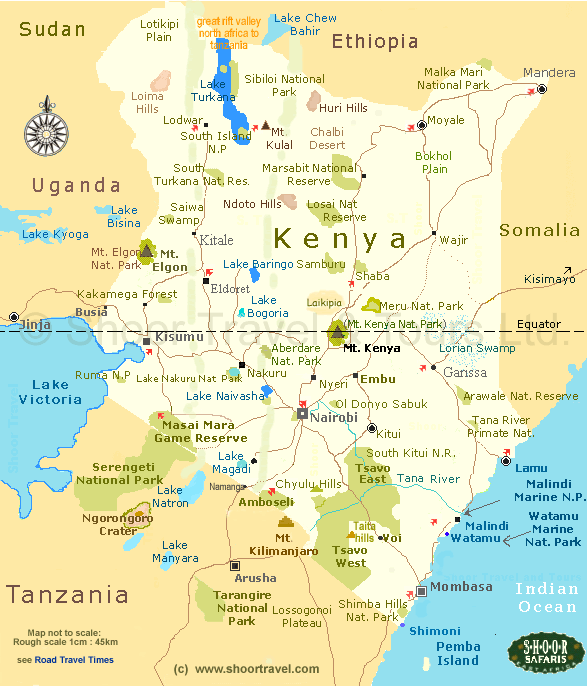
Kenya-Map1.gif

Marsgroup Kenya Blog


EXCLUSIVE

By Otsieno Namwaya, East African Standard


Kenya's two former First Families and the family of President Mwai Kibaki are among the biggest landowners in the country.

A residual class of white settlers and a group of former and current power brokers in the three post independent regimes follow them closely while a few businessmen and farmers,many with either current or past political connections, also own hundreds of thousands of acres.

The extended Kenyatta family alone owns an estimated 500,000 acres approximately
the size of Nyanza Province according to estimates by independent surveyors and
Ministry of Lands officials who spoke on condition of anonymity.


The Kibaki and Moi families also own large tracts of land though most of the Moi family land is held in the names of his sons and daughters and other close family members.

Most of the holders of the huge parcels of land are concentrated within the 17.2 per cent part of the country that is arable. The remaining 80 per cent is mostly arid and semi arid land.

In fact, according to the Kenya Land Alliance, more than a half of the arable land in the country is in the hands of only 20 per cent of the 30 million Kenyans. That has left up to 13 per cent of the population absolutely landless while another 67 per cent on average own less than an acre per person.

The building land crises in the country, experts say, will be difficult to solve because the most powerful people in the country are also among its biggest landowners.The tracts of land under the Kenyatta family are so widely distributed within the numerous members in various parts of the country that it is an almost impossible task to locate all of them and establish their exact sizes.

During Kenyatta's 15-year tenure in State House, there was an elaborate scheme funded by the World Bank and the British Government, the Settlement Transfer Fund Scheme,under which the family legally acquired large pieces of land all over the country.

Among the best-known parcels owned by Kenyatta's family, for instance, are the 24, 000acres in Taveta sub-district adjacent to the 74, 000 acres owned by former MP Basil Criticos.

Others are 50, 000 acres in Taita that is currently under Mrs Beth Mugo, an Assistant Minister of Education and niece of the first President, 29, 000 acres in Kahawa Sukari along the Nairobi Thika highway, the 10, 000 acre Gichea Farm in Gatundu, 5, 000acres in Thika, 9,000 acres in Kasarani and the 5, 000-acre Muthaita Farm. These are beside others such as Brookside Farm, Green Lee Estate, Njagu Farm in Juja, a quarry in Dandora in Nairobi and a 10, 000-acre ranch in Naivasha.

The acreage quoted in this report is not extracted from official government records....there are none and those that exist are scattered and some cases incomplete but are estimates based on close to a year of interviews with farm staff, independent surveyors, Ministry of Lands experts and land rights NGOs.

Other pieces of land owned by the Kenyatta family include the 52,000-acre farm inNakuru and a 20,000-acre one, also known as Gichea Farm, in Bahati under Kenyatta's daughter, Margaret.

Besides,
Mama Ngina Kenyatta, widow of the former President, owns another 10, 000 acres in Rumuruti while a close relative of the Kenyatta family, a Mrs Kamau, has 40,000 acres in Endebes in the Rift Valley Province.

It is understood that in the late 1990s, the Kenyatta family started considering the possibility of disposing of parts of the land in Nairobi.In the lead-up to the 2002 general elections, for instance, there were indications that the
family was considering selling the 100-acre piece of land in Karen. But even with that, the Kenyatta family would still own a sizeable part of Nairobi, such as the 1,000-acre farm in Dagoretti owned by Kenyatta's first wife Wahu.

It is also understood that part of the land on which Kenyatta and Jomo Kenyatta
Universities are constructed initially belonged the Criticos family. The government bought the land from him in 1972 under the Settlement Transfer Fund Scheme.

It is alleged, though there is little compelling evidence, that the land was transferred to the Kenyatta family the same day Criticos sold it to the government.Neither is it clear how much the family paid for it.

Land for the two universities was subsequently donated by the family.

Under President Kenyatta, most of the power wielders either formed or were associated with land buying companies through which they acquired huge chunks of land around the country, especially at the Coast and in Rift Valley.

They took most of the land previously owned by the former white settlers, which had initially been earmarked for resettling those who had been turned into squatters by the colonial land policies.

One of the most famous land buying companies was Gema Holdings.

Most of the people including retired President Moi and his former Vice President,Mwai Kibaki who had considerable political influence in the Kenyatta regime, were given the opportunity to buy as much land as they could.

One of President Kibaki's earliest acquisitions is the 1,200-acre Gingalily Farm alongthe Nakuru-Solai road. He bought it in the late 1960s. And in the 1970s, Kibaki, who was then the minister for Finance under Kenyatta, bought 10, 000 acres in Bahati from the then Agriculture minister Bruce Mckenzie. Kibaki also
owns another 10, 000 acres at Igwamiti in Laikipia and 10, 000 acres in Rumuruti in Naivasha.

These are in addition to the 1,600 acre Ruare Ranch that came to the limelight when it caught fire last year.

Just next to Kibaki's Bahati land are Moi's 20, 000 acres although his best known piece of land is the 1,600 Kabarak Farm on which he has retired. It is one of the most well utilised farms in the area, with wheat, maize and dairy cattle.

The former President owns another 20, 000 acres in Olenguruoni in Rift Valley, on which he is growing tea and has also built the Kiptakich Tea Factory. He also has some 20, 000acres in Molo. He also has another 3, 000-acre farm in Bahati on both sides of the Nakuru/Nyahururu road where he grows coffee and some 400 acres in Nakuru on which he was initially growing coffee.

The former President also owns the controversy ridden 50, 000 acre Ol Pajeta Farm part of which has Ol Pajeta ranch in Rumuruti, Laikipia. Last year, the family put out an advert in the press warning the public that some unknown people were sub-dividing and selling it.

Land transactions are ongoing and some of these farms may have changed hands.

Lands minister Amos Kimunya said yesterday the Government is formulating a land
policy, which will address the question of idle land.

"If it is lying idle, the Government will definitely apply the law to the letter to ensure it is put to productive use," he said.

"The policy is being developed by the people. At the end of it all, views that emerge are tobe synthesised to come up with prudent policy." But the Government has no quarrel with the size of land one owns. "The question is, is that land, notwithstanding the size, beingput to productive use?"


http://www.eastandard.net/archives/cl/hm_news/news.php?articleid=2189
 
Who is who in the exclusive big land owners' register

By Dauti Kahura


The most glaring contradiction on land ownership in Kenya is that one of the biggestindigenous owners in Kenya is a Maasai.Chief Samuel Koriata, who is in his mid 70s, owns approximately 100,000 acres of land in Narok South.

He is the single largest owner of land under one title in Narok District.
Discrete and reclusive, Koriata shuns the limelight, unlike his nemesis, the late Paramount Chief Lerionka Ole Ntutu. Little wonder then that even though he is the richer of the two (in terms of land ownership), it was Ntutu who was well known publicly.

A household name in Narok, Koriata's land is so big that it spills into Tanzania. It takes two-and-half hours just about the distance from Nairobi to Molo to drive through Koriata's land. He has leased most of the land to other Maasai for grazing and farming.

Still in Narok, another famous landowner is the former MP for Nyaribari Chache and EnergyMinister Simeon Nyachae, the de facto leader of Ford People. A one time powerful Chief Secretary to the Cabinet and a career civil servant, Nyachae is a big time barley and wheat farmer in Mau Narok.

Nyachae owns approximately 4,000 acres and grows barley which he sells to the East African Breweries Ltd. Nyachae is also a large-scale wheat farmer.The former MP owns a huge tract of land in the arable Molo land for dairy farming and sheep rearing.

William Ole Ntimama, the Narok North MP and Public Service Minister is also a
landowner in the district. However, compared with Koriata and Nyachae, Ntimama, is a small-time landowner. His pieces are scattered in the district, specifically Mau Narok,Melili and Narok North constituency.

The family of Paramount Chief Ntutu owns close to 10,000 acres of land in Narok South. Together with the Koriata family, the two literally own Narok South constituency whose MP is Stephen Kanyinke ole Ntutu.

The Nyakinyua Group, formed in the 1970s and which started as a women's cultural
troupe for entertaining Mzee Jomo Kenyatta owns close to 10,000 acres in Mau Narok. The group, with about 5,000 members, owns the Nyakinyua Investment Ltd, which in 1977 bought Murera Coffee Estate, in Kiambu.

Central Province has a few individuals with thousand of acres of mostly lush coffee and tea plantations.Former Attorney-General Joseph Karugu owns 2,000-acre coffee estate on the outskirts of Kiambu town known as Kamara Estate.

Mike Maina, the owner of the three star Marble Arc Hotel in downtown Nairobi, owns Kibubuti Farm (2,000 acres) a few kilometers from the town.

Kiambu District is also home to Charles Njonjo's Gwabi Estate, an extensive coffee farm whose acreage we could not immediately establish. Njonjo and Karugu also own big lands in the Naivasha riparian areas where they have put up fabulous homes.

Stanley Githunguri, the owner of the five-star Nairobi Safari Club, owns the Tassia Estatein Ruiru, which is estimated to be about 1,000 acres. Githunguri also owned the land on Outer Ring Road where Tassia estate was built.

Jeremiah Kiereini, the long serving Chairman of East African Breweries Ltd, is the owner of the famous Embori Farm along Meru/Timau/Nanyuki Road. He grows barley for the company he chairs.

Apart from the Kenyatta family, multi-national also own huge tracts of land in the province. Kakuzi Ltd, owned by Linton Park of UK, has over 40,000 acres of land under tea and coffee. The land starts from Makutano on the Nairobi-Muranga Road and runs all the way to Muranga Teachers College in the Makuyu area. The company recently ventured into horticulture farming.

Kakuzi also owns a ranch that starts from Kenol Station in Thika District on to Mt Kilimabogo. The ranch is used to keep cattle.

Sasini, one of the Sameer Group companies also owns about 2,000 acres in the district,most of which is under tea plantations.

Other agricultural groups that own extensive lands are the Ruiru based Sofcinaf Coffee estate and the Del Monte Kenya Ltd, which specializes in pineapples farming and processing

The wife of former Nairobi Provincial Commissioner Fred Waiganjo allegedly owns
3,000 acres of lan
d on the Thika-Garissa Road.

In the undulating Kapiti plains that extend to the adjoining Machakos town and beyond,Prof Philip Mbithi owns a 10,000-acre ranch that was allegedly given to him by retired President Moi. Mbithi, a professor of rural sociology was at one time head of the Civil Service and Secretary to the Cabinet.A former vice-chancellor of the University of Nairobi, Prof Mbithi quit public life he was transferred to the less prestigious East African Community in Arusha Tanzania.

It is not only the aristocratic whites who own land in the expansive Rift Valley Province.Top civil servants and politicians who served during Mzee Kenyatta's time own big tracts of land.The most prominent are former Provincial Commissioner and MP for Nyeri Town, IsaiahMathenge, former Attorney Generals Charles Njonjo and Joseph Karugu and prominent personalities like Geoffrey Gitahi Kariuki.
Mathenge is said to own about 20,000 acres in Naro Moru. It is here that Mathenge in his heydays would entertain guests at Silverbeck Hotel, which was part of the ranch.Mathenge also owns Kio Ranch, situated a few kilometres from Rumuruti.

The former MP for Laikipia West, GG Kariuki has one of the single largest chunk of land in the constituency.

The President's brother, George Mwai, has two separate ranches in Laikipia West
adjacent to the Agricultural Development Corporation's Mutara ranch. The first ranch is about 4,000 acres which is in two pieces (L/R Nos.: 2532 and 3264).
The other ranch is registered under his name and Lucy Wanjiru. Its L/R Nos. are 2515 and 3250.

The President's younger brother uses the ranches for beef farming.

In Laikipia East, there is Mukogodo ranch owned by Mohammud Ismail. Ismail's ranch border's Mpala Ranch.

Then is Marley Ranch owned by a wealthy Samburu rancher Lekorere who is in his late 60's. His ranch borders Chololo and Mugokodo ranch. Lekorere bought the ranch from a white man identified only as Tomlinson. Tomlinson, who is known among the Laikipia Maasai as Tomis, still retain some of the ranch land.

The late Democratic Party (DP) chairman in Nanyuki, Mugambi owned a ranch in
Laikipia East. When he died in 1999, his wife and children took over the management and named Kimakadora Ranch.

Another local who owns some land in Laikipia is one Stephen Kamamia. Kamamia ownsabout 1,000 acres in Laikipia East about 25 kilometres from Nanyuki town.

Nominated Member of ParliamentMutula Kilonzo owns a huge ranch in the Machakos
plains. He also owns 2,000 acres of land next to Moi's Kabarak Farm.

http://blog.marsgroupkenya.org/?p=92
 
Stori za namna hii kwa wakati huu ni uchochezi wa machafuko na kusababisha fujo. Kwa ninavyofahamu mie, Kenya tangu mwanzo ina aamini ktk ubepari. Stori za namna inabidi ziandikwe kama mkibadirisha katiba na kuwa nchi ya kijamaa ama kishoshalsti.

Wananchi wa magharibi wanaoamini ktk ubepari hawana hata kiwanja cha kupanda maua na bado hawalalamiki maana wanaamini ktk ubepari kwa moyo wao wote.
 
Big Money Games That Run Kenya's Politics

EXCLUSIVE

By Kamau Ngotho

After a brief tactical retreat in the wake of the expose on Anglo-Leasing scandal mid last year, key figures in the Narc administration are back in the money games partly to enhance their business portfolio as well as to create a war chest ready for 2007 elections.

The renewed boardroom shifts and intrigues have given rise to rival camps right inside State House competing for new business turfs or fighting to preserve existing ones.But a most interesting twist to it is the new-found working relationship between top money men of the Moi era and key members of the Kibaki administration.

A most talked about illustration of the new business friendship is the deal that saw leading electrical instruments manufacturer East African Cables change hands from business magnate Naushad Merali to associates of President Kibaki.Equally interesting was the sale of the life-insurance portfolio of Alico Insurance Company to Heritage AII Insurance Company and the change of ownership of shares in the former mobile phone firm KenCell Communications Ltd, now Celtel Ltd.

In the first deal in October last year, Merali, a business associate of retired President Moi, sold East African Cables to a little known company, Trans-Century Ltd. The board of the new company is chaired by a Mr Zephania Maina.

A check at the registrar of companies showed that the new company is a subsidiary of Affiliated Business Contacts (ABCON), owned by Mr Eddy Njoroge, the managing director of the Kenya Electricity Generating Company (KenGen). Mr Njoroge is a long time associate of President Kibaki and key financier of Kibaki presidential campaigns since the 1992 election.

The Sh300 million sale of the cable company could raise questions of conflict of interest as East African Cables is the leading manufacturer of electric cables, whose biggest consumer is KenGen and the sister company, Kenya Power and Lighting.
Quick on the heels of the East African Cables deal was another where Alico Insurance Company sold its life-insurance portfolio worth Sh6 billion to Heritage AII Insurance.

It is also around the same time when Merali purchased Vivendi Telecom International shares in KenCell at $230 million and sold them to Celtel the very same day for $250 million, making a cool profit of $20 million. It was followed by an announcement that Celtel would extend its reach in a roll-out project to be financed by a local consortium of financers, with the CFC Bank at the forefront.
Absolutely nothing fishy in all that. However, it was not lost on pundits in business circles that the lists of shareholders and directors of Alico, Heritage AII, Celtel, and CFC Bank read almost the same.

Two directors of Alico, P.K. Jani and H. Da Gama Rose, are also directors of Heritage AII and CFC Bank. Others in CFC Bank and Heritage AII, but not in Alico, are Mr Charles Njonjo and Mr J.C. Kulei.

In Celtel, the principal shareholder is Sameer Investments where Naushad Merali and H. Da Gama Rose are directors. Jani, Kulei and Da Gama Rose are widely believed to represent business interests of retired President Moi.Sources contend that at the end of the day, money was quite probably changing hands from the left to the right.

Local interests acquired the East African Cables from a London-based electric cable manufacturer, Delta Engineering Company, in October 2000. The new owner was a hurriedly constituted subsidiary of Sameer Investments Group called Yana Trading Company. At the time of the purchase, East African Cables assets were valued at Sh274 million. Yana Trading bought the company at a grossly undervalued price of Sh110 million.

Business and political associations in Kenya have a long history. They began in early 1970s when key members of the Kenyatta government registered a private company by the name African Liason and Consulting Services.

The new company's shareholding read like a roll of who was who in Kenya at the time. Among the top names in the privately-owned company were then Vice-President Moi and Finance minister Mwai Kibaki. Moi appeared in the shareholder register in his own name while Kibaki had his shares held in trust by an old friend, Mr Nick Mugwandia Muriuki.

Muriuki and President Kibaki had known each other since the early 1960s when they worked at the BP/Shell company on leaving college. So close were they that they double-dated two girls at Kambui Teachers College in Kiambu, and who ended up as their respective spouses. Kibaki’s date was Miss Lucy Muthoni whom he married in 1960.

The idea to form the company was conceived at the Cabinet level in 1970 at the height of the government's Africanisation project. It was to serve as a local competitor for government supply tenders and contracts. Before this, all contracts and tenders went to European and Asian companies.It is significant that interviews for the first chief executive of Africa Liason were conducted by a committee of the Cabinet, chaired by Moi. The company's first chief executive was Mr Julius Gecau. He was poached from BAT where he was the personnel manager. He later became chief executive of the Kenya Power and Lighting Company.

After that there was no looking back for Alico as it massively invested through purchase of shares in banks, insurance companies, car dealerships, real estate, manufacturing and farming.

Other main shareholders in African Liason Company were then Attorney-General Charles Njonjo, head of civil service Geoffrey Kareithi and GSU commandant Ben Gethi. Others were the PS in charge of Defence, Mr Jeremiah Kiereini, and Central Bank Governor Duncan Ndegwa.

In the footsteps of African Liason Company came Heri Limited, a publicly-owned company but whose shareholding read like a duplicate of African Liason's. While Kibaki was listed by name in Heri shareholding, this time Moi preferred to remain in the shadows with his shares held in trust by a Mr Richard Kemoli.

While the principal mover in the formation of the African Liason Company was the Cabinet itself, for Heri Limited the idea came from the family of car dealers D.T. Dobie. It is believed the Dobie family felt the need to form the company and invite into it the big names of the day as a way to ensure they got a piece of the cake from lucrative government contracts.

Heri's breakthrough came when it was awarded a contract to supply the Kenya Armed forces with Mercedes lorries in 1973.
It is significant that next to the DT Dobie family, then PS in the Ministry of Defence, Mr Jeremiah Kiereini, now the chairman, Kenya Breweries, had the largest number of shareholding in Heri.

If Africa Liason and Heri acted as the business cord that tied together different political operatives of the day, Naushad Merali appears to be the latter day cord that runs through the Kenyatta, Moi and now Kibaki business connections. Merali is with the Kenyatta family at the Commercial Bank of Africa where the later has majority shareholding, and at the First-American Bank.
Merali is also the founder and main shareholder in the Equatorial Commercial Bank. Confidential sources at the Nairobi Stock Exchange have confirmed to The Standard that two senior Cabinet ministers in the Kibaki government bought substantive share-holding in Equatorial Bank mid last year.

Reports that could not be independently confirmed are that late last year, Mr Merali sold to the Kibaki family a 500-hectare piece of land on the Nanyuki-Timau road. The land is next to Lewa ranch. A group associated with Cabinet ministers Christopher Murungaru and Kiraitu Murungi is also reported to has acquired significant interest in the 45,000 Lewa Conservancy from Mr Ian Craig. The later has for long fought behind curtains to have influence over the Kenya Wildlife Services.

A signal that Merali, a formidable business feature of the Moi era, was not in the bad books of the big guns in Narc came in September last year when he was pictured at State House, Nairobi, handing over a Sh500,000 cheque to President Kibaki for the National Famine Relief Fund.

It did not escape observers' notice that whereas many donors to the fund including those with bigger cheques than Merali's had been trooping to the Harambe House office of the Special Programmes minister Njenga Karume to hand in their donations, Merali went to State House.

It was even more remarkable, given the fact that Kibaki, unlike his predecessor, has no time for cheque receiving, that Merali be the very first to be so honoured.

Merali's door to the corridors of power opened in 1983. At the time he was working as an accountant with Ryce Motors, when he registered a company by the name Sameer Investments, with himself as the managing director. The new company hit town with a storm when it immediately acquired majority shareholding in the then Firestone East Africa (1969) Ltd and re-named it Firestone Kenya Ltd.

Besides Merali, the other two directors of Firestone were listed as James Kanyotu, then director of Security Intelligence and Mr F.J. Addley, then working for the law firm, Stratton and Kaplan. Lawyer Addley was retired President Moi's nominee in many companies.

The acquisition was not without controversy. It began with an April 1983 visit to Kenya by then vice-president of the US-based Firestone Tyre and Rubber company, Mr A.G. Kraemer. At the time the US based firm owned 51 per cent equity in Firestone East Africa. The rest of the shares (49 per cent) were owned by the Industrial Commercial Development Corporation (ICDC).

While in Kenya, Kraemer made an announcement that his firm intended to sell its entire stake in Firestone East Africa to indigenous tyre dealers. Subsequently, then Firestone East Africa managing director Steve Fabian arranged for a consortium of five leading indigenous tyre dealers to purchase the shares from the US company.

The consortium included Mutaratara tyres, Buckley Tyres, Kirinyaga African Rubber, Kenya Tyre Enterprises and New Tyre Enterprises. Upon negotiating the sale agreement with the American industrialist, the local consortium applied for foreign exchange from the Central Bank of Kenya in those days of controlled money regime.

CBK rejected the forex application without giving any reasons as was required by law. Recalling the incident, the managing director of one of the bidding companies, Buckley tyres, Mr Samuel Magua says: "There was a strong reason to believe the CBK was ordered not to allocate us forex to buy Firestone. Our worst fears were confirmed when we learnt that the visiting American CEO had been to State House with Mr James Kanyotu, who ended up as a director in the new Firestone company."

The consortium of five was just about to head for the courts when the American firm announced it was selling its shares to Sameer, who already had the forex and a higher offer.

Sameer's acquisition of the 49 per cent shareholding by ICDC was to come in 1995 and in similar controversial circumstances. According to the 1995 report of the Auditor-General, Corporations, the now defunct Parastatal Reform Committee had demanded that ICDC offload its shares at the Nairobi Stock Exchange at Sh100 million, a fifth of their true value.

Prior to the sale, Sameer Investments had placed pre-emptive rights on the ICDC shares to lock out competition. It acquired them and three years down the line, Sameer re-floated the same shares at the Nairobi Stock Exchange for Sh1.5 billion, effectively making a 1,500 per cent profit.

That is the genius of Naushad Merali, who is described in the company website as the "Seer behind Sameer".Perhaps that would partly explain why none of Kenya's First families, past and present, wants to keep him far away from their business stables.

The groups fighting for control of the money bags in Kibaki's State House roughly fall into two groups: The Young Turks, an eager beaver generation spoiling for riches and the Moustache Petes, the veterans of the old money group.The new money group comprises youthful sons of privilege also known as the St Mary's Group as most of them are alumni of Nairobi's Saint Mary's School. The most high profile member of the group is long-serving private secretary to Kibaki, Mr Alfred Getonga. He is the son of a former Nairobi Town clerk, the late Simeon Getonga. Others in the group, but operating in the background, are two sons of the President, Jimmy and David, and their sister Judy Wanjiku.

Away from State House, the foot soldiers of the new money group are Mr John Macharia, the managing director of Triple-A-Capital and son of businessman and media tycoon S.K. Macharia of Citizen Media Group, the chief executive of the City Hoppa bus company, Mr George Thuo, and Mr Francis Michuki, a director of the Windsor Golf and Country Club and son of Transport minister John Michuki.

Acting as the shadowy point-men to the group are businessman Jimmy Wanjigi, a son of former Cabinet minister Maina Wanjigi, and a former top executive at Commercial Bank of Africa, Mr Victor Gitobu.

Also believed to be allied to the Young Turks is National Security minister, Dr Chris Murungaru, and his PS, Mr David Mwangi. Transport minister John Michuki has also been playing ball from their side as can be deduced from the fact that he had given duty exemption to a company associated with his son in the cranes project which was to be financed through Triple-A-Capital.

On the other hand, the old money Moustache Petes consist of old friends of the President, some going back to their days at Makerere in the late 1950s. Others in this category are golfing buddies from Muthaiga and all-time royals from the President's Othaya home. Here we have University of Narobi chancellor Joe Wanjui, businessmen Eddy Njoroge, Nat Kangethe, Peter Kanyago, John Murenga, FTJ Nyamu, Duncan Ndegwa and Robert Gacheche, among others.

Working harmoniously with this group are the old money chiefs of the Moi era, including, Merali, the newly appointed PS in the office of the President, Mr Stanley Murage, businessmen Karanja Kabage and Mr Manga Mugwe.

Each man in the later group has a strong Moi-link. Murage is former PS for Transport in the Moi government. He is also a principal shareholder in the Kenya Bus Company alongside Mr Samuel Gichuru, Mr Kabage and a key figure in Moi's State House, Mr Hoseah Kiplagat.

Kabage is a player in his own right, having been chairman of the strategic Communication Commission of Kenya during the Moi administration. He was appointed to the position at the time when the commission had to draw up rules as well as referee entry into the immensely lucrative telecommunication sector. It is he who supervised the controversial licensing of a second mobile phone operator in 1999 and in which various factions in Moi's State House were pitted against one another. Unable to decide which faction to grant the licence, Kabage eventually settled on a company associated with President Moi himself, Sameer Investments.

Mr Manga Mugwe was another significant key player of the Moi era. He is the chief executive of the steel manufacturing firm, Morris & Co. An interesting name in the firm's share-holding is lawyer H. Da Gama Rose.

Mugwe had joined the company in the 1970s as a nominee of Ms Margaret Kenyattta, then Nairobi mayor. Ms Kenyatta later sold her stake to Mugwe. Throughout last year, Mugwe was in the news as the leader of the local consortium bidding for the third mobile telephone operator. Mugwe's bid through the Econet Wireless company hit a snag when the licence granted was withdrawn three months after it was issued. It is believed that Mugwe, whose firm Morris & Co. has had trouble servicing its loans with both Kenya Commercial bank and the National Bank of Kenya, could have been acting on behalf of more financially stable operatives in both the Moi and Kibaki governments.

It is significant that Mugwe had incorporated the government-associated Kenya Union of Co-operatives in his bid, which is the same group Mr Hoseah Kiplagat intended to use to bid for the second mobile operator six years ago.A Cabinet minister and an assistant minister are believed to have been among the influential names behind Mugwe's intended venture into the cellphone industry.

The controversy clouding the licensing of the City Hoppa bus company to compete with the Kenya Bus Services in Nairobi's Central Business District is the best example of the bitter rivalry between the old and new money groups. On the side of City Hoppa company is Alfred Getonga, a close friend of Thuo, the bus company's managing director. Thuo and Getonga certainly see each other on many other fronts. On the side of Kenya Bus company is of course, Stanley Murage, a major share-holder in the 70-year-old transporter.

The old money group has always held the new entrants with some measure of contempt. It is perhaps not without some history. For instance, in May 1982, a company associated with member of the old money group, Peter Kanyago, Unichem Ltd, took the extraordinary step of putting a newspaper disclaimer on its former employee, one Christopher Ndarathi Murungaru, on a disagreement over a small matter of Sh30,000.

The younger wheeler-dealers have also not helped their cause, having been caught in a series of scandals, some which might result in prosecution. Their first major setback was when their key point man, businessman Jimmy Wanjigi was made to record a lengthy statement with the Kenya anti-Corruption Commission on the matter of the Anglo-Leasing Scandal.

The second embarrassment came when information leaked that Transport and Communications minister Michuki had given an unqualified duty exemption to a company associated with his son, Francis, to import telecommunication equipment. Michuki was forced to make a hasty retreat. Months later, President Kibaki took away the communication docket from the larger ministry of Transport and Communication.

At about the same time, the Triple-A-Capital of John Macharia was caught up in a murky Sh70 million insurance deal with the Nairobi City Council. The deal was cancelled when city councillors and the media screamed foul. Still in the same haste, the Triple-A-capital, which, in the words of it's chief executive Macharia, was angling itself as "Kenya's top finance-arranger" got into two more equally disastrous adventures.

The first was an arrangement to pay off the Kenya Pipeline Company’s Sh1.6 billion debt and recover the same money from the parastatal at an exorbitant profit. The deal came a cropper when Ntonyiri MP Maoka Maore blew the whistle on the scheme he called "modern day shylocking." Worse, it cost the KPC chief executive, Dr Shem Ochuodho, his job, a matter that has since been turned to the courts.

Without batting an eyelid, Triple-A-Capital hopped into yet into another mega deal. This time it bid to "arrange" financing of a Sh5 billion project to upgrade Mombasa port. By now the company had overreached itself and the proposal was rejected outright.
But much as people around President Kibaki may have a healthy appetite for the quick buck, many invariably agree that Kibaki himself has never been greedy, neither has he ever shown an inclination to use his position to amass property even though he has always been in a position to do so having been minister for Commerce, Finance, Vice President and now President.

That said, however, some fault Kibaki for sometimes turning a blind eye when his friends are caught with their little hands in the cookie jar.

A case in point was in 1980 when he was Vice President and minister for Finance. At the time, his friend of many years, Mr. F.T.J. Nyamu was the managing director, Kenya Re-insurance company, a parastatal under the ministry of Finance.

In April that year, the government directed the Kenya Railways to put up decent houses for its workers living in the shanties of Muthurwa and Landi-Mawe railway quarters.

Subsequently, the Kenya Railways set aside the land next to the Railway Training School in Nairobi South-B for the project. But hardly before the housing project could take off, a dummy company, Tass Properties, was hurriedly formed.

The Kenya Railways, then under another of Kibaki's buddies, Mr Davidson Ngini, sold the land set aside for the railway estate to a dummy company at only Sh690, 000. Two weeks later, the dummy company sold the same land to Nyamu's Kenya Re-insurance at Sh14 million. Instead of the Kenya Railways building low-cost houses for its workers as the government had directed, the Kenya Re-insurance company constructed what is today Plainsview and Golden-gate estates and purported to sell the houses to railway workers living at Muthurwa and Landi-mawe.

Of course it was a crazy joke as none of them could afford to buy the newly built houses. They ended up in the hands of anybody who could afford to pay. The Ministry of Finance never bothered to find out who made Sh13 million â€" buying railway land for Sh690,000 and selling it to another parastatal for Sh14 million in just a fortnight.

Nyamu and Kibaki own Finance House, a prestigious address in the central business district. The family company that manages Kibaki's businesses, Lucia Limited, is housed at Finance House.

Another of Kibaki's friends, businessman, Nat Kangethe of Saatchi & Saatchi Associates, was the finance director at the Kenya Meat Commission when it collapsed. During that time, KMC entered into a queer contract with a dummy company called Halal Ltd to construct an abbatoir for the company at Ngong. According to the 1978 Auditor-General's report, no abbatoir was constructed even after the government poured Sh50 million into the project.The dummy company and its sole director, one Mohamed Yusuf have never been heard of ever since.

Though Kibaki is not in the same wealth league as his two predecessors, he too has had an interesting motley of business associates: He is with Mr Nicholas Biwott in the Deacons chain of clothes shops now re-named Woolsworth. He is with Mr Charles Njonjo in Heri Ltd and is with Dr Njoroge Mungai in a real estate firm that owns, among others, the Union Towers Building on Moi Avenue, Paramount Plaza and the Marple Courts in Milimani.

A curious shareholder in the real estate company is Mr. P. Gidmooal who in some instances is a nominee for retired President Moi. Kibaki is also with Mr Chris Kirubi in the International Life House and Mr James Kanyotu in Dolphin Ltd, a real estate company with prime investments at the coast. The directors are listed at Mr John Murenga and Ms. J W Kibaki.

In Kenyan politics and big business, you get the strangest of bedfellows.

http://www.eastandard.net/hm_news/news.php?articleid=10174

The Standard, Jan 8, 2005.
 
Mama Ngina Kenyatta akataa kujibu swali kuhusu ardhi....


Last edited by a moderator:
This one mkuu is quite contentious!... but all the same the writer has chosen to aim mostly Rift-valley and Central province areas for political reasons. 'Commercialization' of land has had its fair share of critiques. Politics is also hampering the simple process of settling squatters. The main challenge has been politics. Let us hope the incoming government can hopefully solve that land . There is also need to illuminate those who have excelled in the private sector especially those vying for elective posts. For instance two of the three Nairobi governer aspirants can act as example. The "UBEPARI/IMPERIAL" word also being coined here has its very deep implications (I wish those who are using that word know exactly what it means and how they are using it
 
Mwanangu MkamaP usipotoshe watu. Tatizo si kuandika stori. Hivi hawa wezi wa ardhi wanaomilki ardhi na aliyeandika ukweli kuwa wanamilki ardhi nani mbaya na anayeweza kuchochea watu kufanya hiyo fujo yako? Je nawe ni miongoni mwa hao wezi au umetumwa? Je umejituma au ni ujinga wa kawaida tu? Kwanini familia za marais zimilki ardhi kubwa je walizipata kihalali au kutumia urais wao? Je hapa tatizo ni kusema ukweli hata kama unauma au kuuogopa ukweli? Nani analeta fujo kati ya mwizi na mwenye mali? Kwani Kenya ni mali ya watawala au wakenya wote kwa pamoja? Uliwahi kutembelea Tanzania hasa Mwisenge kwa Marehemu baba wa taifa? Pamoja na kuongoza nchi kwa miaka kibao Nyerere hakujichukulia ardhi kwani hakuwa mroho na kipofu.
Stori za namna hii kwa wakati huu ni uchochezi wa machafuko na kusababisha fujo. Kwa ninavyofahamu mie, Kenya tangu mwanzo ina aamini ktk ubepari. Stori za namna inabidi ziandikwe kama mkibadirisha katiba na kuwa nchi ya kijamaa ama kishoshalsti.

Wananchi wa magharibi wanaoamini ktk ubepari hawana hata kiwanja cha kupanda maua na bado hawalalamiki maana wanaamini ktk ubepari kwa moyo wao wote.
 
This one mkuu is quite contentious!... but all the same the writer has chosen to aim mostly Rift-valley and Central province areas for political reasons. 'Commercialization' of land has had its fair share of critiques. Politics is also hampering the simple process of settling squatters. The main challenge has been politics. Let us hope the incoming government can hopefully solve that land . There is also need to illuminate those who have excelled in the private sector especially those vying for elective posts. For instance two of the three Nairobi governer aspirants can act as example. The "UBEPARI/IMPERIAL" word also being coined here has its very deep implications (I wish those who are using that word know exactly what it means and how they are using it
Edzeame,

Heshima mbele mkuu.

I wanna say two things and Ima try my best to be careful not to be seen as partisan on this matter. Being a
mod sometimes has its chains that tie me down from articulating my position strongly.

Kwanza kabisa the issue of focusing on Central and RV is not for political reasons but the fact that these
places are what we can call arable lands. History points you to the coming of the white man and the
annexation of these lands for commercial farming. That's why most of the gist is targeted there. To be fair to
the writer, the family of Basil Criticos and the lands at the coast is also highlighted. Therefore you are left
with Eastern and N.E.P which are ASALs, Western which is riddled with floods (Budalangi), Nyanza which is
also full of floods, mosquitoes and the tsetse fly epidemic and coast which can also be regarded as ASALs.

My second point is in the form of a question which I have been asking over and over again...Why doesn't UK just take
like a thousand acres and resettle the squatters/IDPs?...that's political mileage right there even for the naysayers like us
we will have no choice but to give him kudos for such a move. However during my rantings, somebody opined to me
that UK has no control over these parcels of land but Mama Ngina Kenyatta...who has vehemently refused to budge
but at a fee. Thus I let the matter rest after hearing that.

I believe the land issue was amongst the things that needed to be tackled when the agreement was brokered after
the '07 PEV....why the issue died a natural death is anybody's guess. I wouldn't expect Kibaki to do anything about it
bearing in mind he is a 'main player' amongst these land barons against the petit' bourgeoisie .

As for the UBEPARI terminology, pick it up with whoever put it out there. I was just wondering if Ubepari is
imperialism or is it capitalism?...Unajua Kiswahili kina wenyewe eti...:confused2:

Senti hamsini yangu hio.

Good day to you.
 
Mwanangu MkamaP usipotoshe watu. Tatizo si kuandika stori. Hivi hawa wezi wa ardhi wanaomilki ardhi na aliyeandika ukweli kuwa wanamilki ardhi nani mbaya na anayeweza kuchochea watu kufanya hiyo fujo yako? Je nawe ni miongoni mwa hao wezi au umetumwa? Je umejituma au ni ujinga wa kawaida tu? Kwanini familia za marais zimilki ardhi kubwa je walizipata kihalali au kutumia urais wao? Je hapa tatizo ni kusema ukweli hata kama unauma au kuuogopa ukweli? Nani analeta fujo kati ya mwizi na mwenye mali? Kwani Kenya ni mali ya watawala au wakenya wote kwa pamoja? Uliwahi kutembelea Tanzania hasa Mwisenge kwa Marehemu baba wa taifa? Pamoja na kuongoza nchi kwa miaka kibao Nyerere hakujichukulia ardhi kwani hakuwa mroho na kipofu.

Umesomeka na umeeleweka.
 
Mwanangu MkamaP usipotoshe watu. Tatizo si kuandika stori. Hivi hawa wezi wa ardhi wanaomilki ardhi na aliyeandika ukweli kuwa wanamilki ardhi nani mbaya na anayeweza kuchochea watu kufanya hiyo fujo yako? Je nawe ni miongoni mwa hao wezi au umetumwa? Je umejituma au ni ujinga wa kawaida tu? Kwanini familia za marais zimilki ardhi kubwa je walizipata kihalali au kutumia urais wao? Je hapa tatizo ni kusema ukweli hata kama unauma au kuuogopa ukweli? Nani analeta fujo kati ya mwizi na mwenye mali? Kwani Kenya ni mali ya watawala au wakenya wote kwa pamoja? Uliwahi kutembelea Tanzania hasa Mwisenge kwa Marehemu baba wa taifa? Pamoja na kuongoza nchi kwa miaka kibao Nyerere hakujichukulia ardhi kwani hakuwa mroho na kipofu.

Nafikiri uwe unasoma katikati ya mistari, unaposema jambo lazima uliseme kwa mda muafaka vinginevyo unakuwa unafanya uhuni. Nilifikiri neno la kutumwa mmeacha kulitumia siku hizi.

Unaweza mfano kumuita jamaa mfupi na jamaa kweli ni mfupi lakini ukiwa na malengo ya uchokozi kwa kumuita jamaa mfupi, lakini neno hilo hilo ungelitumia kwa mda muafaka lingekuwa neno la kujenga.

Haitaji kuwa profesa wa filosofia kubaini mwandishi ana nia ya kuanzisha vurugu. Wakenya karibu wote wana tambua kuwa ardhi hiyo inamilikiwa na hao alio wataja, sasa kuandika hayo hayo ktk wakati huu, nia yake inakuwa si kuwaelewasha maana kama kuelewa wanatambua tiyari.

Na kwa kawaida mtu anayewahi kuita wengine majina kama wajinga nk, kimsingi mtu huyo ni mjinga maana kama siyo mjinga asingetambua ujinga unafanana vipi?

Nyerere angemiliki vipi ardhi wakati alikuwa mjamaa? ni sawa na sheikh kumwambia mbona wewe huna rozari ya msalaba kama yule padri. Tofautisha mazingira na jifunze huko ujamaa/ubepari uliko anza ni wangapi wana miliki ardhi na ukaulize hayohayo maswali kwanini nchi nzima wanao miliki ardhi hawafiki 100 kwa nchi za kibepari.

Jamaa angeandika haya wakati wa maoni ya katiba ili watu waandike katiba ya ku balance hiyo ardhi, na si wkati wa campaign ya uchaguzi. mfano mzuri wa ubepari ni ule wa wazungu zimbabwe kumiliki ardhi na Mgabe ku swap over aka-apply ujamaa kt ardhi.
 
ubepari== capitalism
ubeberu== imperialism
ujamaa ==socialism
 
Mwananangu MkamaP hujui unachosema. Mimi nimeishi Kenya na najua machungu wanayopambana nayo wakenya. Hata hisia za wakenya kuhusu ardhi nazifahamu. Kama hujui sema ujulishwe. Una habari mojawapo ya ahadi ya Raila Odinga ni equal distribution of resources? Una habari watu kama Daniel Moi wameishaanza hata kunyang'anywa baadhi ya parcels za ardhi walizowadhurumu watu? Una habari Uhuru Kenyatta ameishaanza kurejesha ardhi taratibu? Hata kwa taarifa za jana tu Raila kwenye kampeni yake kule Western amesema hao wanaomilki ardhi waliyonyakua warejeshe badala ya kujisifu eti ni kizazi cha dot com. Nadhani wewe siasa za Kenya huzijui na kama unazijua basi unajitia kutoelewa. Sema ueleweshwe siyo kutetea upuuzi na unyonyaji. Huwa sibwabwaji wala kuongea vitu bila ushahidi. Hebu GONGA hapa halafu uchague ile video yenye caption ya Cord in Bungoma:Raila hunts for Luhya votes huenda utaacha kushambikia usichojua na kusema usichofahamu.
Nafikiri uwe unasoma katikati ya mistari, unaposema jambo lazima uliseme kwa mda muafaka vinginevyo unakuwa unafanya uhuni. Nilifikiri neno la kutumwa mmeacha kulitumia siku hizi.

Unaweza mfano kumuita jamaa mfupi na jamaa kweli ni mfupi lakini ukiwa na malengo ya uchokozi kwa kumuita jamaa mfupi, lakini neno hilo hilo ungelitumia kwa mda muafaka lingekuwa neno la kujenga.

Haitaji kuwa profesa wa filosofia kubaini mwandishi ana nia ya kuanzisha vurugu. Wakenya karibu wote wana tambua kuwa ardhi hiyo inamilikiwa na hao alio wataja, sasa kuandika hayo hayo ktk wakati huu, nia yake inakuwa si kuwaelewasha maana kama kuelewa wanatambua tiyari.

Na kwa kawaida mtu anayewahi kuita wengine majina kama wajinga nk, kimsingi mtu huyo ni mjinga maana kama siyo mjinga asingetambua ujinga unafanana vipi?

Nyerere angemiliki vipi ardhi wakati alikuwa mjamaa? ni sawa na sheikh kumwambia mbona wewe huna rozari ya msalaba kama yule padri. Tofautisha mazingira na jifunze huko ujamaa/ubepari uliko anza ni wangapi wana miliki ardhi na ukaulize hayohayo maswali kwanini nchi nzima wanao miliki ardhi hawafiki 100 kwa nchi za kibepari.

Jamaa angeandika haya wakati wa maoni ya katiba ili watu waandike katiba ya ku balance hiyo ardhi, na si wkati wa campaign ya uchaguzi. mfano mzuri wa ubepari ni ule wa wazungu zimbabwe kumiliki ardhi na Mgabe ku swap over aka-apply ujamaa kt ardhi.
 
Mwananangu MkamaP hujui unachosema. Mimi nimeishi Kenya na najua machungu wanayopambana nayo wakenya. Hata hisia za wakenya kuhusu ardhi nazifahamu. Kama hujui sema ujulishwe. Una habari mojawapo ya ahadi ya Raila Odinga ni equal distribution of resources? Una habari watu kama Daniel Moi wameishaanza hata kunyang'anywa baadhi ya parcels za ardhi walizowadhurumu watu? Una habari Uhuru Kenyatta ameishaanza kurejesha ardhi taratibu? Hata kwa taarifa za jana tu Raila kwenye kampeni yake kule Western amesema hao wanaomilki ardhi waliyonyakua warejeshe badala ya kujisifu eti ni kizazi cha dot com. Nadhani wewe siasa za Kenya huzijui na kama unazijua basi unajitia kutoelewa. Sema ueleweshwe siyo kutetea upuuzi na unyonyaji. Huwa sibwabwaji wala kuongea vitu bila ushahidi. Hebu GONGA hapa halafu uchague ile video yenye caption ya Cord in Bungoma:Raila hunts for Luhya votes huenda utaacha kushambikia usichojua na kusema usichofahamu.

sielewi unachoongea, hayo unayoongea yalitakiwa kuwa kwenye katiba ama kwenye ILANI ya uchaguzi ya chama fulani, tuseme cha Raila na kama ndiyo, na wakenya wanaumizwa na unyonyaji wa akina moi na uhuru basi si watamuangusha vibaya kwenye saduku la kura hapo march, ili ilani ya Raila ifanye kazi. Kama kweli wanauchungu na hiyo ardhi basi watawamwaga kwenye sanduku. Lakini, haya maandishi kwa wakati huu yanabaki kuwa maadishi ya uchochezi tu na uvujifu wa amani.

Hawa ndo wanamchukia ama
http://www.youtube.com/watch?v=SkODfo3G6Co
 
Edzeame,

Heshima mbele mkuu.

I wanna say two things and Ima try my best to be careful not to be seen as partisan on this matter. Being a
mod sometimes has its chains that tie me down from articulating my position strongly.

Kwanza kabisa the issue of focusing on Central and RV is not for political reasons but the fact that these
places are what we can call arable lands. History points you to the coming of the white man and the
annexation of these lands for commercial farming. That's why most of the gist is targeted there. To be fair to
the writer, the family of Basil Criticos and the lands at the coast is also highlighted. Therefore you are left
with Eastern and N.E.P which are ASALs, Western which is riddled with floods (Budalangi), Nyanza which is
also full of floods, mosquitoes and the tsetse fly epidemic and coast which can also be regarded as ASALs.

My second point is in the form of a question which I have been asking over and over again...Why doesn't UK just take
like a thousand acres and resettle the squatters/IDPs?...that's political mileage right there even for the naysayers like us
we will have no choice but to give him kudos for such a move. However during my rantings, somebody opined to me
that UK has no control over these parcels of land but Mama Ngina Kenyatta...who has vehemently refused to budge
but at a fee. Thus I let the matter rest after hearing that.


I believe the land issue was amongst the things that needed to be tackled when the agreement was brokered after
the '07 PEV....why the issue died a natural death is anybody's guess. I wouldn't expect Kibaki to do anything about it
bearing in mind he is a 'main player' amongst this land barons against the petit' bourgeoisie .

As for the UBEPARI terminology, pick it up with whoever put it out there. I was just wondering if Ubepari is
imperialism or is it capitalism?...Unajua Kiswahili kina wenyewe eti...
:confused2:

Senti hamsini yangu hio.

Good day to you.
Mkuu As a mod I know the position you are in, but it is understandable that JF has been predominately an ODM supporter's brook-side and no one, I included, should try to put a burden on you. we will differ for different reason politics/leadership/governance etc but the key thing is to sustain each other after elections and beyond.

The other day I saw Basil criticos reemerge under the UDF banner intact and have come to study the Kenyan situation to be driven by class factor order. The people affected in IDP camps are normally taken for granted because the land issue is not a matter of national importance but a political one. So those vying for elections will use land issues for campaigns after which they die down after elections. After all it is politics that displaces people to be landless and I do not think the land issue will be solved in he near future (I am not saying this out of impunity) lol.

I think maybe a new generation should be given a try. Of all these aspirants selling themselves, very few if any can actually boast of an impressive record when it comes to service delivery. One generation of a family cannot even fill a land of 500,000 acres so it is time they that hold huge parcels of land out of generosity and a political gesture, will stop all this cries.

Thanks for actually telling me the meaning of ubepari I knew not its meaning:smile:.
 
Kwakweli linapokuja suala la ARDHI waKenya wengi sana wameshapoteza maisha na wengine bado wanazidi kupoteza maisha yao. Lakini ufumbuzi wake bado uko mbali sana. Hivi katika hiyo katiba yao mpya inayosifika kila pande suala la ARDHI linazungumziwaje? au limeachwa juujuu?
 
Mama Ngina Kenyatta akataa kujibu swali kuhusu ardhi....


Aisee kumbe Mama Ngina bado wamo sana...:becky: mwenzake mama Maria kule Butiama Umri umekwenda.
 
Last edited by a moderator:
I thought Kenya was a capitalist country ....
If so, what made the writer(s) of all those looong and boring articles think there's or at least should be a cap on land ownership?
We (Tanzanians) are Socialist by constitution .... we can do that, but y'all cant.
Sorry, but you guys had promulgation ceremonies with Bashir waving his "stick" and now you're talking redistribution and ICC!!
Kinda weird.
 
Back
Top Bottom