Asante Kiongozi ni mezama nikaibuka na hii kitu:
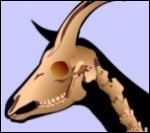
HEAD grubs inhabit the nasal passages and adjoining cavities in sheep. They cause heavy losses everywhere.
The grubs are the larval, or maggot, stage of the sheep botfly, Oestrus ovis, which also is called the sheep gadfly or nasal fly. The fly is slightly larger than the common housefly. It is brownish gray and hairy. It can dart quickly in and out among sheep and occasionally hovers in front of a sheep's nose. Sometimes it remains motionless for some time on the ground.
The fly has no functional mouth parts; so it does not bite or feed. It has no stinger. Its sole purpose in life apparently is to reproduce its kind and deposit its young in sheep's nostrils.
The female fly deposits tiny larvae not eggs through a small, flexible tube, which she extends from the rear of her abdomen. She makes repeated, persistent attacks on different sheep, depositing a few larvae at a time. A fly can deposit 500 young grubs during her lifetime. When conditions are favorable she completes her deposition of larvae within a few days and then dies. During periods of cold or stormy weather, when conditions are not favorable for flight, she conserves her energy for later attacks on sheep by remaining motionless in some sheltered spot and so may live for 2 weeks.
The sheep botfly is hard to see it flies fast, and at rest its coloring usually blends with the surroundings. But sheep recognize its presence at once and become nervous and agitated. They stop feeding and gather in groups with their noses held close to the ground. They become alert, stare at the ground, stomp their feet, and snort or sneeze.
Just how the fly accomplishes the deposition of its young in the sheep's nostrils we do not know. It is thought that since practically all sheep become infested with head grubs, the fly must somehow come in contact with the nostrils. Perhaps she does so by quick, darting attacks while hovering in front of the sheep's nose or from the position she assumes on the ground near the places where sheep are feeding or resting.
After the sheep botfly makes a deposit of her young in or on the moist edges of the nostrils, the tiny grubs crawl quickly back into the nasal passages. There they move about over the mucous membranes, feeding on the mucus secreted by the tissues. Many conceal themselves within the many folds and crevices of the interior nasal structures, from which sheep cannot expel them by sneezing. They are then too small to be seen readily. They are only about one-sixteenth inch long, slender, and nearly colorless, like the mucous secretion in which they are found. Some of the tiny larvae soon molt and become second-stage grubs in about 2 weeks. Others remain unchanged for varying periods.
In the second stage of growth, the grubs are about three-sixteenths inch long, whiter, and somewhat thicker than when first deposited by the botfly. The second-stage grubs crawl further back into the nasal cavity and on through small passages into the more remote head cavities the frontal sinuses. There they soon molt again, passing into their third and final stage of development.
The third-stage grubs are white or yellowish at first and slightly larger than second-stage grubs. They grow fast, getting darker as they develop. Some become fully grown in 2 weeks. The mature grubs are about 1 inch long and one-fourth inch thick and have several dark stripes on the back.
The grubs have two dark mouth hooks and many rows of sharp spines across their under surface. This armament increases in size and becomes darker as the grubs grow. They use it for moving about and for attaching themselves to the mucous membranes that line the head cavities. In so doing, the grubs irritate the membranes and cause them to secrete large amounts of mucus.
The fully grown grub works its way back out to the nostrils, drops to the ground, and burrows into the soil. There its skin hardens, and it becomes a pupa, or crysalis, from which a sheep botfly emerges in 4 to 6 weeks. Thus some grubs may complete their life cycle from tiny, newly deposited maggot to botfly in about 2 months.
The space within the frontal sinuses of sheep is limited in size. Ordinarily, therefore, only 2 to 8 grubs occupy those cavities at a time. Each nasal passage, however, may harbor as many as 25 of the smaller, first- and second-stage grubs.
As the mature grubs vacate the frontal sinuses, the second-stage grubs enter from the nasal passages and complete their growth to maturity. This process is continuous during warm weather and goes on the whole year in regions of mild winters.
In regions where the winters are cold, however, the botflies and the grubs that drop from the nostrils of sheep cannot survive freezing temperatures. Nature has provided for the perpetuation of the species under such conditions. The tiny first-stage grubs that are still in the nasal passages when the first cold days of fall arrive become dormant. They remain in this inactive state until the following spring. They then resume their development, become second-stage grubs, and migrate to the frontal sinuses, where they grow to maturity, leave the sheep, and subsequently become botflies.
LOSSES due to sheep head grubs are twofold those produced by the grubs while living in the head cavities of sheep and those caused by the botflies.
The pests are found in practically every region where sheep are raised. Goats are sometimes infested. Occasionally the grubs are found in deer, especially if goats or deer occupy the same range with sheep.
The damage caused by the grubs themselves is usually most apparent in old or weak animals and occurs oftenest when large grubs are present in the head cavities. The grubs cause the production of excessive amounts of mucus, which flows from the head cavities to the nostrils. In the nostrils it often accumulates in thick, stringy masses, which sheepmen call snotty nose.
Strong, healthy sheep usually have no difficulty in expelling the excess flow of mucus from the nasal passages and ordinarily show little distress or evidence of illness from infestations of head grubs.
Old or weak sheep usually lack the strength to rid themselves of the excess mucus. It accumulates in their nasal passages, becomes thicker, and often stops up the passages, so that breathing becomes difficult. Bacterial invasion sometimes occurs and causes inflammation and thickening of the mucous membranes that line the head cavities. That produces further difficulty in breathing and may kill the animal. The thickening of the membranes often obstructs the escape route of mature grubs, and they die in the deeper head cavities. Abscesses, which may cause severe illness or death, may then form in the cavities.
The greatest loss produced by this pest is that caused by the botflies. When the flies are active among sheep, the animals become nervous and are constantly on the alert as they attempt to protect their nostrils from the attacks. Thus throughout the summer grazing season sheep frequently are prevented from feeding or resting normally during the daytime. The result is a great loss of growth.
CONTROL MEASURES for head grubs in sheep have been attempted by many workers over the years, but none has proved universally practicable.
The measures have included the application of repellants to the noses of sheep in attempts to prevent the botfly from depositing her young in the nostrils and the introduction of larvicides into the head cavities to destroy the grubs therein. The sheep botfly is not easily deterred from depositing her young. Field tests involving the thorough and frequent application of some of the best known fly repellents, such as pine tar and fish oils, to the noses of sheep have proved unsuccessful. When slaughtered, lambs so treated were found to have as many grubs as untreated lambs in the same flock.
Hii kitu hata pundamilia inawasumbuwa sana: