
NairobiWalker
JF-Expert Member
- Oct 31, 2012
- 14,267
- 14,890
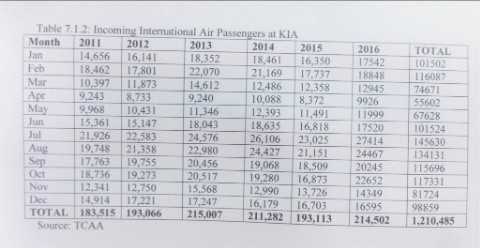
In 6 years, the total number of passengers for KIA is still less than Mombasa's for one year.
Follow along with the video below to see how to install our site as a web app on your home screen.
Note: This feature may not be available in some browsers.


That's still too low.Incoming international PAX, there's outgoing plus local n regional PAX!
In 2014, the numbers were over 800,000 PAX n tourists numbers have been increasing plus number of airlines. I am confident by now the total number of PAX at KIA is beneficial 1.1-1.2 mln.Kuna siku tuliambiwa KIA will be a threat to JKIA.

Build hospital for them first! Isn't Taveta the same place that hospitals r in horrible conditions?that reminds we had planned to build a rival mt. kilimanjaro airport on our side of the border near taveta but gava shelved the idea in brotherly spirit after tantrums thrown by danganyika.
Hii kitu hata Kisumu Airport ishaishinda kwa infrastructure na kwa numbers soon itaishinda.Kuna siku tuliambiwa KIA will be a threat to JKIA.
Tuta-In 2014, the numbers were over 800,000 PAX n tourists numbers have been increasing plus number of airlines. I am confident by now the total number of PAX at KIA is beneficial 1.1-1.2 mln.
The 44-year-old airport, located between the Arusha and Kilimanjaro regions, handled a total of 802,731 passengers in 2014, of which 45 per cent were international, 38 per cent domestic and 17 per cent transit.
Kilimanjaro airport upgrade to double its capacity
SATURDAY NOVEMBER 28 2015
Kilimanjaro International Airport has been handling nearly 80 per cent of the tourists visiting Tanzania annually. PHOTO | FILE
In Summary
By ADAM IHUCHA, TEA Special Correspondent
- The upgrade of Tanzania’s second largest airport, Kilimanjaro International Airport, is underway.
- The makeover, which started last week, will see all runways, apron, taxiways and passenger lounges modernised.
- KIA is one of four international airports in Tanzania, and is the second largest airfield after Julius Nyerere International Airport in Dar es Salaam. The other two are Mwanza and Songwe in Mbeya.
- The airport has been handling nearly 80 per cent of the tourists visiting Tanzania annually, making it a key gateway to the Northern Circuit.
The upgrade of Tanzania’s second largest airport, Kilimanjaro International Airport, is underway. It is expected to give KIA the capacity to handle more aircraft and passengers.
The makeover, which started last week, will see all runways, apron, taxiways and passenger lounges modernised.
Project engineer Mathew Ndossi said that the $39.7 million expansion works, set to be completed in May 2017, will enable the airport to handle 1.2 million passengers, up from 600,000 passengers per annum.
The government has awarded BAM International of Netherlands the contract to overhaul the facility, financed jointly by Tanzania and the Netherlands government. KIA will have additional aprons for five aircraft and a new parallel taxiway to the west for outbound aircraft.
“The aprons’ capacity will almost double as they will be able to accommodate 11 major aircraft, up from the current six at a go,” Mr Ndossi told The EastAfrican.
The scope of work comprises the refurbishment of the terminal building (built in 1971), the construction of a new parallel taxiway, the extension of the existing apron and taxiways, including repairs on the runway, as well as the drainage and sewage works.
RELATED CONTENT
BAM will also install new airfield ground lighting and floodlights along the apron.
KIA is one of four international airports in Tanzania, and is the second largest airfield after Julius Nyerere International Airport in Dar es Salaam. The other two are Mwanza and Songwe in Mbeya.
The airport has been handling nearly 80 per cent of the tourists visiting Tanzania annually, making it a key gateway to the Northern Circuit.
“The idea behind this project is to stimulate air traffic via KIA,” said the managing director of Kilimanjaro Airports Development Company (Kadco), Bakari Murusuri.
It is expected that the project will not only contribute to strengthening of the tourism sector in northern Tanzania, but will also spur economic and infrastructure development.
Mr Murusuri said that since 2010, Kadco had been running promotions overseas, seeking to attract major global airlines to operate from KIA.
The 44-year-old airport, located between the Arusha and Kilimanjaro regions, handled a total of 802,731 passengers in 2014, of which 45 per cent were international, 38 per cent domestic and 17 per cent transit.
Mr Murusuri said that they expect to handle between 800,000 and 900,000 passengers by the end of this year.
“We expect slightly less growth compared with recent years, largely driven by a slowdown in local demand in the run-up to the presidential elections in October and the Ebola scare among international travellers,” he said.
The majority of passengers using KIA are leisure passengers. Latest official statistics show that KIA’s top five international visitor markets from outside of Africa are the US (23 per cent), the UK and Germany (8 per cent) each, Canada (4 per cent) and the Netherlands (3 per cent).
Tanzania Association of Tour Operators CEO, Sirili Akko applauded the facelift but said that Kadco should also develop other tourism-related infrastructure and recreation facilities to attract overseas tourists.
Already, Kadco has developed a comprehensive plan that will see the 110 sq km estates surrounding the airport transformed into a modern duty-free shopping city.
Apart from the air terminal, the KIA area, strategically placed at the meeting point of the Northern Zone regions of Arusha, Kilimanjaro and Manyara, has for many years remained unoccupied.
According to the master plan, the location is to become a “city” located between Moshi and Arusha, where prospective investors were to establish huge shopping centres, high class tourist hotels, duty free ports, export processing zone, educational institutions, custom bonded warehouses, Curio shops, golf courses and a large game ranch.
Kilimanjaro airport upgrade to double its capacity
Do they even know how international flights look alike?Hii kitu hata Kisumu Airport ishaishinda kwa infrastructure na kwa numbers soon itaishinda.
See a Tanzania lecturing Kenyans on what international flights are, lol. JKIA's international flights alone are more than the total flights of all Airports in Tanzania combined.😀Do they even know how international flights look alike?

that reminds we had planned to build a rival mt. kilimanjaro airport on our side of the border near taveta but gava shelved the idea in brotherly spirit after tantrums thrown by danganyika.

that reminds we had planned to build a rival mt. kilimanjaro airport on our side of the border near taveta but gava shelved the idea in brotherly spirit after tantrums thrown by danganyika.
Hakuna cha u-brotherly spirit wala nini, wakenya waluposikia kuna Serengeti International Airport on the pipeline, na huku barabara inatakiwa ipite kati ya mbuga ya Serengeti, GoK ilikaa chini bila kukalishwa. We know were it hurt as far as Kenya is concerned..Gava iliboa sana kwa ku-shelve that idea, this is business, nothing personal... Watalia siku mbili haalfu kimya.
well said its all business nothing personal.Gava iliboa sana kwa ku-shelve that idea, this is business, nothing personal... Watalia siku mbili haalfu kimya.
Hakuna cha u-brotherly spirit wala nini, wakenya waluposikia kuna Serengeti International Airport on the pipeline, na huku barabara inatakiwa ipite kati ya mbuga ya Serengeti, GoK ilikaa chini bila kukalishwa. We know were it hurt as far as Kenya is concerned..
A $350 Million Airport Next Door to the Serengeti?
SATURDAY NOVEMBER 28 2015Capacity ya KIA kumbe ni 600k na wanaplan kuongeza iwe 1.2m, kumbe Kisumu with it's 2 million ni kilimanjaro times 3.
Kisumu airport yet to benefit from Sh3.3bn faceliftCapacity ya KIA kumbe ni 600k na wanaplan kuongeza iwe 1.2m, kumbe Kisumu with it's 2 million ni kilimanjaro times 3.


You are the stupid one here. Kisumu has the capability of handling 2 million pax a year while hio KIA ni 600k pekee, while our economy grows Kisumu airport will achieve it's full potential soon. Sasa unataka tubomoe ikue ya 600k kama Kilimanjaro airport. So long as infrastructure iko already in place other plans can take effect, thats all that matters. Sisi hatuimbii ule wimbo wenu wa tutajenga na tutafanya, tunapanga kwa utaratibu na ndio kwa maana hua mnaisoma number.Kisumu airport yet to benefit from Sh3.3bn facelift
MONDAY OCTOBER 24 2016
A view of a section of Kisumu International Airport. PHOTO | TOM OTIENO | NATION MEDIA GROUP
In Summary
- The Kisumu International Airport (KIA) continues to be mainly dominated by local scheduled flight affiliated to Kenya Airways Ltd, and Fly540 Kenya, which fly the Kisumu-Nairobi route.
- The business community in Kisumu and western region, say this scenario has seriously disorganized them as many ventured into the lakeside town in anticipation that they will be able to cash in on the expected large number of international arrivals.
- The Kenya Airways CEO clarifies that infrastructure by its very nature starts to attract traffic, and then over time, that traffic then demands that an international flight be started.
By ABIUD OCHIENG
More by this Author
Almost four (now 6) years since the Kisumu airport was upgraded to international standards, not a single scheduled passenger flight has used it for direct international travel.
Traders who had set up businesses in the lakeside town hoping to cash in on international flights are now frustrated.
The facility is dominated by domestic operators flying from Nairobi, although it has received non-scheduled craft from countries such as South Africa, Seychelles, Nigeria, Europe, France, Italy and Sweden.
Transport Cabinet Secretary James Macharia says the airport has the facilities and services (Immigration, Port-health and Customs) to handle international flights.
“As the demand for such services improves, coupled with an ongoing facelift, we expect to have regular international flights,” says Mr Macharia.
He says the airport is being improved to handle larger aircraft. The upgrade includes strengthening of the runway and expansion of its shoulders. It is scheduled for completion in June, 2017, at a cost of about Sh600 million.
Related Content
Mr Macharia says cargo facilities are run on a concession basis, with Trans Global Ltd being awaited to develop transit sheds and warehouses. The capacity will be determined by business volumes, he says.
- ONYANGO-OBBO: Kisumu shows us full effect of Kibaki’s ‘Tosha levy’
- Little Ride follows Uber with Mombasa launch
- Airports boss yet to report to work 3 months later
- Relief as stranded KQ customers get assistance
The Kisumu International Airport (KIA) continues to be mainly dominated by local scheduled flight affiliated to Kenya Airways Ltd, and Fly540 Kenya, which fly the Kisumu-Nairobi route.
The business community in Kisumu and western region, say this scenario has seriously disorganized them as many ventured into the lakeside town in anticipation that they will be able to cash in on the expected large number of international arrivals.
The Sh3.3 billion upgrade of Kisumu airport to international standards which started in October 2008 involved the extension of the runway, and widening its width to enable it accommodate larger aircrafts. There was also the construction of taxi way, apron and a new terminal that can now hold upto 600 people per hour.
Mr Robinson Anyal, chairman Western Kenya Hospitality Leaders Association, says there are investors who set up businesses in the western Kenya region, with the KIA being the main factor, and its delayed use internationally, has hit their businesses hard.
“We had expected that the larger aircrafts will start landing immediately after the expansion to international status,” Mr Anyal said.
The upgraded KIA was officially opened in February, 2012 by President Mwai Kibaki and Prime Minister Raila Odinga.
Mr Vinod Patel, former Federation of Kenya Employers (FKE) western Kenya chairman says that the fishing industry in Lake Victoria is on its knees as Kenya imports fish from China. He says that opening up KIA to the international world will create market for local fish.
Further, flower grown in Nandi and Kericho areas, can be processed and packaged in Kisumu and then exported to Netherlands among others, through the KIA.
Currently, the flowers are being transported to Nairobi for export through Jomo Kenyatta International Airport (JKIA).
However, National carrier — Kenya Airways — chief executive Mbuvi Ngunze says, airlines will always consider the level of direct traffic between an airport and another international destination, before international flights can commence.
“Air transport is an investment and a firm in that business like Kenya Airways, will always be looking at, where is the fine balance between the traffic that is originating from a place to where it is going,” said Mr Ngunze.
Mombasa for instance, has seasonal air traffic. Kenya Airways has done flights for example, Nairobi, Mombasa, Jeddah (a city in Saudi Arabia), because of the Hajj festivities (an annual Islamic pilgrimage to Mecca), because it is a very specific traffic.
Mr Ngunze argues that International airport does not mean that there has to be an international flight immediately.
“A country plans for 10 to 15 years ahead, and that is the way we should think actually,” he added.
The Kenya Airways CEO clarifies that infrastructure by its very nature starts to attract traffic, and then over time, that traffic then demands that an international flight be started.
“So let’s not worry about it today. Worry that there is infrastructure that you can go to Kisumu in 40 minutes today, that is the most important thing,” he said.
Another major concern by business stakeholders and hoteliers in western Kenya region has been that there have been occasions when planes were diverted by the Kenyan authorities to as far as International Airports in neighboring countries, while by passing KIA, which they felt should have been the first option.
Mr Anthony Ochieng, the chief executive officer Lake Victoria Tourism Association (LVTA), a body formed to promote tourism in western Kenya, says the lakeside airport should have been the first alternative in times of crisis, adding that.
Mr Ochieng adds that the western region has the numbers needed to enable international flights directly to the KIA a reality because there are quite a number of businesspersons, county government officials, who fly from KIA to JKIA, and then connect to Dubai, China, India, among others.
“There are also business persons who prefer driving to Kampala because it is nearer and cheaper rather than take a flight from KIA to JKIA then proceed to Entebbe International Airport,” Mr Ochieng said.
Jetlink which used to fly from Kisumu to Mwanza in Tanzania and had given the KIA a feel of the East African region, ran into financial challenges and stopped operations. The High Court recently allowed an application for it to be wound up over a Sh4 billion debt.
Mr Arthur Mahasi, a tourism and wildlife consultant on his part holds the position that for international airport to operate efficiently, they must be economically viable.
“There is no airline which will drop off passengers or cargo at an airport and return empty. By aviation economics, that is not possible, they should return fully loaded," he says.
He says the national and county governments should revive the collapsed textile industry in Nyanza region, and also support the horticulture and fishing sector so that sufficient products can be available for export directly to Europe and other world markets through KIA.
Mr Mahasi says beaches should be improved and Lake Victoria, which is the second largest fresh water mass in the world after Lake Superior in North America, should be made viable for water sports, while roads leading to key attractions sites should all be tarmacked.
“Domestic and international tourists don’t want to come and wallow in mad,” he said.
Further, neighbouring county governments in former Nyanza, Western and Rift Valley provinces, should jointly market their tourist products, so that rather than spend only two days to sample attraction sites in Nyanza, the visitors will be kept busy for at least a week, sampling what the counties in these areas have to offer and thus, spend more in the region, hotels remain booked for long and a vast array of businesses and services that serve the industry also benefit.
“These county governments should assist the tourists plan their holiday so cleverly and keenly so that they see different things and appreciate different cultures every day and by the end of it, they have spent enough money locally,” Mr Mahasi argues.
There are counties which have out-priced themselves when it comes to tourism because in addition to tax paid to the central government, some county governments have also introduced other taxes targeting this sector. Such taxes should be removed so that tourism is affordable.
Airport yet to benefit from Sh3.3bn facelift
MY TAKE
Hide ur stupidity