Kumbukizi: Arthur afungiwa Mechi sita baada ya kumtemea mate Mchezaji mwenzake
Our Community
Regional Communities
Navigation
Install the app
How to install the app on iOS
Follow along with the video below to see how to install our site as a web app on your home screen.
Note: This feature may not be available in some browsers.
More options
Style variation
You are using an out of date browser. It may not display this or other websites correctly.
You should upgrade or use an alternative browser.
You should upgrade or use an alternative browser.
Kumbukizi: Arthur afungiwa Mechi sita baada ya kumtemea mate Mchezaji mwenzake
- Thread starter Amavubi
- Start date


Amavubi
JF-Expert Member
- Dec 9, 2010
- 30,156
- 13,258
- Thread starter
- #47
What ban should be applied to footballers who spit at opponents?
Jonny Evans and Papiss Cissé appeared to spit at each other during Newcastle's defeat to Manchester United. For how long should players be banned if they are found guilty of spitting?

Jonny Evans clashes with Papiss Cissé. Photograph: Lee Smith/Action Images via Reuters
The punditocracy are united on this one. Spitting at a fellow footballer is "disgusting", "not acceptable" and "the lowest of the low", according to Dietmar Hamann, Phil Neville and Robbie Savage. It's hard to argue with their revulsion. As Neville said on Match of the Day, the players should be embarrassed by their behaviour. But is spitting really a serious offence?
The punishment applied to spitting footballers has varied over place and time. Patrick Vieira was given a four-match ban for spitting at Neil Ruddock back in 1999. Fabian Barthez was more stupid but less fortunate; he was given a six-month ban, with the last three months suspended, for spitting at a referee during a friendly in 2005. The FA banned George Boyd for three matches last season after he spat at Manchester City goalkeeper Joe Hart, but their new guidelines suggest that Jonny Evans and Papiss Cissé could be out for six matches if found guilty.
The whole issue of punishing players seems fairly confused. Luis Suárez was banned from all "football activity" for four months for a bite that did not injure his victim, while Alan Hutton was only shown a yellow card for planting his foot into Saido Berahino's nether regions on Tuesday night and Maynor Figueroa went unpunished on Saturday when he left Stephen Ireland with a leg that looks like a prop from a horror film. Judging the severity of footballers' fouls is not a simple matter, but where does spitting fit into the sport's long list of misdemeanours?
Jonny Evans and Papiss Cissé appeared to spit at each other during Newcastle's defeat to Manchester United. For how long should players be banned if they are found guilty of spitting?
Jonny Evans clashes with Papiss Cissé. Photograph: Lee Smith/Action Images via Reuters
The punditocracy are united on this one. Spitting at a fellow footballer is "disgusting", "not acceptable" and "the lowest of the low", according to Dietmar Hamann, Phil Neville and Robbie Savage. It's hard to argue with their revulsion. As Neville said on Match of the Day, the players should be embarrassed by their behaviour. But is spitting really a serious offence?
The punishment applied to spitting footballers has varied over place and time. Patrick Vieira was given a four-match ban for spitting at Neil Ruddock back in 1999. Fabian Barthez was more stupid but less fortunate; he was given a six-month ban, with the last three months suspended, for spitting at a referee during a friendly in 2005. The FA banned George Boyd for three matches last season after he spat at Manchester City goalkeeper Joe Hart, but their new guidelines suggest that Jonny Evans and Papiss Cissé could be out for six matches if found guilty.
The whole issue of punishing players seems fairly confused. Luis Suárez was banned from all "football activity" for four months for a bite that did not injure his victim, while Alan Hutton was only shown a yellow card for planting his foot into Saido Berahino's nether regions on Tuesday night and Maynor Figueroa went unpunished on Saturday when he left Stephen Ireland with a leg that looks like a prop from a horror film. Judging the severity of footballers' fouls is not a simple matter, but where does spitting fit into the sport's long list of misdemeanours?
Amavubi
JF-Expert Member
- Dec 9, 2010
- 30,156
- 13,258
- Thread starter
- #48
Is spitting at someone really worse than a leg-breaking tackle?
The spitting row between Papiss Cissé and Jonny Evans is pretty disgusting but is it ‘the lowest of the low’ or just a British obsession?
• John Carver says he will look into footage of Cissé v Evans incident
• Poll: What ban should be applied to footballers who spit at opponents?
Gregg Bakowski
Thu 5 Mar 2015 13.29 GMT Last modified on Mon 27 Nov 2017 17.50 GMT
Shares
251
Comments
352

Manchester United's Jonny Evans, right, looks on as Papiss Cissé of Newcastle appears to spit at him. Photograph: Stu Forster/Getty Images
When Jonny Evans and Papiss Cissé exchanged mouthfuls of saliva at St James’ Park on Wednesday night, it was easy to predict the reaction: outrage, pure and simple.
“This is not acceptable. It’s disgusting,” said Dietmar Hamann, a laid-back type who one imagines isn’t so easily revulsed. Phil Neville thought it was “unacceptable”, while Robbie Savage, a man many actively choose to disagree with whatever his opinion, found many echoing his thoughts that the unpalatable act is “the lowest of the low”.
Talk of a lengthy ban being handed down followed and among the swirl of commotion on TV and social media there was very little perspective. Alan McInally, the former Celtic and Scotland striker, perhaps had the most eye-opening view. “If you get tackled and somebody injures you, I think you take it. If somebody spits on you, as a footballer player, that’s not happening … maybe six games isn’t enough. If you give them 10 games, they take the wrath of their football club.”

Gruesome image emerges of Stephen Ireland’s leg after tackle
Read more
It would be interesting to hear whether the Stoke midfielder Stephen Ireland agrees with McInally. He’s currently out of action with 15 stitches in his right calf after Hull’s Maynor Figueroa sliced his leg with an unpunished tackle last weekend.
Or Neymar, who was lucky not to be seriously injured after feeling the full force of a lunge from Villarreal’s Tomás Pina for Barcelona in the Copa del Rey on Wednesday night.
Or Alf-Inge Haaland, who was left writhing around in agony on the Old Trafford pitch after Roy Keane’s intentional studs-up lunge in 2001. And then there’s Saido Berahino, who given the choice of being assaulted by a warm, wet splodge of saliva or the studs of an airborne Alan Hutton with his sights set on the West Bromwich Albion forward’s crown jewels – as was the case on Tuesday night – well, you could imagine what he’d choose.
Facebook Twitter Pinterest
Louis van Gaal says he cannot imagine Jonny Evans and spitting at Papiss Cissé.
But perhaps that simplifies the argument. Everyone would opt for being spat at above suffering serious injury. As humiliating as it is to have a gob-full dripping down your face, its effect on you is psychological. I’ve been inadvertently spat on in a football match and it hasn’t bothered me because I knew the intent wasn’t there. I may well have done the same to someone else, it’s impossible not to have to clear the pipes when your body’s being pushed to the limits outdoors. So, call it friendly fire if you will.
But when it is intentionally launched in your face, it is entirely different. Even in the heat of battle you have to give it some thought. So, yes, it is horrible. And offensive. And the arguments about it being a terrible example for those easily influenced is valid.
But “the lowest of the low”? No. Perhaps it’s a very British thing to rank spitting so high in the list of things to be outraged by. John Terry was banned for four games after being found guilty of using racist language on a football field. In 1999 Patrick Vieira received the same punishment – plus a further two games for his reaction to being sent off – for spitting at Neil Ruddock, a player who was so outraged he broke with tradition and even managed a sprint to confront the Frenchman. And that’s the same Ruddock who fractured both of Andy Cole’s legs in a reserve match for Liverpool against Manchester United some years earlier with one typically errant swipe.
Yes, we probably need to have a rethink when it comes to moral outrage. Maybe the reason people get so hot and bothered about spitting is because it’s an easy thing to get hot and bothered about. There can be no discussion about interpretation when you see a sticky ball of drool fired from one person to another. It is hard to mount a legal defence when others accuse you of doing something that can be judged so easily and with so little comeback. Pundits and fans perhaps feel a little more comfortable about condemning it. Here’s something the whole world, no matter who they are or where they’re from, can all agree on as being wrong.
It is just a pity that the condemnation of potentially career-ending challenges and the discussion around how to better protect players from them rarely grab the headlines in the same way.
So how do we bring a little perspective to the discussion about these far from great expectorations?
Maybe the reaction to spitting should be set aside, put into a separate box that exists outside of football. Yes, we all know it’s disgusting. What more is there to add? A better use of everybody’s time would be to call out those players who still try to harm the wellbeing of fellow professionals.
Facebook Twitter Pinterest
We could all do well to refer to the story of Rudi Völler v Frank Rijkaard at Italia 90. We all know it. The image of Rijkaard’s flob dangling from the West Germany striker’s hair is hard to forget. They were both sent off following a tussle on the pitch in which Völler appeared to do little wrong.
“Spitting is universally recognised as perhaps the ultimate degradation and it’s bound to result in rather aggressive retaliation,” said the consultant psychologist Dr Aric Sigman, in a documentary about Italia 90. But Völler didn’t retaliate. He was the bigger man. He was even spat on again by Holland’s Rijkaard as he jogged back to the dressing room.
That Völler forgave Rijkaard some years later is remarkable. It is hard to imagine Haaland doing likewise with Keane. But Völler could play on. Others, when suffering violent conduct launched by legs, rather than lips, cannot.
Poll: What ban should be applied to footballers who spit at opponents?
The spitting row between Papiss Cissé and Jonny Evans is pretty disgusting but is it ‘the lowest of the low’ or just a British obsession?
• John Carver says he will look into footage of Cissé v Evans incident
• Poll: What ban should be applied to footballers who spit at opponents?
Gregg Bakowski
Thu 5 Mar 2015 13.29 GMT Last modified on Mon 27 Nov 2017 17.50 GMT
Shares
251
Comments
352
Manchester United's Jonny Evans, right, looks on as Papiss Cissé of Newcastle appears to spit at him. Photograph: Stu Forster/Getty Images
When Jonny Evans and Papiss Cissé exchanged mouthfuls of saliva at St James’ Park on Wednesday night, it was easy to predict the reaction: outrage, pure and simple.
“This is not acceptable. It’s disgusting,” said Dietmar Hamann, a laid-back type who one imagines isn’t so easily revulsed. Phil Neville thought it was “unacceptable”, while Robbie Savage, a man many actively choose to disagree with whatever his opinion, found many echoing his thoughts that the unpalatable act is “the lowest of the low”.
Talk of a lengthy ban being handed down followed and among the swirl of commotion on TV and social media there was very little perspective. Alan McInally, the former Celtic and Scotland striker, perhaps had the most eye-opening view. “If you get tackled and somebody injures you, I think you take it. If somebody spits on you, as a footballer player, that’s not happening … maybe six games isn’t enough. If you give them 10 games, they take the wrath of their football club.”
Gruesome image emerges of Stephen Ireland’s leg after tackle
Read more
It would be interesting to hear whether the Stoke midfielder Stephen Ireland agrees with McInally. He’s currently out of action with 15 stitches in his right calf after Hull’s Maynor Figueroa sliced his leg with an unpunished tackle last weekend.
Or Neymar, who was lucky not to be seriously injured after feeling the full force of a lunge from Villarreal’s Tomás Pina for Barcelona in the Copa del Rey on Wednesday night.
Or Alf-Inge Haaland, who was left writhing around in agony on the Old Trafford pitch after Roy Keane’s intentional studs-up lunge in 2001. And then there’s Saido Berahino, who given the choice of being assaulted by a warm, wet splodge of saliva or the studs of an airborne Alan Hutton with his sights set on the West Bromwich Albion forward’s crown jewels – as was the case on Tuesday night – well, you could imagine what he’d choose.
Facebook Twitter Pinterest
Louis van Gaal says he cannot imagine Jonny Evans and spitting at Papiss Cissé.
But perhaps that simplifies the argument. Everyone would opt for being spat at above suffering serious injury. As humiliating as it is to have a gob-full dripping down your face, its effect on you is psychological. I’ve been inadvertently spat on in a football match and it hasn’t bothered me because I knew the intent wasn’t there. I may well have done the same to someone else, it’s impossible not to have to clear the pipes when your body’s being pushed to the limits outdoors. So, call it friendly fire if you will.
But when it is intentionally launched in your face, it is entirely different. Even in the heat of battle you have to give it some thought. So, yes, it is horrible. And offensive. And the arguments about it being a terrible example for those easily influenced is valid.
But “the lowest of the low”? No. Perhaps it’s a very British thing to rank spitting so high in the list of things to be outraged by. John Terry was banned for four games after being found guilty of using racist language on a football field. In 1999 Patrick Vieira received the same punishment – plus a further two games for his reaction to being sent off – for spitting at Neil Ruddock, a player who was so outraged he broke with tradition and even managed a sprint to confront the Frenchman. And that’s the same Ruddock who fractured both of Andy Cole’s legs in a reserve match for Liverpool against Manchester United some years earlier with one typically errant swipe.
Yes, we probably need to have a rethink when it comes to moral outrage. Maybe the reason people get so hot and bothered about spitting is because it’s an easy thing to get hot and bothered about. There can be no discussion about interpretation when you see a sticky ball of drool fired from one person to another. It is hard to mount a legal defence when others accuse you of doing something that can be judged so easily and with so little comeback. Pundits and fans perhaps feel a little more comfortable about condemning it. Here’s something the whole world, no matter who they are or where they’re from, can all agree on as being wrong.
It is just a pity that the condemnation of potentially career-ending challenges and the discussion around how to better protect players from them rarely grab the headlines in the same way.
So how do we bring a little perspective to the discussion about these far from great expectorations?
Maybe the reaction to spitting should be set aside, put into a separate box that exists outside of football. Yes, we all know it’s disgusting. What more is there to add? A better use of everybody’s time would be to call out those players who still try to harm the wellbeing of fellow professionals.
Facebook Twitter Pinterest
We could all do well to refer to the story of Rudi Völler v Frank Rijkaard at Italia 90. We all know it. The image of Rijkaard’s flob dangling from the West Germany striker’s hair is hard to forget. They were both sent off following a tussle on the pitch in which Völler appeared to do little wrong.
“Spitting is universally recognised as perhaps the ultimate degradation and it’s bound to result in rather aggressive retaliation,” said the consultant psychologist Dr Aric Sigman, in a documentary about Italia 90. But Völler didn’t retaliate. He was the bigger man. He was even spat on again by Holland’s Rijkaard as he jogged back to the dressing room.
That Völler forgave Rijkaard some years later is remarkable. It is hard to imagine Haaland doing likewise with Keane. But Völler could play on. Others, when suffering violent conduct launched by legs, rather than lips, cannot.
Poll: What ban should be applied to footballers who spit at opponents?
Amavubi
JF-Expert Member
- Dec 9, 2010
- 30,156
- 13,258
- Thread starter
- #49
Biting, butting, spitting... what is football's deadliest sin?
By Luke Reddy
BBC Sport
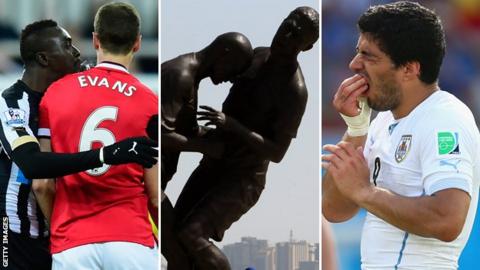
Fighting and biting are bad but never use an elbow. Headbutting is for cowards. No-one pushes the referee. And whatever you do, do not spit at an opponent.
The incident at St James' Park on Wednesday, in which Newcastle's Papiss Cisse and Manchester United's Jonny Evans appeared to spit at each other, has again highlighted the limits of acceptable behaviour on a football field.
BBC Sport - with the help of pundit Steve Claridge, who played for 22 clubs in a 29-year professional career - examines just how far you can go before you commit the sport's ultimate sin.
Spitting
Verdict: 'You just don't do it'
World Cup moments: Rijkaard spits at Voeller
Footballers spitting is not an unfamiliar sight. Rarely a minute of a game goes by in which you cannot see a footballer depositing various levels of phlegm on the pitch.
Footballers spitting at each other is less common, though. It not only shocks but also disgusts. The image of Netherlands midfielder Frank Rijkaard spitting into Rudi Voller's mullet twice at the 1990 World Cup is one of the most revolting moments in World Cup history. But why do players dislike it so much?
"It was and is the unwritten rule that you don't do it," said Claridge. "You don't lower yourself to that level. It's not even a football thing; in general life, you just don't do it.
"It's not behaviour we ever want to see, but again, compared to physical harm, it's something players can cope with."
Football's most notorious spitters
Netherlands player Frank Rijkaard spat into Rudi Voller's hair as the West German ran past him after both men had been sent off in a match at the World Cup in Italy in 1990.
El Hadji Diouf was fined two weeks' wages by Liverpool, £5,000 by the Glasgow Sheriff Court and given a two-match ban after spitting at a Celtic fan in the front row of the stand during a Uefa Cup tie at Celtic Park in 2003.
Arsenal's Patrick Vieira was handed a four-match ban and a £30,000 fine for spitting at West Ham's Neil Ruddock in a Premiership match at Upton Park in September 1999.
France and ex-Manchester United goalkeeper Fabian Barthez was given a six-month ban (suspended for three months) for spitting at a Moroccan referee during a friendly between Marseille and Wydad Casablanca in 2005.
Alexander Frei of Switzerland was charged with misconduct and banned for three games after a crafty spit on the neck of Steven Gerrard during England's 3-0 win at Euro 2004.
Brawling
Verdict: 'Not a big deal'

Joey Barton later said he was trying to provoke a Manchester City player into getting sent off
The term 'fight' in football should be used loosely. Very rarely do we see a scrap worthy of Madison Square Garden on the pitch, although one or two players have certainly shown they pack a tasty right-hook.
Francis Lee and Norman Hunter threw thunderous punches at one another when Derby met Leeds in 1975, and Hristo Stoichkov was initially given a lifetime ban for his role in a ding-dong during the 1985 Bulgarian Cup final.
Stoichkov, who later managed Bulgaria, eventually saw his penalty reduced to a month.
Steve Claridge on brawling...
"It happened to me twice and both times I got sent off for reacting..."
QPR midfielder Joey Barton, meanwhile, served a 12-match ban for sparking a melee on the final day of the 2011-12 season at Manchester City. Barton was sent off and thrust a knee into Sergio Aguero's thigh before leaving the field. Cue chaos.
"The actual brawl is not what the incident is about," said BBC Radio 5 live pundit Claridge. "It comes after something. It's not a big deal in my view and part and parcel of a physical game.
"I can remember playing for Weymouth and good old Vinnie Jones was involved in a fight with our goalkeeper and it got very unsavoury. But these things happen and once it's done, it's done."
By Luke Reddy
BBC Sport
Fighting and biting are bad but never use an elbow. Headbutting is for cowards. No-one pushes the referee. And whatever you do, do not spit at an opponent.
The incident at St James' Park on Wednesday, in which Newcastle's Papiss Cisse and Manchester United's Jonny Evans appeared to spit at each other, has again highlighted the limits of acceptable behaviour on a football field.
BBC Sport - with the help of pundit Steve Claridge, who played for 22 clubs in a 29-year professional career - examines just how far you can go before you commit the sport's ultimate sin.
Spitting
Verdict: 'You just don't do it'
World Cup moments: Rijkaard spits at Voeller
Footballers spitting is not an unfamiliar sight. Rarely a minute of a game goes by in which you cannot see a footballer depositing various levels of phlegm on the pitch.
Footballers spitting at each other is less common, though. It not only shocks but also disgusts. The image of Netherlands midfielder Frank Rijkaard spitting into Rudi Voller's mullet twice at the 1990 World Cup is one of the most revolting moments in World Cup history. But why do players dislike it so much?
"It was and is the unwritten rule that you don't do it," said Claridge. "You don't lower yourself to that level. It's not even a football thing; in general life, you just don't do it.
"It's not behaviour we ever want to see, but again, compared to physical harm, it's something players can cope with."
Football's most notorious spitters
Netherlands player Frank Rijkaard spat into Rudi Voller's hair as the West German ran past him after both men had been sent off in a match at the World Cup in Italy in 1990.
El Hadji Diouf was fined two weeks' wages by Liverpool, £5,000 by the Glasgow Sheriff Court and given a two-match ban after spitting at a Celtic fan in the front row of the stand during a Uefa Cup tie at Celtic Park in 2003.
Arsenal's Patrick Vieira was handed a four-match ban and a £30,000 fine for spitting at West Ham's Neil Ruddock in a Premiership match at Upton Park in September 1999.
France and ex-Manchester United goalkeeper Fabian Barthez was given a six-month ban (suspended for three months) for spitting at a Moroccan referee during a friendly between Marseille and Wydad Casablanca in 2005.
Alexander Frei of Switzerland was charged with misconduct and banned for three games after a crafty spit on the neck of Steven Gerrard during England's 3-0 win at Euro 2004.
Brawling
Verdict: 'Not a big deal'
Joey Barton later said he was trying to provoke a Manchester City player into getting sent off
The term 'fight' in football should be used loosely. Very rarely do we see a scrap worthy of Madison Square Garden on the pitch, although one or two players have certainly shown they pack a tasty right-hook.
Francis Lee and Norman Hunter threw thunderous punches at one another when Derby met Leeds in 1975, and Hristo Stoichkov was initially given a lifetime ban for his role in a ding-dong during the 1985 Bulgarian Cup final.
Stoichkov, who later managed Bulgaria, eventually saw his penalty reduced to a month.
Steve Claridge on brawling...
"It happened to me twice and both times I got sent off for reacting..."
QPR midfielder Joey Barton, meanwhile, served a 12-match ban for sparking a melee on the final day of the 2011-12 season at Manchester City. Barton was sent off and thrust a knee into Sergio Aguero's thigh before leaving the field. Cue chaos.
"The actual brawl is not what the incident is about," said BBC Radio 5 live pundit Claridge. "It comes after something. It's not a big deal in my view and part and parcel of a physical game.
"I can remember playing for Weymouth and good old Vinnie Jones was involved in a fight with our goalkeeper and it got very unsavoury. But these things happen and once it's done, it's done."
Amavubi
JF-Expert Member
- Dec 9, 2010
- 30,156
- 13,258
- Thread starter
- #50
"Spitting is disgusting at all times. It's unhygienic and unhealthy, particularly if you spit close to other people," said an HPA spokesman. "Footballers, like the rest of us, wouldn't spit indoors so they shouldn't do it on the football pitch.
"If they are spitting near other people it could certainly increase the risk of passing on infections. Spitting is a nasty habit that should be discouraged – and it should be discouraged by the clubs. It's about setting examples for young people who idolise footballers."
The spokesman added that footballers should follow the same guidelines as other members of the public by washing their hands, covering their mouth when sneezing and disposing of used tissues. "The advice is catch it, bin it, kill it," he said.
The Football Association and Premier League said they were following guidance from health experts in handling the issue. "As ever, when it comes to health matters the Premier League will be guided by the relevant statutory authorities," said a Premier League spokesman.
"If they are spitting near other people it could certainly increase the risk of passing on infections. Spitting is a nasty habit that should be discouraged – and it should be discouraged by the clubs. It's about setting examples for young people who idolise footballers."
The spokesman added that footballers should follow the same guidelines as other members of the public by washing their hands, covering their mouth when sneezing and disposing of used tissues. "The advice is catch it, bin it, kill it," he said.
The Football Association and Premier League said they were following guidance from health experts in handling the issue. "As ever, when it comes to health matters the Premier League will be guided by the relevant statutory authorities," said a Premier League spokesman.


Ulimakafu
JF-Expert Member
- Mar 18, 2011
- 31,248
- 13,244
Achana nao hawa.huko ni uingereza kwenye TFF adhabu hii ipo? simba acheni kuisukuma TFF