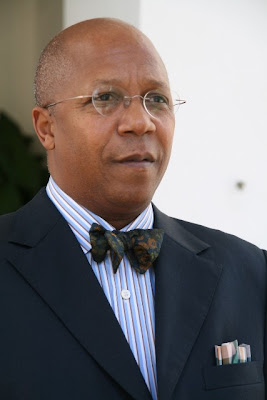
Actually it was The Nation, edition ya May 11 iliyotoka leo, ona paragraph ya pili kutoka mwisho hapo nilipo bold.
Misreading the Somali Threat
Misreading the Somali Threat
In the days after the Maersk Alabama was attacked by Somali pirates, the papers here were full of news about the incident. Many letter writers praised the cargo ship's captain, Richard Phillips, for volunteering to be a hostage in exchange for his crew's safety, with one commenting that he wished Kenya's feuding leaders would draw a lesson "and put the interests of the country before their own." Others expressed the hope that the United States will work to eliminate the pirate menace, noting how close Somalia is to Kenya. No one, however, has proposed military action against Somalia.
That was left to US hawks, who--conflating piracy, the militant Somali group Al Shabab and Al Qaeda--swiftly turned the attack into a new excuse for extending the "war on terror" to this corner of Africa. John Bolton, former ambassador to the United Nations, called for an invasion as "the prudential response" to piracy, while the Heritage Foundation's James Carafano argued for "going into Somalia and rooting out the [pirate] bases." Former FBI interrogator Ali Soufan maintained in the Wall Street Journal that if Al Qaeda mounts another successful attack, "there is a strong chance it will be linked to Somalia."
The Obama administration's response to Somali piracy--and the strategy it develops to deal with Al Shabab--will be a crucial test of whether the neocon worldview retains any traction. So far the signals are frustratingly mixed. On the one hand, Defense Secretary Robert Gates's coolheaded comments in the wake of the attack signaled that the administration has thrown off the Bush-era lens and sees the world as the messy and complicated place that it is. On April 13 Gates explained that "there is no purely military solution" to the threat of piracy and suggested that the best strategy for dealing with hijackers like those who captured the Maersk Alabama--whom he described as "untrained teenagers with heavy weapons"--was to improve governance and economic stability. On the other hand, if a front-page April 11 Washington Post story is to be believed, even before the piracy incident administration officials were paying respectful attention to defense officials' recommendations to pre-emptively strike Al Shabab training camps "based on the potential threat the group poses to American interests."
What worries me in particular is the ease with which Americans who should know better are buying into the claim that Al Shabab is working closely with Al Qaeda--a contention reminiscent of the repeated charge that Saddam Hussein was in league with Osama bin Laden. The Washington Post story, for example, spoke flatly of the "ties between [Al Shabab's] leaders and al-Qaeda." Reuters, by contrast, carefully referred to Al Shabab on March 19 as a group that "Washington accuses of having close ties to al Qaeda." Al Shabab denies organizational links to Al Qaeda, though in a March 3 interview with Al Jazeera (as reported by Purdue professor Michael Weinstein), its spokesman said the group shares Al Qaeda's goals of implementing Sharia, uniting Islamic countries and "restoring the Caliphate."
Sitting here in Nairobi, in a country grappling with ethnic tensions and an estimated 40 percent unemployment rate, the question of just what the Obama administration believes about piracy and terrorism in Somalia is not academic. Somalia is Kenya's neighbor, and even the few US bombing runs into the country to date, targeting alleged Al Qaeda operatives, have resulted in a huge influx of Somali refugees. Kenya's Dadaab refugee center is home to an estimated 250,000 people, while the population of the area of Nairobi known--not affectionately--as Little Mogadishu has swelled with illegal immigrants.
One friend of mine here, an Ethiopian by birth, is gloomy about Obama's ability to resist the hawks' demands. He says that Obama, being new and black, is under great pressure to prove his military credentials. There's no way to do that, he says, in either Afghanistan or Iraq. Somalia, in contrast, offers a chance to define and fight his "own" war. My concerns rest more with the ambitions of Africom, the Pentagon command for Africa, which has been warmly endorsed by several of Obama's top advisers.
Despite general distrust of Africom throughout the continent, former Ambassador to Tanzania Charles Stith blithely wrote in the Boston Globe that "while Africom has met some resistance, this latest hostage-taking involving an American might be just the opportunity to jump-start conversations about how Africom might be more effectively engaged." Yes, and just the ticket to career advancement for a young Africom officer.
An African proverb says, "When the elephants fight, it is the grass that suffers." Those of us who are Somalia's neighbors can only hope that if the American elephant decides to start something, we won't get stepped on.
OP ED yake ya Boston Globe hii hapa
No silver bullet for Somalia problems - The Boston Globe
No silver bullet for Somalia problems
By Charles R. Stith | April 15, 2009
SEA CAPTAIN Richard Phillips' heroic sacrifice to surrender himself to Somali pirates to save his crew, as well as the sharp-shooting Navy Seals who took out his captors, is the stuff of Hollywood dramas. Unfortunately, the circumstances that precipitated this crisis reflect the real-world problems the United States has on the foreign front. We should not be deluded into thinking there is a silver-bullet solution to problems in the troubled waters off the coast of Somalia.
From the perspective of several African leaders I spoke with during a recent trip to the continent, the hostage-taking of an American was fairly predictable. Likewise, the sorts of strategies that are needed to prevent this from happening again are also obvious.
First, the United States has got to get in the game. As critical as it is for us to pay attention to Afghanistan, Iraq, Iran, and the Middle East, Africa is no less important. Attention from either the president or the secretary of state would help reinforce that we understand the valuable strategic interests in Africa as well as the volatility of the region. One way to demonstrate the seriousness with which we take Africa's problems is to quickly confirm Johnnie Carson as the assistant secretary of state for African affairs.
Carson has been US ambassador to several African nations. I met him when he was ambassador to Kenya and I was the top US envoy to Tanzania, just after the bombings of both embassies. Carson is one of the most able career diplomats in the service, well respected in the State Department and, more important, in Africa. Getting him on the job is the best chance to put us on a path to get our hands around regional problems.
Another issue that came up in conversations about Somalia is that engaging regional leadership is critical. The United States must make an "investment" in our allies in the region so that they can increase their capacity to counter such threats. This is another part of the world where there are no "go it alone" options to deal with imminent threats. Engaging regional leadership means supporting regionally originated solutions to respond to the deeply rooted problems of the area. It means increasing our allies' capacity to deal with security problems on land as well as on the sea.
Moreover, the Africa Strategic Command, which was launched during the Bush administration, must be fully embraced and given new marching orders by the Obama administration. Although the key to our engagement in the region must be diplomatic, there is clearly a military aspect to some the challenges. While AFRICOM has met some resistance, this latest hostage-taking involving an American might be just the opportunity to jump-start conversations about how AFRICOM might be more effectively engaged.
Piracy off the coast of Somalia has been a front-burner issue in Africa for some time. It has endangered and slowed commerce and has had a significant adverse impact on East Africa. Many leaders want to resolve, or at least contain, the problem. It presents a clear opportunity to further bilateral cooperation on the military front in the region.
Given the excellent way the Navy deployed special-services personnel to end the hostage crisis, there were clearly some lessons learned on how to defuse future similar situations. But the real lesson we should take from this situation is that if we are going to effectively deal with the problem of "pirates gone wild" and the instability of the region, we need a comprehensive policy agenda rather than just stellar police action.
Charles R. Stith, a former US ambassador to Tanzania, is director of the African Presidential Archives and Research Center at Boston University.