Archival Sense
JF-Expert Member
- Dec 16, 2025
- 576
- 252
President Yoweri Museveni has declined to assent to the Income Tax (Amendment) Bill, 2026 and the Excise Duty (Amendment) Bill, 2026, sending them back to Parliament for reconsideration after raising concerns that some of the proposed tax measures would create unfair competition, encourage tax avoidance and harm the economy.
The two bills were passed by the 11th Parliament ahead of the 2026/27 national budget and the start of the new financial year in July.
While presiding over Parliament on 14 July 2026, Deputy Speaker Thomas Tayebwa informed MPs that the President had objected to specific provisions in both bills, particularly the proposed withholding tax on betting winnings and the increase in excise duty on single-use plastics.
The President's main objection to the Income Tax (Amendment) Bill relates to Clause 11, which proposed introducing a 20 percent withholding tax on winnings from betting and gaming activities. However, the clause exempted winnings from land-based casinos licensed under the Lotteries and Gaming Act, 2016.
Museveni argued that exempting one category of gaming businesses while taxing others would create an unfair competitive advantage and allow businesses to structure transactions in ways that reduce their tax obligations.
"The exemption creates opportunities for tax avoidance and revenue leakage," the President said in his communication to Parliament.
He also questioned why businesses carrying out similar economic activities should be treated differently for tax purposes.
"There is no justification for exempting one category while taxing the other," he said.
The President also rejected the proposed increase in excise duty on single-use plastics under the Excise Duty (Amendment) Bill, 2026.
Parliament had approved raising the tax from the current 2.5 percent, or US$70 per tonne, to 25 percent, or US$1,500 per tonne, whichever is higher.
The proposal was intended to discourage the use of single-use plastics and strengthen environmental protection by making plastic packaging more expensive.
However, Museveni said the increase was too steep and could have serious economic consequences.
He warned that the higher tax would significantly increase production costs for manufacturers that rely on plastic packaging, potentially affecting investment, production and jobs in the sector.
"The proposed increase is substantial and is likely to impose significant cost pressures on manufacturers engaged in the production and use of single-use plastics," Museveni said.
He added that Uganda's manufacturing sector is not yet ready to shift to alternative packaging materials because suitable substitutes are still not widely available.
"Viable alternatives to plastic packaging are not yet readily available in Uganda," he said, recommending that the proposal be studied further before it is implemented as an environmental policy.
The President's decision means the two bills will return to Parliament for reconsideration.
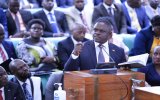
During the debate, Bbale County MP Charles Tebandeke questioned whether the bills should instead begin the legislative process afresh because they were passed by the dissolved 11th Parliament.
Hon. Tebandeke (Photo courtesy of Parliament Of Uganda)
Deputy Speaker Tayebwa dismissed concerns that the President had acted outside the constitutional timeline, reminding MPs that the Constitution gives the President 30 days from the date a bill is presented to either assent to it or return it to Parliament with recommendations.