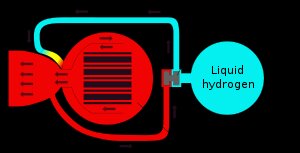
A nuclear thermal rocket is a proposed spacecraft propulsion technology. In a nuclear thermal rocket a working fluid, usually liquid
hydrogen, is heated to a high temperature in a
nuclear reactor, and then expands through a
rocket nozzle to create
thrust. In this kind of
thermal rocket, the nuclear reactor's energy replaces the chemical energy of the
propellant's reactive chemicals in a
chemical rocket. The thermal heater / inert propellant paradigm as opposed to the reactive propellants of chemical rockets turns out to produce a superior
effective exhaust velocity, and therefore a superior propulsive efficiency, with specific impulses on the order of twice that of chemical engines. The overall gross lift-off mass of a nuclear
rocket is about half that of a chemical rocket, and hence when used as an upper stage it roughly doubles or triples the payload carried to orbit.[
citation needed]
A nuclear engine was considered for some time as a replacement for the J-2 used on the S-II and S-IVB stages on the Saturn V and Saturn I rockets. Originally "drop-in" replacements were considered for higher performance, but a larger replacement for the S-IVB stage was later studied for missions to Mars and other high-load profiles, known as the S-N. Nuclear thermal space "tugs" were planned as part of[
clarification needed] the
Space Transportation System to take payloads from a propellant depot in Low Earth Orbit to higher orbits, the Moon, and other planets.
Robert Bussard proposed the
single stage to orbit "Aspen" vehicle using a nuclear thermal rocket for propulsion and liquid hydrogen propellant for partial shielding against neutron back scattering in the lower atmosphere.
[1] The Soviet Union studied nuclear engines for their own moon rockets, notably upper stages of the
N-1, although they never entered an extensive testing program like the one the U.S. conducted throughout the 1960s at the
Nevada Test Site. Despite many successful firings, American nuclear rockets did not fly before the
space raceended.
To date, no nuclear thermal rocket has flown, although the
NERVA NRX/EST and NRX/XE were built and tested with flight design components. The highly successful U.S.
Project Rover which ran from 1955 through 1972 accumulated over 17 hours of run time. The NERVA NRX/XE, judged by
SNPO to be the last "technology development" reactor necessary before proceeding to flight prototypes, accumulated over 2 hours of run time, including 28 minutes at full power.
[2]The Russian nuclear thermal rocket
RD-0410 was also claimed by the Soviets to have gone through a series of tests at the nuclear test site near
Semipalatinsk.
[3][4]
The United States tested twenty different sizes and designs during
Project Rover and NASA's NERVA program from 1959 through 1972 at the Nevada Test Site, designated Kiwi, Phoebus, NRX/EST, NRX/XE, Pewee, Pewee 2 and the Nuclear Furnace, with progressively higher power densities culminating in the
Pewee(1970) and
Pewee 2.
[2] Tests of the improved Pewee 2 design were cancelled in 1970 in favor of the lower-cost Nuclear Furnace (NF-1), and the U.S. nuclear rocket program officially ended in spring of 1973. Current (2010) 110 kN (25,000 lbf) reference designs (NERVA-Derivative Rockets, or NDRs) are based on the Pewee, and have
specific impulses of 925 seconds.[
citation needed]