(AICD)
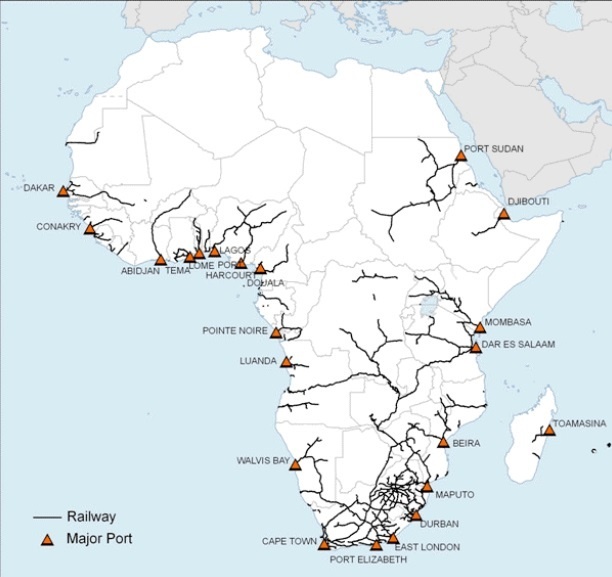
As the map above demonstrates, most colonial rail networks operate on a linear route (southern Africa is an exception). Rather than creating an interconnected network of cities, as modern railways often do, colonial rails simply connected resource-rich hinterlands to the coastline. The final destination along the port is where goods (and people) were ultimately shipped off to Europe and beyond. Not surprisingly, this is where Africa's major urban centers grew.
"If you look at the movement of goods, people, information, etc., most of these [African countries] have basically one [rail] line that leads ultimately to the port," explains Sean Fox, an urban geographer at Bristol University in the U.K.
Unlike in the U.S., where major cities are found on both the east and west coasts and the midwest, African countries generally boast a single major city, which is almost exclusively located along the final destination of its colonial railway network: a port.
Sean Fox, of Bristol University, says colonial railways contributed to what's known as a "
primate urban system." This is when single municipalities—port cities at the end of railways, in the case of Africa—come to dominate all forms of urban activity. "What you don’t see is a dense interconnected web of transport infrastructure that could facilitate the movement of goods, people, [and] ideas within the country," Fox adds.
So unlike the United States, where major cities are found on both the east and west coasts and the midwest, African countries generally boast a single major city, which is almost exclusively located along the final destination of its colonial railway network. Africa's mid-size cities away from the coast, meanwhile, essentially developed in isolation—from the rail infrastructure and the commercial benefits that came with it.
This is why the revitalization of Africa's colonial-era railways is a crucial opportunity for urban planning and development. A
2014 working paper from Oxford University found that cities in Kenya that developed near rail networks were not only denser but also wealthier. So by refurbishing and ultimately expanding aging rail networks, Africa's once closed-off secondary cities could finally become integrated into nationwide rail networks and reap the accompanying rewards
Source :
How Overlooked Colonial Railways Could Revolutionize Transportation in Africa