Raisi awaidhinisha wahindi kama kabila la 44 nchini Kenya
Our Community
Regional Communities
Navigation
Install the app
How to install the app on iOS
Follow along with the video below to see how to install our site as a web app on your home screen.
Note: This feature may not be available in some browsers.
More options
Style variation
You are using an out of date browser. It may not display this or other websites correctly.
You should upgrade or use an alternative browser.
You should upgrade or use an alternative browser.
Raisi awaidhinisha wahindi kama kabila la 44 nchini Kenya
- Thread starter mulisaaa
- Start date

MK254
JF-Expert Member
- May 11, 2013
- 32,408
- 50,809
Dah! Kiswahili chako huwa kibovu sana jamaa, kama Nyerere aliwaunganisha kwa kutumia Kiswahili, basi wewe alikusahau. Hivi wewe huwa unawasiliana kivipi, maana hujui Kingereza, halafu wengi wenu hamjui kuongea lugha zenu za asili, ilhali Kiswahili chenyewe unaandika majanga hadi unatia kichefuchefu.

Hansss
JF-Expert Member
- Jul 17, 2015
- 2,370
- 2,723

Daudi Mchambuzi
JF-Expert Member
- Nov 25, 2010
- 62,197
- 128,160

game over
JF-Expert Member
- Jan 1, 2016
- 10,727
- 24,840
Kwa mujibu wa mleta mada kuna kabila No 1 hadi No.44

Iconoclastes
JF-Expert Member
- May 26, 2014
- 4,091
- 2,511
Nenda zako! Ni kitu gani kuhusu Kenya kinaweza kusikitisha wewe? Tangu lini? Mnafiq mkubwa sana wee.Hii kiukweli imenisikitisha kuona majirani zetu baada yaku waunganisha wa Kenya inawagawa. Kwa namna hii ukabila kuisha Kenya ni ndoto. Na mshukuru Nyerere aliweza kuuwa ukabila Tanzania nakutuunganisha kwa lugha moja ya Kiswahili....View attachment 548220
Ukabila wetu mwahifurahia tena sana, na tukianza kuchinjana hivi sasa wewe ndiye utakuwa wa kwanza kukenua haya meno yako kwa furaha.
Ati 'imenisikitisha'.

Mgagaa na Upwa
JF-Expert Member
- Sep 30, 2013
- 13,481
- 28,116
Nenda zako! Ni kitu gani kuhusu Kenya kinaweza kusikitisha wewe? Tangu lini? Mnafiq mkubwa sana wee.
Ukabila wetu mwahifurahia tena sana, na tukianza kuchinjana hivi sasa wewe ndiye utakuwa wa kwanza kukenua haya meno yako kwa furaha.
Ati 'imenisikitisha'.


aganza
JF-Expert Member
- Mar 9, 2017
- 1,450
- 3,153
Well saidHii kiukweli imenisikitisha kuona majirani zetu baada yaku waunganisha wa Kenya inawagawa. Kwa namna hii ukabila kuisha Kenya ni ndoto. Na mshukuru Nyerere aliweza kuuwa ukabila Tanzania nakutuunganisha kwa lugha moja ya Kiswahili....View attachment 548220

Sammuel999
JF-Expert Member
- Jun 1, 2016
- 3,481
- 2,347
Lol The Level of stupidity hapa inasikitisha
Hauelewi hata the reason why kazi yako ni Kuleta Udanganyika hapa
Being Declared a Kenyan Means You can get your ID, Join the military Get Government Scholarship, Participate in Public Tender Participate in Public Hearings etc .....this is what people in South Africa Are doing
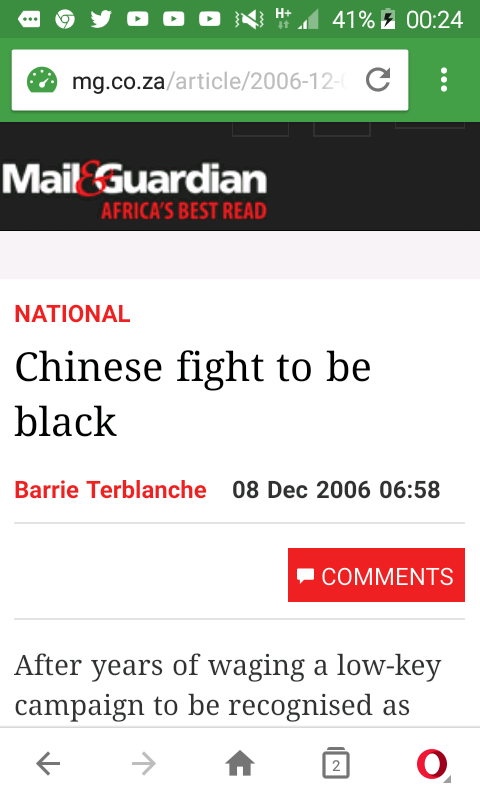
The High Court in South Africa has ruled that Chinese South Africans are to be reclassified as black people.
It made the order so that ethnic Chinese can benefit from government policies aimed at ending white domination in the private sector.
The Chinese Association of South Africa took the government to court, saying its members had been discriminated against.
An estimated 200,000 ethnic Chinese live in South Africa.
The association said their members often failed to qualify for business contracts and job promotions because they were regarded as whites.
The association said Chinese South Africans had faced widespread discrimination during the years of apartheid when they had been classified as people of mixed race.
Hauelewi hata the reason why kazi yako ni Kuleta Udanganyika hapa
Being Declared a Kenyan Means You can get your ID, Join the military Get Government Scholarship, Participate in Public Tender Participate in Public Hearings etc .....this is what people in South Africa Are doing
The High Court in South Africa has ruled that Chinese South Africans are to be reclassified as black people.
It made the order so that ethnic Chinese can benefit from government policies aimed at ending white domination in the private sector.
The Chinese Association of South Africa took the government to court, saying its members had been discriminated against.
An estimated 200,000 ethnic Chinese live in South Africa.
The association said their members often failed to qualify for business contracts and job promotions because they were regarded as whites.
The association said Chinese South Africans had faced widespread discrimination during the years of apartheid when they had been classified as people of mixed race.

Jay456watt
JF-Expert Member
- Aug 23, 2016
- 10,356
- 7,992
Rais amegawa wakenya vipi hapa? the only thing ambacho kinasikitisha ni kichwa chako.....ila Kenyatta naona anatafuta kura kwel kwel...hehe

TangataUnyakeWasu
JF-Expert Member
- Dec 18, 2016
- 1,268
- 1,611
Bora huyo Rais wa Kenya kaunganusha Wakenya na Kabila la wahindi. Huyu wa kwetu Mzee wa PhD feki anazidi kutugawa Watanzania kwa ukanda, ukabila na siasa!!
Huyu makufuli anakolipeleka Taifa ni Mungu tu ndiye anajua.
Sent using Jamii Forums mobile app
Huyu makufuli anakolipeleka Taifa ni Mungu tu ndiye anajua.
Sent using Jamii Forums mobile app
Ulitaka ajue nani future yako?Bora huyo Rais wa Kenya kaunganusha Wakenya na Kabila la wahindi. Huyu wa kwetu Mzee wa PhD feki anazidi kutugawa Watanzania kwa ukanda, ukabila na siasa!!
Huyu makufuli anakolipeleka Taifa ni Mungu tu ndiye anajua.
Sent using Jamii Forums mobile app
Sent using Jamii Forums mobile app

FaizaFoxy
Platinum Member
- Apr 13, 2011
- 100,246
- 123,145
Si kweli.Hii kiukweli imenisikitisha kuona majirani zetu baada yaku waunganisha wa Kenya inawagawa. Kwa namna hii ukabila kuisha Kenya ni ndoto. Na mshukuru Nyerere aliweza kuuwa ukabila Tanzania nakutuunganisha kwa lugha moja ya Kiswahili....View attachment 548220
Nyerere hakukuta watu ambao hawajaungana,
Kiswahili alikikuta kinaongewa tayari hata kwao.
Msitake kuleta historia ambayo haikuwepo.
Si kweli.
Nyerere hakukuta watu ambayo hawajaungana,
Kiswahili alikikuta kinaongewa tayari hata kwao.
Msitake kuleta historia ambayo haikuwepo.
Safi sana kwa kuweka mambo sawa kuhusu lugha yetu hii adhimu ya Kiswahili iliyochanguliwa na wananchi wenyewe wakati wa kufanya biashara, wanazuoni wa dini, watawala wa kikoloni, shule na baadaye sana Nyerere pia akaenzi kazi nzuri ya wahenga waliomtangulia kubaini Kiswahili ni chombo cha kuunganisha wakaazi wa eneo hili la Afrika Mashariki na mashariki ya DR Congo ya Wangwana.
EXTENSION OF KISWAHILI DURING THE GERMAN COLONIAL
ADMINISTRATION IN CONTINENTAL TANZANIA (FORMER
TANGANYIKA), 1885-1917
NASORMALIK
When European explorers in the 19th century came to East Africa they found Kiswahili was
already established as a lingua franca in the coastal region and along the trade routes from the
coast to the interior One of them, an Englishman, John Hanning Speke, embarked on his
second journey, in 1860, from Bagamoyo and travelled inland .. When he reached Karagwe on
the west side of Lake Nyanza, he was welcomed by Mukama Rumanika, the ruler of Karagwe,
who "spoke to Speke in Swahili" (Clerke 1960: 74}. (On his previous journey to the same area,
Speke gave the name of Victoria to Lake Nyanza, in honour of Queen Victoria of England)
Kiswahili, then, was taken for granted as a language of communication as far inland as
Karagwe Other 19th century European travellers and explorers (Albrecht Roscher, Hermann
von Wissmann, Richard Bmton, David Living stone and others) who reached trade centres
inland, such as Njombe, Tabora and Ujiji, found Kiswahili was an important language of trade
In the wake of these explorers there followed a wave of European missionaries and a rapid
European colonisation of East Afiica. Kiswahili was a useful tool to them, both for the
consolidation of colonial administration and the spread of Christianity into the interior, as it
had been instrumental earlier in the spread of Islam farther inland. However, Kiswahili then
was mainly used as a lingua fianca along narrow trade corridors running from the coastal
towns of Pangani, Bagamoyo, Kilwa and later Dar es Salaam to the trade centres inland
Farther away from the trade corridors, Kiswahili was not the favoured language of
communication, and in some places it was not well known until the coming of the European
missionaries and the establishment of the German administration
Although the German colonial rule in East Afiica lasted for just thirty two years ( 1885 -
1917) yet it was a great influence for culturaL economic and political change in a vast region,
which was called then by the Germans as Deutsch-Ostaftika (i.e. German East Afiica) It
comprised of Rwanda, Bmundi and the aiea that later came to be called I anganyika (by the
British) In some parts of this region, and before the German rule, Catholic and Protestant
missionaries were aheady establishing their missions and opening up schools in some of which,
especially along the coastal area, Kiswahili was used for instruction or as one ofthe subjects of
study, along side technical training with the aim of making missions and their schools as far as
possible self-sufficient in many of their requirements.
In the 1890s Kiswahili was chosen by the German colonial authorities to support their
administration in many parts of the colony By doing so they increased the prestige of the
language, and "gave (the) knowledge of Swaliili a new importance outside the coastal area and
trade centres "(Polome & Hill 1980: 181) But their action of prefening Kiswahili, along.....
READ MORE : http://www.qucosa.de/fileadmin/data/qucosa/documents/9559/3_11_Malik.pdf
Mtoro bin Mwinyi Bakari
Swahili lecturer and author in Germany
This book presents a study of the life history of Mtoro bin Mwinyi Bakari (c. 1869 - 1927). Mtoro bin Mwinyi Bakari grew up and studied Islamic Sciences in Bagamoyo, Tanzania. He became a Swahili lecturer and author in Germany African Books Collective: Mtoro bin Mwinyi Bakari
Sammuel999
JF-Expert Member
- Jun 1, 2016
- 3,481
- 2,347
Sasa Tanzania mna abbriviate aje DR Congo juu mnapenda sana Kiswahili??
DA-RA-CHA ? Dont come to me ukiringa unapenda kiswahili alafu useme DRC ...
Sent using Jamii Forums mobile app
DA-RA-CHA ? Dont come to me ukiringa unapenda kiswahili alafu useme DRC ...
Sent using Jamii Forums mobile app
Hamia Kenya uwe "Mtanzania" kabila No.45, utuachie nchi yetu.Bora huyo Rais wa Kenya kaunganusha Wakenya na Kabila la wahindi. Huyu wa kwetu Mzee wa PhD feki anazidi kutugawa Watanzania kwa ukanda, ukabila na siasa!!
Huyu makufuli anakolipeleka Taifa ni Mungu tu ndiye anajua.
Sent using Jamii Forums mobile app
MK254
JF-Expert Member
- May 11, 2013
- 32,408
- 50,809
Hamia Kenya uwe "Mtanzania" kabila No.45, utuachie nchi yetu.
Mbona tumewapokea Wamakonde...
Hao mliowapokea ni wamakonde au watu wa Msumbiji?Mbona tumewapokea Wamakonde...
Sasa hao wahidi wenu waliopewa ukabila namba 44, wanakuwa wahindi au wakenya?
Sisi ni Watanzania, haya makabila ni masuala ya mila na desturi na isn't an issue ya kitaifa. Ukabira kwetu hauhutaji a presidential certification or recognition!
MK254
JF-Expert Member
- May 11, 2013
- 32,408
- 50,809
Hao mliowapokea ni wamakonde au watu wa Msumbiji?
Sasa hao wahidi wenu waliopewa ukabila namba 44, wanakuwa wahindi au wakenya?
Sisi ni Watanzania, haya makabila ni masuala ya mila na desturi na isn't an issue ya kitaifa. Ukabira kwetu hauhutaji a presidential certification or recognition!
Kwanza inafaa ikuingie kwamba nchi zetu hizi hazikua na watu tangia mwanzo, mababu zetu walihamia tu, labda huwa hampewi hiyo elimu shuleni, ni kwamba hayo makabila ya Tanzania yalihamia kutoka kwa mataifa mengine, Wanyamwezi waliingia Tanzania kwenye karne ya 17, huo ni mfano mmoja tu na kila kabila lina historia yake.
Hivyo sisi tulichokifanya kwa Wamakonde na hawa Wahindi ni kuidhinisha uwepo wa jamii zao na kuzitambua kikatiba kama jamii za Kenya. Wao walikuja tu kama jinsi jamii zingine zilivyokuja. Kwa mfano jamii yangu ya Wakikuyu walitokea kule Kongo, wakapitia hapo Tanzania na kuishi Kilimanjaro kwa zaidi ya miaka 1,000 ndio hatimaye wakahamia huku Kenya. Hivyo itakua unafiki kutotambua jamii zingine ambazo zilihamia huku kihivyo kabla Kenya haijawa taifa huru.
Nyie hapo mnajiita Watanzania leo, lakini hiyo ni baada ya mzungu kuja na kuchora chora mipaka baina ya Waafrika na kuanzia hapo akawaambia mjiite Watanzania au mwanzo Watanganyika, na sisi akatuambia tujiite Wakenya. Huko kwenu kuna jamii zaidi ya 120 zinazotambuliwa na katiba yenu, hivyo wacha kubwatuka maana hamna utofauti wowote na Waafrika wengine.
Tatizo ni kwamba nyie mumetelekeza tamaduni na asili zenu kiasi cha kuwa kama watumwa wasiojua historia au asili yao. Utakuata asilimia kubwa ya Watanzania hawajui hata kuamkuana kilugha, utumwa kabisa huo.
