Right to protection in illegal profession

Right to protection in illegal profession

ngoshwe

JF-Expert Member
Joined
Mar 31, 2009
Posts
4,131
Reaction score
937
Because someone worked in an illegal profession, this did not mean they had no rights under the law. In a recently reported South African case of
Kylie v Commission for Conciliation, Mediation and Arbitration and two others,
The Labour Appeals Court of South Africa noted that 'many sex workers are particularly vulnerable and are exposed to exploitation and vicious abuse' and as part of a class of vulnerable employees, sex workers should have the protection of the Labour Relations Act. Sex workers can now approach the relevant CCMA or Bargaining Council or the Labour Court.

That arbiter or judge would then have to consider if the sex worker have been treated unfairly and what an appropriate remedy would be. It may not mean re-instatement, but there are other available remedies, such as compensation. The Court decided that the CCMA does have jurisdiction to decide the case.

The Labour Court held that while the definition of 'employee' in the Labour Relations Act was wide enough to include a sex worker, sex workers were not entitled to protection because of the common law principle that courts 'ought not to sanction or encourage illegal activity'.

The LAC accepted that the starting point should be the Constitution and that the illegal activity of a sex worker does not as such prevent her from enjoying a range of Constitutional rights. The LAC Court held that the right to fair labour practices does vest in 'everyone' in an employment relationship. The court endorsed the Constitutional Court's comments in another case that sex workers should not be stripped of their right to be treated with dignity by clients, and concluded that this should apply to employers as well. Thus right to fair labour practices applies to sex workers in an employment relationship.

In relation to the LAC's finding that giving sex workers a remedy would encourage and sanction illegal activity, the LAC said that the common law principle was not absolute or inflexible and the Court has a discretion in relation to its application.

Download the judgment


http://www.legalbrief.co.za/article.php?story=20100531094412904
 
Because someone worked in an illegal profession, this did not mean they had no rights under the law. In a recently reported South African case of
Kylie v Commission for Conciliation, Mediation and Arbitration and two others,
The Labour Appeals Court of South Africa noted that 'many sex workers are particularly vulnerable and are exposed to exploitation and vicious abuse' and as part of a class of vulnerable employees, sex workers should have the protection of the Labour Relations Act. Sex workers can now approach the relevant CCMA or Bargaining Council or the Labour Court.

That arbiter or judge would then have to consider if the sex worker have been treated unfairly and what an appropriate remedy would be. It may not mean re-instatement, but there are other available remedies, such as compensation. The Court decided that the CCMA does have jurisdiction to decide the case.

The Labour Court held that while the definition of 'employee' in the Labour Relations Act was wide enough to include a sex worker, sex workers were not entitled to protection because of the common law principle that courts 'ought not to sanction or encourage illegal activity'.

The LAC accepted that the starting point should be the Constitution and that the illegal activity of a sex worker does not as such prevent her from enjoying a range of Constitutional rights. The LAC Court held that the right to fair labour practices does vest in 'everyone' in an employment relationship. The court endorsed the Constitutional Court's comments in another case that sex workers should not be stripped of their right to be treated with dignity by clients, and concluded that this should apply to employers as well. Thus right to fair labour practices applies to sex workers in an employment relationship.

In relation to the LAC's finding that giving sex workers a remedy would encourage and sanction illegal activity, the LAC said that the common law principle was not absolute or inflexible and the Court has a discretion in relation to its application.

Download the judgment


Legalbrief - Kylie v Commission for Conciliation, Mediation and Arbitration and 2 others

Ngoshwe, mahakama za South africa ziko so much realistict, they do not take law as it is, but law as it ought to be. Kule haki ya kila mtu inalindwa na mahakama kuanzia mvuta bangi mpaka prostitute. Hivyo sishangai kwa hii hukumu, utasikia siku moja hao hao prostitutes wakaenda mahakamani kudai kuwa ujira wanayolipwa na wateja wao ni ndogo kulinganisha na kazi wanayofanya na mahakama inaweza kuwasikiliza na kuwakubalia au wanaweza hata kugoma.

Hii inawapa mwanya wa kudai haki zaidi, maana sasa wametambuliwa tayari
 
As time goes everything is changing-every must be treated equally.Big up south africa.
 
As time goes everything is changing-every must be treated equally.Big up south africa.

The legal regime is reversibly changing.

Practices show that most of our legal sytems reflected the transplanted colonial laws for which we considered ours up to early 80's. However, the whole trend is gradually changing, our laws in developing countries can no longer be stable and effective to protect what by then we thought to be our own cultures, norms, taboos, or customs. For example, a recent pardon granted to the convicted Gays in Malawi by the President Muthalika can demostrate where we are up to with our legal reforms.
 
The legal regime is reversibly changing.

Practices show that most of our legal sytems reflected the transplanted colonial laws for which we considered ours up to early 80's. However, the whole trend is gradually changing, our laws in developing countries can no longer be stable and effective to protect what by then we thought to be our own cultures, norms, taboos, or customs. For example, a recent pardon granted to the convicted Gays in Malawi by the President Muthalika can demostrate where we are up to with our legal reforms.

Ngoshwe, the law is always a reflection of the ruling classand it will always protect them, no wonder the laws up to the 80"s, reflected the colonial laws. Coming to the present era they are not stable and they will never do because whoever comes to power will legislate what is good for him and his colleaguesand associates, they will never take into account our cultures, norms, taboos or customs.

The case of Malawi is a good example of course they are several people who are in Prison and are entitled to presedential pardon, however these two guys were pardoned fasta fasta because of pressure za wazungu and nothing else, hapo muluzi was trying to please the wazungus.
 
ngoshwe, the law is always a reflection of the ruling classand it will always protect them, no wonder the laws up to the 80"s, reflected the colonial laws. Coming to the present era they are not stable and they will never do because whoever comes to power will legislate what is good for him and his colleaguesand associates, they will never take into account our cultures, norms, taboos or customs.

The case of malawi is a good example of course they are several people who are in prison and are entitled to presedential pardon, however these two guys were pardoned fasta fasta because of pressure za wazungu and nothing else, hapo muluzi was trying to please the wazungus.

i do agree with you mzee...

See like imposed terrorism legislation, anti-money laundering, and othe criminal legislation ..

On the muthalika's decision, the western world has to declare a great defeat over our own stance on deciding every thing!!

<h1>malawi pardons jailed gay couple
_47953484_009335970-1.jpg
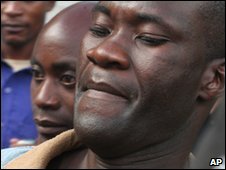
aid donors had put pressure on the government to free the pair a gay couple jailed in malawi after getting engaged have been pardoned by president bingu wa mutharika.
Mr mutharika, speaking as un chief ban ki-moon visited his country, said he had ordered their immediate release.
Steven monjeza and tiwonge chimbalanga were given 14-year jail terms earlier this month after being convicted of gross indecency and unnatural acts.
The case has sparked international condemnation and a debate about homosexuality in the country.
Mr ban hailed the president's decision as "courageous".
"this outdated penal code should be reformed wherever it may exist," he said.
The bbc's karen allen, in lilongwe, says mr ban is trying to put pressure on parliamentarians to reform anti-homosexuality laws that date back to colonial times.
'culture of hate' correspondents say malawi is a deeply conservative society where religious leaders equate same-sex liaisons with satanism.
analysis

continue reading the main story
_47954124_karen_allen_sep09.jpg
karen allen
bbc news, lilongwe

the president has certainly gone against public opinion in pardoning the gay men. What we have seen recently is a boldening of public opinion against gay rights.
But this issue is causing friction between western governments and several african nations which have similar legislation.
It will be interesting to see what the reaction is on the rest of the continent. There is talk of constitutional change in a number of countries across africa which, theoretically at least, could see gay people protected.
But so far, south africa is the only country on the continent to legislate for gay rights. If public opinion does not change, it is unlikely many other countries will follow their lead.

Mr mutharika, who has in the past dismissed homosexuality as alien, said he had set them free on humanitarian grounds.
"in all aspects of reasoning, in all aspects of human understanding, these two gay boys were wrong - totally wrong," he said after meeting mr ban.
"however, now that they have been sentenced, i as the president of this country have the powers to pronounce on them and therefore, i have decided that with effect from today, they are pardoned and they will be released."
monjeza, 26, and chimbalanga, 20, were arrested in december 2009 after celebrating their engagement. They have been in custody ever since.
Their lawyers say the two men are likely to be freed by monday.
Our correspondent says there are plenty of people who were not sorry to see the men go to jail, many of whom will be slightly puzzled at the president's announcement.
Gift trapence, from the campaign group centre for the development of people, welcomed the decision.
"we're very happy and we praise the president for his maturity, but there is still a long way to go to end the culture of hate," he said.
External pressure aid donors and human rights groups have been putting pressure on his government to respect the rights of minority groups.
The uk government, malawi's biggest donor, said it was dismayed by the sentencing, and the us labelled it a step backwards for human rights.
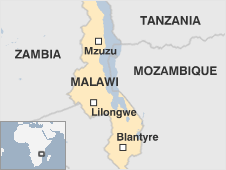
_47953717_malawi_190509.gif
on saturday, british popstar and aids campaigner sir elton john wrote an open letter to mr mutharika in the uk's guardian newspaper pleading for the release of the pair.
"their trial and harsh sentencing will have a perilous effect on our continuing efforts to combat aids in malawi and potentially reverse the gains we have achieved," he said.
The two men were convicted under a law dating back to colonial rule by britain.
Many of britain's former colonies have similar laws outlawing homosexuality; india overturned its anti-homosexuality law last year.
In uganda, mps are debating whether to strengthen the laws to include the death penalty for some gay people - a move which has infuriated western governments and rights campaigners.
</h1>
 
i do agree with you mzee...

See like imposed terrorism legislation, anti-money laundering, and othe criminal legislation ..

On the muthalika's decision, the western world has to declare a great defeat over our own stance on deciding every thing!!

</h1>


I am in entire agreement with you, Hawa ndio viongozi wetu unaona wanavyoichukua International Crimanal Court, because they know that they are potential clients of that court, they really hate it, hizo ulizotaja ni kufurahisha wazungu tu na kulinda maslahi ya wazungu
 
Back
Top Bottom