
Bavaria
JF-Expert Member
- Jun 14, 2011
- 53,092
- 53,496
[h=2]1. John D. Rockefeller[/h]

Rockefeller made his fortune by revolutionizing the oil industry. Before his time, lamp oil was unpredictable. But he figured out a way to standardize the quality, and Standard Oil was born.
Rockefeller's shrewd business sense led to the rise of one of the biggest companies in the world. By 1880, Standard controlled 90% of the oil produced in the United States. The government broke it up in 1911 amid allegations of price fixing and other underhanded business dealings, but not before Rockefeller became the country's first billionaire.
He spent the last part of his life giving away much of his fortune, including money to found the University of Chicago and the Rockefeller Foundation. The companies that sprung from Standard Oil's breakup -- including ExxonMobil (XOM), Chevron (CVX), ConocoPhillips (COP) and a big chunk of what are now BP's (BP) U.S. operations -- remain among the world's largest.
[h=2]2. Cornelius Vanderbilt[/h]

Vanderbilt got his start sailing barges across New York Harbor, and gradually expanded into steamships and railroads. One of his favorite business tactics was to undercut the competition so heavily that they would pay him to stay out of a given market.
He was rough around the edges -- swearing, chewing tobacco -- and never really fit in with New York high society.
His heirs did better, building great mansions along New York's Park Avenue and hob-knobbing with the city's elite. But they spent heavily, and by a 1973 family reunion, not one of the 120 Vanderbilt descendants present was a millionaire.
[h=2]3. John Jacob Astor[/h]

Astor got his start as a fur trader after hearing a fellow traveler talk about the profession on his voyage to America. A penniless German immigrant, his business endeavors were helped when he married his wife, who came from a wealthy family.
But his real money came from investing in Manhattan real estate. By the time his son ran the family businesses, the Astors owned over 700 Manhattan properties.
The Astor family fortune was one of the most enduring of the top 20, thanks in part to the elder Astor's insistence that half his trust be set to skip a generation, preventing its squander by spendthrift heirs.
[h=2]4. Stephen Girard[/h]

The French-born Girard started as a cabin boy working the Europe-Caribbean trade route, and became a sea captain by the age of 23. Eventually he owned a fleet of trading ships.
He went on to settle in Philadelphia and used his shipping wealth to become a financier, buying banks and lending money to the U.S. government during the war of 1812. While some of his business practices were thought to have been unscrupulous, he left nearly his entire fortune to charity when he died.
[h=2]5. Richard Mellon[/h]
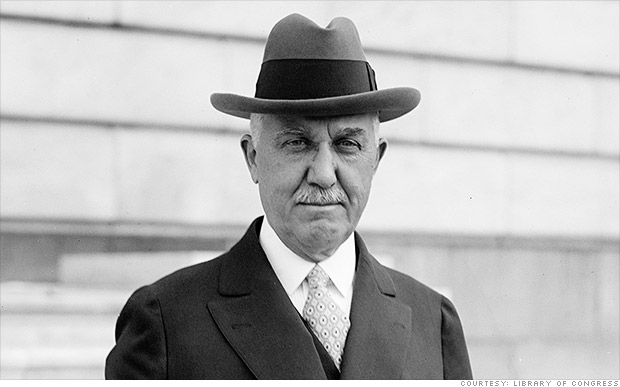
Richard and brother Andrew (No. 15) were Pittsburgh bankers that had a hand in a variety of burgeoning 19th century industries, including steel, oil, coal and railroads.
In addition to Mellon Bank, the companies they helped found include Gulf Oil and aluminum maker Alcoa (AA).
[h=2]6. Andrew Carnegie[/h]

Founder of the Carnegie Steel Company, Carnegie is perhaps even more famous for giving his fortune away.
After selling his steel behemoth to J.P. Morgan's U.S. Steel, Carnegie established a number of philanthropic and non-profit organizations including the Carnegie Corporation, the Carnegie Endowment for International Peace, and nearly 3,000 public libraries.
A "man who dies rich dies disgraced," he wrote in Wealth, his most famous essay.
[h=2]6. Stephen Van Rensselaer[/h]

Van Rensselaer was the last in a line of aristocrats that had been given vast land grants in the New World under Dutch colonial rule. At one point he controlled over a million acres in New York State and had up to 100,000 tenants living on his land. He's the only member on this list to entirely inherit his fortune.
But Van Rensselaer was a progressive at heart, and let much of the rent owed to him slide. He also divided his estate among his 10 children instead of granting it all to his eldest son, which was the custom at the time.
In addition to founding Rensselaer Polytechnic Institute, he also helped finance work on the Erie Canal, commanded 6,000 men during the War of 1812, and was a U.S. Congressman.
[h=2]8. Alexander Turney Stewart[/h]

An Irish-born textile merchant, Stewart went on to run one of the biggest wholesale and retail dry goods businesses in the United States and was a major uniform supplier to the Union Army during the civil war.
His big innovation was to eliminate haggling over retail goods, instead opting for fixed pricing.
[h=2]9. Frederick Weyerhäuser[/h]

Timber, lumber and paper magnate Frederick Weyerhäuser and his family were once rumored to control an area the size of Wisconsin.
The Weyerhaeuser (WY) company replanted the trees it cut, and is still considered one of the more responsible forest products firms.
[h=2]10. Jay Gould[/h]

Gould was a railroad executive, financier and speculator, and considered one of the most unscrupulous businessmen in U.S. history.
Land grabs, stock watering, bribes -- Gould was accused of it all. He once won control of a railroad company from Vanderbilt by issuing false stock, and then bribing New York regulators to approve the sale.
As a result, he had few friends and was largely shunned by New York society, though he died a rich man.
[h=2]11. Marshall Field[/h]

Field founded the now-closed Marshall Field's department store chain, with a flagship store in Chicago.
Field pushed concepts that were innovative for the time -- including store credit, a return policy, and in-store restaurants. The stores were eventually acquired by the Macy's chain and have since been renamed.
[h=2]12. William Henry Gates III[/h]

The Microsoft (MSFT) co-founder is currently the world's richest man, according to several different rankings.
After leaving full-time employment at the company in 2008 (he's still an adviser), most of his time is now spent on the Bill and Melinda Gates Foundation, his charity which focuses on global development and health issues.
[h=2]13. Henry Ford[/h]

Ford's name is synonymous with his famous Model-T car and the automaking behemoth he founded, but his greatest contributions to the country were arguably two other ideas.
By combining the assembly line with interchangeable parts, Ford paved the way for goods of all types to be produced for a fraction of the cost. And by paying a generous $5 wage -- more than double the going rate at the time -- he enabled his workers to purchase the goods they produced.
[h=2]14. Warren Buffett[/h]

Buffett has turned his 1965 purchase of clothing company Berkshire Hathaway (BRKA) into one of the most successful investing vehicles of all time. From the 1960s through the 1990s, major stock indexes averaged an 11% annual gain, while Berkshire's stock averaged 28%.
Berkshire currently has stakes in a variety of industries, and owns many companies outright, including Heinz, Fruit of the Loom, Geico, and the railroad BNSF.
Buffett, famous for championing higher taxes on the rich, plans on giving most of his money away to charity upon his death -- a big chunk of it to his friend Bill Gates' foundation.
[h=2]15. Andrew Mellon[/h]

Though he lived just five years longer than his brother Richard (No. 5), Andrew's ranking is 10 spots lower because the U.S. economy recovered greatly during this time period, lowering his relative wealth.
While Richard's philanthropy focused on Pittsburgh, Andrew was interested in the arts. His donation of 126 famous paintings helped found the National Gallery of Art in Washington, D.C.
[h=2]16. Samuel M. Walton[/h]

Fresh out of college, the Wal-Mart founder cut his teeth in a J.C. Penney management training program. Later, he ran a chain of five-and-dime stores in the South.
He left that discount retailer -- Ben Franklin -- over a fallout with company management. Walton wanted to expand to other small rural towns, but management wanted to stick to the old formula of locating stores in and around big cities.
So Walton founded Wal-Mart (WMT), and pioneered a concept of stocking several smaller stores from a centrally located distributor -- a model that remains key to the success of big box retailers.
Wal-Mart is now the country's largest retailer, and Walton's heirs are worth over $130 billion combined.
[h=2]17. Moses Taylor[/h]

The son of an aide to John Jacob Astor (No. 3), Taylor used his own and his family's money to invest in a wide range of industries: sugar, coffee, shipping, railroads, steel, coal and utilities, to name a few.
His basic strategy was to keep a lot of cash on hand during the good times so he could buy assets cheap during the bad. He used this same strategy to build wealth when he was president of the National City Bank of New York, which later became Citibank. (C)
[h=2]18. Russell Sage[/h]

Born poor in upstate New York, Sage started out as a grocery store clerk. But he was a prodigious worker, saver and trader, and soon had enough money for his own shop. From there, he expanded into horse brokering, shipping and making loans to friends.
Sage hit his stride in New York City, trading stocks and pioneering the system of puts and calls still used on Wall Street today. These gave Sage the ability to buy or sell stock at predetermined prices. He was a friend of Jay Gould (No. 10), and the two often teamed up to manipulate share prices.
Famously stingy (he was once caught stealing a cheap fan from the boardroom of Western Union), Sage's wife gave away most of his fortune after his death. One of the main organizations she founded -- the Russell Sage Foundation -- specifically works to improve living conditions in the United States.
[h=2]19. James G. Fair[/h]

Fair, along with three other partners, made his money on a Nevada silver and gold mine -- at that time the largest mining discovery in U.S. history.
Money did not appear to buy him happiness, though. His wife divorced him amid accusations of adultery and his son committed suicide. He was said to often be found drinking and wandering around seedy sections of San Francisco. He died at age 63.
[h=2]20. William Weightman[/h]

Weightman founded a drug company that developed a synthetic form of quinine, which is used to treat malaria. The firm was later absorbed into Merck (MRK).
He also made money off substantial investments in Philadelphia real estate.
20. William Weightman - The richest Americans in history - CNNMoney
- Adjusted wealth*: $253 billion
- Lived: 1839-1937
Rockefeller made his fortune by revolutionizing the oil industry. Before his time, lamp oil was unpredictable. But he figured out a way to standardize the quality, and Standard Oil was born.
Rockefeller's shrewd business sense led to the rise of one of the biggest companies in the world. By 1880, Standard controlled 90% of the oil produced in the United States. The government broke it up in 1911 amid allegations of price fixing and other underhanded business dealings, but not before Rockefeller became the country's first billionaire.
He spent the last part of his life giving away much of his fortune, including money to found the University of Chicago and the Rockefeller Foundation. The companies that sprung from Standard Oil's breakup -- including ExxonMobil (XOM), Chevron (CVX), ConocoPhillips (COP) and a big chunk of what are now BP's (BP) U.S. operations -- remain among the world's largest.
[h=2]2. Cornelius Vanderbilt[/h]
- Adjusted wealth*: $205 billion
- Lived: 1794-1877
Vanderbilt got his start sailing barges across New York Harbor, and gradually expanded into steamships and railroads. One of his favorite business tactics was to undercut the competition so heavily that they would pay him to stay out of a given market.
He was rough around the edges -- swearing, chewing tobacco -- and never really fit in with New York high society.
His heirs did better, building great mansions along New York's Park Avenue and hob-knobbing with the city's elite. But they spent heavily, and by a 1973 family reunion, not one of the 120 Vanderbilt descendants present was a millionaire.
[h=2]3. John Jacob Astor[/h]
- Adjusted wealth*: $138 billion
- Lived: 1763-1848
Astor got his start as a fur trader after hearing a fellow traveler talk about the profession on his voyage to America. A penniless German immigrant, his business endeavors were helped when he married his wife, who came from a wealthy family.
But his real money came from investing in Manhattan real estate. By the time his son ran the family businesses, the Astors owned over 700 Manhattan properties.
The Astor family fortune was one of the most enduring of the top 20, thanks in part to the elder Astor's insistence that half his trust be set to skip a generation, preventing its squander by spendthrift heirs.
[h=2]4. Stephen Girard[/h]
- Adjusted wealth*: $120 billion
- Lived: 1750-1831
The French-born Girard started as a cabin boy working the Europe-Caribbean trade route, and became a sea captain by the age of 23. Eventually he owned a fleet of trading ships.
He went on to settle in Philadelphia and used his shipping wealth to become a financier, buying banks and lending money to the U.S. government during the war of 1812. While some of his business practices were thought to have been unscrupulous, he left nearly his entire fortune to charity when he died.
[h=2]5. Richard Mellon[/h]
- Adjusted wealth*: $103 billion
- Lived: 1858-1933
Richard and brother Andrew (No. 15) were Pittsburgh bankers that had a hand in a variety of burgeoning 19th century industries, including steel, oil, coal and railroads.
In addition to Mellon Bank, the companies they helped found include Gulf Oil and aluminum maker Alcoa (AA).
[h=2]6. Andrew Carnegie[/h]
- Adjusted wealth*: $101 billion (tie)
- Lived: 1835-1919
Founder of the Carnegie Steel Company, Carnegie is perhaps even more famous for giving his fortune away.
After selling his steel behemoth to J.P. Morgan's U.S. Steel, Carnegie established a number of philanthropic and non-profit organizations including the Carnegie Corporation, the Carnegie Endowment for International Peace, and nearly 3,000 public libraries.
A "man who dies rich dies disgraced," he wrote in Wealth, his most famous essay.
[h=2]6. Stephen Van Rensselaer[/h]
- Adjusted wealth*: $101 billion (tie)
- Lived: 1764-1839
Van Rensselaer was the last in a line of aristocrats that had been given vast land grants in the New World under Dutch colonial rule. At one point he controlled over a million acres in New York State and had up to 100,000 tenants living on his land. He's the only member on this list to entirely inherit his fortune.
But Van Rensselaer was a progressive at heart, and let much of the rent owed to him slide. He also divided his estate among his 10 children instead of granting it all to his eldest son, which was the custom at the time.
In addition to founding Rensselaer Polytechnic Institute, he also helped finance work on the Erie Canal, commanded 6,000 men during the War of 1812, and was a U.S. Congressman.
[h=2]8. Alexander Turney Stewart[/h]
- Adjusted wealth*: $100 billion
- Lived: 1803-1876
An Irish-born textile merchant, Stewart went on to run one of the biggest wholesale and retail dry goods businesses in the United States and was a major uniform supplier to the Union Army during the civil war.
His big innovation was to eliminate haggling over retail goods, instead opting for fixed pricing.
[h=2]9. Frederick Weyerhäuser[/h]
- Adjusted wealth*: $91.2 billion
- Lived: 1834-1914
Timber, lumber and paper magnate Frederick Weyerhäuser and his family were once rumored to control an area the size of Wisconsin.
The Weyerhaeuser (WY) company replanted the trees it cut, and is still considered one of the more responsible forest products firms.
[h=2]10. Jay Gould[/h]
- Adjusted wealth*: $78.3 billion
- Lived: 1836-1892
Gould was a railroad executive, financier and speculator, and considered one of the most unscrupulous businessmen in U.S. history.
Land grabs, stock watering, bribes -- Gould was accused of it all. He once won control of a railroad company from Vanderbilt by issuing false stock, and then bribing New York regulators to approve the sale.
As a result, he had few friends and was largely shunned by New York society, though he died a rich man.
[h=2]11. Marshall Field[/h]
- Adjusted wealth*: $75 billion
- Lived: 1834-1906
Field founded the now-closed Marshall Field's department store chain, with a flagship store in Chicago.
Field pushed concepts that were innovative for the time -- including store credit, a return policy, and in-store restaurants. The stores were eventually acquired by the Macy's chain and have since been renamed.
[h=2]12. William Henry Gates III[/h]
- Adjusted wealth*: $74 billion
- Lived: 1955-present
The Microsoft (MSFT) co-founder is currently the world's richest man, according to several different rankings.
After leaving full-time employment at the company in 2008 (he's still an adviser), most of his time is now spent on the Bill and Melinda Gates Foundation, his charity which focuses on global development and health issues.
[h=2]13. Henry Ford[/h]
- Adjusted wealth*: $67.2 billion
- Lived: 1863-1947
Ford's name is synonymous with his famous Model-T car and the automaking behemoth he founded, but his greatest contributions to the country were arguably two other ideas.
By combining the assembly line with interchangeable parts, Ford paved the way for goods of all types to be produced for a fraction of the cost. And by paying a generous $5 wage -- more than double the going rate at the time -- he enabled his workers to purchase the goods they produced.
[h=2]14. Warren Buffett[/h]
- Adjusted wealth*: $63.8 billion
- Lived: 1930-present
Buffett has turned his 1965 purchase of clothing company Berkshire Hathaway (BRKA) into one of the most successful investing vehicles of all time. From the 1960s through the 1990s, major stock indexes averaged an 11% annual gain, while Berkshire's stock averaged 28%.
Berkshire currently has stakes in a variety of industries, and owns many companies outright, including Heinz, Fruit of the Loom, Geico, and the railroad BNSF.
Buffett, famous for championing higher taxes on the rich, plans on giving most of his money away to charity upon his death -- a big chunk of it to his friend Bill Gates' foundation.
[h=2]15. Andrew Mellon[/h]
- Adjusted wealth*: $63.2 billion
- Lived: 1855-1937
Though he lived just five years longer than his brother Richard (No. 5), Andrew's ranking is 10 spots lower because the U.S. economy recovered greatly during this time period, lowering his relative wealth.
While Richard's philanthropy focused on Pittsburgh, Andrew was interested in the arts. His donation of 126 famous paintings helped found the National Gallery of Art in Washington, D.C.
[h=2]16. Samuel M. Walton[/h]
- Adjusted wealth*: $56.5 billion
- Lived: 1918-1992
Fresh out of college, the Wal-Mart founder cut his teeth in a J.C. Penney management training program. Later, he ran a chain of five-and-dime stores in the South.
He left that discount retailer -- Ben Franklin -- over a fallout with company management. Walton wanted to expand to other small rural towns, but management wanted to stick to the old formula of locating stores in and around big cities.
So Walton founded Wal-Mart (WMT), and pioneered a concept of stocking several smaller stores from a centrally located distributor -- a model that remains key to the success of big box retailers.
Wal-Mart is now the country's largest retailer, and Walton's heirs are worth over $130 billion combined.
[h=2]17. Moses Taylor[/h]
- Adjusted wealth*: $54.5 billion
- Lived: 1806-1882
The son of an aide to John Jacob Astor (No. 3), Taylor used his own and his family's money to invest in a wide range of industries: sugar, coffee, shipping, railroads, steel, coal and utilities, to name a few.
His basic strategy was to keep a lot of cash on hand during the good times so he could buy assets cheap during the bad. He used this same strategy to build wealth when he was president of the National City Bank of New York, which later became Citibank. (C)
[h=2]18. Russell Sage[/h]
- Adjusted wealth*: $53.6 billion
- Lived: 1816-1906
Born poor in upstate New York, Sage started out as a grocery store clerk. But he was a prodigious worker, saver and trader, and soon had enough money for his own shop. From there, he expanded into horse brokering, shipping and making loans to friends.
Sage hit his stride in New York City, trading stocks and pioneering the system of puts and calls still used on Wall Street today. These gave Sage the ability to buy or sell stock at predetermined prices. He was a friend of Jay Gould (No. 10), and the two often teamed up to manipulate share prices.
Famously stingy (he was once caught stealing a cheap fan from the boardroom of Western Union), Sage's wife gave away most of his fortune after his death. One of the main organizations she founded -- the Russell Sage Foundation -- specifically works to improve living conditions in the United States.
[h=2]19. James G. Fair[/h]
- Adjusted wealth*: $52.9 billion
- Lived: 1831-1894
Fair, along with three other partners, made his money on a Nevada silver and gold mine -- at that time the largest mining discovery in U.S. history.
Money did not appear to buy him happiness, though. His wife divorced him amid accusations of adultery and his son committed suicide. He was said to often be found drinking and wandering around seedy sections of San Francisco. He died at age 63.
- 229
TOTAL SHARES
- 134
- 95
- 0
[h=2]20. William Weightman[/h]
- Adjusted wealth*: $51.8 billion
- Lived: 1813-1904
Weightman founded a drug company that developed a synthetic form of quinine, which is used to treat malaria. The firm was later absorbed into Merck (MRK).
He also made money off substantial investments in Philadelphia real estate.
20. William Weightman - The richest Americans in history - CNNMoney


