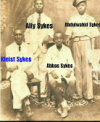
Among them the following were selected to represent Tanganyika: Chief
Makwaya, K.M., of Shinyanga, Mwami
Lwamgira,
K.M., of Bukoba, Mr. H. M. T.
Kayamba of Tanga (the
writer).
View attachment 2929497
The Story of Martin Kayamba
has been proved that Africans can do the work if they are
only patiently controlled.
We built our own Club building. It was the centre of much progress socially and in sports. Several distinguished officers visited our Club and gave donations. One gave us a football ground which the Club had to clear and put in
order. The Club started the football game in Tanga and
now there are several African football teams. It was the
intention of the Club to start a library in the Club build-
ing, but owing to lack of funds this scheme was imprac-
ticable. The late Bishop F. Weston was invited to the Club and was very pleased to see something at last had been done which he never thought he would see, and that was Christians and Mohammedans, Africans and Arabs joining together as members of the association, and all being very friendly.
Religion is the matter for the heart and must come first, but it does not prevent members of one religious community from combining with members of
another religious community. I firmly believe that Africans will never progress well unless they realize the necessity for unity. A great deal of our progress rests with us. We cannot move if we do not wish to move together.
In 1928 I was appointed as a member of the Provincial
Committee on African Education. In 1 929 1 was appointed
a member of the Advisory Committee on African Edu-
cation for the Territory. I have much advocated educa-
tion for girls. In Africa, where the great majority of the Africans are uneducated, the education for girls is very important indeed and will help considerably the progress of the boys' education. The mother is the guide of her
children. If she is educated there will be very few children who will not go to school and the hygiene at home will be thoroughly observed. Childbirth and child welfare will be better understood at home. African homes will be
Page 198
The Story of Martin Kayamba
improved. We lack at present the co-operation of African
women in social affairs and education. Their influence is
very great and precious, but it has not been used, for lack
of female education.
In church, I was appointed churchwarden from 1917.
Our church was too small for the congregation and we decided to extend it. African Christians contributed fairly well towards the fund in proportion to their income, and our church has now been enlarged. The condition of
Christians in Tanga is different to that of up-country Christians. We have a floating population and conditions are somewhat difficult, but on the whole we are progressing. The population of Tanga town is about 7,000 natives of mixed tribes. For most of them Tanga is not their home $ they have migrated from the hinterland to Tanga in search of work, and return to their homes up country as soon as they have made some money; some of them come to Tanga periodically for work and return to their homes during the cultivation and planting season. Tanga, being a town, offers the Christians many temptations
which they are not likely to meet with in their own tribal
homes.
Early in 1951 I was appointed as a witness from Tanganyika to the Joint Parliamentary Committee on East Africa. The story of my visit to England forms the next
part of this autobiography.
Page 199
The Story of Martin Kayamba
PART II
My Visit to England
Since 1924 there had been a rumour in East Africa about the proposed federation of the East African Territories, i.e. Kenya Colony, Uganda Protectorate and Tanganyika Territory.
The Ormsby-Gore Commission was sent out in 1924. It toured through the East African Territories and eventually made its report on the matter. The Hilton- Young Commission was sent out to East Africa in 1927 on the same question and made its report, as the result of which
the Joint Committee on Closer Union of the East African
Territories was appointed in England, composed of mem-
bers of the Houses of Lords and Commons, to make further
inquiry into the matter.
The Joint Committee required
witnesses to be sent to England to give evidence before the
Committee on the subject, and for the first time in the history of the British Empire, and East Africa in particular, three Africans were required from each of the three
territories of East Africa, i.e. Kenya, Uganda and Tangan-
yika Territory, to go to England to give evidence to the Honourable Committee, on behalf of ten million natives inhabiting these territories.
The following were selected to represent Tanganyika:
Chief Makwaya, K.M., of Shinyanga,
Mwami Lwamgira,
K.M., of Bukoba,
Mr. H. M. T. Kayamba of Tanga (the
writer).
The Tanganyika African delegates left Dar-es-Salaam
by S.S. Francisco Crispi on 50th March, 1951, together with P. E. Mitchell, Esq., M.C., Secretary for Native
Page 200
The Story of Martin Kayamba
Affairs, and 0. Guise- Williams, Esq., District Officer. Chief
Makwaya was accompanied by his son-in-law,
Makoni.
Two of us were Christians and two Mohammedans. Christians have no difficulty in sailing by European steamers and to European countries, as they can eat any food cooked for European tables. But there was a small point to dear regarding the food of our Mohammedan colleagues.
Chief Makwaya and
Makoni are staunch Mohammedans
and were very particular about food. Mr. Mitchell arranged with the District Commissioner at Mombasa for Chief
Makwaya to consult with Sir
Ali bin Salim, K.B.E., C.M.G., of Mombasa in order to remove the scruple from
his mind about food.
On 51st March we arrived at Mombasa; the first thing we did was to drive by taxi to the District Commissioner to see Sir Ali bin Salim. The District Commissioner took us to Sir Ali bin Salim, who kindly invited us into his office. After the matter had been explained to him, he told Chief Makwaya that Mohammedans are not forbidden by their religion to eat food cooked by Christians ormeat of animals killed by Christians or Jews, because Christians have the Gospel (Injili) and Jews have the Deuteronomy (Torati). Both these books come from 'God. He
had been to England himself for one year and during that
period ate the same food which Europeans ate. The only
meat which a Mohammedan is forbidden to eat is pork,
and he strongly warned
Chief Makwaya that they should
not touch it. In confirmation of what he had said he was
willing to come on board S.S. Francisco Crispi to lunch
with us. We were very pleased to invite him to lunch. At 12 noon he arrived on board and had lunch with us. At 4p.m. he kindly sent his car to take us round Mombasa Island, and we enjoyed the trip very much. Sir Ali bin
Page 201
The Story of Martin Kayamba
Salim is famous for his hospitality and charity to all races in Kenya Colony.
Kenya Native delegates embarked on board the steamer
on 1st April. Arab delegates also embarked on the same day. Our steamer left Mombasa at 12,50 p.m. for Kismayu. We left Kismayu at 2.50 the same day and arrived at Mogdishu at 7.50 a.m. on 5rd April Good Friday. We
landed at Mogdishu and strolled round the town. The Roman Catholic Cathedral there is a fine building. The native village is rather poor and filthy, especially the market place. There is no shed for the market, and natives
have to sell their goods on a sandy place. Some of them
stick dirty pieces of clothes on pieces of wood as shelters
for themselves and their commodities. The Governor's
palace is a fine building. The Sultan or Sheik of Somalis has
his residence here.
We left Mogdishu at 5 p.m. on 4th April for Hafun. On board there were always cinema shows in the evenings and music. We were very well treated on board. On the 6th we arrived at Hafun.
On the 9th we arrived at Massawa. It is a fine port be-
longing to the Italian Eritrea. There is a fine pier, and
our steamer was berthed alongside it. An Italian man-of-
war was at the harbour. The natives of this town are
mixed Arabs, Abyssinians, Danakil, etc. There are nice
buildings of stone for Europeans and natives. This is a sign of the wealthiness of the natives of this town. Chief
Makwaya made friends with one wealthy Egyptian who invited him to his house and made him a nice dinner, and gave him a present of a beautiful fez. He offered to pay his expenses to Mecca on pilgrimage, but the Chief was
unable to accept his kind offer. When Chief
Makwaya
told me this, I was doubtful if the man was genuine and
was not one of the slave dealers enticing the Chief to go to
Page 202
The Story* of Martin Kayamba
Mecca and on the way dispose of him to Arabian slave
dealers on the Persian Gulf.
At daybreak on the 14th we arrived at Suez and at
9 a.m. entered the canal. Here we were shown the Sinai
Mountains, where Prophet Moses received the tablets con-
taining the ten Commandments.
Ismalia is a fine town. I saw the monument erected to
commemorate the defence of the canal during the Great
War. On the eastern side of the canal palm groves and cul-
tivated land can be seen. It is said that this country belongs to the Biblical land of Goshen where Patriarch Jacob
and his children settled. Here also traces of the ancient
canal of the Pharaohs have been discovered. We were shown the supposed track of the Israelites crossing through the Bitter Lakes. El Kantara (the bridge) in the olden days was an important place of caravans between Egypt, Palestine and Syria. It is related that probably Abraham, and his sons spent a few days at El Kantara on their way to
Egypt. We arrived at Port Said at 12 midnight. Port Said is a fine port. On this day it was decorated with electric lights in honour of the Egyptian Prime Minister, Sidky Pasha, who visited Port Said on the same day.
This is the western gateway of the canal. At the 'entrance of the harbour there is the statue of Ferdinand de Lesseps, the builder of the canal. Some of us landed and saw very little of the town, as it was night time. This was the last port of Africa on our journey and we were now
sailing through the Mediterranean Sea. Up to this port we enjoyed a fine voyage except for the heat in the Red Sea.
The sea after leaving Port Said was rough. Two or three
of our colleagues were seasick and unablfe to touch food.
On the 18th we sighted the island of Stromboli which has a volcanic mountain. We could see the smoke issuing
Page 205
The Story of Martin Kayamba
from the peak of the volcano. The town is built on the sides of the hill, which looks like a man sitting on the furnace. All of us were amazed to see the inhabitants of this volcanic island living around the volcano with ease and happiness and without any fear of the possible eruption.
We were told that vine trees are grown on the island and
the soil is very fertile, which may be the inducement to the
inhabitants to hazard their living on the volcano.
Read more :
Full text of "TEN AFRICANS"