Ayatollah Khomeini
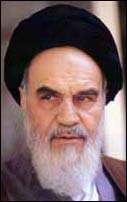
Ayatollah Rouhollah Mousavi Khomeini (Imam Khomeini)
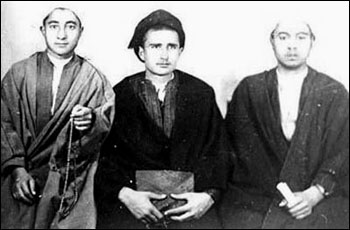
| Rouhollah Mousavi Khomeini (center) |
Rouhollah Mousavi Khomeini was born on 24 September 1902 (20 Jamadi al-Akhir 1320), the anniversary of the birth of Hazrat Fatima, in the small town of Khomein, some 160 kilometres to the southwest of Qom. He was the child of a family with a long tradition of religious scholarship. His ancestors, descendants of Imam Mousa al-Kazim, the seventh Imam of the Ahl al-Bayt, had migrated towards the end of the eighteenth century from their original home in Neishapour (in Khorasan province of Iran) to the Lucknow region of northern India. There they settled and began devoting themselves to the religious instruction and guidance of the region's predominantly Shi'i population.
Khomeini's grandfather, Seyed Ahmad, left Lucknow (according to a statement of Khomeini's elder brother, Seyed Morteza Pasandideh, his point of departure was Kashmir, not Lucknow) some time in the middle of the nineteenth century on pilgrimage to the tomb of Hazrat 'Ali in Najaf. While in Najaf, Seyed Ahmad met Yousef Khan, a prominent citizen of Khomein. Accepting his invitation, he decided to settle in Khomein to assume responsibility for the religious needs of its citizens and also took Yousef Khan's daughter in marriage.
Seyed Ahmad, by the time of death, the date of which is unknown, had two children: a daughter by the name of Sahiba, and Seyed Moustafa Hindi, born in 1885, the father of Khomeini. Seyed Moustafa began his religious education in Esfahan and continued his advanced studies in Najaf and Samarra (this corresponded to a pattern of preliminary study in Iran followed by advanced study in the "Atabat", the shrine cities of Iraq; Ayatollah Khomeini was in fact the first religious leader of prominence whose formation took place entirely in Iran). After accomplishing his advanced studies he returned to Khomein, and then married with Hajar (mother of Rouhollah Khomeini).
In March 1903, Khomeini when was just 5 months old lost his father. And in 1918, Khomeini lost both his aunt, Sahiba, who had played a great role in his early upbringing, and his mother, Hajar. Responsibility for the family then devolved on his eldest brother, Seyed Mourteza (later to be known as Ayatollah Pasandideh).
Khomeini began his education by memorizing the Qoran at a maktab (traditional religious school). In 1920-21, Seyed Mourteza sent the Rouhollah Khomeini to the city of Arak (or Sultanabad, as it was then known) in order for him to benefit from the more ample educational resources available there.
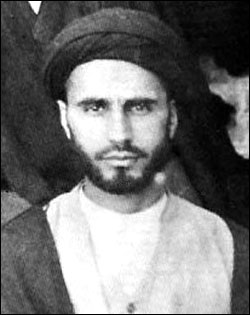
| Young Rouhollah Khomeini |
In 1923, Khomeini arrived in Qom and devoted himself to completing the preliminary stage of madreseh (school or academy) education.
Khomeini did not engage in any political activities during the 1930's. He believed that the leadership of political activities should be in the hands of the foremost religious scholars, and he was therefore obliged to accept the decision of Ayatollah Haeri to remain relatively passive toward the measures taken by Reza Shah against the traditions and culture of Islam in Iran. In any event, as a still junior figure in the religious institution in Qom, he would have been in no position to mobilize popular opinion on a national scale.
In 1955, a nationwide campaign against the Baha'i sect was launched, for which the Khomeini sought to recruit Ayatollah Boroujerdi's (he was the most prominent religious leader in Qom after the death of Ayatollah Haeri) support, but he had little success.
Ayatollah Khomeini therefore concentrated during the years of Ayatollah Boroujerdi's leadership in Qom on giving instruction in fiqh (Islamic science) and gathering round him students who later became his associates in the movement that led to the overthrow of the Pahlavi Dynasty, not only Ayatollah Mutahhari and Ayatollah Muntaziri, but younger men such as Hojatolislam Muhammad Javad Bahonar and Hojatolislam Ali Akbar Hashimi-Rafsanjani.
The emphases of the Ayatollah Khomeini's activity began to change with the death of Ayatollah Boroujerdi on March 31, 1961, for he now emerged as one of the successors to Boroujerdi's position of leadership. This emergence was signaled by the publication of some of his writings on fiqh, most importantly the basic handbook of religious practice entitled, like others of its genre, Tozih al-Masael. He was soon accepted as Marja-e Taqlid by a large number of Iranian Shi'is.
In the autumn of 1962, the government promulgated new laws governing elections to local and provincial councils, which deleted the former requirement that those elected be sworn into office on the Qoran. Seeing in this a plan to permit the infiltration of public life by the Baha'is, Imam Khomeini telegraphed both the Mohammad Reza Shah and the prime minister of the day, warning them to desist from violating both the law of Islam and the Iranian Constitution of 1907, failing which the 'ulama' (religious scholars) would engage in a sustained campaign of protest.
In January 1963, the Shah announced a six-point program of reform called the White Revolution, an American-inspired package of measures designed to give his regime a liberal and progressive facade. Ayatollah Khomeini summoned a meeting of his colleagues in Qom to press upon them the necessity of opposing the Shah's plans. They sent Ayatollah Kamalvand, to see the Shah and gauge his intentions. Although the Shah showed no inclination to retreat or compromise, it took further pressure by Ayatollah Khomeini on the other senior 'ulama' of Qom to persuade them to decree a boycott of the referendum that the Shah had planned to obtain the appearance of popular approval for his White Revolution. Ayatollah Khomeini issued on January 22, 1963 a strongly worded declaration denouncing the Shah and his plans. Two days later Shah took armored column to Qom, and he delivered a speech harshly attacking the 'ulama' as a class.
Ayatollah Khomeini continued his denunciation of the Shah's programs, issuing a manifesto that also bore the signatures of eight other senior scholars. In it he listed the various ways in which the Shah had violated the constitution, condemned the spread of moral corruption in the country, and accused the Shah of comprehensive submission to America and Israel. He also decreed that the Norooz celebrations for the Iranian year 1342 (which fell on March 21, 1963) be cancelled as a sign of protest against government policies.
On the afternoon of 'Ashoura (June 3, 1963), Imam Khomeini delivered a speech at the Feyziyeh madreseh in which he drew parallels between the Umayyad caliph Yazid and the Shah and warned the Shah that if he did not change his ways the day would come when the people would offer up thanks for his departure from the country. The immediate effect of the Imam's speech was, however, his arrest two days later at 3 o'clock in the morning by a group of commandos who hastily transferred him to the Qasr prison in Tehran. As dawn broke on June 3, the news of his arrest spread first through Qom and then to other cities. In Qom, Tehran, Shiraz, Mashhad and Varamin, masses of angry demonstrators were confronted by tanks and paratroopers. It was not until six days later that order was fully restored. This uprising of 15 Khordad 1342 marked a turning point in Iranian history.
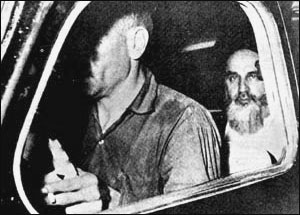
| Ayatollah Khomeini going to exile |
After nineteen days in the Qasr prison, Ayatollah Khomeini was moved first to the 'Eshratabad' military base and then to a house in the 'Davoudiyeh' section of Tehran where he was kept under surveillance.
He was released on April 7, 1964, and returned to Qom.
The Shah's regime continued its pro-American policies and in the autumn of 1964, it concluded an agreement with the United States that provided immunity from prosecution for all American personnel in Iran and their dependents. This occasioned the Khomeini to deliver a speech against the Shah. He denounced the agreement as surrender of Iranian independence and sovereignty, made in exchange for a $200 million loan that would be of benefit only to the Shah and his associates, and described as traitors all those in the Majlis who voted in favor of it; the government lacked all legitimacy, he concluded.
Shortly before dawn on November 4, 1964, again commandos surrounded the Ayatollah Khomeini house in Qom, arrested him, and this time took him directly to Mehrabad airport in Tehran for immediate exile to Turkey on the hope that in exile he would fade from popular memory. As Turkish law forbade Ayatollah Khomeini to wear the cloak and turban of the Muslim scholar, an identity which was integral to his being. However, On September 5, 1965, Ayatollah Khomeini left Turkey for Najaf in Iraq, where he was destined to spend thirteen years.
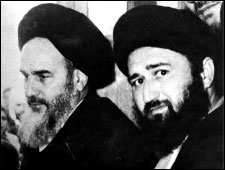
| Ayatollah Khomeini and his son Mostafa
in exile (Iraq) |
Once settled in Najaf, Ayatollah Khomeini began teaching fiqh at the Sheikh Mourteza Ansari madreseh. At this madreseh he delivered, between January 21 and February 8, 1970, his lectures on Velayat-e faqeeh, the theory of governance and Islamic Leadership (the text of these lectures was published in Najaf, not long after their delivery, under the title Velayat-e faqeeh ya Hukumat-i Islami). The text of the lectures on Velayat-e faqeeh was smuggled back to Iran by visitors who came to see the Khomeini in Najaf.
The most visible sign of the popularity of Ayatollah Khomeini in the pre-revolutionary years, above all at the heart of the religious institution in Qom, came in June 1975 on the anniversary of the uprising of 15 Khordad. Students at the Feyziyeh madreseh began holding a demonstration within the confines of the building, and a sympathetic crowd assembled outside. Both gatherings continued for three days until they were attacked military forces, with numerous deaths resulting. Ayatollah Khomeini reacted with a message in which he declared the events in Qom and similar disturbances elsewhere to be a sign of hope that "freedom and liberation from the bonds of imperialism" were at hand. The beginning of the revolution came indeed some two and a half years later.
In January 7, 1978 when an article appeared in the semi-official newspaper Ittila'at attacking him in such terms as a traitor working together with foreign enemies of the country. The next day a furious mass protest took place in Qom; it was suppressed by the security forces with heavy loss of life. This was the first in a series of popular confrontations that, gathering momentum throughout 1978, soon turned into a vast revolutionary movement, demanding the overthrow of the Pahlavi regime and the installation of an Islamic government.
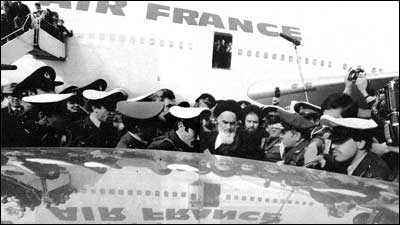
| Ayatollah Khomeini arrives in Tehran.
He is received by officers of Royal Air Force |
Shah decided to seek the deportation of Ayatollah Khomeini from Iraq, the agreement of the Iraqi government was obtained at a meeting between the Iraqi and Iranian foreign ministers in New York, and on September 24, 1978, the Khomeini's house in Najaf was surrounded by troops. He was informed that his continued residence in Iraq was contingent on his abandoning political activity, a condition he rejected. On October 3, he left Iraq for Kuwait, but was refused entry at the border. After a period of hesitation in which Algeria, Lebanon and Syria were considered as possible destinations, Ayatollah Khomeini embarked for Paris. Once arrived in Paris, the Khomeini took up residence in the suburb of Neauphle-le-Chateau in a house that had been rented for him by Iranian exiles in France. From now on the journalists from across the world now made their way to France, and the image and the words of the Ayatollah Khomeini soon became a daily feature in the world's media.
On January 3, 1979, Shapour Bakhtiar of the National Front (Jabhe-yi Melli) was appointed prime minister to replace General Azhari. And on January 16, Shah left Iran.
The Ayatollah Khomeini embarked on a chartered airliner of Air France on the evening of January 31 and arrived in Tehran the following morning. He was welcomed by a very popular joy. On February 5, he introduced Mehdi Bazargan as interim prime minister (yet Bakhtiyar was appointed prime minister of Shah).
| Ayatollah Khomeini's
last years |
On February 10, Ayatollah Khomeini ordered that the curfew should be defied. The next day the Supreme Military Council withdrew its support from Bakhtiyar, and on February 12, 1979, following the sporadic street gunfight all organs of the regime, political, administrative, and military, finally collapsed. The revolution had triumphed.
On March 30 and 31, a nationwide referendum resulted in a massive vote in favor of the establishment of an Islamic Republic. Ayatollah Khomeini proclaimed the next day, April 1, 1979, as the "first day of God's government". He obtained the title of "Imam" (highest religious rank in Shia). With the establishment of Islamic Republic of Iran he became Supreme Leader (Vali-e Faqeeh).
He settled in Qom but on January 23, 1980, Ayatollah Khomeini was brought from Qom to Tehran to receive heart treatment. After thirty-nine days in hospital, he took up residence in the north Tehran suburb of Darband , and on April 22 he moved into a modest house in Jamaran, another suburb to the north of the capital. A closely guarded compound grew up around the house, and it was there that he spent the rest of his life as absolute ruler of Iran.
Ayatollah Khomeini, on June 3, 1989, after eleven days in hospital for an operation to stop internal bleeding, lapsed into a critical condition and died.
Ayatollah Khomeini in his 10 years of leadership established a theocratic rule over Iran. He did not fulfil his pre-revolution promises to the people of Iran but instead he started to marginalize and crash the opposition groups and those who opposed the clerical rules. He ordered establishment of many institutions to consolidate power and safeguard the cleric leadership. During his early years in power he launched the Cultural Revolution in order to Islamize the whole country. Many people were laid off, and lots of books were revised or burnt according to the new Islamic values. Newly established Islamic Judiciary system sentenced many Iranians to death and long-term imprisonment as they were in opposition to those radical changes |