Iranian Elections: Ahmedinejad's Victory and The Aftermath!

Iranian Elections: Ahmedinejad's Victory and The Aftermath!

Kama Serikali ya Iran imeblock websites inawezekana vp watu wanaupload hizi video kwenye You-Tube?.

Kama kweli Serikali haitaki habari zitoke kupitia kwenye mtandao wa Internet, serikali ya Iran imeshindwa kuushusha mtandao wote down atleast kwa kipindi hiki?
 
Kama Serikali ya Iran imeblock websites inawezekana vp watu wanaupload hizi video kwenye You-Tube?.

Kama kweli Serikali haitaki habari zitoke kupitia kwenye mtandao wa Internet, serikali ya Iran imeshindwa kuushusha mtandao wote down atleast kwa kipindi hiki?

Iran's blocked websites resurface
By Sebastian Usher
BBC world media correspondent


The Emrooz website has reappeared in rudimentary form
Three Iranian reformist websites blocked more than a week ago have re-emerged at different internet addresses.
Their temporary disappearance has been blamed on the hardline conservative establishment in Iran trying to prevent the expression of any political opinion opposed to theirs.

With the broadcast media in the hands of the state and controlled by hardliners, and most of the reformist and independent press harried into submission by bans and closures, the internet had become a vital source of communication for Iran's reformists.

It, too, has been targeted, with websites forced to close and independent bloggers silenced.

Alternative view missing

The three sites that were blocked last week - Emrooz, Rooydad and Baamdad - were the main outlets for the reformist party, the Participation Front, which is led by Mohammed Reza Khatami, the president's brother.

The loss of these sites meant that a key source of alternative news and commentary in Iran was no longer available.

Now, all three sites have reappeared - to some extent.

One is using its weblog address, another an old internet address that had not been blocked, and the third has a completely new address.

What they all have in common is a stripped-down, temporary look, compared to their previous appearance.


Khatami, the president's brother, is leader of the Participation Front
There are no longer any bylines or pictures, except for one of Mohammed Reza Khatami.

This may in part be explained by reports that some of the staff on the original sites have been arrested.

Despite the technical shortcomings, the sites seem to be regularly updated and continue to catalogue reports of abuses of power by conservative hardliners.

One news item in Baamdad from a few days ago reports on moves to try to dissolve the Participation Front, while another reports on threats to a singer by a radical Islamic group.

As for their own situation, one report on the Rooydad site says that one of the government's senior legal officials has said the blocking of the websites will be investigated, in response to Mohammed Reza Khatami's letter of protest.
Source: BBC NEWS | Middle East | Iran's blocked websites resurface
 
Duh!! Hawa Basij wanatoa kichapo kweli some people don't play.
 
Kama Serikali ya Iran imeblock websites inawezekana vp watu wanaupload hizi video kwenye You-Tube?.

Kama kweli Serikali haitaki habari zitoke kupitia kwenye mtandao wa Internet, serikali ya Iran imeshindwa kuushusha mtandao wote down atleast kwa kipindi hiki?

Watu wanatumia proxy.
 
New York Times Op-Ed columnist Roger Cohen was out on Tehran's streets on Saturday and has filed this account of what he witnessed. He reports:

I don't know where this uprising is leading. I do know some police units are wavering. That commander talking about his family was not alone. There were other policemen complaining about the unruly Basij. Some security forces just stood and watched. "All together, all together, don't be scared," the crowd shouted.

I also know that Iran's women stand in the vanguard. For days now, I've seen them urging less courageous men on. I've seen them get beaten and return to the fray. "Why are you sitting there?" one shouted at a couple of men perched on the sidewalk on Saturday. "Get up! Get up!"

Another green-eyed woman, Mahin, aged 52, staggered into an alley clutching her face and in tears. Then, against the urging of those around her, she limped back into the crowd moving west toward Freedom Square. Cries of "Death to the dictator!" and "We want liberty!" accompanied her.

There were people of all ages. I saw an old man on crutches, middle-aged office workers and bands of teenagers. Unlike the student revolts of 2003 and 1999, this movement is broad. [...]

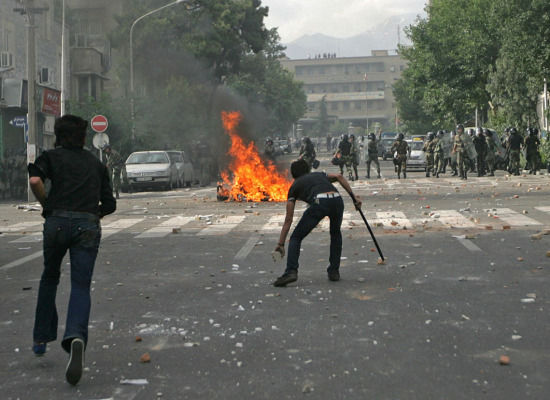
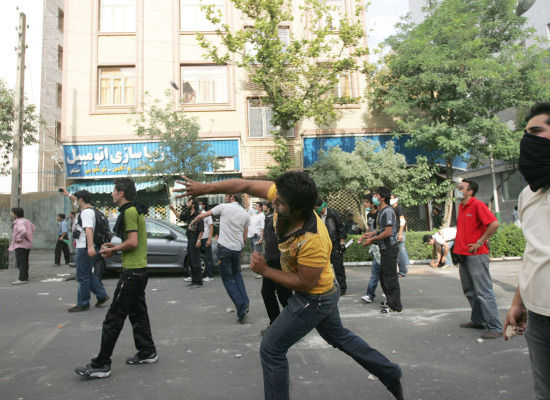
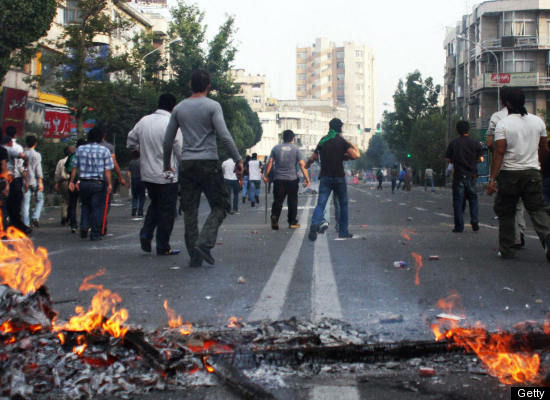
Later, we moved north, tentatively, watching police lash out from time to time, reaching Victory Square where a pitched battle was in progress. Young men were breaking bricks and stones to the right size for hurling. Crowds gathered on overpasses, filming and cheering the protesters. A car burst into flames. Back and forth the crowd surged, confronted by less-than-convincing police units.

I looked up through the smoke and saw a poster of the stern visage of Khomeini above the words, "Islam is the religion of freedom."

Later, as night fell over the tumultuous capital, from rooftops across the city, the defiant sound of "Allah-u-Akbar" - "God is Great" - went up yet again, as it has every night since the fraudulent election, but on Saturday it seemed stronger.
 
Gunfire, euphoria: week that shook Iran

By The Associated Press – Sat Jun 20, 2:41 pm ET
A protest song from decades ago rings out from the green-clad crowds supporting Mir Hossein Mousavi. Motorcycles weave through Tehran with backers of President Mahmoud Ahmadinejad waving Iranian flags. Protesters run wildly from the sound of gunshots.
The epic events in Iran have brought countless images to the world - many of them iconic scenes that will become part of history; others are the small but powerful vignettes that will be tucked away as personal narratives.
The AP gives a street-level view of a week that shook Iran.
Friday, June 12
Election Day and the excitement in Tehran is palpable. Never mind the broiling heat. Never mind the long lines. Bearded men, women in headscarves - no one seems to complain. Families bring their children to the polling stations in a carnival atmosphere. Their enthusiasm is striking. People seem genuinely eager to cast their ballots and make their voices heard. After all, this is what Iranians fought for in the 1979 revolution that toppled the shah and installed the Islamic republic - even though 60 percent of the population is too young to remember the struggle. As the day fades, however, signs of conflict loom. Soon after the polls close, Mousavi declares he has won. The government news agency then proclaims President Mahmoud Ahmadinejad the winner. Young Ahmadinejad supporters cruise through the streets on motorbikes, waving Iranian flags and shouting "Mousavi is dead." Battle lines are drawn.
Saturday, June 13
Yesterday's euphoria is gone. The day begins with an ominous calm. Mobile phones and the Internet - the opposition's main organizing tools - no longer function. At Mousavi's headquarters, volunteers are in shock. They tell journalists that government militiamen attacked their office overnight and fired tear gas on Vali Asr Street. Angry Mousavi supporters, some wearing makeshift green masks, set fire to mounds of tires and torch a bus. Riot police in body armor swarm Tehran's wide, leafy streets, blocking traffic and beating protesters - men and women - with rubber truncheons. News photographers cruise the streets in cars, snapping images from open windows before speeding away to elude the police. Still, life goes on, with shoppers wandering through stores in one block while protesters battle police in another. The whole city smells of burning tires.
Sunday, June 14
The fissures in Iranian society are laid bare. A confident Ahmadinejad appears before the media, comparing the protesters to soccer hooligans. A few minutes walk away, young men are setting fire to piles of tires to block the police. It's a tactic used a generation ago in the uprising against the shah. But not every Iranian supports the opposition. In Vali Asr Square, thousands cheer Ahmadinejad. A woman weeps with emotion when the president appears. As night falls, some neighborhoods are alight with bonfires or trash cans set ablaze. From the roofs, residents hurl stones at the police or chant "Allahu Akbar," or "God is Great," the battle cry of the 1979 revolution. Sidewalks in front of bank offices are littered with broken glass. Ringtones of mobile phones echo through the streets as Iranians call their friends to trade information. Gunfire crackled through streets of a few neighborhoods - probably police or militiamen firing in the air to disperse crowds. At one hotel, a middle-aged desk clerk complains that the Iranian people have been wronged. Opposition is clearly spreading beyond the young, Westernized class in trendy north Tehran.
Monday, June 15
Mousavi calls his followers to a mass rally at Revolution Square. But will they come? Protests so far have been small. The risk of arrest or a beating is great. By mid-afternoon, tens of thousands of people march to the square, chanting "death to dictatorship" and "where's my vote?" It's people power - Iranian style. Journalists mingle freely among the crowd, protected from the police by the sheer numbers. Government militiamen and riot police relax nearby. Neither the government nor the organizers want violence. Protest leaders urge the crowd to march silently and flash the "V for victory" sign. For the most part, the crowd complies. A protester points to two large men among the crowd. "Take their picture," he urges a photographer. "They are the ones beating people." Sounds of pre-revolutionary protest songs unheard in public for decades waft through the square. When Mousavi's convoy appears, the crowd swarms around it, chanting his name. All sorts of people are there - grandmothers, government workers, clerics, women in black chador robes, taxi drivers, hip young adults. Suddenly, shots ring out. People begin to run wildly. State media reports seven people were killed. One of the victims - a middle-aged man in khaki trousers and a white shirt - is carried through the crowd with a gaping head wound.
Tuesday, June 16
The Culture Ministry telephones international news organizations and bans them from reporting from the streets. Foreign journalists are told their visas will not be renewed and they must leave the country. Nevertheless, thousands of Mousavi supporters pour into the streets. Iranians turn to social-networking sites like Facebook, Twitter and Flickr to send reports and post shaky images from mobile phones on the Internet. Callers tell news agencies that the crowd along Vali Asr avenue stretches for a mile. Mousavi urges supporters on his Web site not to resort to violence and calls for another mass rally Wednesday. Ahmadinejad attends a regional summit in Russia, seeking to portray confidence.
Wednesday, June 17
With foreign television crews shut down, Iranians post amateur video on the Internet showing thousands marching along an overpass in Tehran in support of Mousavi. Marchers flash the victory sign or carry placards. In a show of solidarity with Mousavi, several Iranian soccer players wear green tape on their wrists - the color of the opposition - during a World Cup qualifying match in South Korea that was televised in Iran. Nighttime cries of "Allahu akbar" ring out even louder than before.
Thursday, June 18
Mousavi calls his followers back to the streets to protest the election and mourn those killed in clashes. Many protesters wear black - the color of mourning - with green headbands and scarves. The protest is largely silent. A few men recognized as members of the secret police mingle in the crowd, watching but not interfering. One person in the crowd is overheard telling the plainclothes police that the protests won't last and opponents will grow tired of marches. Mobile phone service goes down again in the capital.
Friday, June 19
One week after the voting, Iran's supreme leader, Ayatollah Ali Khamenei, warns the opposition to end street protests and declares that the results of the disputed balloting will surely stand. Nightfall brings cries of "Death to the dictator!" and "Allahu akbar." But the stern warning pushes the opposition movement into a pivotal moment: either back down or risk a crushing response from police and the security forces. Mousavi and his allies take stock and plan a strategy that will have enormous implications for Iran and the world.
___
Associated Press journalists and other witnesses in Tehran contributed to this report.
 
Mwanafa, unajua kwa tamko alilotoa Khamenei jana na matendo ya Basij na IRGC leo ndio anaweza akawa amejichimbia kaburi la kisiasa. Nilikuwa sijafuatilia kwa sana hii issue mpaka jana ila naona moto wake umekuwa mkubwa sana.
 
Mwanafa, unajua kwa tamko alilotoa Khamenei jana na matendo ya Basij na IRGC leo ndio anaweza akawa amejichimbia kaburi la kisiasa. Nilikuwa sijafuatilia kwa sana hii issue mpaka jana ila naona moto wake umekuwa mkubwa sana.

Unajua mkuu Mousavi anajua uraisi haupati tena. Yeye anacho taka kwa sasa ni kuforce mazungumzo ili apewe chochote na anatumia hisia za wafuasi wake kufanya hivyo. Anajua kabisa kuwa kwa katiba ya Iran Ayatollah ndiyo sauti ya mwisho. Au labda anaona pressure ya nje itafanya kazi in his favor.
 
Obama on the Iran elections June 12th 2009

"We are excited to see what appears to be a robust debate taking place in Iran. And obviously, after the speech that I made in Cairo, we tried to send a clear message that we think there is the possibility of change. And ultimately, the election is for the Iranians to decide, but just as has been true in Lebanon, what can be true in Iran as well is that you’re seeing people looking at new possibilities. And whoever ends up winning the election in Iran, the fact that there’s been a robust debate hopefully will help advance our ability to engage them in new ways."


Nadhani mkulu Obama bado anaangalia upepo utakwendaje. Ukisomamaneno yake utaona kuwa anajaribu kuwa very general na kuto kutaka kuonekana yupo upande fulani.
 
Top cleric may be playing role in Iran unrest

By HAMZA HENDAWI, Associated Press Writer – Sat Jun 20, 5:58 pm ET
CAIRO – One of Iran's most powerful men may be playing a key role behind closed doors in the country's escalating postelection crisis.
Former president and influential cleric Ayatollah Hashemi Rafsanjani has made no public comment since Iran erupted into confrontation between backers of hardline President Mahmoud Ahmadinejad and reformists who claim he stole re-election through fraud.
But Iranian TV has shown pictures of Rafsanjani's daughter, Faezeh Hashemi, speaking to hundreds of opposition supporters. And Rafsanjani, who has made no secret of his distaste for Ahmadinejad, was conspicuously absent from an address by the country's supreme leader calling for national unity and siding with the president.
Supreme Leader Ayatollah Ali Khamenei praised Rafsanjani, 75, on Friday as one of the revolution's architects and an effective political figure for many years, but he acknowledged that the two have "many differences of opinion."
"Of course, the president's ideas are closer to mine," Khamenei said, warning opposition candidate Mir Hossein Mousavi and his supporters to halt protests or face the consequences.
Demonstrators clashed with security forces in Tehran on Saturday despite the ultimatum in the most widespread violence of the crisis. There were unconfirmed reports of violence in other Iranian cities.
While his true views, and even his whereabouts, remain unclear, any support for the opposition would place Rafsanjani in direct conflict with many of the most powerful clerics in Iran's highest echelons of power.
The stakes for the world are high.
Iran is pressing ahead with its nuclear program in the face of international sanctions and Israeli threats of military action. The United States and other Western nations maintain that the program is geared toward making a bomb, a charge Iran consistently denies.
Meanwhile, President Barack Obama is seeking to improve relations with Iran, ending 30 years of animosity that have helped define the Islamic Republic.
The regime's militant wing, with Ahmadinejad its most visible face, takes a hard-line position on relations with Washington and is determined to push forward with the nuclear program regardless of the consequences, experts say.
A camp of pragmatic clerics and politicians led by Rafsanjani, while loyal to the revolution's principles, wants to build better ties with the West and a more friendly image of Iran.
"What is clear is that the leadership is far more polarized and splintered than has been clear in the past," said Anthony Cordesman, a former Pentagon analyst with the Washington-based Center for Strategic and International Studies.
Friday's comments showed the country's ultimate authority is firmly behind Ahmadinejad, who has publicly accused Rafsanjani and members of his family of corruption. Experts said that could mean Rafsanjani's power is waning.
"Now that the leader has made clear he was supportive of Ahmadinejad and sharing the same vision of the future of the Islamic Republic, it can be taken as a major defeat for Rafsanjani and for the political options he promotes," said Frederic Tellier, an Iran expert in the International Crisis Group, a Brussels-based think tank.
Iran's crisis began when Mousavi, a reform-minded architect who served as prime minister in the 1980s, claimed he was the victor of the June 12 election, accusing Ahmadinejad of using widespread fraud to win it.
Mousavi insists he wants a new election, an option Khamenei ruled out.
Rafsanjani was president between 1989 and 1997, but failed to win a third term when in 2005, losing to Ahmadinejad in a runoff. He was a close follower of the late Ayatollah Ruhollah Khomeini, father of Iran's Islamic Revolution. He now heads the Expediency Council, a body that arbitrates disputes between parliament and the unelected Guardian Council, which can block legislation.
He also is the head of the powerful Assembly of Experts, which comprises senior clerics who can elect and dismiss the country's supreme leader.
Alireza Nader, an expert on Iran with the RAND corporation, says Rafsanjani retains some leverage against Khamenei and Ahmadinejad as chairman of the Assembly of Experts. However, he says, Khamenei ignored a letter Rafsanjani wrote asking him to restrain Ahmadinejad, who accused the former president of corruption in a televised debate.
Ignoring the letter, Nader said, "was perceived by many Iranians as a rebuke to Rafsanjani and his role in the political system."
Rafsanjani's influence may have significantly dissipated as a result, he said.
"Rafsanjani is a son of the revolution," said Tellier of the International Crisis Group. "But his own future depends on how far the leader will allow Ahmadinejad to go in his attacks against Rafsanjani and his family."
 
Wakuu, heshima mbele,

Nadhani wengi tunasoma historia lakini hatujifunzi kutokana na historia. Tatizo kubwa katika hii issue ya wairani ni kwamba ni kwa maslahi ya watu wa nje. I can assure you hata kama utawala uliopo Iran ukiondoka these changes wont bring changes most of Irans are hoping for. Swala ni kwamba USA na Israel wanataka kuwaweka sawa wairan wasiwe tishio kwa Israel" Tujiulize tatizo la Iran ni lipi? Do they have any problem with the rest of the world? I would say, wairan wana matatizo na ulimwengu kwa sababu Western world wamesema hivyo. Sijaona tatizo kubwa la Iran...hakuna wale extremist as we would see in Pakistan au Afghanistan. Kifupi..ni kwamba USA na Israel wameshaona kwamba Iran inaweza kuwa na nguvu waka-call shots in the Middle East..ndo maana wamefanya kila wawezalo kuwa discredit wairan. Na ambao hawajui..wana follow tren tuu..wanaojua wako kimya..Why Iran? ni nchi gani ambazo chaguzi zinavurugwa na wao hukaa kimya? juzi tumeona Kosovo wakijitangazia uhuru kwa jeuri na support kubwa ya western world...Abhkazia alivyofanya hivyo...kila mtu was up in arms? why this double standard?

Make no mistake..everybody wants change...but not change for the sake of it. Hivi jiulizeni..Msharafu aliwekwa madarakani na wakubwa..wamemchoka..akaondoka..nani aliwekwa? Its ZADARI..NOW TELL ME is Zadari any better for Pakistanis than the previous regimes? Lakini kwa sababu wakubwa wanamtaka..no body cares.

Mushi anaongelea generation ya vijana wa Iran..but Mushi..dont go far..hawa vijana wengi..ni wale akina sisi ambao ulimwengu tunauangalia katika mtizamo wa CNN, facebook na BBC wakitupa analysis ya Freedom. WANAFIKIRIA wakipata utawala tofauti..watakuwa huru..but reality ni kwamba USA na wengine..wana agenda tofauti kabisa na wala siyo hao wairan...Mfano, I really dont approve what CCM is doing..but..I do believe watanzania ipo siku wataamua Wenyewe what they want na wataibadilisha CCM..sio watu kutoka nchi za nje.

TATIZO kubwa la western countries wanaogopa any person or entity to tilt the balance of power. Mpaka hapa sijaona kosa la Iran..sema tuu..ukiwa na media utacontrol dunia. Angalia TV zote..sasa hivi news bulletin zote ni "crisis in Iran"

Again I say..this conflict is being engineered by the western powers. I would be the last person to blame the west for our misery, basi lakini watuache tufanye yanayotuhusu..Sioni nchi ya ulimwengu wa kwanza yenye credibility ya kutufundisha freedom ni nini..The world is a very complicated place..depending on which side of the fence you are.
 
mwanafalsafa, i told you, this election wasn't fair from the beginning ukabisha. What is this now? If not dictatorship? Why cracking down people who're trying to make their point peaceful? People have decided they'll march but, it's going to be in a peaceful way but, the government doesn't even want that. This is big time oppression. At some point, i think the whole world need to side with the oppressed ones, the innocent citizens, who're trying to fight for their rights.

(tanzania take note)


kuna tofauti gani na tanzania ????
 
slide_1809_24348_large.jpg


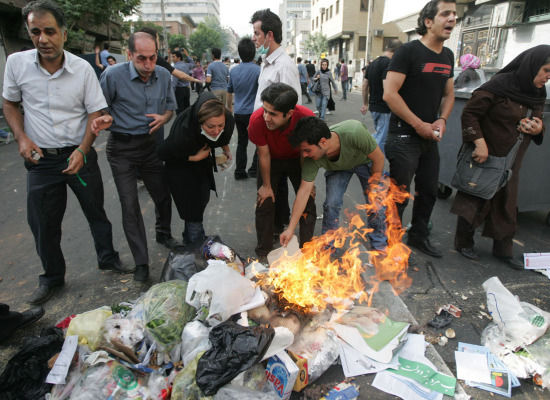
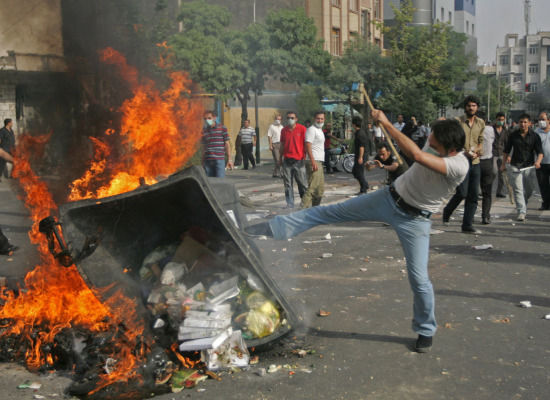
Supporters of opposition leader Mir Hossien Mousavi set a fire to avoid the effects of tear gas during protest in Tehran on Saturday June, 20, 2009. Police beat protesters and fired tear gas and water cannons at thousands who rallied Saturday in open defiance of Iran's clerical government

slide_1809_24349_large.jpg


slide_1809_24350_large.jpg


slide_1809_24351_large.jpg


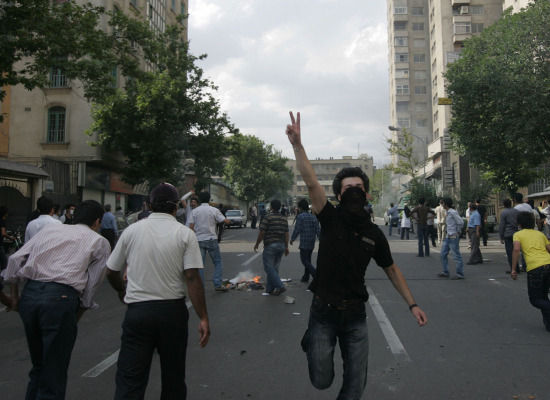
Supporters of opposition leader Mir Hossien Mousavi during protest in Tehran on Saturday

slide_1809_24353_large.jpg


slide_1809_24313_large.jpg
 
Iran raises death toll in clashes to at least 19

By NASSER KARIMI and WILLIAM J. KOLE, Associated Press Writers – 19 mins ago
TEHRAN, Iran – State media reported Sunday at least 10 more deaths in post-election unrest and said authorities have arrested the daughter and four other relatives of former President Hashemi Rafsanjani, one of Iran's most powerful men.
The reports brought the official death toll for a week of unrest to at least 19. State television inside Iran said 10 were killed and 100 injured in clashes Saturday between demonstrators contesting the result of the June 12 election and black-clad police wielding truncheons, tear gas and water cannons.
However English-language Press TV, which is broadcast only outside the country, put the toll at 13 and labeled those who died "terrorists." There was no immediate explanation for the discrepancy.
Amnesty International cautioned that it was "perilously hard" to verify the casualty tolls.
"The climate of fear has cast a shadow over the whole situation," Amnesty's chief Iran researcher, Drewery Dyke, told The Associated Press. "In the 10 years I've been following this country, I've never felt more at sea than I do now. It's just cut off."
On Sunday, the streets of Tehran were eerily quiet.
Press TV reported Rafsanjani's eldest daughter, Faezeh Hashemi, and four other family members were arrested late Saturday. It did not identify the other four. Last week, state television showed images of Hashemi speaking to hundreds of Mousavi supporters.
Rafsanjani, 75, has made no secret of his distaste for President Mahmoud Ahmadinejad, whose re-election victory in a June 12 vote was disputed by opposition candidate Mir Hossein Mousavi. Ahmadinejad has accused Rafsanjani and his family of corruption.
Rafsanjani now heads two very powerful groups. The most important one is the Assembly of Experts, made up of senior clerics who can elect and dismiss the supreme leader. The second is the Expediency Council, a body that arbitrates disputes between parliament and the unelected Guardian Council, which can block legislation.
Also Sunday, Iranian Foreign Minister Manouchehr Mottaki held a news conference where he rebuked Britain, France and Germany for raising questions about reports of voting irregularities in hardline Ahmadinejad's re-election - a proclaimed victory which has touched off Iran's most serious internal conflict since the 1979 Islamic Revolution.
Thousands of supporters of Mousavi, who claims he won the election, squared off Saturday against security forces in a dramatic show of defiance of Iran's supreme leader, Ayatollah Ali Khamenei.
Underscoring how the protesters have become emboldened despite the regime's repeated and ominous warnings, witnesses said some shouted "Death to Khamenei!" at Saturday's demonstrations - another sign of once unthinkable challenges to the virtually limitless authority of the country's most powerful figure.
Sunday's state media reports also said rioters set two gas stations on fire and attacked a military post in clashes Saturday. They quoted the deputy police chief claiming officers did not use live ammunition to dispel the crowds.
Iran has also acknowledged the deaths of seven protesters in clashes on Monday.
On Saturday, state media also reported a suicide bombing at the shrine of the Islamic Revolution leader Ayatollah Ruhollah Khomeini killed at least two people and wounded eight. Another state channel broadcast images of broken glass, but no other damage or casualties, and showed a witness saying three people had been wounded. But there was no independent verification of the shrine attack or the deaths.
State TV quoted an unidentified witness as saying a man wearing an explosives belt blew himself up at the mausoleum's main gate.
Iran has imposed strict controls on foreign media covering the unrest, saying correspondents cannot go out into the streets to report.
Mottaki criticized Britain, France and Germany for raising questions about Ahmadinejad's victory.
Mottaki accused France of taking "treacherous and unjust approaches." But he saved his most pointed criticism for Britain, raising a litany of historical grievances and accusing the country of flying intelligence agents into Iran before the election to interfere with the vote. The election, he insisted, was a "very transparent competition."
In Washington on Saturday, President Barack Obama urged Iranian authorities to halt "all violent and unjust actions against its own people." He said the United States "stands by all who seek to exercise" the universal rights to assembly and free speech.
Obama has offered to open talks with Iran to ease a nearly 30-year diplomatic freeze, but the upheaval could complicate any attempts at outreach.
The New-York based International Campaign for Human Rights in Iran said Sunday that scores of injured protesters who had sought medical treatment after Saturday's clashes were arrested by security forces at hospitals in the capital.
It said doctors had been ordered to report protest-related injuries to the authorities, and that some seriously injured protesters had sought refuge at foreign embassies in a bid to evade arrest.
"The arrest of citizens seeking care for wounds suffered at the hands of security forces when they attempted to exercise rights guaranteed under their own constitution and international law is deplorable," said Hadi Ghaemi, spokesman for the campaign, denouncing the alleged arrests as "a sign of profound disrespect by the state for the well-being of its own people."
"The government of Iran should be ashamed of itself. Right now, in front of the whole world, it is showing its violent actions," he said.
Saturday's unrest came a day after Khamenei sternly warned Mousavi and his backers to all off demonstrations or risk being held responsible for "bloodshed, violence and rioting." Delivering a sermon at Friday prayers attended by tens of thousands, Khamenei sided firmly with Ahmadinejad, calling the result "an absolute victory" that reflected popular will and ordering opposition leaders to end their street protests.
Mousavi did not directly reply to the ultimatum.
A police commander sharpened the message Saturday. Gen. Esmaeil Ahmadi Moghadam said more than a week of unrest and marches had become "exhausting, bothersome and intolerable." He threatened a more "serious confrontation" if protesters return.
Late Saturday, Ahmadinejad thanked Khamenei for his support, telling the supreme leader: "Without a doubt, you strongly raised the flag of dignity and awareness of the Iranian nation against the arrogant."
The government has blocked Web sites such as BBC Farsi, Facebook, Twitter and several pro-Mousavi sites used by Iranians to tell the world about protests and violence. Text messaging has not been working in Iran since last week, and cell phone service in Tehran is frequently down.
But that won't stifle the opposition networks, said Sami Al Faraj, president of the Kuwait Center for Strategic Studies.
"They can resort to whispering ... they can do it the old-fashioned way," he said.
____
Karimi reported from Tehran and Kole from Cairo. Associated Press Writers Ali Akbar Dareini in Tehran, Brian Murphy in Dubai, United Arab Emirates, and Sebastian Abbot in Cairo contributed to this report.
 
The Iranian election was a coup as leaked confidential results show Ahmadinejad won only 13% of the votes, instead of his "landslide" victory as announced by the Islamist regime...
Iran's President Ahmadinejad, a veteran of the Islamic Republic's repressive Revolutionary Guard, took office on August 3, 2005, after unexpected win in a sham presidential election -- there are no democratic elections in the Islamic Republic of Iran. All candidates are prescreened by the Guardian Council before they are allowed to run for office. In practice, a president of Iran is already chosen through a farce process of giving the voters a chance to elect one of the men hand-picked from the regime's functionaries, as was the case with President Ahmadinejad.
During the previous "election," only a small percentage of the voters bothered to vote, since voting under the pre-screening and undemocratic system of the mullahs is more like selection than election. The result of staying away from the polls materialized in the person of the fascist Ahmadinejad.
The great majority of the people of Iran are disillusioned and even disgusted by the mediaeval incompetent, oppressive, and corrupt rule of the mullahs, irrespective of which mafia gang is in power. The votes, more than anything else, are protest ballots cast against the entire system, rather than indications of support for the so-called conservative-moderate coalition.
It took less than 4 years for Iranians to realize that boycotting the so-called elections in the Islamic Republic of Iran can only bring to power even a worse bunch of Islamofascists. This time around the people turned out to vote for the lesser of two camps of evil -- the mullah dominated gang of conservatives and "moderates."
After a fiery month long campaign and unprecedented passions and tensions, the mass rallies, polished campaign slogans, savvy Internet outreach and worldwide televised debates, which revealed rampant corruption, ineptitude, and illegal and criminal activities of all four candidates, on June 12, 2009, the Iranian people went to the polls, challenging not only the incumbent president Ahmadinejad, but the entire establishment of the Islamic regime.
Iran's elections are considered extremely unfair and the Islamist government does not allow international monitors to be present. The ruling clerics put their stamp on the elections from the very beginning by deciding who can run. It is really a joke. More than 470 people sought to join the presidential race, but only Ahmadinejad and three rivals were cleared.
However, the turnout was massive, a near record high 85 percent of Iran's 49.2 million eligible voters. Based on the information from Mousavi's website, a group of Interior Ministry employees have leaked out the following results which seem to be closer to reality than the one released by the establishment:
Total eligible: 49.2 Million
Participated in the election: 75% to 85%
Mir Hussein Mousavi: 45%
Mehdi Karoobi: 33%
Mahmoud Ahmadinejad: 13%
Mohsen Rezai: 9%
Cancelled votes: 3%
It is clear that Mr. Mir Hussein Mousavi won the election by a large margin. Ahmadinejad came out third. But on Friday June 12, 2009, in the Islamic election (selection) something happened. Something beyond what anyone could have ever imagined. Something huge. A daylight coup d'état by the elements of the establishment, particularly, the Islamic Revolutionary Guard Corps (IRGC), which the Senate designated as a terrorist organization (with Senator Obama not voting). The clerical leadership in Iran has grown increasingly reliant on the IRGC to help it stave off internal pressure for political and economic reform and external pressure resulting from international concern over Iran's nuclear program.
An Iranian journalist said, "The important event that took place in Iran is that it wasn't an election; it was a coup d'état. [They] stole 24 million votes of the nation and took them away for themselves. If there were really a winner, they would have to celebrate, but instead they beat people. They performed a coup, but they don't call it a coup."
He continued, "Please don't use the word "fraud" because it is mitigation of what has happened in Iran. Fraud is what was happening in the past 30 years. This is not fraud. They haven't [counted] people's votes. Using the word fraud is like calling a deep cut a small scratch. There was no fraud; it was a coup."
What the so called reformists call a coup was described today as a great achievement by the Islamic Republic Supreme Leader, Ayatollah Ali Khamenei, the man who has the final say in all affairs of the country. It was no secret by that President Mahmoud Ahmadinejad was Khamenei's favorite choice. If an electoral fraud, tantamount to a coup, had indeed happened, everyone believes that it certainly had Khamenei's blessing.
Demonstrators, on Saturday, were shocked and angry by Ali Khamenei's disregard for their vote and apparent coup. "If Mr. Khamenei cannot tolerate even a mild-mannered president like Mousavi, then I really don't know what to do," said a demonstrator, who was among thousands of students on Pahlavi Avenue before she started to chant "Death to the dictator". The day after the election, Khamenei urged the nation to unite behind Ahmadinejad and called the result a "divine assessment."
The political chief of the powerful Revolutionary Guard warned it would crush any [ame="http://www.youtube.com/watch?v=I0MkATcn04M%20%20%20"]"revolution"[/ame] against the Islamic system by Mousavi's "green movement" -- the signature color of his campaign. However, on Saturday and Sunday, hundreds of thousands of opponents of Mahmoud Ahmadinejad clashed with Hizbollah thugs dressed in police uniforms in the heart of Iran's capital, pelting them with rocks and setting fires in the worst unrest in Tehran since the 1979 Islamic revolution. They accused the hard-line president of using fraud to steal the election victory from his reformist rival.
The ever-conniving mullahs dread the Iranian people. Granted that a small percentage of Iranians, known as the 3Fs -- fools, fanatics and frauds -- support the mullahs. No totalitarian rule can ever survive without a segment of the population, for one reason or another, supporting it. Yet, time is not on the side of the mullahs. By their mismanagement, thievery and oppression of the masses, they have created explosive internal conditions. As I have said over and over, the Mullahs need to have the N-bomb to create a fake sense of security so they can prolong their survival.
It was reported and verified by a Spiegel German reporter in Iran that the regime has brought many Arab speaking Hizbollah factions from Lebanon to attack the Iranian people. Overnight Sunday, police reportedly raided student dormitories at Tehran University where some 3,000 students had earlier held an anti-Ahmadinejad rally. Rooms were damaged, computers smashed, and hard drives taken, and students beaten and arrested, according to the Associated Press (AP). It is that reported 5 students have died in the attack.
The vicious attacks on people by the hired thugs of the regime are failing more and more as the mullahs' instrument of rule by terror. The police and official security apparatus are less and less willing to exercise brute force to suppress the people. That's exactly why the regime has imported Arab speaking terrorist groups such as Lebanese Hizbollah and Palestinian thugs.
In short, Iran is in a state of serious upheaval. Replacing Ahmadinejad with the already tried and proven wanton gang of Rafsanjani-Khatami-Mousavi is not going to change matters much.
As for the West, it is prudent that it does not embark on a trigger-happy, self-interested policy. The mullahs' lease on life, [short of brutal massacre of the Iranian people in the absence of any foreign media] is just about over. A concerted political, economic, and moral support for the long-suffering and valiant Iranian people and the secular opposition can put an end to the shameful and hate-driven Islamofascists of any and all stripes.
 
Umecopy wapi huo uongo? Hivi huoni kuwa hizo ni njama za UK, US na Israel za ku destabilise Iran? Tusisome na kukubali mambo kichwa kichwa, fuata trend za matukio, angalia matukio halafu utapata jibu mwenyewe bila kudanganywa.
 
[FONT=Tahoma, Verdana, Arial]Iran's presidential elections held on June 12 in which the incumbent, President Mahmoud Ahmedinejad, retained his post with a wide margin over his nearest rival Mir Hussain Mousavi has provided the Muslim-hating West another opportunity to spout its anti-Islamic venom. Through its corporate-controlled media mouthpieces, they had already declared Mousavi the winner even before the people of Iran had had an opportunity to cast their vote. When the result turned out to be contrary to their perceived wisdom, it was immediately denounced as "rigged". It seems even Mousavi had fallen for this propaganda because as soon as the polls closed, he told a press conference in Tehran that he had "won". How he could make such a claim when no results had come in? [/FONT] [FONT=Tahoma, Verdana, Arial]When the first results started to trickle in late on Friday June 12 and showed Ahmedinejad leading by a wide margin, the Western media, led by the BBC News World Service started to question their authenticity. Others followed suit. Soon there was a flood of accusations that there must have been massive rigging otherwise how could Ahmedinejad be ahead by such a wide margin. This was based on the Western media's own wishful thinking of Mousavi's victory. Part of the reason for their failure to accurately read the mood in Iran is due to the fact that Western journalists stay at Five-Star hotels-Isteqlal, Azadi and others-located in North Tehran. It is in this part of the city that the taghutis and other parasites of Iranian society live. Physically, these people may live in their mansions in North Tehran but mentally they are in Europe or North America-destinations they frequently visit. Such people feed their prejudices to Western reporters who need little prodding, based on their equally jaundiced view of the Islamic Republic, to reflect the most negative stereotyped images of Iran. [/FONT]
[FONT=Tahoma, Verdana, Arial]Some examples may help explain the point. In the weeks leading to the June 12 election, the overriding theme in Western media reporting was that most people would "boycott" the polls because they have "no faith" in the system. As the election campaign generated excitement, especially with televised debates between candidates, the Western media's tune changed; their coverage started to focus on the "huge crowds" Mousavi was attracting and deliberately ignored the even larger crowds attending Ahmedinejad's rallies. Media outlets that bothered to report Ahmedinejad's rallies dismissed them as "rented crowds". The largely ignorant Western public did not know the difference; besides, they had little interest in Iran's elections. Their knowledge of Iran is based on the drivel fed to them by their own media: it is "building" a nuclear bomb and Ahmedinejad has threatened to "wipe out Israel". Such prejudices are reinforced by the Iranian expatriate community that is largely opposed to the Islamic revolution, hence their decision to live outside Iran. Supporters of the revolution went back to Iran to help the Islamic Republic. [/FONT]
[FONT=Tahoma, Verdana, Arial]Western media reports started to speculate that Mousavi would win. Besides, their hatred of Ahmedinejad, the plucky Iranian President who drew rings around them with his masterful interviews, did not allow them to see that he may have support among the Iranian masses. President Ahmedinejad has maintained a level of modesty and simplicity that has earned him respect not only among Iranians but also Muslims worldwide. They saw in him a truly Islamic leader. The more the West hated and ridiculed him, the more the ordinary people of Iran admired him. But his popularity was not merely based on sentiment; he had promised during his first presidential campaign in 2005 that he would put Iran's oil wealth on the tables of the poor. And this he did. He delivered this wealth to the Iranian masses in the rural areas where the majority resides. This majority had been ignored and dismissed by the liberals, reformists and other Western-doting Iranians. But they made the mistake of being taken in by the hangers-on from within the taghuti crowd in Tehran. Regrettably, it appears even Mousavi's campaign has been infiltrated by such people despite the fact that during his tenure as prime minister (1981-1989), Mousavi was liked by the people because of his modest demeanour and able handling of the economy. It must also be pointed out that Mousavi was never elected to public office; he was appointed prime minister by Imam Khomeini (at that time, there were two offices: that of president and prime minister. Only the president was elected who then appointed the prime minister). In a constitutional amendment in 1989, the prime minister's post was abolished and all executive powers were united in the office of the president. [/FONT]
[FONT=Tahoma, Verdana, Arial]Mousavi's supporters have questioned the wide margin of Ahmedinejad's victory. They were expecting that there would be a run off election because no single candidate would garner the 50 percent plus one vote as required by the constitution. This was again based on wishful thinking and the fact that Mousavi drew huge crowds in Tehran. Two days before elections, Ahmedinejad cancelled an appearance at one of his campaign rallies in Tehran because the crowd was so massive that he feared people might get trampled in a stampede. Few media outlets reported this nor did they report the huge victory rally Ahmedinejad held on June 14 in Tehran. Instead, the media focussed on Mousavi's rally on June 15. This was preceded by rumours that he and his supporters had been arrested; when this turned out to be false, their tune changed: the authorities had refused to give permission for his rally, they alleged. When this, too, turned out to be untrue, then the media changed its tack again: they said Mousavi's supporters had defied the ban and the authorities were forced to "retreat". [/FONT]
[FONT=Tahoma, Verdana, Arial]There was no interference from the authorities to disrupt the rally despite people setting fire to buses, smashing store windows and causing damage to property. At the end of the rally, some people tried to storm the Basij offices in Tehran. It was at this stage that shooting occurred that resulted in seven deaths. By nightfall, calm had returned. Both camps announced rallies for June 16 but only one-that of Ahmedinejad supporters-was held as they arrived at the rally site, Vali Asr square, ahead of the opposition group and seemed to take control. Also, the Guardian Council announced on June 16 that it would hold a recount in those polling stations where the opposition said irregularities had occurred. This was rejected by Mousavi's supporters who demanded that the June 12 election results be annulled and fresh ones held, a demand unlikely to be met. [/FONT]
[FONT=Tahoma, Verdana, Arial]Amid all the hype about rigging, some basic facts must be kept in mind. President Ahmedinejad may be unpopular in the West because of his outspoken views but he enjoys widespread support in Iran. His support base includes the rural population, the urban poor as well as the religious. This constitutes the overwhelming majority of Iran's population. The urban educated middle class is a minority and is generally confined to the northern parts of Tehran. Their children go to university, drive expensive cars and frequent five-star hotels. It is this group that has largely coalesced around Mousavi. It would be unfair, however, to accuse Mousavi of egging the rioters to indulge in violence but there is little doubt that there are agents provocateurs within his group that are bent on creating chaos in Iran. [/FONT]
[FONT=Tahoma, Verdana, Arial]Ahmedinejad's supporters are largely poor; most do not speak English, hence their inability to convey their feelings to Western reporters who in any case are not interested in their point of view, but they are solidly behind the revolution and know where their interests lie. It is this class of people that made the greatest sacrifices in defence of the revolution during the brutal Iraqi-imposed war in 1980-1988. This is not mere conjecture. In an article jointly authored by Ken Ballen and Patrick Doherty and published in the Washington Post on June 15, 2009, the two writers revealed that Ahmedinejad's 2 to 1 margin was actually confirmed by their own survey of public opinion conducted in Iran three weeks earlier. "While Western news reports from Tehran in the days leading up to the voting portrayed an Iranian public enthusiastic about Ahmadinejad's principal opponent, Mir Hossein Mousavi, our scientific sampling from across all 30 of Iran's provinces showed Ahmadinejad well ahead." [/FONT]
[FONT=Tahoma, Verdana, Arial]The poll undertaken by two US non-profit organizations-Terror Free Tomorrow: The Center for Public Opinion, and the American Strategy Program at the New America Foundation-from May 11 to May 20 was the third in a series over the past two years. It was conducted by telephone from a neighbouring country (probably Dubai); field work was carried out in Farsi by a polling company whose work in the region for ABC News and the BBC has received an Emmy award. The polling was funded by the Rockefeller Brothers Fund and thus had nothing to do with the government of Iran or with Ahmedinejad. [/FONT]
[FONT=Tahoma, Verdana, Arial]In recent media coverage, much has been said about Iranian youth with the automatic assumption that they all oppose the Islamic government. This is not true, as the US-led survey found. The misconception has emerged because Western reporters only talk to north Tehran-based, university educated youth. These rich, spoiled youth do not represent the entire country. Nor is the Internet the harbinger of change, as made out by media reports. The poll by Ken Ballen and Patrick Doherty found "that only a third of Iranians even have access to the Internet, while 18-to-24-year-olds comprised the strongest voting bloc for Ahmadinejad of all age groups." [/FONT]
[FONT=Tahoma, Verdana, Arial]There was an even more startling revelation made by the poll. Some reports have questioned how Ahmedinejad could win in the home province of Mousavi. Here is what the Ballen and Doherty survey found. "The breadth of Ahmadinejad's support was apparent in our pre-election survey. During the campaign, for instance, Mousavi emphasized his identity as an Azeri, the second-largest ethnic group in Iran after Persians, to woo Azeri voters. Our survey indicated, though, that Azeris favoured Ahmadinejad by 2 to 1 over Mousavi." It is not difficult to see why. Ahmedinejad had gone out of his way to help the poor and dispossessed in Iran. They in turn came out to vote with their feet. The survey also confirmed what we have said already: Mousavi's "support came primarily from university students and graduates, and the highest-income Iranians." These are people that are well-connected and are able to convey their thoughts and ideas to Western reporters, hence the kind of images of Iran created abroad. [/FONT]
[FONT=Tahoma, Verdana, Arial]There is one final point that needs to be made. Some people have argued that in Iran people make up their mind only in the last two weeks of elections. Again, this is true only for the urbanized elites; the rural population knows who their friend or supporter is. Besides, the vote can swing either way: both toward and against Ahmedinejad and it is inaccurate to assume that all the swing votes would have gone to Mousavi. Ballen and Doherty reported that when their survey was conducted, "almost a third of Iranians were also still undecided. Yet the baseline distributions we found then mirror the results reported by the Iranian authorities, indicating the possibility that the vote is not the product of widespread fraud." [/FONT]
[FONT=Tahoma, Verdana, Arial]Finally, one must make a quick comparison with what happened in the June 7 elections in Lebanon. Tens of thousands of people of Lebanese origin were flown from abroad, all expenses paid by the Saudis, to vote for the March 14 group led by Saad Hariri. The Saudis also paid each person $500 for pocket money. Despite this massive fraud, Hariri's group got 68 seats in parliament (two less than they had in the previous one) while the Hizbullah-backed alliance got 57 seats (one less than in the earlier one). There were three independents. Hizbullah Secretary General did not complain that the election was rigged. He told his supporters to accept the result and move on. [/FONT]
[FONT=Tahoma, Verdana, Arial]There was little or no mention in the Western media about Lebanese vote rigging; the only thing one heard was that Hizbullah had been "defeated". [/FONT]
 
[ame="http://www.youtube.com/watch?v=GRwUZ-u6KFo"]YouTube - Broadcast Yourself.[/ame]
 
Back
Top Bottom