Mtei akosoa mgombea binafsi kuruhusiwa kuwania urais

Mtei akosoa mgombea binafsi kuruhusiwa kuwania urais

Ndoto za mzee wangu mtei zimepotea. maana sasa watu makini mnaowafanyia zengwe ktk vyama wataondoka na kushinda wakiwa wagombea huru . ulimkabidhi chama shemeji yako Makani na baadae ukampa mkwe wako Mbowe sasa mw
isho wa udicteta wa vyama umefika.sisi watanzania tunataka maendeleo ,hivyo ninyi wenye malengo ya kunufaika kupitia saccos zenu ambazo ninyi mnaita vyama mtaumbuka,hutapewa tena tenda za cdm za kuingiza pikipiki maana chama kitakosa ruzuku. si wananchi tumesubiri siku ya kupiga kura ya ndio kuikubali katiba Mzee wangu Mtei
 
Last edited by a moderator:
Mzee mtei mwenyewe uliifisadi benki kuu huku ukishirikiana na Nimrod mkono. baada ya kugundulika mkakimbilia nchi za nje,mwenzio mkono karudi baada ya nyerere kufa,sasa mzee wetu leo eti unahofu kuwa mafisadi wanaweza kuchukua nchi wakiwa wagombea huru mbona we uliifirisi nchi na mpaka leo we na familia ndio mnanufaika na chadema na watu wapo kimyaaaa?
Kama kuna watu wa kuwalaani kwa kukosa uzalendo ni Edwin Mtei,lakini laana ya watanzania kuwafanya maskini hawezi kukwacha salama. nikikumbuka ulitoyafanya wakati upo BOT machozi yananitoka ,maana huna hata chembe ya uzalendo.
 
George Washington was an independent candidate

Wiki ya Independent candidacy na nchi zinazoruhusu ipo hapa

Independent (politician) - Wikipedia, the free encyclopedia

Bado unabisha US hairuhusu Private/ independent candidate?


OK... I'm still TELLING YOU IT IS VERY DIFFICULT to have an INDEPENDENT CANDIDATE in USA HII NI KUTOKA US CONSTITUTION na UNAJUA kila mtu anajarubu kuinterprate kwasababu ina VIPENGELE VINGI lakini bado inakushika sehemu kuwa INDEPENDENT CANDIDATE ni VINGUMU kwasababu Wananchi lazima wawe huru kuchagua ITIKADI za huyo mtu... lakini kama CCM, Warioba na kundi lake wanataka kuiweka Tanzania kwenye JENEZA ni WAO soma yafuatayo...

Kwanza ni 1st Ammendments -- Katiba ya USA ina 17 Ammendments

First Amendment
The Supreme Court has found that the First Amendment, in guaranteeing the people's right "peaceably to assemble," protects the voters' right to associate for political purposes.

The Court has found that this right includes associating either in political parties or with a preferred independent candidate.15 It has used two tests to review the constitutionality of independent
candidate regulations. Each test is described below.

(1) Compelling Interest Test. In Storer v. Brown the Supreme Court stated one test of the validity of legislation that puts substantial burdens on the right to vote or to associate for political purposes: whether the legislation is essential to serve a compelling state interest.16 The Court noted that predicting the results of applying the compelling interest test in any specific election law case may be very difficult.17
Probably the best that can be done to evaluate the validity of particular election proposals or statutes is to seek a case involving a statute as nearly similar as possible.


While the test requires a "compelling state interest," Storer suggests that states have much greater latitude in regulating the election process than in such areas as statutes involving racial or religious issues.18
Storer involved, in part, a challenge to a California statute that prevented seeking office as an independent at a general election if an individual was a registered party member within one year before the primary for that general election. The plaintiffs, who wanted to run for Congress, claimed the one-year period violated their constitutional right of association. A three-judge district court rejected thisargument. The Supreme Court affirmed.


Introduction
An independent candidate is one who runs without party affiliation. In 1980 the Minnesota Supreme Court struck down a statute that required certain statements in an independent candidate's affidavit of candidacy.1
Since that case Minnesota has had in effect only one expressstatutory requirement governing an independent candidacy.


Three common modes of valid regulation, if properly drafted, are: early filing deadlines, prohibitions on primary losers appearing as independents at the general election ("sore loser" statutes), and disaffiliation statutes. Minnesota has the first two kinds of statutes.

The third, a disaffiliation statute, is deemed by commentators to be the most effective regulation. The disaffiliation statute works best with a party registration system of voting. Although Minnesota does not require party registration, constitutional variations on the typical disaffiliation statute probably could be drafted to fit Minnesota law. References to Minnesota law are for Minnesota Statutes as amended through 1999.

Rationale for Regulating Independents
There are two major reasons why a state may want to regulate candidates who run without party affiliation. First, a state has an interest in protecting the integrity of the political party process.

This interest includes the goals of (1) stopping intraparty fights after the primary in order to have a settled contest, and (2) preventing one party from "raiding" another's votes by running a party candidate disguised as an independent. Second, a state has an interest in protecting the integrity of the electoral process.
This includes such concerns as verifying that a candidate is truly
independent, keeping the ballot a manageable length, and ensuring that candidates on the ballot are serious and have a minimal level of support that would make it possible for them to govern if elected.

Federal Constitutional Issues
Candidates and Voters are Protected United States Supreme Court cases reviewing statutes on independents have recognized that these statutes may affect constitutional rights of both candidates and voters.

The voter's right to cast an effective vote is based in part on the First Amendment right to associate for the advancement of political beliefs.3
The Court has ruled that "[t]he right to vote is heavily burdened if that vote may be cast only for major party candidates at a time when other parties or candidates are‘clamoring for a place on the ballot'."

Mfano MZURI ni wa MINNESOTA
The Minnesota Statute Litigation
A Minnesota Statute enacted in 1978 required a candidate filing for partisan office as an independent to indicate in the affidavit of candidacy that she or he does not seek, does not intend to seek, and will not accept any political party's support in the campaign.29 A 1980 lawsuit found this statute unconstitutional. The essential flaws in the statute were:
• it denied equal protection to independents by allowing party candidates, but not independents, to accept support from any source; and
• it restricted the First Amendment freedom of speech and association of party members who want to express support for independents


http://www.house.leg.state.mn.us/hrd/pubs/indcand.pdf
 
mzee wangu mtei una khofu kubwa sana na kijana wako zitto manake una mbania sana kuwakilisha chamma chako katika ngazi ya juu sas ukimchezea tena atakukimbia na itakuwa anguko la ajabu la chama chako.

Mbona unamwekea maneno mdomoni mzee wa watu? Ndiye nyie mliolelewa vibaya.

Sent from my BlackBerry 9860 using JamiiForums
 
Mzee umechemsha.Mgombea binafsi ndo itakuwa habari ya mjini 2015 tumeshachoka na hii mivyama yenu iliyojaa unafiki,fitina,majungu,umafia,ushirikina,umbea,rushwa,ufisadi na kila aina ya upuuzi.Mtatia akili jinsi jeshi la mtu mmoja mmoja litakavyoburuza mijivyama yenu lazima akili ziwakae sawa.Safi sana.
Kama Lowassa asipoteuliwa agombee kupitia mgombea binafsi ndipo ngoma itanoga.


Sent from my BlackBerry 9860 using JamiiForums
 
OK... I'm still TELLING YOU IT IS VERY DIFFICULT to have an INDEPENDENT CANDIDATE in USA HII NI KUTOKA US CONSTITUTION na UNAJUA kila mtu anajarubu kuinterprate kwasababu ina VIPENGELE VINGI lakini bado inakushika sehemu kuwa INDEPENDENT CANDIDATE ni VINGUMU kwasababu Wananchi lazima wawe huru kuchagua ITIKADI za huyo mtu... lakini kama CCM, Warioba na kundi lake wanataka kuiweka Tanzania kwenye JENEZA ni WAO soma yafuatayo...

Kwanza ni 1st Ammendments -- Katiba ya USA ina 17 Ammendments

First Amendment
The Supreme Court has found that the First Amendment, in guaranteeing the people's right "peaceably to assemble," protects the voters' right to associate for political purposes.

The Court has found that this right includes associating either in political parties or with a preferred independent candidate.15 It has used two tests to review the constitutionality of independent
candidate regulations. Each test is described below.

(1) Compelling Interest Test. In Storer v. Brown the Supreme Court stated one test of the validity of legislation that puts substantial burdens on the right to vote or to associate for political purposes: whether the legislation is essential to serve a compelling state interest.16 The Court noted that predicting the results of applying the compelling interest test in any specific election law case may be very difficult.17
Probably the best that can be done to evaluate the validity of particular election proposals or statutes is to seek a case involving a statute as nearly similar as possible.


While the test requires a "compelling state interest," Storer suggests that states have much greater latitude in regulating the election process than in such areas as statutes involving racial or religious issues.18
Storer involved, in part, a challenge to a California statute that prevented seeking office as an independent at a general election if an individual was a registered party member within one year before the primary for that general election. The plaintiffs, who wanted to run for Congress, claimed the one-year period violated their constitutional right of association. A three-judge district court rejected thisargument. The Supreme Court affirmed.


Introduction
An independent candidate is one who runs without party affiliation. In 1980 the Minnesota Supreme Court struck down a statute that required certain statements in an independent candidate's affidavit of candidacy.1
Since that case Minnesota has had in effect only one expressstatutory requirement governing an independent candidacy.


Three common modes of valid regulation, if properly drafted, are: early filing deadlines, prohibitions on primary losers appearing as independents at the general election ("sore loser" statutes), and disaffiliation statutes. Minnesota has the first two kinds of statutes.

The third, a disaffiliation statute, is deemed by commentators to be the most effective regulation. The disaffiliation statute works best with a party registration system of voting. Although Minnesota does not require party registration, constitutional variations on the typical disaffiliation statute probably could be drafted to fit Minnesota law. References to Minnesota law are for Minnesota Statutes as amended through 1999.

Rationale for Regulating Independents
There are two major reasons why a state may want to regulate candidates who run without party affiliation. First, a state has an interest in protecting the integrity of the political party process.

This interest includes the goals of (1) stopping intraparty fights after the primary in order to have a settled contest, and (2) preventing one party from "raiding" another's votes by running a party candidate disguised as an independent. Second, a state has an interest in protecting the integrity of the electoral process.
This includes such concerns as verifying that a candidate is truly
independent, keeping the ballot a manageable length, and ensuring that candidates on the ballot are serious and have a minimal level of support that would make it possible for them to govern if elected.

Federal Constitutional Issues
Candidates and Voters are Protected United States Supreme Court cases reviewing statutes on independents have recognized that these statutes may affect constitutional rights of both candidates and voters.

The voter's right to cast an effective vote is based in part on the First Amendment right to associate for the advancement of political beliefs.3
The Court has ruled that "[t]he right to vote is heavily burdened if that vote may be cast only for major party candidates at a time when other parties or candidates are‘clamoring for a place on the ballot'."

Mfano MZURI ni wa MINNESOTA
The Minnesota Statute Litigation
A Minnesota Statute enacted in 1978 required a candidate filing for partisan office as an independent to indicate in the affidavit of candidacy that she or he does not seek, does not intend to seek, and will not accept any political party's support in the campaign.29 A 1980 lawsuit found this statute unconstitutional. The essential flaws in the statute were:
• it denied equal protection to independents by allowing party candidates, but not independents, to accept support from any source; and
• it restricted the First Amendment freedom of speech and association of party members who want to express support for independents

[/COLOR][/FONT][/SIZE]

http://www.house.leg.state.mn.us/hrd/pubs/indcand.pdf

Independent/ private candidature being difficult is one thing and being illegal is another.

Mbona difficulty nishaielezea kwa mfano wangu wa kutembea mpaka Bagamoyo hapo juu?

Lakini kama mtu kaamua kutembea mpaka Bagamoyo, kwa nini umzuie kwa sababu ni "difficult"?

Kinachojadiliwa hapa si urahisi wa kupata urais.

Ni nani aruhusiwe kugombea urais.

Do not confuse the two and give us a litany of impertinent and irrelevant literature, you are flooding the thread with things that are not material to the case.

The case being the right of Tanzanians to contest the presidency on and independent/ private candidate ticket.

Usituletee Minnesota Statute litigation ambayo hata wewe mwenyewe huielewi ina maana gani.
 
Independent/ private candidature being difficult is one thing and being illegal is another.

Mbona difficulty nishaielezea kwa mfano wangu wa kutembea mpaka Bagamoyo hapo juu?

Lakini kama mtu kaamua kutembea mpaka Bagamoyo, kwa nini umzuie kwa sababu ni "difficult"?

Kinachojadiliwa hapa si urahisi wa kupata urais.

Ni nani aruhusiwe kugombea urais.

Do not confuse the two and give us a litany of impertinent and irrelevant literature, you are flooding the thread with things that are not material to the case.

The case being the right of Tanzanians to contest the presidency on and independent/ private candidate ticket.

Usituletee Minnesota Statute litigation ambayo hata wewe mwenyewe huielewi ina maana gani.

Ninaishi huko na Jesse Ventura ndio Maana hakuweza kugombea tena UGAVANA as INDEPENDENT CANDIDATE
 
Ninaishi huko na Jesse Ventura ndio Maana hakuweza kugombea tena UGAVANA as INDEPENDENT CANDIDATE

Bottom line,

1. Nchi yoyote inayosema kwamba hairuhusu independent candidate haiwezi kusema ina demokrasia.
2. Marekani inaruhusu independent candidate kwenye kiti cha urais.
3. Ugavana wa Minnesota si urais wa Marekani.

Usichanganye madawa.
 
Bottom line,

1. Nchi yoyote inayosema kwamba hairuhusu independent candidate haiwezi kusema ina demokrasia.
2. Marekani inaruhusu independent candidate kwenye kiti cha urais.
3. Ugavana wa Minnesota si urais wa Marekani.

Usichanganye madawa.


Kwani Tanzania imeruhusu URAIS pekee? na ni nchi gan NYINGINE ina INDEPENDENT candidates -NONE-
 
Kwani Tanzania imeruhusu URAIS pekee? na ni nchi gan NYINGINE ina INDEPENDENT candidates -NONE-

Nimekuwekea Wiki nzima ya nchi zinazoruhusu independent candidates. Rais wa Kosovo wa sasa ameshinda kama independent candidate.

US wanaruhusu independent candidates.

Angalia candidature ya Ralp Nader 2008

Ralph Nader presidential campaign, 2008 - Wikipedia, the free encyclopedia

Ralph Nader received 738,475 votes for 0.56 percent of the popular vote in the 2008 United States presidential election.[SUP][1][/SUP] He ran as an independent. His running mate was Matt Gonzalez.

[TABLE="class: infobox vcard, width: 22"]
[TR]
[TH="class: fn n org, colspan: 2, align: center"]Ralph Nader for President 2008[/TH]
[/TR]
[TR]
[TD="colspan: 2, align: center"][/TD]
[/TR]
[TR]
[TH]Campaign[/TH]
[TD]U.S. presidential election, 2008[/TD]
[/TR]
[TR]
[TH]Candidate[/TH]
[TD]Ralph Nader
Founder of Public Citizen and
progressive activist[/TD]
[/TR]
[TR]
[TH]Affiliation[/TH]
[TD]independent candidate[/TD]
[/TR]
[TR]
[TH]Status[/TH]
[TD]Lost election November 4, 2008[/TD]
[/TR]
[TR]
[TH]Headquarters[/TH]
[TD]Washington, DC[/TD]
[/TR]
[TR]
[TH]Key people[/TH]
[TD]Matt Gonzalez, Running mate[/TD]
[/TR]
[TR]
[TH]Slogan[/TH]
[TD]People fighting back.[/TD]
[/TR]
[TR]
[TH="colspan: 2, align: center"]Website[/TH]
[/TR]
[TR]
[TD="colspan: 2, align: center"]www.votenader.org[/TD]
[/TR]
[/TABLE]

Bado unabisha Marekani hawaruhusu Independent candidates katika presidential elections?

Wewe unakaa Marekani kweli? Chini ya jiwe gani huko Minnesota? Magazeti husomi? Hata TV huangalii?
 
Nimekuwekea Wiki nzima ya nchi zinazoruhusu independent candidates. Rais wa Kosovo wa sasa ameshinda kama independent candidate.

US wanaruhusu independent candidates.

Angalia candidature ya Ralp Nader 2008

Ralph Nader presidential campaign, 2008 - Wikipedia, the free encyclopedia

Ralph Nader received 738,475 votes for 0.56 percent of the popular vote in the 2008 United States presidential election.[SUP][1][/SUP] He ran as an independent. His running mate was Matt Gonzalez.

[TABLE="class: infobox vcard, width: 22"]
[TR]
[TH="class: fn n org, colspan: 2, align: center"]Ralph Nader for President 2008[/TH]
[/TR]
[TR]
[TD="colspan: 2, align: center"][/TD]
[/TR]
[TR]
[TH]Campaign[/TH]
[TD]U.S. presidential election, 2008[/TD]
[/TR]
[TR]
[TH]Candidate[/TH]
[TD]Ralph Nader
Founder of Public Citizen and
progressive activist[/TD]
[/TR]
[TR]
[TH]Affiliation[/TH]
[TD]independent candidate[/TD]
[/TR]
[TR]
[TH]Status[/TH]
[TD]Lost election November 4, 2008[/TD]
[/TR]
[TR]
[TH]Headquarters[/TH]
[TD]Washington, DC[/TD]
[/TR]
[TR]
[TH]Key people[/TH]
[TD]Matt Gonzalez, Running mate[/TD]
[/TR]
[TR]
[TH]Slogan[/TH]
[TD]People fighting back.[/TD]
[/TR]
[TR]
[TH="colspan: 2, align: center"]Website[/TH]
[/TR]
[TR]
[TD="colspan: 2, align: center"]www.votenader.org[/TD]
[/TR]
[/TABLE]

Bado unabisha Marekani hawaruhusu Independent candidates katika presidential elections?

Wewe unakaa Marekani kweli? Chini ya jiwe gani huko Minnesota? Magazeti husomi? Hata TV huangalii?

RALPH NADER pia analean Socialist an kila anapogombea anachukua kura nyingi za DEMOCRATS huko New York na California ndio maana alisababisha AL GORE akashindwa na George Bush 2000; ni Democrat very left Very LIBERAL nadhani unajua what's LIBERAL now baada ya CUF...

Angalia HAPA --- ninavyokuambia hakuna INDEPENDENT PARTY na RALPH NADAR alipata only states 45 kati ya 50 kwahiyo states 5 hakuwa kwenye BALLOT... kwasababu local vyama vya states hizo hazikupenda ITIKADI ZAKE...


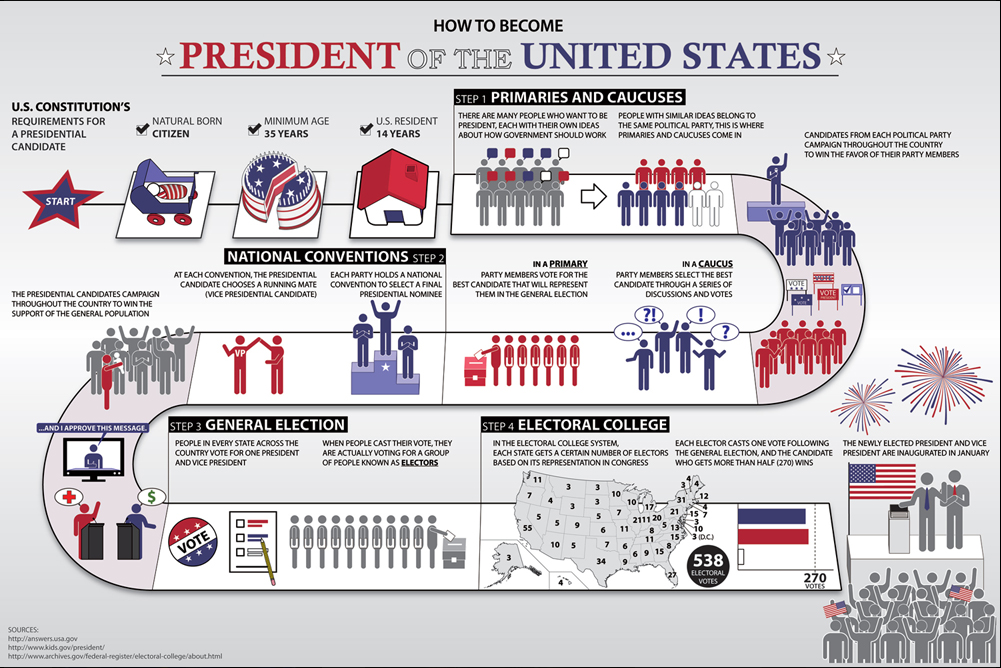
How to Become the US President: A Step-by-Step Guide
[TABLE="width: 780, align: center"]
[TR]
[TD]1. Meet Eligibility Guidelines Set by the US Constitution

2. Test the Water: Pre-Candidacy Process

3. Declare Candidacy & File Applications with Federal Election Commission

4. Fundraise and Campaign

5. Party Primaries, Caucuses, and Delegates

6. Party Conventions

7. General Election Campaign: The Final Candidates

8. Election Day: Winning the Popular and Electoral Votes[/TD]
[TD="align: center"]
(Click to enlarge)[/TD]
[/TR]
[TR]
[TD="align: center"]
A step-by-step chart of how to become US President
Source: Shahed Syed, www.shah3d.com
[/TD]
[/TR]
[/TABLE]

[TABLE="width: 755, align: center"]
[TR]
[TD="bgcolor: #9FB4B9"]1. Meet Eligibility Guidelines Set by the US Constitution[/TD]
[/TR]
[TR]
[TD]Article II of the United States Constitution establishes the Executive Branch of the Government, including the President, Vice-President, and other executive officers. Within Article II, rules are set as to who can become President and how a President is elected:

"Article II

Section 1.
The executive power shall be vested in a President of the United States of America. He shall hold his office during the term of four years, and, together with the Vice President, chosen for the same term, be elected, as follows:

...No person except a natural born citizen, or a citizen of the United States at the time of the adoption of this Constitution, shall be eligible to the office of President neither shall any person be eligible to that office who shall not have attained to the age of thirty five years, and been fourteen Years a resident within the United States."
United States Constitution, Sep. 17, 1787

[/TD]
[/TR]
[TR]
[TD="bgcolor: #9FB4B9"]2. Test the Water: Pre-Candidacy Process[/TD]
[/TR]
[TR]
[TD][TABLE="width: 124"]
[TR]
[TD="align: center"]
testing-the-water-pre-candidacy-process.jpg
[/TD]
[/TR]
[/TABLE]
"Serious candidates for president must begin preparing for the election years in advance. The first decision potential candidates and their families face is whether or not they are suited for the demands of the office and willing to make the personal sacrifices necessary to win the election. The next step usually involves forming political action committees to broaden a candidate's visibility, to test the candidate's appeal nationwide, and to raise money for increasingly expensive campaigns. Candidates also establish exploratory committees whose job it is to 1) seriously consider the candidate's chances of becoming president, 2) suggest possible campaigns themes and slogans, 3) write speeches and position papers, 4) seek endorsements from powerful individuals and groups, 5) recruit professional and volunteer staff, 6) begin organizing state campaigns in key states, 7) hire pollsters and consultants, and 8) develop media appeals."
Thomas S. Vontz and William A. Nixon, "Teaching About Presidential Elections," Indiana University at Bloomington, Center for Social Studies and International Education website, Aug. 2000

[/TD]
[/TR]
[TR]
[TD="bgcolor: #9FB4B9"]3. Declare Candidacy & File Applications with Federal Election Commission[/TD]
[/TR]
[TR]
[TD]The Federal Election Commission (FEC), created by Congress to administer and enforce the Federal Election Campaign Act (FECA) - the statute that governs the financing of federal elections, defines the process of registering a candidacy for President in the following manner:

"If you are running for the U.S. House, Senate or the Presidency, you must register with the FEC once you (or persons acting on your behalf) receive contributions or make expenditures in excess of $5,000. Within 15 days of reaching that $5,000 threshold, you must file a Statement of Candidacy authorizing a principal campaign committee to raise and spend funds on your behalf. Within 10 days of that filing, your principal campaign committee must submit a Statement of Organization. Your campaign will thereafter report its receipts and disbursements on a regular basis."
"Quick Answers to Candidate Questions," www.fec.gov (accessed Aug. 29, 2011)
[/TD]
[/TR]
[TR]
[TD="align: center"]
[/TD]
[/TR]
[TR]
[TD]"Filing papers with the FEC usually coincides with announcements by candidates that they have formed an 'exploratory committee' to investigate the possibility of a presidential run. Even if it's clear that the candidates have every intention of running for president, this exploratory committee provides an escape hatch should they decide the time's not right to run...

From the perspective of the officials at the FEC who regulate how candidates finance their campaigns, announcing an exploratory committee is the same thing as announcing a full-fledged campaign for the presidency. The reason is that once a candidate starts raising funds for a presidential bid, everything counts toward the legal limits on contributions and spending, provided the candidate intends to participate in the public financing system...

Raising lots of money early in the game shows that a candidate is a serious contender and therefore helps raise even more money. Candidates need to file quarterly financial reports with the FEC, and these are public records. So all interested players can immediately see who is doing well in 'the invisible primary.'"
"Choosing the President 2004," League of Women Voters website, 2003

[/TD]
[/TR]
[TR]
[TD="bgcolor: #9FB4B9"]4. Fundraise and Campaign[/TD]
[/TR]
[TR]
[TD][TABLE="width: 250"]
[TR]
[TD="align: center"]
barack-obama-2008-campaign.png
[/TD]
[/TR]
[TR]
[TD="align: center"]
Democratic US presidential hopeful Senator Barack Obama (D-IL) greets US Steel Corp. workers in Braddock, PA during his 2008 campaign
Source: "Barack Obama Takes Campaign Bus Tour Through Pennsylvania," www.zimbio.com, Mar. 28, 2008
[/TD]
[/TR]
[/TABLE]
"Presidential campaigns today are grueling marathons that take candidates by air from New York to Chicago to San Francisco and back again in a single day. On the campaign trail they typically make speeches, kiss babies, shake hands, pose for photographs, and find other ways to connect with the 'average' American. Candidates must raise millions of dollars from the party faithful and corporate leaders, ride buses through the hinterland, and rub shoulders with farmers, factory workers, veterans, and soccer moms...They must paint pictures of a better America, make passionate appeals to reason, and stake a claim for moral leadership. Not for the faint of heart, the modern presidential campaign tests the mettle of those who would live in the White House."
The American Presidency: A Glorious Burden, Lonnie G. Bunch, 2000

[TABLE="width: 447, align: left"]
[TR]
[TD="align: center"]
[/TD]
[/TR]
[/TABLE]


"The process The process by which American presidents are chosen has almost no resemblance to the ways in which other democratic countries select their chief executives...

[A] U.S. presidential campaign officially spans nine months and actually starts much earlier. It includes not only a general election but also a series of state caucuses and primary elections in which candidates essentially campaign as individuals, outside the party system...

The major justification for Americas elaborate presidential election system is legitimacy - the idea that the voters must choose the party nominees as well as the final winner if the outcome is truly to reflect the people's choice. Because of popular participation in the nominating process, presidential campaigns are necessarily long and involve large fields of contending candidates...

[TABLE="width: 250"]
[TR]
[TD="align: center"]
george-w-bush-2004-campaign-1.jpg
[/TD]
[/TR]
[TR]
[TD="align: center"]
President George W. Bush kisses a baby during his 2004 campaign
Source: "President George Bush Baby Kiss," prezbaby.com, 2004
[/TD]
[/TR]
[/TABLE]
A Presidential campaign is lengthy and demanding, and there can be only one winner. Nevertheless, recent nominating campaigns, except those in which an incumbent president is seeking reelection, have attracted a half-dozen or more contenders. They begin planning their campaigns almost as soon as the last presidential election is over and hit the campaign trail six to twelve months in advance of the first primaries and caucuses...

Most presidential contenders are not well known to the nation's voters before the campaign, and many of them have no significant record of national accomplishment. They enter the race out of personal ambition and with hopes that a strong showing in the earliest state contests will propel them into the national spotlight."
The American Democracy, Thomas E. Patterson, 1990

[TABLE="width: 447, align: left"]
[TR]
[TD="align: center"]
[/TD]
[/TR]
[/TABLE]


"Why is it so expensive to run for president today? It costs money to raise money, something candidates have to do during their pre-candidacy phase, during the phase when they are officially seeking their party's nomination and, increasingly, during the presidential election as well. Identifying potential donors and supporters, contacting them, and getting them to contribute, as well as to the polls, is expensive. Moreover, candidates are forced to campaign simultaneously in several states. To do so, they need to use the electronic media, design advertisements, and purchase time to air them. This too is costly."
The Road to the White House 2000: The Politics of Presidential Elections, Stephen J. Wayne, 2000

[/TD]
[/TR]
[TR]
[TD="bgcolor: #9FB4B9"]5. Party Primaries, Caucuses, and Delegates[/TD]
[/TR]
[TR]
[TD][/TD]
[/TR]
[TR]
[TD="bgcolor: #F7F7F7"]Primaries[/TD]
[/TR]
[TR]
[TD][TABLE="width: 400"]
[TR]
[TD="align: center"][/TD]
[/TR]
[TR]
[TD="align: center"]
(Click to enlarge)
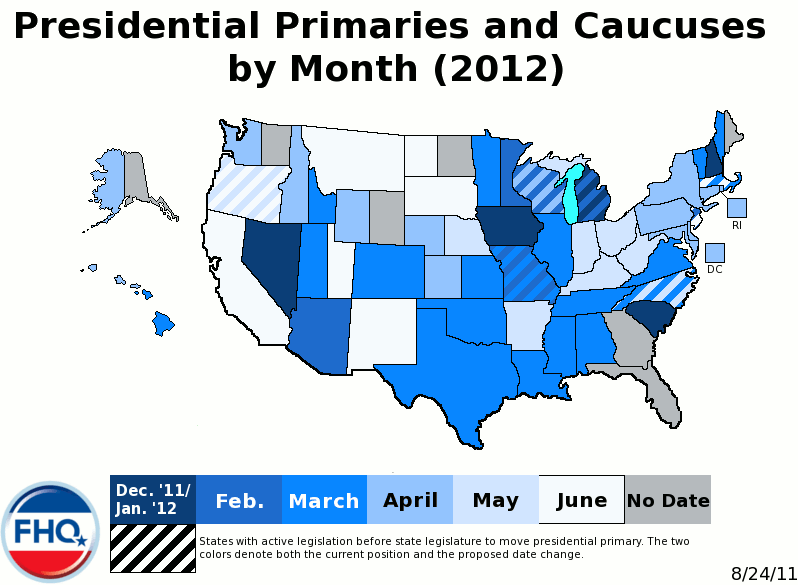
Map of the 2012 presidential primaries and caucuses by month and state
Source: "The 2012 Presidential Primary Calendar," frontloading.blogspost.com, Aug. 24, 2011
[/TD]
[/TR]
[/TABLE]
"In the early twentieth century there was a movement to give more power to citizens in the selection of candidates for the party's nomination. The primary election developed from this reform movement. In a primary election, registered voters may participate in choosing the candidate for the party's nomination by voting through secret ballot, as in a general election.There are two main types of primaries, closed or open, that determine who is eligible to vote in the primary. In a closed primary a registered voter may vote only in the election for the party with which that voter is affiliated. For example a voter registered as Democratic can vote only in the Democratic primary and a Republican can vote only in the Republican primary. In an open primary, on the other hand, a registered voter can vote in either primary regardless of party membership. The voter cannot, however, participate in more than one primary. A third less common type of primary, the blanket primary, allows registered voters to participate in all primaries.
In addition to differences in which voters are eligible to vote in the primary, there are differences in whether the ballot lists candidate or delegate names. The presidential preference primary is a direct vote for a specific candidate. The voter chooses the candidate by name. The second method is more indirect, giving the voter a choice among delegate names rather than candidate names. As in the caucus, delegates voice support for a particular candidate or remain uncommitted.
In some states a combination of the primary and caucus systems are used. The primary serves as a measure of public opinion but is not necessarily binding in choosing delegates. Sometimes the Party does not recognize open primaries because members of other parties are permitted to vote."
"How Does the Primary Process Work?," www.vote-smart.org (accessed Aug. 29, 2011)
[/TD]
[/TR]
[TR]
[TD="align: center"]
[/TD]
[/TR]
[TR]
[TD]"Presidential caucuses and primaries differ from state to state, as do the rules and qualifications for getting on the ballot. Generally, a state presidential caucus is a multilayered system of meetings usually attracting only dedicated party members who elect delegates to represent them in the next stage of the election process. There are two types of state primaries. In the first type, voters directly vote for the person they want to nominate for the presidency. In the second type, voters elect delegates to the national nominating convention. Since 1956 these state contests have determined each party's nominee for the presidency. Traditionally, Iowa conducts the first caucus and New Hampshire the first primary, giving these two smaller states significant influence over the process."
Thomas S. Vontz and William A. Nixon, "Teaching About Presidential Elections," Indiana University at Bloomington, Center for Social Studies and International Education website, Aug. 2000

[/TD]
[/TR]
[TR]
[TD="bgcolor: #F7F7F7"]Caucuses[/TD]
[/TR]
[TR]
[TD]"Caucuses were the original method for selecting candidates but have decreased in number since the primary was introduced in the early 1900's. In states that hold caucuses a political party announces the date, time, and location of the meeting. Generally any voter registered with the party may attend. At the caucus, delegates are chosen to represent the state's interests at the national party convention. Prospective delegates are identified as favorable to a specific candidate or uncommitted. After discussion and debate an informal vote is taken to determine which delegates should be chosen."
"How Does the Primary Process Work?," www.vote-smart.org (accessed Aug. 29, 2011)
[TABLE="width: 372, align: right"]
[TR]
[TD="align: center"]
[/TD]
[/TR]
[/TABLE]

[TABLE="width: 300"]
[TR]
[TD="align: center"]
2008-texas-democratic-caucus-vote-1.jpg
[/TD]
[/TR]
[TR]
[TD="align: center"]
Members of Precinct 379 in Houston, TX vote at a Mar. 29, 2008 caucus to select 67 delegates to the Democratic national convention
Source: "Fighting for Every Texas Delegate," www.time.com, Mar. 31, 2008
[/TD]
[/TR]
[/TABLE]

"A caucus is a gathering of voters from the same party at the precinct level; a precinct is the smallest electoral district within a county. Caucuses tend to attract no more than 10 percent of the eligible voters; primaries often get 20 percent or more. Participants in a caucus vote on party platforms and policies and select delegates to the next-higher-level party convention. There may be two or three higher levels, including district or county and state. In a caucus state, all those who want to represent their state at one of the national conventions must first win election as a convention delegate at one of the caucuses. Caucuses generally occur at a set time and date in locations throughout the state; thousands of caucus meetings can be happening all at once. Party rules require caucus dates, times, and locations to be publicized well in advance so voters can plan to attend. The conventional wisdom is that caucuses are won by the best-organized candidates--those who are able to mobilize large numbers of loyal supporters to attend the caucus meetings."
"Choosing the President 2004," League of Women Voters website, 2003

[TABLE="width: 521, align: center"]
[TR]
[TD="align: center"]
[/TD]
[/TR]
[/TABLE]
"Caucus, a general term for a policymaking meeting of members of a political party. The term has various shades of meaning, depending on the nature of the business transacted at such a meeting. Undertones of disrepute are associated with the word because of the early American practice of holding clandestine caucuses to select candidates and determine issues without public discussion.​
The congressional caucus for nominating U.S. presidential candidates in the first quarter of the 19th century was later discredited and gave way to national party conventions. Nominating caucuses in state legislatures gave way to conventions and later to direct primary elections. Legislative caucuses on the national and state levels in the United States remain useful tools for determining party strategy, but their decisions are not necessarily binding on legislators."
"Caucus," ap.grolier.com (accessed July 3, 2007)

[/TD]
[/TR]
[TR]
[TD="bgcolor: #F7F7F7"]Delegates[/TD]
[/TR]
[TR]
[TD="align: center"][TABLE="width: 566, align: center"]
[TR]
[TD]Democrats[/TD]
[TD]Republicans[/TD]
[TD]Third Parties[/TD]
[/TR]
[/TABLE]
[/TD]
[/TR]
[TR]
[TD]Democrats[/TD]
[/TR]
[TR]
[TD][TABLE="width: 425"]
[TR]
[TD="align: center"][/TD]
[/TR]
[TR]
[TD="align: center"](Click to enlarge)
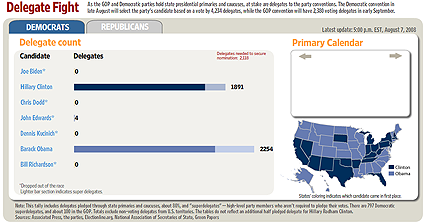
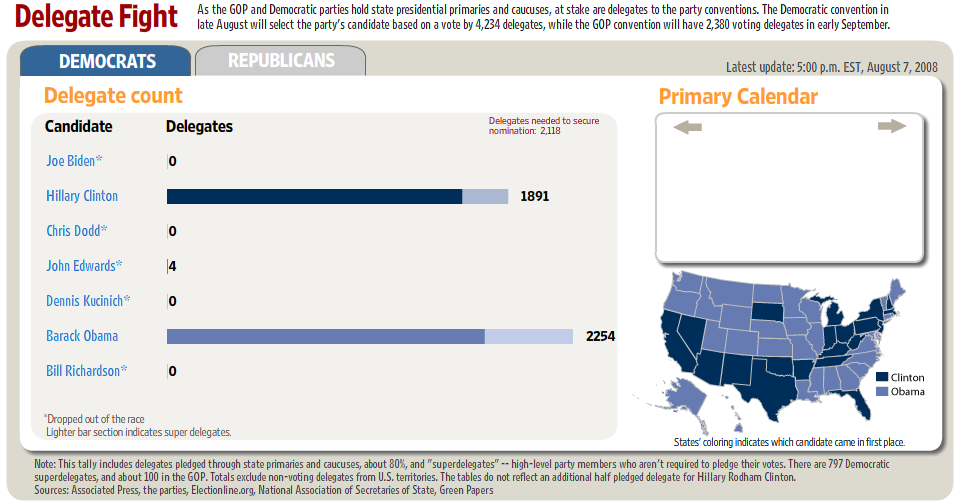
Democratic party delegate count for the 2008 presidential election
Source: "Delegate Fight," Wall Street Journal website, Aug. 7, 2008
[/TD]
[/TR]
[/TABLE]
Why do Democratic delegates matter?

"To become the Democratic nominee for president, a candidate has to be nominated by a majority of delegates attending the Democratic National Convention [in Charlotte, NC, Sep. 1-4, 2012]."

What types of Democratic delegates are there?

"The Democratic Party has two types of delegates: Pledged and superdelegates...

A pledged delegate is elected or chosen on the state and local level with the understanding that they will support a particular candidate at the convention.

However, pledged delegates are not actually bound to vote for the candidate. Consequently, candidates are allowed on a state-by-state basis to review lists of delegates who have pledged their support and can delete anyone whose support they consider unreliable.

Superdelegates [created in 1982]... are usually Democratic members of Congress, governors, national committee members or party leaders (such as former presidents and vice presidents). They are not required to indicate a preference for a candidate, nor do they compete for the privilege like pledged delegates..."

[Read a complete list of the 2008 Superdelegates]

How are Democratic delegates awarded after a primary or caucus is held?

"The Democratic Party uses proportional representation to decide how many pledged delegates are awarded to each candidate.

For instance, a candidate who wins 40 percent of the vote in a state's primary would essentially win 40 percent of that state's pledged delegates. A second-place finisher in that primary who wins 30 percent of the vote essentially gets 30 percent of the pledged delegates.

However, a candidate has to receive at least 15 percent of the vote to get any pledged delegates...

There is no official process to win superdelegates because they can vote for whomever they please. But a candidate can use whatever powers of persuasion they have at their disposal to win the support of a superdelegate."
"Why Delegates Matter in the Presidential Race," CNN.com, (accessed Aug. 29, 2011)
["Pledged delegate" and "Superdelegates" bolded by ProCon.org]

[Read our 2008 Democratic Party State-by-State Primary and Caucus Guide]

What happens to Democratic delegates who have pledged their votes to a candidate who has dropped out of the race?

"When a candidate decides to leave the presidential race, they are entitled to keep any district-level delegates that were awarded to them and any district-level delegates that might be awarded to them in future contests. If pledged PLEO [party leader and elected official] delegates and at-large delegates have been selected prior to the candidate withdrawing from the race, they are also allowed to keep those delegates. However, if a candidate leaves the race prior to the selection of pledged PLEO and at-large delegates, those delegate positions are reallocated to the candidates still in the race.

Delegates are not 'bound' to vote for the candidate they were elected to represent. They can, and have in the past, cast a vote for another presidential candidate at the Convention. As a sign of good faith, most former candidates will "release” their delegates from voting for them; however, this is not required, and only has a symbolic meaning to it. Delegates can vote for another presidential candidate without being 'released.'"
"DELEGATES 101: Frequently Asked Questions About the Presidential Nominating Process,"
Democratic National Committee document emailed to ProCon.org, Feb. 14, 2008
[/TD]
[/TR]
[TR]
[TD="align: center"]
[/TD]
[/TR]
[TR]
[TD]Republicans[/TD]
[/TR]
[TR]
[TD][TABLE="width: 425"]
[TR]
[TD="align: center"][/TD]
[/TR]
[TR]
[TD="align: center"](Click to enlarge)
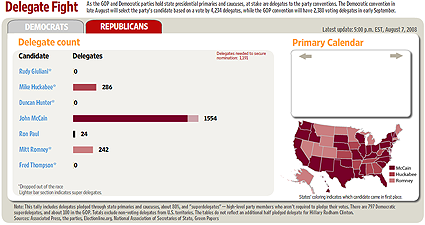
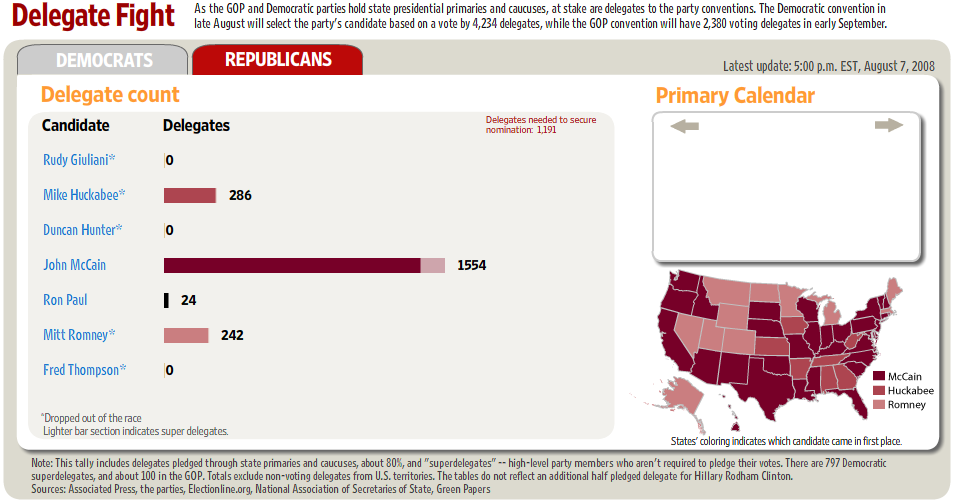
Republican party delegate count for the 2008 presidential election
Source: "Delegate Fight," Wall Street Journal website, Aug. 7, 2008
[/TD]
[/TR]
[/TABLE]
Why do Republican delegates matter?

"To become the Republican nominee for president, a candidate has to be nominated by a majority of delegates attending the Republican National Convention [in Tampa Bay, FL, Aug. 25-28, 2012]."

What types of Republican delegates are there?

"The Republican Party has two types of delegates: Pledged and unpledged...

[P]ledged delegates... have to indicate support for a particular candidate at the convention. They are usually elected or chosen on the state and local level.

Unpledged delegates...are not required to indicate a preference for a candidate."

How are Republican delegates awarded after a primary or caucus is held?

"A majority of Republican unpledged delegates are elected just like pledged delegates and are likely to be committed to a specific candidate. A sizable minority of unpledged delegates automatically become delegates by virtue of their status as either a party chair or a national party committee person. This group is known as unpledged RNC [Republican National Committee] member delegates....

State parties decide how pledged delegates are awarded to each candidate during the Republican nomination process.

Many states use a 'winner take all' system. Some states use a proportional representation system in which a candidate's share of the popular vote is the percentage of pledged delegates they are awarded.

The Republican National Committee does not require a 15 percent threshold, but individual state parties may have a threshold.

The unpledged RNC member delegates -- party chairmen and committee persons who are not elected delegates -- are free to vote for any candidate and are not bound by the electoral results of their state.

The unpledged delegates who are elected or chosen -- though they are technically free to vote for any candidate -- are likely to be committed to a specific candidate."
"Why Delegates Matter in the Presidential Race," CNN.com (accessed Aug. 29, 2011)
["Pledged" and "Unpledged delegates" bolded by ProCon.org]
[Read our 2008 Republican Party State-by-State Primary and Caucus Guide]

What happens to Republican delegates who have pledged their votes to a candidate who has dropped out of the race?

"Throughout the country, there are more than 280 Romney delegates, but different states have different rules. For instance, Loomis [Burdett Loomis, University of Kansas Political Science Professor] says, the two dozen Romney delegates in his home state of Michigan have been told that they are free to vote as they like. In Massachusetts, the former governor still has control of his 22 delegates. And in some states, GOP delegates won't even be selected until upcoming county conventions."
"What Happens to Delegates for Romney, Edwards?," Alex Cohen, National Public Radio (NPR) online, Feb. 13, 2008
[/TD]
[/TR]
[TR]
[TD="align: center"]
[/TD]
[/TR]
[TR]
[TD]Third Party[/TD]
[/TR]
[TR]
[TD]Third parties have national conventions, and they do participate in primaries and caucuses although not necessarily in every state. Each party varies in how they select delegates. Below we highlight the delegate process for the Constitution Party, Green Party, Libertarian Party, and Reform Party. These political parties were included based on 2004 Presidential election ballot access. Each of these third parties had candidates on the ballot in enough states to have a chance of winning the 270 electoral votes needed to be elected president.[/TD]
[/TR]
[TR]
[TD]The Constitution Party

The Constitution Party selects its delegates in state primaries and caucuses. The number of delegates awarded within each state is loosely based on the number of electoral college votes and the level of organization for the party within the state, i.e. the number of state party members and their success at electing party members to local and state offices.

Green Party

The Green Party selects its delegates in state primaries and caucuses. The number of delegates in each state is based on the state's electoral votes, the number of votes the Green Party received in the most recent major statewide election, the number of Green Party members elected to office during the most recent election, and the number of state delegates on the National Coordinating Committee.

Libertarian Party

The Libertarian Party selects its delegates in state primaries and caucuses. The number of delegates in each state is determined by that state's Libertarian Party membership and the number of votes the nationally nominated Libertarian Presidential candidate received from that state in the prior presidential election.

Reform Party

The Reform Party selects its delegates in state primaries and caucuses. The number of delegates in each state's delegation is equal to the number of Congressional Districts of the State plus three at-large delegates.[/TD]
[/TR]
[TR]
[TD][Note: We normally quote other organizations when presenting data; however, we were unable to find a suitable quote describing how third parties select delegates, so we opted to create our own description in this case.]

[See the results of all the Democratic, Republican, and Third Party primaries in the 2008 presidential election]
[/TD]
[/TR]
[TR]
[TD="bgcolor: #9FB4B9"]6. Party Conventions[/TD]
[/TR]
[TR]
[TD]"A key part of the American political process has included party conventions held every four years to determine the major parties Presidential candidates. The first party to introduce nominating conventions was the Anti-Masons. Delegates from 13 states met in Baltimore Maryland on September 26, 1831 were they selected Attorney General William Wirt of Maryland to be there candidate. The Democrats followed in 1832 renominated President Jackson. Since that time many of the conventions have been places of great drama, where it has taken multiple votes to elect a parties Presidential candidate. In recent years with the current system of primaries in which most of the convention votes are decided the drama of the conventions has been lost as the outcomes have been predetermined. Instead the conventions have been used as a tool by the parties to market their candidates and unveil their parties platform. In recent years the only true disagreements at the conventions have been negotiations over party platform."[TABLE="width: 250"]
[TR]
[TD="align: center"]
2008-republican-national-convention-st-paul-1.jpg
[/TD]
[/TR]
[TR]
[TD="align: center"]
Members of the Texas delegation at the 2008 Republican National Convention in St. Paul, MN
Source: "Photo Galleries," apps.detnews.com, Sep. 1-4, 2008
[/TD]
[/TR]
[/TABLE]
"Presidential Conventions," HistoryCentral.com (accessed on Aug. 29, 2011)
[TABLE="width: 372, align: left"]
[TR]
[TD="align: center"]
[/TD]
[/TR]
[/TABLE]


"Political conventions are almost as old as political parties. They have symbolic as well as practical importance for the parties and for the country. They are ritual -- part of the American political tradition. They are a showpiece for party leaders and elected officials and a mechanism by which nominees are formally chosen, platforms drafted, and presidential campaigns launched...

Preliminary decisions on the convention are made by the party's national committee, usually on the recommendation of its chair and appropriate convention committees. An incumbent president normally exercises considerable influence over many of these decisions: the choice of a convention city, the selection of temporary and permanent convention officials, and the designation of the principal speakers. Both the Democrats and the Republicans have traditionally turned to national party leaders, primarily members of Congress, to fill many of the positions"
The Road to the White House 2000: The Politics of Presidential Elections, Stephen J. Wayne, July 3, 2007
[TABLE="width: 250"]
[TR]
[TD="align: center"]
2008-democratic-national-convention-denver.png
[/TD]
[/TR]
[TR]
[TD="align: center"]
2008 Democratic National Convention in Denver, CO
Source: "2008 Democratic National Convention,"www.iop.harvard.edu, Aug. 25-28, 2008
[/TD]
[/TR]
[/TABLE]
[TABLE="width: 372, align: right"]
[TR]
[TD="align: center"]
[/TD]
[/TR]
[/TABLE]


"The Changing Character of Conventions

In the past, the national convention served as a decision-making body, actually determining the party's nominee...
Two significant changes have occurred in recent decades. First, most of the national convention delegates are now selected by voters in primary contests rather than by party caucuses and meetings. Second, with the advent of television, conventions have become tightly scripted made-for-TV spectacles. Each party seeks to present itself in the best possible light and to demonstrate a united front rather than to hash out its differences...
The conventions may have been reduced to rubber stamps, but they still fulfill a vital function in the life of the political parties. In many ways, the essence of a convention is what happens off of the convention floor. In the lead-up to the convention, the drafting of the party platform provides interests aligned with the party a forum to present their concerns. During the days of the convention itself, hundreds of events, caucuses, receptions, breakfasts, fundraisers, and parties take place in the hotels surrounding the convention hall. At the end of the convention, party activists return to their communities energized for the fall campaign and, if all goes well, the presidential ticket emerges with a convention bounce...
The major party conventions are funded by grants from the Presidential Election Campaign Fund (the $3 income tax check-off), by non-partisan, non-profit host committees, and to a lesser degree by local taxpayers. For their 2008 conventions, the Democrats and Republicans each received grants of about $16.4 million. On June 16, 2007 the FEC certified the Democratic and Republican parties were each entitled to receive $16,356,000 in public funds to put on their 2008 national conventions, and sent letters to the Secretary of the Treasury requesting the payments be made. (These grants, set out in the Federal Election Campaign Act, started at $2.2 million back in 1976 and were increased a couple of times in addition to being adjusted for cost-of-living increases)."
"Conventions," Eric M. Appleman, www.gwu.edu/~action (accessed Aug. 29, 2011)

[/TD]
[/TR]
[TR]
[TD="bgcolor: #9FB4B9"]7. General Election Campaign: The Final Candidates[/TD]
[/TR]
[TR]
[TD][TABLE="width: 375"]
[TR]
[TD="align: center"][/TD]
[/TR]
[TR]
[TD="align: center"](Click to enlarge)
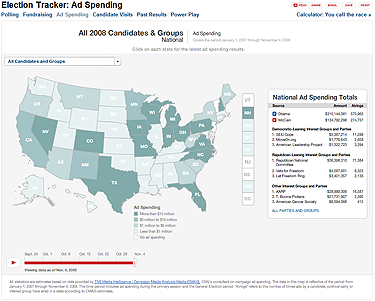
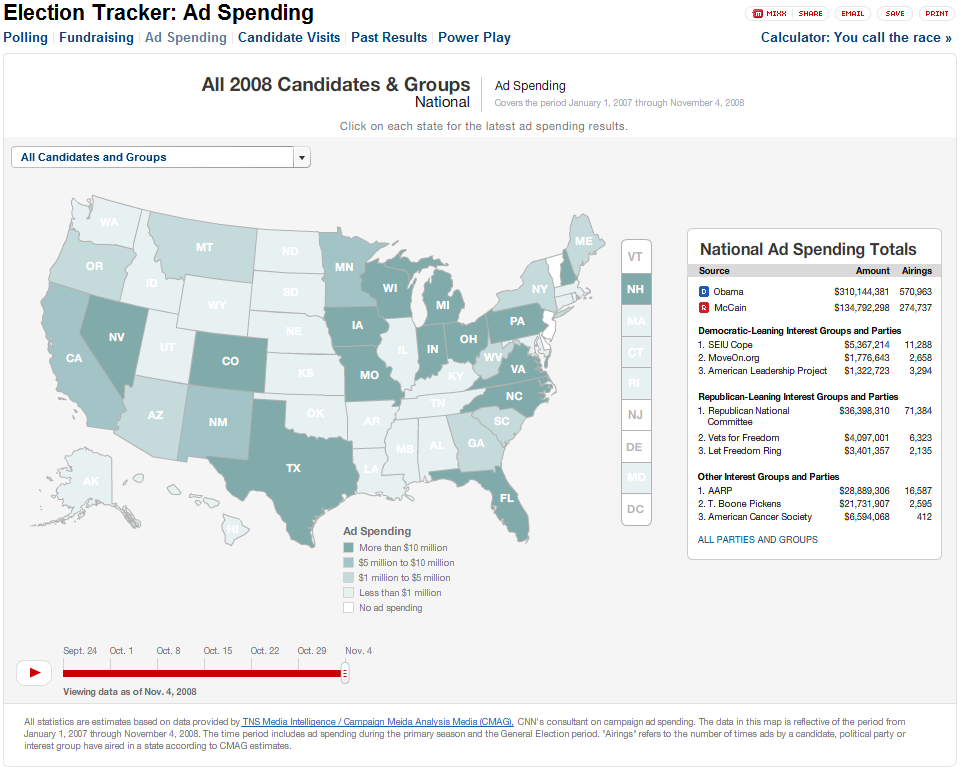
Ad spending for all 2008 candidates and groups, Jan. 1, 2007-Nov. 4, 2008
Source: "ElectionCenter2008," www.cnn.com, Nov. 4, 2008
[/TD]
[/TR]
[/TABLE]
"Today's general election contest is an elaborate production, with the candidates and their supporters crisscrossing the country and blanketing the airwaves with poll-tested political commercials. With the primaries and the conventions behind them, the goal of the presidential candidates during the fall is to appeal to as many different kinds of people in a country where close to two hundred million individuals are eligible to vote is a staggering task...

The fall brings with it a number of strategic decisions for the candidates and their campaign organizations. But perhaps the most important decision facing the candidates as they approach the general election season is how to refine their message so it resonates with a majority of the American electorate... 'Shifting to the center,' as it is called, is often a tightrope walk for the candidates because they don't want to offend their primary supporters or make it appear as though they are abandoning their earlier commitments...

Today's presidential candidates essentially wage three campaigns at the same time. The first is the grassroots campaign. While the candidates themselves have little direct involvement in it, national campaign staff help to give it direction. It includes hundreds of local campaign headquarters and party organizations, from which volunteers and a few paid staff reach out into local communities. They register voters, make phone calls, send out mail, help friendly voters apply for absentee ballots, put up signs, do door-to-door canvassing, and get out the vote on Election Day...

The second level of campaigning is on the ground, and includes all of the candidate's appearances and speeches, as well as the appearances throughout the country of key supporters, from the candidate's spouse and children to the vice presidential nominee, Hollywood celebrities, and prominent party leaders... The third campaign in which the candidates are engaged is an on-the-air battle of radio and television commercials. This advertising is the most expensive line item in the campaign budget--an estimated one-third of the $1.5 billion spent on the 2000 presidential campaign. The advertising gives the candidates massive nation-wide exposure that they couldn't possibly achieve on the ground."
"Choosing the President 2004," League of Women Voters website, 2003


How to Become the US President: A Step-by-Step Guide - 2012 Presidential Election - ProCon.org[/TD]
[/TR]
[/TABLE]
 
RALPH NADER pia analean Socialist an kila anapogombea anachukua kura nyingi za DEMOCRATS huko New York na California ndio maana alisababisha AL GORE akashindwa na George Bush 2000; ni Democrat very left Very LIBERAL nadhani unajua what's LIBERAL now baada ya CUF...

Angalia HAPA --- ninavyokuambia hakuna INDEPENDENT PARTY na RALPH NADAR alipata only states 45 kati ya 50 kwahiyo states 5 hakuwa kwenye BALLOT... kwasababu local vyama vya states hizo hazikupenda ITIKADI ZAKE...


How to Become the US President: A Step-by-Step Guide
[TABLE="width: 780, align: center"]
[TR]
[TD]1. Meet Eligibility Guidelines Set by the US Constitution

2. Test the Water: Pre-Candidacy Process

3. Declare Candidacy & File Applications with Federal Election Commission

4. Fundraise and Campaign

5. Party Primaries, Caucuses, and Delegates

6. Party Conventions

7. General Election Campaign: The Final Candidates

8. Election Day: Winning the Popular and Electoral Votes[/TD]
[TD="align: center"]
(Click to enlarge)[/TD]
[/TR]
[TR]
[TD="align: center"]
A step-by-step chart of how to become US President
Source: Shahed Syed, www.shah3d.com
[/TD]
[/TR]
[/TABLE]

[TABLE="width: 755, align: center"]
[TR]
[TD="bgcolor: #9FB4B9"]1. Meet Eligibility Guidelines Set by the US Constitution[/TD]
[/TR]
[TR]
[TD]Article II of the United States Constitution establishes the Executive Branch of the Government, including the President, Vice-President, and other executive officers. Within Article II, rules are set as to who can become President and how a President is elected:

"Article II

Section 1.
The executive power shall be vested in a President of the United States of America. He shall hold his office during the term of four years, and, together with the Vice President, chosen for the same term, be elected, as follows:

...No person except a natural born citizen, or a citizen of the United States at the time of the adoption of this Constitution, shall be eligible to the office of President neither shall any person be eligible to that office who shall not have attained to the age of thirty five years, and been fourteen Years a resident within the United States."
United States Constitution, Sep. 17, 1787

[/TD]
[/TR]
[TR]
[TD="bgcolor: #9FB4B9"]2. Test the Water: Pre-Candidacy Process[/TD]
[/TR]
[TR]
[TD][TABLE="width: 124"]
[TR]
[TD="align: center"]
testing-the-water-pre-candidacy-process.jpg
[/TD]
[/TR]
[/TABLE]
"Serious candidates for president must begin preparing for the election years in advance. The first decision potential candidates and their families face is whether or not they are suited for the demands of the office and willing to make the personal sacrifices necessary to win the election. The next step usually involves forming political action committees to broaden a candidate's visibility, to test the candidate's appeal nationwide, and to raise money for increasingly expensive campaigns. Candidates also establish exploratory committees whose job it is to 1) seriously consider the candidate's chances of becoming president, 2) suggest possible campaigns themes and slogans, 3) write speeches and position papers, 4) seek endorsements from powerful individuals and groups, 5) recruit professional and volunteer staff, 6) begin organizing state campaigns in key states, 7) hire pollsters and consultants, and 8) develop media appeals."
Thomas S. Vontz and William A. Nixon, "Teaching About Presidential Elections," Indiana University at Bloomington, Center for Social Studies and International Education website, Aug. 2000

[/TD]
[/TR]
[TR]
[TD="bgcolor: #9FB4B9"]3. Declare Candidacy & File Applications with Federal Election Commission[/TD]
[/TR]
[TR]
[TD]The Federal Election Commission (FEC), created by Congress to administer and enforce the Federal Election Campaign Act (FECA) - the statute that governs the financing of federal elections, defines the process of registering a candidacy for President in the following manner:

"If you are running for the U.S. House, Senate or the Presidency, you must register with the FEC once you (or persons acting on your behalf) receive contributions or make expenditures in excess of $5,000. Within 15 days of reaching that $5,000 threshold, you must file a Statement of Candidacy authorizing a principal campaign committee to raise and spend funds on your behalf. Within 10 days of that filing, your principal campaign committee must submit a Statement of Organization. Your campaign will thereafter report its receipts and disbursements on a regular basis."
"Quick Answers to Candidate Questions," www.fec.gov (accessed Aug. 29, 2011)
[/TD]
[/TR]
[TR]
[TD="align: center"]
[/TD]
[/TR]
[TR]
[TD]"Filing papers with the FEC usually coincides with announcements by candidates that they have formed an 'exploratory committee' to investigate the possibility of a presidential run. Even if it's clear that the candidates have every intention of running for president, this exploratory committee provides an escape hatch should they decide the time's not right to run...

From the perspective of the officials at the FEC who regulate how candidates finance their campaigns, announcing an exploratory committee is the same thing as announcing a full-fledged campaign for the presidency. The reason is that once a candidate starts raising funds for a presidential bid, everything counts toward the legal limits on contributions and spending, provided the candidate intends to participate in the public financing system...

Raising lots of money early in the game shows that a candidate is a serious contender and therefore helps raise even more money. Candidates need to file quarterly financial reports with the FEC, and these are public records. So all interested players can immediately see who is doing well in 'the invisible primary.'"
"Choosing the President 2004," League of Women Voters website, 2003

[/TD]
[/TR]
[TR]
[TD="bgcolor: #9FB4B9"]4. Fundraise and Campaign[/TD]
[/TR]
[TR]
[TD][TABLE="width: 250"]
[TR]
[TD="align: center"]
barack-obama-2008-campaign.png
[/TD]
[/TR]
[TR]
[TD="align: center"]
Democratic US presidential hopeful Senator Barack Obama (D-IL) greets US Steel Corp. workers in Braddock, PA during his 2008 campaign
Source: "Barack Obama Takes Campaign Bus Tour Through Pennsylvania," www.zimbio.com, Mar. 28, 2008
[/TD]
[/TR]
[/TABLE]
"Presidential campaigns today are grueling marathons that take candidates by air from New York to Chicago to San Francisco and back again in a single day. On the campaign trail they typically make speeches, kiss babies, shake hands, pose for photographs, and find other ways to connect with the 'average' American. Candidates must raise millions of dollars from the party faithful and corporate leaders, ride buses through the hinterland, and rub shoulders with farmers, factory workers, veterans, and soccer moms...They must paint pictures of a better America, make passionate appeals to reason, and stake a claim for moral leadership. Not for the faint of heart, the modern presidential campaign tests the mettle of those who would live in the White House."
The American Presidency: A Glorious Burden, Lonnie G. Bunch, 2000

[TABLE="width: 447, align: left"]
[TR]
[TD="align: center"]
[/TD]
[/TR]
[/TABLE]


"The process The process by which American presidents are chosen has almost no resemblance to the ways in which other democratic countries select their chief executives...

[A] U.S. presidential campaign officially spans nine months and actually starts much earlier. It includes not only a general election but also a series of state caucuses and primary elections in which candidates essentially campaign as individuals, outside the party system...

The major justification for Americas elaborate presidential election system is legitimacy - the idea that the voters must choose the party nominees as well as the final winner if the outcome is truly to reflect the people's choice. Because of popular participation in the nominating process, presidential campaigns are necessarily long and involve large fields of contending candidates...

[TABLE="width: 250"]
[TR]
[TD="align: center"]
george-w-bush-2004-campaign-1.jpg
[/TD]
[/TR]
[TR]
[TD="align: center"]
President George W. Bush kisses a baby during his 2004 campaign
Source: "President George Bush Baby Kiss," prezbaby.com, 2004
[/TD]
[/TR]
[/TABLE]
A Presidential campaign is lengthy and demanding, and there can be only one winner. Nevertheless, recent nominating campaigns, except those in which an incumbent president is seeking reelection, have attracted a half-dozen or more contenders. They begin planning their campaigns almost as soon as the last presidential election is over and hit the campaign trail six to twelve months in advance of the first primaries and caucuses...

Most presidential contenders are not well known to the nation's voters before the campaign, and many of them have no significant record of national accomplishment. They enter the race out of personal ambition and with hopes that a strong showing in the earliest state contests will propel them into the national spotlight."
The American Democracy, Thomas E. Patterson, 1990

[TABLE="width: 447, align: left"]
[TR]
[TD="align: center"]
[/TD]
[/TR]
[/TABLE]


"Why is it so expensive to run for president today? It costs money to raise money, something candidates have to do during their pre-candidacy phase, during the phase when they are officially seeking their party's nomination and, increasingly, during the presidential election as well. Identifying potential donors and supporters, contacting them, and getting them to contribute, as well as to the polls, is expensive. Moreover, candidates are forced to campaign simultaneously in several states. To do so, they need to use the electronic media, design advertisements, and purchase time to air them. This too is costly."
The Road to the White House 2000: The Politics of Presidential Elections, Stephen J. Wayne, 2000

[/TD]
[/TR]
[TR]
[TD="bgcolor: #9FB4B9"]5. Party Primaries, Caucuses, and Delegates[/TD]
[/TR]
[TR]
[TD][/TD]
[/TR]
[TR]
[TD="bgcolor: #F7F7F7"]Primaries[/TD]
[/TR]
[TR]
[TD][TABLE="width: 400"]
[TR]
[TD="align: center"][/TD]
[/TR]
[TR]
[TD="align: center"]
(Click to enlarge)
Map of the 2012 presidential primaries and caucuses by month and state
Source: "The 2012 Presidential Primary Calendar," frontloading.blogspost.com, Aug. 24, 2011
[/TD]
[/TR]
[/TABLE]
"In the early twentieth century there was a movement to give more power to citizens in the selection of candidates for the party's nomination. The primary election developed from this reform movement. In a primary election, registered voters may participate in choosing the candidate for the party's nomination by voting through secret ballot, as in a general election.There are two main types of primaries, closed or open, that determine who is eligible to vote in the primary. In a closed primary a registered voter may vote only in the election for the party with which that voter is affiliated. For example a voter registered as Democratic can vote only in the Democratic primary and a Republican can vote only in the Republican primary. In an open primary, on the other hand, a registered voter can vote in either primary regardless of party membership. The voter cannot, however, participate in more than one primary. A third less common type of primary, the blanket primary, allows registered voters to participate in all primaries.
In addition to differences in which voters are eligible to vote in the primary, there are differences in whether the ballot lists candidate or delegate names. The presidential preference primary is a direct vote for a specific candidate. The voter chooses the candidate by name. The second method is more indirect, giving the voter a choice among delegate names rather than candidate names. As in the caucus, delegates voice support for a particular candidate or remain uncommitted.
In some states a combination of the primary and caucus systems are used. The primary serves as a measure of public opinion but is not necessarily binding in choosing delegates. Sometimes the Party does not recognize open primaries because members of other parties are permitted to vote."
"How Does the Primary Process Work?," www.vote-smart.org (accessed Aug. 29, 2011)
[/TD]
[/TR]
[TR]
[TD="align: center"]
[/TD]
[/TR]
[TR]
[TD]"Presidential caucuses and primaries differ from state to state, as do the rules and qualifications for getting on the ballot. Generally, a state presidential caucus is a multilayered system of meetings usually attracting only dedicated party members who elect delegates to represent them in the next stage of the election process. There are two types of state primaries. In the first type, voters directly vote for the person they want to nominate for the presidency. In the second type, voters elect delegates to the national nominating convention. Since 1956 these state contests have determined each party's nominee for the presidency. Traditionally, Iowa conducts the first caucus and New Hampshire the first primary, giving these two smaller states significant influence over the process."
Thomas S. Vontz and William A. Nixon, "Teaching About Presidential Elections," Indiana University at Bloomington, Center for Social Studies and International Education website, Aug. 2000

[/TD]
[/TR]
[TR]
[TD="bgcolor: #F7F7F7"]Caucuses[/TD]
[/TR]
[TR]
[TD]"Caucuses were the original method for selecting candidates but have decreased in number since the primary was introduced in the early 1900's. In states that hold caucuses a political party announces the date, time, and location of the meeting. Generally any voter registered with the party may attend. At the caucus, delegates are chosen to represent the state's interests at the national party convention. Prospective delegates are identified as favorable to a specific candidate or uncommitted. After discussion and debate an informal vote is taken to determine which delegates should be chosen."
"How Does the Primary Process Work?," www.vote-smart.org (accessed Aug. 29, 2011)
[TABLE="width: 372, align: right"]
[TR]
[TD="align: center"]
[/TD]
[/TR]
[/TABLE]

[TABLE="width: 300"]
[TR]
[TD="align: center"]
2008-texas-democratic-caucus-vote-1.jpg
[/TD]
[/TR]
[TR]
[TD="align: center"]
Members of Precinct 379 in Houston, TX vote at a Mar. 29, 2008 caucus to select 67 delegates to the Democratic national convention
Source: "Fighting for Every Texas Delegate," www.time.com, Mar. 31, 2008
[/TD]
[/TR]
[/TABLE]

"A caucus is a gathering of voters from the same party at the precinct level; a precinct is the smallest electoral district within a county. Caucuses tend to attract no more than 10 percent of the eligible voters; primaries often get 20 percent or more. Participants in a caucus vote on party platforms and policies and select delegates to the next-higher-level party convention. There may be two or three higher levels, including district or county and state. In a caucus state, all those who want to represent their state at one of the national conventions must first win election as a convention delegate at one of the caucuses. Caucuses generally occur at a set time and date in locations throughout the state; thousands of caucus meetings can be happening all at once. Party rules require caucus dates, times, and locations to be publicized well in advance so voters can plan to attend. The conventional wisdom is that caucuses are won by the best-organized candidates--those who are able to mobilize large numbers of loyal supporters to attend the caucus meetings."
"Choosing the President 2004," League of Women Voters website, 2003

[TABLE="width: 521, align: center"]
[TR]
[TD="align: center"]
[/TD]
[/TR]
[/TABLE]
"Caucus, a general term for a policymaking meeting of members of a political party. The term has various shades of meaning, depending on the nature of the business transacted at such a meeting. Undertones of disrepute are associated with the word because of the early American practice of holding clandestine caucuses to select candidates and determine issues without public discussion.​
The congressional caucus for nominating U.S. presidential candidates in the first quarter of the 19th century was later discredited and gave way to national party conventions. Nominating caucuses in state legislatures gave way to conventions and later to direct primary elections. Legislative caucuses on the national and state levels in the United States remain useful tools for determining party strategy, but their decisions are not necessarily binding on legislators."
"Caucus," ap.grolier.com (accessed July 3, 2007)

[/TD]
[/TR]
[TR]
[TD="bgcolor: #F7F7F7"]Delegates[/TD]
[/TR]
[TR]
[TD="align: center"][TABLE="width: 566, align: center"]
[TR]
[TD]Democrats[/TD]
[TD]Republicans[/TD]
[TD]Third Parties[/TD]
[/TR]
[/TABLE]
[/TD]
[/TR]
[TR]
[TD]Democrats[/TD]
[/TR]
[TR]
[TD][TABLE="width: 425"]
[TR]
[TD="align: center"][/TD]
[/TR]
[TR]
[TD="align: center"](Click to enlarge)
Democratic party delegate count for the 2008 presidential election
Source: "Delegate Fight," Wall Street Journal website, Aug. 7, 2008
[/TD]
[/TR]
[/TABLE]
Why do Democratic delegates matter?

"To become the Democratic nominee for president, a candidate has to be nominated by a majority of delegates attending the Democratic National Convention [in Charlotte, NC, Sep. 1-4, 2012]."

What types of Democratic delegates are there?

"The Democratic Party has two types of delegates: Pledged and superdelegates...

A pledged delegate is elected or chosen on the state and local level with the understanding that they will support a particular candidate at the convention.

However, pledged delegates are not actually bound to vote for the candidate. Consequently, candidates are allowed on a state-by-state basis to review lists of delegates who have pledged their support and can delete anyone whose support they consider unreliable.

Superdelegates [created in 1982]... are usually Democratic members of Congress, governors, national committee members or party leaders (such as former presidents and vice presidents). They are not required to indicate a preference for a candidate, nor do they compete for the privilege like pledged delegates..."

[Read a complete list of the 2008 Superdelegates]

How are Democratic delegates awarded after a primary or caucus is held?

"The Democratic Party uses proportional representation to decide how many pledged delegates are awarded to each candidate.

For instance, a candidate who wins 40 percent of the vote in a state's primary would essentially win 40 percent of that state's pledged delegates. A second-place finisher in that primary who wins 30 percent of the vote essentially gets 30 percent of the pledged delegates.

However, a candidate has to receive at least 15 percent of the vote to get any pledged delegates...

There is no official process to win superdelegates because they can vote for whomever they please. But a candidate can use whatever powers of persuasion they have at their disposal to win the support of a superdelegate."
"Why Delegates Matter in the Presidential Race," CNN.com, (accessed Aug. 29, 2011)
["Pledged delegate" and "Superdelegates" bolded by ProCon.org]

[Read our 2008 Democratic Party State-by-State Primary and Caucus Guide]

What happens to Democratic delegates who have pledged their votes to a candidate who has dropped out of the race?

"When a candidate decides to leave the presidential race, they are entitled to keep any district-level delegates that were awarded to them and any district-level delegates that might be awarded to them in future contests. If pledged PLEO [party leader and elected official] delegates and at-large delegates have been selected prior to the candidate withdrawing from the race, they are also allowed to keep those delegates. However, if a candidate leaves the race prior to the selection of pledged PLEO and at-large delegates, those delegate positions are reallocated to the candidates still in the race.

Delegates are not 'bound' to vote for the candidate they were elected to represent. They can, and have in the past, cast a vote for another presidential candidate at the Convention. As a sign of good faith, most former candidates will "release" their delegates from voting for them; however, this is not required, and only has a symbolic meaning to it. Delegates can vote for another presidential candidate without being 'released.'"
"DELEGATES 101: Frequently Asked Questions About the Presidential Nominating Process,"
Democratic National Committee document emailed to ProCon.org, Feb. 14, 2008
[/TD]
[/TR]
[TR]
[TD="align: center"]
[/TD]
[/TR]
[TR]
[TD]Republicans[/TD]
[/TR]
[TR]
[TD][TABLE="width: 425"]
[TR]
[TD="align: center"][/TD]
[/TR]
[TR]
[TD="align: center"](Click to enlarge)
Republican party delegate count for the 2008 presidential election
Source: "Delegate Fight," Wall Street Journal website, Aug. 7, 2008
[/TD]
[/TR]
[/TABLE]
Why do Republican delegates matter?

"To become the Republican nominee for president, a candidate has to be nominated by a majority of delegates attending the Republican National Convention [in Tampa Bay, FL, Aug. 25-28, 2012]."

What types of Republican delegates are there?

"The Republican Party has two types of delegates: Pledged and unpledged...

[P]ledged delegates... have to indicate support for a particular candidate at the convention. They are usually elected or chosen on the state and local level.

Unpledged delegates...are not required to indicate a preference for a candidate."

How are Republican delegates awarded after a primary or caucus is held?

"A majority of Republican unpledged delegates are elected just like pledged delegates and are likely to be committed to a specific candidate. A sizable minority of unpledged delegates automatically become delegates by virtue of their status as either a party chair or a national party committee person. This group is known as unpledged RNC [Republican National Committee] member delegates....

State parties decide how pledged delegates are awarded to each candidate during the Republican nomination process.

Many states use a 'winner take all' system. Some states use a proportional representation system in which a candidate's share of the popular vote is the percentage of pledged delegates they are awarded.

The Republican National Committee does not require a 15 percent threshold, but individual state parties may have a threshold.

The unpledged RNC member delegates -- party chairmen and committee persons who are not elected delegates -- are free to vote for any candidate and are not bound by the electoral results of their state.

The unpledged delegates who are elected or chosen -- though they are technically free to vote for any candidate -- are likely to be committed to a specific candidate."
"Why Delegates Matter in the Presidential Race," CNN.com (accessed Aug. 29, 2011)
["Pledged" and "Unpledged delegates" bolded by ProCon.org]
[Read our 2008 Republican Party State-by-State Primary and Caucus Guide]

What happens to Republican delegates who have pledged their votes to a candidate who has dropped out of the race?

"Throughout the country, there are more than 280 Romney delegates, but different states have different rules. For instance, Loomis [Burdett Loomis, University of Kansas Political Science Professor] says, the two dozen Romney delegates in his home state of Michigan have been told that they are free to vote as they like. In Massachusetts, the former governor still has control of his 22 delegates. And in some states, GOP delegates won't even be selected until upcoming county conventions."
"What Happens to Delegates for Romney, Edwards?," Alex Cohen, National Public Radio (NPR) online, Feb. 13, 2008
[/TD]
[/TR]
[TR]
[TD="align: center"]
[/TD]
[/TR]
[TR]
[TD]Third Party[/TD]
[/TR]
[TR]
[TD]Third parties have national conventions, and they do participate in primaries and caucuses although not necessarily in every state. Each party varies in how they select delegates. Below we highlight the delegate process for the Constitution Party, Green Party, Libertarian Party, and Reform Party. These political parties were included based on 2004 Presidential election ballot access. Each of these third parties had candidates on the ballot in enough states to have a chance of winning the 270 electoral votes needed to be elected president.[/TD]
[/TR]
[TR]
[TD]The Constitution Party

The Constitution Party selects its delegates in state primaries and caucuses. The number of delegates awarded within each state is loosely based on the number of electoral college votes and the level of organization for the party within the state, i.e. the number of state party members and their success at electing party members to local and state offices.

Green Party

The Green Party selects its delegates in state primaries and caucuses. The number of delegates in each state is based on the state's electoral votes, the number of votes the Green Party received in the most recent major statewide election, the number of Green Party members elected to office during the most recent election, and the number of state delegates on the National Coordinating Committee.

Libertarian Party

The Libertarian Party selects its delegates in state primaries and caucuses. The number of delegates in each state is determined by that state's Libertarian Party membership and the number of votes the nationally nominated Libertarian Presidential candidate received from that state in the prior presidential election.

Reform Party

The Reform Party selects its delegates in state primaries and caucuses. The number of delegates in each state's delegation is equal to the number of Congressional Districts of the State plus three at-large delegates.[/TD]
[/TR]
[TR]
[TD][Note: We normally quote other organizations when presenting data; however, we were unable to find a suitable quote describing how third parties select delegates, so we opted to create our own description in this case.]

[See the results of all the Democratic, Republican, and Third Party primaries in the 2008 presidential election][/TD]
[/TR]
[TR]
[TD="bgcolor: #9FB4B9"]6. Party Conventions[/TD]
[/TR]
[TR]
[TD]"A key part of the American political process has included party conventions held every four years to determine the major parties Presidential candidates. The first party to introduce nominating conventions was the Anti-Masons. Delegates from 13 states met in Baltimore Maryland on September 26, 1831 were they selected Attorney General William Wirt of Maryland to be there candidate. The Democrats followed in 1832 renominated President Jackson. Since that time many of the conventions have been places of great drama, where it has taken multiple votes to elect a parties Presidential candidate. In recent years with the current system of primaries in which most of the convention votes are decided the drama of the conventions has been lost as the outcomes have been predetermined. Instead the conventions have been used as a tool by the parties to market their candidates and unveil their parties platform. In recent years the only true disagreements at the conventions have been negotiations over party platform."[TABLE="width: 250"]
[TR]
[TD="align: center"]
2008-republican-national-convention-st-paul-1.jpg
[/TD]
[/TR]
[TR]
[TD="align: center"]
Members of the Texas delegation at the 2008 Republican National Convention in St. Paul, MN
Source: "Photo Galleries," apps.detnews.com, Sep. 1-4, 2008
[/TD]
[/TR]
[/TABLE]
"Presidential Conventions," HistoryCentral.com (accessed on Aug. 29, 2011)
[TABLE="width: 372, align: left"]
[TR]
[TD="align: center"]
[/TD]
[/TR]
[/TABLE]


"Political conventions are almost as old as political parties. They have symbolic as well as practical importance for the parties and for the country. They are ritual -- part of the American political tradition. They are a showpiece for party leaders and elected officials and a mechanism by which nominees are formally chosen, platforms drafted, and presidential campaigns launched...

Preliminary decisions on the convention are made by the party's national committee, usually on the recommendation of its chair and appropriate convention committees. An incumbent president normally exercises considerable influence over many of these decisions: the choice of a convention city, the selection of temporary and permanent convention officials, and the designation of the principal speakers. Both the Democrats and the Republicans have traditionally turned to national party leaders, primarily members of Congress, to fill many of the positions"
The Road to the White House 2000: The Politics of Presidential Elections, Stephen J. Wayne, July 3, 2007
[TABLE="width: 250"]
[TR]
[TD="align: center"]
2008-democratic-national-convention-denver.png
[/TD]
[/TR]
[TR]
[TD="align: center"]
2008 Democratic National Convention in Denver, CO
Source: "2008 Democratic National Convention,"www.iop.harvard.edu, Aug. 25-28, 2008
[/TD]
[/TR]
[/TABLE]
[TABLE="width: 372, align: right"]
[TR]
[TD="align: center"]
[/TD]
[/TR]
[/TABLE]


"The Changing Character of Conventions

In the past, the national convention served as a decision-making body, actually determining the party's nominee...
Two significant changes have occurred in recent decades. First, most of the national convention delegates are now selected by voters in primary contests rather than by party caucuses and meetings. Second, with the advent of television, conventions have become tightly scripted made-for-TV spectacles. Each party seeks to present itself in the best possible light and to demonstrate a united front rather than to hash out its differences...
The conventions may have been reduced to rubber stamps, but they still fulfill a vital function in the life of the political parties. In many ways, the essence of a convention is what happens off of the convention floor. In the lead-up to the convention, the drafting of the party platform provides interests aligned with the party a forum to present their concerns. During the days of the convention itself, hundreds of events, caucuses, receptions, breakfasts, fundraisers, and parties take place in the hotels surrounding the convention hall. At the end of the convention, party activists return to their communities energized for the fall campaign and, if all goes well, the presidential ticket emerges with a convention bounce...
The major party conventions are funded by grants from the Presidential Election Campaign Fund (the $3 income tax check-off), by non-partisan, non-profit host committees, and to a lesser degree by local taxpayers. For their 2008 conventions, the Democrats and Republicans each received grants of about $16.4 million. On June 16, 2007 the FEC certified the Democratic and Republican parties were each entitled to receive $16,356,000 in public funds to put on their 2008 national conventions, and sent letters to the Secretary of the Treasury requesting the payments be made. (These grants, set out in the Federal Election Campaign Act, started at $2.2 million back in 1976 and were increased a couple of times in addition to being adjusted for cost-of-living increases)."
"Conventions," Eric M. Appleman, www.gwu.edu/~action (accessed Aug. 29, 2011)

[/TD]
[/TR]
[TR]
[TD="bgcolor: #9FB4B9"]7. General Election Campaign: The Final Candidates[/TD]
[/TR]
[TR]
[TD][TABLE="width: 375"]
[TR]
[TD="align: center"][/TD]
[/TR]
[TR]
[TD="align: center"](Click to enlarge)
Ad spending for all 2008 candidates and groups, Jan. 1, 2007-Nov. 4, 2008
Source: "ElectionCenter2008," www.cnn.com, Nov. 4, 2008
[/TD]
[/TR]
[/TABLE]
"Today's general election contest is an elaborate production, with the candidates and their supporters crisscrossing the country and blanketing the airwaves with poll-tested political commercials. With the primaries and the conventions behind them, the goal of the presidential candidates during the fall is to appeal to as many different kinds of people in a country where close to two hundred million individuals are eligible to vote is a staggering task...

The fall brings with it a number of strategic decisions for the candidates and their campaign organizations. But perhaps the most important decision facing the candidates as they approach the general election season is how to refine their message so it resonates with a majority of the American electorate... 'Shifting to the center,' as it is called, is often a tightrope walk for the candidates because they don't want to offend their primary supporters or make it appear as though they are abandoning their earlier commitments...

Today's presidential candidates essentially wage three campaigns at the same time. The first is the grassroots campaign. While the candidates themselves have little direct involvement in it, national campaign staff help to give it direction. It includes hundreds of local campaign headquarters and party organizations, from which volunteers and a few paid staff reach out into local communities. They register voters, make phone calls, send out mail, help friendly voters apply for absentee ballots, put up signs, do door-to-door canvassing, and get out the vote on Election Day...

The second level of campaigning is on the ground, and includes all of the candidate's appearances and speeches, as well as the appearances throughout the country of key supporters, from the candidate's spouse and children to the vice presidential nominee, Hollywood celebrities, and prominent party leaders... The third campaign in which the candidates are engaged is an on-the-air battle of radio and television commercials. This advertising is the most expensive line item in the campaign budget--an estimated one-third of the $1.5 billion spent on the 2000 presidential campaign. The advertising gives the candidates massive nation-wide exposure that they couldn't possibly achieve on the ground."
"Choosing the President 2004," League of Women Voters website, 2003


How to Become the US President: A Step-by-Step Guide - 2012 Presidential Election - ProCon.org[/TD]
[/TR]
[/TABLE]

There you go again.

The issue si Ralph Nader ana lean Socialist or Capitalist. After all everyone must lean somewhere, even if it's by a Planck scale.

The issue was.

Marekani wanaruhusu independent candidates au hawaruhusu.

Wewe ukasema hawaruhusu.

Nimekuonyesha Ralph Nader ameshiriki kama candidate wa urais kama independent.

Bado unabisha Marekani hawaruhusu independent candidates?

Usilete copy paste ndefu wakati swali halihusiani nazo na linalohusiana nacho ni kitu tofauti.
 
RALPH NADER pia analean Socialist an kila anapogombea anachukua kura nyingi za DEMOCRATS huko New York na California ndio maana alisababisha AL GORE akashindwa na George Bush 2000; ni Democrat very left Very LIBERAL nadhani unajua what's LIBERAL now baada ya CUF...

Angalia HAPA --- ninavyokuambia hakuna INDEPENDENT PARTY na RALPH NADAR alipata only states 45 kati ya 50 kwahiyo states 5 hakuwa kwenye BALLOT... kwasababu local vyama vya states hizo hazikupenda ITIKADI ZAKE...


How to Become the US President: A Step-by-Step Guide
[TABLE="width: 780, align: center"]
[TR]
[TD]1. Meet Eligibility Guidelines Set by the US Constitution

2. Test the Water: Pre-Candidacy Process

3. Declare Candidacy & File Applications with Federal Election Commission

4. Fundraise and Campaign

5. Party Primaries, Caucuses, and Delegates

6. Party Conventions

7. General Election Campaign: The Final Candidates

8. Election Day: Winning the Popular and Electoral Votes[/TD]
[TD="align: center"]
(Click to enlarge)[/TD]
[/TR]
[TR]
[TD="align: center"]
A step-by-step chart of how to become US President
Source: Shahed Syed, www.shah3d.com
[/TD]
[/TR]
[/TABLE]

[TABLE="width: 755, align: center"]
[TR]
[TD="bgcolor: #9FB4B9"]1. Meet Eligibility Guidelines Set by the US Constitution[/TD]
[/TR]
[TR]
[TD]Article II of the United States Constitution establishes the Executive Branch of the Government, including the President, Vice-President, and other executive officers. Within Article II, rules are set as to who can become President and how a President is elected:

"Article II

Section 1.
The executive power shall be vested in a President of the United States of America. He shall hold his office during the term of four years, and, together with the Vice President, chosen for the same term, be elected, as follows:

...No person except a natural born citizen, or a citizen of the United States at the time of the adoption of this Constitution, shall be eligible to the office of President neither shall any person be eligible to that office who shall not have attained to the age of thirty five years, and been fourteen Years a resident within the United States."
United States Constitution, Sep. 17, 1787

[/TD]
[/TR]
[TR]
[TD="bgcolor: #9FB4B9"]2. Test the Water: Pre-Candidacy Process[/TD]
[/TR]
[TR]
[TD][TABLE="width: 124"]
[TR]
[TD="align: center"]
testing-the-water-pre-candidacy-process.jpg
[/TD]
[/TR]
[/TABLE]
"Serious candidates for president must begin preparing for the election years in advance. The first decision potential candidates and their families face is whether or not they are suited for the demands of the office and willing to make the personal sacrifices necessary to win the election. The next step usually involves forming political action committees to broaden a candidate's visibility, to test the candidate's appeal nationwide, and to raise money for increasingly expensive campaigns. Candidates also establish exploratory committees whose job it is to 1) seriously consider the candidate's chances of becoming president, 2) suggest possible campaigns themes and slogans, 3) write speeches and position papers, 4) seek endorsements from powerful individuals and groups, 5) recruit professional and volunteer staff, 6) begin organizing state campaigns in key states, 7) hire pollsters and consultants, and 8) develop media appeals."
Thomas S. Vontz and William A. Nixon, "Teaching About Presidential Elections," Indiana University at Bloomington, Center for Social Studies and International Education website, Aug. 2000

[/TD]
[/TR]
[TR]
[TD="bgcolor: #9FB4B9"]3. Declare Candidacy & File Applications with Federal Election Commission[/TD]
[/TR]
[TR]
[TD]The Federal Election Commission (FEC), created by Congress to administer and enforce the Federal Election Campaign Act (FECA) - the statute that governs the financing of federal elections, defines the process of registering a candidacy for President in the following manner:

"If you are running for the U.S. House, Senate or the Presidency, you must register with the FEC once you (or persons acting on your behalf) receive contributions or make expenditures in excess of $5,000. Within 15 days of reaching that $5,000 threshold, you must file a Statement of Candidacy authorizing a principal campaign committee to raise and spend funds on your behalf. Within 10 days of that filing, your principal campaign committee must submit a Statement of Organization. Your campaign will thereafter report its receipts and disbursements on a regular basis."
"Quick Answers to Candidate Questions," www.fec.gov (accessed Aug. 29, 2011)
[/TD]
[/TR]
[TR]
[TD="align: center"]
[/TD]
[/TR]
[TR]
[TD]"Filing papers with the FEC usually coincides with announcements by candidates that they have formed an 'exploratory committee' to investigate the possibility of a presidential run. Even if it's clear that the candidates have every intention of running for president, this exploratory committee provides an escape hatch should they decide the time's not right to run...

From the perspective of the officials at the FEC who regulate how candidates finance their campaigns, announcing an exploratory committee is the same thing as announcing a full-fledged campaign for the presidency. The reason is that once a candidate starts raising funds for a presidential bid, everything counts toward the legal limits on contributions and spending, provided the candidate intends to participate in the public financing system...

Raising lots of money early in the game shows that a candidate is a serious contender and therefore helps raise even more money. Candidates need to file quarterly financial reports with the FEC, and these are public records. So all interested players can immediately see who is doing well in 'the invisible primary.'"
"Choosing the President 2004," League of Women Voters website, 2003

[/TD]
[/TR]
[TR]
[TD="bgcolor: #9FB4B9"]4. Fundraise and Campaign[/TD]
[/TR]
[TR]
[TD][TABLE="width: 250"]
[TR]
[TD="align: center"]
barack-obama-2008-campaign.png
[/TD]
[/TR]
[TR]
[TD="align: center"]
Democratic US presidential hopeful Senator Barack Obama (D-IL) greets US Steel Corp. workers in Braddock, PA during his 2008 campaign
Source: "Barack Obama Takes Campaign Bus Tour Through Pennsylvania," www.zimbio.com, Mar. 28, 2008
[/TD]
[/TR]
[/TABLE]
"Presidential campaigns today are grueling marathons that take candidates by air from New York to Chicago to San Francisco and back again in a single day. On the campaign trail they typically make speeches, kiss babies, shake hands, pose for photographs, and find other ways to connect with the 'average' American. Candidates must raise millions of dollars from the party faithful and corporate leaders, ride buses through the hinterland, and rub shoulders with farmers, factory workers, veterans, and soccer moms...They must paint pictures of a better America, make passionate appeals to reason, and stake a claim for moral leadership. Not for the faint of heart, the modern presidential campaign tests the mettle of those who would live in the White House."
The American Presidency: A Glorious Burden, Lonnie G. Bunch, 2000

[TABLE="width: 447, align: left"]
[TR]
[TD="align: center"]
[/TD]
[/TR]
[/TABLE]


"The process The process by which American presidents are chosen has almost no resemblance to the ways in which other democratic countries select their chief executives...

[A] U.S. presidential campaign officially spans nine months and actually starts much earlier. It includes not only a general election but also a series of state caucuses and primary elections in which candidates essentially campaign as individuals, outside the party system...

The major justification for Americas elaborate presidential election system is legitimacy - the idea that the voters must choose the party nominees as well as the final winner if the outcome is truly to reflect the people's choice. Because of popular participation in the nominating process, presidential campaigns are necessarily long and involve large fields of contending candidates...

[TABLE="width: 250"]
[TR]
[TD="align: center"]
george-w-bush-2004-campaign-1.jpg
[/TD]
[/TR]
[TR]
[TD="align: center"]
President George W. Bush kisses a baby during his 2004 campaign
Source: "President George Bush Baby Kiss," prezbaby.com, 2004
[/TD]
[/TR]
[/TABLE]
A Presidential campaign is lengthy and demanding, and there can be only one winner. Nevertheless, recent nominating campaigns, except those in which an incumbent president is seeking reelection, have attracted a half-dozen or more contenders. They begin planning their campaigns almost as soon as the last presidential election is over and hit the campaign trail six to twelve months in advance of the first primaries and caucuses...

Most presidential contenders are not well known to the nation's voters before the campaign, and many of them have no significant record of national accomplishment. They enter the race out of personal ambition and with hopes that a strong showing in the earliest state contests will propel them into the national spotlight."
The American Democracy, Thomas E. Patterson, 1990

[TABLE="width: 447, align: left"]
[TR]
[TD="align: center"]
[/TD]
[/TR]
[/TABLE]


"Why is it so expensive to run for president today? It costs money to raise money, something candidates have to do during their pre-candidacy phase, during the phase when they are officially seeking their party's nomination and, increasingly, during the presidential election as well. Identifying potential donors and supporters, contacting them, and getting them to contribute, as well as to the polls, is expensive. Moreover, candidates are forced to campaign simultaneously in several states. To do so, they need to use the electronic media, design advertisements, and purchase time to air them. This too is costly."
The Road to the White House 2000: The Politics of Presidential Elections, Stephen J. Wayne, 2000

[/TD]
[/TR]
[TR]
[TD="bgcolor: #9FB4B9"]5. Party Primaries, Caucuses, and Delegates[/TD]
[/TR]
[TR]
[TD][/TD]
[/TR]
[TR]
[TD="bgcolor: #F7F7F7"]Primaries[/TD]
[/TR]
[TR]
[TD][TABLE="width: 400"]
[TR]
[TD="align: center"][/TD]
[/TR]
[TR]
[TD="align: center"]
(Click to enlarge)
Map of the 2012 presidential primaries and caucuses by month and state
Source: "The 2012 Presidential Primary Calendar," frontloading.blogspost.com, Aug. 24, 2011
[/TD]
[/TR]
[/TABLE]
"In the early twentieth century there was a movement to give more power to citizens in the selection of candidates for the party's nomination. The primary election developed from this reform movement. In a primary election, registered voters may participate in choosing the candidate for the party's nomination by voting through secret ballot, as in a general election.There are two main types of primaries, closed or open, that determine who is eligible to vote in the primary. In a closed primary a registered voter may vote only in the election for the party with which that voter is affiliated. For example a voter registered as Democratic can vote only in the Democratic primary and a Republican can vote only in the Republican primary. In an open primary, on the other hand, a registered voter can vote in either primary regardless of party membership. The voter cannot, however, participate in more than one primary. A third less common type of primary, the blanket primary, allows registered voters to participate in all primaries.
In addition to differences in which voters are eligible to vote in the primary, there are differences in whether the ballot lists candidate or delegate names. The presidential preference primary is a direct vote for a specific candidate. The voter chooses the candidate by name. The second method is more indirect, giving the voter a choice among delegate names rather than candidate names. As in the caucus, delegates voice support for a particular candidate or remain uncommitted.
In some states a combination of the primary and caucus systems are used. The primary serves as a measure of public opinion but is not necessarily binding in choosing delegates. Sometimes the Party does not recognize open primaries because members of other parties are permitted to vote."
"How Does the Primary Process Work?," www.vote-smart.org (accessed Aug. 29, 2011)
[/TD]
[/TR]
[TR]
[TD="align: center"]
[/TD]
[/TR]
[TR]
[TD]"Presidential caucuses and primaries differ from state to state, as do the rules and qualifications for getting on the ballot. Generally, a state presidential caucus is a multilayered system of meetings usually attracting only dedicated party members who elect delegates to represent them in the next stage of the election process. There are two types of state primaries. In the first type, voters directly vote for the person they want to nominate for the presidency. In the second type, voters elect delegates to the national nominating convention. Since 1956 these state contests have determined each party's nominee for the presidency. Traditionally, Iowa conducts the first caucus and New Hampshire the first primary, giving these two smaller states significant influence over the process."
Thomas S. Vontz and William A. Nixon, "Teaching About Presidential Elections," Indiana University at Bloomington, Center for Social Studies and International Education website, Aug. 2000

[/TD]
[/TR]
[TR]
[TD="bgcolor: #F7F7F7"]Caucuses[/TD]
[/TR]
[TR]
[TD]"Caucuses were the original method for selecting candidates but have decreased in number since the primary was introduced in the early 1900's. In states that hold caucuses a political party announces the date, time, and location of the meeting. Generally any voter registered with the party may attend. At the caucus, delegates are chosen to represent the state's interests at the national party convention. Prospective delegates are identified as favorable to a specific candidate or uncommitted. After discussion and debate an informal vote is taken to determine which delegates should be chosen."
"How Does the Primary Process Work?," www.vote-smart.org (accessed Aug. 29, 2011)
[TABLE="width: 372, align: right"]
[TR]
[TD="align: center"]
[/TD]
[/TR]
[/TABLE]

[TABLE="width: 300"]
[TR]
[TD="align: center"]
2008-texas-democratic-caucus-vote-1.jpg
[/TD]
[/TR]
[TR]
[TD="align: center"]
Members of Precinct 379 in Houston, TX vote at a Mar. 29, 2008 caucus to select 67 delegates to the Democratic national convention
Source: "Fighting for Every Texas Delegate," www.time.com, Mar. 31, 2008
[/TD]
[/TR]
[/TABLE]

"A caucus is a gathering of voters from the same party at the precinct level; a precinct is the smallest electoral district within a county. Caucuses tend to attract no more than 10 percent of the eligible voters; primaries often get 20 percent or more. Participants in a caucus vote on party platforms and policies and select delegates to the next-higher-level party convention. There may be two or three higher levels, including district or county and state. In a caucus state, all those who want to represent their state at one of the national conventions must first win election as a convention delegate at one of the caucuses. Caucuses generally occur at a set time and date in locations throughout the state; thousands of caucus meetings can be happening all at once. Party rules require caucus dates, times, and locations to be publicized well in advance so voters can plan to attend. The conventional wisdom is that caucuses are won by the best-organized candidates--those who are able to mobilize large numbers of loyal supporters to attend the caucus meetings."
"Choosing the President 2004," League of Women Voters website, 2003

[TABLE="width: 521, align: center"]
[TR]
[TD="align: center"]
[/TD]
[/TR]
[/TABLE]
"Caucus, a general term for a policymaking meeting of members of a political party. The term has various shades of meaning, depending on the nature of the business transacted at such a meeting. Undertones of disrepute are associated with the word because of the early American practice of holding clandestine caucuses to select candidates and determine issues without public discussion.​
The congressional caucus for nominating U.S. presidential candidates in the first quarter of the 19th century was later discredited and gave way to national party conventions. Nominating caucuses in state legislatures gave way to conventions and later to direct primary elections. Legislative caucuses on the national and state levels in the United States remain useful tools for determining party strategy, but their decisions are not necessarily binding on legislators."
"Caucus," ap.grolier.com (accessed July 3, 2007)

[/TD]
[/TR]
[TR]
[TD="bgcolor: #F7F7F7"]Delegates[/TD]
[/TR]
[TR]
[TD="align: center"][TABLE="width: 566, align: center"]
[TR]
[TD]Democrats[/TD]
[TD]Republicans[/TD]
[TD]Third Parties[/TD]
[/TR]
[/TABLE]
[/TD]
[/TR]
[TR]
[TD]Democrats[/TD]
[/TR]
[TR]
[TD][TABLE="width: 425"]
[TR]
[TD="align: center"][/TD]
[/TR]
[TR]
[TD="align: center"](Click to enlarge)
Democratic party delegate count for the 2008 presidential election
Source: "Delegate Fight," Wall Street Journal website, Aug. 7, 2008
[/TD]
[/TR]
[/TABLE]
Why do Democratic delegates matter?

"To become the Democratic nominee for president, a candidate has to be nominated by a majority of delegates attending the Democratic National Convention [in Charlotte, NC, Sep. 1-4, 2012]."

What types of Democratic delegates are there?

"The Democratic Party has two types of delegates: Pledged and superdelegates...

A pledged delegate is elected or chosen on the state and local level with the understanding that they will support a particular candidate at the convention.

However, pledged delegates are not actually bound to vote for the candidate. Consequently, candidates are allowed on a state-by-state basis to review lists of delegates who have pledged their support and can delete anyone whose support they consider unreliable.

Superdelegates [created in 1982]... are usually Democratic members of Congress, governors, national committee members or party leaders (such as former presidents and vice presidents). They are not required to indicate a preference for a candidate, nor do they compete for the privilege like pledged delegates..."

[Read a complete list of the 2008 Superdelegates]

How are Democratic delegates awarded after a primary or caucus is held?

"The Democratic Party uses proportional representation to decide how many pledged delegates are awarded to each candidate.

For instance, a candidate who wins 40 percent of the vote in a state's primary would essentially win 40 percent of that state's pledged delegates. A second-place finisher in that primary who wins 30 percent of the vote essentially gets 30 percent of the pledged delegates.

However, a candidate has to receive at least 15 percent of the vote to get any pledged delegates...

There is no official process to win superdelegates because they can vote for whomever they please. But a candidate can use whatever powers of persuasion they have at their disposal to win the support of a superdelegate."
"Why Delegates Matter in the Presidential Race," CNN.com, (accessed Aug. 29, 2011)
["Pledged delegate" and "Superdelegates" bolded by ProCon.org]

[Read our 2008 Democratic Party State-by-State Primary and Caucus Guide]

What happens to Democratic delegates who have pledged their votes to a candidate who has dropped out of the race?

"When a candidate decides to leave the presidential race, they are entitled to keep any district-level delegates that were awarded to them and any district-level delegates that might be awarded to them in future contests. If pledged PLEO [party leader and elected official] delegates and at-large delegates have been selected prior to the candidate withdrawing from the race, they are also allowed to keep those delegates. However, if a candidate leaves the race prior to the selection of pledged PLEO and at-large delegates, those delegate positions are reallocated to the candidates still in the race.

Delegates are not 'bound' to vote for the candidate they were elected to represent. They can, and have in the past, cast a vote for another presidential candidate at the Convention. As a sign of good faith, most former candidates will "release” their delegates from voting for them; however, this is not required, and only has a symbolic meaning to it. Delegates can vote for another presidential candidate without being 'released.'"
"DELEGATES 101: Frequently Asked Questions About the Presidential Nominating Process,"
Democratic National Committee document emailed to ProCon.org, Feb. 14, 2008
[/TD]
[/TR]
[TR]
[TD="align: center"]
[/TD]
[/TR]
[TR]
[TD]Republicans[/TD]
[/TR]
[TR]
[TD][TABLE="width: 425"]
[TR]
[TD="align: center"][/TD]
[/TR]
[TR]
[TD="align: center"](Click to enlarge)
Republican party delegate count for the 2008 presidential election
Source: "Delegate Fight," Wall Street Journal website, Aug. 7, 2008
[/TD]
[/TR]
[/TABLE]
Why do Republican delegates matter?

"To become the Republican nominee for president, a candidate has to be nominated by a majority of delegates attending the Republican National Convention [in Tampa Bay, FL, Aug. 25-28, 2012]."

What types of Republican delegates are there?

"The Republican Party has two types of delegates: Pledged and unpledged...

[P]ledged delegates... have to indicate support for a particular candidate at the convention. They are usually elected or chosen on the state and local level.

Unpledged delegates...are not required to indicate a preference for a candidate."

How are Republican delegates awarded after a primary or caucus is held?

"A majority of Republican unpledged delegates are elected just like pledged delegates and are likely to be committed to a specific candidate. A sizable minority of unpledged delegates automatically become delegates by virtue of their status as either a party chair or a national party committee person. This group is known as unpledged RNC [Republican National Committee] member delegates....

State parties decide how pledged delegates are awarded to each candidate during the Republican nomination process.

Many states use a 'winner take all' system. Some states use a proportional representation system in which a candidate's share of the popular vote is the percentage of pledged delegates they are awarded.

The Republican National Committee does not require a 15 percent threshold, but individual state parties may have a threshold.

The unpledged RNC member delegates -- party chairmen and committee persons who are not elected delegates -- are free to vote for any candidate and are not bound by the electoral results of their state.

The unpledged delegates who are elected or chosen -- though they are technically free to vote for any candidate -- are likely to be committed to a specific candidate."
"Why Delegates Matter in the Presidential Race," CNN.com (accessed Aug. 29, 2011)
["Pledged" and "Unpledged delegates" bolded by ProCon.org]
[Read our 2008 Republican Party State-by-State Primary and Caucus Guide]

What happens to Republican delegates who have pledged their votes to a candidate who has dropped out of the race?

"Throughout the country, there are more than 280 Romney delegates, but different states have different rules. For instance, Loomis [Burdett Loomis, University of Kansas Political Science Professor] says, the two dozen Romney delegates in his home state of Michigan have been told that they are free to vote as they like. In Massachusetts, the former governor still has control of his 22 delegates. And in some states, GOP delegates won't even be selected until upcoming county conventions."
"What Happens to Delegates for Romney, Edwards?," Alex Cohen, National Public Radio (NPR) online, Feb. 13, 2008
[/TD]
[/TR]
[TR]
[TD="align: center"]
[/TD]
[/TR]
[TR]
[TD]Third Party[/TD]
[/TR]
[TR]
[TD]Third parties have national conventions, and they do participate in primaries and caucuses although not necessarily in every state. Each party varies in how they select delegates. Below we highlight the delegate process for the Constitution Party, Green Party, Libertarian Party, and Reform Party. These political parties were included based on 2004 Presidential election ballot access. Each of these third parties had candidates on the ballot in enough states to have a chance of winning the 270 electoral votes needed to be elected president.[/TD]
[/TR]
[TR]
[TD]The Constitution Party

The Constitution Party selects its delegates in state primaries and caucuses. The number of delegates awarded within each state is loosely based on the number of electoral college votes and the level of organization for the party within the state, i.e. the number of state party members and their success at electing party members to local and state offices.

Green Party

The Green Party selects its delegates in state primaries and caucuses. The number of delegates in each state is based on the state's electoral votes, the number of votes the Green Party received in the most recent major statewide election, the number of Green Party members elected to office during the most recent election, and the number of state delegates on the National Coordinating Committee.

Libertarian Party

The Libertarian Party selects its delegates in state primaries and caucuses. The number of delegates in each state is determined by that state's Libertarian Party membership and the number of votes the nationally nominated Libertarian Presidential candidate received from that state in the prior presidential election.

Reform Party

The Reform Party selects its delegates in state primaries and caucuses. The number of delegates in each state's delegation is equal to the number of Congressional Districts of the State plus three at-large delegates.[/TD]
[/TR]
[TR]
[TD][Note: We normally quote other organizations when presenting data; however, we were unable to find a suitable quote describing how third parties select delegates, so we opted to create our own description in this case.]

[See the results of all the Democratic, Republican, and Third Party primaries in the 2008 presidential election][/TD]
[/TR]
[TR]
[TD="bgcolor: #9FB4B9"]6. Party Conventions[/TD]
[/TR]
[TR]
[TD]"A key part of the American political process has included party conventions held every four years to determine the major parties Presidential candidates. The first party to introduce nominating conventions was the Anti-Masons. Delegates from 13 states met in Baltimore Maryland on September 26, 1831 were they selected Attorney General William Wirt of Maryland to be there candidate. The Democrats followed in 1832 renominated President Jackson. Since that time many of the conventions have been places of great drama, where it has taken multiple votes to elect a parties Presidential candidate. In recent years with the current system of primaries in which most of the convention votes are decided the drama of the conventions has been lost as the outcomes have been predetermined. Instead the conventions have been used as a tool by the parties to market their candidates and unveil their parties platform. In recent years the only true disagreements at the conventions have been negotiations over party platform."[TABLE="width: 250"]
[TR]
[TD="align: center"]
2008-republican-national-convention-st-paul-1.jpg
[/TD]
[/TR]
[TR]
[TD="align: center"]
Members of the Texas delegation at the 2008 Republican National Convention in St. Paul, MN
Source: "Photo Galleries," apps.detnews.com, Sep. 1-4, 2008
[/TD]
[/TR]
[/TABLE]
"Presidential Conventions," HistoryCentral.com (accessed on Aug. 29, 2011)
[TABLE="width: 372, align: left"]
[TR]
[TD="align: center"]
[/TD]
[/TR]
[/TABLE]


"Political conventions are almost as old as political parties. They have symbolic as well as practical importance for the parties and for the country. They are ritual -- part of the American political tradition. They are a showpiece for party leaders and elected officials and a mechanism by which nominees are formally chosen, platforms drafted, and presidential campaigns launched...

Preliminary decisions on the convention are made by the party's national committee, usually on the recommendation of its chair and appropriate convention committees. An incumbent president normally exercises considerable influence over many of these decisions: the choice of a convention city, the selection of temporary and permanent convention officials, and the designation of the principal speakers. Both the Democrats and the Republicans have traditionally turned to national party leaders, primarily members of Congress, to fill many of the positions"
The Road to the White House 2000: The Politics of Presidential Elections, Stephen J. Wayne, July 3, 2007
[TABLE="width: 250"]
[TR]
[TD="align: center"]
2008-democratic-national-convention-denver.png
[/TD]
[/TR]
[TR]
[TD="align: center"]
2008 Democratic National Convention in Denver, CO
Source: "2008 Democratic National Convention,"www.iop.harvard.edu, Aug. 25-28, 2008
[/TD]
[/TR]
[/TABLE]
[TABLE="width: 372, align: right"]
[TR]
[TD="align: center"]
[/TD]
[/TR]
[/TABLE]


"The Changing Character of Conventions

In the past, the national convention served as a decision-making body, actually determining the party's nominee...
Two significant changes have occurred in recent decades. First, most of the national convention delegates are now selected by voters in primary contests rather than by party caucuses and meetings. Second, with the advent of television, conventions have become tightly scripted made-for-TV spectacles. Each party seeks to present itself in the best possible light and to demonstrate a united front rather than to hash out its differences...
The conventions may have been reduced to rubber stamps, but they still fulfill a vital function in the life of the political parties. In many ways, the essence of a convention is what happens off of the convention floor. In the lead-up to the convention, the drafting of the party platform provides interests aligned with the party a forum to present their concerns. During the days of the convention itself, hundreds of events, caucuses, receptions, breakfasts, fundraisers, and parties take place in the hotels surrounding the convention hall. At the end of the convention, party activists return to their communities energized for the fall campaign and, if all goes well, the presidential ticket emerges with a convention bounce...
The major party conventions are funded by grants from the Presidential Election Campaign Fund (the $3 income tax check-off), by non-partisan, non-profit host committees, and to a lesser degree by local taxpayers. For their 2008 conventions, the Democrats and Republicans each received grants of about $16.4 million. On June 16, 2007 the FEC certified the Democratic and Republican parties were each entitled to receive $16,356,000 in public funds to put on their 2008 national conventions, and sent letters to the Secretary of the Treasury requesting the payments be made. (These grants, set out in the Federal Election Campaign Act, started at $2.2 million back in 1976 and were increased a couple of times in addition to being adjusted for cost-of-living increases)."
"Conventions," Eric M. Appleman, www.gwu.edu/~action (accessed Aug. 29, 2011)

[/TD]
[/TR]
[TR]
[TD="bgcolor: #9FB4B9"]7. General Election Campaign: The Final Candidates[/TD]
[/TR]
[TR]
[TD][TABLE="width: 375"]
[TR]
[TD="align: center"][/TD]
[/TR]
[TR]
[TD="align: center"](Click to enlarge)
Ad spending for all 2008 candidates and groups, Jan. 1, 2007-Nov. 4, 2008
Source: "ElectionCenter2008," www.cnn.com, Nov. 4, 2008
[/TD]
[/TR]
[/TABLE]
"Today's general election contest is an elaborate production, with the candidates and their supporters crisscrossing the country and blanketing the airwaves with poll-tested political commercials. With the primaries and the conventions behind them, the goal of the presidential candidates during the fall is to appeal to as many different kinds of people in a country where close to two hundred million individuals are eligible to vote is a staggering task...

The fall brings with it a number of strategic decisions for the candidates and their campaign organizations. But perhaps the most important decision facing the candidates as they approach the general election season is how to refine their message so it resonates with a majority of the American electorate... 'Shifting to the center,' as it is called, is often a tightrope walk for the candidates because they don't want to offend their primary supporters or make it appear as though they are abandoning their earlier commitments...

Today's presidential candidates essentially wage three campaigns at the same time. The first is the grassroots campaign. While the candidates themselves have little direct involvement in it, national campaign staff help to give it direction. It includes hundreds of local campaign headquarters and party organizations, from which volunteers and a few paid staff reach out into local communities. They register voters, make phone calls, send out mail, help friendly voters apply for absentee ballots, put up signs, do door-to-door canvassing, and get out the vote on Election Day...

The second level of campaigning is on the ground, and includes all of the candidate's appearances and speeches, as well as the appearances throughout the country of key supporters, from the candidate's spouse and children to the vice presidential nominee, Hollywood celebrities, and prominent party leaders... The third campaign in which the candidates are engaged is an on-the-air battle of radio and television commercials. This advertising is the most expensive line item in the campaign budget--an estimated one-third of the $1.5 billion spent on the 2000 presidential campaign. The advertising gives the candidates massive nation-wide exposure that they couldn't possibly achieve on the ground."
"Choosing the President 2004," League of Women Voters website, 2003


How to Become the US President: A Step-by-Step Guide - 2012 Presidential Election - ProCon.org[/TD]
[/TR]
[/TABLE]

There you go again.

The issue si Ralph Nader ana lean Socialist or Capitalist. After all everyone must lean somewhere, even if it's by a Planck scale.

The issue was.

Marekani wanaruhusu independent candidates au hawaruhusu.

Wewe ukasema hawaruhusu.

Nimekuonyesha Ralph Nader ameshiriki kama candidate wa urais kama independent.

Bado unabisha Marekani hawaruhusu independent candidates?

Usilete copy paste ndefu wakati swali halihusiani nazo na linalohusiana nacho ni kitu tofauti.
 
There you go again.

The issue si Ralph Nader ana lean Socialist or Capitalist. After all everyone must lean somewhere, even if it's by a Planck scale.

The issue was.

Marekani wanaruhusu independent candidates au hawaruhusu.

Wewe ukasema hawaruhusu.

Nimekuonyesha Ralph Nader ameshiriki kama candidate wa urais kama independent.

Bado unabisha Marekani hawaruhusu independent candidates?

Usilete copy paste ndefu wakati swali halihusiani nazo na linalohusiana nacho ni kitu tofauti.

Nimekujibu long time ago aligombea as LIBERAL DEMOCRAT hicho chama ni local sio national kwahiyo ni local in New York lakini hakiko states zingine kwahiyo wanasema ni INDEPENDENT but in real sense kiko registered somewhere na kina itikadi... that what he did and that what ROSS PEROT did...

Ni watakuwa attached na chama kimoja local somewhere in the USA... Either a State Party; County Party etc
 
Nimekujibu long time ago aligombea as LIBERAL DEMOCRAT hicho chama ni local sio national kwahiyo ni local in New York lakini hakiko states zingine kwahiyo wanasema ni INDEPENDENT but in real sense kiko registered somewhere na kina itikadi... that what he did and that what ROSS PEROT did...

Ni watakuwa attached na chama kimoja local somewhere in the USA... Either a State Party; County Party etc

Aligombea kama Liberal Democrat? Unajua kusoma wewe?

Unajua maana ya "Affiliation : Independent Candidate" ?

[TABLE="class: infobox vcard, width: 22"]
[TR]
[TH="class: fn n org, colspan: 2, align: center"]Ralph Nader for President 2008[/TH]
[/TR]
[TR]
[TD="colspan: 2, align: center"][/TD]
[/TR]
[TR]
[TH]Campaign[/TH]
[TD]U.S. presidential election, 2008[/TD]
[/TR]
[TR]
[TH]Candidate[/TH]
[TD]Ralph Nader
Founder of Public Citizen and
progressive activist[/TD]
[/TR]
[TR]
[TH]Affiliation[/TH]
[TD]independent candidate[/TD]
[/TR]
[TR]
[TH]Status[/TH]
[TD]Lost election November 4, 2008[/TD]
[/TR]
[TR]
[TH]Headquarters[/TH]
[TD]Washington, DC[/TD]
[/TR]
[TR]
[TH]Key people[/TH]
[TD]Matt Gonzalez, Running mate[/TD]
[/TR]
[TR]
[TH]Slogan[/TH]
[TD]People fighting back.[/TD]
[/TR]
[TR]
[TH="colspan: 2, align: center"]Website[/TH]
[/TR]
[TR]
[TD="colspan: 2, align: center"]www.votenader.org[/TD]
[/TR]
[/TABLE]

Tunaongelea uchaguzi wa rais hapa, forget about liberal democrat, he could be Wiccan for all I care.

Hivi unaelewa maana ya independent candidate wewe?

Lowassa, Mwana CCM, keshokutwa 2015, akitaka kugombea kwa tiketi ya CCM, kamati kuu ya chama ikamkataa, katika system inayokubali independent candidates anaweza kwenda kugombea urais kama independent candidate, bila ya kujivua uanachama wake wa CCM.

Unachanganya uanachama wa mtu na platform anayotumia kugombea urais.

Kinachozungumziwa hapa sio suala la nani ni wa chama gani, hasha.

Kinachozungumziwa hapa, kesho kutokee mzozo CHADEMA mtu A na mtu B wote watake kuwa wagombea wa CHADEMA, mtu A anakubalika na wananchi, lakini kwenye chama kuna majungu hakubaliki, chama kinataka kumpitisha mtu B ambaye kwa wananchi hakubaliki.

Katiba impe nafasi mtu A aweze kwenda kugombea urais kama mgombea binafsi, bila kutakiwa kwamba apitishwe na chama
 
Mambo mengine huwa ni ubishi usio na tija kabisa! Marekani inaruhusu independent candidates kugombea urais na hata congressional office. Huo ndiyo ukweli.

Stephen Rollins: An independent candidate seeking the White House


Bernie Sanders ni Independent senator kutoka Vermont na Angus King ni Independent senator kutoka Maine. Wote hawa wawili wana-'caucus' na Democrats na mmoja wao (King) atafanya hivyo hadi 2014.

Independent candidates wanaruhusiwa Marekani.
 
Aligombea kama Liberal Democrat? Unajua kusoma wewe?

Unajua maana ya "Affiliation : Independent Candidate" ?

[TABLE="class: infobox vcard, width: 22"]
[TR]
[TH="class: fn n org, colspan: 2, align: center"]Ralph Nader for President 2008[/TH]
[/TR]
[TR]
[TD="colspan: 2, align: center"][/TD]
[/TR]
[TR]
[TH]Campaign[/TH]
[TD]U.S. presidential election, 2008[/TD]
[/TR]
[TR]
[TH]Candidate[/TH]
[TD]Ralph Nader
Founder of Public Citizen and
progressive activist[/TD]
[/TR]
[TR]
[TH]Affiliation[/TH]
[TD]independent candidate[/TD]
[/TR]
[TR]
[TH]Status[/TH]
[TD]Lost election November 4, 2008[/TD]
[/TR]
[TR]
[TH]Headquarters[/TH]
[TD]Washington, DC[/TD]
[/TR]
[TR]
[TH]Key people[/TH]
[TD]Matt Gonzalez, Running mate[/TD]
[/TR]
[TR]
[TH]Slogan[/TH]
[TD]People fighting back.[/TD]
[/TR]
[TR]
[TH="colspan: 2, align: center"]Website[/TH]
[/TR]
[TR]
[TD="colspan: 2, align: center"]www.votenader.org[/TD]
[/TR]
[/TABLE]

Tunaongelea uchaguzi wa rais hapa, forget about liberal democrat, he could be Wiccan for all I care.

Hivi unaelewa maana ya independent candidate wewe?

Lowassa, Mwana CCM, keshokutwa 2015, akitaka kugombea kwa tiketi ya CCM, kamati kuu ya chama ikamkataa, katika system inayokubali independent candidates anaweza kwenda kugombea urais kama independent candidate, bila ya kujivua uanachama wake wa CCM.

Unachanganya uanachama wa mtu na platform anayotumia kugombea urais.

Kinachozungumziwa hapa sio suala la nani ni wa chama gani, hasha.

Kinachozungumziwa hapa, kesho kutokee mzozo CHADEMA mtu A na mtu B wote watake kuwa wagombea wa CHADEMA, mtu A anakubalika na wananchi, lakini kwenye chama kuna majungu hakubaliki, chama kinataka kumpitisha mtu B ambaye kwa wananchi hakubaliki.

Katiba impe nafasi mtu A aweze kwenda kugombea urais kama mgombea binafsi, bila kutakiwa kwamba apitishwe na chama

Tafadhali sana Angalia Candidate Ralf Nadar na pia Candidate Ross Perot... Wote nilikuwambia walikuwa na VYAMA


[TABLE="width: 772, align: center"]
[TR]
[TD="bgcolor: #42599a, align: center"]Year[/TD]
[TD="bgcolor: #42599a, align: center"]Presidential Candidates
(winner in bold)[/TD]
[TD="bgcolor: #42599a, align: center"]Political Parties*[/TD]
[TD="bgcolor: #42599a, align: center"]Electoral Votes**[/TD]
[TD="bgcolor: #42599a, align: center"]Popular Votes[/TD]
[TD="bgcolor: #42599a, align: center"]VP Candidates
(winner in bold)[/TD]
[/TR]
[TR]
[TD]2008[/TD]
[TD]Barack Obama (44th Pres.)
John McCain
Ralph Nader
Bob Barr
Chuck Baldwin
Cynthia McKinney
[/TD]
[TD]Democratic
Republican
Independent
Libertarian
Constitution
Green
[/TD]
[TD]365
173
0
0
0
0
[/TD]
[TD]69,456,897
59,934,814
738,475
523,686
199,314
161,603[/TD]
[TD]Joe Biden
Sarah Palin
Matt Gonzalez
Wayne Root
Darrell Castle
Rosa Clemente
[/TD]
[/TR]
[TR]
[TD="colspan: 6"][TABLE="width: 760, align: center"]
[TR]
[TD]Related links:[/TD]
[TD]Detailed 2008 election results[/TD]
[/TR]
[TR]
[TD][/TD]
[TD]2008 Election ProCon.org website[/TD]
[/TR]
[/TABLE]
[/TD]
[/TR]
[TR]
[TD="colspan: 6"]
[/TD]
[/TR]
[TR]
[TD="width: 10%"]2004[/TD]
[TD="width: 25%"]George W. Bush (43rd)
John Kerry
Ralph Nader
Michael Badnarik
Michael Peroutka
David Cobb
[/TD]
[TD="width: 15%"]Republican
Democratic
Independent
Libertarian
Constitution
Green
[/TD]
[TD="width: 10%"]286
251*
0
0
0
0
[/TD]
[TD="width: 15%"]62,040,610
59,028,439
463,655
397,265
144,499
119,859
[/TD]
[TD="width: 25%"]Dick Cheney
John Edwards
Peter Camejo
Richard Campagna
Charles Baldwin
Pat LaMarche
[/TD]
[/TR]
[TR]
[TD][/TD]
[TD="colspan: 5"]*One elector from Minnesota cast a vote for John Edwards.[/TD]
[/TR]
[TR]
[TD="colspan: 6"]
[/TD]
[/TR]
[TR]
[TD="width: 10%"]2000[/TD]
[TD="width: 25%"]George W. Bush (43rd)
Al Gore
Ralph Nader
Pat Buchanan
Harry Browne
[/TD]
[TD="width: 15%"]Republican
Democratic
Green
Reform
Libertarian
[/TD]
[TD="width: 10%"]271
266*
0
0
0
[/TD]
[TD="width: 15%"]50,456,002
50,999,897**
2,882,955
448,895
384,431
[/TD]
[TD="width: 25%"]Dick Cheney
Joe Lieberman
Winona LaDuke
Ezola B. Foster
Art Olivier
[/TD]
[/TR]
[TR]
[TD][/TD]
[TD="colspan: 5"]*One elector from the District of Columbia left her ballot blank to protest the city's lack of representation in Congress.[/TD]
[/TR]
[TR]
[TD][/TD]
[TD="colspan: 5"]**Although Gore received more popular votes, Bush received more electoral votes and therefore won the presidency.[/TD]
[/TR]
[TR]
[TD="colspan: 6"]
[/TD]
[/TR]
[TR]
[TD="width: 10%"]1996[/TD]
[TD="width: 25%"]Bill Clinton (42nd)
Bob Dole
Ross Perot
Ralph Nader
Harry Browne
Howard Phillips
[/TD]
[TD="width: 15%"]Democratic
Republican
Reform
Green
Libertarian
Taxpayers
[/TD]
[TD="width: 10%"]379
159
0
0
0
0
[/TD]
[TD="width: 15%"]45,590,703
37,816,307
7,866,284
685,128
485,798
184,820
[/TD]
[TD="width: 25%"]Al Gore
Jack Kemp
Pat Choate
Winona LaDuke
Jo Jorgensen
Herbert Titus
[/TD]
[/TR]
[TR]
[TD="colspan: 6"]
[/TD]
[/TR]
[TR]
[TD="width: 10%"]1992[/TD]
[TD="width: 25%"]Bill Clinton (42nd)
George H.W. Bush
Ross Perot
Andre Marrou
James "Bo" Gritz
[/TD]
[TD="width: 15%"]Democratic
Republican
Independent
Libertarian
Populist
[/TD]
[TD="width: 10%"]370
168
0
0
0
[/TD]
[TD="width: 15%"]44,909,326
39,103,882
19,741,657
291,627
107,014
[/TD]
[TD="width: 25%"]Al Gore
Dan Quayle
James Stockdale
Nancy Lord
Cy Minett
[/TD]
[/TR]
[TR]
[TD="colspan: 6"][TABLE="width: 764"]
[TR]
[TD="align: justify"][/TD]
[/TR]
[/TABLE]
[/TD]
[/TR]
[/TABLE]
 
Back
Top Bottom