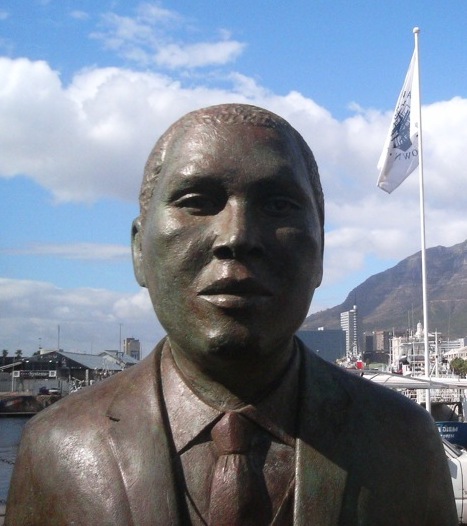
Albert John Lutuli (commonly spelled
Luthuli;
[1] c. 1898 21 July 1967), also known by his
Zulu name
Mvumbi, was a
South African teacher and
politician. Lutuli was elected president of the
African National Congress (ANC), at the time an
umbrella organisation that led opposition to the white minority government in South Africa. He was awarded the 1960
Nobel Peace Prize for his role in the
non-violent struggle against
apartheid. He was the first African, and the first person from outside Europe and the Americas, to be awarded the Nobel Peace Prize.
Muhammad Anwar Al Sadat (
Arabic: محمد أنور السادات‎
Muḥammad Anwar as-Sādāt, Egyptian Arabic pronunciation:
[mæˈħæmmæd ˈʔɑnwɑɾˤ essæˈdæːt]; 25 December 1918 6 October 1981) was the
third President of Egypt, serving from 15 October 1970 until his assassination by fundamentalist army officers on 6 October 1981. He was a senior member of the
Free Officers group that overthrew the
Muhammad Ali Dynasty in the
Egyptian Revolution of 1952, and a close confidant of President
Gamal Abdel Nasser, whom he succeeded as President in 1970.
In his eleven years as president he changed
Egypt's direction, departing from some of the economic and political principles of
Nasserism by re-instituting the
multi-party system and launching the
Infitah.
He led the
Yom Kippur War of 1973 against
Israel, making him a hero in Egypt and, for a time, throughout the
Arab World. Afterwards he engaged in
negotiations with Israel, culminating in the
Egypt-Israel Peace Treaty. This won him the
Nobel Peace Prize but also made him unpopular among some Arabs, resulting in a temporary suspension of Egypt's membership in the
Arab League,
[1][2][3][4] and eventually his assassination.
The Most Rev. Dr. Desmond Mpilo Tutu (born 7 October 1931) is a South African activist and
Christian cleric who rose to worldwide fame during the 1980s as an opponent of
apartheid. He was the first black South African
Anglican Archbishop of Cape Town, South Africa, and
primate of the Church of the Province of Southern Africa (now the
Anglican Church of Southern Africa). Archbishop Tutu has been active in the defense of human rights and uses his high profile to campaign for the oppressed. He has campaigned to fight
AIDS,
tuberculosis,
homophobia,
transphobia, poverty and racism. Tutu received the
Nobel Peace Prize in 1984, the
Albert Schweitzer Prize for Humanitarianism in 1986, the
Gandhi Peace Prize in 2005,
[1] and the
Presidential Medal of Freedom in 2009. Tutu has also compiled several books of his speeches and sayings.
Gonga
hapa
Nelson Rolihlahla Mandela (
Xhosa pronunciation:
[xoˈliːɬaɬa manˈdeːla]; born 18 July 1918)
[1] served as
President of South Africa from 1994 to 1999, and was the first South African president to be elected in a
fully representative democratic election. Before his presidency, Mandela was an anti-
apartheid activist, and the leader of
Umkhonto we Sizwe, the armed wing of the
African National Congress (ANC). In 1962 he was arrested and convicted of
sabotage and other charges, and sentenced to life in prison. Mandela served 27 years in prison, spending many of these years on
Robben Island. Following his release from prison on 11 February 1990, Mandela led his party in the negotiations that led to multi-racial democracy in 1994. As president from 1994 to 1999, he frequently gave priority to reconciliation.
In South Africa, Mandela is often known as
Madiba, his
Xhosa clan name; or as
tata (
Xhosa:
father).
[2] Mandela has received
more than 250 awards over four decades, including the 1993
Nobel Peace Prize.
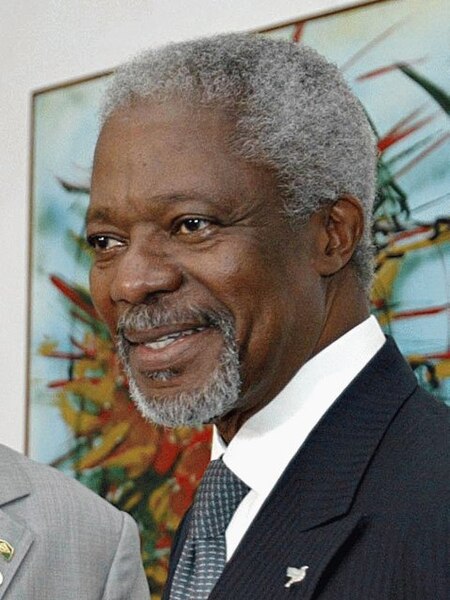
Kofi Atta Annan (
/kəʊfɪ ɑˈnɑn/;born 8 April 1938) is a
Ghanaian diplomat who served as the
seventh Secretary-General of the
United Nations from 1 January 1997 to 31 December 2006. Annan and the United Nations were the co-recipients of the
2001 Nobel Peace Prize for his founding the
Global AIDS and Health Fund to support developing countries in their struggle to care for their people
Wangari Muta Maathai (born April 1, 1940 in Ihithe village,
Tetu division,
Nyeri District of
Kenya) is a Kenyan
environmental and political
activist. She was educated in the
United States at
Mount St. Scholastica and the
University of Pittsburgh, as well as the
University of Nairobi in Kenya. In the 1970s, Maathai founded the
Green Belt Movement, an environmental non-governmental organization focused on the planting of trees, environmental conservation, and women's rights. In 1984, she was awarded the
Right Livelihood Award, and in 2004, she became the first
African woman to receive the
Nobel Peace Prize for her contribution to
sustainable development, democracy and peace. Maathai was an elected member of
Parliament and served as Assistant Minister for
Environment and
Natural Resources in the government of President
Mwai Kibaki between January 2003 and November 2005.
and
Gonga
hapa
Why not Mwalimu too?