South Sudan is in negotiation with Uganda and Tanzania to use Hoima-Tanga pipeline after DRC Congo

South Sudan is in negotiation with Uganda and Tanzania to use Hoima-Tanga pipeline after DRC Congo

Tullow shareholders to vote on Uganda sale

By FREDERIC MUSISI


The Anglo-Irish Tullow Oil PLC shareholders are next month due to vote on approval for the sale of the company’s stake in Uganda, a transaction the company described as of “critical importance” .

The company’s board in a statement issued yesterday said it “unanimously recommends that all shareholders vote or procure votes in favour of the resolution” to green light the sale transaction during the July 13 shareholders’ meeting.

Tullow, in April, announced the sale of its remaining 33.33 per cent stake in Uganda to French oil giant Total E&P to raise $575m (about Shs2.1 trillion), amid the company’s financial doldrums.

Total E&P will pay Shs1.8 trillion ($500m) once the deal has been approved by government, and the balance of Shs780b ($75m) paid whenever Final Investment Decision (FID) is reached.

Total E&P also offered “conditional” or bonus payments to Tullow when commercial oil production starts in the future, and only if a barrel of brent crude—the global benchmark for oil—will be trading upwards Shs232,285 ($65) per barrel.

Yesterday, Tullow further indicated that the sales transaction had been approved by the UK financial watchdog, the Financial Conduct Authority.

However, the company being listed on the London Stock Exchange, the listing corporate governance regulations, provide the shareholders have to give nod to the transaction by a simple majority of votes cast.

Other conditions
Tullow also indicated the transaction remains subject to a number of other conditions, including customary government and other approvals and the execution of a binding tax agreement with the government and Uganda Revenue Authority on the “agreed tax principles previously announced.”

Once all approvals have been secured, the company expects the deal to be concluded by latest early August.

The deal attracted a paltry Shs54.6b ($14.6m) in Capital Gains Taxes (CGT), which Tullow Oil announced late-last month “can now be progressed” following Cnooc’s decision not to pre-empt —acquiring half of the shares floated to Tullow—a contractual clause in the joint venture partnership agreement.

Cnooc’s decision not to pre-empt makes validation of the deal even much easier, giving Total E&P majority shareholding of 66.66 per cent, and Cnooc 33 per cent in each of the Exploration Areas—EA, 2 and 3—upstream. But it also means more headache in the midstream, on the proposed crude oil export pipeline, hence Final Investment Decision will take a bit longer.

Last year, Total E&P, the lead coordinator on the pipeline, had frozen all activities amidst the bad blood with government, but officials are now in the process of resuming negotiations to conclude the Host Government Agreement.

musisif@ug.nationmedia.com

Tullow shareholders to vote on Uganda sale
 
UGANDA Issue dated 16/06/2020
Total unperturbed as it moves towards the second round of legal battle against NGOs

French major Total's Ugandan activities, which have come under attack from several environmental groups, will be examined afresh by a French court at the end of June. Total is about to become the sole major decision-marker on the Tilenga oil project and is behaving as if nothing was amiss. [...] (348 words)

UGANDA : Total unperturbed as it moves towards the second round of legal battle against NGOs
Hizo NGO no za kutoka nchi jirani ya KE.
 
Why best time for striking FID deal is now
By Pascal Kwesiga
Added 28th June 2020 03:39 PM

Why best time for striking FID deal is now

An oil exploration site in Buliisa district

OIL & GAS
The collapse of the oil prices sends shivers through countries that heavily depend on petroleum receipts to fuel their economies. Yet the investors in the industry do not necessarily have to deal with the same level of panic and worry as the oil-producing countries.

For investors, especially the major oil companies, low prices are not unexpected and do opportunities to make new investments. This is based on projections on production and market situations, especially when the prices have stabilized. For example, the French oil giant, Total, has accepted to buy 33.33% worth of assets belonging to Tullow in Uganda for $575m.

The announcement by Tullow on April 23 that it had reached a deal to dispose of its Ugandan assets to Total came as a surprise to some people at the time when the oil prices had collapsed into negative territory for the first time in decades and producers were pleading with buyers to take crude oil off their hands.

Some analysts have said the decision by Total to acquire Tullow's assets at this time highlights the readiness of the big oil companies to acquire additional property cheaply when prices are low, relying on projections that the same resources would appreciate in future.

But it is also, according to analysts, the best time to reach the Final Investment Decision (FID) for the development of Uganda's oil resources. According to an industry source, now is the right time for the investors to achieve FID for Uganda's oil resources because raw materials and contracts are cheaper than a year ago.

"First of all, Total has acquired 33.33% of Tullow cheaply. Just 21.57% of the same assets had been valued at $900m in 2017 and Total and its Chinese partner, Cnooc, had agreed to acquire the same at that price. But now Total is getting more than what was being sold in 2017 for less. Then, the prices of steel products for building development facilities has now fallen," a source said.

The energy ministry permanent secretary, Robert Kasande, said in times of low crude prices, companies can engage labour and contractors to deliver projects cheaply. "The contracts are expensive in times of high crude prices. But the prices of contracts fall with crude oil prices. This is a critical time for companies to invest because they would get cheap contracts to deliver projects," he added.

Since the prices of steel products used to build production and crude oil transportation infrastructure fall with oil prices, this, Kasande, stated is the ideal time for the petroleum companies to achieve FID for Uganda's petroleum projects.

"The industry is heavily dependent on steel. It consumes a lot of these products and their prices are influenced by the crude oil price. It means that companies can now hire drilling machines and other equipment cheaply," he added.

Another industry source said companies engage in scenario planning from time to time which enables them to understand what the crude oil price situation would be like in future.

"In times of low prices, not many companies may invest in exploration. But companies go ahead and develop confirmed resources. This means when prices go up, there may not be enough oil to meet the demand. Companies taking FID for resources like Uganda's now would then benefit from high prices," he added.

Oil-3-720x518.jpg

An oil and gas metering skid. The metering system that Uganda intends to put in place is intended to stop theft of oil

The cost of producing a barrel of Uganda's oil is estimated by the oil companies to be between $40 and $50. This could mean that for a company to realize a return on investment to produce Uganda's oil, the price of a barrel should be higher than $50.

This factors in the costs of finding oil, building production facilities, opening up roads, royalties, the pipeline and refinery. But the cost of producing Uganda's oil would fall after the aforementioned facilities have been established.

"That means the production would be lower in future. Here, we are starting from scratch, it is a new project. There will be no need for another refinery or pipeline and production facilities in future since they will have been established. But these do not stop companies from reaching FID," a source added.

Since it would take three or more years for oil production to occur after FID has been taken, analysts said, by that time the oil prices would have recovered. "The best time to invest is now when prices are low, especially when you have done scenario planning and you know demand for oil is still available and growing. By the time when you start producing a lot will have changed and that is why companies are still investing here," another source stated.

Competitive projects

The current prices, he added, may not affect FID for Uganda's resources because that decision is still several months away. But the prices could affect exploration projects.

"The Uganda project is now mature and companies have already invested their money. They will produce whether prices are high or low. The other thing is if you wait for the prices to go high, everyone would start investing and prices would fall by the time you start production," the source said.

A professor of business management, Wasswa Balunywa, also the principal at Makerere University Business School, said the oil companies have already sank money into Uganda's project, and are committed to producing the oil.

"You can see Total is really committed and it's a big company. It can produce even when the costs are high. These can be absorbed by other projects elsewhere. Oil prices will rebound soon and big companies were ready for the current situation," he added.

Oil-2-720x442.jpg

Oil and gas graduates can work with manufacturing companies, refineries and renewable energy firms

Denis Kamurasi, the vice president of the oil and gas service providers association, said the oil companies would continue to invest in the production of Uganda's oil despite the current oil prices because the industry is associated with the boom and burst cycle.

"We may not be in a good position now, but the situation will normalize soon. Uganda's oil will have to be produced," he added.

The head of corporate and legal affairs at the national oil company, Peter Muliisa, said the Government and the oil forms are taking advantage of the existing digital tools to continue negotiating the outstanding issues for FID.

He is optimistic that companies will also take advantage of the "cheap services" to reach FID which is expected to trigger investment estimated at between $15b and $20b.

"The good thing about low oil prices is that you get cheap services. It means most of the service providers in the industry are not engaged currently. It means contracts are cheap and you can get rig services and other field services at reasonably low prices today," he added.

It is estimated that 1.5 million tons or more of building materials, mainly steel products, will be needed to construct the refinery and crude oil pipeline as well as other production and transport facilities for oil. The FID is expected this year.

Why best time for striking FID deal is now
 
Uganda-Tanzania $3.5 Billion Oil Pipe Decision Seen in December
Bloomberg Bookmark June 26 2020, 9:25 PM June 28 2020, 3:11 PM

(Bloomberg) -- The final investment decision on a planned $3.5 billion oil pipeline from Uganda to Tanzania’s coast is expected to be reached in December, according to the Tanzanian national oil company. “Construction of the project’s infrastructure is scheduled to begin in early 2021,” the Tanzania Petroleum Development Corp. said in a statement on its website on Friday. “We expect to relaunch a call for tenders soon and conclude negotiations between the project’s joint venture partners and the governments of Uganda and Tanzania by September.”

Uganda plans to start producing and exporting oil via the conduit from 2023-24 following its discovery of commercially viable deposits in 2006. Plans to develop the oil fields resumed after Tullow Oil Plc resolved tax disagreements with Uganda, allowing it sell its assets in that country to Total SA. Cnooc Ltd. of China owns fields there too.

Tanzania’s announcement comes a day after a group of climate activists protested Standard Bank Group Ltd.’s plan to help fund the project. 350.org handed over their petition to Africa’s largest lender in Johannesburg, saying the pipeline set to traverse the two countries may cause irreversible environmental damage.

Read more at: Uganda-Tanzania $3.5 Billion Oil Pipe Decision Seen in December
Copyright © BloombergQuint


Copyright © BloombergQuint
 
1 JUNE 2020
Total needs to cover $12bn shortfall due to Covid-19 crisis
SHARE
Total
Total has anticipated a $12bn revenue shortfall due to fall in oil prices triggered by Covid-19. Credit: WhisperToMe.


French oil and gas major Total anticipates a $12bn revenue shortfall due to a fall in oil prices triggered by the novel coronavirus (Covid-19) outbreak.

The latest announcement by Total CEO Patrick Pouyanne is significantly higher than the previous deficit forecast of $9bn. The increase is expected to force Total to devise deeper cost cut measures, reported Reuters.

According to Pouyanne, Total had expected oil prices to stand at around $60 a barrel this year, but with prices currently at around $30, the company faces a much bigger shortfall.

Reuters quoted Pouyanne as saying in a shareholders’ general assembly meeting: “It is globally at least $12bn that we believe we must cover through our action plan due to the crisis.”

Total plans to launch its 230,000 barrel per day (bpd) project in Uganda by the end of this year.

Pouyanne also confirmed that Total has finalised plans to completely acquire oil and gas exploration firm Tullow Oil’s stake in the Lake Albert development project in Uganda for $575m, which also includes the purchase of the East African Crude Oil Pipeline (EACOP).

Earlier last month, Total kept its dividend stable despite reporting a sharp drop in first-quarter (Q1 2020) net adjusted profit due to to the collapse in oil prices and the economic slowdown caused by Covid-19.

Total reported 14 cases of Covid-19 in its operations in Congo in April this year.

Total needs to cover $12bn shortfall due to Covid-19 crisis
 
Uganda-Tanzania crude oil pipeline deal talks underway

plustvafrica.com
1d

Dar es saalem- Treaty for a Host Government Agreement (HGA) for the Eastern Africa Crude Oil Pipeline (EACOP) project will commence early, the citizens were told.

Immediately following is the conclusion of Total Oil’s procurement of 33.334 percent of Tullow Oil’s stake thus making it easy for the French oil giant to possess a 66.7 percent exploration share in the project.

Moreso, this has conferred its legal possession and the right to advance rapidly in carrying out the plan.

The HGA is a treaty between a foreign investor and the local government with the intention to minimize monetary and political adverse outcome directed at investors by unexpected occurrences in the country’s laws.

The HGA clearly spelled out instances relating to tax and other revenues be augmented from the project, also Tanzanians involvement in the plan as well as measures to tackle issues arising during the actualization process of the project.

HGA negotiation with Tanzania commences immediately an agreement is reached between Total Oil and Uganda.

Salum Mnuna, the EACOP national coordinator, explained to The Citizen earlier this week that the measures been put in place for the treaty by Tanzanians are at a higher level, therefore negotiations commence soon.

He affirmed that the HGA crew in charge of the treaty in Uganda will participate with them. He stated further that it is intended by the plan that the treaty is concluded by the end of September 2020, in other to give room for other development plans.

Attention will be directed to other functions of the project, after the conclusion of the HGA treaty, with the issue of Land Lease, Tenure, Shareholders Agreement (SHA), and the Ports Agreement not left out.

According to Mr. Mnuna, Upon the conclusion of the treaty, the Final Investment Decision (FID) is achieved, making way for progress in the plan.

Medard Kalemani, Energy minister explained to the Parliament that the set date for the commencement of the project is in April 2021 which is upon the conclusion of the FID; the important stage of the project that specifies to investors and shareholders that companies are ready to spend money on a new project and that they expect the project, once fully operational, to make enough money to make the initial investment worth it.

President, exploration, and production Arnaud Breuillac led a full delegation, earlier this month to meet with Energy Minister, Merdard Kalemani to update the Tanzanian government on the recent progress.

According to Mr. Breuillac, with the outbreak of Covid-19 which has resulted in the recession of the global economy, several international easy offers would be reviewed to portray the present market situation.

Speaking during the meeting, Dr. Kalemani said Total Oil has accepted his request to fast track the project expected to start in early 2021 and be completed before the 36 months set in the deadline because the plan has already been slow down.

The Director-General Tanzania Petroleum Development Corporation (TPDC) James Mataragio in September 2019, said the reasons that caused the project to delay are normal in such undertakings, therefore assured the public that the plan would be carried out as stated.
 
Patrick Pouyanne -- Chairman and Chief Executive Officer
Oil and gas by some countercyclical deals like, of course, the one in Uganda, where by acquiring the Tullow interest, putting us in charge of this process. We have relaunched all the call for tender in Uganda for the next quarter to benefit from the depressing supply market, and we have the ambition to sanction the project as soon as possible.

We have also this quarter finalized the acquisition of the Block 20, 21 in Angola, which is a development which will benefit from synergies with our large base of operations in Angola. As we announced yesterday, the dramatic change in the environment prompted the Board to make a comprehensive review of the assets using a different price scenario for the next few years.

We have been, I would say, quite stringent and have a pessimistic view or varied view for $35 per barrel in 2020, $40 per barrel in 2021, then $50 in '22 and $60 in '23. We adjusted the gas prices accordingly. For the longer term, we maintain our analysis that the weakness of investments in the hydrocarbon sector since 2015, accentuated by the health and economic crisis of 2020, will result by 2025 in insufficient worldwide production capacity and potentially rebound in prices.

Beyond 2030, given technological developments and, in particular, the evolution of the transportation sector, we anticipate that oil demand might reach its peak, and Brent prices should trend toward a long-term price of $50 per barrel, in line with the International Energy Agency's below two degrees scenario.

TOTAL SA (TOT) Q2 2020 Earnings Call Transcript | The Motley Fool
 
Hvi ili bomba kwa hapa Tanzania linaanza kutengenezwa lini wakuu mnaojua tuambieni?
 
ivi ili bomba kwa hapa tanzania linaanza kutengenezwa lini wakuu mnaojua tuambieni?
Mpaka Final Investment Decision (FID) ifanywe nadhani kabla ya March! then ndo ujenzi utaanza!
 
Ha haaa haaa,mambo ni bam bam. Majirani watajua hawajui
 
ivi ili bomba kwa hapa tanzania linaanza kutengenezwa lini wakuu mnaojua tuambieni???


Uganda, Total sign key oil pipeline agreement

It represents significant progress towards achieving the Final Investment Decision which is expected by the end of this year.

Uganda, Total sign key oil pipeline agreement

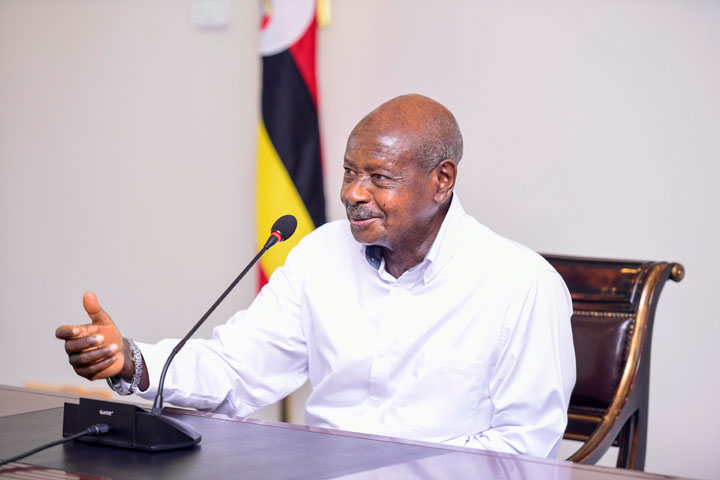
President Museveni chatting with his guests before a photo moment at State House Entebbe

UGANDA | BUSINESS |OIL & GAS
ENTEBBE - The Government of Uganda and Total have concluded and signed the Host Government Agreement (HGA) for the East Africa Crude Oil Pipeline (EACOP) project.

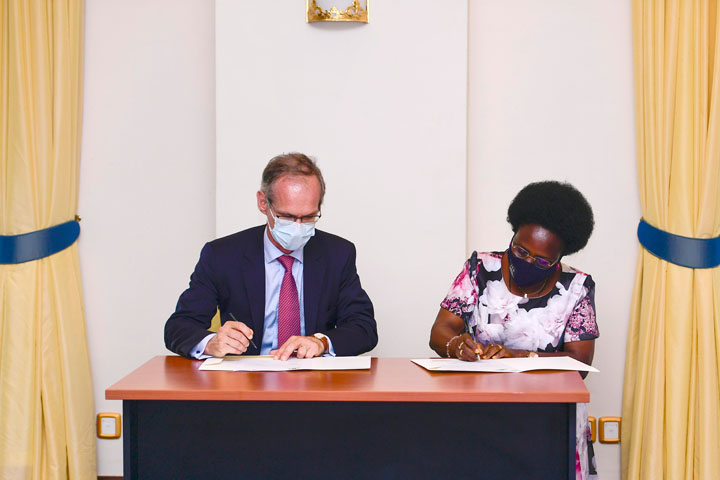
The ceremony took place on Friday (September 10, 2020) afternoon at State House Entebbe and was presided over by President Museveni, and witnessed by Mr. Patrick Pouyanne, the Chairman and Chief Executive Officer of Total.

The Minister of Energy and Mineral Development, Mary-Gorett Kitutu, signed on behalf of the Uganda while Nicolas Terraz, the Total Exploration and Production President for Africa, signed on behalf of his employer.

Signing Ceremony - The  Host Government Agreement For The East African Crude Oil Pipeline being signed by Kitutu and Terraz

The Signing of the HGA signifies that the oil companies (represented by Total) and Government have reached agreement on the commercial framework for the Lake Albert Development Project.

It also represents significant progress towards achieving the Final Investment Decision which is expected by the end of this year.

Speaking shortly after the signing ceremony, President Museveni said Uganda is a very peaceful and attractive investment destination.

He said proceeds from oil will be used to further develop the country's other important sectors like infrastructure, education and health.

"Our oil will be used to develop our infrastructure, and ICT to enhance durable capacity of our country," President Museveni said.

"I am glad that Total and other companies licenced in the country are taking bold steps to quickly commence the production of petroleum," President Museveni said.

Mr. Museveni reassured Total of the Government's support during their work.

"It has taken long, but it was a deliberate move, I can assure you Ugandans," said the President, adding that Uganda is a rich country with oil as a small fraction of this natural wealth.

fbee4b6a-103b-4d0f-a10b-a885993a8eda.jpg

He pointed out that other potential lies in Agriculture, Tourism, Services, and Human Resource among others.

The President promised to get in touch with his Tanzanian counterpart, John Pombe Magufuli, to resolve other pending issues, especially concluding the Host Government Agreement in Tanzania.

"I congratulate Total and our Ugandan team on this milestone. We have been slow but steady and sure," the President said.

Minister Kitutu said once the final investment decision is made by the oil companies, the opportunities for investment in the country will grow exponentially and give a boost to the economy.

She later said local companies should take advantage of this agreement to tap into opportunities in the oil sector.

Total CEO Pouyanne said this is a great achievement between the Total and the Government of Uganda.


Signing-ceremony-The-Host-Gov-t-Agreement-for-the-East-African-Crude-oil-Pipeline-with-Total-4-720x480.jpg

"It was a bumpy road but I am glad we have overcome the challenges. I thank the teams from both sides that have worked tirelessly," he said.

He commended President Museveni for his leadership and promised that the project would be executed successfully.

Today's ceremony follows a series of high-level discussions between President Museveni and Mr. Pouyanne which were aimed at addressing the commercial bottlenecks in the achievement of a Final Investment Decision (FID) for Uganda's upstream and EACOP projects.

The function was attended by among others the Attorney General, Mr. William Byaruhanga.

ALSO SIGNED TODAY:
The government and Total also agreed on the following agreements in relation to the Uganda National Oil Company:

1. The deed of assignment in relation to the Block 1 Production Sharing Agreement & Block 1 Production Licences in respect of exploration Areas 1,2 and 3A

2. The deed of novation and amendment with Uganda National Oil Company in relation to the Joint Operating Agreement in respect of Exploration Areas 1,2 and 3A.

ABOUT EACOP
The oil pipeline will start in Buseruka sub-county, Hoima District, and run for 1,445km to the Tanzania port city of Tanga. When complete, it will be the world's longest heated oil pipeline.

Uganda, Total sign key oil pipeline agreement


MY TAKE
Paving a way for Final investment Decision!
 
Aiports along ECOP in Tanzania
Bukoba Airport
Chato Airport (currently U/C)
Mwanza international Airport
Tabora Airport (currently under expansion)
Kahama Airstrip
Shinyanga Airport (currently under expansion)
upcoming Msalato Airport
Dodoma Airport (currently under expansion)
Ngerengere Airforce Airport
Kilimanjaro International Airport
Tanga airport (currently under expansion)

Ports along the EACOP in Tanzania
Mwanza port
Tanga port (currently under expansion)

Railways along the EACOP in Tanzania
Dar-Isaka MGR (over 99% revamped)
Tanga-Ruvu-Isaka MGR (over 99% revamped)
Dar-Mwanza electrical SGR (Dar-Morogoro over 90%, Morogoro-Dodoma-makutupora over 40%, Mwanza-Isaka about to be launched)
Tanga-Moshi-Arusha-Mara MGR(Tanga-Moshi-Arusha 100 revamped, Arusha-Mara MGR (in planning stages))
 
INVESTING NEWS
SEPTEMBER 12, 20209:32 AMUPDATED 9 HOURS AGO

Uganda, Total reach agreement bringing crude pipeline construction closer

KAMPALA (Reuters) - Uganda and France’s Total have reached an agreement that will bring the oil firm and its partners closer to starting construction of a crude pipeline to neighbouring Tanzania, the company’s local unit said on Friday.

The logo of French oil and gas company Total. REUTERS/Gonzalo Fuentes

Uganda discovered crude oil reserves about 14 years ago but commercial production has been delayed partly because of a lack of infrastructure, such as an export pipeline.

The 1,445-km (900-mile) East African Crude Oil Pipeline, costing $3.5 billion, would pass through neighbouring Tanzania to the Indian Ocean port of Tanga.

Total said it had reached an agreement with Uganda protecting its rights and obligations in the pipeline’s construction and operation - known as the host government agreement.

“We have today reached major milestones which pave the way to the Final Investment Decision in the coming months,” Pierre Jessua, Managing Director of Total E&P Uganda, said in a statement.

“We now look forward to concluding a similar HGA (host government agreement) with the Government of Tanzania and to completing the tendering process for all major engineering, procurement and construction contracts.”

Total said a meeting between President Yoweri Museveni and its Chief Executive Officer Patrick Pouyanné also agreed to conditions allowing Uganda National Oil Company to join the project.

Total is the major shareholder in Uganda’s oil fields after agreeing in April to buy Tullow Oil’s entire stake in jointly-held onshore fields in Uganda for $575 million.

Tullow said this week it was confident of finalising the sale in fourth quarter of this year.

The other partner in the 230,000 barrel-per-day project is China’s CNOOC.

The government said last year once pipeline construction begins, it would take 2-1/2 to three years to complete.

Uganda discovered crude oil reserves estimated at 6 billion barrels in the Albertine rift basin near the border with the Democratic Republic of Congo in 2006.

Reporting by Elias Biryabarema; Writing by George Obulutsa; Editing by Andrew Cawthorne

Our Standards: The Thomson Reuters Trust Principles.

Uganda, Total reach agreement bringing crude pipeline construction closer
 
INVESTING NEWS
SEPTEMBER 12, 20209:32 AMUPDATED 9 HOURS AGO
Uganda, Total reach agreement bringing crude pipeline construction closer
By Reuters Staff
2 MIN READ

KAMPALA (Reuters) - Uganda and France’s Total have reached an agreement that will bring the oil firm and its partners closer to starting construction of a crude pipeline to neighbouring Tanzania, the company’s local unit said on Friday.


The logo of French oil and gas company Total. REUTERS/Gonzalo Fuentes

Uganda discovered crude oil reserves about 14 years ago but commercial production has been delayed partly because of a lack of infrastructure, such as an export pipeline.

The 1,445-km (900-mile) East African Crude Oil Pipeline, costing $3.5 billion, would pass through neighbouring Tanzania to the Indian Ocean port of Tanga.

Total said it had reached an agreement with Uganda protecting its rights and obligations in the pipeline’s construction and operation - known as the host government agreement.

“We have today reached major milestones which pave the way to the Final Investment Decision in the coming months,” Pierre Jessua, Managing Director of Total E&P Uganda, said in a statement.

“We now look forward to concluding a similar HGA (host government agreement) with the Government of Tanzania and to completing the tendering process for all major engineering, procurement and construction contracts.”

Total said a meeting between President Yoweri Museveni and its Chief Executive Officer Patrick Pouyanné also agreed to conditions allowing Uganda National Oil Company to join the project.

Total is the major shareholder in Uganda’s oil fields after agreeing in April to buy Tullow Oil’s entire stake in jointly-held onshore fields in Uganda for $575 million.

Tullow said this week it was confident of finalising the sale in fourth quarter of this year.

The other partner in the 230,000 barrel-per-day project is China’s CNOOC.

The government said last year once pipeline construction begins, it would take 2-1/2 to three years to complete.

Uganda discovered crude oil reserves estimated at 6 billion barrels in the Albertine rift basin near the border with the Democratic Republic of Congo in 2006.

Reporting by Elias Biryabarema; Writing by George Obulutsa; Editing by Andrew Cawthorne

Our Standards: The Thomson Reuters Trust Principles.

Uganda, Total reach agreement bringing crude pipeline construction closer

Mambo yanazidi kunoga.
 
Back
Top Bottom