
Mohamed Said
JF-Expert Member
- Nov 2, 2008
- 21,967
- 32,074

|
| Mohamed Said and Peter Colmore, Muthaiga, Nairobi 1995 |

|
| Peter Colmore, Muthaiga, Nairobi 1995 |

Ally Sykes and Peter Colmore in Paris 1963 
|
Masengo Edouard ''With Colmore as my partner we set up an office in Dar es Salaam. Our company advertised from cigarettes to petroleum products. We represented, promoted, and were consultants to Coca Cola (East Africa) Ltd; The Cooper Motors Corporation Ltd; Allsopp (EA) Ltd; The Shell Company of East Africa Ltd, Aspro Nicholas Ltd; Gailey and Roberts Ltd; Bata Shoes Company Ltd; Kenya Broadcasting Service, Cotton Lint and Seed Marketing Board, Raleigh Industries of East Africa Ltd; Commercial Representative in Kenya for Tanganyika Broadcasting Corporation. The head office of this massive sales promotion venture was in Nairobi Delamere Avenue, now Kenyatta Avenue. Peter Colmore then founded his own recording company - High Fidelity Productions Limited. Peter Colmore built some products into household names in East Africa. The best musicians East Africa had ever known promoted some products. Apart from this Colmore also ventured into film making with Dr. Johnson who owned the recording company Jambo of which the talented singer and bandmaster Salum Abdallah recorded. Colmore signed Edouard Masengo the gifted guitarist from Elizabethville, Belgian Congo to promote Coca-Cola. Masengo had come to Nairobi with a group called Je-Co-Ke meaning, Jean Comedian Katanga. Colmore who was already in broadcasting was informed that there was a young man in town who played terrific guitar. Colmore went to the hotel where Masengo was lodging. There he found Masengo in a dirty hotel at River Road. He was sitting on the floor playing his guitar with people around him listening to his music. This was the beginning of the association between Colmore and Masengo. There was the famous poster of Masengo with his guitar and holding a bottle of Coca-Cola. There was also the famous photograph of Msafiri Morimori the trombone player. These photographs were familiar in all newspapers in East Africa. This had a dual effect to the musician as well as to the product. First the sales of the product rose as the market responded to the idol, and second the music of the artist himself was promoted through his personality being associated with the product. The artists made money, the industries earned money made profit and more people were employed. Ally Sykes and Peter Colmore also made money. The quality of life of the people improved and at the end of the day everybody was happy. Through Masengo, Colmore signed the talented singer and guitarist, Jean Mwenda Bosco also from Elizabethville. Masengo and Bosco were cousins. In January 1959 Peter Colmore and Edward Masengo flew to Elizabethville to fetch Bosco for a short contract for promotion of Aspro. Bosco was a household name in East Africa but no one has seen even his photograph or knew how he looked like because he had never traveled out of Congo. At that time he was recording with a South African recording company, Gallatone. Bosco stayed in Nairobi for six months. 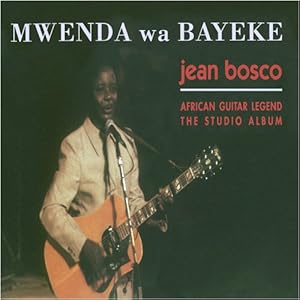
The Belgian government made Colmore pay 30,000 francs as deposit to make sure that Colmore would return Bosco back to Congo. The effect, which Bosco had on the sales of Aspro, was unimaginable. Colmore put Bosco on a countrywide tour of Kenya promoting Aspro as relief for headaches, fever and flu. At that time Bosco was twenty-nine years old and at the prime of his career. Before he left for home Bosco composed a song in praise of Peter Colmore, Shangwe Mkubwa in which he sang of his flight from Elizabethville to Nairobi. In the song Bosco pronounce Cormore instead of Colmore because of his French accent. Music critics of those times were of the opinion that in all his compositions, in this number in praise of Peter Colmore, Bosco was at his best. And if one wants to appreciate the talent of Bosco he only has to listen the guitar work in the song. Bosco died in a road accident in early 1990s in his hometown only few weeks after being interviewed by the BBC Swahili Service. He was 60 years old. Colmore also arranged for Masengo and Bosco to perform together at dance halls in Nairobi. By the time Masengo left Kenya he had already made a total of shs.250, 000.00 and had married a very beautiful Masai girl, Lucie Akukuu Mainge and had a daughter, which they named Jojo. This marriage took place in April 1959. Masengo was 29 years old. The marriage could not be conducted in a church because Lucie was a Pagan. Masengo a Catholic had to settle for a civil marriage. Later when Colmore established his own recording studio, the sales promotion programmes and music of the artists were all recorded under one roof and then distributed from there. There was never a day when High Fidelity Productions was not in the airwaves either in Tanganyika, Kenya or Uganda. Our advertisements were all over East Africa. Colmore also composed his own tunes to go with the programmes. There were signature tunes, which were synonymous to the products. In short we put all kinds of imagination and innovations into our sales promotion. Colmore also promoted entertainers and comedians such as Omari Sulemani best known as Mzee Pembe,Halima bint Said popular radio entertainers and others. He also promoted musicians such as Frank Humplick, Mathias Mulamba, Esther John and John Mwale. He also brought into broadcasting in the Kenya Broadcasting Corporation famous radio announcers and personalities like Stephen Kikumu, Julius Kilua and Said Omari. I also broadcasted radio shows for Philips Company of Holland and was agent for Air France. My wife, Zainab helped me organise and manage the Air France office in Dar es Salaam. I also used my band for sales promotion. When we began promoting The Shell Company of East Africa Limited; I changed the band's name to Shell Merry Makers. I did all this in my spare time while still a civil servant. After coming from work I would go to my office and work until late at night. In December 1960 we brought Edouard Masengo over to Dar es Salaam for shows. Masengo was not the only musician to visit Dar es Salaam. We also brought over Msafiri Mori Mori and his Sportsman Cha Cha Band. Nyerere my friend and colleague was the guest of honour in the show, which Masengo gave at Arnautoglo Hall. Colmore also came over from Nairobi for the show and I took the opportunity to introduce Colmoreto Julius Nyerere. I took Colmore over to Nyerere's house at Magomeni Majumba Sita where he was staying. On that day Nyerere was a bit distressed since reports had been received from Congo that Lumumba had been killed. Newspaper report, which we had received, was that, Lumumba was recaptured at Port Francqui after he had escaped from house arrest in Leopoldville. Few days earlier Belgians had ordered a manhunt for Lumumba who it was believed was heading towards Stanleyville where his supporters were based. 
Masengo was also very sad to hear of the news that Katanga his home province under Moise Tshombe had declared secession from the Congo Republic. Masengo was from the Bayeke, the same tribe as Tshombe. Nyerere had a pathological hatred of Tshombe. We took that opportunity to have Masengo record his old songs with Tanganyika Broadcasting Corporation (TBC). Back in Nairobi both Colmore and Masengo wrote to me, Colmore thanking me for introducing him to Nyerere and Masengo for successfully managing his tour and shows. Colmore told me how grateful he was to Nyerere for showing a firm stand on the Congo problem. At that time Masengo was incorporated into High Fidelity Productions as one of the directors. Colmore was a man of forethought he realised that we will need the support of Nyerere if we were to expand our business in free Tanganyika. That is why that introduction was important to him. Colmore knew how close I was to Nyerere the future leader of Tanganyika. The two of us saw in the independence of Tanganyika only bright future for our company. It was so far what one would call a success story, a dream come true. Colmore business interests were growing and becoming so important in Tanganyika he built a house in Moshi and used to drive over from Nairobi to Moshi each weekend. At that time Tanganyika had self-government and I took that opportunity to lobby for a dignitary to receive any visiting celebrity at the airport. The following morning the papers would again have no alternative but to give us coverage. Pictures of the musician say Masengo or Msafiri Morimori and the minister would be splashed in all the morning papers thus getting free publicity. The Minister and his wife would also be invited to the show as Guests of Honour I could get any dignitary into our program with relative ease because I did not need an intermediary. My visit or telephone call was enough. I had people like Nyerere, Bhoke Munanka, Job Lucinde, Heri Baghdelleh, Lucy Lameck and others as guests of honour to our shows. (In those days of the struggle having a common enemy that is the colonial government we loved each other very much. It was only after we had achieved independence that is when jealousy, intrigues and what have you crept in). In the meantime the company made profits and I passed part of what I earned to TANU with the aim of achieving independence as quickly as possible.'' (Excerpts from unpublished autobiography of Ally Sykes: ''Under The Shadow of British Colonialism - The Life of Ally Kleist Sykes 1926 - 2013''). 
Frank Humplink in Nairobi, 1960s 
Frank Humplink in Nairobi, 1960s |


