Ukweli ni upi kuhusu Oscar Kambona?

Ukweli ni upi kuhusu Oscar Kambona?

A Bill of Rights was a political luxury in Tanzania

In Tanzania, the freedom of association is deemed by the government to be a privilege, not a right. Soon after Independence, a government campaign eradicated most formal civil organizations, especially those with dissenting views and opposing positions. In 1964, for example, the government banned independent trade unions and formed the National Union of Tanzanian Workers Association (NUTA), a state controlled trade union. In so doing, it essentially outlawed strikes and the right to advocate for fair wages. In 1968, it passed a law curtailing the activities of Cooperative Unions.

In 1976, it dealt a devastating blow to the cooperative unions by outlawing them. In the absence of civil society organizations, the government enacted and pursued policies-often through a Presidential Decree or administrative fiat-some of which had profound and negative impacts on the well-being of most Tanzanians. For example, in 1973-75 the state resettled about 80 percent of the population in Ujamaa villages which resulted in famine and drastic reduction of crop production. To date, Tanzania has not recovered from the aftermath of this policy.

These and other restrictions forced most Tanzanians to be passive watchers of state-sponsored initiatives, many of which had negative consequences on their lives. Citizens were denied the right to be shapers and masters of their own destiny. The situation was complicated by the absence of a Bill of Rights in the country's Constitution. The government had consistently argued that a Bill of Rights was a political luxury that a poor country like Tanzania could not afford. It saw a Bill of Rights as an impediment to rapid social and economic development.

But after more than 20 years of independence, it became clear that the centralized government had failed to deliver promised economic prosperity to Tanzania. This led, among other efforts, to a backlash and intensified public demand for a Bill of Rights. Eventually and with a surprisingly restricted constitutional debate, a Bill of Rights was enshrined in the Constitution, vide Act No.16 of 1984. Tanzania's Bill of Rights, however, includes many exception clauses which subjects the rights enshrined in the Constitution to various pieces of legislation. By enacting a Bill of Rights with exception clauses the state hoped to curtail the powers of the judiciary to uphold and protect peoples' rights.
 
Majimoto,
If it walks like a duck, eats like a duck, cries like a duck, shit like a duck.....then it's a duck!!!. Right?
 
Very strong point indeed, na ndio hasa tatizo letu kubwa kitaifa lilipo, ni taifa lililozoea kuamuliwa maamuzi yake na mtu mmoja, hatukutayarishwa kuamua maaamuzi yetu wenyewe, sasa yule muamuzi hayupo tena, tizama tunavyohangaika!

Hii statement inanikumbusha maneno ya some black civil rights leaders wa hapa Marekani ambao badala ya ku-inspire watoto wao na some black kids waende shule na kufight the system so hard, wao wanasema slavery imefanya blacks waendelee kuwa chini for the rest of their lives. Wanaona hakuna kitu hata wajukuu zao watafanya kwa vile wamekuwa so affected na slavery.

Ndio maana blacks wengi huwa wanashangaa Afrikans wakija hapa wanasoma wanafanikiwa wanapata kazi nzuri wanabaki wakiuliza how do you guys do that.

Damn dikteta Nyerere. Unaona ulichofanya. Hata miaka karibu kumi baada ya kufa kwako bado watanzania (kwa mujibu wa mkuu FMES) hawajui cha kufanya.

Tanzania imfanyeje huyu Dikteta Nyerere?
 
Nationalisation of cooperative union

Tanzania is one of the poorest countries in Africa, which in the world’s poorest continent, is saying something. It is also a case study in the damage that harmful government policy can inflict on co-operatives. In the colonial period, British authorities encouraged co-ops. I found a wonderful photograph on the wall of the Kilimanjaro Native Co-operative Union (KNCU), the pioneer of coffee co-ops, showing the Secretary of the State for the Colonies, and the Governor of the colony (then Tanganyika) visiting KNCU’s college in 1958.

After independence, co-operatives were promoted by government policy, but in the framework of a rigid top down state controlled economy. In 1976, co-operative assets were nationalised and the movement turned into a ‘mass organisation’ of the ruling party, which was in fact the only permitted party. In 1984, co-operatives were re-established, but without their assets.

In the 1990s, the stick was bent too far the other way. Complete liberalisation was the watchword, and co-operatives were abandoned, without preparing them for the rigours of liberalisation.

In 2000, the President of Tanzania, Benjamin Mkapa, established a commission to review the co-operative sector, and a realistic and balanced Co-operative Policy now exists and new legislation is in force. I wish I could re-print the whole policy, as it summarises the problems that co-operatives face and the benefits they can bring. Let one quotation suffice:

Without co-operatives, small producers have been left with almost no form of organisation to operate at the grassroots level. In the current economic environment where market access is poor, and market information is inadequate, not being involved in collective organisations, the small farmer is left in a weak position

What a shame the Government of Tanzania could not understand this simple fact and the advantages of co-operatives for cashewnuts, tobbaco, coffee,cotton etc. for poor farmers.
 
Dear wangu, nimeshakubali hoja zao, Nyerere ni Dikteta na historia ya TAnzania ingeandikwa vizuri pasipo huyu Dikteta. Dikteta kawaachia nchi miaka 22 iliyopita hadi leo ati hawajui kuongoza! Leo wanakimbilia kwenye Ulaya kuomba wataalamu wa Mikataba kwa sababu ya Dikteta hakuwapeleka shule! Huko nyuma nilifikiri Bunge lilikuwa linashinda kubadili sheria na Katiba kwa sababu wajumbe walikuwa wanamuogopa Dikteta. Leo hii sheria zile zile zipo kitabuni na Dikteta kawaachia waongoze miaka 22 iliyopita.

Wakati umefika Tanzania iache kukumbuka siku ya kufa Dikteta huyu mkubwa!

Mwanakijiji sikiliza message kwenye simu yako - cell phone.

Wewe unasema kuacha kukumbuka siku ya kufa tu, inabidi kwanza hata uwanja wa ndege ubadilishwe jina kuwa Kambona International Airport.

Inabidi Nyerere road ibadilishwe jina kuwa Malecela rd.

Shule zote zenye majina ya Nyerere inabidi ziitwe majina mengine kwani huwezi kumpa sifa dictator aliyesababisha na ambaye anaendelea kusababisha nchi hii iendelee kuwa masikini leo na vizazi vingi sana vijavyo.
 
Boooooooooooooooooooooooooooooooooooooooooooooooooooooooooooo
 
Admin,

Mimi naomba ubadili title ya thread kuwa something anti-Nyerere kwani inaongelea sana mabaya ya Nyerere kuliko namna ya kumuenzi UNSUNG HERO - THE GREAT KAMBONA

Napendekeza kitu kama:

Dikiteta Nyerere na athari zake kwa Tanzania leo na kesho
 
mama, nimepata ujumbe; Ati Nyerere alikuwa Dikteta kwa sababu hakuandaa viongozi ndio maana leo tunaviongozi uchwara! Yaani mijitu mizima inapita kuomba kura kwa wananchi kumbe ni vikaragosi vya mawazo ya Dikteta Mwalimu. Yaani, walijiita wanafunzi wa Mwalimu kumbe hawakujifunza lolote! Dikteta kawaachia nchi miaka 22 iliyopita hadi leo bado hawajui cha kufanya. Utumwa mwingine wa mawazo ni mbaya sana.

Ila hilo ulilosema ni la kweli kabisa ndio maana wengine tunaongoza mapambano ya kifikra ili kuondoa mawazo tegemezi kama haya. Mawazo kuwa kwa vile Mwalimu hayupo basi viongozi hawawezi kuongoza! Kila nyakati ina watu wake, Mwalimu alifanya alichoweza kufanya na alipojua amefikia kikomo chake akawaachia wengine. Leo hii watoto na watoto wa watoto wao wanalalamika kuwa Mwalimu hakutuandaa; yaani kweli watu walikuwa waoga kiasi hicho?

Leo hii tunaunda kamati nne kuangalia tatizo lile lile na kamati ya mwisho inaangalia kazi za kamati zilizotangulia na watu wanapiga makofi kushangilia. Leo hii, wanashindwa kufanya maamuzi magumu kwa sababu hawana ujasiri wa kidikteta;

Unajua kuna kitu labda nimekipuuza kuwa yawezekana Mwalimu alikuwa ni Dikteta mkubwa kabisa kiasi kwamba hadi leo jina lake likitajwa jamaa wanatetemeka wanashindwa hata kufikiri. Nakumbuka Mkapa alipokuwa South Africa alisema kuwa hakuweza kufanya kazi vizuri as long as he was "under the shadow of Mwalimu". Ndio maana uchafu wake wote ulianza siku chache tu alipojua Mwalimu ni mgonjwa na akahakikisha mambo yote yametengemaa pale Mwalimu alipofariki.

Yule Dikteta apendwaye alikuwa ni mtu pekee aliyekaa kati ya watawala wabovu na mali zetu, kati ya uongozi na uzandiki; kati ya manufaa ya wananchi kwenda kwa manufaa ya wenye nchi; Leo hii wanajiita wao viongozi kumbe ndio wanageuka kuwa viongozi wasioongoza.

Dikteta Mwalimu atakumbukwa kwa kuwaweka sawa hawa jamaa ndio maana hadi leo hawana hamu naye. Leo hii wanashindwa hata kukemeana na wamebakia kuimbiana nyimbo za shangwe.
 
wakuu,

binafsi nimesikitika sana kuona kwamba hoja hii imechukua mkondo ulionao sasa. siamini kabisa kwamba kuwapachika majina viongozi wetu waanzilishi wa taifa hili ni sahihi. wote walifanya makosa na nadhani ni vyema tuyatambue makosa yao kama makosa ambayo hatustahili kuyarudia.

wakuu, tuwaenzi viongozi wetu waliopita. tuwaombee malazi mema peponi, kwa wale waliotangulia mbele ya haki ambako huko kila mmoja atahukumiwa kwa haki. kwa wale ambao bado tunao tuwaombee maisha marefu na kuwahamasisha kuweka historia sawa. watueleze kama kuna makosa yalifanyika huko nyuma ni yapi na nini kilikuwa kiini au misingi yake na tusaidiane kutoyarudia makosa hayo. tusiwape imani kwamba mara watakapotutoka (kama watatangulia) huku nyuma wataanza kuitwa majina kama au yanayofanana na yaliyojitokeza katika mjadala huu.

kweli mola ibariki tanzania

Mkuu Kafara,

Tanzania ya leo inaonekana hakuna kitu kitafanyika kama Dikiteta Nyerere ataendelea kuenziwa. Mkulu FMES amekumbusha kuwa kitendo cha Nyerere kuwaamulia watanzania cha kufanya miaka yote hii ndio kimesababisha viongozi leo wanasaini mkataba kama Buzwagi.

Inabidi huyu Nyerere awe -exposed na aadhibiwe au ikiwezekana afutwe kwenye historia kwa vile inaonekana kuwa as longer as this guy yupo kwenye historia ya Tanzania hakuna chochote kile kitakachofanyika! nchi itaendelea kuwa mbovu na masikini.

Mwelekeo wa hii thread ndio dawa ya matatizo ya Tanzania. Futa anything about this Dictator Nyerere ili watu waanze upya. Kisha badili historia ya Tanzania ili watu tuliozaliwa miaka mingi baada ya shujaa Kambona kwenda uhamishoni tumuenzi vilivyo.
 
Rudisheni mada kwenye siasa. Haya mambo siyo vibweka bwana....
 
wakuu,

binafsi nimesikitika sana kuona kwamba hoja hii imechukua mkondo ulionao sasa.
siamini kabisa kwamba kuwapachika majina viongozi wetu waanzilishi wa taifa hili ni sahihi.

Kafara, kama mtu ni mwizi, kumuita mwizi siyo kosa! Kama mtu ni dikteta basi anaitwa Dikteta, mlaghai wa kisiasa anaitwa mlaghai wa kisiasa!

wote walifanya makosa na nadhani ni vyema tuyatambue makosa yao kama makosa ambayo hatustahili kuyarudia.

Sidhani kama hilo ni hoja; hoja ni kuwa kuna wengine wamefanya makosa ya kilaghai ya siasa, kihaini na ya kutengeneza historia feki. Na wapo wengine ambao wamefanya makosa ya kidikteta.


wakuu, tuwaenzi viongozi wetu waliopita. tuwaombee malazi mema peponi, kwa wale waliotangulia mbele ya haki ambako huko kila mmoja atahukumiwa kwa haki.

Sidhani kama kuna ulazima wa kuwaenzi viongozi wezi, madikteta, n.k Leo hii Ujerumani haimuenzi Hitler, na Italia haimuenzi Mussolini. Uganda haina siku kuu ya Idi Amin. Inashangaza kuwa sisi Watanzania tumuenzi kiongozi Dikteta ambaye amelisababisha Taifa madhara makubwa na ambaye mchango wake katika historia yetu unafutika kama chaki ubaoni.


kwa wale ambao bado tunao tuwaombee maisha marefu na kuwahamasisha kuweka historia sawa.

Sidhani kama kuna haja ya kuwaombea maisha marefu, kwani tulipomuaombea maisha marefu mmoja wao akageuka Dikteta!

watueleze kama kuna makosa yalifanyika huko nyuma ni yapi na nini kilikuwa kiini au misingi yake na tusaidiane kutoyarudia makosa hayo. tusiwape imani kwamba mara watakapotutoka (kama watatangulia) huku nyuma wataanza kuitwa majina kama au yanayofanana na yaliyojitokeza katika mjadala huu.


Historia huandikwa na watu na historia ya mtu huandikwa baada ya mtu huyo kufa. Sasa, kama historia itaonesha kuwa Watanzania walidanganywa kuamini kuwa Nyerere alikuwa ni mtu mwema, kiongozi mzuri, aliyeweka Taifa na watu wake mbele, ambaye hakuwa baradhuli n.k na kumbe alikuwa ni Dikteta mkubwa ambaye ni chanzo cha matatizo yote tunayoyaona leo hii basi hiyo ni historia na jina lake lifutwe kwenye historia kama Wamisri walivyofuta jina la Amnon.

mola ibariki tanzania

Tulipobarikiwa, tukamweka Dikteta Madarakani... so I don't know about this one..
 
Duh yameshakuwa haya, anyways kwa kifupi nadhani kila mtu ana mtizamo wake kutokana na kilichomtokea wakati wa utawala wa Nyerere, nadhani umefika wakati wa kumove on kutoka kwenye hizi yengele za alikuwa dikteta or hakuwa dikteta na kuangalia Taifa letu linaelekea wapi maana kwa kusoma historia inaonyesha Mwalimu alikuwa na vision na Taifa kulinganisha na hawa viongozi wetu wa siku hizi.
Weekend njema and Happy 46th Independence.

*MIaka 46 iliyopita watu walikuwa wanabishania Uhuru, Leo tunabishania sijui nini?

Mkuu Icadon,

Imeshaonekana kuwa Nyerere ndiye anakwamisha maendeleo ya Tanzania leo hii. Hii thread ilianza kwa nia ya kumuenzi shujaa Kambona lakini ikachukua very strong turn kuwa anti-Nyerere (it should be).

1. Inaonekana bila kufuta historia ya Nyerere, Tanzania haiwezi kusaini mikataba bora ya madini leo.

2. Inaonekana bila kufuta historia ya Nyerere, Kikwete hawezi kuondoa mafisadi kwenye baraza lake la mawaziri.

3. Inaonekana bila kufuta historia ya Nyerere, wizi BOT hauwezi kuisha.

4. Inaonekana bila kufuta historia ya Nyerere, miundo mbinu Tanzania haiwezi kujengwa.

5. Inaonekana bila kufuta historia ya Nyerere, watoto na vitukuu vyetu wataendelea kuwa masikini mpaka siku this guy akiadhibiwa.


Mimi naona haya yanayoendelea hapa ni sawa tu maana ndio suluhisho la matatizo ya Tanzania (kwa mtazamo wa wana-JF).

So hii ni muhimu sana kwa memba wa JF!
 
Admin,

rudisheni hii mada na zile nyingi mulizohamisha toka kwenye siasa mahali zinapostahili - Siasa.

Na pia napendekeza kuwa picha ya dikiteta Nyerere itolewe toka katika pesa halali za Tanzania na badala yake iwekwe picha ya Shujaa Kambona au Malecela.
 
Umesema yote bi mdogo.. hasa ukizingatia kuwa huyo dikteta aliwaachia nchi miaka 22 iliyopita! Aidha jamaa alikuwa na control kubwa ya mawazo ya watu hasa viongozi kiasi kwamba hadi leo hii wanashindwa kuamua mambo kwa maslahi ya Taifa lao au kwa kuangalia hali halisi kwani mawazoni mwao wanahisi Dikteta Nyerere na fimbo yake amewasimamia..! Nina uhakika ilikuwa ni mzimu wa Dikteta Nyerere uliosababisha CCM wamfungie Zitto kwani walifanya hivyo kwa kuogopa Nyerere angewachapa fimbo!
 
October 21, 1999
Web posted at: 3:50 a.m. EDT (0750 GMT)


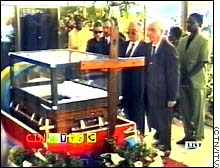
story.casket.mourners.jpg

From staff and wire reports

DAR ES SALAAM, Tanzania (CNN) -- Dignitaries on Thursday filed past the bier of Julius Nyerere, Tanzania's first president, revered throughout Africa as an independence leader.

African heads of state and representatives of the United States, European, Middle Eastern and Asian countries were attending the funeral. Nyerere is remembered as a modest man who put the welfare of his countrymen before his own and built a peaceful, stable nation -- an exception to the rule in Africa.

Nyerere died October 14 in a London hospital following a massive stroke; he was being treated for leukemia. He was 77.

His body has been lying in state in a simple glass structure at the National Stadium since Tuesday. He will be buried Saturday in his home town, Butiama. Thousands of grieving Tanzanians greeted his coffin when it arrived Monday, and people have waited patiently in line for hours to file by his open casket.

"We're really rushing to greet all these people; we've never seen anything like this here before," said senior official Hassan Chande earlier, the day before the service.

Forged unity for his nation
Since Nyerere's death, praise has poured in from world leaders, who recall that he led the drive to oust dictator Idi Amin from Uganda, and spearheaded international efforts to dismantle South Africa's apartheid.

An advocate of self-reliance and cooperation, he forged unity for his nation, where 120 ethnic or linguistic groups coexist. He also championed what he called African socialism, which he later acknowledged had failed as an economic experiment.

But the founder of modern Tanzania is also remembered as the man who led the drive for Tanzania's independence from Britain in 1961. He incorporated then-Tanganyika and the Indian Ocean islands of Zanzibar into the unified nation.

After serving 23 years as president at the head of a single-party state, Nyerere stepped down in 1985. He was later instrumental in opening Tanzania up to multi-party politics.
 
Umesema yote bi mdogo.. hasa ukizingatia kuwa huyo dikteta aliwaachia nchi miaka 22 iliyopita! Aidha jamaa alikuwa na control kubwa ya mawazo ya watu hasa viongozi kiasi kwamba hadi leo hii wanashindwa kuamua mambo kwa maslahi ya Taifa lao au kwa kuangalia hali halisi kwani mawazoni mwao wanahisi Dikteta Nyerere na fimbo yake amewasimamia..! Nina uhakika ilikuwa ni mzimu wa Dikteta Nyerere uliosababisha CCM wamfungie Zitto kwani walifanya hivyo kwa kuogopa Nyerere angewachapa fimbo!

Wewe unasema hayo tu,

Prof Mahalu alivyokula zile pesa kule ubalozi ni matokeo ya sera mbovu za dikiteta Nyerere.

Wakati nikiwa shule boarding school wanafunzi tulikuwa tukilala kwa woga kuwa usiku tutavamiwa na mizimu ya Nyerere. Kulikuwa na story kuwa mama yake Nyerere ni bonge la mchawi na anatembelea mashule yote kupumbaza wanafunzi.

Kila siku usiku watu tunalala kwa hofu maana haijulikani lini masikini bi-mgaya atakuja shuleni kwetu.
 
WEB POSTED 11-03-1999

African political giant laid to rest


--------------------------------------------------------------------------------

DAR ES SALAAM, Tanzania (PANA)-Dr. Julius Nyerere, the first president of Tanzania, was interred Oct. 23 at his home village of Butiama in northern Tanzania amid solemn pomp and ceremony.

The casket containing his body was lowered in the grave accompanied by full military honors, including a final 21-gun salute.

The burial was preceded by a requiem mass at the 400-seat Catholic Church which the late leader helped build in the village not too far from his home.

The casket was then transported to the burial site at Mwitongo, near the late Mr. Nyerere's newly-built residence.

He is buried near where his father Chief Burito Nyerere and mother Christina Mgaya Ny-ang'ombe were laid to rest.

His funeral was witnessed by Presidents Benjamin Mkapa of Tanzania and Salmin Amour of Zanzibar. Uganda's President Yoweri Museveni, who once gave Mr. Nyerere a few heads of Ankole cattle to rear on his farm, was also present, and so was former Zambian leader Kenneth Kaunda, a long-time ally in the liberation struggles of southern Africa.

The wife of former South African President Nelson Mandela, Graca Machel, was at the funeral flanked by Mr. Nyerere's widow. Kenyan President Daniel Arap Moi was represented by Foreign Affairs Minister Bonaya Godana.

Secretary General Salim Ahmed Salim represented the Organization of African Unity, of which Mr. Nyerere was founding president.

Mr. Nyerere died Sept. 14 at St. Thomas Hospital in London of chronic lymphocytic leukemia. He was 77-years-old.

At least 18 heads of state from Africa and Europe came to mourn Mr. Nyerere, whose body lay in state several days at the national stadium for public viewing. Tanzanians wept for the beloved leader and invaded the airfield when the plane carrying his remains landed at his home village.

Heads of State are Olusegun Obasanjo of Nigeria, South Africa's Thabo Mbeki, Uganda's Yoweri Museveni, Ghana's Jerry Rawlings, Mozambique's Joachim Chissano, Rwanda's Pasteur Bizimungu, Pierre Buyoya of Burundi, Namibia's Sam Nujoma, Marti Ahtisaari of Finland and Hosni Mubarak of Egypt attended memorial services, where Secretary of State Madeleine Albright represented the United States.

Presidents Robert Mugabe of Zimbabwe, King Mswati of Swaziland, Bakili Muluzi of Malawi, Libya's Moammar Gadhafi and Kenya's Daniel Arap Moi and Botswana's Festus Mogae and the country's former President, Sir Ketumile Masire attended the memorial as did Eritrea's Isayas Afeworki has also confirmed to participate.

Sweden was represented by Deputy Prime Minister, Seychelles by its Vice President James Michael. The East African Cooperation Secretariat was represented by Executive Secretary Francis Muthaura, while the OAU was represented by Secretary General Salim Ahmed Salim, a Tanzanian national himself and a former premier under Mr. Nyerere.

Jimmy Carter, the former U.S. president and close friend of Mr. Nyerere, paid his respects. The Netherlands was represented by Crown Prince Willem Alexander.

In total, about 56 countries were represented during the requiem mass at which Mr. Nyerere's eulogy will also be read.

Soon after the mass, Mr. Nyerere's body was flown to Musoma and transported by road to his Butiama home for burial.

Beyond the fact that he was one of the first African presidents to voluntarily leave power, Mr. Nyerere will be remembered for championing the African liberation struggle and particularly for being "one of the few to look for an indigenous approach to devel-opment," said Dr. Sibry J.M. Tapsoba, of the West and Central Africa Regional Office of the International Development Research Centre, based in Dakar, Senegal.

Known as the "father of the nation," and affectionately called "Mwalimu," a Kiswahili word for teacher, Mr. Nyerere was Tanzania's first president, serving from 1962 to 1985.

He is credited with helping his country forge a strong national identity, and known for his Pan-Africanist commitment to continent-wide progress and unity, ability to connect with common people and help of freedom fighters, especially in South Africa, who fought colonial and white minority rule.

Many of today's African political leaders were given haven in Tanzania as they fought to liberate their own nations and, in recent years, Mr. Nyerere had worked to negotiate peace for nearby Burundi and south and central Africa.
 
Back
Top Bottom