[emoji85] [emoji85] [emoji85]
SASA HIVI
sasa hata wewe nawe,
1)kikuyus make 23% of the population of Kenya, Found mostly in central and Nairobi... So obviosly they would be expected to occupy most proffecions..
2)Having said that, I also acknowledge a disappointing reality that due to marginalisation/tribalism most good schools (atleast in the past) used to be located in Nairobi and also in what is now Kiambu county, where a significant number of Kikuyus are located and thus used to get more opportunities(higher number of school going children, better education etc)...
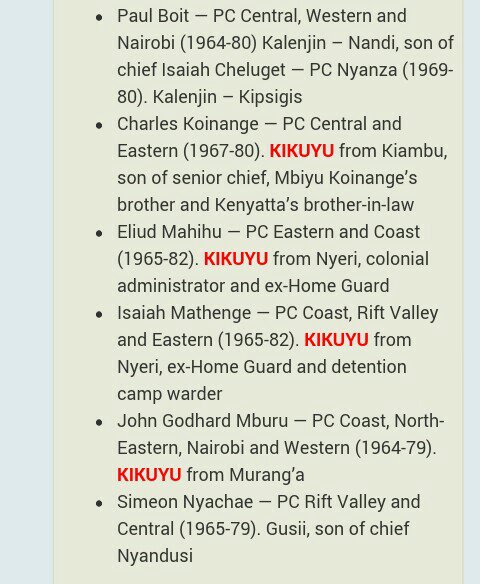
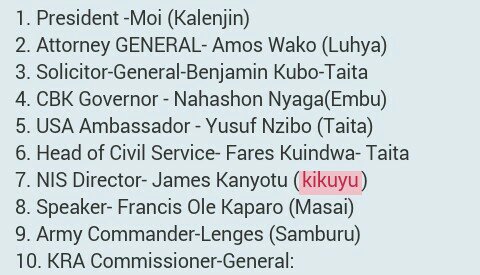
3) But from the first list you have provided, surely, is there something between your ears, really???? can't you think for yourself, I mean what is that list supposed to mean, The list has just rundomly taken people who are Kikuyus who have held important positions over the years.... So what is that supposed to mean?? are people supposed to make a conclusion from that? One can easily make a list just like that of Kambas or Jaluos who have held important possition over the years, it wont mean anything...
I think there is a word for it in journalism they use... when someone takes facts and present them to you and make a conclusion based on those facts, kumbe on the other hand, he/she has ommited/hidden contradicting facts which would have skewed the results and thus lead to a different conclusion.
If you really want to find how tribalism affect people employed, if you are going to compare the governor of central bank, then compare the tribes of all the previous CBK govs, if its army commander then compair with all the previos army comander, if its the speaker then compaire him to the previous people who have held that position..... You cant just randomly pick positions of govenment you deem important that have Kikuyus and then conclude that ''all important positions are held by kikuyus" hio ni watu hawakuenda shule ndo unaeza wadanganya na pata potea kama hizo
where is the Chief of defence forces?
Comander of the airforce and the navy?
Director of public prosecution
Speaker of the senate
Inpector general of the Police
President of the supreme court -chief justice..
A proper analysys would be one that compares ALL the managers/CEO/Heads of government departments...like the one budalangi Mp did....
Anyway, here is a more scientific one done for all government paid employees
Revealed: How ethnic groups share public jobs
The Civil Service is dominated by four communities, who take up more than half of all the jobs, a new government report has revealed.
Members of the Kikuyu community lead the pack, followed by their counterparts from the Kalenjin, Luhya and Kamba communities. Together, they control 58 per cent of the workforce in government ministries, departments and agencies.
However, the report, dated December 2014, says that new appointments in the last financial year were done in a manner that ensured ethnic balance. The report was the product of a survey conducted in 168 agencies with a workforce of 94,286.
READ :
THREE TRIBES TAKE HALF OF ALL PUBLIC SECTOR JOBS
“Ethnicity is normally one of the criteria we use when hiring. We want to ensure that all communities are fairly represented,” Prof Margaret Kobia, the chairperson of the Public Service Commission, told the
Nation in a telephone interview.
Prof Kobia said the report gives the Public Service Commission baseline guidelines that would help it to reduce the gaps to ensure that the public service has a national face.
“We can see the gains we have made in reducing the gap in ethnic representation,” she said.
THREE GROUPS OVER-REPRESENTED
The report is the first informed by research and will be useful to scholars, public servants and Kenyans who want to understand the civil service.
It reveals that members of the Kikuyu community had the highest number of employees, at 21,567, accounting for 22.9 per cent of the total workforce.
Although there are about six million people from the community — who form 17 per cent of Kenya’s population, according to the 2009 census figures — the study said the community was over-represented by 5.5 per cent.
Members of the Kalenjin community, who hold 12,082 jobs in the surveyed departments, were also over-represented by 1.57 per cent. They form 12.8 per cent of the total government workforce.
The Luhya community was third with 11,487 civil servants, representing 12.2 per cent of the workforce. Although it was one of the communities with the highest number of workers in government, it was, however, under-represented by 1.78 per cent based on its members’ proportion of the national population, which stands at 14 per cent.
The report ranked the Kamba community fourth, with 10,321 employees. This translated to an over-representation of 0.76 per cent.
TRIBALISM AND HISTORICAL REASONS
“Taking the size of Kenya’s ethnic groups in the national population into account, the Kikuyu, Kalenjin, Kisii and Embu have a fairly large representation relative to their population,” it says.
Prof Kobia attributed the distribution of jobs to tribalism and historical reasons but said the government had put in place measures to ensure the public service reflects the face of Kenya.
In the 2013/2014 financial year, 2,211 people were hired in various government agencies. Of these, 1,424 were male while 787 were female.
Whereas this met the one-third gender requirement, individuals from the Kalenjin community secured 454 government jobs followed by those from the Kikuyu community (412), from the Luhya (404) and from the Luo communities (381). The Kamba and Kisii communities had more than 100 people hired, with 161 and 145, respectively.
Education, according to the report, was one of the factors that continue to lock out minorities from civil service jobs.
“It should be noted that employment is a function of, among other factors, skill, knowledge and literacy, which, in progression towards compliance, will slow down equal representation among the minorities unless they improve their low literacy skills,” the report said.
According to the data, the Somali community has the highest deficit in the public service at 4.4 per cent, followed by the Turkana at 2.2 per cent and the Luhya at 1.8 per cent. There are 1,751 government workers of Somali origin in the civil service and 384 from the Turkana community.
Others who are under-represented include the Meru, with a workforce of 3,815, which translated to an under-representation of 0.29 per cent.
MIJIKENDA
The Mijikenda community has a workforce of 5,823, while the Swahili community has only 448 employees in various government agencies.
According to the findings, five communities are not represented at all, while three have less than 20 employees. Those not represented are the Galla, with a population of 8,146, the Konso (1,758), the Galjeel (7,553), the Leysan (5,941) and Kenyan Americans (2,422).
The El Molo community, which is at risk of extinction, has five employees. The community has a total of 2,844 members nationally.
The Borana community has a workforce of 973 out of 161,399 people.
Only one Kenyan European is in the civil service, out of the 5,166 people from that community.
According to the 2009 census, the Kikuyu community is the most populous, with 6.62 million people, while the Luhya are second, with 5.33 million, followed by the Kalenjin, with 4.3 million.
In 2011, a report by the National Cohesion and Integration Commission on ethnicity in the public service revealed that five communities — Kikuyu, Kalenjin, Luhya, Kamba and Luo — commanded about 70 per cent of the total workforce.
The Kikuyu community led with 22.3 per cent, followed by the Kalenjin followed with 16.7 per cent, the Luhya (11.3 per cent) and the Kamba (9.7 per cent).