Ziara ya Rais Samia nchini Ufaransa: Nini maana ya Uchumi wa bluu, Je, ni muhimu kuhudhuria? Pata shule fupi

Ziara ya Rais Samia nchini Ufaransa: Nini maana ya Uchumi wa bluu, Je, ni muhimu kuhudhuria? Pata shule fupi

FRANCE AND TANZANIA STRENGTHEN THEIR COOPERATION FOR MORE INCLUSION AND SUSTAINABILITY IN THE AGRICULTURAL AND URBAN TRANSPORT SECTORS

PUBLISHED ON FEBRUARY 11, 2022

Agriculture and rural developmentMobility and transportSustainable cities
AfricaTanzania
default image

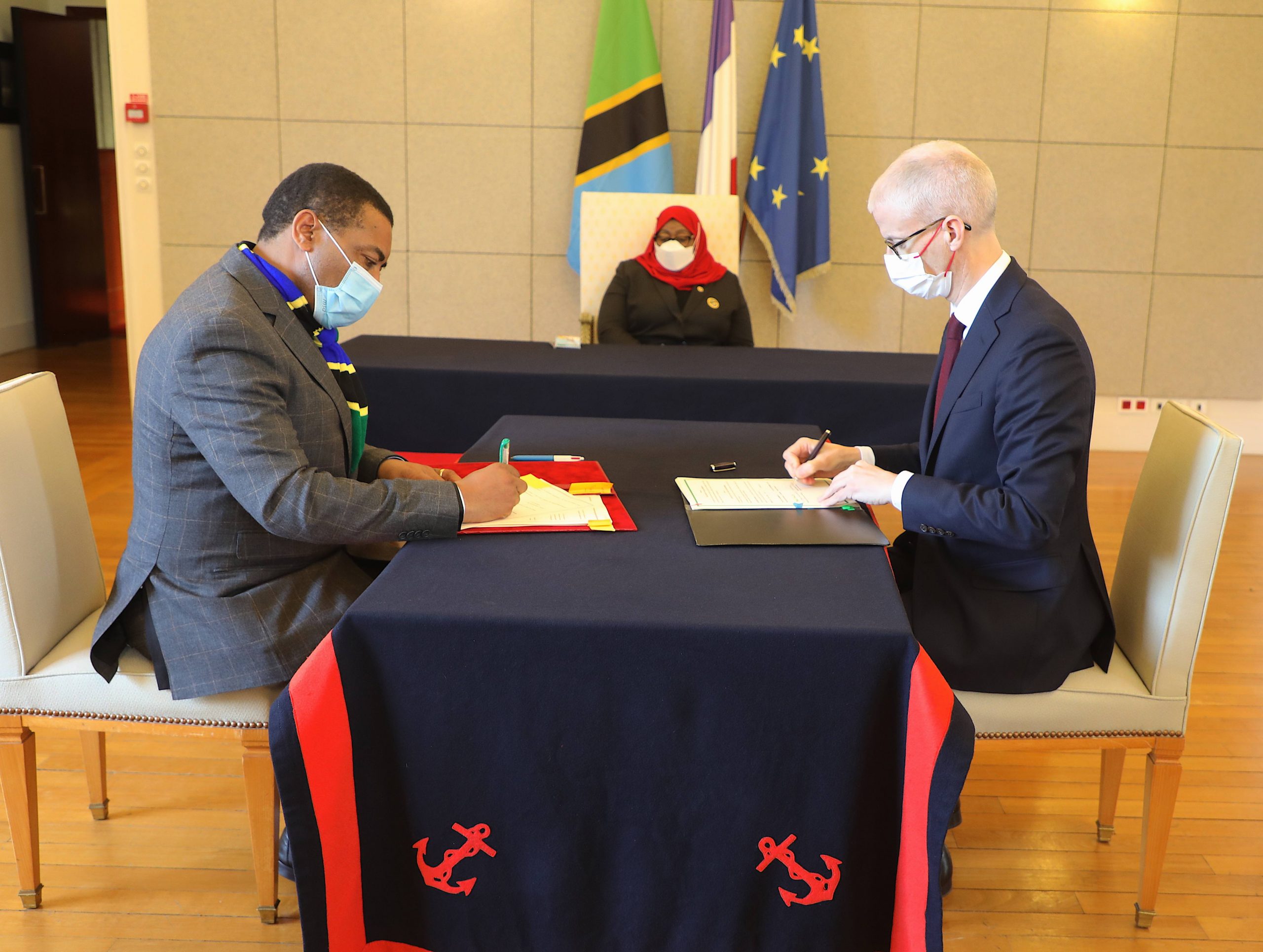
On the sidelines of the One Ocean Summit, organized this year in Brest, Samia Suluhu Hassan, President of the United Republic of Tanzania, Franck Riester, Minister Delegate in charge of Foreign Trade and Attractiveness and Rémy Rioux, Director General of the French Agency (AFD) presided over the signing of three financing agreements between France and Tanzania, for a total amount of 259 million euros.

To improve access to financing for the agriculture sector in Tanzania , a sovereign loan of €80 million from AFD to the Tanzanian Ministry of Finance and Planning, together with a grant of €1 million euros in the form of technical assistance, have been granted. This line of credit will be used to strengthen the Tanzania Agricultural Development Bank ( TADB ) in its role as a catalyst for financing the agricultural sector.

As a public development bank, the TADB is mandated to finance and catalyze private financing for the agricultural sector. This support will enable it to increase the financial inclusion of players in the sector (particularly women and young people) and to promote better environmental and social practices.

Through access to appropriate financial and non-financial services, smallholder farmers and agribusiness SMEs will ultimately see their incomes and livelihoods increase.

In support of Dar Es Salaam's sustainable urban mobility development policy , AFD also signed a sovereign loan agreement of 178 million euros with the government of Tanzania. This loan is intended to finance the fifth phase of the city's Bus Rapid Transit , which will reduce the sector's carbon emissions, reduce pollution and facilitate access to services for populations.

Third largest city in Africa in terms of growth, the economic capital of Tanzania should become a megalopolis of more than 10 million inhabitants by 2030, according to the United Nations : La France et la Tanzanie renforcent leur coopération pour plus d’inclusion et de durabilité dans les secteurs agricole et des transports urbains


5-10-scaled.jpg


Rais wa Jamhuri ya Muungano wa Tanzania Mhe. Samia Suluhu Hassan akishuhudia Waziri wa Fedha na Mipango Mhe. Mwigulu Nchemba akiweka saini moja ya mikataba ya ushirikiano wa kimaendeleo katika Nyanja mbalimbali kati ya Tanzania na Ufaransa iliyowakilishwa na Waziri wake wa Biashara Franck Reister katika mji wa Brest nchini Ufaransa leo tarehe 11 Februari, 2022.
 
Utangulizi:

Kijiografia bahari zinachukua takriban 71% ya eneo lote la uso wa Dunia yetu na kwa nadharia za kisayansi inaaminika kwamba maisha ya viumbe yalianzia baharini. Hivyo basi, kwa vyoyote vile iwavyo, bahari imekua sehemu muhimu kabisa ya maisha ya kila siku ya binadamu. Binadamu anafanya shughuli zake mbalimbali katika mazingira ya maji au bahari, nyingine ni za kiuchumi na nyingine si za kiuchumi.


Uchumi wa bluu:

Huu ni mkusanyiko wa shughuli zote za kiuchumi ambazo zinafanyika katika mazingira ya maji hasa bahari. Shughuli hizo ni pamoja na uvuvi (fishing), ukuzaji viumbe maji (aquaculture), utalii (tourism), usafiri na usafirishaji (transportation and shipping), uvunaji wa mafuta na gesi (oil and gas exploration), uzalishaji nishati (energy generation), uchimbaji madini (minerals extraction) na mengineyo mengi. Ukienda mbele zaidi, uchumi wa bluu unajumuisha pia shughuli za utunzaji na uhifadhi wa mazingira ya bahari (conservation and management activities).

Ili kuleta uwiano mzuri kati ya matumizi ya rasilimali za baharini na kuzitunza au kuzihifadhi ndipo inakuja dhana nzima ya matumizi endelevu ya rasilimali bahari (Sustainable utilization of marine resources).

Kwa sababu bahari imeenea kwenye eneo kubwa sana katika uso wa dunia, jitihada za kuhakikisha kunakua na uhifadhi na matumizi endelevu ya bahari zinapaswa kuwa ni za pamoja baina ya mataifa mbalimbali (collaborative approach of marine resources management).

Jitihada hizo hufanyika kwa namna mbalimbali kama vile mikutano na makongamano (summits, conferences and conventions) ili kujadiliana, kuweka mikakati ya pamoja na wakati mwingine kusaini mikataba na kupitisha sheria mbalimbali. Lakini pia hatua nyingine za kiutekelezaji zinajumuisha kufanya miradi ya uhifadhi pamoja, kupeana misaada ya rasilimali kadha wa kadha, kubadilishana taarifa za tafiti na mambo mengine “chungu nzima”.

Mkutano wa Kimataifa wa Rasilimali za Bahari: The One Planet Summit for The Oceans

Ni mkutano wa kimataifa unaojumuisha mataifa ya Ulaya na mataifa mengine kwa lengo la kuchukua hatua dhidi athari hasi zinazoyakabili mazingira ya bahari. Mwaka huu 2022, mkutano huu unafanyika mjini Brest nchini Ufaransa chini ya uenyeji wa Rais wa nchi hiyo bwana Emmanuel Macron. Pamoja na wahudhuriaji wengine mkutano huu unajumuisha wakuu wa nchi, wakuu wa taasisi mbalimbali za kimataifa pamoja na wadau wengine wanaoguswa moja kwa moja na masuala ya mazingira ya bahari.

Lengo kuu la mkutano huu ni kutafuta suluhu ya pamoja ya kukabiliana na changamoto “za kesho” ya bahari ambazo kwa uchache ni kama vile uchafuzi (pollution), uharibifu wa maeneo muhimu ya bahari (degradation of keystone habitats), madhara ya mabadiliko ya tabia ya nchi (marine induced climate changes) na mengineyo mengi. Masuala mengine yanayoangaziwa macho ni pamoja na kuweka mikakati ya pamoja ya kuendeleza uvuvi endelevu bila kusahau hatua nyingine za uhifadhi na utunzaji wa bayoanuai (biodiversity).

Katika mkutano huo, Tanzania imewakilishwa na Rais Mh. Samia Suluhu Hassan.
Rubbish.
 
Mazungumzo mengine hufanyika faragha (behind closed doors), mfano suala nyeti kuhusu kesi namba 16/2021 inayowakabili Mh. Freeman Mbowe na wenzie 3 ambalo ni gumzo jijini Paris France hadi makao makuu ya Umoja wa Ulaya EU kule Brussels Belgium , Tanzania ya awamu ya 6 ingependa suala hili lizungumzwe ktk faragha ili kulinda heshima ya serikali wakati ikitafuta wakati muafaka wa kuifutilia mbali kesi hii ya kihistoria.

Na hii huwa na uzito ikifanyika tête-à-tête huku viongozi wakiangaliana macho kwa macho katika chumba cha mazungumzo na kukubaliana kiungwana kesi hiyo ifutwe, ili ukurasa mpya wa mashirikiano kati ya Tanzania ya awamu ya 6 na Jumuiya za Kimataifa uendelee bila vikwazo vilivyotishiwa kuwekwa na wakubwa hawa wa dunia.
Wewe unapopiga simu kwa mkeo huwa jamii nzima inasikikiza au huwa mnazungumza kwa faragha? Ni faragha ya namna gani hiyo ambayo imeshindikana kwa video conferencing?
 
Utangulizi:

Kijiografia bahari zinachukua takriban 71% ya eneo lote la uso wa Dunia yetu na kwa nadharia za kisayansi inaaminika kwamba maisha ya viumbe yalianzia baharini. Hivyo basi, kwa vyoyote vile iwavyo, bahari imekua sehemu muhimu kabisa ya maisha ya kila siku ya binadamu. Binadamu anafanya shughuli zake mbalimbali katika mazingira ya maji au bahari, nyingine ni za kiuchumi na nyingine si za kiuchumi.


Uchumi wa bluu:

Huu ni mkusanyiko wa shughuli zote za kiuchumi ambazo zinafanyika katika mazingira ya maji hasa bahari. Shughuli hizo ni pamoja na uvuvi (fishing), ukuzaji viumbe maji (aquaculture), utalii (tourism), usafiri na usafirishaji (transportation and shipping), uvunaji wa mafuta na gesi (oil and gas exploration), uzalishaji nishati (energy generation), uchimbaji madini (minerals extraction) na mengineyo mengi. Ukienda mbele zaidi, uchumi wa bluu unajumuisha pia shughuli za utunzaji na uhifadhi wa mazingira ya bahari (conservation and management activities).

Ili kuleta uwiano mzuri kati ya matumizi ya rasilimali za baharini na kuzitunza au kuzihifadhi ndipo inakuja dhana nzima ya matumizi endelevu ya rasilimali bahari (Sustainable utilization of marine resources).

Kwa sababu bahari imeenea kwenye eneo kubwa sana katika uso wa dunia, jitihada za kuhakikisha kunakua na uhifadhi na matumizi endelevu ya bahari zinapaswa kuwa ni za pamoja baina ya mataifa mbalimbali (collaborative approach of marine resources management).

Jitihada hizo hufanyika kwa namna mbalimbali kama vile mikutano na makongamano (summits, conferences and conventions) ili kujadiliana, kuweka mikakati ya pamoja na wakati mwingine kusaini mikataba na kupitisha sheria mbalimbali. Lakini pia hatua nyingine za kiutekelezaji zinajumuisha kufanya miradi ya uhifadhi pamoja, kupeana misaada ya rasilimali kadha wa kadha, kubadilishana taarifa za tafiti na mambo mengine “chungu nzima”.

Mkutano wa Kimataifa wa Rasilimali za Bahari: The One Planet Summit for The Oceans

Ni mkutano wa kimataifa unaojumuisha mataifa ya Ulaya na mataifa mengine kwa lengo la kuchukua hatua dhidi athari hasi zinazoyakabili mazingira ya bahari. Mwaka huu 2022, mkutano huu unafanyika mjini Brest nchini Ufaransa chini ya uenyeji wa Rais wa nchi hiyo bwana Emmanuel Macron. Pamoja na wahudhuriaji wengine mkutano huu unajumuisha wakuu wa nchi, wakuu wa taasisi mbalimbali za kimataifa pamoja na wadau wengine wanaoguswa moja kwa moja na masuala ya mazingira ya bahari.

Lengo kuu la mkutano huu ni kutafuta suluhu ya pamoja ya kukabiliana na changamoto “za kesho” ya bahari ambazo kwa uchache ni kama vile uchafuzi (pollution), uharibifu wa maeneo muhimu ya bahari (degradation of keystone habitats), madhara ya mabadiliko ya tabia ya nchi (marine induced climate changes) na mengineyo mengi. Masuala mengine yanayoangaziwa macho ni pamoja na kuweka mikakati ya pamoja ya kuendeleza uvuvi endelevu bila kusahau hatua nyingine za uhifadhi na utunzaji wa bayoanuai (biodiversity).

Katika mkutano huo, Tanzania imewakilishwa na Rais Mh. Samia Suluhu Hassan.
Asante kwa shule nzuri na mimi umenifungua, maana nilikuwa nadhani uchumi wa blue ni uvuvi tuu.

Pili niliona Rais katoa wito kwa Mataifa makubwa kuheshimu makubaliano ya ulinzi wa makubaliano ya uchumi wa blue.

Maana hao mbwa wamekuwa wanakuja kuvua kwenye Bahari zetu usiku yaani deep water bila vibali na kumwaga taka sumu kwenye Bahari zetu.
 

bagamoyo


Naona umerudi kwa kasi ya ajabu lakini watoto wa watumwa hawawezi kuondoa umasikini Tanzania kwa sababu bado wapo utumwani. Mazoea ya vitu vya bure bure. Rejea Hotuba ya baba wa Taifa, ..... ..... ..... ''kuna watu wapo kama malaya, tabia zao ni za kimalaya malaya.''
Rubbish,miaka Zaidi ya 25 alifanya kipi cha maana?.

Ni sawa na wewe hapo hakuna cha maana unafanya unasubiria kulaumu serikali 😁😁
 
Jumatatu ya tarehe 14 February 2022 Mh. Rais pamoja na ujumbe wake watakuwa na shughuli ifuatayo :
Meeting of the France - East Africa Business Council with Samia Suluhu Hassan, President of the Republic of Tanzania, at the Cercle de l'Union Interalliée - 33, rue du Faubourg Saint-Honoré (8th)

14 February 2022

1644685454496.png


MEETING OF THE FRANCE-EAST AFRICA BUSINESS COUNCIL
Mrs. Samia SULUHU HASSAN, President of the Republic of Tanzania

This meeting will take place in two parts:

a plenary sequence around the President of the Republic
sectoral sequences following the plenary around the ministers present. A list of sequences will be communicated to those registered for the event at a later date.
The Tanzanian economy has shown significant dynamism over the past decade, with an average GDP growth rate of 6.5% per year before the start of the pandemic. In 2020, the economy is experiencing weaker growth than expected (2.1%) but avoids the recession that has affected the majority of African economies. In 2021, growth has approached its pre-pandemic level, around 5%.

Still on the macroeconomic level, inflation has been below 5% for more than 10 years and public debt remains below 40% of GDP. While many countries in the region are facing macroeconomic imbalances as a result of the pandemic, Tanzania maintains a relatively sound framework.

The priorities of the new executive remain those established under the Magufuli presidency: infrastructure projects in the water, transport and energy sectors (production, transmission and distribution), the diversification of the tourism sector and the urban development of the city of Dodoma. Developments are therefore expected in these sectors. President Suluhu Hassan has also listed the improvement of the business environment and the revitalization of the private sector among her priority objectives.

This meeting will be an opportunity to:

  • learn about the economic priorities of the Executive of Tanzania
  • to take stock of your current or future projects;
  • to exchange with French companies on the situation in the country
  • to meet key actors of the Tanzanian economy belonging to the public and financial spheres.

Source : Présidente de la République - MEDEF International
 
POSTED ON FEBRUARY 11, 2022

Brest's commitments for the ocean​

2022-02-11 (213404) Brest - One Ocean Summit @ SDLM


Brest's commitments for the ocean
More than 100 countries, from all sea basins and representing more than half of the world's exclusive economic zones, have expressed their determination to preserve the oceans by contributing to the "Brest Ocean Commitments", alongside the Secretary General of the United Nations, the Director General of UNESCO and the Secretary General of the International Maritime Organization.

These strong commitments were made during the One Ocean Summit held from February 9 to 11, 2022 in Brest, bringing together 41 States, representatives of civil society and businesses, a milestone of a French presidency of the Council of the European Union committed to the climate and of an active European policy in favor of the oceans.

Aware that the place of the ocean in the international political agenda today is neither commensurate with its role in the planetary climatic, environmental and social balances, nor in terms of the threats weighing on marine life, the leaders gathered in Brest pledged to work collectively, quickly and concretely to put a stop to the degradation of the ocean.

They have chosen to act for the preservation of biodiversity, the end of the overexploitation of marine resources, the fight against pollution and the mitigation of climate change.

Protecting the biodiversity and resources of our oceans​

The creation of protected areas is an essential pillar for the preservation of biodiversity. It is now essential to continue and amplify the momentum by setting high ambitions for the decade to come.
  • More than 30 new countries have joined the High Ambition Coalition for Nature and People launched at the One Planet Summit in January 2021. There are now 84 countries with the goal of protecting 30% of the world's land and seas by 2030 .
Two-thirds of the ocean, located beyond national jurisdictions, ie 45% of the surface of our planet, cannot currently benefit from marine protected areas.
  • The 27 Member States of the European Union, joined by 16 third countries , have therefore launched the "High Ambition Coalition for a High Seas Treaty" in order to work towards the conclusion this year of an operational and on the sustainable use of the high seas and the protection of its biodiversity.
Illegal, unreported or unregulated fishing accounts for almost a fifth of global catches, undermines efforts to manage fish stocks sustainably and is often accompanied by very poor safety and working conditions for fishermen.
  • 14 countries participating in the One Ocean Summit have committed to strengthening the fight against illegal fishingon several fronts:
    • 6 countries have committed to ratify, before the deadline of October 2022, the Cape Town agreement of the International Maritime Organization, which will thus finally be able to come into force and set safety standards for fishing vessels.
    • 2 new countries will ratify the FAO Port State Measures Agreement, which allows better control of fishing activities at landing ports.
    • Several Member States of the European Union have undertaken to mobilize their State Navy in the framework of missions abroad to strengthen the surveillance of illegal fishing, in application of the European regulation of 2008.

Joining forces with those of the ocean in the face of climate change​

The strong growth of maritime transport, driven by that of world trade, requires a rapid and significant reduction in nuisance.
  • 22 European shipowners have committed to the new Green Marine Europe label , applying very concrete measures in eight areas: underwater noise, polluting atmospheric emissions, greenhouse gas emissions, invasive aquatic species, management of residual materials, oily discharges, ship recycling.
  • 35 players, including 18 major European and world ports, have committed to accelerating the supply of electricity to ships calling to limit greenhouse gas emissions and reduce atmospheric pollution in often dense port cities.
  • In order to reduce air pollution, all Mediterranean countries, joined by the European Union, have undertaken to ask the IMO to create a low sulfur emission zone across the entire Mediterranean by 1 January 2025 . France, Spain, Italy and Monaco will also ask the IMO this summer for the creation of a Particularly Vulnerable Maritime Area with regard to the strong presence of cetaceans, in order to be able to limit the speed of navigation there and thus reduce collisions.
The ocean plays a decisive role in the fight against and adaptation to climate change. Certain marine and coastal ecosystems (salt meadows, underwater meadows or mangroves) have the capacity to absorb and store large quantities of carbon: this must now be valued to accelerate protection and restoration projects, in order to enable genuine “blue carbon offsetting”.
  • France and Colombia have launched in Brest an international coalition for blue carbon , which will bring together national and multilateral actors in this field to contribute to the financing of the restoration of coastal ecosystems, on the basis of common and rigorous methodologies.

To put an end to plastic pollution of the oceans​

9 million tonnes of plastic are dumped into the ocean each year, 80% of which comes from coasts and rivers. Massive investment is needed to upgrade sanitation and waste treatment infrastructure on all continents
  • On the occasion of the One Ocean Summit, the European Bank for Reconstruction and Development joined the European Investment Bank and the French (AFD), German (KfW), Italian (CDP), Spanish (ICO) development banks which have joined forces in the largest initiative dedicated to reducing plastic pollution at sea through the Clean Oceans Initiative . Together, they have doubled their intervention in this sector by committing to provide a total of €4 billion in financing by 2025 .
The best way to ensure that waste does not reach the ocean is to stop producing it. To accelerate the transition to a circular economy that aims for 100% reuse or recycling of plastic materials and the abandonment of all single-use uses, the global commitment for a new plastics economy, led by the Ellen MacArthur Foundation and the United Nations Environment Program brings together States, local authorities, businesses and NGOs.
  • On the occasion of the One Ocean Summit, Greece, Italy, Colombia, South Korea, the City of Paris and the Maritime Region of Central Greece joined the “global commitment for a new plastics economy” and 500 signatories from all over the world, including 250 companies.
  • On the occasion of the One Ocean Summit, India and France jointly launched a multilateral initiative on the elimination of pollution due to single-use plastic .

Placing the Ocean at the heart of the international political agenda​

The work of the One Ocean Summit is the starting point for a series of international meetings for which the ocean will be central, in particular the United Nations Ocean Conference in Lisbon in June, but also COP27 hosted by the Egypt in the fall.
  • To confirm this momentum and build an ambitious international ocean agenda, France and Costa Rica have proposed to organize the next United Nations conference on the ocean together in 2024.
To decide, you have to understand better. The digital revolution is an opportunity to build an integrated model of the ocean, covering physics, chemistry, marine life and human activities. This "digital twin" will be able to shed light on political decisions and monitor their effects, allow the economy of the sea to develop while respecting ecosystems and foster dialogue with stakeholders and the public.
  • The European Union is committed to equipping itself with a digital twin of the ocean which will make it possible to gather knowledge and test action scenarios, in the service of European blue growth and global governance.
  • UNESCO is committed to having at least 80% of the seabed mapped by 2030.

In addition to its active participation in the collective commitments announced at the summit, France, the host country, acts at the national level and intends to be exemplary.​

  • It contributes to raising the collective ambition for the preservation of marine biodiversity:
  • It announced that it has now reached and exceeded the objective of classifying 30% of the land and sea areas under French jurisdiction as protected areas, with the extension of the national nature reserve of the French Southern Territories, which has become the 2nd largest marine area. protected in the world with more than 1.5 million km2.
  • To go further, French Polynesia has undertaken to create within its EEZ a network of marine protected areas of at least 500,000 km².
  • France also presented a progress report on the implementation of the action plan adopted to deal with incidental catches of small cetaceans in the Bay of Biscay.
France has announced commitments to further combat ocean pollution:
  • It undertakes to treat within 10 years the abandoned landfills on its coasts presenting risks of discharge into the sea of waste, in particular plastic. Three of them, where the situation is particularly urgent, will be dealt with from this year 2022: those of Dollemard in Seine-Maritime, Fouras in Charente-Maritime and Anse Charpentier in Martinique.
  • The anti-waste law for a circular economy puts France on the path to phasing out single-use plastic packaging by 2040.
Finally, France is committed to improving knowledge of the effect of climate change on sea level rise:
  • France will soon publish its first national polar strategy and will launch a scientific program to measure the contribution of East Antarctica to sea level rise.
For the record, 41 countries responded to the invitation and contributed at a very high level to the summit : Germany, Barbados, Canada, China, Cyprus, Colombia, Comoros, Congo, South Korea, Costa Rica, Côte d'Ivoire, Croatia, Egypt, Spain, United States, France, Gabon, Ghana, Greece, India, Ireland, Iceland, Italy, Japan, Madagascar, Malta, Morocco, Mexico, Monaco, Namibia, Norway, Palau, Panama, Papua New Guinea , Portugal, United Kingdom, Senegal, Seychelles, Tanzania, Tonga, Tunisia
Source :
 
AFD also signed a sovereign loan agreement of 178 million euros with the government of Tanzania.

1.3. Key features of sovereign borrowing during the COVID-19 crisis​

Choice of borrowing instruments and methods is central to sovereign debt management.5 In normal times, policy makers consider various factors including medium and long-term costs and risks associated with a wide range of securities along with market demand in order to structure their annual borrowing strategy. Times of crisis such as the COVID-19 pandemic, however, risk provoking a mismatch between the timing and scale of government funding needs and market demand. Under such conditions, market demands for duration as well as liquidity conditions become more important factors in the choice of borrowing methods and instruments than those of associated long-term costs and risk considerations. Sovereign issuers are therefore expected to adjust their short-term borrowing strategies, giving priority to financing the increased borrowing needs of governments without putting extra pressure to the financial markets.

As the COVID-19 crisis evolved throughout 2020, sovereign debt managers had to adjust different aspects of their borrowing operations. In the initial phase of the crisis, market liquidity suddenly evaporated as uncertainty about the impact of the shock on economic activity increased, and investors became highly risk-averse. At the same time, cash forecasting became difficult as government health expenses and, in some countries direct transfers, rose while revenues suddenly dropped. Depending on the impact of the crisis on short-term cash needs as well as on market conditions, governments relied on contingency funding tools such as issuance of Treasury-Bills and use of available liquidity buffers.

While policy measures taken by major central banks improved liquidity conditions in the markets rapidly, the unprecedented increase in annual borrowing needs and continuing macroeconomic uncertainties have changed the annual sovereign borrowing plans in all OECD countries. These changes include increased issuance of new types of securities, including short-term securities, and modifications to the size and number of auctions as well as use of other means of borrowings. At the same time, interest rates on government securities declined in line with robust market demand supported by central bank bond buying programmes. Overall, the increased supply of government securities in the wake of COVID-19 crisis has been well received by market participants. OECD area sovereign debt managers reported that the market remained resilient in the face of the unprecedented size of sovereign financing programmes...

1.3.3. Heavy reliance on short-term debt issuance​

T-Bill markets, typically used for cash management purposes, are often the most liquid markets and offer cheap financing conditions. Because of these features, T-Bills are considered as ‘shock absorbers’ by sovereign debt managers (Box 1.1) and played a key role in sovereign financing in 2020. The uncertainties associated with public expenditure related to the COVID-19 crisis have posed challenges for government cash-flow forecasting and management of the resulting cash positions resulted in increased use of short-term debt instruments. Many sovereigns issued T-Bills also for boosting liquidity buffers against possible changes in cash needs.

Given the funding flexibility T-Bills, offer, the bulk of the initial cash needs of governments due to the COVID-19 shock were financed through T-bill issuance. More than 70% of pandemic-related debt has been issued in the form of T-Bills in France, Germany, Japan and the United States, at almost no cost (e.g. negative 6-month Treasury bill yields in euro area and Japan, and 0.1% in the United States). As a result, the share of short-term instruments in central government marketable debt issuance in the OECD area, which averaged 40% in the past five years, increased to 48% in 2020 (Figure 1.8).

While the initial borrowing needs were predominantly met through T-bill issuance, sovereign issuers have been increasing long-term bond issuances steadily as a prudent means of managing their maturity profile and limiting potential future issuance volatility. This also aims at rebuilding contingency capacity in the event that significant funding is needed again in short order. The 2020 survey on Central Government Marketable Debt and Borrowing projects the share of long-term debt to increase by more than 2 percentage points in 2021 to reach 54.4% at the end of the year. However, it should be noted that governments’ ability to rebalance their issuance towards long-dated bonds may be constrained in the short-term by the large size of the financing needs and limits to investor demand for duration

READ MORE : source : Home
 
In Tanzania, France and the Aga Khan join forces against cancer

Ocean Road Cancer Institute (34775222422).jpg
Ocean Road Cancer Institute, Dar es Salaam

De nombreux patients s’entassent dans la salle de chimiothérapie de l’Ocean Road Cancer Institute, à Dar es-Salaam, pour suivre leur traitement. Pierre Anhoury

REPORT - A 13 million euro project, to which the Institut Curie brings its expertise, hopes to improve cancer screening and treatment in this East African country. Subject to many beliefs and too little known, the disease has a growing hold on public health.

Special Envoy to Tanzania

Facing the Indian Ocean, the white building opens its pointed windows wide to the offshore winds. 200 meters from a beach in Dar es Salaam, the largest city in Tanzania, this could be a luxury hotel. But the building, erected at the end of the 19th century by the German colonial government, welcomes another kind of traveller: the Ocean Road Cancer Institute (Orci) is one of the few public establishments in the country taking charge of cancer.

Each year, 7,000 to 8,000 new patients come here for chemotherapy and radiotherapy treatments. The surgery is done a few kilometers away, at Muhimbili National Hospital.

But Ocean Road patients are rarely eligible anyway: by the time they get here, the disease has metastasized multiple times and is no longer operable. “70 to 80% of patients come to us at an advanced stage,” says Dr. Julius Mwaiselage, CEO of Orci.

Source : En Tanzanie, la France et l’Aga Khan se liguent contre le cancer
 
Back
Top Bottom