Sio result ya Mutation. Mutation inapelekea upungufu wa Genetic information sio kuja kwa information mpya by chance.
Alafu ukumbuke genes (gene-pools) zinamabilions of information ambazo unapomuona bacteria haimaanishi ametumia information zote alizonazo. Haya yote darwin alikufa hayajui.
soma na hapa
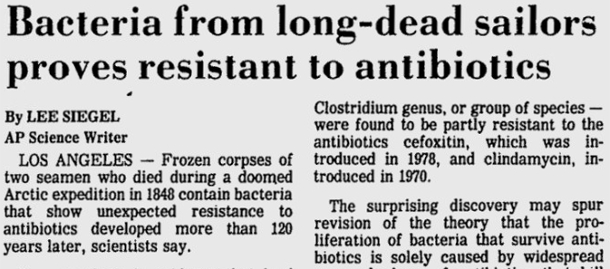
"Bacteria taken from the frozen bodies of 19th-century explorers are resistant to certain types of antibiotics. Antibiotics came into general use 40 years ago, so the discovery challenges the view that only the widespread use and abuse of antibiotics has built up resistance to them. Kay Kowalewska-Grochowska and coleagues from the University of Alberta Hospital at Edmonton in Canada, isolated six strains of bacteria of the genus Clostridium from the bodies of William Braine and John Hartnell, members of the Franklin expedition to the Artctic in 1845.
Kowalewska-Grochowska grew the bacteria, which are part of the normal flora present in people's intestines, and tested the mocrobes' resistance to various antibiotics... surprisingly, the 140 year-old bacteria were resistant to two other antibiotics, cefoxitin and clindamycin."
-Rhonda Siddal, "Ancient Bacteria Resistant to Some Antibiotics,"
New Scientist, Feb 11, 1989, p. 34
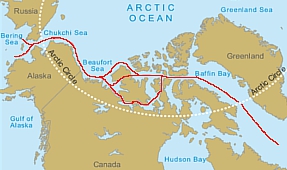
Explorers (led by Sir John Franklin in 1845) were sent north to look for a faster water-based trade route which would be better than having to sail all the way around the southern tip of South America to trade between the east coast and west coast of North America, and in a nutshell, they died in their search. The frozen bodies of dead men were discovered preserved in the waters north of Canada, and
the bacteria tested in their system was found to be resistant to antibiotics that would not have been invented for another 120 years.
When reading the entire article from
New Scientist Magazine, it forced the researchers to look for another explanation for how the bacteria were becoming resistant outside of the "new information" idea. The hilarious thing about this article is that they are listing out many possibilities, but the one they don't consider is that it's just a recessive trait (that causes damage and information loss to the ribosome). They won't consider a simple recessive gene because it doesn't help their religious evolutionary presuppositions.
"In 1988, researchers did autopsies on three of the Northwest Passage explorers whofroze to death in the Arctic in 1845. Bacteria from their colons were carefully cultured, andmany were already resistant to the most powerful modern antibiotics."
-Dr. Carl Wieland, "Antibiotic Resistance in Bacteria,"
CEN Tech Journal, Vol. 8, No. 1, 1994, p. 2
Keep in mind, if you show this article to evolutionists, they will simply ignore the information because they have a presuppositional bias in their hearts that needs evolution to be true. For this reason, one of the more common dismissals of the documentation will be, "They must have had contaminated samples," but according to research done by the
Medical Tribune, contamination was eliminated as a possibility.
"Well-preserved bodies of members of the Franklin expedition, frozen in the Canadian Arctic in 1845, contain bacteria resistant to antibiotics. Because the first antibiotics were developed in the early 1940s,
these resistant bacteria could not have evolved in response to antibiotics.
Contamination has been eliminated as a possibility."
-Rick McGuire, "Eerie: Human Arctic Fossils Yield Resistant Bacteria,"
Medical Tribune, Dec 29, 1988, p. 1
If an evolutionist wants to believe with all his heart and soul that evolution is true, then he is welcome to his beliefs. I don't care what he wants to believe. Evolution is a religious presupposition built on a tower of faith-based assumptions, and I just don't have enough faith to believe in it.