LAPSSET: Lamu Port and South Sudan Ethiopia Transport: News & Photos

LAPSSET: Lamu Port and South Sudan Ethiopia Transport: News & Photos

2021 statistics on Mombasa port Transit Cargo!

Transit Cargo.png


Yani kuna nchi nyengine bado zinatutegemea na bado watu wengine wanajigamba hapa eti watatupiku na bandari zao!
 
New Kipevu offshore oil terminal almost about to begin operations.

The oil and gas terminal was built using KPA's own internal revenue to a tune of $400 million.

6ilHDbY.jpg


pjxyB7i.jpg


Valve Station
OP2C7wY.jpg


Storage Tanks
qBuNQS1.jpg


okiJZdZ.jpg


Service Jetty (with SGR bridge in the background crossing the Indian Ocean into other berths of the port)
6zLhOrC.jpg
 

Kenyan ports lose regional grip as neighbours grow


pitkfqfopunwrcjcf62449875e2f72.jpg

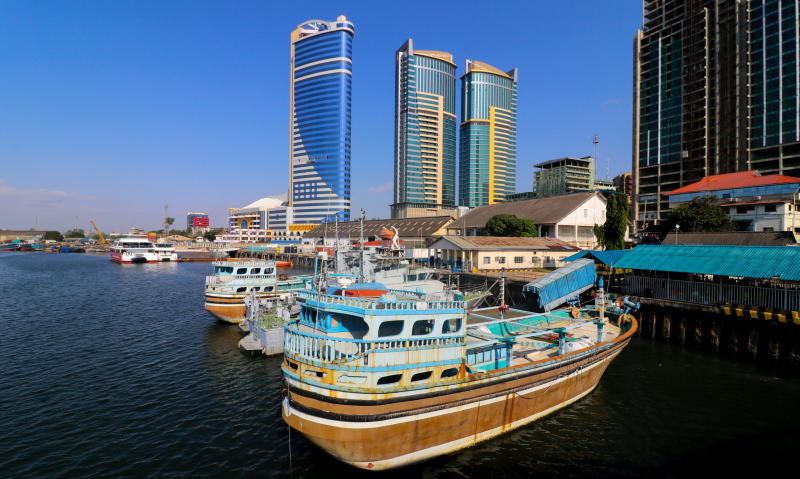
Dar es Salaam port [Courtesy]

Ugandan President Yoweri Museveni is always quick to warn neighbours not to dislike Kenya because “she is a pygmy who is an inch taller than her fellow pygmies in East Africa”.

What President Museveni means is that Kenya is a little stronger economically than her neighbours and so they should not be envious over such a trifling.

And indeed, Kenya’s strength is dwindling by the day if the performance of its ports in comparison to its neighbours is anything to go by.

Fresh data from Shippers’ Council of East Africa (SCEA) shows the country is losing cargo business destined to Uganda, Rwanda and Burundi, mainly to the Port of Dar es Salaam.

Goods to Uganda through Mombasa port dropped by four per cent in 2021-22 while those to Rwanda plummeted by 30 per cent.

Mombasa and the Port of Dar es Salaam have for decades battled for the lucrative transit business especially to Uganda, Rwanda, Burundi and Democratic Republic of Congo.

“It is very clear that cargo to Uganda is passing through another route,” said SCEA Chief Executive Gilbert Langat in an interview. He warned Mombasa to brace for stiff competition.

At the same time, major transport projects coming up in Tanzania, Somalia and Djibouti threaten to eat into Mombasa port’s transit market, and dampen the prospects of Lamu Port.

In Tanzania, a port project fronted by China, Oman and Tanzania in Bagamoyo is taking shape. Once complete, it is expected to eat into Mombasa port’s business.

In the Island of Zanzibar, a new port is also being built by United Arab Emirates, which trade analysts say will threaten Mombasa’s transshipment market.


Meanwhile, a Central Corridor Electric (CCE) Standard Gauge Railway (SGR) is being built by Turkey to link Burundi, Rwanda, Uganda and DRC shippers to Dar es Salaam.

“The (corridor) will link Burundi, Rwanda, DRC and Uganda to the western side of Tanzania. Shippers from those countries will find it an ideal route to use,” said Mr Langat.

The CCE SGR will be powered by electricity from the Grand Dam in the Selous Game Reserve and Songosongo gas.

Construction of a $3 billion (Sh344.5 billion) dam at Rufiji River is on. “In Tanzania, the Port of Mtwara has made Mombasa very unattractive for transshipment business,” said Tom Nyaminde of Tomsea Logistics Ltd.

Mr Nyaminde said the intense lobbying over the Uganda Oil Pipeline was a sign of trade battles ahead between Kenya and Tanzania once transport projects are completed.

On oil imports, a new oil pipeline is being constructed between Hoima in Uganda and Tanga in Tanzania. The Sh572 billion line is expected to be completed before 2025.

In 2016, Tanzania beat Kenya in the battle for the pipeline, which it had planned to link to Lamu Port. But Kenya has announced that it will go it alone and build the pipeline.

In Kenya, the construction of the Sh40 billion offshore Kipevu Oil Terminal in Mombasa, the largest of its kind in Africa, is also 96 per cent complete.

The offshore terminal will be able to load and offload very large sea tankers of up to 200,000 Deadweight tonnage (DWT) carrying all categories of petroleum products including crude oil, white oils and LPG.

Meanwhile, Somalia is also expanding its port of Berbera in Somaliland. The first terminal with a capacity of 500,000 twenty-foot equivalent units (TEUs) is about to be completed.

The port is expected to target the Ethiopian market through the Berbera road whose construction is funded by the Abu Dhabi Fund for Development and the UK’s Department of International Development.

At the same time, UK Aid is also funding the construction of the Hargeisa Bypass Road that will link to the modern highway in the Ethiopian side.

This is expected to be a direct, fast and efficient trade route for Ethiopian transit cargo. Kenya’s new port of Lamu is also targeting the Ethiopia market.

But the competition for the lucrative Ethiopian market will not be between Kenya and Somalia alone. Djibouti has also upped its fight for the Ethiopian Market.

A 752-kilometre Ethio-Djibouti railway line seen as a key route for passengers and cargo to and from Ethiopia is currently operational.

Interviews with players in the shipping industry reveal that Djibouti has been able to attract both cargo and military bases because it is located between Somalia, Eritrea, and Yemen.

Djibouti is also located near the Bab el Mandab Strait, which connects the Red Sea to the Gulf of Aden; a critical corridor for international shipping.

It is approximately 900 kilometres from Djibouti Port to Addis Ababa compared to 1,279 kilometres from Lamu Port.

This means that Kenya’s Lamu Port will have to compete with Djibouti and Durban in South Africa for the transshipment business.

Kenya Ports Authority has offered generous promotional tariffs to shipping lines and shippers keen to use Lamu Port.

Traders in Mombasa, however, say Mombasa and Lamu can still compete and get the business if the government puts in place systems to bolster efficiency.

Mombasa has for years been beleaguered by inefficient cargo clearance processes causing delays and rendering the port expensive and uncompetitive.

This scenario, blamed on cumbersome documentation, cargo clearance and customs procedures has contributed to the high costs of transport along the Northern Corridor.

According to a report by the Northern Corridor Transit and Transport Coordination Authority, different state agencies have not integrated their on-line systems.

The report reveals that clearing processes at port, container freight stations and customs procedures remain the main sources of delay and high logistics costs.

“There are more than twenty-nine clearance steps to import containers through Mombasa port which are destined for the Kenyan market, and twenty-seven steps for clearance for transit containers,” the report reads.

“Overall, the multiple and duplicated steps which are required to clear both local and transit containers illustrate the reasons for delays along the logistics chain, and the reason why clearance is the leading barrier to smoother transit flow in the region.”


Chinese Embassy supports Bagamoyo port project construction -Mingjian​


27Apr 2022

Getrude Mbago

Features

The Guardian

Chinese Embassy supports Bagamoyo port project construction -Mingjian

THE Chinese Embassy has expressed its determination to participate and benefit from the construction of Bagamoyo port in Coast Region which the sixth phase government has shown commitment to implement it.

Mingjian.jpg


Mooted in 2013, construction of the $10bn (22.3trillion) Bagamoyo port has been hit by several issues thus leading to its commencement delays.

Chinese ambassador to Tanzania Chen Mingjian said in an interview recently that China was already engaging in implementation of various mega investment projects to support the country’s efforts including attaining its industrialisation agenda.

“I am very glad to see that the government of Tanzania has made significant progress in improving the investment climate. President Samia Suluhu Hassan promised reforms to improve the business climate as soon as she took office in March 2021, and identified attracting foreign investment as a key priority,” she said.

She said currently, Chinese enterprises are participating in the construction of two strategic flagship projects, Lot Five of the Central Standard Gauge Railway and the Julius Nyerere Hydropower Project (JNHPP).

“We also expect that relevant Tanzanian authorities and potential Chinese investors could have further discussion and make substantial progress on the restart of the Bagamoyo port project,” ambassador Mingjian said.

She said: “We hope that relevant parties in China and Tanzania will join hands and work together, adhere to high standards and high-quality requirements, to build model projects of pragmatic cooperation between China and Tanzania, and further deepen our friendship in the new era,” she stated.

The envoy said since the 1970s, Chinese enterprises have been participating in the construction of almost all the major strategic projects in Tanzania, such as the Tanzania-Zambia Railway, which set up a monument to China-Tanzania and China-Africa friendship.

At present, President Samia Suluhu Hassan is leading Tanzania towards greater economic and social development. Our two countries are working closely to implement the Belt and Road Initiative (BRI). We will inherit and carry forward our traditional friendship, supporting leading Chinese companies to participate in major projects under the BRI.

“I have learned that the Tanzanian government would make amendments to the Investment Policy and Investment Promotion legislation. The relevant authorities have managed to reduce the cost and time of doing business such as the simplification of tax and labor procedures,’ she said.

She further expressed hope as the government is working on the establishment of Tanzania Electronic Investment Window (TelW), which means investors will acquire all permits through one single stop. “I believe that the improvements above would attract more international investors to Tanzania,” she said.

According to the data of the Tanzania Investment Center (TIC), China is Tanzania’s largest source of foreign investment. Chinese investors have established hundreds of projects in various sectors, including transportation, manufacturing, mining, tourism, agriculture, fishing, agro-processing and many others.

Chinese investment projects have created approximately 150,000 direct local jobs in total, generated considerable revenues and foreign reserves for Tanzania. The Chinese Embassy is willing to publicize the improvements in the investment environment in Tanzania so as to encourage more Chinese companies to start business and make investments in this country.

In 2013, the government signed a framework agreement with China Merchants Holdings International (CMHI) and Oman’s State General Reserve Fund to build the port and a special economic zone as part of efforts to transform Tanzania into a trade and logistics hub in the region.

But the fifth phase administration of the late John Magufuli dismissed the project, saying it had tough and ‘exploitative’ conditions.
However, chairing the Tanzania National Business Council in Dar es Salaam last year, President Samia Suluhu Hassan said the Bagamoyo Port project should be implemented for the benefit of the country.

When fully developed, the Bagamoyo Special Economic Zone will attract about 700 industries to become a strategic investment zone in East Africa.

The Bagamoyo port and its affiliate industrial zone is meant to address congestion at the old port and support Tanzania to become East Africa’s leading shipping and logistics centre.

 
1651416374139.png


THROUGHPUT - PERFORMANCE OF MOMBASA PORT
BY END OF THIS YEAR THE PORT WILL HAVE A CAPACITY OF 38 MILLION TONNES AGAINST 34.4 MILLION TONNES BEING THE HIGHEST THROUGHPUT EVER HANDLED BY THE PORT.
 
Hii bandari inajifia polepole hata mwaka haujaisha!

Kenya’s second commercial port in Lamu was meant to boost operations but 11 months after launch, the facility has only been able to handle 11 vessels, with throughput of 1,821 twenty-foot equivalent units (TEUs), according to Kenya Port Authority’s (KPA) data.
 
Hii bandari inajifia polepole hata mwaka haujaisha!


Hehehe, utangoja sana! Lamu port haina rail mounted STS gantry cranes, Ujenzi wa Barabara ya ya kuelekea hinterlanng haujakamilika... etc wewe ushafanya conclusion kwamba Lamu inakufa polepole wakati hata haijazaliwa vizuri...
FYI kuna campuni zaidi ya 16 za meli ambazo zinangojea barabara ikamilike ili ziingize bandari ya Lamu kwenye schedule yao, ni sisi wenyewe ndo tunadelay kukamilisha all supporting infrastructure.
 
Hehehe, utangoja sana! Lamu port haina rail mounted STS gantry cranes, Ujenzi wa Barabara ya ya kuelekea hinterlanng haujakamilika... etc wewe ushafanya conclusion kwamba Lamu inakufa polepole wakati hata haijazaliwa vizuri...
FYI kuna campuni zaidi ya 16 za meli ambazo zinangojea barabara ikamilike ili ziingize bandari ya Lamu kwenye schedule yao, ni sisi wenyewe ndo tunadelay kukamilisha all supporting infrastructure.
img_1559-jpg.2219444


MY TAKE
The August 9the election is carefully and deliberately used as the reason why the cargo decreased at Mombasa port, but the reality is larger than that!
 
Back
Top Bottom