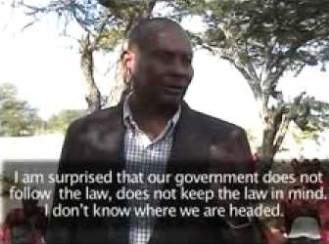
Maasai pastoralists in Loliondo are under the threat of having a massive 1,500-km2 piece of dry season grazing land taken away from them by the Tanzanian government.
The Minister for Natural Resources and Tourism admitted that there had been "excesses" during a hunt by the Brigadier (Deputy Minister for Defence) and the Minister for Defence of UAE, Mohammed bin Rashid al Maktoum (Ruler of Dubai, Prime Minister and Vice President of UAE), shortly before taking possession of the hunting block.
Maasai pastoralists in Loliondo are under the threat of having a massive 1,500-km2 piece of dry season grazing land taken away from them by the Tanzanian government. This will have a decidedly negative impact on their livelihoods and has to be stopped.
I've been trying to find out the background, and this is a summary of what I've found so far. I may have to make some amendments if I receive information that I've been waiting for a bit too long now.
Loliondo Game Controlled Area covers all of Loliondo and Sale Divisions of Ngorongoro District. The GCA was established in colonial times and regulates hunting while it has no influence at all on other land uses. It overlaps completely with Village Lands and the same happens in many other places in Tanzania. Though with the Wildlife Conservation Act of 2009 that came into force in June 2010 this has radically changed. With the new Act both agriculture and grazing are prohibited in GCAs making them into practically the same thing as Game Reserves. It is now illegal for village land and GCAs to overlap and according to the new Wildlife Conservation Act the minister for Natural Resources and Tourism has to "
ensure that no land falling under the village land is included in the game controlled areas," and to do this within one year of the Act coming into force.
This should have been the moment of scrapping Loliondo Game Controlled Area, but instead the government decides to once again attack Ngorongoro people, this time with a Land Use Plan that for the pastoralists basically extends Serengeti National Park with 1,500 km2 of dry season grazing land that at the same time happens to be the core hunting area of the company Otterlo Business Corporation Limited (OBC) from the United Arab Emirates.
The whole of Loliondo Game Controlled Area is also a hunting block, which is a concession leased out for tourism hunting. In 1992 this lease was granted to OBC by the Minister for Natural Resources and Tourism, or more exactly it was granted to Brigadier Mohammed Abdulrahim Al-Ali from the UAE who then went on to register the company since hunting concessions are granted to companies and not to individuals.
The concession was granted for 10 years instead of the 5 year prescribed by the law, the Tanzania Wildlife Corporation – TAWICO, the organization that had been coordinating the tourist hunting business in Tanzania - had already got the concession for five years, from 1991 to 1996 – and the whole deal was done above the heads of Loliondo villagers. Brigadier Al-Ali got an agreement with the Ngorongoro District Council for "wildlife conservation, management and rural development" of Loliondo GCA. The MP for Ngorongoro the late Richard Koillah, DC Lt. Leban Makunenge, and other government officials failed at tricking the villagers into signing the agreement - so they just signed it themselves.
The DC signed for the Central Government, the District Executive Director signed for the District Council and The MP signed for the villages Ololosokwan, Soitsambu, Oloipiri, Oloirien-Magaiduru, Loosoito-Maaloni and Arash.
Even the Minister for Natural Resources and Tourism admitted that there had been "excesses" – like taking live animals to fly them out of the country - during a hunt by the Brigadier (Deputy Minister for Defence) and the Minister for Defence of UAE, Mohammed bin Rashid al Maktoum (current Ruler of Dubai and Prime Minister and Vice President of UAE), shortly before taking possession of the hunting block.
The press, especially the journalist Stan Katabalo who received death threats and sadly passed away under disputed circumstances on 26 September 1993, soon caught up on what was happening and the allocation of the Loliondo hunting block turned into a national scandal under the name Loliondogate. The first MP for Ngorongoro, Moringe Parkipuny, contributed much of the information and survived an assassination attempt close to Loliondo Police Station in 1993. The reasons for the scandal was that the people whose land it was had not been consulted, especially since the villages had recently even been given title deeds; the strange way of allocating the block; the reported hunting excesses, and the fact that the Brigadier was a personal friend of president Ali Hassan Mwinyi.
In April 1993 the Minister for Natural Resources and Tourism was removed from his ministry, but president Mwinyi and OBC stayed on.
In 1995 Benjamin Mkapa came into office as President of Tanzania appointing a presidential commission of enquiry into corruption in the country. In 1996 the Warioba Report named OBC as one of the most corrupt companies in Tanzania.
The Minister for Natural Resources and Tourism, Dr. Juma Ngasongwa resigned, but OBC stayed.
In April 2000 a 13-men delegation led by Sandet ole Reya was sent to Dar es Salaam to take their protest against OBC directly to president Mkapa. They did not manage to meet the president, but the minister for Natural Resources and Tourism, Zakia Mweghji went to Loliondo and called a press conference saying that the Maasai's accusations of OBC plundering natural resources were unfounded.
Some of the allegations against OBC were: using fire to re-direct herd movements, baiting, hunting from vehicles, using automatic guns and flying out live animals.
During the years local pastoralists have clashed with OBC when the company has had complaints over their land use, like too many cattle in the wrong area – while the police work for the hunting company and even have a post close to the OBC camp. Many have felt humiliated by a foreign company acting as the owners of the land. There have been incidents of violence and permanent buildings have been constructed in Soitsambu without any agreement or lease from the village. OBC have also built an airstrip without any village permission.
Photographic operators that have lease agreements with the villages sometimes come into conflict with OBC. Initially in the early 90s these agreements were strongly supported by the Wildlife Division, but since OBC came into the picture the rhetoric has more and more been to call these agreements illegal.
The operator that is most often described as in conflict with OBC is &Beyond with its Klein's Camp in Ololosokwan. Unlike OBC it's not imposed by the government as part of the never-ending agenda of alienating prime wildlife real estate from pastoralists. Though recent information suggests that &Beyond could be leaving its good behaviour. I hope this is solved and that the company will not copy some of its tourism colleagues in Loliondo.
OBC's current executive manager and the last Minister for Natural Resources and Tourism have both complained about an anti-Arab component in the opposition to OBC, but it should be noted that the government is also working together with other companies, like the very American Thomson Safaris that claim ownership of 12,617 acres in Loliondo Division. In early 2010 I, as a tourist, asked some questions about this private nature refuge and was thrown out of the country. I've written about this here.
View from the Termite Mound: The Sukenya Farm Conflict – What Thomson Safaris are up to in Loliondo and How I Became a Prohibited Immigrant in Tanzania
OBC have been working on making friends as well - with success in some cases. They have built primary schools, a secondary school, renovated water systems and built a dispensary. The dispensary was a strategic move to help a friendly politician. The OBC executive manager since 2007 – Isaack Mollel - has appeared widely in the press and even in a "documentary" on state television. He has declared annual payments to the central government of US$560,000, to Ngorongoro District Council of US$109,000, and to the villages of US$150,000. OBC have also provided scholarships, like for the son of the late MP Richard Koillah's education in India.
In articles praising OBC – including in a 12-page OBC advertisement in Mtanzania from May 2010 - the three new wards and guesthouse at Wasso District Designated Hospital are mentioned as built by OBC, but these were actually undertakings by the UAE ambassador to Tanzania and a donation from the UAE. Maybe it's seen as the same thing.
In 2005 Jakaya Mrisho Kikwete came into office as President of Tanzania. It was soon clear that the rights of pastoralists were not high on his agenda. All over the country environmental protection, especially the protection of watersheds, was used to justify human rights abuses against pastoralists.
In the afternoon of 8 august 2007 Molonget Konerei and some other herders were out looking for lost sheep. At sundown they were passing OBC's yard in Soitsambu when behind them came one or more vehicles. The herders ran off in panic in different directions and when they got home they discovered that Konorei was missing. They returned to the site where they found a puddle of blood at the roadside. Koronoi's dead body was at Wasso Hospital. Local authorities concluded that it was an ordinary road accident. OBC staff said they had been out pursuing poachers when they hit Konerei killing him instantly. Some of the herders said they had heard gunshots, and Konorei's family wanted a new post mortem.
In 2009 Loliondo suffered one of the worst droughts in recent history. High concentrations of cattle were gathering in the dry season grazing area next to the National Park. This is what is supposed to happen under such conditions. This area is also the core hunting area of OBC and their July hunting was drawing closer. In May the villages had received letters ordering them to vacate the area. This order had come after a commission sent by the Regional Commissioner, Isidori Shirima, together with the Ngorongoro Security Committee had found a strategy of how to end the "invasion" problem of OBC's hunting block.
In May and June the Tanzanian press reported how OBC had donated 100 tonnes of grain to the residents of Ngorongoro District and how they were assisting in anti-poaching operations.
On 4 July 2009 Tanzania's special police force - the Field Force Unit – in an operation managed by Regional and District authorities and using OBC vehicles, began evicting people and livestock from OBC's core hunting area, starting on village land belonging to Soitsambu and moving south over the days ending in Piyaya and Malambo in Sale Division. At least 150 bomas were burnt to the ground, including grain stores and even some young livestock that were burnt to death. Some 60,000 heads of cattle were pushed into an extreme drought area and calves were left behind in the stampede. This significantly worsened the alarming rates of cattle deaths of this drought. Many cases of beatings, humiliations and sexual assault have been reported. Several children were lost in the chaos and terror and one of them – 7-year-old Nashipai Gume from Arash – has not been found.
Judging from published pictures Muhammed bin Rashid al Maktoum of Dubai and crown prince Hamdan bin Mohammed al Maktoum enjoyed their 2009 Loliondo hunting trip.
In parliament the MP for Ngorongoro, Kaika Telele, demanded explanations on the evictions. The Prime Minister denied any knowledge and the next day the Minister for Natural Resources and Tourism, Shamsa Mwangunga, replied that the Regional Commissioner told her that the pastoralists moved out voluntary after consultation and that they themselves decided to set blaze to their homes. She also informed the parliament that she on a visit to Loliondo had found that there was no conflict between the OBC and the pastoralists - and she went on to listing the many development projects that the company was involved in.
In the press, the evictions were called "Operation Save Loliondo". The District Commissioner for Ngorongoro, Elias Wawa Lali explained how the operation had been necessary to save the environment of the wildlife corridor from destruction by the Maasai pastoralists, that the Field Force Unit had been forced to burn down houses of people that for months refused to heed warnings, but that there had been no human rights abuses, which were lies made up by NGOs. No evidence of this destruction that would have included cutting down trees and putting water catchments, especially for the Grumeti River, in danger has been presented.
Residents of Loliondo marched to Dar es Salaam demanding to see the president who was attending other issues. In Arusha three very Tanzanian women from Loliondo, including a CCM councillor, were suspected of being Kenyan and interrogated by Immigration Officers.
On 14 September 2009 the Minister for Natural Resources and Tourism issued a press release stating that Maasai from Kenya started invading the hunting block in March. The eviction of pastoralists was meant to protect the wildlife and tourism hunting business. She denied human rights violations and blamed the conflict on business rivalry.
On 28 September Ngodidio Roitiken lost his eye when he was hit by a tear gas canister in a clash between herders and the police at Mambarashani in Soitsambu. Ngodidio has been charged with "trespassing, environmental destruction and threatening the police". In this case the Republic is the complainant and as far as I know the police action has not been investigated.
In November the MP for Ngorongoro through a private statement sought explanations to 14 points concerning the evictions, human rights abuses and the OBC situation in general. The Minister for Natural Resources and Tourism provided the usual "explanations" that had been found by a ministerial commission of enquiry. The MP for Simanjiro spoke up against the many lies in the "explanations" and eventually it was decided that a Standing Committee on Land, Natural Resources and Environment chaired the MP for Kongwa, Job Ndugai would investigate the conflict and report back in February 2010.
On 23 November 2009, Isaack Mollel, the executive director of OBC, is quoted in the newspaper Habari Leo saying that the company has donated TSh.156 million to Arusha Region for land use planning in Loliondo Game Controlled Area.
In December 2009 the Minister for Natural Resources and Tourism appointed the Board of Conservators for Ngorongoro Conservation Area. The MP for Ngorongoro is usually on this board, but this time he was left out. Instead the MP for Kongwa, Job Ndugai was appointed.
The tabling of the Ndugai Report was scheduled for 9 February 2010. On the 8th the legislators from the ruling CCM party met in Dodoma. Job Ndugai dismissed all 14 complaints raised buy the Ngorongoro MP as baseless.
Telele protested and demanded that the report be tabled in parliament the next day, the MP for Longido walked out of the meeting in protest and the MP for Kiteto who had been instrumental in the demarcation of the villages in 1990 asserted that the land was village land. The Prime Minister vowed that under no circumstances would the Ndugai report be read in the National Assembly.
Apart from the usual talk about Kenyans, environmental destruction, evil NGOs and jealous tour operators, I've been told that the Ndugai report recommended the closing down of Klein's airstrip and the removal of &Beyond's TALA licence.
In April 2010 there were mass protests by women in Loliondo turning in or burning their CCM cards. Their demands were to have the Ndugai report tabled in parliament and for the government to stop any plans for cutting away village land to create a wildlife corridor next to Serengeti National Park. Following this event three CSO representatives were detained for 45 hours, the government claiming that they must have organized the women.
There were indications that there would be consultations with village governments and civil society organisations – but on 22 May 2010 massive national, regional and district government representation cracked down on Loliondo with John Chiligati, the at that time Minister for Lands, Housing and Settlement Development as the principal speaker, and senior officials for the Ministry of Natural Resources and Tourism attending. It was an extreme top-down meeting where questions were aggressively evaded. The impending boundary demarcation and land use planning were announced, including the need for making a wildlife corridor of OBC's core hunting area.
On 31 October 2010 Jakaya Kikwete was re-elected as President of the United Republic of Tanzania.
In December 2010 a constitutional suit was filed in the High Court of Tanzania by several CSOs – LHRC, PINGOs, Ngonet and UCRT - against the Government to petition the July 2009 evictions. The defendants are the Attorney General, the Ngorongoro District Commissioner – Elias Wawa Lali, the District Police Commander- Liston Mponjoli, the Minister for Natural Resources and Tourism – Shamsa Mwangunga - and the managing director of Otterlo Business Corporation Ltd – Isaack Mollel.
The new Minister for Natural Resources and Tourism. Ezekiel Maige, was determined to solve the Loliondo land conflicts. Upon his visit to Loliondo towards the end of 2010, unlike his predecessor, he admitted that there was no environmental destruction in the "core hunting area" and he formed a committee led by the District Commissioner and as members the seven councillors from the wards bordering Serengeti National Park plus the District Natural Resources Officer and the District Community Development Officer. The ward councillors had made it clear that the dry season grazing could not be lost to a "wildlife corridor". The executive manager of OBC for the first time met the councillors assuring them that it was the government and not the company that wanted a wildlife corridor.
Some people came forward with the compromise idea of forming a Wildlife Management Area of the proposed "corridor". WMAs were introduced as a form of wildlife conservation that local people would control and benefit from, but because of the form of the current regulations in practise WMAs are just another form of loss of land and natural resources, and a proposed WMA in Loliondo has earlier been rejected.
In February 2011 a Land Use Plan prepared by "experts" without any involvement by Loliondo villagers was released. A 1,500 km2 Game Controlled Area as in Wildlife Conservation Act of 2009 was on the map cut away from village land bordering Serengeti National Park, the land that is also known as OBC's core hunting area. This is a frontal attack on Loliondo pastoralists and will lead to increased poverty and conflict. Showing seriousness and unity all ward councillors spoke out clearly against this in press conferences. Though I'm no longer sure of this unity since later some of them, more exactly the Council Chairman, have heaped praises on OBC in interviews.
The latest I've heard is that OBC is "lobbying" village leaders and offering meat eating "reconciliation" ceremonies with Loliondo communities.
Susanna Nordlund
. Monday, 11 July 2011 copied from:
A blog about threats against Maasai land in Loliondo - Thomson Safaris, OBC and ruthless hypocrisy.

termitemoundview.blogspot.com