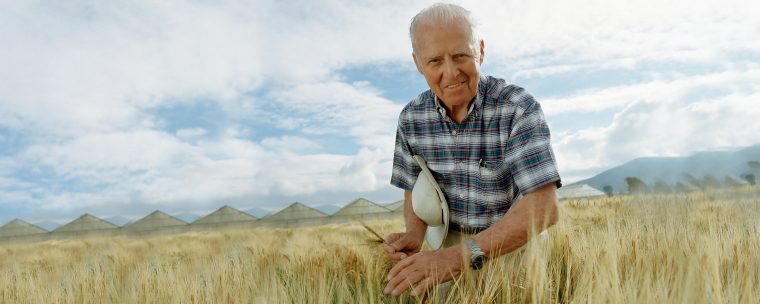
DR. NORMAN E. BORLAUG, SHUJAA TAJWA WA KAMPENI YA KILIMO KWANZA NA MAPINDUZI YA UZALISHAJI MAZAO YA KILIMO
Every year, the World Food Prize helps focus the world’s attention on issues of food production.
In 2001, Dr. Norman E. Borlaug, at age 87, revisits his Green Revolution farms in India. (© Pallava Bagla/Corbis)
In the 1980s, Borlaug’s methods were criticized by some environmentalists for their reliance on chemical pesticides and fertilizers, but Borlaug was quick to point out that by increasing the productivity of existing farmland, his followers removed the necessity for destroying standing forests to clear additional farmland.
In India alone, wooded areas the size of California were spared because of his work. Lobbying by Western activists blocked Borlaug’s first efforts in Africa, but when a devastating famine struck Ethiopia in 1984, the Japanese industrialist Roichi Sasakawa approached Borlaug about starting a new program there.
In his 70s, Borlaug agreed to head the Sasakawa Africa Association, and was soon doubling grain production in half a dozen African countries. Through a joint venture with the Carter Center, founded by former U.S. President Jimmy Carter, the program trained over eight million farmers in 15 countries.
While much of the continent lacks the roads and other infrastructure to modernize its agriculture, former President Carter took up the cause, and agricultural progress in Africa continues.
Dr. Norman Borlaug gives President George W. Bush a “thumbs-up” after receiving the National Medal of Science at the White House, 2006. The medal is the nation’s highest scientific honor. (AP Images/Pablo Martinez Monsivais)
While crop failure and hunger persist in many parts of the world, the mass starvation predicted by many experts in the ’60s and ’70s was avoided by the efforts of Borlaug and his followers. As the years pass, it has become apparent that roughly a billion of the earth’s inhabitants owe their lives to the Green Revolution. Although famine was averted by his past efforts, Borlaug insisted that a concerted campaign to build roads and infrastructure in underdeveloped countries will be necessary to avoid mass starvation in the decades ahead.
Speaker of the House Nancy Pelosi, Dr. Norman Borlaug, President George W. Bush, and Senate Majority Leader Harry Reid as Borlaug is awarded the Congressional Gold Medal in 2007. (© Matthew Cavanaugh/EPA/Corbis)
While Norman Borlaug’s accomplishments are largely unknown to much of the public in his own country, he received numerous honors for his achievements, including the Presidential Medal of Freedom and the Congressional Gold Medal. Streets and institutions are named for him in his native Iowa, in Minnesota, in Mexico and in India. Margaret Borlaug, Norman’s wife of 69 years, died in 2007. The couple had two children, five grandchildren and four great-grandchildren. In his tenth decade, Dr. Borlaug continued to consult with CIMMYT in Mexico, to teach at Texas A&M University, and to travel, promoting his ideas to end world hunger. He spent his last years in Dallas, Texas, where he died at the age of 95.
The impact of Norman Borlaug’s achievement has continued long after his death, and so has interest in the man and his work. In 2020, the PBS television series
The American Experience profiled Borlaug in an hour-long film,
The Man Who Tried to Feed the World. Although the film explored criticism of Borlaug’s work, the significance of his achievement cannot be denied. As the Earth’s population continues to grow, the importance of Norman Borlaug’s contribution to saving the world from mass starvation cannot be denied.
READ MORE :
Growing up on a farm in Iowa, Norman Borlaug learned firsthand the importance of a healthy agricultural economy. In the depths of the Great Depression, he saw crop failures ruin small farmers, while food shortages and farm foreclosures drove ordinary people to violence. An expert in plant...
achievement.org