
BARD AI
JF-Expert Member
- Jul 24, 2018
- 3,591
- 8,826
RIPOTI: Shirika la Chakula na Kilimo (FAO) limesema Robo Tatu ya Idadi ya Watu katika Bara la Afrika hawana uhakika wa kupata Lishe Bora
Kwa mujibu wa Ripoti ya FAO, Takriban Watu 864 duniani hawana uhakika wa Kupata Chakula Bora ambapo Bara la Asia ni Milion 467, Afrika Milioni 316, Marekani Kaskazini Milioni 18, na Marekani Kusini Watu Milioni
Aidha, maeneo ya Vijijini yana kiwango kikubwa cha uhaba wa Chakula Bora ambapo kwa Afrika hali iko kwa 22.9% na Mijini ni 19.9% na dunia kwa ujumla ni 11.3.% na 9.0% mtawalia.
Two thirds of Africa’s population is unable to afford a healthy diet, against a global average of a third, the Food and Agriculture Organisation (FAO) says in a recent report.

Prices, in purchasing power parity (PPP) rose significantly-a global average of 6 percent in 2020 and 11 percent in 2021.
The global average cost of a healthy diet rose to 3.96 PPP dollars – a measure that compares purchasing power parity across economies – in 2022.
Subregional variations were considerable, ranging from a high of 5.34 PPP dollars in Eastern Asia to a low of 2.96 PPP dollars in Northern America. For Africa, the average price was 3.74 PPP dollars; for Asia 4.20 PPP dollars; for Latin America and the Caribbean 4.56 PPP dollars; for Oceania 3.46 PPP dollars and for Northern America and Europe 3.75 PPP dollars, with a sizable difference between Southern Europe, at 4.15 PPP dollars and Western Europe at 3.01 PPP dollars.
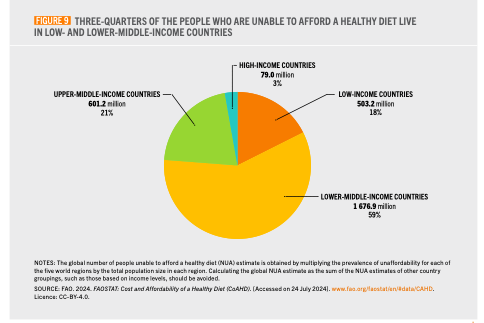
1.677 billion people living in lower-middle-income countries cannot afford a heathy diet, and the same holds for 503 million people living in low-income countries. Combined, these account for 77 percent of people unable to afford healthy diets.
According to the FAO, the foray into gauging and tracking affordable healthy diets in addition to its traditional metrics of hunger is as “an early warning of sorts. “People who cannot afford the least-cost healthy diet in their countries are likely facing at least some degree of food and nutritional insecurity and thus face the risk of swelling the ranks of the hungry,” the organisation said in a statement.

“Africa remains the region with the largest estimated proportion of the population facing hunger – 20.4 percent, compared with 8.1 percent in Asia, 6.2 percent in Latin America and the Caribbean, and 7.3 percent in Oceania,” FAO said in the The State of Food Security and Nutrition in the World report.
Kwa mujibu wa Ripoti ya FAO, Takriban Watu 864 duniani hawana uhakika wa Kupata Chakula Bora ambapo Bara la Asia ni Milion 467, Afrika Milioni 316, Marekani Kaskazini Milioni 18, na Marekani Kusini Watu Milioni
Aidha, maeneo ya Vijijini yana kiwango kikubwa cha uhaba wa Chakula Bora ambapo kwa Afrika hali iko kwa 22.9% na Mijini ni 19.9% na dunia kwa ujumla ni 11.3.% na 9.0% mtawalia.
Two thirds of Africa’s population is unable to afford a healthy diet, against a global average of a third, the Food and Agriculture Organisation (FAO) says in a recent report.
- At 64.8 percent, Africa has the highest proportion of people who can’t afford a healthy diet, followed by Asia (35.1%), Latin America and the Caribbean (27.7%) and Oceania (20.1%).
- In low-income and lower-middle-income countries, the number of people unable to afford healthy diets grew from 2019 to 2022.
- While food prices increased throughout 2022, pushing up the average cost of a healthy diet, this was largely offset by economic recovery and the ensuing positive income effects
Prices, in purchasing power parity (PPP) rose significantly-a global average of 6 percent in 2020 and 11 percent in 2021.
The global average cost of a healthy diet rose to 3.96 PPP dollars – a measure that compares purchasing power parity across economies – in 2022.
Subregional variations were considerable, ranging from a high of 5.34 PPP dollars in Eastern Asia to a low of 2.96 PPP dollars in Northern America. For Africa, the average price was 3.74 PPP dollars; for Asia 4.20 PPP dollars; for Latin America and the Caribbean 4.56 PPP dollars; for Oceania 3.46 PPP dollars and for Northern America and Europe 3.75 PPP dollars, with a sizable difference between Southern Europe, at 4.15 PPP dollars and Western Europe at 3.01 PPP dollars.
1.677 billion people living in lower-middle-income countries cannot afford a heathy diet, and the same holds for 503 million people living in low-income countries. Combined, these account for 77 percent of people unable to afford healthy diets.
According to the FAO, the foray into gauging and tracking affordable healthy diets in addition to its traditional metrics of hunger is as “an early warning of sorts. “People who cannot afford the least-cost healthy diet in their countries are likely facing at least some degree of food and nutritional insecurity and thus face the risk of swelling the ranks of the hungry,” the organisation said in a statement.
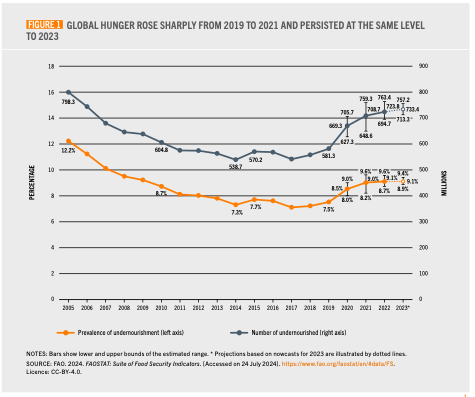
“Africa remains the region with the largest estimated proportion of the population facing hunger – 20.4 percent, compared with 8.1 percent in Asia, 6.2 percent in Latin America and the Caribbean, and 7.3 percent in Oceania,” FAO said in the The State of Food Security and Nutrition in the World report.