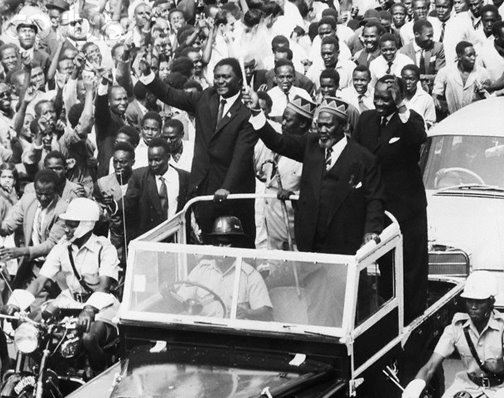
Tukumbuke Zamani: Historia ya Taifa letu katika picha

Tukumbuke Zamani: Historia ya Taifa letu katika picha

_39408799_picgallpresidentap.jpg


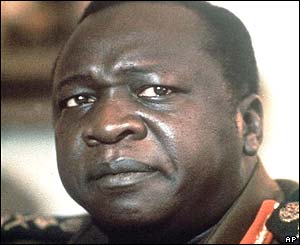
Idi Amin's rule of Uganda began in 1971 when he seized power in a coup - and his capacity for brutality soon became clear.

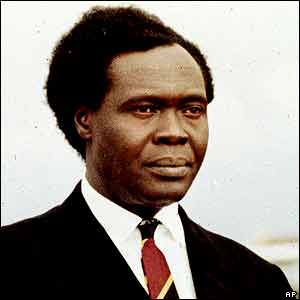
- Rais wa zamani wa Uganda Amin, aliyempindua rais Obote hapa chini aliyekua kipenzi cha rais wetu Mwalimu Nyerere, Amin hatimaye alianzisha vita na Tanzania vilivyoishia kumfanya akimbie Uganda.
 
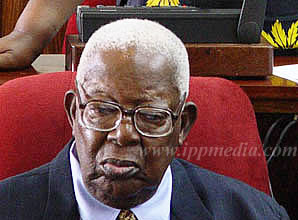
sasa sijui hizi tarehe vipi, Karimjee alikuwa mpaka lini...i just spotted the overlap of dates...waambieni website ya bunge wa clarify...
 
Uganda united in joy at Amin's exit

Thirty years ago, Idi Amins military government was overthrown by a combined force of the Tanzanian army and a motley of armed Ugandan groups exiled in Kenya and Tanzania during the 1970s. In our continuing series on the events before and after the fall of the man who has gone down in history as one of the most brutal leaders in post colonial Africa, Timothy Kalyegira reports on the euphoria in Uganda and beyond after he was overthrown:-

For those who have lived long enough in Uganda to gauge public euphoria during changes of government, in order of ranking the change of government that was received with the greatest outpouring of cheers, screams, whistles, car horns, ululations, and tens of thousands of Ugandans pouring on the streets, was the January 25, 1971 military coup that brought the 42 year-old army commander, Major-General Idi Amin to power.

The second greatest such outpouring of euphoria was that which received the news, announced by Lt. Colonel David Oyite-Ojok on April 11, 1979, of the fall of the Amin regime.

The third most enthusiastically received change of government, based on an evaluation of crowd sizes, levels of cheer, and general ululation heard across the nation, was on January 26, 1986 that saw 41 year-old Yoweri Museveni take state power.

If this great roar and cheer in Uganda were to be combined with the excitement and relief outside Uganda and worldwide, there is no doubt that the fall of Idi Amin in April 1979, if it can be measured in weights, decibels of noise, brought about the greatest total volume of cheer and celebration ever witnessed for an event in Uganda.


To millions of Ugandans, there was nothing that felt so right as April 11, 1979. Nothing proved so convincingly that God exists, hears and acts on prayers, that justice eventually triumphs, and that evil is always defeated by good, as the fall of Amin.


In grocery markets in Kampala, traders cheerfully cut the price of sugar and meat by half so that Ugandans could celebrate Amins fall. Crowds cheered the Tanzanian soldiers everywhere they went. (My father gave his watch to a Tanzanian solder as the Tanzanians arrived in Entebbe on April 10).

A sea of happy, relieved, and disbelieving Ugandans walked up to the Parliament Buildings in Kampala on April 13 to witness the swearing-in ceremony of the soft-spoken, mild-mannered former Principal of Makerere University College, Prof. Yusuf Lule, who could not have cut a more different image from the semi-literate and cantankerous Idi Amin.

Shortly after Lules swearing-in, a huge crowd carried, shoulder-high, the new army chief of staff Lt. Colonel David Oyite-Ojok through the streets of Kampala. Soldiers of the Uganda National Liberation Army, the new national army that replaced the Uganda Army, affectionately referred to Oyite-Ojok as Daudi.

A student at Makerere University called Edward Kale Kayihura led a march of fellow students from Makerere through Kampala streets to celebrate the fall of the man who had gained the nickname The butcher of Africa.

Ugandans gave the Tanzanian soldiers watches, kisses, hugs, love, money, and food. It was the happiest moment in Ugandan history, at least the happiest since Independence Day in October 1962 or the day the Uganda Cranes football team qualified for the Africa Cup of Nations final in 1978.

The new government led by Lule settled down to work and after a few days of partying and celebration, so too did the rest of the country.

What came out of this euphoria was one of the best lessons in history. It demonstrated the importance of listening to both sides of every conflict and story. It proved that formal education and reading is not sufficient. The citizen has to remain all his life in a constant state of watchfulness, reading, re-reading, listening to every angle to everything, and searching and re-searching.

What very few Ugandans could see in April 1979 was that they were about to be painfully disillusioned and that disillusionment would last the next 30 years right into 2009.

The only people who knew what Ugandans were about to face were the recently ousted president Idi Amin and a few senior military officers of the Uganda Army and Airforce, and officers of the now disbanded and much-dreaded State Research Bureau intelligence agency.

They are the only people who had an accurate picture of what was going on during the Amin years. The second group of people who had a fairly accurate picture of events in Uganda during Amins dark rule were some of the senior Ugandan exiles.

The third group was the Israeli foreign intelligence agency, Mossad. To this day, most Ugandans and most of the outside world still do not know who Idi Amin was.

30 years since his fall from power, five years since his death, and even with the ocean of information called the Internet, the world at large still does not know who Amin was.

Amin, a simple, naïve, jovial, efficient, patriotic, and cantankerous man who always spoke his mind, clearly told Ugandans and the world who he was. But people refused to believe him.

He was, in the eyes of millions, a murderer, eater of human flesh, who ate one of his own children, murdered one of his wives along with 500,000 Ugandans, and destroyed Ugandas economy and infrastructure. The story of how the world came to be deceived about Amin is one of the most incredible in modern human history.

So now that Amin was out of power and in exile in Libya, in April 1979, his army defeated, the State Research Bureau security service disbanded, his henchmen in jail, in hiding, or in exile, what new beginning could Ugandans expect? They were about to find out, much to their horror.
 
In pictures: Robert Mugabe turns 80


o.gif
o.gif
o.gif
o.gif
o.gif

_39880479_nkomo245.jpg

o.gif
1 of 11
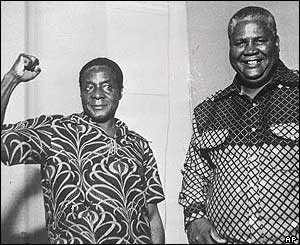
Now 80 years old, Robert Mugabe (l) came to prominence as one of the leaders of a guerrilla war against white minority rule in the former Rhodesia, along with Joshua Nkomo (r).

- Hawa ni viongozi wapigania uhuru wa Zimbabwe, ambako Tanzania tulitoa msaada mkubwa sana katika kuwakomboa kutoka mikononi mwa Wazungu wachache.

Respect.

FMEs!
 
Tito okello,rais wa uganda 1985-1986,tumekaa naye jirani mtaa wa mindu,upanga.jamaa alikuwa so simple that we were surprised when he became president.He got his driving licence at the fourth attempt
 
mwamkumbuka Charles m Njonjo,former kenyan attorney general,yeye never boarded a plane piloted by a blackman,alaafu suti zake zote handmade toka saville row-na ukitumia microscope kutazama hizo suti unaona initials zake CMN all over
 
mwamkumbuka Charles m Njonjo,former kenyan attorney general,yeye never boarded a plane piloted by a blackman,alaafu suti zake zote handmade toka saville row-na ukitumia microscope kutazama hizo suti unaona initials zake CMN all over
Duh!! Kweli huyo ni Njonjo (unaweza ku-add mi mbele ya jina lake MI-NJONJO)
 
- Bwana Charles Njonjo ndiye aliyekua instrument ya kuvunjika kwa EAC, soma chini:-


Story by:
JOHN KIHURIA


For a man who has consistently been reluctant to have his memoirs recorded on pen and paper, it was rather ironical to hear ˜Sir Charles” lament what a pity it was that one time provincial commissioner, Eliud Mahihu, had died without telling the world the events that surrounded and followed the death of Kenya’s first President Mzee Jomo Kenyatta.
He was the only man who was with Mzee when he died and so the only man who knew exactly the circumstances under which the former president died.


He was also the man who secretly arranged for the body of the late president to be flown to Nairobi and one shudders to imagine what might have happened if some people found out about the death before the body was ferried to the capital from where we announced the death. What a pity he had to die before he told this story, pensively wondered one time attorney general, Charles Mugane Njonjo in a recent interview.
Our journey through memory lane with Mr Njonjo had started with a kingly ride in Mzee Kenyatta’s presidential limousine one day in the late 1960s following the abrupt resignation of then vice president Joseph Murumbi.
I think we were coming from Kericho and Mzee was agonising loudly who he would appoint the VP to replace Murumbi.


Whom do I have? the old man worried as we sat in the back seat of the presidential limousine, Njonjo recalled last week, in the spacious confines of his CFC Bank office on Chiromo Road. And when the current chairman of CFC Bank quipped, What about Moi? It was according to him like a revelation to the late president. He was so pleased with the suggestion that he appointed Moi the vice president the very next day.
The former AG says he recommended Moi because he believed the man who would survive the rough and tumble of Kenyan politics to rise to the presidency in 1978 and later have the country in his grips for more than two decades would be loyal to the president and would also cooperate with others.


Mzee all long felt Kenya being made up of many tribes, it would have been unwise for a Kikuyu to succeed him, unless he had exceptional leadership qualities, but the Kikuyu who were poised to succeed him were mostly from among the so called Kiambu Mafia and he would gather us together and loudly wonder who among us could “cross the Chania River.
By this Mzee who was a national figure, meant that none of us senior politicians and civil servants were known outside our home district Kiambu and so we could never hope to lead this country.


That despite the much hyped real or imaginary line associated with Kiambu politicians at that time, “itigakira Chania” (the motorcycle outriders will never cross Chania River). But the man who would stand by Moi and by following the constitutional route ensure the man from Sacho became president, would years later suffer untold humiliation under Moi’s rule; branded traitor, teased by lesser mortals, made to undergo harsh rebukes by judges and lawyers who were his juniors just a few months before, only for Moi to show his magnanimity and pardon him when the show was all over.
I had no intention of overthrowing the government of President Moi, and the whole thing was made up by people who thought I was too strong and wanted to get out of the power equation. They claimed that I had the direct support of the American and British with the express mission of forcibly installing me as president which was not the case at all, he said.
It was very sad that Moi was misled by some people and instead of checking out the facts, he accepted what he was told as the gospel truth. If you are told something and you do not investigate to find out the truth, you can make a very serious mistake, a pensive Mr Njonjo told the Sunday Nation.


What Mr Moi did, he said, was quite contrary to what Mzee Kenyatta would have done. If you told Mzee something about one of your colleagues, he would note how interesting what you were telling him was, then confront you with it in the presence of the person you had accused.
He recalled an incident when a senior Kikuyu politician had accused him of planning to overthrow the Kenyatta government.


A traitor


When Mzee confronted him with the accusation in my presence, the man could only hide behind alcohol, weakly claiming that he had been tipsy when he made the accusation, Njonjo said, laughing. He said there is no truth and no foundation to the allegations that he was a traitor in Moi’s government, and though these were truly trying times (the inquiry period), he at times enjoyed their singing for he believed their (his accusers) lies would eventually put them to shame.


He lost quite a few friends, but there are those who steadfastly stood by him, led by business partner Jeremiah Kiereini, former cabinet colleague GG Kariuki and the late spymaster Joseph Kanyotu. For more than a decade following the conclusion of the inquiry into his conduct and the subsequent pardon by Mr Moi, Mr Njonjo disappeared from public view during which time he says he spent restoring his family farm in Kibichiku in Kikuyu.
I was also kept busy by my three young children whom I used to take out (abroad) and teach how to ski. I also had my banking and insurance businesses to take care of. Mr Njonjo married rather late in life, on November 20, 1972.


I liked my work very much and for many years I was married to it, and the idea of marriage did not feature much in my mind. I also worked odd hours and believed there would be a clash of interests if someone else entered my life. When not working, I was either swimming, at the sauna or the theatre, and that was enough for me. But there was a lot of pressure from Mzee Kenyatta for Mr Njonjo to get married as “he could not understand how a bachelor could advise him! My parents, especially my mother Wairimu, would also insist that I was getting old and must be married.


But he said with a smile that he could not get anybody suitable from the backyard Kikuyu or Luo communities but was lucky to get one (of British extraction) from among the Kalenjin (his wife was born in the Rift Valley).
I used to attend church services at the All Saints Cathedral, and there was this girl who was in the choir but also sat in my pew. I would look at her and think to myself, now there’s a nice girl.


Maybe his pastor also thought the girl was good enough for Sir Charles, and he would invite the two among other faithful to his house for supper; gradually the two got to know each other and were eventually married.
In the middle of the interview, an SMS news alert about President Kibaki warning his Cabinet against discussing affairs of government in the media appeared on Mr Njonjo’s cell phone, and he promptly switched to matters of collective responsibility and the media.


The press is the worst enemy of government, and matters discussed in government should never be brought to the attention of the press. In my opinion, ministers should not make press statements; these should be left to a qualified and professional government spokesman as is the case in established democracies. “He said under Kenyatta the government was very well organized and efficient. There were, of course, allegations of favouritism towards the Kikuyu, but only highly qualified people were employed by the Kenyatta government. If this favoured the Kikuyu, it was rather by accident and not design, he said with a straight face.
Mr Njonjo called the so-called change the constitution move meant to prevent Mr Moi from succeeding Kenyatta constitutional.
You do not change the constitution in the bush, and I told them (the Kiambu mafia) to bring the necessary amendment to Parliament, but they instead chose to seek public sympathy.


They were playing the tribal card, warning the Kikuyu that the community stood to lose everything they had acquired under a Moi presidency; the excuse they used was that Mzee was ageing. and it was only through the constitutional change that Moi would be barred from ascending to the most powerful seat in the land. But Mr Njonjo went to Kenyatta and told him the mafia was going round the country saying he was sick and even imagining his death.


Kenyatta, a man who could not tolerate talk about death, especially his own, immediately called a Cabinet meeting and brought the change the constitution debate to a close. Hence the famous Njonjo statement that, it is a capital offence to even imagine the death of the president.
On the Kenyatta succession, Mr Njonjo insists he followed the constitutional path – the king is dead, long live the king. The president was dead, and under the Constitution, the vice president had to take over for a period of 90 days before fresh elections could take place. In an effort to subvert this clause, there were people who did not want Mzee’s death to be announced, but I resisted this and as soon as the body was flown to Nairobi from Mombasa, we announced the death and Moi was appointed acting president.


Only tribe


On this score and his recent real or perceived support of ODM leader Raila Odinga, Mr Njonjo says he is not popular with his fellow Kikuyus some of whom think I should not have done what I did and that someone else should have succeeded Kenyatta. In the recent past I have been accused of supporting Raila at the expense of fellow tribesmen, but we (Kikuyu) must realize we are not the only tribe in Kenya and learn to live and cooperate with others. However Sir Charles is quick to qualify that there is no personal rivalry or vendetta between him and President Kibaki.
We have never quarreled, but I suppose he (at one time or the other), was told I do not support him, and he believed it.


How politicians bungled Mboya, JM murder


Perhaps in appreciation of the unwavering support his Attorney-General had given him to the extent of alienating himself from his community, former President Daniel arap Moi offered Charles Njonjo the vice-presidency.
But Mr Njonjo, the chief government legal officer, was a civil servant who could not become the Number Two in government. He would later join politics, as the Member of Parliament for Kikuyu. Did he do that so that Mr Moi could make good on his offer?


As the Attorney-General I had done what I could do and more and I had a ready successor. By going into politics, I felt it was time I helped the people of my native Kikuyu constituency develop, especially by providing clean tap water to women who would trek long distances in search of the precious commodity.


Today, I feel ever so happy when I go to far-flung villages in the constituency and find women fetching water from taps outside or inside their houses. The former AG readily admits he was one of the most powerful people in the Kenyatta government. Perhaps I was powerful because Kenyatta was a powerful president and I was working for him. As the Attorney-General, I headed a powerful ministry as, apart from prosecutions, I was also in charge of investigations.


One of the high profile cases he investigated during his tenure was that of MPs Jesse Gachago and Muhuri Muchiri, who were charged with smuggling coffee in from Uganda at the height of the magendo (illegal) coffee trade in the 1980s. The two politicians were among the people who were involved in the scam and despite their plea to the President, I maintained they had to face the full force of the law so that we could set an example. We could not afford to be selective in dispensing justice and, on their conviction, the magendo coffee business came to an end.
Njonjo says he was traumatised by the death of Tom Mboya in 1969 and deeply shocked by that of JM Kariuki in 1975, but he regrets that politicians led by Elijah Mwangale meddled in the investigations.
I told them to let the CID that was under my docket conduct the investigations but they instead insisted on leading the investigations. Can you imagine these people (the inquiry committee) interrogating Moi (then Vice-President) and myself at a time when I was Attorney-General and the CID was under me? Were the CID allowed to conduct proper investigations, we would have got to the bottom of this matter, he says.


As AG, some of Mr Njonjo’s greatest moments were with Mzee Jomo Kenyatta and he enjoyed working for him, travelling with him, listening to him and watching him as he transformed the country from a British colony to independent prosperity.
He says Kenya’s biggest problem is that it has been eaten up by corruption and those supposed to fight the vice are unable or unwilling to do their work.


He hits out at the Ninth Parliament for increasing their salaries and allowances instead of addressing the issue of poverty, which is partly to blame for the prevalence of corruption.
He hopes the 10th Parliament will serve the people first.
Additional reporting by John Kihuria
——————-
The publisher – Korir – is the Chief Editor, African Press International – api
 
mimi naona there was a time NJONJO was untouchable.In fact njonjo was a white man in a black skin na alikuwa hakopeshi,kitu kiki mu irritate he makes his feelings known hapohapo-along the route he made many enemies,the likes of nyerere loathed him na ni kweli he was instrumental in the break up of the EAC
 
Bwana Tom Mboya, kwenye picha hapo juu, kutoka Kenya alikuwa ni mmoja wa kipenzi cha Mwalimu, na pia alitoa mchango mkubwa sana katika uanzishwaji wa EAC:-


Thomas Joseph Mboya

The Columbia Encyclopedia, Sixth Edition | 2008 | CopyrightThe Columbia Encyclopedia, Sixth Edition. Copyright 2008 Columbia University Press. (Hide copyright information)

Thomas Joseph Mboya , 1930-69, Kenyan political leader. The son of a Luo farmer, he was born in the "white highlands" of Kenya and educated at Roman Catholic mission schools. Early involved in trade union activities, he joined Jomo Kenyatta's Kenya African Union and soon became one of its leaders. In 1953 he was elected general secretary of the Kenya Federation of Labor. After studying in India and England, Mboya returned (1956) to Kenya and, under the first elections held (1957) for African members of the Kenya Legislative Council, was one of eight elected. Heading a delegation to the All-African People's Conference (1958) in Accra, Ghana, he was elected its president. As leader of the Kenya Independence Movement, he was instrumental in securing a constitution assuring African political supremacy. Merging his group with the newly formed Kenya African National Union in 1960, he


he became general secretary of the organization. After Kenya gained (1963) its independence, Mboya served as minister of labor (1962-63), minister of justice and constitutional affairs (1963-64), and minister of economic planning and development (1964-69). His popularity established him as a likely successor to Kenyatta, and his assassination in 1969 set off widespread rioting. He wrote Kenya Faces the Future: A Statement of the African Case in Kenya (1959).
 
Katika thread hii naona ES huna mpinzani

sasa tuletee picha za wale wazee wa KISWAHILI waliomnunulia Nyerere suruuali na kumpa nchi kama zina mzee AKIDA, KAGASHEKI, FUNDIKIRA,KANDORO na wengineo
 
mimi naona there was a time NJONJO was untouchable.In fact njonjo was a white man in a black skin na alikuwa hakopeshi,kitu kiki mu irritate he makes his feelings known hapohapo-along the route he made many enemies,the likes of nyerere loathed him na ni kweli he was instrumental in the break up of the EAC

Heshima mbele sana mkuu, ni kweli huyu alikuwa ni the man of principle, ila mchango wake katika kuua EAC tena kwa kutumiwa na maadui hasa wa Mwalimu na taifa letu, haikuwa busara kwa the future of Africa, alikosa sana u-Pan-Africanism.

Respect.

FMEs!
 
Marehemu Chifu Fundikira, waziri katika cabinet ya kwanza Tanzania na mmoja wa wazee walioshirikiana sana na Mwalimu kutafuta uhuru wetu:-

Fundikira.jpg
 
The Institute for Security Studies

CHAPTER 3

A HISTORICAL PERSPECTIVE ON CIVIL-MILITARY RELATIONS: 1964-1990S

Nestor Luanda

Monograph No 128, December 2006

Civil Security Relations in Tanzania

Investigating the Relationship Beween the State, Security Services and Civil Society

Edited by Martin Rupiya, Jonathan Lwehabura and Len le Roux

Introduction

This paper examines the political direction informing civil-military relations in Tanzania during 1964 and the 1990s. In September 1964, Jeshi la Wananchi la Tanzania, JWTZ or the Tanzanian Peoples Defence Force, (TPDF) was established. A patched-together interim force, the Tanganyika Military Force (TMF) had existed for only a few months when the JWTZ came into being. This discussion considers the topic in three broad sections. First is a general picture of civil-military relations in Africa. Second is an examination of the promulgation of the Arusha Declaration in 1967, causing the military in Tanzania to be placed firmly under the control of the then sole ruling party, Tanu Anu/Afro-ShiraziI, later Chama cha Mapinduzi (CCM).The third section shows that during this period the TPDF documented the best chapter in this history of the liberation of southern Africa.

The signs of political control of the military include recruitment into the military by means of national service, the posting of Party cadres into the military and, significantly, in 1987, the creation of the Partys Mkoa wa Majeshi within the armed forces. Mkoa wa Majeshi represented the high watermark of the politicization of the military. The post-1991 period, characterized by liberalization, globalization and multi-party politics, witnessed the loosening up of political control of the military. The Nyalali Commission Reports recommendations on multi-partyism, and especially on the military, represented a major policy shift regarding civilmilitary relations.

Background

Sub-Saharan Africa suffered many acts of political violence during the 1950s and 1960s,1 while during the 1990s it was engulfed by liberalization and globalization. The interim period witnessed the whole of Africa achieving independence and freedom from colonialism, racism and apartheid. Tragically, there was a plethora of violent changes in government throughout the continent.2 Africas track record of border disputes, ethnic divisions, religious strife, military dictatorship, civil war and a general absence of democratic political culture has been the cause of endemic instability on the continent. Africa has become, in fact, a continent perpetually at war with itself.

A quick audit of the continents democratic balance sheet shows that many countries are quite literally in the red. A considerable number of them are embroiled in armed conflict or civil strife. Many are enduring prolonged political crises and turbulence.3 Some have gone from conflict to peace, only to regress, while others suffer the structural problems associated with conflict and brutalization.

Violent conflict is the major impediment to development in Africa. It inflicts suffering through death, the destruction of homes and livelihood, the constant displacement of people, and insecurity. The overwhelming ethnic conflict is cataclysmic, its dimensions almost impossible to grasp. The unparalleled tide of human misery washing across countries like Rwanda, Sierra Leone and, as we write, Sudan is beyond imagining. Violent conflict disrupts the process of production, while creating conditions for the pillage of countries resources and diverting their application from the development process to serving Armageddon.

There is incontrovertible evidence that violent conflict and bad governance are inextricably connected. Most conflicts in Africa result from the paucity of tradition and structures of good governance, thanks to colonialism. In the light of the steep rise in the number of countries experiencing intense armed conflict, one can only conclude that the African State has failed. The fragility of the state in Africa signifies the abortion of the democratization process. Civil war and strife are but the violent reactions to many conditions: a pervasive lack of democracy; the denial of human rights; complete disregard for the peoples right to sovereignty; general disempowerment; the complete lack of accountability; and generally bad government.

The daunting question is: How can civil-military relations in Africa be characterized and explained? The suppression, coercion and brutalization of citizens are significant factors in violent conflicts. Many an African country has strengthened and sustained colonial authoritarianism, despotism, bureaucratic centralization and top-down forms of governance. Typically, countries undergoing violent conflict are military, so it is fallacious to view the military and politics in Africa as separate.

The nature and character of the military in Africa

The militaryhas long occupied the centre-stage in Africa. Generally, the trend has been towards increased authoritarian rule and governments dominated by the military. As far as political affairs are concerned, the increasing numbers of incidents involving the military is astounding. This has robbed African states of their political stability and economic development. The incursive actions of armed forces, especially the army, means that they have surrendered their legal labels of watch dog of nations, defenders against external aggression and guardians of society. When military leaders overthrow political power, they breach the constitution.

Few states in Africa have been spared the spectre of the military coup. The proliferation of ambitious, opportunistic military men reduces politics in so many African countries to little more than an endless process of dissension, intrigue and counter-revolutionary turmoil. The perpetrators of coups, civil wars and conflicts have juxtaposed the military with allegedly corrupt and vile civilian politicians. Coup-makers and leaders have sought to rationalize their actions by adopting a blameless front. In fact, the military has been largely responsible for the cataclysm that has overtaken Africa. The extent of the anguish and human suffering inflicted upon millions of innocent and unarmed illiterate peasants is execrable.

The military in most African countries is indisputably a remnant of colonialism.5 Adaptation of the military to the facts of independence has enjoyed low priority, even in the minds of the politicians who have to rely on them. The armies of independent Africa have tended to retain their colonial flavour, their foreign advisors and their affinity with Europe. Colonial armies stood for punitive expeditions and brutal, licentious soldiery. They were armies of occupation intended to pacify the hinterland, suppress nascent nationalist struggles and protect European property.

Mwalimu Julius Nyerere aptly captures the nature and character of the colonial military:

For instance, the British did not keep their Regular Army in Zanzibar, Tanganyika or Kenya. The British Regular Army did not recruit from the colonies. However, the British kept a colonial army. It was an army of the conqueror. It was an army of occupation whose task was to keep down the natives. The colonial army was raised and kept as a minion of the colonial state. It was meant to protect the colonial state from an internal enemy, the natives. It is not surprising that the colonial army was kept apart from the natives.

Conventional wisdom holds that a good military knows its place and obeys a higher civilian authority. A bad military, on the other hand, seeks to inflate both its own importance and its share in the material rewards of society. A compromise between the first and second types is the neutral army. The neutral army is particularly in vogue among societies in which the military has resisted profound political entanglement. This is an image of a military that is professionalized, well-trained, honest and efficient. Bravery, discipline, obedience, self-abnegation, patriotism, valour and fidelity are some of the accolades attributed to a professional army. In this context, the rightful place for the military is the barracks. Its chief role is to protect the state from external invasion and it is expected to remain outside of politics.

Jeshi la Wananchi la Tanzania (JWTZ), or the Tanzanian Peoples Defence Force (TPDF): a political army from birth, 1964 to the 1980s

It was noted above that most of the military establishments in Africa have a strong colonial legacy. In Tanzania, the January 1964 mutiny by the Tanganyika Rifles brought about a major change in the conception of defence and foreign policy, and the Rifles were completely reorganized. The mutiny was a turning point in terms of Tanganyikas concept of the military. According to Mwalimu Nyerere, Tanganyika has to re-organize and rebuild its army. We cannot afford a large or elaborate military establishment nor does our foreign policy require one. But our army must be efficient.7 When he made this statement, Mwalimu Nyereres conception of the military was still informed by the idea of the conventional, well-trained, professional and disciplined army.

To all intents and purposes, Mwalimu Nyerere was still agonizing over how the military should be viewed:


I request TANU Youth League members wherever they are to go to register. We shall reconstruct our Republics army from TYL members.

However, Mwalimu Nyerere took strong exception to the idea of a neutral or apolitical army:

It is not that the colonial army was apolitical. Indeed, the military is a political tool. The issue really is whose politics. I am unable to imagine a situation where the army is apolitical. To say that (British) officers commanding Colonel Chacha and cohorts (native troops) did not represent a political ideology is a fallacy. To say that these officers were just mercenaries is absolutely not true. The (British) officers stood as a political watchdog. They stood for British imperialism. Ours is Jeshi la Wananchi a peoples army. The task of the army has changed. Its task is not to watch over natives wishing to cause trouble. It is a peoples army whose task is to make sure that the people do not suffer another colonial disaster. Its task is to make sure that the people do not experience another colonial invasion. This is the Tanzania Peoples Defence Force. Its task is first and foremost to see to it that we do not suffer from another colonial invasion.

Mwalimu Nyerere was also resolutely opposed to military intervention in the political thicket. We will always oppose a system whereby the gun becomes the ballot box, he said.10 Self-discipline, leadership, combat skills, determination, dexterity of mind, dedication to soldiering and corporate responsibility are the cornerstones of military professionalism. Soldiers anywhere are technicians in the management and organization of violence. By the very nature of its appointed task of national defence, the military must be imbued with nationalism. Soldiers regard all nations as enemies. After all, military training, by its very nature, presupposes an enemy. However, ones own nation must be the focus of loyalty. Armies should have very special and indeed unique identification with the nations interests.

National service: the core of military recruitment

From its very inception, the military in Tanzania was to be political. The most important consideration in recruiting the new army was political loyalty to TANU, with whom it was going to be very closely integrated, seeing that membership of that body was compulsory for recruitment. A few days after the mutiny, thousands of TANU Youth League members from all over the country arrived in Dar es Salaam, responding to President J.K. Nyereres appeal for recruitment into the new army.

In May 1964, a few hundred members of the Zanzibar Youth League arrived in Dar es Salaam, also wishing to be recruited. It is important to note that all JWTZ recruits, including former Tanganyika Rifles officers and men, had to pass through Jeshi la Kujenga Taifa, national service, before they could be enlisted. JWTZ was officially inaugurated in September 1964, with about 1000 men. The President, Mwalimu J.K. Nyerere, took the salute while 1000 troops of the new army, Jeshi la Wananchi Tanzania, marched past in the Presidents parade. In his address to the newly-created army Nyerere emphasized the four requirements of loyalty, obedience, bravery and patriotism.

Significantly, and this is important here, the government saw a more encompassing concept of national service to be at the core of the new army.

It is Governments intention that everyone shall go through National Service. In future the National Service will serve as the main gate. One will not proceed to any other profession without passing through the National Service. It is necessary that everyone goes through National Service. It is imperative that one passes through here before proceeding to other professions. In future no one can join the Army without going through National Service first. We sent out people to summon you to come here. I presume they put you into two groups. They told you that one group would be recruited directly into Tanganyika Rifles and the other group would join the National Service. We say, absolutely no All of you will have to go through National Service first.

Another major step in the politicization of the military in Tanzania was the posting of TANU/ASP cadres into the army. The Party cadres duties included inculcating the military with the TANU/ASP ideology. The very first party cadres posted to the newly-created army included Kitundu, Simba, Bakonzi and Mwasomola. They were given military ranks.

The emerging picture is one of the deliberate infusion of non-professionals into the military, which brought the army under more effective political control. The long-term consequences of the politicization of the military were profound. Five years after the establishment of TPDF, Major General Sam Sarakikya, then the CDF, pledged political loyalty to the Commander-in-Chief

You Excellency, Mr President, after the mutiny you took the bold step of dismantling the remnants of the colonial army; you ordered for the creation of a new army originating from peasants and workers under the guidance of our parties TANU and AFRO. A lot of effort has been put into this exercise. On 1 September 1964, you received the sapling of the new army, imbued with a new philosophy of our two parties. This is Jeshi la Wananchi la Tanzania, JWTZ.
Your Excellency, Mr President, upon receiving the new army, you emphasized three things namely, loyalty, obedience and bravery. We put emphasis on training in various courses, forming new units as we go along, establishing good governance, obedience and political education.
We have attached very special attention to the (teaching of) political education during the past 5 years. Our tasks on defence and our lives in general are guided by the ideology of our parties TANU and AFRO. Political education provides the guiding principle on all aspects of our military draining.
Socialism and self-reliance tells us what to defend. We are pledging that we shall not allow anyone, from within or without to desecrate the (Arusha) Declaration. Just give the command we will crush (sic) them all.

The process of integration


Within five years of its establishment, TPDF was slowly but surely moving beyond the conventional basic military requirements of loyalty, obedience, bravery and patriotism. Above all, TPDF was being charged with the task of becoming a higher institution of learning, as well as disseminating information about Ujamaa. On Heroes Day, 1 September 1969, when TPDF was also celebrating its fifth anniversary, Mwalimu Nyerere said:

A soldier of Tanzania must be patriotic. It is imperative that our soldier understands the politics of our country. Our army must accept this fact. Otherwise, I am unable to tell the difference between you and the colonial (army). Our army must accept the principle of equality. Our army must be the highest institution of learning in matters of defence and socialism.

Mwalimu Nyerere was serious and very emphatic about integrating the military into the ideological machinery of the sole ruling party, TANU/AFRO.


I tell you that you should feel free to learn (about) socialism. We must be serious about building socialism. You are completely free to learn (about) socialism. Read Marx. There is no way you can be a socialist without learning about Marx(ism). You must strive to be socialists .The army must train the people about socialism. The task of the army must be to build socialism.
The Monduli Military Academy, whose precursor was the Kurasini Officer Cadet School, 1969, opened in 1974. The Academy provided a grander opportunity for establishing Mwalimu Nyereres vision of imbuing the military with the mainstream political ideology of the party. The Monduli Military Academy catered for both military commanders and TANU/AFRO/CCM leaders and cadres. Graduates from the Academy could be posted to the military, the party or the government.

Army officers are (simultaneously) leaders of the party. We want our army officers to understand this. It is true we did not fight a (liberation) war. However, the military belongs to the Party. I do not have to say this to FRELIMO. FRELIMO knows this to be the case. One does not need to tell the Chinese that the military belongs to the Party. It would be like telling them that these are my eyes! My eyes are mine, who elses can they possibly be? The military is an instrument of the party.

The novelty of Mwalimu Nyereres conception of the military is that he wanted a small, well-trained, highly-professional and disciplined regular army, but one that was decidedly political. Furthermore, JWTZ was charged with the task of liberation:

In cooperation with other progressive forces JWTZ will continue to be the bulwark in the struggle for justice and liberation of Africa. Apart from its task of defence, JWTZ is a liberation army. JWTZ must take the lead and set an example in understanding and implementing socialism and self-reliance. Political education must be given equal or even a little more emphasis than military training.

It was noted above that the TPDF documented the best chapter in its history in the war of liberation, especially in Southern Africa. Furthermore, in creating a peoples Militia, Mwalimu Nyerere vastly expanded the States potential for mobilization.

The significant point is that, from its very inception, JWTZ was recognized as part of the ruling party, TANU/AFRO and later Chama cha Mapinduzi (CCM). The various processes followed while bringing the military into the fold of the sole ruling party have been noted above. A much more significant step in the politicization of the military was the formal institutionalization in 1987 of the Party (CCM) in the armed forces, JWTZ, the Police Services, the Prisons Services and KMKM. The armed forces formally became Mkoa wa Majeshi of the sole ruling party. Mkoa wa Majeshi was represented in all the CCM organs, on a footing equal to that of the other regions.

Politicization of the military under one-party rule seriously eroded the professional character of the military. Discipline, leadership and corporate responsibility probably suffered the most. The military command structure is founded on discipline and leadership. Political party organs are premised on debate, argumentation and even disagreement. The levelling of officers and men, and debating or even contesting party issues could undermine command.

Mwalimu Nyerere saw the danger of subverting discipline in the military. However, he firmly believed that he could build an ideologically-oriented, disciplined and professional army. The CCM party invention kofia mbili was hastily imposed. Nyerere told the military commanders at the opening ceremony of a CCM meeting in JWTZ:

In your capacity as leaders of the Party you do not give many orders. As Party leaders you give elaborate explanations and engage in lengthy argumentations. However, you are also army commanders. In that capacity you do give orders and argumentation is restricted. We want a professional army. Military commanders should be professionalized to the highest possible standards. We want professionalism and discipline. The Army is a University for defence and socialism. CCM professes socialism. The Army must be an army of socialism.

Civil-military relations

Military professionalism is probably the decisive factor in keeping soldiers out of politics. Soldiers anywhere are technicians for the management and organization of violence. It has been stated above that the role of the military is to provide violence or the threat of violence at the behest of the state. However, the military cannot be run like a democracy. That would be to say that the military should be able to perform its violent tasks in a manner responsible to public opinion and without compromising the political process. However, even a small-scale use or threat of violence could have catastrophic practical and political consequences.

All these issues have significant bearing on civil-military relations. Civil control demands the same obedience that the military owes to the state. In very simple terms, the military is one of a number of instruments of the state, such as the police or the diplomatic service. Like other such instruments, the military owes the duty of loyalty to the state, by which it is employed on behalf of the citizens and the taxpayers. The military, among its other functions, questions and advises on the formulation of defence policy and helps to carry it out. However, it does not create defence policy any more than police officers create policy against crime.

Multi-party politics and the conception of defence in Tanzania

The transformation of the political landscape in Tanzania from a one-party to a multi-party system brought in its wake a reformulation of the conception of defence and security. In 1991, a Presidential Commission, known as the Nyalali Commission, was launched to evaluate the Tanzanian peoples opinion on whether they wanted a multi-party system. The Nyalali Commission wisely decided to respect the views of the substantial minority of Tanzanians and recommended that the country should adopt the multi-party system. Consequently, in 1992, Tanzania adopted multi-party democracy.

Currently Tanzania boasts approximately 16 registered political parties. Liberalized political systems require the military to refrain from active politics. Accordingly, the Nyalali Commission recommended that soldiers be permitted to enjoy their citizen right of association, which means that, as individual citizens, they may join a political party. However, they are not to actively demonstrate allegiance to that party. Similarly, soldiers are not permitted to aspire to leadership posts in a political party. Generally, though, members of the TPDF enjoy the same fundamental rights as other citizens.

Because of the unique nature of the armed forces and military service, it has been necessary to make certain exceptions to these principles. The exceptions are limited and specific. With reference to political participation, military personnel are entitled to vote in national and civic elections, but may not be members of any political party. They may not attend political rallies in uniform unless they are on official duty.

During the single-party political regime, the armed forces constituting Mkoa wa Majeshi comprised the four districts of the Tanzanian Peoples Defence Force, the Police, the Prisons Services and the armed units of the Revolutionary Government of Zanzibar (Chuo Cha Mafunzo, JKU and KMKM). Mkoa wa Majeshi and the four constituent districts had political commissars. The Nyalali Commission recommended the dissolution of Mkoa wa Majeshi. Participation in active politics by members of the armed forces was disallowed. Political commissars were required either to remain in the military establishment or return to their former posts.

However, the Nyalali Commission recommended that soldiers be given instruction on the Constitutions of the United Republic of Tanzania, the Zanzibar Revolutionary Government and nationalism. The implication is that, in a liberal democracy, the military should provide training in national interests and core values, a principle that should normally lead to responsible nationalism and nation-building on the part of the military.

Perspectives on national defence in the multi-party system

Peace, tranquillity and national unity form the cornerstones of the new vision and direction for defence. This new concept of defence prioritizes the protection of Tanzanias national interests and core values, which include: the preservation of national independence; sovereignty; territorial integrity; the protection of natural resources; the preservation of the Union; peace and tranquillity; democracy; economic prosperity and socio-economic development; regional peace, stability and social justice.

Tanzania is a secular democratic state with a pluralist political system and a liberalized market economy. According to the Constitution, every citizen has the duty to protect, preserve and maintain the independence, sovereignty, territory and unity of the nation. Thus defence, as part of national security, tries to meet the political, economic, social and cultural rights and needs of the Tanzanian people. This means ultimately the promotion and maintenance of domestic security. In this regard, too, the Defence Forces, which include the Regular Force, the Regular Reserve, the Volunteer Reserve and the Disciplined Forces-Police, the Prisons Services and national service, should operate strictly according to the Constitution, domestic legislation and international humanitarian law. The TPDF should respect human rights and the democratic process. Also, it should not further or prejudice political interests. Much more significantly though, the Defence Forces should be subordinate and fully accountable to civilian authority.

Democratic civilian authority over the Defence Force

Civil-military relations refer to the hierarchy among the Executive, Parliament, and the Armed Forces, as well as to civil control over the Armed Forces. Stable civil-military relations depend to a great extent on the professionalism of the Armed Forces. They should maintain the highest level of military professionalism, which includes self-discipline, leadership, combat skills, determination, aggressiveness, dexterity of mind, dedication to soldiering and unity of purpose. This is consistent with democracy, the constitution and international standards. Stable civil-military relations are subject to control of the military by the democratically- elected authority.

In most developing countries, democracy is understood to be and limited to the physical act by the electorate of casting votes in general or civic elections. Admittedly, democracies that sprang up during the last quarter of the twentieth century, the greatest period of democratic ferment in the history of modern civilization. The reverberations of such democratic ferment might have been demonstrated powerfully in sub-Saharan Africa, but they have more often than not given rise to distortions of democracy. There are certain defining components whose inclusion is indispensable to modern political democracy:

  • Control over government decisions on policy is constitutionally vested in elected officials​
  • Elected officials are chosen in frequent and fairly-conducted elections, during which coercion is uncommon;​
  • Practically all adults have the right to vote in the election of officials;​
  • Practically all adults have the right to run for elective offices in the government;​
  • Citizens have a right to express themselves on political matters broadly defined without the danger of severe punishment;​
  • Citizens have the right to seek out alternative sources of information. Moreover, alternative sources of information exist and are protected by law;​
  • Citizens also have the right to form relatively independent associations or organizations, including independent political parties and interest groups;​
  • Popularly-elected officials must be able to exercise their constitutional powers without being subjected to overriding opposition from unselected officials. Democracy is in jeopardy if military officers, entrenched civil servants, or state managers retain the capacity to act independently of elected civilians or even veto decisions made by the peoples representatives; (emphasis added).​
  • The polity must be self-governing; it must be able to act independently of constraints imposed by some other overriding political system.​
A perusal of the defining components of modern political democracy reveals that democracy could be inconsistent with defence policy. However, liberal democracy and its practice are essential to defence policy. This amounts to the recognition that democratic control of defence and security forces is the cardinal principle in a liberal democratic constitution.

Defence and security establishments should adhere strictly to the principle of subservience to civil authority and institutions. There are two mechanisms for democratic control of the military. The first involves public relations exercises. The civil elite must demonstrate by work and deed that they are in control. Similarly, the defence forces themselves have a role to play. They should consciously and deliberately increase public relations exercises by conducting lectures in schools, opening up museums, and producing publications, leaflets and flyers.

The public relations exercises are significant because they situate the civil elite, the general population and the military at the grassroots level. This in turn enhances democracy. The second cornerstone of civilian control of the military is parliamentary monitoring. This is a legalizing mechanism dealing with whatever should transpire in the armed forces, so that democracy is enshrined. It is also important for there to be joint training of senior military personnel, senior civilian government officials and those from civil society. These training exercises should be conducted regularly, and should be well-prepared and integrated.

In brief, the mission of national defence is to defend national independence, the people, sovereignty and the territorial integrity of the United Republic of Tanzania. In specific terms, the actual task of the defence forces in a democratizing Tanzania comprises:

  • making a contribution to Tanzanias foreign and security policies and their promotion;​
  • directing and providing a defence effort that meets the needs of the present, preparing for the future and insuring against the unpredictable;​
  • creating, developing and nurturing a research and development organization;​
  • generating modern, battle-winning forces and other defence capabilities that will prevent conflict and build stability, resolve crises, respond to emergencies and protect and further national interests;​
  • supporting the civil authorities and rendering the necessary assistance in dealing with national emergencies and natural disasters;​
  • supporting and assisting the civil power in internal security operations;​
  • contributing to peace support and humanitarian operations;​
  • participating in national-social-economic activities in peace time.​
Conclusion

What is the rationale for the nature of the Tanzanian Peoples Defence Force? It is organized in such a way as to reflect its full integration with society and drawing recruits from the ruling party, the CCM (comprising the two political parties on the mainland and those from the islands of Zanzibar, Pemba and Ugunja). From September 1964 until February 1992, it constituted one of the countrys political/military regions and hosted a parallel command and commissariat structure within its units.

This chapter has explained why the ruling party and the presidency under Julius Kambaraga Nyerere re-structured and re-formed the security sector, particularly the army, following the abortive mutiny/coup of January 1964. The first part of the chapter presents the rationale for the political purpose of the Jeshi la Wananchi la Tanzania (JWTZ), or Tanzanian Peoples Defence Force (TPDF) as an instrument, not only of foreign policy, but also of domestic interests in the implementation of socialism.

The politicization of the post-1964 defence and security sector was deliberate and extensive, addressing both the root and branch of the former colonial army inherited from the departing British and the developments leading to the establishment of the Monduli Military Academy. The Academy was established for the ideological underpinning and better understanding of socialism, or Ujaama, by both military and senior civilian government officials.

The impact of the transformation was to effectively remove the monopoly of force previously enjoyed by the organized state organs and to re-deploy it equitably to villagers, peasants and the rest of society. This was achieved by means of the popularization of military culture, the creation of party-controlled national service and the introduction of entry points into the institutions subject to party discipline, membership, manifesto and vision. Eventually, the JWTZ or TPDF extended this to the countrys foreign policy, thus assisting liberation movements still fighting colonial domination throughout the rest of Southern Africa.

The background and environment of Tanzania from 1964 until the 1980s, which led to the establishment of the Nyalali Commission, is important in providing concrete evidence of the mode of thought of the ruling party. This evidence is supported by extensive quotations from statements and speeches by the party leader, Julius Nyerere, on the military question and how this affected the armed forces. Barely five years into the launch of the project the Commander-in-Chief, President Julius Nyerere, received a pledge of loyalty from the re-formed army commander Major-General Sam Sarakikya. However, the process was still not complete, because only in 1987 was a formal step taken to institutionalize the CCM in the structures of the armed forces. From this moment on, the army became formally known as the Mkoa wa Majeshi, ideologically bringing it closer to the people.

However, during the process of achieving this close party-political integration, a dimension of conventional military professionalism was lost. This is in contrast with party dialogues, during which ideas are canvassed and challenged, and consensus emerges from the lowest level rather than from the single wish of a strong commander.

Further, the single-party political leadership of state institutions revealed serious limitations when the security organs were exposed to the democratic environment in which other parties had a national stake. The challenges of the final phase in the historical examination of the TPDF from its inception in 1964 are not dealt with in this paper, but are highlighted to create an important entry point for the next chapter, which discusses the Nyalali Commission, its recommendations and the governments response.
 
Back
Top Bottom