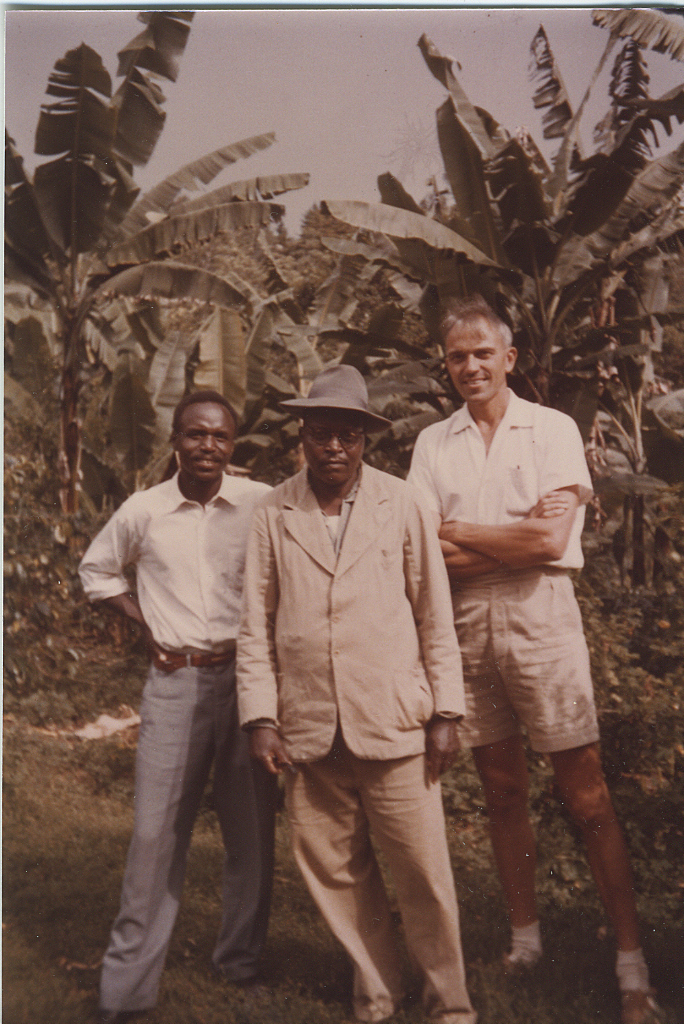
Eid Mubaraka wana-ukumbi nakuwekeeani hiki kipande mkiangalie. Hapa nilikuwa ndiyo nahitimisha kukiandika kitabu nikitaraji watakaosoma nitakuwa nimewawekea kitu cha kuhangaisha fikra zao:
In Dar es Salaam at the Kitumbini Mosque a hawli (prayer of remembrance for a departed Muslim) is held each year in the month of October to remember Abdulwahid Kleist Sykes. It is more or less a family affair with only relatives in attendance. Apart from the obligatory duty of praying for the departed as is the custom in Islam, Abdulwahid is accorded this respect for other reasons. In his short lifetime he used to pray regularly at the mosque and it was from this mosque that Abdulwahid made his last journey to meet his Creator. Abdulwahid was an important personality in the Muslim community. He had for many years been active in Al Jamiatul Islamiyya fi Tanganyika (The Muslim Association). He had also been Secretary of the Tanganyika African Association (TAA) and later its President. Although historians so far have not acknowledged his political achievements, Abdulwahid was the brains behind the formation of the Tanganyika African National Union (TANU), the political party which united the people of Tanganyika for their independence struggle against the British.
Many of Abdulwahid's contemporaries are still living and pray at the same mosque. They cherish this yearly occasion. Most of these are TANU veterans of the 1950s. They are now old and for bitter reasons they have lost interest in the Party. Apart from a small circle of relatives (now comprising of his grandchildren), close friends and former TANU members , nobody in the Party which he founded in 1954 seems to remember him. Abdulwahid has been completely forgotten. His name is hardly associated with the Party or with the political history of Tanzania. Yet this person was the main driving force in Tanganyika's independence movement.
A team of party historians, commissioned by the Party-Chama Cha Mapinduzi (CCM) to research and write an official history of TANU, did not even mention Abdulwahid's name in the entire book. The dominant school of thought in the book is the assertion that before the emergence of Julius Nyerere in April 1953, when he was elected TAA President, the African Association leadership did not articulate any concrete political thought. This premise has denied many patriots a place of honour in the political history of Tanzania and also eroded the status of the Association as a political movement. Local historians and post-independence party bureaucrats do not want to credit the African Association with a political identity. Kambona referred to the African Association as a debating society:
"It is just a little over one year since the inception of the Tanganyika African National Union and during this period it has grown from strength to strength, sometimes in the teeth of great opposition. As you are well aware it superseded the former Tanganyika African Association which was little more than a debating society."
Ulotu has referred to the organisation as a welfare association. Others have referred to the Association as a social organisation: Nyerere (1966), Japhet and Seaton (1966), John Hatch (1976). In other places it is referred to as a semi-protest movement: Kaniki (1974), as a semi-political movement: Nyerere (1953). Julius Nyerere appearing in an oral hearing at the Trusteeship Council at the United Nations, New York, on 7 th March, 1955, shifted his position and referred to the Association as a semi-political movement:
"The Tanganyika African National Union is, in one sense, a new organisation, but in another it is an old organisation. It was taken over from what was formerly called the Tanganyika African Association, which was founded in 1929, largely as a social organisation. The Tanganyika African National Union, which took over from the African Association about ten months ago, is a new organisation in the sense that it is a political organisation, where as the former was semi-political."
Other scholars have reduced the association to the level of club: Mwenegoha (1976) writes: ‘In 1954, after 25 years of inertia, Nyerere remodelled TAA from a social club into a formidable political organisation called the Tanganyika African National Union.'
Abdulwahid as one of the main actors in the modern history of political parties in colonial Tanganyika referred to the association as a political party (1951). Among writers and scholars who have analysed the African Association, it is only Nyerere and Hatch who have shifted their positions.
Nyerere, writing to Edward Twining the Governor of Tanganyika on 10 th August, 1953, referred to TAA as a political party. Nyerere has for a very long time maintained this view which has appeared in all his subsequent writings and speeches on the African Association. But recently he qualified his earlier statements on the subject referring to the association as a ‘political party without a political constitution'. Hatch (1976) refers to the association in one place as a social organisation and as ‘a serious political party' in another.
John Kabudi has referred to the Association as a ‘private civil organisation of a nationalistic character'. It is worth noting that even the pioneers of the organisation are not referred to as politicians. Kaniki, for lack of an appropriate word with which to refer to the pioneers, gave them quotation marks:
"Nyerere, hitherto almost unknown to the majority of ‘politicians' in Tanganyika, was then schoolmaster at St. Francis' Secondary School, Pugu, near Dar es Salaam, and he had been elected Territorial President the previous year."
Iliffe (1968) indicated that the written history of TANU was incomplete and went further in his analysis of the association perceiving its direction and membership as being political.
Kandoro and Japhet, the two TANU founder members who came to prominence while Abdulwahid was TAA president in 1952 were the only pioneers who worked closely with him during the Meru Land Case. Kirilo's visit to Dar es Salaam and the engagement of Seaton to represent Meru Citizens' Union in the conflict was very much facilitated by the intervention of Abdulwahid and the TAA leadership. It was Abdulwahid who helped Kirilo obtain a passport in Dar es Salaam after he was denied one in Arusha. Kirilo and Seaton, as well as Kandoro, have written their colonial experience, but no where in the two works is Abdulwahid mentioned, even in passing. The two try to link the Meru Land Case with Nyerere although prior to 1954 Nyerere had not yet made any impact on the politics of Tanganyika. In fact when the Meru Land Case went before the Trusteeship Council of the United Nations in New York, Nyerere was at Edinburgh University in Scotland studying for a master's degree.
An exception to this omission of Abdulwahid is Judith Listowel (1965) who, although only in passing, mentioned Abdulwahid in her book as one of the leading TANU pioneers.
Of late there has been interest in Tanzania's political history and Abdulwahid's name has been coming up every now and then in journals, newspapers, international magazines, and books these publications vary in their perception of Abdulwahid. There are some which shed light on the centrality of Abdulwahid in the founding of the Party and in initiating Julius Nyerere into politics. In these publications Abdulwahid appears as a revolutionary. Tandon called Abdulwahid and other patriots like Chege Kibachia, Makhan Singh, Fred Kubai, James Kivu, I.K. Musazi, Erika Fiah and Gama Pinto as ‘veteran leaders of the struggle of the peoples of East Africa... whom our recent historians have forgotten'. There are also those who have dismissed him as being ‘petty bourgeois.'
Among the TANU founding members, it is only those from the headquarters who could give a correct account of the formation of the Party. These are: John Rupia, Dossa Aziz, Tewa Said Tewa, Julius Nyerere, Dome Budohi, Abdulwahid and Ally Sykes. The two Sykes brothers, Abdulwahid and Ally, have a family connection in the African Association, their father Kleist Sykes having been founder Secretary of the Association in 1929. The Sykes files make very interesting reading for any researcher in the political history of colonial Tanganyika. These records contain information on Nyerere's early political career and it is surprising that when Party historians were researching, these records, which have so much information about Nyerere, and the party itself, were not consulted. No member of the family, including Ally and Abbas Sykes, the two surviving members of the three Sykes brothers, were interviewed.
In the late 1960s, when John Iliffe from Cambridge University, then at the Department of History, University of Dar es Salaam, began his research on Tanzania's history he obtained a lot of information on the African Association from one of his students, Aisha Daisy Sykes, Abdulwahid's daughter. Although Daisy informed Iliffe that it was her father who provided her with additional primary information articulated in her history seminar papers on Tanzania, it is very strange that Iliffe, interested as he was in the modern history of Tanzania, did not bother to meet Abdulwahid.
Iliffe, however, realising the potential in the Sykes' records encouraged Daisy to write a biography of her grandfather, Kleist Sykes which she did. When Abdulwahid died in 1968, Daisy, encouraged by the success of her previous work, wanted to work on the biography of her late father. Daisy was fired by the passion to write after realising that history had been unfair to her father and it was time she put the record straight. Daisy had in her possession Abdulwahid's files and diaries. Iliffe, for reasons probably unknown to Daisy at that time, discouraged her from writing on the grounds that the timing was inappropriate, and that the subject should be given time. There was no doubt in Iliffe's mind that Abdulwahid was a reliable source of information on TANU and its history; and any work on his life history would have been a great contribution to the political history of Tanzania. Following Iliffe's negative response Abdulwahid's biography was never to be written by her daughter.
The history of nationalism in Tanzania has always been shrouded in mystery. In 1962 Ally Sykes tried to recollect in an article to Mambo Leo how TANU was founded. Responding to the article sent to him, the editor M.J. Sichwale wrote to Ally Sykes rejecting his work on the grounds that the author of the article was not conversant enough with the subject. One can only imagine Ally Sykes' frustration.
When TAA was transformed into TANU, the TAA pioneers, probably sensing the attitude of the latecomers who had risen with TANU, had for some time toyed with the idea of recording the history of the party. Mwalimu Kihere, a TAA pioneer from Tanga, had once suggested to Abdulwahid and Ally Sykes, Dossa Aziz and John Rupia that the history of Tanganyika's political development should be written and preserved in their own lifetime to avoid distortions and interpolations by new comers in the political arena. But the idea was not taken up seriously and therefore up to the time when Mwalimu Kihere, Abdulwahid and John Rupia, Stephen Mhando and Hassan Suleiman died none of the pioneers had lifted a pen to put words on to paper.
Hassan Suleiman lays the burden of not having a conclusive and correct history of Tanganyika's nationalism on historians whom he accuses of ignoring all other patriots and centering Tanganyika's history on Julius Nyerere. Before he passed away, Hassan Suleiman donated his personal papers to the Party Archives in Dodoma in a ceremony presided over by the then Secretary-General of the ruling Party, Rashid Mfaume Kawawa.
The first serious attempt to record the history of TANU was done by none other than Abdulwahid himself. When TANU captured state power from the British in 1961 and was in the first phase of consolidating itself as a mass party, it is said that Abdulwahid was asked by Julius Nyerere, then Prime Minister of the country, to record the history of the struggle of the Africans of Tanganyika against the British. This, in essence, was to be the history of TANU. To assist him in the research was the late Dr Wilbert Kleruu, recently returned from studies in the United States.
Abdulwahid occupied his former office at the TANU headquarters; the one which he had occupied in the 1950s when he was TAA President. Abdulwahid's personal files, dairies and his late father's papers dating back to the days of the formation of African Association in 1929 were made available to researchers for the first time as primary sources of information. Abdulwahid's version, analysis, presentation of facts and interpretation of forces at play which led to the rise of nationalism were, however, not acceptable to the TANU leadership. We shall see in the following pages reasons why Abdulwahid's version of history could not be allowed to flourish. Abdulwahid abandoned the assignment after being convinced that the new leadership in TANU was not really interested in documenting an authenticated history of Tanganyika but was interested in merely creating a personality cult for President Nyerere. Dr Kleruu went ahead with the research and completed the work. This manuscript remains unpublished, at least in its original form. The manuscript disappeared from Party archives and was published for the first time in 1971 under a different name after changes had been done by the ‘author' on the original manuscript to prevent detection by the Party. After the book was published, the Party silently tried to stop the second edition of the book from being published but failed. The work has now been published several times. The approach, style and analysis of the subject is not very much different from the book on TANU published in 1981 by the Party ideological college.
However there is an anomaly in the book which the ‘author' overlooked. The ‘author', so to speak, writing in the first person, states that he wrote the book in 1964. In that particular passage the ‘author' provides information from which by reading between the lines the reader gets an impression that the author is familiar and intimate with the Party members mentioned. But the ‘author', in providing the date of his work, forgot that in 1964 he was a young boy in his teens and could not have known those people in 1950s nor have the intellect to undertake such an academic pursuit. The question is now, who is the real author of that passage? With the information now known, this could not even be the pen of Dr Kleruu writing that passage because he, like the ‘author', was never part of that period. Only one person could have such information and mastery of issues of those times. This could only be Abdulwahid writing in 1964. The ‘author' had carelessly copied a passage from Abdulwahid's notes preserved in the TANU archives. And this was not done in 1964 either, but much later after his death.
From that time Abdulwahid avoided involving himself in any discussion about the subject, although before his death he accepted an invitation and talked to the Historical Association of Tanzania (HAT). It has not been possible to get information on the topic presented for discussion, but it is said that one of the questions from the audience to him was whether it was not true that, Julius Nyerere had turned round the Party beginning in 1954. To this Abdulwahid gave an analogy of the astronaut John Glenn, the first American to go into outer space. Abdulwahid threw the question back to his audience and asked, "Where should the credit go, to the American scientists who designed and built the rocket, or to John Glenn who piloted it?"
When Judith Listowel came to Tanganyika in 1962 to research for her book, The Making of Tanganyika, she wanted to interview Abdulwahid. However, knowing the controversy which had surrounded the first attempt to research the subject, Abdulwahid avoided her. When Listowel finally caught up with him, Abdulwahid remained reserved and did not give any meaningful details about his own political career or that of his father. However Listowel was able to get little information from Abdulwahid on the formation of TANU from which she wrote: Abdul Sykes, Ally's brother, said that they had to awaken the political consciousness of the people and form a political organization.'
From this encounter with Abdulwahid, Listowel wrote to Ally Sykes giving her impression of Abdulwahid. Listowel wrote: ‘I like your brother very much and only wish we could have a longer conversation.' Back in London Listowel wrote to Ally Sykes on several occasions seeking clarifications on many points of historical importance.
When Abdulwahid died the Ministry of Information issued a press release announcing that the President had attended the funeral of Abdulwahid Sykes. Surprisingly the press release gave few details of his government service, completely eclipsing his checkered political career. It was an Englishman, Brendon Grimshaw, the editor of Tanganyika Standard, who published a fitting obituary to Abdulwahid describing him as: ‘one of the architects of the independence movement and one of the men who helped launch President Nyerere on his political carrier...'
The obituary also paid glowing tribute to the family on its contribution to the political development of Tanganyika by mentioning that ‘much of the desire among Africans for a powerful political party in Tanzania came from the drive of the Sykes family' (Sunday News 20 October 1968). It is said that this recognition of Abdulwahid as one of the founding fathers of the nation became a focus of attack from certain members of the TANU leadership. They were overheard grumbling in the corridors of the TANU headquarters in Dar es Salaam that Ally and Abbas Sykes were trying to glorify their elder brother. At the time of Abdulwahid's death, Abbas Sykes was Counselor at the Tanzania High Commission in Canada and Ally Sykes had resigned from politics and government service and was a private businessman. Ally Sykes had unceremoniously been made to resign from government service for failing to abide by the leadership code which required senior government officials not to own property or be engaged in business.
This position was to assert itself years later when the Party was researching its history. A research assistant by the name of Hassan Upeka, who happened to be one of earliest recruits of TANU, having joined the party directly from school in 1956, presented to the research panel, notes of an interview he had with Abdulwahid many years back. The research assistant was bluntly told that the intended book had nothing to do with Abdulwahid.
In 1974 President Julius Nyerere granted the responsibility of recording the history of TANU to Kivukoni Ideological College. Kivukoni College was established in the tradition of Ruskin College of Britain. Kivukoni was and still is a training centre for propaganda and mass indoctrination for party cadres. Kivukoni, therefore, was unsuitable for any serious research work. In 1976, at the 16 th TANU conference, Nyerere again insisted on having an official history of the Party. Official histories always have failed in objectivity.
In 1985, President Nyerere, while conferring an honorary degree on Basil Davidson, challenged the University of Dar es Salaamto write a correct history of Tanzania. In 1988, while commemorating thirty years of the Tabora Declaration, Nyerere in reference to early TANU members and as a tribute to them Nyerere asked the Party to take stock of those who joined TANU between 1954 and 1958. Nyerere said: "That was the most trying period in the history of our Party and few people were courageous enough to join and work for the Party."
In supporting Nyerere for his recent call and taking up the challenge to record a correct history which he had for the first advanced in 1974 and again in 1985 the present author published an article in African Events in which Abdulwahid and other forgotten TANU pioneers received prominence. In that article the author did what no other scholar had done before. He mentioned the fact that Muslims were in the forefront during the struggle for independence. It was at that time taboo to associate Islam or Muslims with the independence movement. The author received sharp rebuke from a Party historian, Dr Mayanja Kiwanuka, a leading member of the panel which wrote the Party book Historia ya Chama Cha TANU 1954-1977, the official history of the Party. The Party historian had this to say:
"(the)... article...argues that although Muslims in Tanzania played a crucial role in the struggle for independence, there is a deliberate effort to downplay their contribution. Consequently, the entire article contains half-baked fairy tales to sustain his argument, more so by mentioning names of several TANU stalwarts who happened to be Muslims...The greatness of TANU, indeed that of its founder-leader, Mwalimu Nyerere, is that, in so short a time since its inception, it managed to weave together into a formidable, relatively homogenous nationalist movement, a people so ethnically, culturally and religiously diverse... Said's major goal is to sow seeds of discord, and at any price, truth to him is a matter to be ignored."
This was the reaction from Kiwanuka, who supervised the research on the official history of the party, reducing a research article to what he called a ‘fairy tale'. The author was also accused of lying. Kiwanuka, not deviating from the Party stand, emphasised ‘the greatness of the party and its founder-leader'. Kiwanuka was at that time the Assistant Secretary in the Department of Political Propaganda and Mass Mobilisation of the Chama Cha Mapinduzi. Kiwanuka had as an undergraduate student at University of Dar es Salaam, written on post-independence Muslim-Christian relations.
In response to the author's interpretation of Tanzania's political history which posits Islam as an ideology of resistance to colonial rule, Fr. Peter Smith, a Catholic priest and a resource person in Muslim-Christian relations, responded with two papers to counter the Muslim factor in the independence movement. In one of them he argues that:
"There are revisionist histories being attempted today which are trying to show these early movements in support of TANU as Islamic Movements. The truth is that Muslims were involved; so, too, were Christians-the movement was mainly nationalistic and the ethos, though not anti-religious, was decidedly secular."
Father Smith of the Roman Catholic Church and the Party seem to be of the same mind on this dissension. Both Kiwanuka and Fr Smith are expressing their own personal opinion, not facts. No one denies the fact that some Christians were there. Indeed Christian names appear in the dramatis personae of the play. But no one can deny the truth that they did not occupy centre stage. This work has given a descriptive analysis of the role of urban Muslims in the struggle for independence; their contribution in the founding of TANU; in membership drives and composition which took strong Muslim characteristics. Dar es Salaam Province TANU Elders Council under its chairman Sheikh Suleiman Takadir had 173 members who were all Muslims.
In response to Kiwanuka's criticism the author published a short biography of Abdulwahid to commemorate twenty years of his death. This was followed by a memorial by the family in the Party and Government papers. This was not to pass without incident. The editor of the Daily News, the government paper, rang up the family late in the night informing them that he would not publish Abdulwahid's memorial the following day until he got permission from Party headquarters in Dodoma. The reason given was that his life history touched important events and personalities in the history of the nation. But somehow the memorial was published in both the Party and government dailies the following morning. Two years earlier in 1986, after a silence of almost twenty-five years, Ally Sykes gave an interview to a British journalist, Paula Park. Park wrote a full page article on the family's political history. When the article was published Ally Sykes received telephone calls from both friends and business associates asking him if he was quoted correctly. Shortly after, Park was quietly asked by immigration officials to leave the country.
Since then the author has been questioned about the authenticity of the work and the stated achievements of Abdulwahid. Doubts emerged, in spite of the fact that the article carried adequate reference material from old local newspapers, published books, journals and colonial papers. Abdulwahid's biography understandably was not challenged by anyone, not even the Party historian. This reaction by the Party, of denying part of its own history, while at the same time indicating that it has not documented its past, makes the subject even more intriguing. The fact that the Party has researched into its own history with inconclusive results means more research by independent scholars needs to be done. The subject is still open for further research.
Is this omission a result of neglect or is it a premeditated and calculated decision by the present leadership of the Party which took control of politics in the last years of the struggle beginning at 1958 after the Tabora Conference? Why is Abdulwahid's contribution and that of other patriots suppressed? What do the perpetrators of this campaign want to achieve and in whose interest?
When one enters the headquarters of the Chama Cha Mapinduzi (CCM) in Dodoma one cannot fail to notice the famous enlarged photograph of the TANU founding members. This photograph shows Abdulwahid in dark glasses, standing to the left of Dossa Aziz; both of them in suit and tie. Abdulwahid stands staring at the camera. Former president Julius Kambarage Nyerere in shorts and stockings is sitting on the bench to the left of John Rupia. Standing just behind Nyerere Saadani Abdu Kandoro. This photograph is the only living memory the Party has of the late Abdulwahid. His name only appears on the general list of the TANU pioneers when there is need to mention the seventeen founder members.
Baada ya hayo hapo juu sasa nakusikilizeni wana-ukumbi mnasemaje tufunge mjadala au tuendelee?