Uliza lolote kuhusu mgogoro ndani ya DRC hasa mapigano kati ya M23 na FARDC

Uliza lolote kuhusu mgogoro ndani ya DRC hasa mapigano kati ya M23 na FARDC

ni aibu sana na fedheha kwa mtu mwenye akili timamu kujisifia kupata maendeleo kwa njia zisizo endelevu za uporaji na mauaji

Marekani ni baba wa dunia kafanya hivo hivo anakula kuku kwa mrija mbona humsemi.
JK ALIMWAMBIA JAMAA AKAE NA WAASI AKAONA HUYU MWEHU AKAMPOTEZEA SASA JK MWENYEWE AKAJISTUKIA OOH MATA TUKAE TUONGEE TUYAMALIZE JK KAMA MWANAUME ANGESIMAMIA KAULI MPKA MWISHO AT THE END KAGAME AKAONEKANA DUME JK AKAMFUATA KUMWOMBA PEACE KWA KAUL ZA KUKURUPUKA NA WIVU USIO NA MAANA KWA KAGAME.tz kila siku misaada tu lakin hatutoki kagame maisha ubishi anakomaa katoka
 
Marekani ni baba wa dunia kafanya hivo hivo anakula kuku kwa mrija mbona humsemi.
JK ALIMWAMBIA JAMAA AKAE NA WAASI AKAONA HUYU MWEHU AKAMPOTEZEA SASA JK MWENYEWE AKAJISTUKIA OOH MATA TUKAE TUONGEE TUYAMALIZE JK KAMA MWANAUME ANGESIMAMIA KAULI MPKA MWISHO AT THE END KAGAME AKAONEKANA DUME JK AKAMFUATA KUMWOMBA PEACE KWA KAUL ZA KUKURUPUKA NA WIVU USIO NA MAANA KWA KAGAME.tz kila siku misaada tu lakin hatutoki kagame maisha ubishi anakomaa katoka

Unatoa maoni kwa JWTZ kufuatia na wanachokifanya DRC?
 
mlipe kodi kwa kuwauza dada zenu au? kwa rasilimali gani zilizopo Rwanda ? madini ya damu za wakongo ndizo zinazo inua uchumi wa Rwanda. Kwa mantic hiyo siyo uchumi endelevu. Acheni uporaji na mauaji ya wengine kwa ajili ya sifa ambazo hamna, rudini kwenu milimani mkalime viazi kama alivyowahikutamka kagame

Da!sikutegemea kama kuna watu wenye wivu kiasi hiki yani unaweza ua mtu
kabisa,rwanda ina chukiwa na majirani kutokana na maendeleo yake,mbona tz ina madini haijaendelea?tena hakuna vita,mmepatia makaburu wanajilia na sasa wamewapeleka congo mkawapiganie kikwete na riz pesa zinajazwa kwenye account zao,nyie mnakalia rwanda inamaendele kwasababu ya madini ya kongo mbona nyie masikini?
 
Unatoa maoni kwa JWTZ kufuatia na wanachokifanya DRC?

Ishu ni kua hawa jamaa m23 december nina hakika watarudi Goma back up bado ipo JWTZ kama ni wapiganaji na wanajifanya wana huruma na binadamu waende kule Somalia kwenye vita since 90's. Wakawatoe wale wanamgambo linked to al qaeda.
 
Da!sikutegemea kama kuna watu wenye wivu kiasi hiki yani unaweza ua mtu
kabisa,rwanda ina chukiwa na majirani kutokana na maendeleo yake,mbona tz ina madini haijaendelea?tena hakuna vita,mmepatia makaburu wanajilia na sasa wamewapeleka congo mkawapiganie kikwete na riz pesa zinajazwa kwenye account zao,nyie mnakalia rwanda inamaendele kwasababu ya madini ya kongo mbona nyie masikini?

Waswahili ya kwao yamewashinda wanaanza kupiga chabo jirani kala nini na kinawauma sana Kila siku kigali iko juu kimaendeleo wao pa1 nakujikweza kwa wazungu bado hoi kaz ya gov ya Tz ni kurusha mabom kwenye mikutano ya chadema
 
JAMAA MBISHI taratibu kaka, maneno yako ni makali ingawa yana ukweli ambao huenda watu wa aina ya MUKAMASIMBA wasingependa kuyasikia.


Hata kama siyo makali always the truth hurts na ndiyo maana PK anajaribu kuua kila anayesema ukweli juu yake.
 
[h=1]DR Congo army in 'last phase' push against M23 rebels after seizing guerrilla stronghold[/h]
  • Democratic Republic of Congo carried out attacks on the M23 rebels
  • Assault saw government troops seize final stronghold in east DRC
  • M23 rebellion has been ongoing since April 2012
By SARA MALM
PUBLISHED: 19:12 GMT, 31 October 2013 | UPDATED: 19:12 GMT, 31 October 2013

View
comments


Government troops in the Democratic Republic of Congo are making a final push to crush the M23 rebellion which has been controlling areas near the Ugandan border for over a year.
In an attempt to quell the last of the rebel troops, the DRC army seized the insurgents' final remaining stronghold in the eastern province of North Kivu, near the Ugandan border.
Exchange of gunfire between DRC government troops and the M23 rebels have been confirmed with at least one young girl caught in crossfire, locals have said.

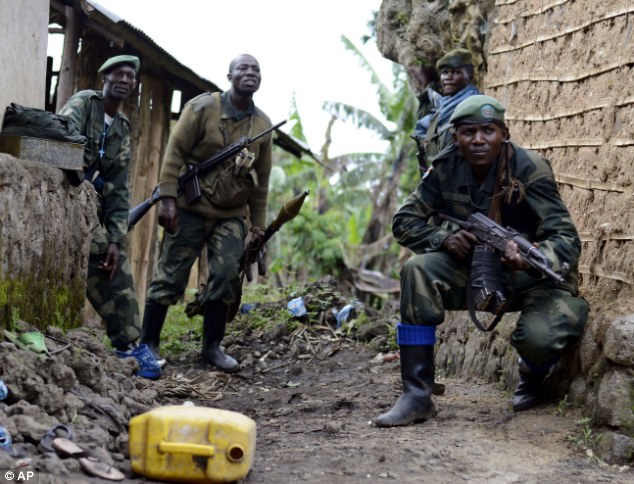
article-2481758-1915E94200000578-305_634x484.jpg
Final fight: Congolese army soldiers take cover during an assault on rebel-held Jomba, as they advance toward Bunagana, eastern Congo

The DRC government launched an offensive on the M23 rebels last week and have since been carrying out operations to eliminate rebel resistance in territory near the Ugandan border.
‘The soldiers spent the night here and then went to the front’ at dawn, a resident in the border town of Jomba said, as mortar fire could be heard in the background.


[h=4]More...[/h]

A source in the UN mission in DR Congo (MONUSCO), which is helping the army, said the offensive against the M23 was in ‘the last phase’, after the army captured the main rebel base at Bunagana on Wednesday.
Diehard M23 fighters, estimated at just a few hundred men, were dug in on three hills in farming territory about 50 miles north of Goma, the capital of strife-torn North Kivu province.

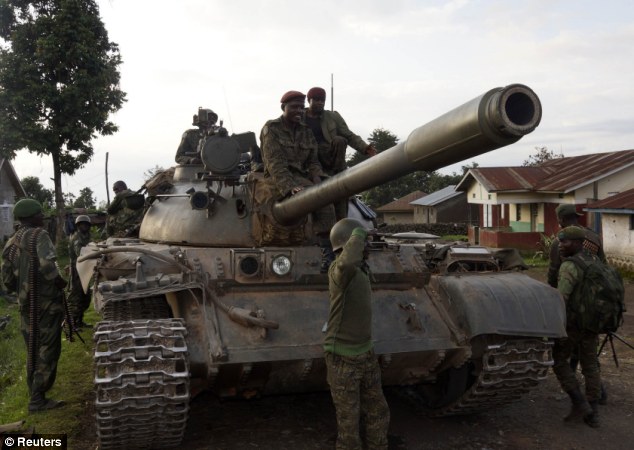
article-2481758-19184C1900000578-843_634x450.jpg
Rolling in: Democratic Republic of the COngo government troops arrive atop a tank in Bunagana, widely considered to be the final stronghold of the M23 rebels


The DRC army (FARDC) ‘has encircled the residual M23 positions to dislodge them. The operation is under way,’ the source said.
[h=3]THE M23 REBELLION[/h]The M23, an abbreviation of The March 23 Movement, is also known as the Congolese Revolutionary Army, based in east DRC.

The rebellion takes its name from a peace treaty signed between the DRC milita group National Congress for the Defence of the People (CNDP) and the DRC government on March 23, 2009, which saw the ethnic Tutsi former rebels incorporated into the Congolese army.

In April 2012, nearly 300 soldiers, a majority of which were former members of the CNDP, turned against the government and formed the M23 rebellion, claiming the terms of the 2009 peace treaty had not been fully implemented.

The group took control of several areas in the North Kivu province, including the capital of Goma, which has a population of one million, in November 2012, holding the city for ten days.
The Democratic Republic of the Congo and the UN claim that the M23 is backed by neighbouring Rwanda and Uganda, an allegation the two countries strongly deny.


Since fighting resumed on October 25, after peace talks collapsed in Uganda, no UN troops have directly taken part in the offensive, but MONUSCO has provided government forces with intelligence, reconnaissance and logistical help.
After the fall of the rebel headquarters at Bunagana, President Joseph Kabila on Wednesday again urged the M23 fighters to ‘demobilise voluntarily’, warning that his men would otherwise ‘make them do so by force’.

Kabila said that ‘political and diplomatic solutions’ remained on the negotiating table in Uganda's capital Kampala, where the rival sides have held stop-start talks since December and their representatives expressed guarded optimism.
‘The negotiations are making progress,’ M23's deputy delegation chief Roger Lumbala said at midday Thursday.
‘Maybe today, they will have finished and we can put an accord on the table to sign it.’
The conflict has displaced hundreds of thousands of people in North Kivu, a densely populated province rich in precious minerals and agricultural produce that has been a battleground for soldiers, rebels and militias for more than two decades.
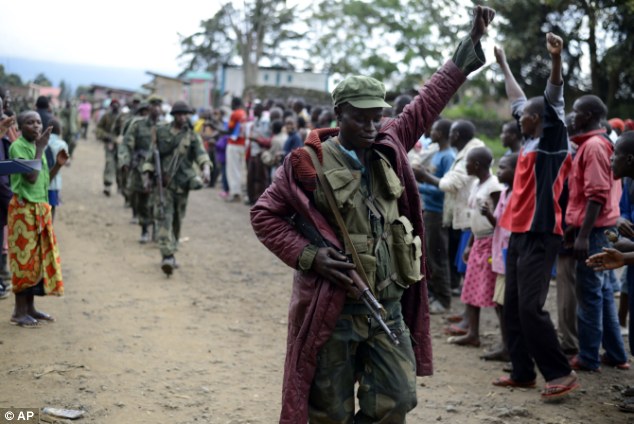
article-2481758-1915E1FA00000578-82_634x424.jpg
Red carpet welcome: Cheer from locals as the DRC army arrives in an area near the UGandan border in North Kivy where the M23 rebels have been fighting against troops since April 2012


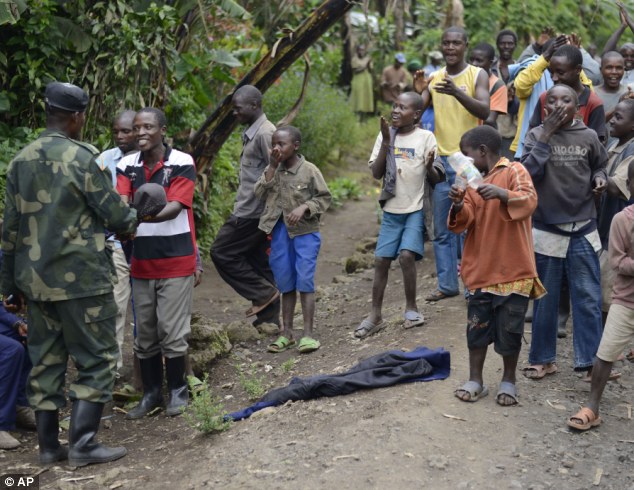
article-2481758-1915F22100000578-201_634x490.jpg
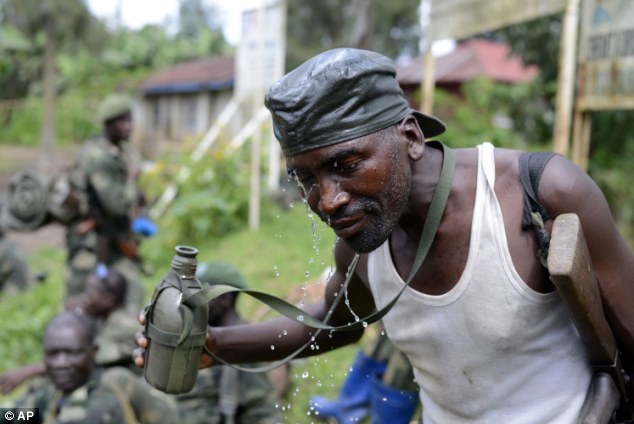
Joy: A DRC army soldier is welcomed with applause and gifts as the army enters Jomba, DRC, to end the 18-month insurgency


article-2481758-1915F24600000578-338_634x424.jpg
Progress: The army retook one of the last remaining strongholds of the rebels Wednesday, with fighters heading for the hills as the military sought to extinguish the M23

Some 5,000 civilians crossed into Uganda at Bunagana between Monday and Wednesday, according to the United Nations, but on Thursday the refugees started trying to return to their homes in DR Congo.
‘This morning we crossed back to go to our fields, but soldiers told us to turn round,’ said Imelda Nyirankusi, who had eight children in tow and a baby on her back. ‘We had the impression that gunshots were getting nearer.’
Imelda said that she had fled Bunagana the previous day and then returned to Uganda after her bid to go back. The soldiers had ‘slit the throat of one of my fat cows... and eaten it, saying it was a Tutsi cow, an M23 cow,’ she added.
‘How do you want me to go home if people kill my cows and make me feel I'm not wanted?’ Imelda asked.


Read more: DR Congo army in 'last phase' push against M23 rebels after seizing guerrilla stronghold | Mail Online
Follow us: @MailOnline on Twitter | DailyMail on Facebook
 
[h=1]How The U.N. Turned The Tide Against A Congolese Rebel Group[/h]BY HAYES BROWN ON OCTOBER 31, 2013 AT 2:40 PM
drcongo-unrest-monusco_ho007-555x452.jpg
Indian MONUSCO forces fire an RPG to protect civilians in fight against M23 rebels
CREDIT: AP PHOTO / MONUSCO
The Congolese army has in recent days shown marked success against a Congolese rebel group, capturing its base city and upping the pressure for the rebels to engage in peace talks with the government. The difference between this and other offenses against the rebels? The presence of a United Nations brigade, specially mandated to aid in taking the fight to the rebels in a way the organization hasn't done in decades.
The Congo was the scene of one of the earliest U.N. interventions, when thousands of blue helmets were deployed first to stabilize the newly independent country, then to aid in suppressing the rebellion of the Katanga province. The mission was a full-scale military operation, going so far as to have its own military intelligence contingent. In the time since, the U.N. has kept itself to what have become more traditional peacekeeping roles, deploying only after a conflict has ended in order to separate the formerly warring sides when necessary.
Ethnic tensions between the Hutu and Tutsi groups that led to the Rwandan genocide in 1994 have since then been playing out in the Great Lakes region, to the detriment of the Congo. After a period of warfare in the late 1990s large scale enough to be dubbed "Africa's World War," in which all of the Democratic Republic of the Congo's many neighboring countries found themselves taking part in proxy battles within the country, hope for stability has found itself constantly thwarted by one rebel group or another. The most recent claimant to the title of spoiler has been the M23 movement, whose rise can be seen as a continuation of events in 2009. The CNDP - a Rwandan-backed, Tutsi rebel group in Eastern Congo - had in 2004 rejected the authority of President Joseph Kabila, citing the corruption of his administration, and began open warfare against the government in the Kivu region of the country.
The fighting became enough of a threat to civilians that the European Unionthreatened to intervene directly, forcing the two sides into peace talks, and the CNDP leader Laurent Nkunda into exile in Rwanda. The solution at the time to end the fighting, agreed to on Mar. 23, 2009, was to integrate the rebels into the Congolese army as part of a larger peace deal. Instead of forging a lasting settlement, many of those same soldiers defected earlier this year to form the M23, led by wanted war-criminal Gen. Bosco Ntaganda.
Since then, the group has swung wildly between launching offensive after offensive against the key town of Goma in eastern Congo to demanding peace talks with the government in Kinshasaa. All the while, Congo's eastern neighbor, Rwanda, has been implicated both by the United Nations and theUnited States as supporting the group as part of its bid to maintain influence in the DRC. The United Nations' peacekeeping force in the Congo, known asMONUSCO, did its best to fulfill its role of protecting civilians. Despite being the largest peacekeeping force in the world, with nearly 20,000 troops deployed in blue helmets, M23 appeared to be a bridge too far in terms of providing stability to the country.
Then the U.N. Security Council in March voted to authorize a component of MONUSCO to serve as an intervention brigade, provided with heavy weaponry and the mandate to take the fight to the rebels if need be. While not the first time the U.N. has authorized an offensive force, the decision to provide that authority to a peacekeeping force was seen as precedent-setting. In no small part, this is because offensive operations have become the purview of loose coalitions of member-states once the U.N. has given its imprimatur as seen in the Gulf War or through regional groups such as NATO as seen in Libya. Actually having countries offer up blue helmeted forces to the United Nations and under the command of a U.N.-appointed general do the fighting has become a rarity.
The Council was clear from the start that this brigade was meant to have muscle that previous U.N. promises of civilian protection as seen in Bosnia did not. In the authorizing resolution, the Security Council laid out that the brigade would consist "inter alia of three infantry battalions, one artillery and one Special force and Reconnaissance company with headquarters in Goma, under direct command of the MONUSCO Force Commander, with the responsibility of neutralizing armed groups."
These fighters, the U.N. determined, would combat and reduce the threat "posed by Congolese and foreign armed groups, [...] violence against civilians, including sexual and gender-based violence and violence against children to a level that can be effectively managed by the Congolese justice and security institutions."
And it seems that they've managed to do just that. In late July, MONUSCOissued an ultimatum to the group, demanding that the rebels lay down their weapons or face the consequences. The M23 refused, setting up the last two weeks' impressive show of force from the Congolese army, also known as the FARDC, and the intervention brigade. On Wednesday, the FARDC captured the city of Rutshuru, the informal capital of the M23, before taking their last stronghold in Bunagana.
Darren Olivier, writing at the African Defence Review, detailed just how the Intervention Brigade managed to turn the tide against the M23. "Using UN Mi-8s, Oryxes and Mi-26s, [Force Intervention Brigade (FIB)] troops were separated into three task forces and deployed near Kiwanja, Munigi/Kibati and north-west of Rutshuru," he wrote, acting as a blocking force in support of the FARDC. "Crucially, this involved establishing sufficient logistics for each front, avoiding the typical problem in Congolese operations where poor roads make operations riskier the further they move away from main logistics bases."
"It was also the first time the entire FIB was together in a single operation, as the Malawian infantry who arrived earlier in October were part of the UN positions," Olivier added, allowing for a three-front operation, establishing a southern, western, and northern front. "It formed a pincer movement that squeezed M23 out from its strongholds and into the Virunga mountains against the Rwandan border," he concluded. "It also proved that the FIB concept works, as the support its troops provided were what allowed for the three fronts to be established."
The result is that members of MONUSCO are declaring victory in the fight against the M23. MONUSCO chief Martin Kobler told the U.N. Security Councillate on Monday that "practically all M23 positions were abandoned, except for a small triangle at the Rwandan border." While M23 is still claiming that it isholding ground against the FARDC, the MONUSCO Twitter account boasted on Wednesday that "dozens of members of the M23 went to MONUSCO forces" in surrender as a result of the operations, showcasing the downfall of the group.
Laura Seay, an assistant professor at Colby College and an expert on the region, concurred that things look bleak for the M23. "They're in big trouble," she said in a phone interview with ThinkProgress. "This is not the end for Tutsi grievances in Congo, to Rwanda wanting to have an active and friendly ally in the Kivu region, but for this particular iteration, I think it's fair to say that they're not going to survive the current onslaught that they're undergoing."
Key to the success that the Congolese army and MONUSCO have seen thus far, Seay said, is that Rwanda has decided not to intervene in support of M23. "If they were going to do so, they would have already done it," she said. Part of that is due to the diplomatic pressures that have been placed upon Rwanda in recent months, including direct condemnation from the United States on multiple occasions and the U.S. decision not to waive sanctions related to Rwanda's use of child soldiers. While Congo's eastern neighbor has not fully withdrawn support for the M23, Seay told ThinkProgress, it's very clear that that support has been scaled back.
While the U.N. has frequently stressed that the Congolese armed forces have the lead on all missions, the impact the intervention brigade fighting alongside them has had is hard to overstate. The brigade has served as a role model to the Congolese, Seay said, displaying fighting skills, discipline, and handling both logistical issues and tactical issues, such as dealing with snipers. "I think there's a lot of intangible benefits to that and seeing acts of heroism," Seay said. "Nobody has ever seen that before in the Congolese army."
The next target of MONUSCO may also have played a part in Rwanda's choice not to support their alleged proxy group. One of the other armed groups operating in the Congo, the Democratic Forces for the Liberation of Rwanda (FDLR), has proven a frequent thorn in the side of Kigali while also targeting Congolese civilians. Given regional political dynamics, Seay speculated, and that Rwanda wants to ensure that there's no reason that its interests are threatened enough to intervene directly, the FDLR could prove a prime target for the intervention brigade moving forward.
And so military victory over the M23 doesn't, however, mean that the conflict in Eastern Congo is even close to being over. Nor does it make clear what precisely will happen to the rebels now that they've been beaten back completely. Kabila has already rejected the notion of attempting reintigration of the M23 into the Conglese army again, a position which he has public support in taking. It's possible that those captured could find themselves facing trial at the International Criminal Court, as their leader Ntaganda currently is, but that's in no way certain. But the U.N. isn't set to go anywhere anytime soon, with its political staff on the ground to help facilitate stability once the security situation has been improved, and the intervention brigade still authorized to act until March.
 
watusi kizazi kilicholaanika
Mbona unaleta ukabila mkuu?ulikilaani wewe hicho kizazi?kwa taarifa yako Joseph Kabila naye ni mtutsi,vipi kalaanika?Kuna watutsi wengi tu ni wapinzani wakubwa wa Kagame,hata mkuu FLASH HIDER ameeleza jinsi gani watutsi wa Goma walivyoichangia FARDC.
 
Last edited by a moderator:
Mbona unaleta ukabila mkuu?ulikilaani wewe hicho kizazi?kwa taarifa yako Joseph Kabila naye ni mtutsi,vipi kalaanika?Kuna watutsi wengi tu ni wapinzani wakubwa wa Kagame,hata mkuu FLASH HIDER ameeleza jinsi gani watutsi wa Goma walivyoichangia FARDC.

Joseph Kabila akiwa mtutsi so what the f.u.c.k is that?unaona akiwa mtutsi ni big deal?endelea kuzisoma number kichapo kinaendelea huko bunagana haaahaaha!
 
Last edited by a moderator:
Nafikiri hujajua sababu m23 walihama maeneo yao,katika mapambano yaliyo tokea kibumba walikufa askari wengi wa FRDC pamoja na wasindikizaji wao na kwa sababu hiyo jamaa walikuja na hasira nyingi sana,m23 ikabidi iwapishe lakini unajua inavyo uma kupigwa ukiwa na nguvu halafu unakuja na hasira unamkosa imagine,sasa ndio kubadili mtindo wa mapigano hivi wameamua kua offensive watakua wakishambulia badala ya kungojea kushambuliwa kwani hawa UN wanasilaha kali nafikiri huyo HIDER kama yuko GOMA anaweza kukupa sura ya mapigano kwa kuangalia majeruhi na maiti,vita ni kali sana sio mchezo na watu wanakufa sana.

Ni sababu hiyo ndiyo itasaidia UN ku justify kukata kabisa Mzizi! maana bila kuukata mzizi wataendelea kusumbua sana.
 
Back
Top Bottom