Wacha bana, kwani wanafyeka miti ya nchi nzima hadi nchi iwe jangwa? Miti michache ya Selou haiwakilishi nchi.Miti milioni tatu? Hawa jamaa wanataka kuigeuza hii nchi jangwa.
Mbona hawasemi kwanini hawaelekezi nguvu kwenye umeme wa gesi?
Andiko la Prof. Mwalyosi la 2009 kutumika kama tathmini ya mazingira Stiegler's gorge; watakaopinga kufungwa
Our Community
Regional Communities
Navigation
Install the app
How to install the app on iOS
Follow along with the video below to see how to install our site as a web app on your home screen.
Note: This feature may not be available in some browsers.
More options
Style variation
You are using an out of date browser. It may not display this or other websites correctly.
You should upgrade or use an alternative browser.
You should upgrade or use an alternative browser.
Andiko la Prof. Mwalyosi la 2009 kutumika kama tathmini ya mazingira Stiegler's gorge; watakaopinga kufungwa
- Thread starter Zurie
- Start date
Wacha bana, kwani wanafyeka miti ya nchi nzima hadi nchi iwe jangwa? Miti michache ya Selou haiwakilishi nchi.
Kama sikosei Tanzania ni miongoni mwa nchi 5 Africa zinazoongoza kwa ukataji miti. Deforestation


sepaline
JF-Expert Member
- Dec 1, 2014
- 265
- 270
Ipo ila imegoma kutoka huko chinihivi gas imekwisha.....?
Gesi tayari na wenyewe mkuu.Aisee, Miti milion tatu sio mchezo. Kwanini tusirudi tuu kwenye gesi ambako miundombinu yote ishafanyika. Tuweke gas plant kubwa tuu pale Lindi na uzalishaji uanzie pale. Chenji itayobakia tuwekeze kwenye kilimo ili ku boost Sera ya viwanda na kurahisisha upatikanaji wa malighafi.

Steven Robert Masatu
JF-Expert Member
- Aug 7, 2009
- 2,458
- 1,825
Mmmh!! Ina wenyewe kiaje, na ni akina Nani!? Hebu fafanuaGesi tayari na wenyewe mkuu.
yamindinda
JF-Expert Member
- Jul 29, 2011
- 1,581
- 1,318

MIXOLOGIST
JF-Expert Member
- Mar 1, 2016
- 14,311
- 36,056
Zidumu fikra sahihi za mwenyekiti wa chama

Mlachake
JF-Expert Member
- Oct 13, 2009
- 4,437
- 4,618
So no more rule of law?

Yamakagashi
JF-Expert Member
- Sep 19, 2016
- 8,614
- 17,626
Tanzania yangu inatia huruma

yamindinda
JF-Expert Member
- Jul 29, 2011
- 1,581
- 1,318
Environmental Kuznets curve
The environmental Kuznets curve suggests that economic development initially leads to a deterioration in the environment, but after a certain level of economic growth, a society begins to improve its relationship with the environment and levels of environmental degradation reduces.
From a very simplistic viewpoint, it can suggest that economic growth is good for the environment.
However, critics argue there is no guarantee that economic growth will lead to an improved environment – in fact, the opposite is often the case. At the least, it requires a very targeted policy and attitudes to make sure that economic growth is compatible with an improving environment.
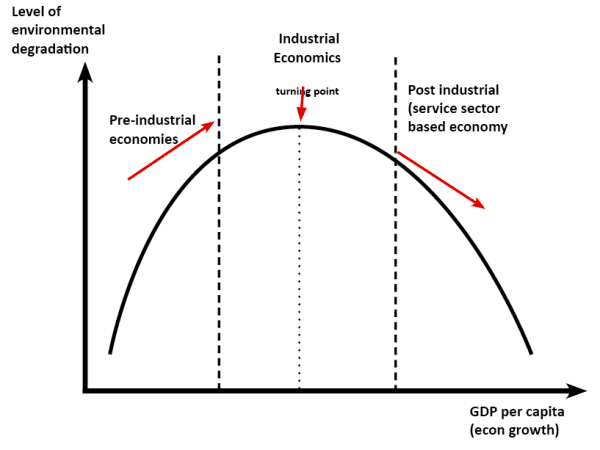
Justification for Environmental Kuznets curve
The link between levels of income and environmental degradation is quite weak. It is possible economic growth will be compatible with an improved environment, but it requires a very deliberate set of policies and willingness to produce energy and goods in most environmentally friendly way.
The environmental Kuznets curve suggests that economic development initially leads to a deterioration in the environment, but after a certain level of economic growth, a society begins to improve its relationship with the environment and levels of environmental degradation reduces.
From a very simplistic viewpoint, it can suggest that economic growth is good for the environment.
However, critics argue there is no guarantee that economic growth will lead to an improved environment – in fact, the opposite is often the case. At the least, it requires a very targeted policy and attitudes to make sure that economic growth is compatible with an improving environment.
Justification for Environmental Kuznets curve
- Empirical evidence of declining pollution levels with economic growth. Studies found that higher economic growth in the US led to increased use of cars, but at the same time – due to regulation, levels of air pollution (in particular sulphur dioxide levels declined). See: Kuznets curve a Primer
- Spare income with growth. With higher rates of economic growth, people have more discretionary income after paying for basic necessities; therefore, they are more amenable to paying higher prices in return for better environmental standards.
- Focus on living standards as opposed to real GDP. Traditional economic theory concentrates on increasing real GDP and rates of economic growth. But there is a growing awareness the link between economic growth and living standards can be weak. Focusing on living standards can become politically popular.
- Improved technology. The primary driving force behind long-term economic growth is improved technology and higher productivity. With higher productivity, we can see higher output, with less raw materials used. For example, since the 1950s, the technology of car use has significantly improved fuel efficiency. In the 1950s, many cars had very low miles per gallon. In recent years, car manufacturers have made strides in reducing fuel consumption and have started to develop hybrid technology.
- Solar and renewable energy. A good example of how improved technology has reduced potential for environmental damage is the progress in solar technology. In recent years, the cost of solar energy has significantly fallen – raising the prospect of clean technology. See: Solar technology
- De-industrialisation. Initially, economic development leads to shifting from farming to manufacturing. This leads to greater environmental degradation. However, increased productivity and rising real incomes see a third shift from industrial to the service sector. An economy like the UK has seen industrialisation shrink as a share of the economy. The service sector usually has a lower environmental impact than manufacturing.
- Role of government regulation. Economic growth and development usually see a growth in the size of government as a share of GDP. The government are able to implement taxes and regulations in an attempt to solve environmental externalities which harm health and living standards.
- Diminishing marginal utility of income. Rising income has a diminishing marginal utility. The benefit from your first £10,000 annual income is very high. But, if income rises from £90,000- £100,000 the gain is very limited in comparison. Having a very high salary is of little consolation if you live with environmental degradation (e.g. congestion, pollution and ill health). Therefore a rational person who is seeing rising incomes will begin to place greater stress on improving other aspects of living standards.
- Empirical evidence is mixed. There is no guarantee that economic growth will see a decline in pollutants.
- Pollution is not simply a function of income, but many factors. For example, the effectiveness of government regulation, the development of the economy, population levels.
- Global pollution. Many developed economies have seen a reduction in industry and growth in service sector, but they are still importing goods from developing countries. In that sense, they are exporting environmental degradation. Pollution may reduce in the UK, US, but countries who export to these countries are seeing higher levels of environmental degradation. One example is with regard to deforestation. Higher income countries tend to stop the process of deforestation, but at the same time, they still import meat and furniture from countries who are creating farmland out of forests.
- N-Shaped. Some economists argue that there is a degree of reduced environmental degradation post-industrialisation. But, if the economy continues to expand, then inevitably some resources will continue to be used in greater measure. There is no guarantee that long-term levels of environmental degradation will continue to fall.
- Countries with the highest GDP have highest levels of CO2 emission. For example, US has CO2 emissions of 17.564 tonnes per capita. Ethiopia has by comparison 0.075 tonnes per capita. China’s CO2 emissions have increased from 1,500 million tonnes in 1981 to 8,000 million tonnes in 2009.
The link between levels of income and environmental degradation is quite weak. It is possible economic growth will be compatible with an improved environment, but it requires a very deliberate set of policies and willingness to produce energy and goods in most environmentally friendly way.

Mzee wa Masauti
JF-Expert Member
- Jul 26, 2014
- 2,199
- 2,510
Tanzania has officially become Banana republic

DiasporaUSA
JF-Expert Member
- Aug 27, 2016
- 23,382
- 29,639
Mnunua mapapai nipo nyuma yako, kanyaga mafuta twende.

yamindinda
JF-Expert Member
- Jul 29, 2011
- 1,581
- 1,318
Total area of Selous Game Reserve 54,600 km²......Total area needed for Stiegler's Gorge Project is about 1,350 square kilometers
MIXOLOGIST
JF-Expert Member
- Mar 1, 2016
- 14,311
- 36,056
Doesn't matter, mazingira yanaharibiwa. Kunya ni kunya tu ata ukinya kidogo harufu ni ile ile.Total area of Selous Game Reserve 54,600 km²......Total area needed for Stiegler's Gorge Project is about 1,350 square kilometers
Ukiona mtu anatumia nguvu kwenye miradi kama hii basi jua kuna wizi mkubwa sana unaandaliwa.
Wakishatoka madarakani ndo ukweli unakuja kuwekwa wazi.
Sawa na mradi wa bomba la gesi ambalo sahivi halitumiki tena.
Mkuu zinatafutwa hela kwa ajili ya uchaguzi 2020. Kabla ya kila uchaguzi, chama kileee lazima kipige hela za kisawasawa. Haya ni maandalizi ya kuhalalisha dili hilo.
yamindinda
JF-Expert Member
- Jul 29, 2011
- 1,581
- 1,318
Rubada discusses implementation of Stiegler`s Gorge Power project: Tue Apr 02, 2013
The Rufiji Basin Development Authority (Rubada) has continued to push forward the implementation of the Stiegler’s Gorge Power project after meeting with various stakeholders and discussed a report and proposal on the development of the project.
The meeting was one of the steps ahead towards the implementation of the huge hydropower project by Runada on behalf of the government and a Brazil based company, Odebretch International.
“We have successfully discussed the report and we are very optimistic,” Rubada Director General, Aloyce Masanja told journalists after the meeting at the weekend in Dar es Salaam.
The report under discussion was prepared by the Brazilian company and presented to Rubada a few months ago.
The proposal mainly touched on power market overview, engineering studies and technical proposal, preliminary social-environmental evaluation, key stakeholders, stage one risk analysis and financial structure and proposed business plan.
According to the report, the project financial requirement is at the tune of USD2bn but the figure may vary depending on the technology to be agreed on at a later stage.
Once completed, the project will have the potential to produce 2100 MW.
The Brazilian company reviewed the Feasibility Study which was done by a Norwegian company, NORCONSULT in 1980 on the similar project but shelved later on.
The next stage after reviewing the proposal will be designing and doing Environmental Impact Assessment (EIA) while the third stage will be the commencement of construction.
Masanja said the meeting to discuss the report was very crucial since its implementation will involve various stakeholders.
“Basically various stakeholders saw the significance of the project and gave their blessings,” he noted.
On his part, Rubada Board Chairman, Prof Raphael Mwalyosi said the project should be supported by stakeholders for the development of Tanzania.
“The project is a multipurpose by nature in agriculture, energy, fisheries, flood control and tourism,” he said, adding that the success of the project will largely depend on the healthy cooperation among stakeholders.
Stakeholders who attended the meeting came from various government departments such as the Ministry of Energy and Minerals, Ministry of Natural Resources and Tourism, Ministry of Water, Ministry of Agriculture, Food Security and Cooperatives, Energy and Water Utilities Regulatory Authority (Ewura), University of Dar es Salaam, Rubada and others.
Odebrecht Company Limited is renowned for being involved in huge and successful constructions of big hydropower projects in the world. It was involved in the construction of the world’s second largest hydroelectric power station, Itaipu Dam in Brazil with a capacity to produce 14,000 MW.
The Rufiji Basin has the potential to produce 4,000 MW.
SOURCE: THE GUARDIAN
The Rufiji Basin Development Authority (Rubada) has continued to push forward the implementation of the Stiegler’s Gorge Power project after meeting with various stakeholders and discussed a report and proposal on the development of the project.
The meeting was one of the steps ahead towards the implementation of the huge hydropower project by Runada on behalf of the government and a Brazil based company, Odebretch International.
“We have successfully discussed the report and we are very optimistic,” Rubada Director General, Aloyce Masanja told journalists after the meeting at the weekend in Dar es Salaam.
The report under discussion was prepared by the Brazilian company and presented to Rubada a few months ago.
The proposal mainly touched on power market overview, engineering studies and technical proposal, preliminary social-environmental evaluation, key stakeholders, stage one risk analysis and financial structure and proposed business plan.
According to the report, the project financial requirement is at the tune of USD2bn but the figure may vary depending on the technology to be agreed on at a later stage.
Once completed, the project will have the potential to produce 2100 MW.
The Brazilian company reviewed the Feasibility Study which was done by a Norwegian company, NORCONSULT in 1980 on the similar project but shelved later on.
The next stage after reviewing the proposal will be designing and doing Environmental Impact Assessment (EIA) while the third stage will be the commencement of construction.
Masanja said the meeting to discuss the report was very crucial since its implementation will involve various stakeholders.
“Basically various stakeholders saw the significance of the project and gave their blessings,” he noted.
On his part, Rubada Board Chairman, Prof Raphael Mwalyosi said the project should be supported by stakeholders for the development of Tanzania.
“The project is a multipurpose by nature in agriculture, energy, fisheries, flood control and tourism,” he said, adding that the success of the project will largely depend on the healthy cooperation among stakeholders.
Stakeholders who attended the meeting came from various government departments such as the Ministry of Energy and Minerals, Ministry of Natural Resources and Tourism, Ministry of Water, Ministry of Agriculture, Food Security and Cooperatives, Energy and Water Utilities Regulatory Authority (Ewura), University of Dar es Salaam, Rubada and others.
Odebrecht Company Limited is renowned for being involved in huge and successful constructions of big hydropower projects in the world. It was involved in the construction of the world’s second largest hydroelectric power station, Itaipu Dam in Brazil with a capacity to produce 14,000 MW.
The Rufiji Basin has the potential to produce 4,000 MW.
SOURCE: THE GUARDIAN
Mlachake
JF-Expert Member
- Oct 13, 2009
- 4,437
- 4,618
[FONT=Courier New said:the implementation would involve felling of more than three million trees.[/FONT]
I thought it was cutting down trees may be my English teacher was wrong