Wizara ya Mambo ya nje ya China imesema China yapinga vikwazo vilivyowekwa vya kujiamulia na Marekani na Jumuia ya nchi za Ulaya dhidi ya Russia. Msemaji wa Wizara hiyo amesema kuwa vikwazo hivyo havina msingi wowote ktk sheria za kimataifa.
======
China is even more opposed to unilateral sanctions that have no basis in international law, Foreign Ministry spokesman Wang Wenbin said.

www.indiatoday.in
China, a close ally of Russia, said on Monday that it was opposed to illegal unilateral sanctions and will continue to carry out normal trade cooperation with Moscow, as the US, EU and their allies stepped up punitive measures against Russia, including the interbank messaging system SWIFT.
Asked about what some have described as the "financial nuclear option" at a regular press briefing in Beijing, Foreign Ministry spokesman Wang Wenbin said China opposes the use of sanctions to solve problems and is even more opposed to unilateral sanctions that have no basis in international law.
"China and Russia will continue to carry out normal trade cooperation in the spirit of mutual respect, equality and mutual benefit," Wang said.
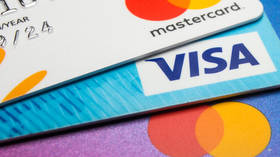
MasterCard and Visa to limit Russia operations
Some cards issued in the country will not be accepted abroad and on foreign websites
© Getty Images / SOPA Images
International card companies Mastercard and Visa have disconnected a number of Russian banks from their payment systems following “
sanction orders” related to Russia’s ongoing military operation in Ukraine.
“
As a result of the sanctions orders, we have blocked several financial institutions in the Mastercard payment network. We will continue to work with regulators in the coming days to fully comply with our obligations,” Mastercard CEO Michael Mibach said in a statement on Tuesday.
The card company did not specify which institutions will be cut off, but Washington last week announced a list of Russian banks which fall under the sanction orders. These include VTB, Otkritie, Sovcombank, Promsvyazbank and Novikombank. Their assets and dollar accounts were blocked, and Apple Pay and Google Pay for the cards of these banks stopped working.
Restrictions were also placed on Sberbank, but they fell short of freezing its assets – instead, only correspondent accounts of the bank will be closed.
 READ MORE: Germany wants limited Russia SWIFT ban – Foreign Ministry
Gazprombank, RSHB, Alfa-Bank, and Credit Bank of Moscow were subject to sectoral sanctions, with only a few restrictions.
According to RBC, Mastercard notified banks that fell under blocking sanctions that they were suspending their participation in the system on February 26.
International payment system Visa also announced on Tuesday it would be taking “
prompt measures” to enforce Ukraine-related sanctions, however, it has not yet specified the details.
According to the sanction orders, clients of sanctioned banks will not be able to pay with their Visa and Mastercard cards abroad and on foreign websites. However, the cards will continue to work in Russia, since payments within the country are processed via the internal National Payment Card System (NSPK), created in 2014.
Tuesday’s announcements from the card companies come a day after the head of the National Bank of Ukraine Kirill Shevchenko called on Visa and Mastercard to stop servicing Russian banks from their payment systems.
Russia launched a military operation in Ukraine last week at the request of the two breakaway Donbass republics, which Russia recognized on February 24. The leaders of the republics urged Moscow to step in and defend their people from what they see as pro-Kiev nationalists who have been terrorizing the region since 2014. Many Western states, however, see Russia’s moves as “unprovoked” aggression and have introduced new sanctions against Russia’s economy. The restrictions have been gradually expanding over the past few days, with new penalties introduced each day.
Ukraine invasion: Russians feel the pain of international sanctions
By Anastasia Stognei in Moscow & Simon Fraser in London
BBC News
Published59 minutes ago
Share
Related Topics
IMAGE SOURCE,EPA
Image caption,
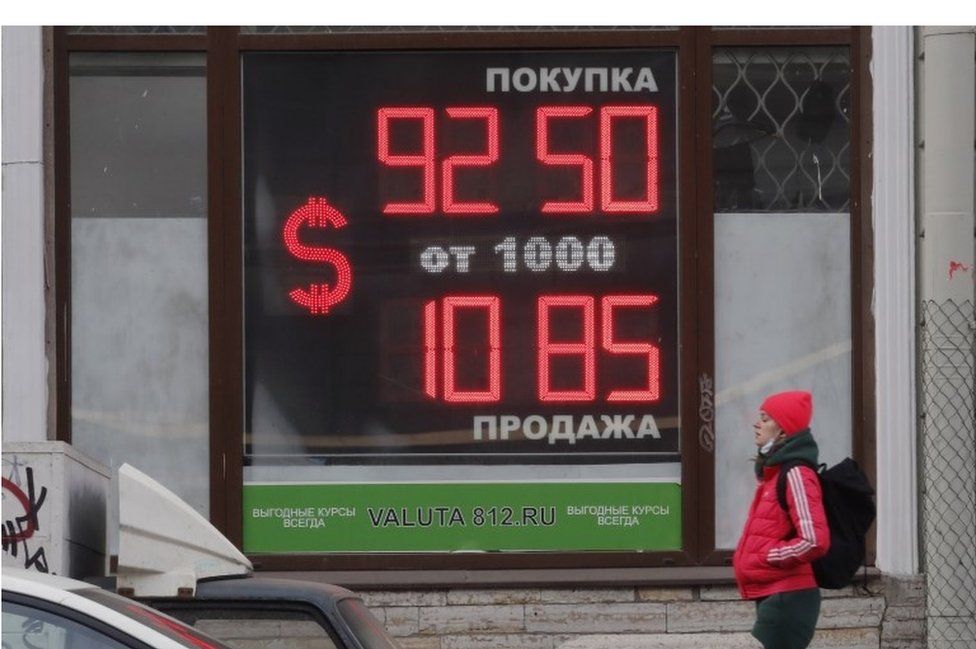
The rouble has plummeted against the dollar and other currencies in recent days
"If I could leave Russia right now, I would. But I can't quit my job," says Andrey.
He can't afford to get a mortgage in Moscow now interest rates have been hiked.
Millions of Russians like him are starting to feel the effect of Western economic sanctions designed to punish the country for invading neighbouring Ukraine.
"I am planning to find new customers abroad asap and move out of Russia with the money I was saving for the first instalment," says the 31-year-old industrial designer.
"I am scared here - people have been arrested for speaking against 'the party line'. I feel ashamed and I didn't even vote for those in power."
Like other interviewees for this article we are not using his full name or showing his face for security reasons. Some names have been changed.
Japan sanctions Putin
Tokyo vows to ‘freeze assets’ of top Russian officials, including President Vladimir Putin
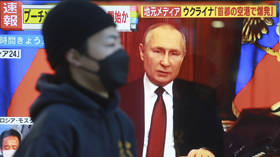
FILE PHOTO: A man walks past a TV screen with image of Russia's President Vladimir Putin in Tokyo, Feb. 24, 2022 © AP / Koji Sasahara
Japan has slapped Russia with additional sanctions for its offensive in Ukraine, targeting three state banks and six top state officials, including President Vladimir Putin, Foreign Minister Sergey Lavrov and Defense Minister Sergey Shoigu.
“We've agreed on the need to take powerful sanctions against Russia,” Prime Minister Fumio Kishida declared on Tuesday.
Japan’s asset freeze will also target Russia’s central bank, as well as the state-owned Vnesheconombank and Promsvyazbank. In addition, Tokyo will ban exports to 49 Russian companies and entities.
Japan joins the US, EU and other Western allies in introducing embargoes against Moscow for
“an invasion of Ukraine.” The measures mostly focus on cutting off certain Russian banks from global financial transactions and freezing assets abroad.
 READ MORE: US singles out ‘Putin ally’ for more sanctions
Russia attacked Ukraine last Thursday, justifying it with a call for the complete
“demilitarization” and
“denazification” of the country, and made a pledge to prosecute those who were involved in “
numerous bloody crimes against civilians.” The move came just days after Moscow recognised the Donetsk and Lugansk People's Republics.
Kiev, however, claims the attack was
“unprovoked,” insisting it has had no plans to retake the breakaway regions of Donetsk and Lugansk by force. They split from Ukraine back in 2014 following the Maidan, which ousted a democratically-elected government in Kiev. Years of low-intensity warfare has left thousands of people dead.
Canada to ban imports of crude oil from Russia
By Beth Timmins
Business reporter, BBC News
Published12 hours ago
Share
Related Topics
IMAGE SOURCE,REUTERS
Image caption,
Russian gas flows through pipelines across eastern and central Europe
Canadian Prime Minister Justin Trudeau has announced a ban on Russian oil imports following the country's invasion of Ukraine.
Mr Trudeau said oil revenues have helped to prop up President Vladimir Putin and Russian oligarchs.
Coordinated Western sanctions against Russia have targeted its banks but still accept its oil and gas exports.
Unlike Europe, Canada is not heavily reliant on Russia's oil exports.
"While Canada has imported very little amounts in recent years, this measure sends a powerful message," Mr Trudeau told a news conference.
Canada imported just C$289m (£170m) worth of energy products in 2021, according to Statistics Canada.
Canada is the world's fourth largest producer of oil.
Europe, however, is far more reliant on Russia's supplies. A quarter of the European Union's petroleum oil imports come from Russia and about 40% of the EU's natural gas imports.
Refusing to buy its oil and gas would be a very tough sanction from European countries, but policymakers have so far been reluctant to take that step, worried about the impact on energy prices in their own countries.
The price of Brent crude rose by 4.6% to $102 barrel on Monday after Western nations imposed new sanctions on Russia - one of the world's largest energy producers.
While the UK gets most of its imports from Norway and the US, fuel prices in the UK still hit record highs on Monday as the impact of Russia's invasion affected global energy markets.
Russian oil and gas exports make up a fifth of Russia's economy and half of its earnings from exports. The country is the European Union's biggest oil trading partner, according to the latest data from Eurostat.
Western nations announced at the weekend that they would impose sanctions on Russia's central bank to prevent it from selling its vast reserves to prop up its own banks and companies.
Russia's central bank has build up $630bn in reserves.
The White House press secretary Jen Psaki also said that sanctions targeting Russia's energy sector remain on the table.
On Saturday, the EU, the US, the UK and other allies also announced that some Russian banks would be banned from Swift, an international payment system.
Swift is the global financial artery that allows the smooth and rapid transfer of money across borders.
Banning Russia from using Swift will, for example, hit payments for its key energy and agricultural products.
More on this story