Dar es Salaam ilikuwa Mecca ya vyama vya ukombozi, pia jiji la mapigano baina ya vyama hasimu vya ukombozi Afrika ya Kusini

Dar es Salaam ilikuwa Mecca ya vyama vya ukombozi, pia jiji la mapigano baina ya vyama hasimu vya ukombozi Afrika ya Kusini

01 September 2026

I Left South Africa at 19 to Fight Apartheid | Dr Tshabalala Tells Her Daughter Her Story


View: https://m.youtube.com/watch?v=dI2ZzGi5gwg
In one of her most personal conversations yet, Dr. Khanyisile Litchfield-Tshabalala sits down with her daughter to tell the story of the decade of her life she gave to South Africa’s liberation struggle.

The conversation is also a rare mother-daughter reflection on what liberation demanded from an entire generation.

What does it mean to give up your youth for freedom? Was the South Africa those young fighters imagined eventually delivered?

And what lessons should the generation that inherited that freedom learn from those who fought for it?This is more than an interview about apartheid.It is a first-hand account of sacrifice, armed struggle, ideology, loss, liberation and the unfinished story of South Africa
Source : THEE ALFA HOUSE
 
11 September 2026
Harare, Zimbabwe

The Growing Social Crisis in Zimbabwe: Exposing the World Bank’s Criteria for Economic Growth...

View: https://m.youtube.com/watch?v=_PaWGrk4Oqg
Zimbabweans from every walk of life are facing increasing hardship – broken health and education services, absence of electricity, water, and sanitation, demolition of houses, the disruption of the informal sector, etc. Why has the World Bank made this strange decision? Who is right about the fragility of the state?

This question will be addressed by an expert panel lead by Prof. Ibbo Mandaza who is currently Executive Chairman of the Southern African Political Economy Series (SAPES) Trust and other invited guest
Source : SAPES Trust
 
2026
Advocates Mathew Chaskalson Just Dropped Evidence That Will DAMAGE Julius Malema’s Political Career


View: https://m.youtube.com/watch?v=9SIfpt5bfoc
The Madlanga Commission has heard evidence suggesting that tobacco executive Mohamed Sayed acted as an intermediary between EFF leader Julius Malema and Crime Intelligence boss Feroz Khan in obtaining confidential case information.Evidence leader Advocate Mathew Chaskalson told the Commission that Sayed forwarded another message from Malema to Khan, in which Malema requested information about the complainant in a specific case and provided the case number.According to the evidence, Khan responded by sending the case details as well as the complainant’s address. The complainant was identified as Anoosh Rooplal, the curator of VBS Mutual Bank.Chaskalson argued that the evidence indicates Malema sought the information because he had been implicated, rightly or wrongly, in alleged wrongdoing linked to the matter. He added that Malema was not entitled to receive the confidential information.
Source : News23
 
28 September 2026

Morgan Tsvangirai’s journey: how the MDC almost took power in 2008


View: https://m.youtube.com/watch?v=Zr6cXjmRHpQ

Morgan Tsvangirai how the Trade union leader came closer to be a president , ended as prime minister

Morgan Tsvangirai, A game changer.. constitutional changes of 2007...
 
2026
Harare, Zimbabwe

Current Situation: Brett Muvet and the Government in Exile, DETAILED ANALYSIS


View: https://m.youtube.com/watch?v=VNxKE_zcMk4
Difficulties of Getting Legitimacy, recognotion

Brett Holley, a Zimbabwean businessman and political commentator, has made a name for himself in recent years on social media through his political interventions. At the end of August 2026, he took a new step by announcing the creation of Varanda VeZimbabwe (VVZ), a new political party whose name can be translated from Shona as « the servants of Zimbabwe


His message is simple, almost disarming: he says he wants to bring Zimbabweans together, whether they live in the country or in the diaspora, while building a network able to act beyond its borders. His project rests on the principle of « servant leadership »: a conception of power which, in his view, must put the interests and well-being of ordinary citizens before those of the political elites.

Clean water, medicines, roads, schools, jobs: the new darling of Zimbabwean politics intends to place these very concrete questions at the heart of his project. He insists that he is not seeking wealth or the privileges of power, and presents his commitment as a fight aimed, not least, at leaving a better country to his son.

But his project does not stop there. Brett Holley also envisages the formation of a « government in exile », notably from South Africa, in order to prepare a future political transition. He argues that elections alone would not be enough to bring about a change of regime, and speaks of a « revolution » — which he defines as a popular mobilisation, not an armed struggle.

View: https://m.youtube.com/watch?v=U4epB95nB5U
 
29 September 2026
Memories of the National Liberation Struggle: Alberto Chipande contextualizes the beginning of the armed struggle for Mozambique liberation ...


View: https://m.youtube.com/watch?v=upGaa5lA_94

Sixty-two years ago, on September 25, 1964 the Mozambique Liberation Front officially began the Armed Struggle for National Liberation.

The attack on the Chai post in Cabo Delgado marked the beginning of a journey that would culminate, ten years later, in National Independence. Today, the protagonists and scholars of that period recall the circumstances that mobilized a generation for the struggle.

This guerrilla strike initiated a decade-long conflict against Portuguese colonial rule, leading to a ceasefire under the Lusaka Accord and full independence on June 25, 1975.


FRELIMO was founded in 1962 in Tanzania and led by , Eduardo Mondlane, who led the liberation struggle until his assassination in 1969.

Mozambique celebrates Armed Forces Day this Friday, marking the start of its armed struggle for independence.

The war began in 1964 at Chai in Cabo Delgado province, led by the Front for the Liberation of Mozambique (FRELIMO), which was formed in 1962 from the merger of three exile movements.

FRELIMO’s first President, Eduardo Mondlane, led the liberation struggle until his assassination in 1969, and was succeeded by Samora Machel who proclaimed independence in 1975.

After independence, the country endured a civil war with RENAMO from the early 1980s until the 1992 General Peace Agreement, followed by multiparty elections from 1994.

Today, Armed Forces Day is marked with military parades, official speeches and national events honouring the sacrifices of liberation fighters and fostering unity.

Cerimônias centrais do Dia da FADM: Chapo convoca à defesa da soberania, militares reafirmam prontidão...


View: https://m.youtube.com/watch?v=D4tKjFoDBjs

CELEBRAÇÃO DO 25 DE SETEMBRO: Chefe de Estado dirige cerimónias centrais do dia das FADM em Inhamban

View: https://m.youtube.com/watch?v=pHKt1ODDhBk
 
10 October 2026

MAJOR INTERVIEW WITH JOAQUIM CHISSANO ON RECONCILIATION 10/04/2026​


View: https://m.youtube.com/watch?v=psE0jmqauvQ
mahojiano marefu na Rais wa zamani Joaquim Chissano, ikizingatia vipengele vya nyuma ya pazia vya Mkataba Mkuu wa Aman na RENAMO pia mkondo wa kihistoria wa nchi hiyo .

Mwanasiasa huyo anatafakari kuhusu maridhiano ya kitaifa, umuhimu wa kuwaweka watu katikati ya sera za maendeleo, na changamoto katika kuimarisha utulivu wa Msumbiji....
Archbishop Goncalves, met Renamo leader Afonso Dhlakama in the bush near Gorongosa, in Sofala province. They then met with President Chissano in August to report their findings. Chissano was angry that the Gorongosa meeting had taken place without his advance knowledge.

Mozambique :​

A calling for peace: Christian leaders and the quest for reconciliation in Mozambique​

An estimated 1 million Mozambicans died during the 16–year civil war that finally ended in October 1992 with the General Peace Agreement signed in Rome. This Accord looks at the diverse initiatives that brought the parties to a negotiated settlement of the conflict, and illustrates the impact of changing regional and international dynamics on Mozambique.
The Mozambican Peace Process In Perspective Accord Issue

A calling for peace: Christian leaders and the quest for reconciliation in Mozambique
A calling for peace: Christian leaders and the quest for reconciliation in Mozambique​

AuthorsDinis S. SengulaneJaime Pedro Gonçalves

Dínis S. Sengulane and Jaime Pedro Gonçalves describe how Mozambique’s churches, based on a position of neutrality, became key mediators between Renamo and the Frelimo government.

Mozambique’s churches helped bring about direct negotiations between the Frelimo government and the Renamo that led to the formal ending of the war in 1992. Dínis S. Sengulane and Jaime Pedro Gonçalves describe how, despite the historical tension between the clergy’s association with Portuguese colonialists and nationalist aspirations, a resurgent church advocated dialogue and reconciliation, and based on a position of neutrality, became key mediators between Renamo and the Frelimo government. The clergy harnessed international pressure to urge the parties to resolve the conflict sooner.

A calling for peace: Christian leaders and the quest for reconciliation in Mozambique​

As the ten year anti-colonial struggle waged by the Mozambique Liberation Front (Frelimo) drew to a close in 1974, the conditions were created for another war which would engulf independent Mozambique until 1992. Although strongly influenced by many outside factors, this conflict was fought largely by Mozambicans and it was they who bore the brunt of the violence. This is the story of how the Mozambican churches took up Jesus’ call to promote peace in the country during this period of intense upheaval. The work of the churches helped bring about direct negotiations between the Frelimo government and the Mozambique National Resistance (Renamo) that led to the formal ending of the war in 1992. Since then, the churches have pursued their peacemaking role, working for reconciliation and reconstruction throughout the country.

Early days​

The Roman Catholic Church has been active in Mozambique for almost 500 years. However, it was only in the 1940s, following the signing of the Concordat and the Missionary Agreement between the Holy See and the Portuguese government, that extensive evangelisation began. The Missionary Agreement had its roots in Vatican frustration with the 1930 Colonial Act that defined the Portuguese Catholic missions overseas as ‘instruments of civilisation and national influence’. Local Catholic churches and the Vatican were not comfortable with the level of control this gave the Portuguese over missionary activities.

The Missionary Agreement paved the way for a new relationship between the Catholic Church and the Portuguese government. Although finding clergy to serve in Africa proved difficult, the establishment of the first three Mozambican dioceses opened the way for many new missionaries to come from Italy, Spain, France as well as Portugal. The Missionary Agreement also stipulated that the Catholic Church should open primary schools and seminaries for the local people. While the bishops and rectors of these institutions had to be Portuguese, the colonial government agreed to pay their salaries. The government also provided finance for explicitly religious activities in Mozambique, as long as these were conducted in line with its policies.

From the 19th century onward, other Christian groups established a presence in Mozambique including Anglicans, Methodists, Pentecostals and Reformed Protestants. While Mozambique has remained the least evangelised country south of the Sahara, its many denominations have enriched the Christian community with their diverse contributions. Over the years, a process of indigenisation has also occurred as Western religious institutions have blended with local cultures, belief systems and practices. The syncretic religious forms which have emerged play an important role both locally and in the international denominational and ecumenical fora in which Mozambican churches are represented.

The dislocation of Church and State​

Mozambican church people responded to the independence struggle in many different ways. While the Catholic missions received extensive support from the colonial regime, many enjoyed a certain amount of freedom in how they conducted their grassroots activities. In central and northern Mozambique, in particular, the Catholic Church became a major modernising and liberalising force during the colonial era. As a process of ‘Africanisation’ took root in local Catholic churches and their social networks, they soon became an important platform for Mozambican nationalism.

This was also the case with the Protestant churches and non-Portuguese missionaries. Because they had weaker links with the colonial power they were able to pursue a more independent political line. It was through their ministry that people such as Eduardo Mondlane, the first president of Frelimo, emerged to speak on behalf of the Mozambican people. However, as these independent church initiatives opened the eyes of local people to the oppressive nature of foreign rule, they were met with suspicion from the colonial government, and later with persecution.

During the liberation war of 1964-74, many clergy, including both Catholics and Protestants, were outspoken in their criticism of the colonial regime. While the Catholic Church in Mozambique made no official statements about the war, individual leaders such as Bishop Jaime Goncalves and Bishop Alexandre dos Santos took individual stands against the violence. They called openly for peace and reconciliation, often to the displeasure of the government.

During this time, the World Council of Churches (WCC) gave both moral and material support to Frelimo through its Programme to Combat Racism. Pope Paul VI also provided support, receiving leaders of the liberation movement in Rome. Despite these international demonstrations of solidarity, the colonial government reacted strongly to clergy who protested against their policies. Some 20 foreign Roman Catholic priests, including the Burgos fathers, were expelled from the country or felt compelled to leave. Many Protestant ministers who remained in Mozambique were ill-treated for associating with the nationalists, and some were jailed or killed.

Many of the Portuguese clergy found themselves in a very difficult position. Due to their close links with the colonists, they did not, or could not, support the Mozambican struggle for independence. This resulted in strained relations between the clergy and local people. After independence in 1975, the dehumanising policies of ‘Portugality’ and ‘civilisation’ were quickly discredited and the churches paid the price for their unwillingness to stand up to the violence during the war. The new Frelimo government began to bear down heavily, though unevenly, on the Christian churches.

The Catholic Church, in particular, was considered a handmaiden of the old regime and many of its leaders were seen as a threat to state power. As a consequence, the new government closed churches, expelled missionaries from the country, and revoked many religious freedoms. The considerable assets of the Church were also nationalised, including schools, hospitals and seminaries, all of which were seen as essential to the government’s ambitious development programmes.

By the end of 1976, seven of Mozambique’s nine Catholic bishops were indigenous, but dialogue between the government and both the Catholic and Protestant churches had ground to a halt. While the churches remained the most influential of civic institutions, state control over the population was increasing. By the time the war with Renamo picked up in the late 1970s, the churches had largely been alienated from political life and their response to the violence was for the most part muted. At various intervals, the Catholic Church presented the Frelimo government with carefully worded and critical reports concerning the growing plight of the Mozambican people, but these did not elicit a significant response.

A gradual breakthrough​

The Mozambican churches began to play a constructive role in promoting peace in the early 1980s in the context of its rapprochement with the government. In 1982, President Machel made some conciliatory moves towards the churches, inviting them to play a role in the revolution as humanitarian actors and as educators in ethical matters. After eight years of alienation, the churches finally received official permission to assist the victims of war and natural disaster.

In October 1982, during its synod, the Anglican Lebombo diocese decided to consult with other churches in the Protestant-dominated Mozambican Christian Council (CCM) and approach the government to seek the abolition of the death penalty. In a meeting with President Machel in December 1982, they also suggested that a peaceful way to end the devastating war needed to be found. The Catholic Archbishop of Beira, Dom Jaime Goncalves, who was present in his capacity as president of the Episcopal Conference of Mozambique, echoed this claim and emphasised that peace needed to include Mozambicans of all ethnic, religious and political persuasions.

In July 1984, in a confidential memorandum to President Machel, the CCM repeated the call for dialogue between all Mozambicans caught up in the war. Machel’s response was unequivocal: no dialogue. In November, the CCM launched a Peace and Reconciliation Commission to use as a vehicle for peace. Members of the commission were drawn from the Methodist Union, the Free Methodists, the Anglicans, the Church of Christ in Manica and Sofala, and the Nazarene Church. The following May, the CCM repeated the request for dialogue between the government and Renamo, but again the response was negative. Informal requests through other church contacts with President Machel continued for a few more months, but still with no result.

In October 1986, after the death of President Machel, the CCM began directing its requests to his successor, Joaquim Chissano. Around this time, the Catholic Church also became more vocal in its call for peace. A pastoral letter was circulated by the Catholic bishops in 1987 calling for dialogue and reconciliation between the government and Renamo. In response, the semi-official newspaper Noticias branded the bishops ‘the Apostles of Treason’. This was followed by President Chissano directly criticising the Catholic Church in his June Independence Day speech. This speech prompted other members of the government to attack the Church, but the president, recognising such an approach was not constructive, stopped the criticism.

In late 1987, a decisive shift in its military fortunes caused a change of mood within the Mozambican government, and a CCM delegation was finally received by Chissano in December. At this meeting, the president expressed appreciation for the CCM initiative, sending a clear message that steps towards dialogue would not be interpreted negatively. Nevertheless, Chissano was keen to control any developments and the limits of the churchmen’s role were clearly defined by the government (see box).

Government terms of reference for Church contacts with Renamo, December 1987​

i) The churches, working either locally or through ecumenical fora such as the All Africa Council of Churches (AACC) and the World Council of Churches (WCC), should not only feel free but are encouraged to contact ‘the other side’ (the bandits) with the clear understanding that these contacts are not to be construed as paving the way for any negotiations with them as a political entity.

ii) The main purpose of such contacts would be to persuade the ‘other side’ to stop assassinating its own people and devastating its own country.

iii) In the event of positive developments in the future, the local churches may assist the reintegration of the rebels into Mozambican society.

Overtures to the rebels​

With President Chissano’s encouragement, the CCM started pursuing contact with Renamo. Meanwhile, the All African Council of Churches (AACC) and the World Council of Churches promised to provide funds to enable CCM leaders to visit the US and Kenya to talk with Renamo representatives. Because the Catholic Church was also known to share a desire for peace, the CCM felt it was time to join forces to bring the government and the rebels together. The government, whose relationship with the Catholic Church was improving, approved this move.

The Archbishop of Maputo, Alexandre dos Santos, was invited to accompany a group of six CCM leaders on a trip to the United States at the invitation of the National Council of Churches of Christ. The council had not been informed of their intention to meet with Renamo, however, and were adamantly opposed to the idea. After some consternation on the part of the Mozambican delegation, a neutral person eventually came forward and offered to establish contact with a Renamo representative. In New York, the clergymen met with Artur Lambo Vilanculo and were promised contact with Renamo’s internal leadership.

The churchmen returned to Maputo in February 1988 and awaited word from Vilanculo. After a time, they decided a smaller task force would be more efficient and formed a new group consisting of two delegates from the CCM, Bishop Dinis Sengulane and Pastor Mucache, and two from the Catholic Church, Archbishops Goncalves and dos Santos. In April, this new group travelled to Kenya where Vilanculo introduced them to Bethuel Kiplagat. Kiplagat was the Kenyan Permanent Secretary for Foreign Affairs, but also an active member of the Anglican Church and had formerly worked for the Christian Council of Kenya. Kiplagat informed the Kenyan government about the churchmen’s mission and efforts were made to convey their message to Renamo leaders.

In May, several clergy, including Archbishop Goncalves, met Renamo leader Afonso Dhlakama in the bush near Gorongosa, in Sofala province. They then met with President Chissano in August to report their findings. Chissano was angry that the Gorongosa meeting had taken place without his advance knowledge. He nonetheless expressed his conviction that dialogue with Renamo’s internal leadership was the only way to achieve peace.

Several more visits were made to Kenya in 1988 in an effort to restore formal contact with Renamo representatives. In December, Kiplagat introduced the churchmen to Renamo’s Information Secretary, Francisco Moisés Nota, who promised to convey a message to Renamo’s leadership inside Mozambique. By this time, the initiative to bring about dialogue had become public and the churchmen had begun to attract press attention inside Mozambique.

Press criticism of the churches’ initiatives​

Prior to the Nairobi talks, the press had speculated that Renamo’s preconditions for dialogue would be the withdrawal of all foreign troops, and that the government would itself demand that Renamo stop fighting. In fact, the initial talks between the rebels and the churchmen took place without preconditions.

The press had also claimed that the churches were biased in favour of the government. In response, the clergymen reiterated that they represented all of the Mozambican churches as well as the country’s suffering people, and that it was only on this impartial basis that Renamo had agreed to talk with them.

Talks in Nairobi​

In January 1989, word came from Kenya that Dhlakama was interested in meeting the churchmen in Nairobi. In February, the rebel leader changed his mind, but announced that he would send a delegation instead. The churchmen duly arrived in Nairobi on 14 February and held meetings with various people, including President Moi, while they awaited the arrival of the Renamo delegation. On 26 February, the delegation finally arrived, led by Raul Manuel Domingos, the rebels’ Secretary for Foreign Relations. Kiplagat sat in on these meetings where the clergymen attempted to convince Domingos that dialogue was the only way to end the war. They underlined that no one was benefiting from the continued fighting and that the people were suffering. Above all, the churchmen emphasised their neutrality, stressing that reconciliation was a basic vocation of the church.

With a commitment from the Renamo representatives to arrange an early meeting with Dhlakama, the churchmen returned to Mozambique and briefed President Chissano on their trip. After various abortive attempts – in March, April and July – they subsequently met with a Renamo delegation led by Dhlakama in Nairobi from 8-14 August 1989.

In preparation for these talks, the government drew up a list of ‘12 principles’ for direct dialogue with Renamo which the churchmen passed on to the rebel group without comment. Renamo replied with a ‘16 point declaration’ which was delivered to Maputo on 14 August. Despite the many areas of disagreement between these two documents, the major stumbling block was the government’s refusal to recognise Renamo as a legitimate political force in Mozambique. The Nairobi declarations seem to have been the first written communication between the two sides, however, and would eventually open the way to direct talks. In the meantime, the clergymen refused to answer questions from either side regarding the other, insisting instead that the government and Renamo talk to each other directly.

A second round of talks, organised by President Moi, took place in Nairobi between 29 August and 1 September, but sadly failed to make progress. Nonetheless, the church leaders made themselves available over the next year to facilitate further contacts between the government and Renamo, provided that such involvement would not violate their pledge to remain neutral. It was because of this clarification, and the development of a bond of trust with both parties, that the churchmen were able to continue their formal role in the peace process after the official negotiations began in Rome.

Preparing for peace in Nampula​

Father Pier Maria Mazzola​

Pier Maria Mazzola is a member of the Comboni missionaries. He served in Mozambique’s Nampula province during much of the war and returned to Italy in 1992. He is the joint author of La Fatica Di Sperare: Lettre dal Mozambico In Guerra, a book about the war and the Comboni efforts to mediate between government and Renamo officials in Nampula province. In 1997, Father Mazzola became editor of Nigrizia, Italy’s primary magazine on Africa.

"As the war progressed, we observed its complexity. We had contacts with both sides and, by the early 1990s, had built up sufficient trust at the local level so we could travel in Renamo zones. At the time, this was very rare. Renamo had a strong presence in some of the districts we operated in. They were keen to have access to the health care we provided and, in return, they allowed us to preach. Eventually, we acquired a permit from a local Renamo commander allowing us unhindered access to his zones, although travel conditions remained unpredictable.

"It was important to be even-handed in dealing with both sides to avoid problems. In 1989, our bishop in Nampula began to announce the names of people killed in the war during the Sunday mass. Increasingly, combatants and residents from both sides would pass us information and the list became more extensive. The reading of the lists became a powerful call for peace. When we obtained credible information, we also began to intervene by raising our concerns with senior commanders from both sides regarding war excesses. On several occasions, soldiers were disciplined or moved from the locality following our intervention.

"Following the Rome accords, we continued our work, explaining to the people what peace meant. We preached reconciliation and used our New Life pastoral newsletters, consisting of pictures and local language texts, to spread the message of peace. Because we had a good reputation, the newsletters were taken seriously. Some 15,000 copies were printed and could be seen everywhere in Nampula after the signing of the peace accords. For many people, this was the first physical symbol of peace. Later we used the newsletter to explain the concept of elections and I believe this also helped build local confidence."

The Rome talks​

Starting in July 1990, the Mozambican government and Renamo met in Rome for direct peace talks. The talks were initially hosted by the Sant’ Egidio lay community, which had a long association with Mozambique and had offered its services as the talks gained momentum. The Mozambican churches remained very closely involved throughout the negotiation process. Archbishop Goncalves became part of the official mediating team because of his knowledge of Renamo and his contacts in Italy. The other mediators were Mario Rafaelli, a socialist parliamentarian representing the Italian government, and two senior members of the Sant’ Egidio community, Andrea Riccardi and Matteo Zuppi.

The talks in Rome were long and difficult. The main concern of the mediators was that, while the parties talked, Mozambicans continued to suffer and die. Another problem was the severe lack of trust between the two parties. Because both sides continued to talk with the church leaders, however, a climate of confidence conducive to dialogue was gradually built up. A third difficulty was that Frelimo’s agenda for discussion was not always acceptable to Renamo, and vice versa. The government was most interested in achieving an immediate ceasefire, while the rebels wanted to discuss sensitive political issues first, including guarantees of their security and the make-up of the new constitution.

The churches pursued various strategies to help speed up the talks. The launching of petition campaigns, with signatures gathered in Mozambique, Italy and Portugal, as well as public prayers for peace, were a great help in drawing attention to Mozambique’s plight and reminding the delegations that the people’s suffering continued. The European Community supported these initiatives and applied pressure on the parties to quickly reach an agreement. Church leaders also worked closely with the American ambassadors to Mozambique and the Holy See, as well as with the governments of Kenya and Zimbabwe, to keep the parties focused on the difficult issues at hand.

In September 1991, the All African Council of Churches expressed an interest in becoming more involved in the peace process. During a courtesy call on President Chissano, the Anglican Archbishop of Cape Town, Desmond Tutu, and AACC secretary-general José Chipenda voiced their concern that the peace process was advancing too slowly. In response, the CCM offered to contact Renamo about the delays.

Once President Chissano had granted permission for this, a contact group for the new initiative was set up comprising Bishop Sengulane, Bishop João Somane Machado, the vice-president of the CCM, and Pastor Lucas Amosse Tivane. In March 1992, this group travelled to Blantyre, Malawi, where they met Kiplagat who organised a meeting with Dhlakama. At this meeting, the CCM leaders raised their concerns about the slowness of the peace process and pushed for a summit meeting between Dhlakama and Chissano as a way of accelerating the talks. On 4 March, they moved on to Kenya for a second meeting with the rebel leader. There they talked about practical issues relating to the peace process and said that now was the time to show mercy to the people of Mozambique.

By this time, the worsening drought in Mozambique was leading to increased attacks by hungry Renamo fighters on civilians and driving many to flee in search of safety and food. The irony was that the negotiating teams, enjoying the luxuries of Rome, seemed little concerned by the impact of the drought and the plight of ordinary Mozambicans. In September 1992, during an impasse in the Rome talks, Archbishop Goncalves wondered, "Did either of the parties sense any urgency or responsibility because mass starvation threatened?".

Against the backdrop of the growing humanitarian crisis, Chissano and Dhlakama were later brought together several times through the efforts of southern African leaders. Gradually they resolved most of the most delicate outstanding political issues and the General Peace Agreement was signed on 4 October 1992.

Sant’ Egidio and the Mozambican peace process​

Alex Vines​

The Sant’ Egidio lay community was founded in Rome in 1968 with a vocation to help the poor. As the community has grown, it has become more involved in seeking negotiated solutions to armed conflicts. Based in a former Carmelite convent in Rome, Sant’ Egidio now numbers some 15-20,000 members spread throughout Italy and other countries around the world. From the beginning, Sant’ Egidio has enjoyed close ties with both the Italian government and the Vatican. Its leaders continue to meet with Pope John Paul II several times each year. Its strength, however, is its unofficial status and its ability to support itself on voluntary contributions. This has given it the freedom of informal diplomatic manoeuvre, which made its role in the search for a settlement of Mozambique’s war so effective.

Sant’ Egidio’s involvement with the Mozambican peace process was made possible by the informal and flexible network of relations it developed in the country. In 1976, Dom Jaime Goncalves, then a young priest studying in Rome, became a friend of the community. In 1977, after being named Bishop of Beira, Goncalves returned to Rome for a synod and discussed the severe restrictions being placed on the Christian churches in post-independence Mozambique. In response to Goncalves’ visit, Sant’ Egidio worked to increase religious freedom in Mozambique over the following years.

In 1981, Andrea Riccardi of Sant’ Egidio invited Goncalves to a meeting between Enrico Berlinguer, the head of the Italian Communist Party, and members of the community interested in Mozambique. At this meeting, Berlinguer offered to use his own moral authority and connections to persuade Frelimo to lift its restrictions on religious practice. These contacts were instrumental in opening dialogue between the government and members of Sant’ Egidio.

Sant’ Egidio also played a humanitarian role in Mozambique, developing ties with missionaries serving in the war zones. In 1982, it helped negotiate the release of priests and nuns held captive by Renamo. These were the first direct contacts with the rebels and the beginning of a relationship that, over time, developed into trust. Andrea Riccardi and his colleague Dom Matteo Zuppi travelled to Maputo in 1984 to discuss humanitarian assistance with government officials. In 1985 and 1987, Sant’ Egidio sent shipments of food and medicine to Mozambique and during this period two members of the community were killed in armed attacks. Around this time, the community also negotiated the release from jail of an Italian friar named Giocondo Pagliara, whom Frelimo had accused of being a ‘treasurer’ for Renamo.

Sant’ Egidio facilitated contacts between the government and the Holy See at several times during the mid-1980s. On several occasions, Archbishop Achille Sylvestrini, then the Vatican’s Foreign Minister, visited Sant’ Egidio for discreet talks with Frelimo officials. In 1985, the community arranged for President Machel to meet the Pope in Rome, despite Machel’s refusal to make a formal request as required by the Holy See. The meeting helped to encourage dialogue between the Catholic Church and the Frelimo government and diplomatic relations between the two were strengthened in the following years.

In April 1989, Renamo telexed the Pope and Sant’ Egidio requesting help in setting up a unilateral Renamo ceasefire in Nampula province. Sant’ Egidio responded by inviting Dhlakama to Rome for a private visit. In June, Dhlakama postponed this visit, although by October he was again open to meeting with Archbishop Goncalves and with Italian Foreign Minister Andreotti. In February 1990, Dhlakama finally visited Rome for meetings set up by Sant’ Egidio.

That March, Mozambique’s Foreign Minister Pascoal Mocumbi met with the Vatican’s Archbishop Sodano and requested Vatican support in seeking direct dialogue with Renamo. In April, the Mozambican Minister of Labour, Aguiar Mazula, suggested in a meeting set up by Sant’ Egidio in Rome that if the attempted mediation efforts of Kenya and Zimbabwe failed, Sant’ Egidio might consider supporting direct negotiations. Following aborted talks in Malawi in June, Sant’ Egidio’s leaders moved quickly to convene dialogue in Rome. Both sides indicated their willingness to meet in the city and the Italian government offered financial and diplomatic support for the talks.

On 16 June, Renamo’s Raul Domingos arrived in Rome and formally asked Sant’ Egidio to mediate. The following week, President Chissano told the Italian ambassador in Maputo that he was ready to send a delegation to Rome to meet with the rebels. The two delegations first met formally at Sant’ Egidio on 8 July, although several had already met informally at a World Cup football match in Rome in June. This was the start of 27 months of negotiations hosted by Sant’ Egidio.

Sant’ Egidio’s success at the Rome talks stemmed in large part from their close links to the Mozambican parties. This significantly enhanced their ability to keep the peace process on track, despite the regular breakdown of dialogue between the government and Renamo. criticism came from different quarters that Sant’ Egidio was too close to one party or the other. Doubts were also expressed about its ability to effectively support, rather than hinder, the parallel diplomatic efforts underway to resolve the conflict. Nevertheless, Sant’ Egidio’s modest claim that it offers no prescriptions but seeks to create opportunities for people to find solutions themselves is perhaps one key reason why the 1992 Mozambican peace settlement continues to hold today.

Patience and method​

The Mozambican case demonstrates how institutions seemingly powerless in the face of violence can make important contributions in bringing about an end to war. The peace initiative waged by the Mozambican churches bore fruit because they put their spiritual vitality to use, proving their faithfulness to God. It is distressing to see how evil human beings can be, hating to the point of wishing death upon one another. Yet it is also true that human beings can change. This is what the churches saw. The people of Renamo and Frelimo hated each other yet, little by little, they became compatriots and brothers.

In working for solutions to armed conflicts, it is necessary to have patience and a method. The Mozambican churches adopted the following practical principles in their quest for peace:

  • Look for what unites rather than what divides.
  • Discuss problems step by step.
  • Keep in mind the suffering that so many people endure as war continues.
  • Work with the friends and supporters of both sides; this is fundamental.
  • Remember the deeper dimensions of peace such as forgiveness, justice, human rights, reconciliation and trust.
  • Work with other groups; the power of the churches was much increased by their inter-denominational cooperation.

All authors and contributors​


​

© Conciliation Resources[email protected] Privacy Policy Terms & Conditions


Conciliation Resources UK
Unit 1.1, First Floor, The Grayston Centre, 28 Charles Square, London, N1 6HT, UK
Company limited by guarantee registered in England and Wales (03196482)
Charity registered in England and Wales (1055436)

Conciliation Resources EU
c/o Hive5, Cours Saint-Michel 30 B, 1040 Brussels, Belgium
A non-profit organisation (ASBL) registered in Belgium (1026.494.184)
Conciliation Resources Australia
552 Victoria St, North Melbourne VIC 3051, Australia
Charity registered with the ACNC ABN (94 642 321 640)

https://rc-services-assets.s3.eu-we...ace_Process_in_Perspective_Accord_Issue_3.pdf

Accord Issue 3​


Mozambique​

A calling for peace: Christian leaders and the quest for reconciliation in Mozambique​

 
ACCORD AFRICA
  • AJCR 2006/1

Nationalist-Military Alliance and the Fate of Democracy in Zimbabwe​


Abstract​

This article examines the dynamics of the connections between the nationalist government of Zimbabwe and the armed forces, which have translated into serious politicisation of the security sector and heavy militarisation of politics in the country. What has emerged in Zimbabwe is a clear nationalist-military oligarchy as a form of government. The question is: When did this nationalist-military oligarchy emerge? What are its dynamics and implications for governance in Zimbabwe? This article grapples with these fundamental questions in an endeavour to contribute to the on-going and animated debate on the crisis of governance in Zimbabwe in the 21st Century.

Introduction​

On the 28th of December 2005, the then president of the main opposition party, the Movement for Democratic Change (MDC), Mr. Morgan Tsvangirai1 wrote a letter to President Robert Mugabe, which was copied to the Chairman of the African Union (AU), the Secretary General of the United Nations (UN) and the Chairman of the Southern African Development Community (SADC), complaining about how Robert Mugabe and the ruling Zimbabwe African National Union – Patriotic Front (ZANU-PF) have transformed the Zimbabwe Defence Forces (ZDF) and the Zimbabwe Republic Police (ZRP) ‘into combative political units of your party ZANU PF.’ Mr. Tsvangirai’s letter went on to highlight how the President of Zimbabwe as the Commander-in-Chief of the ZDF and as State President has violated the Zimbabwean constitution through politicisation of the armed forces. His letter is worth quoting at length because it encapsulates the whole problem of politicisation of the security sector and the militarisation of politics as well as the dangers of these processes to democracy and the future of civilian government in Zimbabwe. Beginning his letter, Mr. Tsvangirai stated that:

As the Commander-in-Chief of the Zimbabwe Defence Forces (ZDF), you are no doubt acutely aware of the Constitutional provisions and the relevant Acts of Parliament governing the conduct and operations of the Zimbabwe Defence Forces (ZDF) and the Zimbabwe Republic Police (ZRP). There are neither constitutional nor legal provisions in either the Constitution or the Defence Act and the Police Act which empower you to transform these national institutions into combative political units of your political party ZANU PF. Instead, in the Constitution and relevant Acts of Parliament, an impregnable line is clearly drawn between the areas of military operations and competence and those that are within the province of competence of political and civic authorities. You are constitutionally bound to maintain and uphold the line. Where the line is drawn is not a matter of interpretation, argument or haggling. The line is cast in stone. To equivocate on this fundamental principle is to overthrow a critical provision of the constitution and subvert the relevant Acts of Parliament. The ZDF and the ZRP are specifically and explicitly barred from participating in politics and political process of the country as organized units with distinctive preferences operationalised in the context of military and police formations aligned to a particular political party. They can participate in politics as individual private citizens entitled to cast their votes in secrecy of the ballot box. This line between military and political/civil matters is designed to ensure the perpetuation of representative civilian government as opposed to the imposition of an unrepresentative military junta. For the record, I have stated that under an MDC government, the professional standing, hierarchy and integrity of the Army and the Police will be jealously guarded. The Army and the Police will be insulated from the negative effects of competitive politics on their esprit de corps (Tsvangirai 2005).

For the purposes of democracy and the canons of constitutionalism, Tsvangirai’s letter is vital because it directly tries to protect the constitution as the supreme governing instrument in Zimbabwe. Secondly, it alludes to the importance of separating military and civilian issues. Thirdly and more importantly, it raises some concerns about the danger of creating conducive environment for a military junta in Zimbabwe.

This takes us to the fundamental question of how the civilian government mobilised resources and mechanisms to protect themselves from their own security forces and how ruling elites have succeeded in keeping the military on its side, but against the people. Zimbabwe under ZANU-PF has seen the ruling nationalist elite succeeding in politicising the army and the police and using these national institutions against the civilian population and opponents since the achievement of independence in 1980. Simon Baynham has underscored the fact that ‘clearly, this is a subject of key importance but one that has received inadequate attention in the study of African political affairs’ (Baynham 1992:5).

In Zimbabwe, a strong alliance between ZANU-PF nationalist leadership and the military forces has stood at the road to democracy and post-nationalist dispensation. It has guarded the nationalist shrine up to today and has defined politics in terms of a straight-jacket that only fits those with nationalist and military background. The latest causality has been the embers of democracy and post-nationalist alternative that started burning in 2000. These have been beaten back by threats and actual violence unleashed on the democratic train by the armed forces (regular ones) in collaboration with irregular quasi-military elements, both in support of the ruling ZANU-PF nationalist regime. This is a point made clearly by Tsvangirai in his letter when he said:

Tragically, the record of your regime displays a deliberate strategy to bend the Constitution and warp the relevant Parliamentary statutes in order to obliterate this critical separation between civilian and military affairs, as a way to thwart and neutralize legitimate and peaceful democratic political change. In the result, you have now created a civil-military junta, which acts as an illegal bulwark against democratic political opposition in general. This is amply demonstrated by the undeniable fact that since 2001, you have remained silent when members of the ZDF and ZRP officer corps make public political pronouncements singling out the MDC as an enemy political formation that must be destroyed, while at the same time, the same officers profess unqualified allegiance to your political party, ZANU PF (Tsvangirai 2005).

Indeed the military forces in Zimbabwe, particularly the senior officers, have not hidden their partisan dispossession in the political landscape of the country. For instance, in December 2001 General Vitalis Zvinavashe, then overall commander of the ZDF, flanked by the commanders of the Zimbabwe National Army (ZNA), Airforce, Police and the Directors of the Central Intelligence Organisation (CIO) and Prisons, openly announced, at a televised press conference, their partisan and unequivocal allegiance to ZANU-PF. They went on to threaten a military takeover if another party other than ZANU-PF won the presidential elections. This action of the military commanders more than any other incident convinced many people that there was indeed an unbreakable umbilical cord between ZANU-PF nationalist elites and the military and that the military had transformed itself into a willing instrument of a particular political party and a particular presidential candidate.

The military commanders’ open declaration of their intention to negate popular will if it happened to be against ZANU-PF amounted to a threat to the constitutionally guaranteed provisions and democracy at large. Since 2000, a significant number of military commanders have uttered political statements favourable to ZANU-PF and threatening to those challenging ZANU-PF’s more than twenty five years rule over Zimbabwe.

Dangers of Involving the Military in Politics: Some Theoretical Issues​

The legendary Napoleon Bonaparte’s maxim that without an army there is neither independence nor civil liberty is countered by Edmund Burke’s warning that an armed disciplined body is in essence dangerous to liberty. Indeed, armies use coercive force to achieve their objectives. The military has three main advantages over civilians. Firstly, superiority in organisational unity. Secondly, it has a highly emotional symbolic status. Finally and more importantly, it has superiority in the means of applying force (Finer 1962:6). Baynham emphasised the fact that since the military has an ‘effective monopoly in the organized use of force’ they should utilise this power in a responsible manner for the benefit of society, rather than in an uncontrolled and self-serving fashion. He proceeded to add that, in order to ensure that this takes place, most societies have insisted on the subordination of the armed forces to the political authority of the day (Baynham 1992:1). However, in Zimbabwe the issue of subordinating the armed forces to the authority of the day has taken a dangerous twist with grave consequences for the future of civilian government.

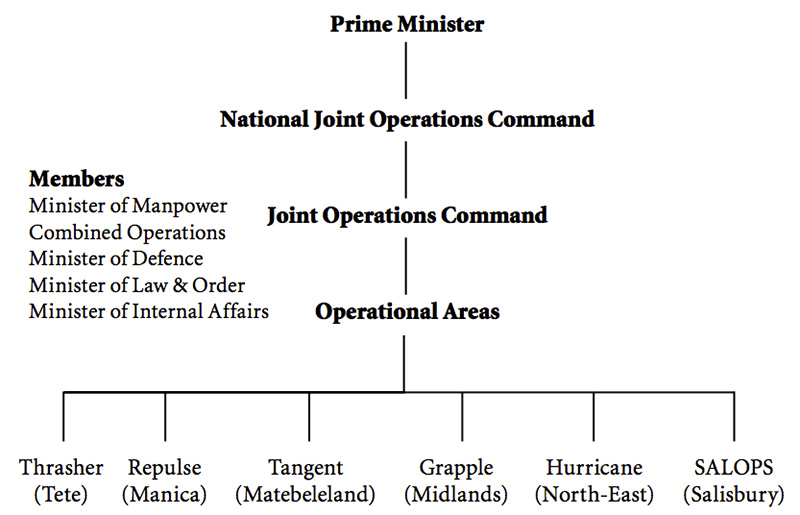
Due to the exigencies of fighting a protracted war of liberation from settler colonialism, the ruling ZANU-PF party operated as a quasi-military organisation. Since the early 1970s when the armed liberation struggle started, ZANU-PF (then known as ZANU only) never lost its military attributes. It became a party of civilian nationalist politicians and armed nationalist indoctrinated guerrillas. On the Rhodesia settler colonial side, the exigencies of counter-insurgency gave too much power to the Commander of the Combined Operations, General Peter Walls. Figure 1 shows the Rhodesian military structure in the period 1977–1979:

Figure 1: Rhodesian Military Structure, 1977–1979 Prime Minister​

fig1---Nationalist-Military-Alliance
Source: Chitiyo & Rupiya 2005:332.
By the time of the ceasefire, the civilian leadership of Rhodesia had given over total control of military matters to Peter Walls to the extent that he was part and parcel of the delegation that negotiated the transition to independence at the Lancaster House Conference in Britain (Morris-Jones 1980, Bhebe & Ranger 1995, Stiff 2000).

Both ZAPU and ZANU civilian politicians fought hard from the 1970s to put those with military training under their control. The young military officers were indeed beginning to challenge the civilian leadership of the nationalist movement. The notable incidents – that were greeted with violence, detention, and/or co-optation – being the 11 March Movement in ZAPU in 1971,2 the Nhari revolt in ZANU, and the Zimbabwe People’s Army (ZIPA) saga that affected both ZAPU and ZANU in the 1970s. All these incidents, of which details are available in Ngwabi Bhebe and Terence Ranger’s Soldiers in Zimbabwe’s Liberation War (Bhebe & Ranger 1995), mirrored and magnified a lurking duality of power between civilian nationalists and their military wings. The crushing of ZIPA was a clear testimony to the resilience and strategic guile of the old guard.

Guerrilla armies of ZAPU (ZIPRA) and ZANU (ZANLA) like other armies enjoyed the monopoly of applying force on civilians. Secondly, guerrilla armies were different from conventional forces in that they were highly politicised if not indoctrinated to the extent that they operated as military cum political units. They carried in their heads nationalist movements’ ideologies and they were the active recruiters of the masses on behalf of their nationalist parties. They had access to the masses and they played a fundamental role in politicising the peasants in rural Zimbabwe (Ranger 1985, Lan 1985, Kriger 1992, McLaughlin 1996). Thirdly, guerrilla armies were not confined to the barracks; rather they existed like ‘fish in water’ among the public, to borrow Mao-Tse Tung’s words. On this issue, Ruth First noted that once the armies stepped beyond the barracks to engage in public policy making, ‘they soaked up social conflicts like a sponge’ (1970:436). First here was referring to conventional forces that are normally confined to barracks, but her analysis is also very relevant to guerrilla armies of ZAPU and ZANU in Zimbabwe. Indeed both ZANLA and ZIPRA ‘soaked up social conflicts like sponges’ in rural Zimbabwe to the extent that they even tried to wipe out what they considered as ‘witches’ (Alexander et al 2000, Nhongo-Simbanegavi 2000).

It is important to note that because the guerrilla armies operated as military cum mini-politicians, they became interested parties in politics. All guerrillas had passed through both military and political education in the rear bases in Mozambique and Zambia. Thus, even though they were not directly involved in the political direction of the nationalist movement, some of them tried to assume the role of umpires – the ultima ratio regum – of how the nationalist movement was to operate and under what conditions and terms. ZIPA was a clear example of this trend in the nationalist movement. ZIPA guerrillas (an out-fit of both ZIPRA and ZANLA) tried to vigorously embrace the Marxist-Leninist philosophy ahead of their leaders, discarding factionalism and fight as a united force, and to embrace the armed liberation option as the only solution to the Rhodesian problem. This initiative by the guerrillas themselves with the support of the frontline states was not welcomed by the civilian leadership of the nationalist movement. There was fear of losing dominance to the military wings as well as the direction of the revolution. Hence, ZIPA was quickly crushed and labelled a reactionary initiative (Bhebe & Ranger 1995).

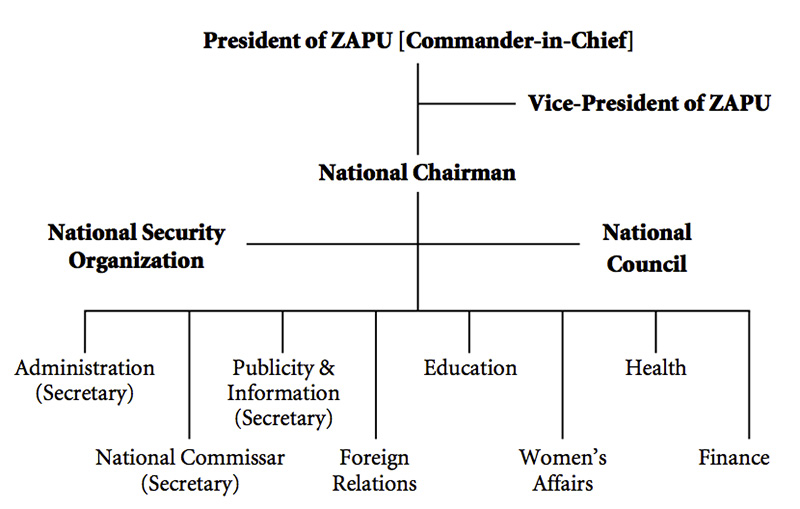
Efforts were taken in both ZAPU and ZANU to subordinate the armed guerrillas to the civilian nationalist leaders. First, the leaders of the parties elevated themselves to the High Commanders of the military wings. Secondly, the guerrilla leaders like General Josiah Tongogara in ZANU and Nikita Mangena (later Lookout Masuku) in ZAPU were integrated into the highest decision-making body of the nationalist movements (Politburo). Figure 2 on page 56 shows the ZAPU Political Structure.

Figure 2: ZAPU Political Structure​

fig2---Nationalist-Military-Alliance
Source: Chitiyo & Rupiya 2005:333.
The fusion of the military and the political leadership in ZAPU is generally attributed to the Jason Ziyapapa Moyo document entitled ‘Observations on Our Struggle of 1976’. See Figure 3, which gives details on the fusion – if not the subordination of the military to the civilian political leadership of ZAPU. Ziyapapa was the deputy President and one of the key strategists of ZAPU before his assassination in 1976.

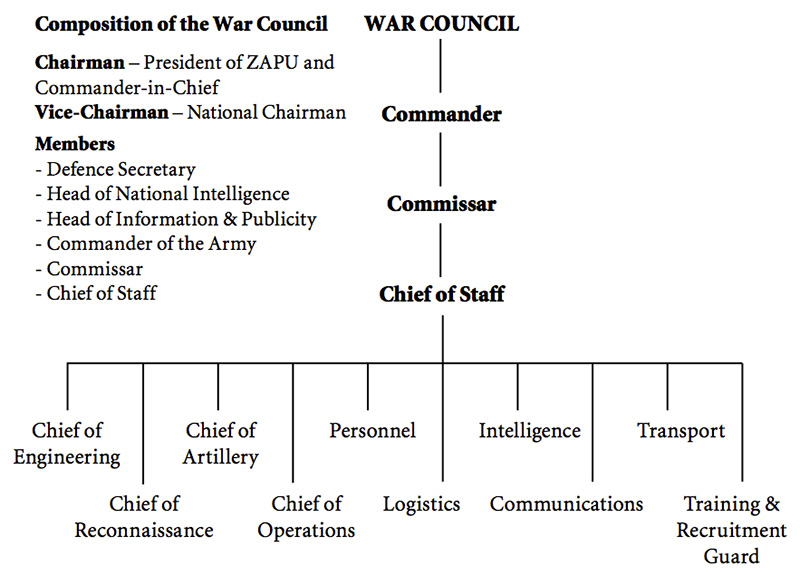
It was in the late 1970s that ZAPU created the Revolutionary Command Council as a representative body of party officials and military commandos. The War Council was the executive body that would take decisions emanating from Revolutionary Council discussions and was linked directly to the ZIPRA High Command. Efforts were made to unite the military and civilian nationalist aristocracy, to the extent that ‘The same men wore both hat and helmet’ (Nordlinger 1977:11). In this way, civilian nationalists won the day and civilian supremacy was maintained because the differentiation between military and non-military elites was very thin or insignificant to the extent that nationalist liberation war propaganda and ideology taught that all the leaders of the nationalist revolution were commanders of the military wings including those without any slightest military training and know-how.

Figure 3: ZIPRA Command Structure​

fig3---Nationalist-Military-Alliance
Source: Chitiyo & Rupiya 2005:334.
Samuel P. Huntington applied himself fully to unravel the question of how civilian supremacy over military forces is achieved. He made a conceptual distinction between the ‘objective’ and ‘subjective’ controls. When applied to guerrilla armies and nationalist liberation movements, Huntington’s models reveal interesting scenarios. Professionalism can be a disciplining factor to a military person, while patriotism and indoctrination can discipline a guerrilla fighter. The more patriotic the guerrilla fighters are, the more they would be prepared to serve the people and to die for them and the less of a threat they would pose to the nationalist leadership. Guerrilla armies were by and large constituted as political forces that operated under close party supervision (Huntington 1957).

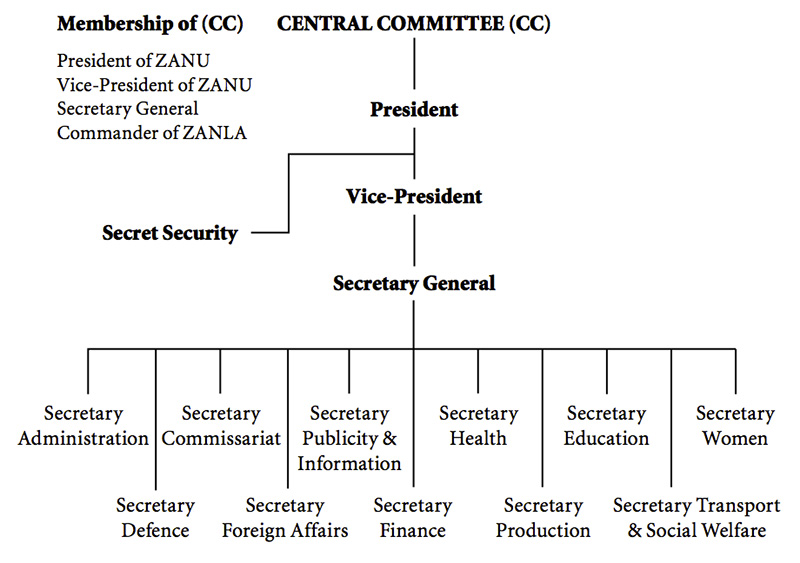
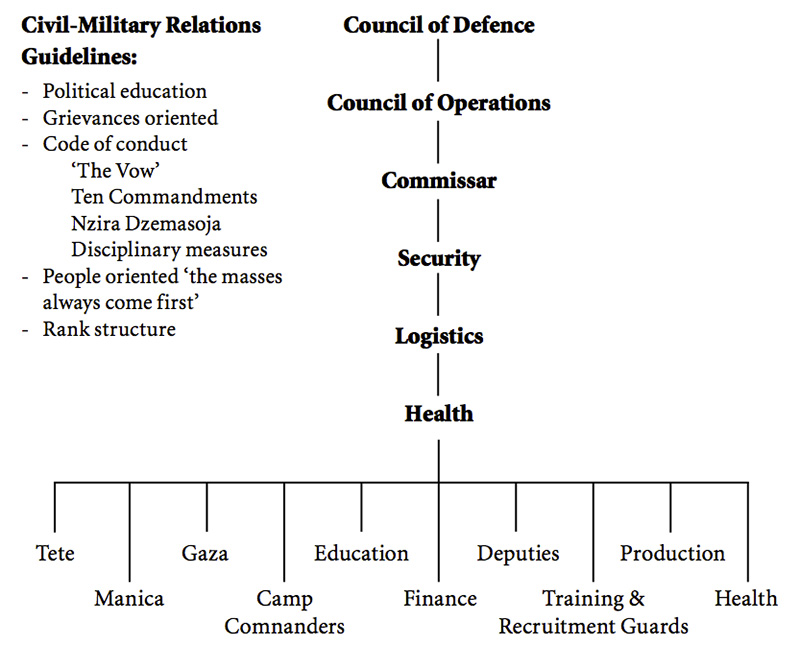
Eric Nordlinger’s penetration model is also very relevant to the understanding of the interaction between guerrillas and civilian nationalist leaders in Zimbabwe. Nordlinger emphasised the idea of civilian dominance that was ensured through the deployment of ideological controls and surveillance, founded upon a dual structure of authority in which military personnel were subordinated to political functionaries (Nordlinger 1977:11). In the case of ZANU and ZAPU, party commissars worked very hard in making sure guerrillas toed the party line (Nhongo-Simbanegavi 2000). See Figure 4 and Figure 5 on pages 59 and 60 respectively.

In the case of the ZANLA forces, they were expected to know ZANU party hierarchy to the extent that whenever they politicised the peasants their slogans followed a clear power line, starting with Pamberi na Comrade Robert Gabriel Mugabe (Forward with Comrade Robert Gabriel Mugabe). The civilian party leaders were literally worshipped by the rank and file of the party including the military forces. The party leader behaved as a super being and the messiah of the revolution. Terence Ranger argued that perhaps it was from this worship of the party leader that the post-colonial problem of personality cult was created (Ranger 2003).

Figure 4: ZANU Political Organisation, 1977–1980​

fig4---Nationalist-Military-Alliance
Source: Chitiyo & Rupiya 2005:335.
At the end of the day one is forced to rephrase Samuel Huntington’s excellent theoretical intervention to read: ‘Subjective civilian control achieves its end by civilianizing the military, making it the mirror of the nationalist party. Objective civilian control achieves its end by militarizing the military, making them the tools of the ruling nationalist elite’ (Huntington 1957:83). [The italicised part is my rephrasing of Huntington’s statement to fit armies under nationalist regimes.]

Figure 5: ZANLA High Command​

fig5---Nationalist-Military-Alliance
Source: Chitiyo & Rupiya 2005:335.
The new Zimbabwean state that emerged from the armed liberation struggle inherited highly politicised and highly indoctrinated military units. The Rhodesian Security Forces (RSF) were indoctrinated to believe that ZANLA and ZIPRA were terrorists and the latter believed that the former were colonial forces that needed to be disbanded. However, the exigencies of the compromise at Lancaster House dictated that these military units with different ideologies were to be integrated into a single Zimbabwe National Army (ZNA). This amalgamation of different military forces into a single national army takes us to the question of the character of the post-colonial Zimbabwean army.

The Character and Orientation of the Zimbabwean Military Forces​

The Lancaster House Agreement of 1979 that gave birth to Zimbabwe in 1980 determined the character of the new army of Zimbabwe. The army was to be an integrated force of three major forces: ZANLA of Robert Mugabe, ZIPRA of Joshua Nkomo and the Rhodesian Security Forces of Ian Smith.

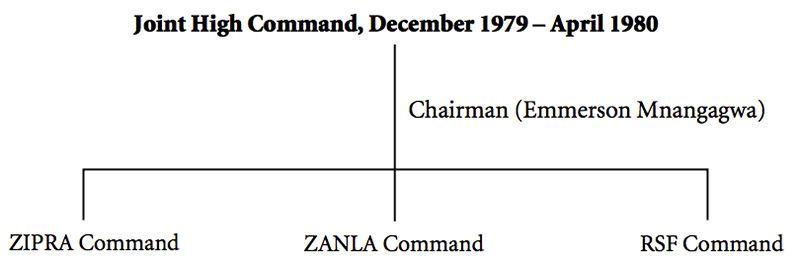
The stages in the integration of the three different forces included the formation of a Joint High Command (JHC) comprised of personnel from ZIPRA, ZANLA and RSF. The JHC emerged from the Ceasefire Commission. At the helm of JHC was the new Minister of State Security, Emmerson Mnangagwa. RSF Commander Lieutenant General (Lt. Gen.) Peter Walls was appointed commander of the JHC. His task was to implement the new defence policy, and manage the integration and conventional training that was to follow, while preparing to defend the state, the people and the country (Parliamentary Debates 1980:964). Wall’s colleagues (subordinates) in the JHC were senior commanders of the Rhodesian Air Force, ZANLA and ZIPRA. The idea was that it was necessary to demonstrate unity in the top echelons of military command in order to facilitate the same process in the middle of the military hierarchy, as well as among the rank and file (Chitiyo & Rupiya 2005:339). See Figure 6 for the transitional JHC structure:

Figure 6: Transitional Period​

fig6---Nationalist-Military-Alliance
Source: Chitiyo & Rupiya 2005:338.
The integration exercise, however, was to be carried out within the context of tension in the country and among the military units themselves. For the first time, ZANLA, ZIPRA and RSF were to come nearer to each other. ZANLA and ZIPRA were expecting privileges as guerrilla forces that brought about the liberation of Zimbabwe. The Rhodesian forces looked at ZIPRA and ZANLA as ill-trained and unprofessional forces. ZIPRA and ZANLA expected to be transformed overnight into the Zimbabwe Defence Forces (ZDF). They believed that the Rhodesian forces were to be disbanded as a colonial force that oppressed the people (Interview with Leonard Ndlovu, Ex-ZIPRA). ZIPRA as a former military wing of PF-ZAPU was also agitated by the fact that their party (ZAPU) and their leader, Joshua Nkomo, had lost elections in 1980, while ZANLA forces were very happy that their party (ZANU-PF) and their leader (Robert Mugabe) had won the elections in 1980 (Mazarire & Rupiah 2000).

While the ZANLA forces sometimes accommodated ZIPRA forces as part of the liberation army, they were outrightly hostile towards the Rhodesian Security Forces. They also privileged themselves above ZIPRA whose leader and party had lost the chance to rule Zimbabwe. These tensions broke out into open military engagements, pitting together ZANLA against ZIPRA in Assembly Points (APs) of Chitungwidza, Connemara, Ntabazinduna, and Entumbane (Stiff 2000).

As the integration exercise was going on, the politicians were busy trying to solve and settle old scores. Inflammatory language was very common among ZANU-PF politicians who were so elated with electoral victory that they forgot that the major task of nation-building and the creation of a national army needed a sober thought. The most provocative ZANU-PF leaders were Enos Nkala, Edgar Tekere, Maurice Nyagumbo, Emmerson Mnangagwa, and Kumbirai Kangai (Catholic Commission for Justice & Peace, and Legal Resources Foundation 1997). PF-ZAPU’s response came through Josiah Chinamano, the Vice-President, who in early November 1980 alluded to the dangers of ZANU-PF slogans which had the effect of denigrating armed ZIPRA men. He referred to such slogans as Pasi ne Machuwachuwa (Down with ZIPRA) and Pasi ne vanematumbu (Down with those with big stomachs – a reference to Nkomo) (The Herald, 7 November 1980). Some ZANU-PF leaders took advantage of their electoral victory to settle scores with PF-ZAPU and the ZIPRA forces. PF-ZAPU and the ZIPRA forces were to be forced to accept that they were a junior force in the liberation struggle and Joshua Nkomo was to surrender the title ‘Father Zimbabwe’ (Ndlovu-Gatsheni 2005).

Norma Kriger (2003) noted that from the start ZANU-PF wanted to build a party nation and a party state, crafted around and backed by its military wing (ZANLA). This was clearly demonstrated by the continued use of party slogans, party symbols, party songs and regalia at national ceremonies like Independence and Heroes Days (Kriger 2003:75). ZANU-PF and ZANLA moved quickly to occupy the centre of Zimbabwean political space immediately after independence. The national broadcaster, Zimbabwe Broadcasting Corporation (ZBC), was soon monopolised by the ruling party (ZANU-PF) and its war-time military wing (ZANLA). A concerted effort was made to de-legitimise and peripherise ZIPRA from the new ZANU-PF reconstructed liberation war history. ZIPRA was soon cast as a threat to the sovereignty of Zimbabwe, and its war-time commanders and the whole leadership of PF-ZAPU were reduced to ‘rabble-rousers and political malcontents who were still licking their wounds as a result of having lost the elections…’ (The Chronicle, 11 November 1981).

David Martin and Phyllis Johnson’s book The Struggle for Zimbabwe: Chimurenga War (1981) became the official master narrative of the liberation struggle that sidelined the other liberation forces and movements, elevating ZANU-PF and ZANLA to the centre of the whole nationalist history of Zimbabwe. This book was distributed to every secondary school in Zimbabwe, marking the beginning of partisan ethos in Zimbabwe.

While the policy of reconciliation adopted in 1980 emphasised unity in the country, the political actions of the ZANU-PF leaders compromised every aspect of this noble notion. ZANU-PF politicians behaved as though Zimbabwe was a one-party state. For instance, every Sunday morning up to the time of the Unity Accord of 22 December 1987, the programme, Dzimbo dzeChimurenga Dzakasunungura Zimbabwe (Chimurenga Songs that Liberated Zimbabwe) consisted of ZANLA songs only. This raised a lot of resentment from other people who felt that ZIPRA songs were supposed to be included too. One letter in the Herald of as far back as August 1980 protested against this bias, saying the songs were ‘…intended to suggest that ZANU (PF) alone fought and won the liberation war and this is a disgraceful distortion of history’ that seeks ‘to shun the visible reality that ZAPU (PF) exists and has fought as much as ZANU (PF) has done in the liberation war’ (The Herald, 21 August 1980). Since the end of the liberation war, ZIPRA mobilisation songs were not played on airwaves.

The broader issue of power struggles among Zimbabwean nationalists as well as factionalism that pre-dated 1980 is well treated in Masipula Sithole’s book Zimbabwe: Struggles Within the Struggle (Sithole 1999). What has not received adequate analysis were the implications and actual impact of this aspect of nationalist politics on the nature of the military that finally emerged in Zimbabwe. As noted by Horace Campbell, there were a number of questions raised by the prospect of integrating three distinct armies with different military traditions and differing perceptions of their role in the politically independent Zimbabwe. The pertinent question that dogged the ZANU-PF leadership and Robert Mugabe, in particular, as the Prime Minister and Minister of Defence was: What sorts of political control would be required to keep cohesion and discipline in the armed forces? (Campbell 2003).

The entire ZANU-PF leadership did not trust the former ZIPRA guerrillas as well as the former Rhodesian Security Forces.3 These two forces too were equally suspicious of ZANU-PF and former ZANLA forces’ intentions and plans. ZANU-PF politicians’ careless speeches worsened the fears among ex-ZIPRA and ex-Rhodesian forces. The first result of all this was demobilisation or early retirement of many white officers from the army. The second consequence was violent clashes between ex-ZIPRA and ex-ZANLA forces at the Assembly Points. The third impact was the demobilisation of a number of ex-ZIPRA forces from the army. The fourth result was a clear and sure move by ZANU-PF away from creating an integrated national army and towards making its war-time military wing the core of the Zimbabwe National Army (ZNA).

This move was concretely indicated by the openly hostile official position towards ex-ZIPRA forces. Instead of being embraced as fellow liberation forces, they were largely viewed and ostracised as a nucleus of an alternative sovereignty, derived from the pre-colonial independent Ndebele state. They and their political leaders were seen in the same light as a potential source of counter-hegemonic alternative that needed to be crushed very quickly. Therefore, the clashes between ex-ZIPRA and ex-ZANLA forces were openly blamed on one side, that is ZIPRA, and their unwanted party, PF-ZAPU. Therefore, the discovery of arms caches in PF-ZAPU and ZIPRA-owned properties in 1982 was enthusiastically seized by ZANU-PF leadership as the clearest example and exhibit that ZIPRA and PF-ZAPU were planning to violently depose the democratically elected government of Zimbabwe under ZANU-PF.4 No wonder then that the discovery led to the crumbling of the veneer of the coalition government and the tenuous national unity (Catholic Commission for Justice & Peace, and Legal Resources Foundation 1997).

The leader of PF-ZAPU, Joshua Nkomo, was dismissed from the government following the discovery of the arms caches. The two former commanders of ZIPRA (Dumiso Dabengwa and Lookout Masuku) were arrested and detained on the grounds of plotting to topple ZANU-PF government. Other PF-ZAPU cabinet ministers were withdrawn from the Government of National Unity (GNU). As though this was not enough, widespread witch-hunts were conducted, targeting former ZIPRA combatants serving in the national army. Some terrified former ZIPRA combatants fled from the army to the bush, leading to swelling of ranks of the so-called ‘dissidents’. ZANU-PF found the needed pretext to deal once and for all with PF-ZAPU and ZIPRA. The fiery ZANU-PF cabinet minister, Enos Nkala, told a rally in Bulawayo that his party’s task ‘from now is to crush Joshua Nkomo’ whom he castigated as a ‘self-proclaimed Ndebele king’. From then onwards, Joshua Nkomo lost the title of ‘Father Zimbabwe’ and was given a new title, ‘Father of Dissidents’. His colleague in cabinet, Edgar Tekere, openly stated that he has been working to destroy PF-ZAPU and Joshua Nkomo since 1962 (The Herald, 4 July 1982).

From as early as 1981 ZANU-PF leadership was already busy building a partisan and highly politicised military force. There were two major justifications for it. First was the South African threat. Second was the existence of dissidents. While no one would deny that the dissidents needed to be dealt with, the questionable issue was whether this dissident menace required the building of another brigade on top of the integrated ZNA. The reality is that by this time Zimbabwe had excess military units to deal effectively with the dissidents. Was a specially trained brigade really needed? On 13 August 1981, Prime Minister Mugabe announced that a new military formation to be called ‘5-Brigade’ was being raised to be used ‘purely for the purposes of defence and not for use outside the country’. It would be used ‘solely to deal with dissidents and any other troubles in the country’ (Stiff 2000:93).

The formation of the Fifth Brigade (later to be known as Gukurahundi) marked the beginning of politicisation of the Zimbabwean military forces. The Fifth Brigade became a purely ZANU-PF army, operating outside the rank and file of the ZNA and directly answerable to Robert Mugabe. Mugabe clearly stated that ‘they [Fifth Brigade] were trained by the North Koreans because we wanted one arm of the army to have a political orientation which stems from our philosophy as ZANU-PF’ (Stiff 2000:93). Also, the formation of the Fifth Brigade marked the beginning of the ethnicisation of the Zimbabwean military forces. The Brigade was composed of former ZANLA elements and they all came from the Shona-speaking group in Zimbabwe.5 It must be noted that ZANU-PF enjoyed widespread support in Mashonaland. So this army was drawn from its base.

In the ranks of the ZNA, Shonalisation was taking place. The former ZIPRA and Rhodesian forces were demobilised in large numbers, leaving ex-ZANLA in place. Some ZIPRA who wanted to serve their country in the capacity of soldiers were harassed and threatened with death. Some just disappeared while serving in the ZNA. This forced more ZIPRA forces to demobilise (Interview with Jervious Moyo, ex-ZIPRA). Numerous incidents indicated the purging of ex-ZIPRA from the ZNA. A confidential British Military Advisory and Training Team (BMATT) document refers to the removal in August 1982 of ZIPRA from the Mechanized Battalion, a battalion in Second Brigade led by ZANLA’s Agnew Kambeu. The report states that: ‘The battalion was well integrated with 33 percent each of Former Army/ZANLA/ZIPRA and had a high standard of operational capability coupled with sensible and constructive training. However last month all ZIPRA elements (some 250) were removed and sent elsewhere which had reduced the battalion to a fairly poor state although the Former Army company is apparently still [in] being and tends to be used for demonstrations’ (Annex C to BMATT/1406, 3 September 1982). Norma J. Kriger’s book, Guerrilla Veterans in Post-War Zimbabwe: Symbolic and Violent Politics, 1980-1987, is full of details on the purging of ZIPRA from the ZNA (Kriger 2003). Chitiyo and Rupiya (2005) also confirm the purging of ZIPRA which they trace to the arrest of ex-ZIPRA Commanders; Dumiso Dabengwa and Lookout Masuku in 1982, the removal of ZAPU officials from Cabinet in February 1982, which led to the collapse of the tripartite military power-sharing arrangement mooted in April 1980. Now only ZANLA senior cadres remained. Chitiyo and Rupiya (2005:341) add that: ‘Much more significantly, from henceforth there was little to stop the full implementation of a factionally based security policy in the country’.6

Unlike the South African Defence Force (SADF) that has continued to reflect the heterogeneous nature of the country after the fall of Apartheid, the ZNA quickly assumed a Shona dominance. There was no attempt at ethnic balancing in the military forces. Ethnicisation went in tandem with politicisation, leading to the emergence of a feared military force in Zimbabwe. Zimbabwean military forces are not a people’s army at all. The civilians fear their military forces (Ndlovu-Gatsheni 2003). The military has been used to harass and kill the people of Matebeleland (1982-1987). University students and workers know the violence of the Zimbabwean military forces – be it the army or the police, they are both violent.

The Constitution, Military Forces and Civilians in Zimbabwe​

Morgan Tsvangirai’s letter quoted at the beginning of this paper alluded to the violation of the constitution by President Robert Mugabe as the Commander-in-Chief of the Zimbabwe Defence Forces. The claim made by Tsvangirai was that the army was misused by Mugabe in a power game. This provoked the need to analyse the constitutional framework governing the command-and-control of the army.

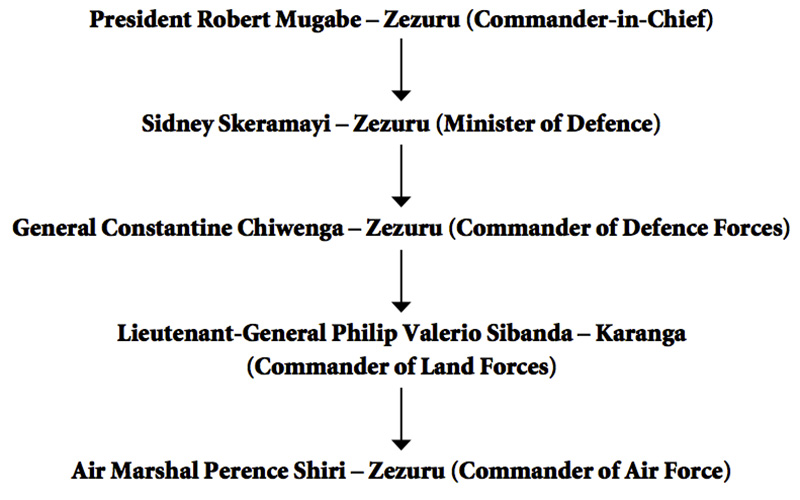
The 1997 revised National Defence Policy contains a clear hierarchy of governance, command and control of the military. President Robert Mugabe is the Commander-in-Chief of the ZDF and he chairs the State Defence Council.

The whole structure is presented in Figure 7 on page 70. The State Defence Council is the highest body responsible for national security affairs and its meetings are attended by ministers of defence, home affairs, foreign affairs and finance, as well as the commander of defence forces and the secretary for defence (Chitiyo & Rupiya 2005:347).

The constitutional framework guiding the ZDF is the national Constitution which underpinned the defence policies. It was elaborated further by the Defence Act. The Constitution provided a clear mechanism for superiority of civilian control over the military as well as public accountability of the military. The National Defence Policy makes it clear that ‘…civilian military relations refer to the hierarchy of authority between the Executive, Parliament and the Defence Force. A cardinal principle is that the Defence Force is subordinate to the civilian authority…’ (Government of Zimbabwe 1997:20).

According to the National Defence Policy, the civilian political authorities formulate defence policy and remain responsible for the political dimensions of defence, while the military executes that policy. It is also clearly stated that the civilian political authorities must respect military autonomy through non-interference with the operational chain of command and application of the military code of discipline. The president’s powers as Commander-in-Chief are:

  • Determining the operational use of defence forces
  • Determining the execution of military action
  • Declaring of war
  • Making peace
The President has power to appoint the Commander of the armed forces, and every commander of a branch of the defence forces, after consultation with a person or authority prescribed by or under an act of parliament. The President also appoints the Minister of Defence as the manager of the daily political functions of the military, and to whom the commanders report, except when they report directly to the President in cases of emergency (Government of Zimbabwe 1997).The parliament constitutes a vital military management structure and mechanism in that the ZDF structures are established by acts of parliament. Parliament makes provision for the organisation, administration and discipline of defence forces. Therefore ZDF is subject to the security and administration of regulatory parliamentary committees such as budget, public accounts and security. The judiciary comes in in cases of civil suits against the military (Chitiyo & Rupiya 2005:350).

Figure 7: Management of Defence Forces in Zimbabwe​

StructureMembersFunctions
Defence Council
  • Commander-in-Chief (Chairman).
  • Minister of Defence.
  • Minister of Foreign Affairs.
  • Minister of State Security.
  • Minister of Home Affairs.
  • Minister of Finance.
  • Commander of Defence forces.
  • Formulate national security and strategy.
  • Formulate defence policy.
  • Determine internal and external operations.
  • Formulate commitments and review budget.
  • Supervise Defence Committee.
Defence Committee
  • Minister of Defence
  • Commander of the Zimbabwe National Army (ZNA).
  • Commander of the Air Force of Zimbabwe.
  • Secretary for Defence.
  • Implement national security and defence strategy.
  • Define and regulate defence policy.
  • Procure strategic defence equipment.
  • Review defence policy, budget and management policies.
  • Assess the security environment.
Defence Co-ordinating Committee
  • Commander of Defence Forces.
  • Secretary for Defence.
  • Commander of ZNA.
  • All Chiefs of Staff at Zimbabwe Defence Force Headquarters.
  • All Chiefs of Staff at Service Headquarters.
  • All Department Secretaries at Minister of Defence.
  • All Defence Group sat Minister of Defence.
  • Implement system of defence issues.
  • Daily management of defence aspects.
  • Liaison with other ministries.

Source: Government of Zimbabwe 1997.​

According to the Zimbabwean constitution, military personnel are prohibited from active participation in politics. They are not allowed to hold office in any political party/political organisation. However, they can exercise their democratic right to vote as individuals (Constitution of the Republic of Zimbabwe).

The Third Chimurenga and Involvement of the Military in Politics​

Despite the existence of noble legal and constitutional provisions for civilian control of the military and clear demarcation of military and political issues, the war-time civil-military relations legacy continued to subvert these structures. During the time of the liberation war, the military wings and the political parties were integrated into one politico-military organisation as represented in Figures 2-5 in this paper. Chitiyo and Rupiya (2005:350) noted that the ideology that political power comes from the barrel of the gun and that the gun is subordinate to the former is a notion that has since been transferred to the present governmental authority without fundamental re-orientation. This nationalist thinking was well articulated by Robert Mugabe long ago in 1976 when he tried to define the role of the military vis-í -vis electoral democracy. He said:

Our votes must go together with our guns; after all, any vote we shall have, shall have been the product of the gun. The gun, which produces the votes, should remain its security officer, its guarantor. The people’s vote and the people’s guns are always inseparable twins (Quoted in Maroleng 2005a:12).

According to Chitiyo and Rupiya, several generals are represented in the politburo, central committee or other ZANU-PF party structures. All this does not augur well for a professional and autonomous military and has far-reaching implications for democracy. Allying guns and votes symbolises a violent conception of electoral democracy.

The periods leading to the general elections of 2000 and presidential elections of 2002 were dominated by clear military intervention in civil affairs on behalf of the ZANU-PF regime. The reconstituted and rejuvenated war veterans association came into the centre stage of Zimbabwean politics. Its leaders gained access to the deadly military arms, which they enthusiastically used to intimidate people, while some of them even shot and injured civilians over political scores.7 The war veterans operated outside the purview of the Zimbabwean laws and were given a free hand to deal in any manner with those assumed to be opposed to ZANU-PF rule.

The fast-track land reform programme was spearheaded by the war veterans and was characterised by some of the most gruesome activities and atrocities. Some commercial farmers were shot in cold blood by people who supposedly had no right to use firearms. The war veterans set up detention and torture centres in the occupied farms where they dealt cruelly with anybody they suspected to be supporting the opposition party (Movement for Democratic Change, MDC).

The other group that entered the centre stage of politics in Zimbabwe was that of the Youth Militias (derogatively termed the Green Bombers due to their greenish military-style uniforms). The Militias, just like the war veterans, operated like Robert Mugabe and ZANU-PF’s storm troopers. They acted as the party’s eyes and ears. They erected roadblocks where they harassed people; asking them to produce ZANU-PF party cards as their travel and life passports in Zimbabwe. The National Youth Training Centres were established throughout the country and as stated by The Herald of 28 January 2002, the aim was ‘to instill unbiased history of Zimbabwe’ on all school leavers. According to the Solidarity Trust, teaching in the youth centres was crudely rudimentary and it elaborated that:

…there is overwhelming evidence that the youth militia camps are aimed at forcing on all school leavers a ZANU/PF view of Zimbabwean history and the present. All training materials in the camps have, from inception, consisted exclusively of ZANU/PF campaign materials and political speeches. This material is crudely racist and vilifies the major opposition party in the country … The propaganda in the training camps appears to be crude in the extreme. One defected youth reported how war veterans told trainees that if anyone voted for the MDC, then the whites would take over the country again … A youth militia history manual called ‘Inside the Third Chimurenga’ gives an idea of the type of ‘patriotism’ that is instilled in the camps. The manual is historically simplistic and racist and glorifies recent ZANU/PF National Heroes along with the land resettlement. It consists entirely of speeches made by President Robert Mugabe since 2000, among them addresses to ZANU/PF party congresses, his speech after the 2000 election result, and funeral orations for deceased ZANU/PF heroes… (Solidarity Peace Trust 2003).

The trained youth ended up as warriors of the Third Chimurenga. They became very active during the past election times where they openly engaged in harassment of those considered to be anti-ZANU-PF. The police and the army either stood by or assisted these irregular forces in the harassment of the civilian population. The army and the police’s connivance at the violence of the state and its direct interference in civil life and politics came out clearly toward the 2002 presidential elections. The military leaders, comprising commanders of the Zimbabwe Defence Forces (ZDF), Zimbabwe Republic Police (ZRP), Zimbabwe Prison Services, and the Secret Service, led by General Vitalis Zvinavashe, issued a televised message to the people of Zimbabwe to the effect that they would never salute any leader (elected by the people) who had no liberation credentials. The incumbent leader of Zimbabwe, Robert Mugabe, clearly had liberation credentials as a former guerrilla leader of ZANU and ZANLA in the 1970s’s liberation war. However, his opponent and competitor in the run up to the presidential elections, Morgan Tsvangirai of MDC, had no clear liberation war credentials. So the military chiefs were vowing that even if he was going to win presidential elections, they were not going to salute him as the new president of the country. Their statement was a masked coup d’état threat in the event of the MDC winning elections.

Prior to the general elections of 2000, the war veterans continuously threatened the Zimbabwean populace with its ‘song of going back to the bush’ if ZANU-PF lost the elections. This was not a new ZANU-PF election strategy. In the first democratic elections of 1980, ZANU-PF in alliance with its ZANLA military wing already threatened the people that if ZANU-PF lost the elections, they were ‘going back to the bush’ (Stiff 2000).

The Zimbabwe army commander, Constantine Chiwenga (a successor to Vitalis Zvinavashe), directly drummed up support among soldiers for President Robert Mugabe’s re-election in 2002. He toured almost all army barracks urging soldiers to rally behind ZANU-PF to thwart a possible victory by Morgan Tsvangirai, the MDC leader (The Financial Gazette, 31 May 2001).

Zimbabwe’s top hierarchy in the defence force is exclusively dominated by Mugabe loyalists that included General Solomon Mujuru, General Vitalis Zvinavashe, Air Marshall Perence Shiri and General Chiwenga. All these men fought as senior members of ZANLA, the military wing of ZANU-PF during the liberation struggle. In other words, these military leaders are just as nationalist in ideological orientation as the civilian leadership of ZANU-PF. They are ‘nationalists in uniforms’ whose loyalty to ZANU-PF as a party is beyond question. The most disturbing issue is that the majority of these men also hail from the Zezuru sub-Shona ethnic group where President Robert Mugabe comes from. This amplifies a worse form of ethnicisation of the military which is even more dangerous than politicisation.

The above scenario at the top level of the military forces explains the solidity of the nationalist-military alliance. The question that needs to be answered is: What devices have been used by the ZANU-PF civilian regime to strike such a solid and enduring deal with the military forces?

Techniques of Creating a Nationalist-Military Oligarchy in Zimbabwe​

Several devices have been utilised to create the nationalist-military oligarchy in Zimbabwe.

  • Ethnic Factor – This technique has been used widely in post-colonial Africa where the post-colonial state is a conglomeration of different ethnic groups with doubtful loyalty to the ruling elite. The Zimbabwean army is today dominated by the Shona ethnic group. The top leadership is derived from President Mugabe’s Zezuru ethnic group. This creates an enduring loyalty to the party and its leadership derived not only from ethnic affiliation but also from ‘home-boyism’. Despite the fact that General Philip Sibanda, an ex-ZIPRA combatant and a Karanga, has been appointed the head of the ZNA, he is surrounded by not only Shona but Zezuru loyalists of Mugabe. The issue of the dominance of the Zezuru ethnic group in the top posts in the military emerged together with the debate on succession and the so-called Tsholotsho Declaration, leading Chris Maroleng of the Institute for Security Studies (ISS) to write of ‘Zimbabwe’s Zezuru Sum Game’ (Maroleng 2005b). The argument is that President Robert Mugabe is Zezuru and the first Army General Solomon Mujuru is also Zezuru and Mugabe has appointed the wife of Gen. Mujuru as his first Vice-President ahead of Emmerson Mnangagwa (a Karanga) who was seen by others as the logical successor to Mugabe based on his loyalty and impressive liberation war credentials as well as post-independence political career. What Chris Maroleng terms the ‘Zezuru Sum Game’ is simply interpreted as a move by Mugabe and his Zezuru associates to establish a fiefdom through gaining total political dominance in key institutions including the army, thus elbowing the Karanga faction from power. As it stands today, the seniority structure in the army is evident in Figure 8 on page 76.
  • Instrumental Pay-Offs – The ruling party has succeeded in ‘buying’ the loyalty of the military through selective material payments and privileges. The top leadership of the army is well accommodated, given good cars and they benefited from the land reform programme ahead of the landless peasants.
  • Political Co-optation – Senior members of the military work together with the civilian members of the government. Some retire into being members of parliament, governors and party-political functionaries. Those who participated in the liberation struggle are considered to be the ears and eyes of ZANU-PF wherever they are. All war veterans have been turned into party functionaries. The ZANU-PF government has increasingly used the military in civilian activities. The widely criticised Operation Murambatsvina was conducted by the military. Military and security personnel have been placed in several top-level positions in civilian institutions. At the helm of the Electoral Supervisory Commission (ESC), the Grain Marketing Board (GMB) and the National Oil Company of Zimbabwe (NOCZIM) are military people. This has made the military to perceive themselves as more than the custodians of Zimbabwean territorial integrity and sovereignty from external threats. They see themselves as some Praetorian Guard that must safeguard ZANU-PF’s political dominance (Maroleng 2005:5). Some analysts even argue that ZANU-PF and Robert Mugabe’s heavy reliance on the military means that this is the only institution they can trust at the moment (Chitiyo & Rupiya 2005).
  • Ideological Indoctrination – The Zimbabwean armed forces are deliberately indoctrinated with the values of ZANU-PF as a party. All the high ranking members of the military forces are expected to be members of ZANU-PF. As it stands today, the military is led by those who passed through the nationalist liberation war and who are thoroughly indoctrinated with ZANU-PF nationalist ideology. National Service Militias are another group of indoctrinated people who are now being recruited into joining the army and police.

Figure 8: Senior Military Personnel in Zimbabwe​

fig8---Nationalist-Military-Alliance
Source: Constructed by the author.

Conclusion​

The Zimbabwean military see themselves, first and foremost, as the servants of ZANU-PF and the particular ZANU-PF constructed regime, rather than servants of the state and the people. Political detachment and neutralism were rendered meaningless by political manipulation and were replaced by an ethos in which enthusiasm for the existing ZANU-PF regime becomes an essential quality in a military officer. This is vindicated by the enthusiasm displayed by both the police and army officers in harassing workers and civilian population during strikes, and other civil events deemed anti-ZANU-PF. Army units, particularly in Harare, kept track of those who were assumed to have voted for the MDC in the 2000 and 2002 elections and subjected them to various forms of harassment and beatings in the post-election period. Up to the time of writing, Zimbabweans stay in fear of their military forces.

Zimbabwe is reeling under a re-radicalised nationalist project presided over by ZANU-PF with the support of the military forces. The Zimbabwean state is militarised in form and content. There is a solid alliance between the war veterans and the ruling party, between the Youth Militias and the ruling party, and between the ZNA and ZRP and the ruling party. The commissioner of the police, Augustine Chihuri, openly stated that he was a ZANU-PF member (The Daily News, 5 September 2001).

The post-nationalist alternative represented by the MDC and the various civic groups such as the National Constitutional Assembly (NCA) has been beaten back by this solid nationalist-military alliance in Zimbabwe. This has so far enabled the old forces of the nationalist liberation struggle to temporarily dislocate and displace the pro-democracy elements in the country.

Sources​

  1. Alexander, J., McGregor, J. & Ranger, T. 2000. Violence and Memory: One Hundred Years in the Dark Forests of Matebeleland. London: James Currey.
  2. Baynham, S. 1992. Civil-Military Relations in Post-Independent Africa, in South African Defence Review, No. 3 (1992).
  3. Bhebe, N. & Ranger, T. (eds.) 1995. Soldiers in Zimbabwe’s Liberation War. Harare: University of Zimbabwe Publications.
  4. British Military Advisory and Training Team 1982. BMATT/1406, 3 September 1982. A confidential document.
  5. Campbell, H. 2003. Reclaiming Zimbabwe: The Exhaustion of the Patriarchal Model of Liberation. Trenton: Africa World Press.
  6. Catholic Commission for Justice & Peace, and Legal Resources Foundation 1997. Breaking the Silence: Building True Peace: A Report on the Disturbances in Matebeleland and the Midlands Region, 1980-1988. Harare: CCJP & LRF.
  7. Chitiyo, K. & Rupiya, M. 2005. Tracking Zimbabwe’s Political History: The Zimbabwe Defence Force from 1980-2005, in M. Rupiya (ed.), Evolutions and Revolutions: A Contemporary History of Militaries in Southern Africa. Pretoria: Institute for Security Studies.
  8. Finer, S.E. 1962. The Man on Horseback: The Role of the Military in Politics. London: Pall Mall.
  9. First, R. 1972. The Barrel of a Gun. Harmondsworth: The Penguin Press.
  10. Government of Zimbabwe 1997. National Defence Policy, Government of the Republic of Zimbabwe. Harare: Government Printers.
  11. Huntington, S.P. 1957. The Soldier and the State. New York: Random House.
  12. Kriger, N. 1992. Zimbabwe’s Guerrilla War: Peasant Voices. Cambridge: Cambridge University Press.
  13. Kriger, N. 2003. Guerrilla Veterans in Post-War Zimbabwe: Symbolic and Violent Politics, 1980-1987. Cambridge: Cambridge University Press.
  14. Lan, D. 1985. Guns and Rain: Guerrillas and Spirit Mediums in Zimbabwe. Berkeley: University of California Press.
  15. MacLaughlin, J. 1996. On the Frontline: Catholic Missions in Zimbabwe’s Liberation War. Harare: Baobab Books.
  16. Maroleng, C. 2005a. Zimbabwe: Increased Securitisation of the State?, in Institute for Security Studies Situation Report, 7 September 2005.
  17. Maroleng, C. 2005b. Zimbabwe’s Zezuru Sum Game: The Basis for the Security Dilemma in Which the Political Elite Finds Itself, in African Security Review, Vol. 14, No. 3, 2005.
  18. Martin, D. & Johnson, P. 1981. The Struggle for Zimbabwe: Chimurenga War. Harare: Zimbabwe Publishing House.
  19. Mazarire, G.C. & Rupiah, M. 2000. Two Wrongs Don’t Make A Right, in Journal of Peace, Conflict and Military Studies, Vol. 1 No. 1, 2000.
  20. Morris-Jones, W.H. 1980. From Rhodesia to Zimbabwe: Behind and Beyond Lancaster House. London: Frank Cass.
  21. Ndlovu-Gatsheni, S. 2003. The Post-Colonial State and Matebeleland: Regional Perceptions of Civil-Military Relations, 1980-2002, in Williams, R., Cawthra, G. & Abrahams, D. (eds.), Ourselves to Know: Civil-Military Relations and Defence Transformation in Southern Africa. Pretoria: Institute for Security Studies.
  22. Ndlovu-Gatsheni, S. 2005. Fatherhood and Nationhood: Joshua Nkomo and the Re-imagination of the Zimbabwe Nation in the 21st Century. Unpublished paper, Monash University, South Africa, 2005.
  23. Nhongo-Simbanegavi, J. 2000. For Better or Worse? Women and ZANLA in Zimbabwe’s Liberation Struggle. Harare: Weaver Press.
  24. Nordlinger, E.A. 1977. Soldiers in Politics: Military Coups and Governments. Englewood Cliffs: Prentice-Hall.
  25. Ranger, T. 1985. Peasant Consciousness and Guerrilla War in Zimbabwe. London: James Currey.
  26. Ranger, T. 2003. Nationalism, Democracy & Human Rights in Zimbabwe. Volume Two. Harare: University of Zimbabwe Publications.
  27. Sithole, M. 1999. Zimbabwe: Struggles Within the Struggle. Harare: Rujeko Publishers.
  28. Solidarity Peace Trust 2003. National Youth Service Training: Shaping Youth in A Truly Zimbabwean Manner: An Overview of Youth Militia Training and Activities in Zimbabwe. Report, 5 September 2003.
  29. Stiff, P. 2000. Cry Zimbabwe: Independence: Twenty Years On. Alberon: Galago.
  30. Tshabangu, O. 1979. The March 11 Movement in ZAPU – Revolution Within the Revolution for Zimbabwe. Heslington: Tiger Papers.

Newspapers​

  1. The Chronicle, 11 November 1981. The Herald, 7 November 1980. The Herald, 21 August 1980.
  2. The Herald, 4 July 1982.
  3. The Herald, 28 January 2002.
  4. The Financial Gazette, 31 May 2001.

Oral Interviews​

  1. Jervious Moyo, Gwanda, Zimbabwe, 19 January 2005. Leonard Ndlovu, Gwanda, Zimbabwe, 19 January 2005.

Other Sources​

  1. Tsvangirai 2005. Letter by Morgan Tsvangirai to President Robert Mugabe, 28th December 2005.
  2. Parliamentary Debates 1980. First Session: First Parliament, 19 August – 19 September 1980.
  3. Constitution of the Republic of Zimbabwe, 1980.
Notes

  1. The MDC suffered an internal split in 2005 over the issue of participation in the senatorial elections. Tsvangirai was opposed to participation but some of his colleagues wanted participation. At the time of writing Tsvangirai is the president of one faction and the other faction is led by Professor Arthur Mutambara.
  2. This incident, just like the whole story of the contribution of ZAPU to the liberation struggle, remains less well known. However, it is documented in a booklet by O. Tshabangu (1979).
  3. Having lost their political influence, most former RSF senior officers soon lost interest in the military. In June, Lt. Gen. Peter Walls tendered his resignation to the Prime Minister and Minister of Defence, citing personal reasons. Senior Air Force Commander Alexander McIntyre also resigned and was followed by other middle- and lower-ranking white soldiers.
  4. Arms cashes were found in ZAPU-owned properties like NITRAM and Egg’s Nest around Bulawayo. Another arms cache was found near Wha Wha prison in Gweru. Up to its dissolution in 1987, ZAPU denied having any connections with the arms caches. Some argue that the arms were hidden by the Central Intelligence Organisation (CIO) who wanted to implicate ZAPU in internal disturbances of the 1980s. That ZANU wanted a casus belli to destroy ZAPU was very apparent as they continually tried to associate Joshua Nkomo with the dissidents. In Zimbabwe under ZANU-PF, political opponents are commonly associated either with the intention to stage a coup, violently destabilise the country or assassinate Robert Mugabe. First, it was Joshua Nkomo and ZAPU, next it was Bishop Muzorewa, third it was Ndabaningi Sithole and now it is Morgan Tsvangirai and the MDC. At the time of writing this paper, ZANU-PF government is talking about having found arms caches in Manicaland and they are frantically trying to link MDC to these weapons. Many people think it is the work of the CIO.
  5. In 2002, I participated in a research project sponsored by the Institute for Security Studies (SA) and the Centre for Defence Studies (Zimbabwe) on civil-military relations and defence transformation in Southern Africa. I did field work in Matebeleland region focusing on Ndebele perceptions of the military. There was overwhelming evidence that the Fifth Brigade that killed an estimated 20 000 civilians was Shona speaking. In some instances people mentioned that the Fifth Brigade itself told people that it was a Shona army sent to wipe out the Ndebele for what they did in Mashonaland in the 19th Century. See Ndlovu-Gatsheni 2003.
  6. After the Unity Accord of 22 December 1987, many ex-ZIPRA combatants who were unfairly dismissed from ZNA during the early 1980s tried to re-join the army indicating that they did not leave on their own volition. A certain Mr. Gibbs Sibanda (not his real name) who now runs a bottle store and is a member of the Zimbabwe War Veterans Association and an ex-ZIPRA, told me that he was a Captain in the then Army and was based in Battle Fields near Kwe Kwe in 1982. He narrated how he left the army. He said one day he was approached by two ex-ZANLA colleagues who asked him whether he still wanted to remain alive. His answer was ‘yes’. He was then told that the position of Captain he was holding was only for ex-ZANLA forces, not ZIPRA. He was told to relinquish the post and to apply for demobilisation. Two of his colleagues who refused to demobilise just disappeared up to today.
  7. The self-proclaimed leader of the farm invasions, Joseph Chinotimba, shot his neighbour in Glen Narah, Harare, accusing the woman of being a supporter of the MDC. He was never prosecuted.

By: Sabelo J. Ndlovu-Gatsheni​


ACCORD-Logo-white
 
Chris Hani , Katibu Mkuu wa SACP na kiongozi wa MK, alichukua jukumu muhimu sana katika mazungumzo na kuwashawishi watu wasio na subira kwamba mazungumzo ndiyo njia bora, hadi alipouawa mwaka wa 1993. Mazungumzo yalilenga zaidi demokrasia kuliko ukomunisti au ujamaa, na uchumi mchanganyiko uliungwa mkono. Mazungumzo yalijumuisha watu mbalimbali kufikia mwisho wa 1991, katika mfumo wa Mkataba wa Afrika Kusini ya Kidemokrasia (CODESA
Chris Hani was a prominent South African anti-apartheid revolutionary, military commander, and politician who served as the general secretary of the South African Communist Party (SACP) and chief of staff of uMkhonto we Sizwe (MK).


08 October 2026
Who is Chris Hani ? | Prof. Zakes Mda Unpacks His Life & Legacy | Kaya 959


View: https://m.youtube.com/watch?v=aNjZalHXse8
Prof. Mda shares memories of Chris Hani’s family and his time in exile in Lesotho, including a remarkable encounter in 1974 when he helped pack the boot of a Volkswagen Beetle belonging to Hani’s father, Gilbert Hani.

The conversation also explores Hani’s early years, his Catholic upbringing, his time at Lovedale, his political awakening and his eventual commitment to activism and the liberation struggle.From altar boy to revolutionary, Hani’s journey was shaped by family, politics, ideology and a deep desire to connect with ordinary people.Prof. Mda also reflects on Hani’s relationship with other prominent figures in the liberation movement, including Thabo Mbeki, and challenges some of the commonly held narratives surrounding their relationship.

More than three decades after his assassination, Chris Hani remains one of South Africa’s most influential and widely remembered political figures.In this special edition of Kaya 959’s Point of View, Phemelo Motene is joined by acclaimed author Prof. Zakes Mda for the launch of his new book, Chris Hani: A Life of Courage and Compassion, in front of a live studio audience.The book explores the life, political journey and legacy of one of South Africa’s most significant struggle figures, while offering a deeply personal perspective from an author whose own history is intertwined with the Hani family.
Source : Kaya 959
 
08 October 2026


Chris Hani​

1791937093031.png


Chief of Staff of Umkhonto we Sizwe and General-Secretary of the SACP.
Thembisile Chris Hani was born in the rural village of Sabalele, in the Cofimvaba region of the former Transkei. He was the fifth of the six children of Gilbert and Mary Hani, and one of the three that did not die during infancy. The name Chris was adopted by him as a nom de guerre, and was in fact the real name of his brother. Chris grew up a devout Christian.

Hani was introduced to the politics of inequality early in life, when his father had to leave their rural home in search of work in the urban areas of South Africa. This had a profound influence on the young Chris, who became aware of his mother's struggle to run the household. Like other young men of his age, Chris tended the livestock until he reached school-going age.

Hani was enrolled at a Catholic school where he soon developed a love for Latin. At this stage of his life, Hani's desire was to enter the priesthood, but his father disapproved and moved him to a non-denominational school, Matanzima Secondary School at Cala, in the Transkei. In 1954, a number of Hani's school teachers who were active in the Unity Movement lost their jobs after they protested against the introduction of Bantu education. This played a further role in developing Hani's political ideas. Hani later moved again to the Lovadale Institute in the Eastern Cape, where he matriculated in 1958.

Hani was exposed to Marxist ideology while a student at University of Fort Hare, where he also explored his childhood passion for the classics and for literature. Hani attended Fort Hare from 1959-1961 and graduated in 1962 from Rhodes University in Grahamstown, with a BA degree in Latin and English. He then moved to Cape Town and worked as an article clerk with the Schaeffer and Schaeffer legal firm from 1962-1963, but did not complete his articles.

Hani was exposed to political thought from a very young age through his father, Gilbert Hani, who was active in the ANC and eventually left South Africa and sought asylum in Lesotho. However, Hani's political involvement really began in 1957 when he became a member of the African National Congress' Youth League (ANCYL). He cites the conviction of the ANC's leaders in the Treason Trial (1956) as his main motivation to begin participating in the struggle for freedom.

While at Fort Hare, Hani's political ideas developed even further. Hani provided greater detail of his time at the university:

In 1959 I went over to university at Fort Hare where I became openly involved in the struggle, as Fort Hare was a liberal campus. It was here that I got exposed to Marxist ideas and the scope and nature of the racist capitalist system. My conversion to Marxism also deepened my non-racial perspective.

My early Catholicism led to my fascination with Latin studies and English literature. These studies in these two courses were gobbled up by me and I became an ardent lover of English, Latin and Greek literature, both modern and classical. My studies of literature further strengthened my hatred of all forms of oppression, persecution and obscurantism. The action of tyrants as portrayed in various literary works also made me hate tyranny and institutionalised oppression.

Share this quote:
The Extension of University Education Act (1959) had put an end to black students attending White universities (mainly the universities of Cape Town and Witwatersrand) and created separate tertiary institutions for Whites, Coloured, Blacks, and Asians. Hani was active in campus protests over the takeover of Fort Hare by the Department of Bantu Education. During his years in the Western Cape Hani participated in protests against the takeover of the university by the Department of Bantu Education and came into contact with the South African Congress of Trade Unions (SACTU). This increased his awareness of the workers' struggle.

Hani's uncle had been active in the Communist Party of South Africa (CPSA), an organisation founded in 1921 but which had dissolved itself in response to the Suppression of Communism Act (1950). Ex-Communist Party members had to operate in secret, and re-emerged as the underground South African Communist Party (SACP) in 1953. Hani's frustration with the Apartheid system and the influence of leaders such as Govan Mbeki, Bram Fischer, JB Marks, Moses Kotane and Ray Simons, led him to join the underground South African Communist Party in 1961 and Umkontho We Sizwe (MK, military wing of the ANC) in 1962. Hani went on to become a member of the MK's Western Cape leadership dubbed the “Committee of Seven.” His encounters with the law began with his arrest at a police roadblock in 1962. He was found to be in possession of pamphlets containing objections to the government's notorious policy of detention without trial. He was subsequently charged under the Suppression of Communism Act and held in jail. He was granted bail of R500.00, and during this period entered Botswana to attend the 1962 ANC Conference in Lobatsi. On his return to South Africa, he was arrested at the border. He was tried and given an 18-month jail sentence. In 1963, while out on bail pending an appeal, Hani went underground on the advice of the ANC leadership. He remained underground in Cape Town for about four months and in May proceeded to Johannesburg where he was instructed to leave South Africa to undergo military training.

Hani left South Africa for the Soviet Union, and returned in 1967 to take an active role in the Rhodesian bush war, acting as a Political Commissar in the Zimbabwe People's Revolutionary Army (ZIPRA). ZIPRA, under the command of Joshua Nkomo, operated out of Zambia. Hani was present for three battles during the “Wankie Campaign” (fought in the Wankie Game Reserve against Rhodesian forces) as part of the Luthuli Detachment of combined ANC and Zimbabwe African People's Union (ZAPU) forces. Although the campaign provided much-needed propaganda for the struggle in Rhodesia and South Africa, in military terms it was a failure. Far too often the local population informed on guerrilla groups to the police.

In early 1967 Hani narrowly escaped into Botswana, only to be arrested and detained in prison for two years for weapons possession. Hani returned to Zambia at the end of 1968 to continue his work with ZIPRA. His imprisonment left him critical of the failure of the ANC leadership to assist him whilst he was in prison and he demanded a conference of all ANC members in exile. The Morogoro Conference took place in 1969. The decision was made to allow White and other “non-Africans” to become members of the ANC, and to ensure that political policy should guide military action, and not vice versa. As a result, The Revolutionary Council, which included Whites and Coloureds, was set up.

In 1974 Hani re-entered South Africa to establish an underground infrastructure for the ANC in the Western Cape. He entered the country from Botswana on foot and spent four months in the country, based in Johannesburg. He helped set-up underground units and a communications system. In addition, various routes through the country were established.

Hani then moved to Lesotho where he remained for about seven years. Here he organised units of the MK for guerrilla operations in South Africa. By 1982, Hani had become prominent enough in the ANC to be the focus of several assassination attempts, including at least one car bomb. He was transferred from the Lesotho capital, Maseru, to the centre of the ANC political leadership in Lusaka, Zambia. That year he was elected to the membership of the ANC National Executive Committee, and by 1983 he had been promoted to Political Commissar of the MK, working with student recruits who joined the ANC in exile after the 1976 Soweto uprising.

When dissident ANC members, who were being held in detention camps in Angola, mutinied against their harsh treatment in 1983–4, Hani played a key role in the uprisings' suppression – although he denied any involvement in the subsequent torture and murders. Hani continued his rise through the ANC ranks and in 1987 he became the Chief of Staff of the MK. During the same period he rose to senior membership of the SACP.

After the unbanning of ANC and SACP on 2 February 1990 Hani returned to South Africa and became a charismatic and popular speaker in townships. By 1990 he was known to be a close associate of Joe Slovo, the General-Secretary of the SACP. Both Slovo and Hani were considered fearful figures in the eyes of South Africa's extreme right: the Afrikaner Weerstandsbewging (AWB, Afrikaner Resistance Movement) and the Conservative Party (CP). When Slovo announced that he had cancer in 1991, Hani took over as General-Secretary.

In 1992 Hani stepped down as Chief of Staff of Umkhonto we Sizwe to devote more time to the organisation of the SACP. Communists were prominent in the ANC and the Council of South African Trade Unions, but were under threat - the collapse of Marxism in Europe had discredited the movement around the world, and the policy of infiltrating other anti-Apartheid groups rather than making an independent stand was being questioned.

Hani campaigned for the SACP in townships around South Africa, seeking to redefine its place as a national political party. It was soon doing well - better than the ANC in fact – especially amongst the young who had no real experiences of the pre-Apartheid era and no commitment to the democratic ideals of the more moderate Mandela.

Hani was described as charming, passionate and charismatic, and soon attracted a cult-like following. He was the only political leader who seemed to have influence over the radical township self-defence groups that had parted from the authority of the ANC. Hani's SACP would have proved a serious match for the ANC in the 1994 elections.

On 10 April 1993, as he returned home to the racially mixed suburb of Dawn Park, Boksberg (Johannesburg), Hani was assassinated by Januzs Walus, an anti-Communist Polish refugee who had close links to the White nationalist AWB. With him was his daughter, Nomakhwezi, then 15 years old. His wife, Limpho, and two other daughters, Neo (then 20 years old) and Lindiwe (then 12 years old) were away at the time. Also implicated in the assassination was Conservative Party MP Clive Derby-Lewis, and strangely a theory based largely on documents given to the Mail & Guardian point to a conspiracy beyond the right wing, linking the assassination to the ANC.

Hani's death came at a critical time for South Africa. The SACP was on the brink of gaining significant status as an independent political party. It now found itself bereft of funds (due to collapse in Europe) and without a strong leader. The assassination helped persuade the bickering negotiators of the Multi-Party Negotiating Forum to finally set a date for South Africa's first democratic election.

Walus and Derby-Lewis were captured, sentenced and jailed within an incredibly short period (only six months) of the assassination. Both were sentenced to death. In a peculiar twist, the new government (and constitution) they had actively fought against, caused in their sentences being lessened to life imprisonment – the death penalty having been ruled “unconstitutional.”

In 1997 Walus and Derby-Lewis applied for amnesty through the Truth and Reconciliation Commission (TRC) hearings. Despite claims that they were working for the Conservative Party, and therefore the assassination had been a political act, the TRC effectively ruled that Hani had been assassinated by right-wing extremists who were apparently acting independently. Walus and Derby-Lewis are currently serving their sentence in a maximum security prison near Pretoria.

Source : https://sahistory.org.za/people/chris-hani
 
14 January 2022
The Breakfast Club with Zenzele Ndrbele : Mcloud Tshawe Ex ZPRA / National Security Order (NSO)

View: https://m.youtube.com/watch?v=aTG6hD6JfMg
Part One: In today's episode of the Breakfast Club, Zenzele Ndebele speaks to Macloud Tshawe, Ex-ZPRA/ National Security Order (NSO) member.
Trained in Soviet Union national security and order. 25 of us did a lot, trained in Intelligence itself, Counter intelligence, Civil intelligence, Army intelligence and Border guards and customs intelligenxe as welll.

Dept. Research and development, external intelligence overseas dept of correctional services and Dept of Recruitment & training looking for suitable people who are well educated for training in Cuba, Yugoslavia and USSR etc


2026
October 9, 2026

We Were the First ZAPU Youths to Receive Military Training in China | Bernard Mberi (Part 1)

View: https://m.youtube.com/watch?v=_QBH5-_f7fY
In Part 1 of this historic interview, Bernard Mberi shares the untold story of how they became the very first ZAPU youths sent to China for military and political training during Zimbabwe's liberation struggle. Discover ZAPU’s early diplomatic relations with


October 16, 2026

Then the Rhodesians Arrested Me" — Bernard Mberi (Part 2)

View: https://m.youtube.com/watch?v=Mua8vvZLZrA
In Part 2 of this exclusive ZPRA Liberation Archives interview, veteran Bernard Mberi recounts his capture and arrest by Rhodesian security forces during the Zimbabwean Liberation War. He details the events leading up to his arrest, the tactics used by Rhodesian forces, and his experience inside the colonial regime's detention system.The ZPRA Liberation Archives project documents and preserves first-hand accounts of combatants, commanders, and key figures who fought in Zimbabwe's struggle for independence
Source : CITEZW
 
23 October 2026

General Constantino Chiwenga And the Seat of Power: WHAT NOW?

View: https://m.youtube.com/watch?v=WpwE1NAiLtc
Constantino Guveya Dominic Nyikadzino Chiwenga is a Zimbabwean politician and former army general currently serving, since 2017, as the First Vice-President of Zimbabwe under President Emmerson Mnangagwa. In August 2020, he added the Health Ministry to his portfolio.
Source : Taffy TheMan
 
Andimba Toivo ya Toivo (Full Interview, Pt: 1) Nambia Documentary


View: https://m.youtube.com/watch?v=XkTttmjiVEk

We had the pleasure to sit down with Namibian nationalist, Andimba Toivo ya Toivo, fondly revered as Namibian Godfather.
1792975529414.png

Andimba Toivo yaToivo born in 1924 was a Namibian anti-apartheid activist and politician who was active in the pre-independence movement of Namibia. He was one of the founders of the South West African People's Organisation (SWAPO) in 1960.

Andimba Toivo ya Toivo (Full interview, Pt: 2) (Namibia Documentary Series)


View: https://m.youtube.com/watch?v=aN3qHDprHPM

Source : Namibia Media Initiative
 
Black South Africans are disgraceful piece of garbage,the way walivyowafanya waafrica wenzao ni aibu tupu,lakini kinachosikitisha zaidi other Africans ni same POS au wanyama zaidi🤮
 
29 October 2026
Dar es Salaam, Tanzania

African Liberation Heritage Centre (ALHC), Dar es Salaam, Tanzania

VIONGOZI WA VYAMA DOLA WA NCHI ZA KUSINI MWA AFRIKA
1793449258289.png

Picha maktaba : kutoka kushoto Sam Nujoma, Kenneth Kaunda, Samora Machel, Julius Nyerere, Robert Mugabe and Eduardo Dos Santos

Presidente João Lourenço visits Africa Liberation Heritage Center

View: https://m.youtube.com/watch?v=hOTiaEWSidw

The President of the Republic, João Lourenço, visited the African Liberation Heritage Center in Dar es Salaam, Tanzania, this Thursday. This institution preserves the historical memory of the struggles for freedom on the continent.
1793445838536.png

1793447518109.png


Step Inside the Memory of Africa’s Freedom Journey!

View: https://m.youtube.com/watch?v=O0MfYTqL57E

Maudhui yanayohusiana na Rais wa zamani wa Angola José Eduardo dos Santos ambaye pia aliyemrithi rais Dr Antonio Agostinho Neto

Angola: José Eduardo dos Santos alitaka "kulinda watu wake" kwa kubaki madarakani​

Mwanahistoria wa Angola Bruno Kambundo alichunguza kwa makini urithi wa urais wa miaka 38 wa José Eduardo dos Santos. Kwa nini maisha marefu ya kisiasa na kusitasita kuachia madaraka, licha ya afya yake ambayo tayari ilikuwa dhaifu?

Je, yeye Dos Santos ni mtu wa vita vya wenyewe kwa wenyewe au mtu wa amani? Msomi kutoka Taasisi ya Juu ya Sayansi ya Elimu ya Luanda na Chuo Kikuu cha Katoliki alijibu maswali haya na mengine mengi.

Rais wa zamani wa Angola José Eduardo dos Santos huko Havana akiwa na kiongozi wa Cuba Fidel Castro mnamo Desemba 16, 1988.
Rais wa zamani wa Angola José Eduardo dos Santos mjini Havana akiwa na kiongozi wa Cuba Fidel Castro mnamo Desemba 16, 1988. AFP PHOTO/RAFAEL PEREZ
Matangazo

RFI : Siku moja baada ya kifo cha rais wa zamani wa Angola José Eduardo dos Santos, tunaendelea kuchunguza ugumu na changamoto ya urithi wake.

Tukiwa na Bruno Kambumdo, mwanahistoria wa Angola kutoka Taasisi ya Juu ya Sayansi ya Elimu huko Luanda, tunaanza kwa kujadili athari ambazo vita vya wenyewe kwa wenyewe vya muda mrefu na vikali vya Angola vilikuwa navyo kwenye njia ya uongozi wa rais José Eduardo Santos.

Bruno Kambundo
: Kwa kweli, ni moja ya hatua muhimu, hatua hasi ikiwa tunataka kuchora mstari, ambayo inaashiria njia ya kisiasa ya Rais José Eduardo dos Santos. Lakini pia ni muhimu kukumbuka kwamba vita vya wenyewe kwa wenyewe, bila kujali kama José Eduardo dos Santos alikuwa kiongozi wa nchi wakati huo, vilipigwa vita na pande mbili. Bila kujali hili, Angola na dunia haziwezi kushindwa kumkumbuka José Eduardo dos Santos kama mtu mashuhuri katika historia ya kisasa ya Afrika, kwa kile alichofanya na kwa urithi aliouacha kwa Angola na haiba za viongozi wa vyama dola kongwe vya ukombozi barani Afrika.

Unaniambia, basi, kwamba kuhusu vita vya wenyewe kwa wenyewe, UNITA ina jukumu lake, kama ilivyo kwa cha kongwe dola MPLA na, kwa ugani, José Eduardo dos Santos?

Ndiyo, nadhani hivyo ndivyo inavyopaswa kutazamwa kwa sababu ni Waangola waliopigana wenyewe kwa wenyewe; kulikuwa na vifo pande zote mbili za UNITA na MPLA. Na kwa sababu hii, nadhani mtazamo haupaswi kulenga José Eduardo dos Santos pekee. Ndiyo, ni tukio ambalo litakumbukwa milele katika urithi /legasi ya kisiasa ya José Eduardo dos Santos, lakini kuna wahusika wengine hapa ambao mara nyingi wanahitaji kukumbukwa.

Na juu ya hayo, wakati wa Vita Baridi, na kwa ushirikiano wa nje pande zote mbili, sivyo?

Ndiyo, kweli. Kama unavyojua, vita vya wenyewe kwa wenyewe vilikuwa na mkono wa kivuli kutoka kwa Vita Baridi, huku UNITA ikiungwa mkono na Marekani na MPLA na Muungano wa Jamhuri za Kisoshalisti za Kisovieti. Lakini, katika wakati huu wa huzuni, inaonekana kwangu kwamba tunahitaji pia kuangalia mafanikio chanya ya José Eduardo dos Santos.

Kwa hivyo ni mafanikio gani chanya ambayo ungependa kuyaangazia?

Naam, José Eduardo dos Santos ndiye mtu aliyetafuta kuwaunganisha WaAngola baada ya kipindi hicho na, kama ilivyosemwa, alifungua nchi kwa demokrasia. Alikuwa mpatanishi mkuu, ingawa kuna mambo ya siri sana katika njia yake.
1793449079170.png

Picha maktaba : Eduardo Dos Santos aliyekuwa rais wa Angola na mwenyekiti wa chama dola MPLA

Pia kuna vipengele hapa ambavyo vinapaswa kuangaziwa, kama hivi; alijaribu kuwapa WaAngola kiwango bora cha maisha. Bila kujali kama bado tuna kila kitu ambacho tungependa kuwa nacho, tayari wameanza kuelezea vipengele vizuri hapa kwa ajili ya mustakabali unaozidi kuwa bora.

Lakini je, hajui kwamba miaka ya mwisho ya muhula wake pia ilionyeshwa na kiwango cha ukandamizaji usioonekana sana, ukandamizaji wa harakati za vijana, wa jamii ya kiraia? Tunawafikiria waimbaji wa rap, watu waliokuwa wakisoma kitabu kinachochukuliwa kuwa cha mapinduzi. Kwa kweli kulikuwa na awamu ya mwisho ya muhula wake ambapo José Eduardo Santos labda pia atahusishwa na aina fulani ya ukandamizaji wa jamii ya kiraia katika mchakato wa ukombozi!

Hakika bila shaka yoyote, kipindi cha mwisho cha muhula wa José Eduardo dos Santos kilikuwa na misukosuko, kwa kiasi fulani kutokana na kufunguliwa kwa asasi za kiraia za Angola, ambazo zilianza kuamka kutokana na magumu ambayo nchi ilikuwa ikipitia. Kiongozi huyo, mkuu wa nchi, alichukua misimamo ambayo iliacha mengi ya kutotamaniwa na WaAngola. Hii inarejelea kundi la " 15+2 ", ambalo José Eduardo dos Santos na timu yake waliwafunga. Ni tukio ambalo linaashiria wazi kipindi hiki cha mwisho cha muhula wake.

Hii inaonyesha kwamba WaAngola walianza kutambua kwamba, bila kujali juhudi za José Eduardo dos Santos za kuboresha maisha ya WaAngola, bado kulikuwa na masuala ya kijamii ambayo yalihitaji kushughulikiwa ipasavyo.

Alibaki madarakani kwa zaidi ya miaka thelathini na minane na, mwishowe, mtu hupata hisia kwamba hatimaye atamwachia jenerali João Lourenço madaraka mwaka wa 2017, lakini mwanzoni, atabaki na urais wa chama kongwe dola cha ukombozi MPLA...

Kilichoundwa hapo, ikawa wazi, kilikuwa uongozi fulani wa pande mbili, kutotulia kati ya mkuu wa nchi, ambaye hakuwa tena José Eduardo dos Santos, na huku mwenyekiti wa MPLA, ambaye bado alikuwa José Eduardo dos Santos. Hadi mabadiliko hayo yalipofanyika, ni kwa kiasi gani alitambua kwamba ilikuwa gharama kubwa kwake kuachia madaraka?


Inaonekana kwamba hadithi ya maisha ya José Eduardo dos Santos imetajwa zaidi kwa miaka mingi madarakani kuliko kitu kingine chochote. José Eduardo dos Santos alijifunza zaidi kuhusu kutoa amri kuliko kuzitii. Na inaonekana kwangu kwamba hakutaka kuachia madaraka kwa urahisi hivyo.

Lakini unafikiri alifanya hivyo kwa sababu za kiafya, hata wakati huo?

Ndiyo na hapana. Suala la afya linaweza kuwa jambo lililofungwa, lakini pia kwa sababu alitaka kuwalinda watu wake mwenyewe. Alitaka kutoa dhamana kwamba kile alichokuwa amefanikisha, kwa kweli, kingeweza kuhifadhiwa.

Unaposema " watu wake," je, unamaanisha familia yake?

Familia yake, wapendwa wake.

Na kisha itakuwa ni kushuka kuzimu, yaani kwa "Zenu" ambaye atakamatwa, kuhukumiwa, na pia Isabel dos Santos ambaye atapoteza nafasi zote alizokuwa nazo na marupurupu yote aliyokuwa nayo Sonangol, Msalaba Mwekundu Red Cross, na kadhalika, sivyo?

Kwa bahati mbaya, huu ni upande mzuri wa historia; historia inaelezea hadithi yake yenyewe.

Na tutakachokiona baadaye ni kwamba watoto wataishia kulipia makosa ambayo baba yao alifanya, na kwamba wakati mwingine watoto waliishia kushiriki katika kile ambacho baba yao alifanya.

Na unafikiri tukio hili linaweza kunufaika kwa namna fulani na MPLA katika kuelekea uchaguzi wa Agosti 24, 2022? Ninarejelea kifo cha José Eduardo Santos.

Tukio hili linaweza kueleweka kama jambo litakaloiongeza MPLA, au la. Itategemea sana jinsi MPLA itakavyotumia hatua zake mpya baada ya Dos Sangos kungoka.

Inaweza kuwa upanga wenye makali pande mbili yaani makali ya kukata na ule butu: je huu ndiyo urithi wa José Eduardo dos Santos?

Ndiyo, inawezekana, tukiangalia matukio ya zamani yanayohusisha familia ya José Eduardo dos Santos na jinsi watakavyoitikia. Ikiwa umakini hautazingatiwa, inaweza hata kusababisha mtawanyiko wa vipengele ambavyo tayari vinaendana na chama, MPLA.

Zaidi ya hayo, tayari kuna kutokubaliana kuhusu mpangilio wa ibada za mazishi. Familia, vizuri, ina uchungu fulani dhidi ya utawala, kwa sababu utawala uliamua... Rais João Lourenço, baada ya kuzungumza na watu wake wa mwisho wa José Eduardo dos Santos, hawasiliani na watoto wake.

Haijabainika wazi jinsi mazishi yatakavyofanyika nchini Angola, na kwa kiwango gani. Je, yatakuwa kwa heshima kamili ya serikali? Je, unafikiri huo ndio mfumo ambao Angola itachagua, ingawa inaonekana watoto hawataki kutumia vibaya mazishi hayo katika nchi yao kwa faida ya kisiasa?


Bila kujali kitakachotokea, lazima tukubaliane kwamba José Eduardo dos Santos ni mtu wa kitaifa, ambaye ana watoto wake, lakini aliyetwaa madaraka na taifa la Angola hivyo lazima... na nadhani itakuwa ukweli kwa sababu alikuwa rais wa pili wa Angola. Na yule aliyebaki madarakani kwa muda mrefu zaidi, na kwa hivyo, hakuna njia ya kuepuka hilo?! Nadhani WaAngola watatafuta kuomboleza, pamoja na familia, na kumtakia José Eduardo dos Santos safari njema.

Lakini unafikiri tukio hili halitaathiri ratiba iliyowekwa kwa ajili ya uchaguzi mkuu, ikimaanisha kwamba tarehe ya Agosti 24 inaweza kutimizwa kikamilifu?

Nadhani hivyo, nadhani hakutakuwa na athari yoyote kwa kalenda ya uchaguzi: siku tano za maombolezo ya kitaifa tayari zimetangazwa. Kunaweza kuwa na masuala madogo, lakini kuhusu tarehe hiyo, sidhani kama kitu chochote kitatokea ambacho kitabadilisha hilo.

Alizungumzia muda mrefu wa mamlaka ya José Eduardo dos Santos: zaidi ya miaka 38. Paul Biya, nchini Kamerun, na Teodoro Obiang Nguema (nchini Guinea ya Ikweta) labda ndio pekee barani Afrika waliofanikiwa kuizidi rekodi hii, alama hii iliyowekwa na José Eduardo dos Santos.

Lakini hili ni suala la muda: zaidi ya ukweli kwamba ilidumu kwa muda mrefu, ni neno au maneno gani unayofikiri yanamtambulisha vyema José Eduardo dos Santos na utawala wake wa miaka 38?


Nadhani kwamba urais wa miaka kumi wa Santos una awamu mbili. Kuna awamu ya uwazi, ambayo ni wakati ambapo José Eduardo dos Santos aliruhusu maridhiano ya kitaifa katika kipindi cha baada ya 1992, bila kutumia uwindaji wa wachawi, kwa sababu José Eduardo dos Santos hata aliweza kulinda maisha ya wapinzani wake wengi! Na, zaidi ya hayo, pia kuna ufunguzi huu wa kidemokrasia ambao Santos alihisi kulazimika kuuendeleza.

Kwa hivyo, mnamo 1992, unafikiri kweli aliamini katika amani, kwamba maridhiano yanawezekana, na kwamba uchaguzi ungeweza kuendelea kwa maana kamili ya neno hilo?

Kama M-Angola, nadhani hivyo, kwa sababu baada ya kushuhudia idadi ya vifo vilivyosababishwa na vita vya wenyewe kwa wenyewe, sipaswi kufikiria vinginevyo.

Kufikiria amani kulimaanisha kufikiria ustawi wa Waangola. Lakini pia kuna kipindi hicho, kilichoangaziwa na mwanzo na mwisho wa muhula wake, ambacho ni vipindi vya kushangaza, vipindi vya ugumu na kutokuwa na utulivu katika utawala wake. Na pengine, katika usawa, vipindi hivi vitakuwa vya kuangaziwa zaidi wakati mwingine. Lakini lazima tukumbuke kila wakati kwamba kulikuwa na nyakati nzuri na mbaya katika utawala wake wote.

Waangola wamehuzunishwa na kifo cha José Eduardo dos Santos, na tunatumai kwamba, kama Waafrika wanavyopendelea, familia na serikali ya Angola wanaweza kushiriki katika mazungumzo ili José Eduardo dos Santos aweze kuletwa kwenye maisha ya baada ya kifo.

Maudhui yanayohusiana
Rais wa zamani wa Angola José Eduardo dos Santos ambaye alikuwa Rais pili wa Angola aliyemrithi Dr Antonio Agostinho Neto aliyekuwa rais wa kwanza wa Angola huru iliyojikomboa kwa vita yakutumia silaha kutoka makucha ya utawala mkongwe wa kikoloni wa Portugal / Ureno.

1793447300610.png

Picha : Dr Antonio Agostinho Neto
 
Dos Santos kiongozi huyo, mkuu wa nchi, alichukua misimamo ambayo iliacha mengi ya kutotamaniwa na WaAngola. Hii inarejelea kundi la " 15+2 ", ambalo José Eduardo dos Santos na timu yake waliwafunga. Ni tukio ambalo linaashiria wazi kipindi hiki cha mwisho cha muhula wake.
Kuhusu Angola "15+2"

1793450798756.png

Baada ya miezi kadhaa ya kuwekwa kizuizini na unyanyasaji kupitia mfumo wa kimahakama, watetezi wa haki za binadamu kutoka kesi ya 15+2 waliachiliwa huru na mashtaka yote yalifutwa.

Mnamo Juni 2016, HRD walikuwa wameachiliwa kutoka gerezani na kuwekwa chini ya kifungo cha nyumbani. Mnamo Machi 28, 2016, Mahakama ya Mkoa ya Luanda ilikuwa imewahukumu kifungo cha jela kuanzia miaka miwili hadi miaka minane kwa makosa yanayodaiwa ya vitendo vya uasi na ushirikiano wa wahalifu.
Kuhusu Angola 15 + 2
Angola 15
Mnamo Juni 2015 polisi wa Angola waliwakamata watetezi 13 wa haki za binadamu, walipokuwa wakishiriki katika mkutano.

Walikuwa wakisoma kitabu cha Gene Sharp cha From Dictatorship to Democracy na kujadili njia za amani za maandamano. Siku mbili baadaye, wanaharakati wengine wawili walikamatwa.

From Dictatorship to Democracy: A Conceptual Framework for Liberation by Gene Sharp

Mamlaka pia yaliwashtaki wanaharakati wawili wanawake - Laurinda Gouveia na Rosa Conde - lakini hawakuwaweka kizuizini. Kundi la watetezi wa haki za binadamu linajulikana kama Angola 15 + 2.


Watetezi 17 wa haki za binadamu ni Messrs Domingos da Cruz, Sedrick de Carvalho, Luaty Beirão, José Gomes Hata, Nito Alves, Afonso Matias “Mbanza Hamza”, Hitler Samussuko, Inocêncio Brito “Drux”, Albano Bingo, Fernando Vuvu, Nelson Dini, Nelson Dini, Nelson Dini, Nicoba Álvaro Dala, Benedito Jeremias, Osvaldo Caholo, ambao walikamatwa Juni 2015, na Bi Rosa Conde na Bi Laurinda Gouveia, ambao pia walihukumiwa, lakini hawakuzuiliwa kabla ya kesi.

Kati ya hukumu zilizotolewa dhidi ya watetezi wa haki za binadamu, kali zaidi ilitolewa kwa Domingos da Cruz , ambaye alihukumiwa kifungo cha miaka minane na nusu kwa uhalifu wa vitendo vya maandalizi ya uasi na ushirika wa wahalifu. Nuno Álvaro Dala, Sedrick de Carvalho, Nito Alves , Inocêncio de Brito, Laurinda Gouveia, Fernando António Tomás “Nicola”, Mbamza Hamza , Osvaldo Caholo, Arante Kivuvu, Albano Evaristo Bingo, Nelson Dibango miaka minne na Hitler Gomesuko miaka minne na Hitler Samus Gomesuko miezi sita na Hitler Gomesuko jela kwa makosa sawa. Rosa Conde na Jeremias Benedito walipata vifungo vya wastani zaidi na watatumikia kifungo cha miaka miwili na miezi mitatu jela. Luaty Beirão , ambaye alipatikana na hatia ya "kughushi nyaraka", pamoja na uhalifu uliotajwa hapo juu, alihukumiwa miaka mitano na miezi sita jela.

Kesi ya watetezi wa haki za binadamu iligubikwa na ukiukwaji wa sheria. Mnamo Machi 21, 2016, wakati wa hoja za mwisho, Ofisi ya Mwendesha Mashtaka ilibadilisha hati ya mashtaka, ikiondoa shtaka la kupanga mapinduzi ya kumpindua Rais José Eduardo dos Santos, na ikijumuisha shtaka jipya la kuhusisha wahalifu, linaloadhibiwa kwa adhabu kali zaidi kuliko kosa la kupanga mapinduzi. Kwa hivyo shtaka hili jipya halikuchunguzwa na mawakili wa washtakiwa.

Watetezi wa haki za binadamu waliarifiwa rasmi kuhusu mashtaka yao mnamo tarehe 8 Oktoba 2015, wakati kipindi cha juu zaidi cha gereza la kabla ya kesi, siku 90 kulingana na sheria ya Angola, kilikuwa tayari kimekwisha. Domingos da Cruz alikamatwa mnamo tarehe 21 Juni 2015 kufuatia kukamatwa kwa Afonso Mayenda, Luaty Beirão, Manuel Nito Alves, Albano Bingo na wanaharakati tisa vijana mnamo tarehe 20 Juni 2015, wakati wa mkutano kuhusu ''Falsafa ya mapinduzi ya amani'', uliotolewa na Domingos da Cruz, katika kitongoji cha Vila Alice huko Luanda. Laurinda Gouveia na Rosa Conde hawakuwa miongoni mwa waliokamatwa, lakini pia walishtakiwa.

Mawakili wa watetezi wa haki za binadamu wana siku tano za kukata rufaa mbele ya Mahakama Kuu.

Watetezi wa Mstari wa Mbele wana wasiwasi mkubwa kuhusu kuhukumiwa kwa watetezi 17 wa haki za binadamu, kwani wanaamini hatua ya mahakama dhidi yao inachochewa pekee na kazi yao ya amani na halali katika kutetea haki za binadamu. Wasiwasi zaidi unaonyeshwa na ukiukwaji wa sheria uliosababisha kesi hiyo. Watetezi wa Mstari wa Mbele wanatoa wito kwa mamlaka ya Angola kufuta hukumu dhidi ya watetezi wa haki za binadamu.
 
2026

Dr Mamphela Aletta Ramphele​

Born28 December 1947
Updated20 Jul 2026


Dr Mamphela Aletta Ramphele portrait

Mamphela Ramphele

Stop Waiting for a Messiah | Dr Mamphela Ramphele | Tutu Talks​


View: https://m.youtube.com/watch?v=JK2qwFXurbE

​

banned person, political prisoner, Member of SASO, BPC and BCP, medical doctor, academic, anthropologist, Vice Chancellor of UCT, Managing Director at the World Bank, Director of Companies, Business woman, author
Mamphela Ramphele was born on 28 December 1947 in Bochum District, Northern Transvaal (now Limpopo). Her mother, Rangoato Rahab, and her father, Pitsi Eliphaz Ramphele were primary school teachers. In 1944, her father was promoted as headmaster of Stephanus Hofmeyr School. Ramphele contracted severe whooping cough at the age of three months. The wife of the local reverend, Dominee Lukas van der Merwe, gave her mother medical advice and bought medicines for the sick child that saved her life.

In 1955, Ramphele witnessed a conflict between a racist Dominee (Reverend) and the people of the village of Kranspoort that also contributed to her political awakening. The dispute centred on whether the mother of a villager could be buried in the mission graveyard. The Dominee refused to allow the burial since he considered the woman to be a heathen who had not converted to Christianity. In defiance, local villagers took control of the church grounds and buried the woman. In revenge, the furious Dominee enlisted the police and banished all of the villagers who were involved in the burial and those known to be sympathetic to their cause. Two thirds of the villagers were cast out, losing their property in their rush to escape the violent police. It was her first direct experience of Blacks’ defiance to the apartheid system.

Ramphele’s political awakening came at a very young age. Her sister Mashadi was expelled from high school after she demonstrated against the celebrations of South Africa’s becoming a Republic in 1961. Ramphele also remembers her parents discussing the detention of her uncle under the 90-day detention clause.

She attended the G. H. Frantz Secondary School but in January 1962 she left for Bethesda Normal School, a boarding school which was part of the Bethesda teachers training college. In 1964, she moved to Setotolwane High School for her matriculation where she was one of only two girls in her class.

On completion of her schooling in 1966, in 1967, Mamphela enrolled for pre-medical courses at the University of the North. In 1968, she was accepted into the University of Natal’s Medical School, then the only institution that allowed Black students to enrol without prior permission from the government. Her meagre financial resources meant that she was forced to borrow money to travel to the Natal Medical School (now the Nelson Rolihlahla Mandela Medical School).

Ramphele won the 1968 South African Jewish Women’s Association Scholarship and the Sir Ernest Oppenheimer Bursary worth about R150 annually for the rest of her years at Medical School. This helped finance her studies at medical school

She worked with the South African Students Association (SASO), a breakaway from the National Union of South African Students (NUSAS) that operated on English speaking white campuses. NUSAS had Black and White students as members. SASO was formed in 1969, under the leadership of Steve Biko, with whom she later had a child.

From 1970 onwards, Ramphele became increasingly drawn into political activism with Biko, Barney Pityana and other student activists at the Medical School. She was elected the Chairperson of the local SASO branch. Between managing a hectic schedule of political activism and her studies, Ramphele qualified as a doctor in 1972. She began her medical internship at Durban’s King Edward VIII Hospital and later transferred to Livingstone Hospital in Port Elizabeth.

In 1974, Ramphele was charged under the Suppression of Communism Act for being in possession of banned literature. In 1975, she founded the Zanempilo Community Health Centre in Zinyoka, a village outside King William’s Town. It was one of the first primary health care initiatives outside the public sector in South Africa. During this time, she was also the manager of the Eastern Cape branch of the Black Community Health Programme. She travelled extensively in the Eastern Cape organising people to be drawn into community projects. In addition to her medical duties, Ramphele also became the Director of the Black Community Programmes (BCP) in the Eastern Cape when Biko was banned. In August 1976, Ramphele was detained under section 10 of the Terrorism Act, one of the first persons to be detained under this newly promulgated law.

In April 1977, Ramphele was issued with banning orders and banished to Tzaneen, Northern Transvaal (now Limpopo), a place she was unfamiliar with. Alone in a strange place, she turned to the church for help. A Father Mooney arranged for her to live with two African nuns at a place called Tickeyline, a village of poor people. She later set up home in Lenyenye Township in Tzaneen where she was under constant security police surveillance. She continued her work with the rural poor, and formed the Isutheng Community Health Programme with money from the BCP. Here she set about empowering women, encouraging them to establish vegetable gardens among other initiatives.

A Father Duane became a close friend, risking arrest by taking her on trips to escape the boredom a banned person experiences. Helen Suzman, the Progressive Party MP, also visited Ramphele. She assisted her in securing a passport when Ramphele had to travel abroad. Father Timothy Stanton, an Anglican priest would visit her and celebrate Eucharist with her.

In 1983, she completed the Commerce degree, for which she had registered with UNISA in 1975. She also completed a Postgraduate Diploma in Tropical Hygiene and a Diploma in Public Health at the University of Witwatersrand. For this, she had to apply for a special dispensation to travel to Johannesburg where she had to report at the John Vorster Square Police Station upon her arrival and departure.

Ramphele left Lenyenye in 1984 to go to Port Elizabeth where she was offered a job at Livingstone Hospital. However, she left to take up an appointment at the University of Cape Town (UCT) which Francis Wilson, a Professor of Economics had arranged. She was to work with him here at the South African Development Research Unit (SALDRU)) as a research fellow.

Ramphele and her two sons (by now she had a second son from her marriage to Sipo Magele) moved to a house in Gugulethu, Cape Town. Wilson and Ramphele collaboratively, produced two publications, Children on the Frontline (1987) and Uprooting Poverty (1988) for SALDRU. Ramphele then transferred to the Department of Anthropology at UCT. Her interest in the plight of people living in the hostels led her to start a project, the Western Cape Men’s Hostel Dwellers Association (HDA).

In 1988 Ramphele left with her sons for Harvard College, America where she was the Carnegie Distinguished international Fellow for the 1988 – 1989 academic year. Here she wrote up her research data on the hostels as a PH.D thesis entitled Empowerment and the Politics of Space which UCT accepted in 1991. A book based on the thesis, A Bed Called Home, Life in the Migrant Labour Hostels of Cape Town was published in 1993.

In 1991, Ramphele was appointed Deputy Vice-Chancellor of UCT. In 1996 she became the first black South African woman to hold the position of Vice Chancellor at UCT and at a South African academic institution. Part of her executive job roles was to take charge of the University’s Equal Opportunity Policy Portfolio, with the aim of changing the culture of the institution. In 1994, Ramphele was a visiting scholar at the Kennedy School of Government in the United States of America (USA).

In 2000, she joined the World Bank in Washington as one of four managing directors, responsible for human development, the first South African to hold this position at this institution. She oversaw the strategic positioning and the operations of the World Bank Institute and was the vice-presidency of external affairs.

She served as Co-Chair on the Global Commission for International Migration (GCIM) between 2004 and 2005 and served as the trustee to the Nelson Mandela Children’s Trust and the President’s Award Trust. She has also served as chairperson of the Independent Development Trust (IDT), as director of the Institute for a Democratic South Africa (IDASA) and a board member to the Anglo-American Corporation and Transnet.

Mamphela Aletta Ramphele has also been appointed director at think-tank Institute for Democracy in South Africa (IDASA) and as a board member of Anglo-American and Transnet. In 2004, she was voted 55th of the Top 100 Great South Africans
Source : https://sahistory.org.za/people/dr-mamphela-aletta-ramphele
 
01 September 2026

I Left South Africa at 19 to Fight Apartheid | Dr Tshabalala Tells Her Daughter Her Story


View: https://m.youtube.com/watch?v=dI2ZzGi5gwg
In one of her most personal conversations yet, Dr. Khanyisile Litchfield-Tshabalala sits down with her daughter to tell the story of the decade of her life she gave to South Africa’s liberation struggle.

The conversation is also a rare mother-daughter reflection on what liberation demanded from an entire generation.

What does it mean to give up your youth for freedom? Was the South Africa those young fighters imagined eventually delivered?

And what lessons should the generation that inherited that freedom learn from those who fought for it?This is more than an interview about apartheid.It is a first-hand account of sacrifice, armed struggle, ideology, loss, liberation and the unfinished story of South Africa
Source : THEE ALFA HOUSE

Huyu ni Afrophobic na Xeniphobic mkubwa sana.
Mfuatilie kwenye interview zake huko kwao South Africa or mcheki kwenye twitter account yake.
Anaishi hapo Tanzania mara nyingi anakuwa hapo na SA.
 
02 November 2026

15 March 1961
History of Apartheid Part 3&4

At the Commonwealth Prime Ministers’ Conference, Hendrik Verwoerd withdrew South Africa's application to remain a member after it became a republic.


View: https://m.youtube.com/watch?v=omvESnQVWDI
This is a documentary about the history or Apartheid in South Africa. I found it on a VHS tape. Did a bit of research and found that it was only aired in Ireland, so no South Africans have been able to watch it until now.

The 1960 referendum authorised the government to establish a republic, but Prime Minister Hendrik Verwoerd initially sought to keep South Africa within the Commonwealth. Because the country’s constitutional relationship with the Crown was changing, continued membership required the agreement of the other Commonwealth governments.

At the March 1961 Commonwealth Prime Ministers’ Conference in London, several leaders pressed for discussion of South Africa’s racial policies. Verwoerd maintained that these were domestic matters, while critics argued that apartheid was incompatible with the association’s developing commitments. When continued membership on an agreed basis proved unattainable, Verwoerd withdrew South Africa’s application on 15 March.

Significance​

The withdrawal separated the Commonwealth question from the establishment of the republic. South Africa’s existing membership ended when the new constitutional order commenced on 31 May 1961.

Why it matters​

The decision meant that South Africa's Commonwealth membership would end when the republic was established on 31 May 1961, changing its international position as well as its constitutional form

Perspective notes​

Verwoerd entered the conference seeking continued membership and maintained that South Africa's domestic policies fell within national jurisdiction. Several member governments argued that apartheid conflicted with the Commonwealth's developing principles of racial equality and pressed for a critical declaration; Verwoerd withdrew the application when agreement could not be reached.

Source : SA History Timeline
 
Back
Top Bottom