Human evolution is the
evolutionary process within the
history of
primates that led to the emergence of
Homo sapiens as a distinct species of the
hominid family that includes all the
great apes.
[1] This process involved the gradual development of traits such as
human bipedalism,
dexterity, and
complex language,
[2] as well as interbreeding with other
hominins (a tribe of the
African hominid subfamily),
[3] indicating that human evolution was not linear but weblike.
[4][5][6][7] The study of the origins of humans involves
several scientific disciplines, including
physical and
evolutionary anthropology,
paleontology, and
genetics; the field is also known by the terms
anthropogeny,
anthropogenesis, and
anthropogony.
[8][9] (The latter two terms are sometimes used to refer to the related subject of
hominization.)
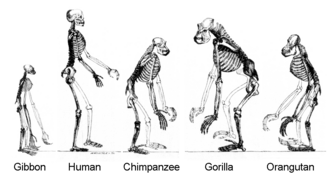
The
hominoids are descendants of a
common ancestor.
Primates diverged from other
mammals about
85 million years ago (
mya), in the
Late Cretaceous period, with their earliest fossils appearing over 55 mya, during the
Paleocene.
[10] Primates produced successive clades leading to the
ape superfamily, which gave rise to the hominid and the
gibbon families; these diverged some 15–20 mya. African and
Asian hominids (including
orangutans) diverged about 14 mya.
Hominins (including the
Australopithecine and
Panina subtribes) parted from the
Gorillini tribe between 8 and 9 mya; Australopithecine (including the extinct biped ancestors of humans) separated from the
Pan genus (containing
chimpanzees and
bonobos) 4–7 mya.
[11] The
Homo genus is evidenced by the appearance of
H. habilis over 2 mya,
[a] while
anatomically modern humans emerged in Africa approximately 300,000 years ago.


