Ni RPA wakishirikiana na mu7 ndio waliotungua ndege iliyokuwa imewabeba marais wale wawili. Acha kutuletea hadithi za kipumbavu wewe. All your evil acts will hunt you down to the end. Labda mfanye toba!Kumbe wewe bado uko ufaransa,pole we,hakuna cha amani kwa rwanda kutoka ufaransa,kwa taarifa yako ni hao na wanajeshi wa habyarimana walioitungua sasa imefichuliwa wanataka jinsi ya kuiondoa serikali,imeisha thibitika kwamba aliyetungua ndege alikua kanombe camp,na wakati huo ilikua chini ya wafaransa na majeshi ya habyarimana,huo utafiti umefanywa na mabingwa na kwanjia iliyo scientificaly.na hatakama ingekua RPF ndiyo waliotungua ndege hawakua na haki ya kuangamiza jamii yote.
Kuna kitu Rwanda inachokitafuta Tanzania! (Serikali, nchi yetu ni salama kiasi gani?)
Our Community
Regional Communities
Navigation
Install the app
How to install the app on iOS
Follow along with the video below to see how to install our site as a web app on your home screen.
Note: This feature may not be available in some browsers.
More options
Style variation
You are using an out of date browser. It may not display this or other websites correctly.
You should upgrade or use an alternative browser.
You should upgrade or use an alternative browser.
Kuna kitu Rwanda inachokitafuta Tanzania! (Serikali, nchi yetu ni salama kiasi gani?)
- Thread starter ALWATAN KIZIGO
- Start date
LOL! Unachekesha sana. TUnawajua waha, wanyambo, wahangaza, washubi WA KWELI!...sasa nyie watutsi mmekuja kujiingiza kwenye haya makabila na kujipachika majina yao. TUNAWAJUA VIZURI SANA...acha kutufanya wajinga. Watu kama akina kamanzi, ntukamazina, rubindamayugi na wengineo wengi; hawa wote ni watutsi waliojipachika majina ya makabila ya wahangaza, waha, washubi nk. .. usitake tuseme mengi, wewe kaa kimya tu!Mnaelekea pagumu,tanzania ilikua nchi ya amani bila ubaguzi sasa huyo shetani wa ubaguzi na ukabila kawaingilia,sasa mumeanza kusakama waha,wahangaza,wahaya,wanyambo eti ni watusi,poleni sana,kwa ushauri wangu hilolitakua kosa kubwa na ambalo mtajutia,kwani mtaipoteza amani na kuirudisha itawagharimu sana,mungu apushilie mbali huyo pepo wa ukabila.
Nyie mnataka kuanzisha Bahima / Tutsi empire. Fungua hii link hapa chini. Kikao hicho kilifanyika nyumbani kwa kaka yenu mkubwa mu7 huko rwakitura mwezi Machi, 1992. Follow the link below:Hizo ni fikira potofu zilizo pandikizwa na ant-tutsi,wakisema mambo ya hima empire,sasa tutasema hii move ya kikwete ni ya kuanzisha hutu-empire?najiuliza sipati jibu hii hima empire ilitokea wapi?kweli kaline hii unaweza tawala nchi kimabavu?huo ni uongo kabisa hakuna kitu kama tutsi empire,hii ni agenda ya ant-tutsi tu.Rwanda na beligium wapi na wapi bwana labda ungesema beligium ndio inataka kuchukua kigoma.
DID THIS MEETING REALLY TAKE PLACE OR ITS JUST A RUMOUR? | Suubi for Ugandans
Wachinjaji wa binadamu wenzao ni nyie watutsi; hakuna binadamu mwingine mwenye roho ya kishetani kama nyie. Hao watu 70 waliochinjwa nyie ndio suspect number one kwa sababu ndio tabia zenu!Mkuu umepata habari kwamba watu wapatao 70 wamechinjwa kinyama huko kivu kaskazini,sasa hao tena ni M23 au rwanda? hivyo vikamera vyao vimekamata maiti tu wala havikuona wauaji,najua sasa hivi JWTZ wamesahau kilicho wapeleka na kuanza kununua madini,now raia wanachinjwa kama mbuzi bila wao kujua.

ROBERT MICHAEL
JF-Expert Member
- Oct 23, 2012
- 5,054
- 2,858
PaKa kashashikwa kalio lazma aweweseke.

kivava
JF-Expert Member
- Apr 2, 2013
- 5,772
- 4,926
A one kwangu just chini ya mnara wa mwenge, nakwambia Kagame anatafuta diversication ya matatizo nyake ya ndani baada ya kushidwA Congo. USIMSAIDIETruth pains but shall be told no matter what. Kama tuna matatizo kama nchi tujichunguze hasa viongozi wetu kuhusu mahusiano na majirani zetu.


jMali
JF-Expert Member
- Nov 9, 2010
- 8,404
- 4,973
Do you know what you are trying to say?
that is what they are trying to say kichini chini.
MUKAMASIMBA
JF-Expert Member
- Aug 11, 2013
- 1,655
- 362
Nafikiri nivizuri kuongea kwa facts,hii ni investigation iliyo fanywa on ground.
10 January 2012 Last updated at 19:38 GMT
[h=1]Rwanda genocide: Kagame 'cleared of Habyarimana crash'[/h]
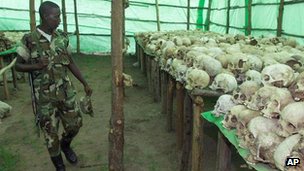
[h=2]Rwanda: Haunted Nation[/h]
A report has appeared to clear Rwanda's President Paul Kagame of orchestrating the 1994 assassination of the country's then-leader Juvenal Habyarimana.
The team - mandated by a French inquiry - visited the scene of the attack to work out the trajectory of the missile which shot down his plane.
The crash was one of the triggers that sparked the genocide.
An earlier French probe blamed Mr Kagame and his allies, but they say Hutu extremists killed Habyarimana.
Rwanda's government has welcomed the conclusions of this new report.
The plane crash on 6 April 1994 - in which Habyarimana and Burundi's leader died - triggered the genocide of 800,000 Tutsis and moderate Hutus in just 100 days.
The killings came to an end when the Tutsi-led Rwandan Patriot Front (RPF) rebel movement, headed by Mr Kagame, captured Rwanda's capital, Kigali.
Elite presidential troops Continue reading the main story [h=2]Analysis[/h]
 Hugh Schofield BBC News, Paris
This is an important development in the row over the Habyarimana assassination, because it removes much of the force from the theory that he was killed by President Paul Kagame's then RPF rebels. The emergence of this theory - and then the support it received from France's leading anti-terrorist judge - caused a total diplomatic breakdown between Paris and Kigali.
In the Rwandan capital, it was widely believed that the judge was under government instructions to implicate Mr Kagame's men in order to deflect attention from France's own alleged guilt in the 1994 massacres. There is no evidence of that. But it is true that claims about RPF involvement were based mainly on the evidence of defectors, which could not be seen as reliable.
The new technical report - ordered by a new judge - appears to be based on much more solid evidence. The experts say the missile that downed President Habyarimana's jet must have come from his own army camp. In other words, it must have been fired by Hutu extremists. That is exactly the version that President Kagame has always upheld.
If the report ends up exculpating the associates of Mr Kagame named in the investigation, there will be much relief in Kigali. Probably in the French foreign ministry too.
Correspondents say the court on Tuesday concluded that the missile was shot from a distance of up to 1km (more than half a mile) away from the plane, which was about to land at Kigali airport.
At the time this area was held by the Rwandan army - a unit of elite presidential troops.
The experts say it would be very difficult for forces loyal to Mr Kagame to be in this area and therefore shoot down the plane.
They concluded that it would have been much easier for Habyarimana's troops or French troops who were in the area to launch the missile.
In 2006, a French judge accused Mr Kagame and his allies of killing Habyarimana - an allegation he dismissed as "ridiculous" and which prompted him to break off relations with Paris for three years.
Five years later, in 2011, a former senior ally of the president Theogene Rudasingwa - the RPF's secretary general and a major at the time of the genocide - also accused Mr Kagame. Mr Rudasingwa fell out with the president and now lives in exile in the US.
Mr Kagame has always insisted that Hutu hardliners - who considered Habyarimana too moderate - shot down the plane and blamed the RPF to provide a pretext for carrying out the premeditated slaughter.
Critics of the 2006 investigation said it failed to visit the area of the attack, or interview the nine high-ranking RPF officers it accused of involvement. It said the missile was shot from a distance of four kilometres away from the airport.
French judge Marc Trevidic headed this latest French inquiry, launched - with the full co-operation of the Rwandan authorities - towards the end of 2010 because the French crew of the plane also died.
The team has interviewed six of those accused in the 2006 report and conducted a forensic investigation. Two missiles specialists, two air accident experts, a pilot, two surveyors and a sound expert have reconstructed the sequence of the attack.
'Unhappy' Following this report, Judge Trevidic can either drop the affair or continue his investigations, which could result in a court case.
"Today's findings constitute vindication for Rwanda's long-held position on the circumstances surrounding events of April 1994," Rwanda's Foreign Minister Louise Mushikiwabo said in a statement.
The lawyer for the Habyarimana family said they are unhappy about the report's conclusions - questioning the credibility of the experts - and they still want someone to be found guilty.
"It does not matter where the shooting took place," Habyarimana's son Jean-Luc told the BBC's Great Lakes service.
"What matters is who fired the missile," he said.
Habyarimana's widow, Agathe, told the BBC that she wanted the French inquiry to find out who had bought the allegedly Russian missile that hit the plane - because that would help to identify those behind the attack.
Rwanda has historically been beset by ethnic tension. It worsened under Belgian colonial rule when the Tutsi minority enjoyed better jobs and better education than the Hutu majority.
At independence, following inter-ethnic violence, many thousands of Tutsis went into exile in Uganda from where they eventually launched a civil war in 1990.
A 1993 peace agreement was supposed to usher in a power-sharing government - but it did little to stop the unrest.
BBC News - Rwanda genocide: Kagame 'cleared of Habyarimana crash'
10 January 2012 Last updated at 19:38 GMT
[h=1]Rwanda genocide: Kagame 'cleared of Habyarimana crash'[/h]
[h=2]Rwanda: Haunted Nation[/h]
A report has appeared to clear Rwanda's President Paul Kagame of orchestrating the 1994 assassination of the country's then-leader Juvenal Habyarimana.
The team - mandated by a French inquiry - visited the scene of the attack to work out the trajectory of the missile which shot down his plane.
The crash was one of the triggers that sparked the genocide.
An earlier French probe blamed Mr Kagame and his allies, but they say Hutu extremists killed Habyarimana.
Rwanda's government has welcomed the conclusions of this new report.
The plane crash on 6 April 1994 - in which Habyarimana and Burundi's leader died - triggered the genocide of 800,000 Tutsis and moderate Hutus in just 100 days.
The killings came to an end when the Tutsi-led Rwandan Patriot Front (RPF) rebel movement, headed by Mr Kagame, captured Rwanda's capital, Kigali.
Elite presidential troops Continue reading the main story [h=2]Analysis[/h]
This is an important development in the row over the Habyarimana assassination, because it removes much of the force from the theory that he was killed by President Paul Kagame's then RPF rebels. The emergence of this theory - and then the support it received from France's leading anti-terrorist judge - caused a total diplomatic breakdown between Paris and Kigali.
In the Rwandan capital, it was widely believed that the judge was under government instructions to implicate Mr Kagame's men in order to deflect attention from France's own alleged guilt in the 1994 massacres. There is no evidence of that. But it is true that claims about RPF involvement were based mainly on the evidence of defectors, which could not be seen as reliable.
The new technical report - ordered by a new judge - appears to be based on much more solid evidence. The experts say the missile that downed President Habyarimana's jet must have come from his own army camp. In other words, it must have been fired by Hutu extremists. That is exactly the version that President Kagame has always upheld.
If the report ends up exculpating the associates of Mr Kagame named in the investigation, there will be much relief in Kigali. Probably in the French foreign ministry too.
Correspondents say the court on Tuesday concluded that the missile was shot from a distance of up to 1km (more than half a mile) away from the plane, which was about to land at Kigali airport.
At the time this area was held by the Rwandan army - a unit of elite presidential troops.
The experts say it would be very difficult for forces loyal to Mr Kagame to be in this area and therefore shoot down the plane.
They concluded that it would have been much easier for Habyarimana's troops or French troops who were in the area to launch the missile.
In 2006, a French judge accused Mr Kagame and his allies of killing Habyarimana - an allegation he dismissed as "ridiculous" and which prompted him to break off relations with Paris for three years.
Five years later, in 2011, a former senior ally of the president Theogene Rudasingwa - the RPF's secretary general and a major at the time of the genocide - also accused Mr Kagame. Mr Rudasingwa fell out with the president and now lives in exile in the US.
Mr Kagame has always insisted that Hutu hardliners - who considered Habyarimana too moderate - shot down the plane and blamed the RPF to provide a pretext for carrying out the premeditated slaughter.
Critics of the 2006 investigation said it failed to visit the area of the attack, or interview the nine high-ranking RPF officers it accused of involvement. It said the missile was shot from a distance of four kilometres away from the airport.
French judge Marc Trevidic headed this latest French inquiry, launched - with the full co-operation of the Rwandan authorities - towards the end of 2010 because the French crew of the plane also died.
The team has interviewed six of those accused in the 2006 report and conducted a forensic investigation. Two missiles specialists, two air accident experts, a pilot, two surveyors and a sound expert have reconstructed the sequence of the attack.
'Unhappy' Following this report, Judge Trevidic can either drop the affair or continue his investigations, which could result in a court case.
"Today's findings constitute vindication for Rwanda's long-held position on the circumstances surrounding events of April 1994," Rwanda's Foreign Minister Louise Mushikiwabo said in a statement.
The lawyer for the Habyarimana family said they are unhappy about the report's conclusions - questioning the credibility of the experts - and they still want someone to be found guilty.
"It does not matter where the shooting took place," Habyarimana's son Jean-Luc told the BBC's Great Lakes service.
"What matters is who fired the missile," he said.
Habyarimana's widow, Agathe, told the BBC that she wanted the French inquiry to find out who had bought the allegedly Russian missile that hit the plane - because that would help to identify those behind the attack.
Rwanda has historically been beset by ethnic tension. It worsened under Belgian colonial rule when the Tutsi minority enjoyed better jobs and better education than the Hutu majority.
At independence, following inter-ethnic violence, many thousands of Tutsis went into exile in Uganda from where they eventually launched a civil war in 1990.
A 1993 peace agreement was supposed to usher in a power-sharing government - but it did little to stop the unrest.
BBC News - Rwanda genocide: Kagame 'cleared of Habyarimana crash'

Ntuzu
JF-Expert Member
- Aug 8, 2013
- 17,418
- 10,877
Nafikiri nivizuri kuongea kwa facts,hii ni investigation iliyo fanywa on ground.
10 January 2012 Last updated at 19:38 GMT
[h=1]Rwanda genocide: Kagame 'cleared of Habyarimana crash'[/h]
[h=2]Rwanda: Haunted Nation[/h]
A report has appeared to clear Rwanda's President Paul Kagame of orchestrating the 1994 assassination of the country's then-leader Juvenal Habyarimana.
The team - mandated by a French inquiry - visited the scene of the attack to work out the trajectory of the missile which shot down his plane.
The crash was one of the triggers that sparked the genocide.
An earlier French probe blamed Mr Kagame and his allies, but they say Hutu extremists killed Habyarimana.
Rwanda's government has welcomed the conclusions of this new report.
The plane crash on 6 April 1994 - in which Habyarimana and Burundi's leader died - triggered the genocide of 800,000 Tutsis and moderate Hutus in just 100 days.
The killings came to an end when the Tutsi-led Rwandan Patriot Front (RPF) rebel movement, headed by Mr Kagame, captured Rwanda's capital, Kigali.
Elite presidential troops Continue reading the main story [h=2]Analysis[/h]Hugh Schofield BBC News, Paris
This is an important development in the row over the Habyarimana assassination, because it removes much of the force from the theory that he was killed by President Paul Kagame's then RPF rebels. The emergence of this theory - and then the support it received from France's leading anti-terrorist judge - caused a total diplomatic breakdown between Paris and Kigali.
In the Rwandan capital, it was widely believed that the judge was under government instructions to implicate Mr Kagame's men in order to deflect attention from France's own alleged guilt in the 1994 massacres. There is no evidence of that. But it is true that claims about RPF involvement were based mainly on the evidence of defectors, which could not be seen as reliable.
The new technical report - ordered by a new judge - appears to be based on much more solid evidence. The experts say the missile that downed President Habyarimana's jet must have come from his own army camp. In other words, it must have been fired by Hutu extremists. That is exactly the version that President Kagame has always upheld.
If the report ends up exculpating the associates of Mr Kagame named in the investigation, there will be much relief in Kigali. Probably in the French foreign ministry too.
Correspondents say the court on Tuesday concluded that the missile was shot from a distance of up to 1km (more than half a mile) away from the plane, which was about to land at Kigali airport.
At the time this area was held by the Rwandan army - a unit of elite presidential troops.
The experts say it would be very difficult for forces loyal to Mr Kagame to be in this area and therefore shoot down the plane.
They concluded that it would have been much easier for Habyarimana's troops or French troops who were in the area to launch the missile.
In 2006, a French judge accused Mr Kagame and his allies of killing Habyarimana - an allegation he dismissed as "ridiculous" and which prompted him to break off relations with Paris for three years.
Five years later, in 2011, a former senior ally of the president Theogene Rudasingwa - the RPF's secretary general and a major at the time of the genocide - also accused Mr Kagame. Mr Rudasingwa fell out with the president and now lives in exile in the US.
Mr Kagame has always insisted that Hutu hardliners - who considered Habyarimana too moderate - shot down the plane and blamed the RPF to provide a pretext for carrying out the premeditated slaughter.
Critics of the 2006 investigation said it failed to visit the area of the attack, or interview the nine high-ranking RPF officers it accused of involvement. It said the missile was shot from a distance of four kilometres away from the airport.
French judge Marc Trevidic headed this latest French inquiry, launched - with the full co-operation of the Rwandan authorities - towards the end of 2010 because the French crew of the plane also died.
The team has interviewed six of those accused in the 2006 report and conducted a forensic investigation. Two missiles specialists, two air accident experts, a pilot, two surveyors and a sound expert have reconstructed the sequence of the attack.
'Unhappy' Following this report, Judge Trevidic can either drop the affair or continue his investigations, which could result in a court case.
"Today's findings constitute vindication for Rwanda's long-held position on the circumstances surrounding events of April 1994," Rwanda's Foreign Minister Louise Mushikiwabo said in a statement.
The lawyer for the Habyarimana family said they are unhappy about the report's conclusions - questioning the credibility of the experts - and they still want someone to be found guilty.
"It does not matter where the shooting took place," Habyarimana's son Jean-Luc told the BBC's Great Lakes service.
"What matters is who fired the missile," he said.
Habyarimana's widow, Agathe, told the BBC that she wanted the French inquiry to find out who had bought the allegedly Russian missile that hit the plane - because that would help to identify those behind the attack.
Rwanda has historically been beset by ethnic tension. It worsened under Belgian colonial rule when the Tutsi minority enjoyed better jobs and better education than the Hutu majority.
At independence, following inter-ethnic violence, many thousands of Tutsis went into exile in Uganda from where they eventually launched a civil war in 1990.
A 1993 peace agreement was supposed to usher in a power-sharing government - but it did little to stop the unrest.
BBC News - Rwanda genocide: Kagame 'cleared of Habyarimana crash'
Unalipwa Kiasi gani kwa kumsafisha Huyo mshikaji?
MUKAMASIMBA
JF-Expert Member
- Aug 11, 2013
- 1,655
- 362
Nyie mnataka kuanzisha Bahima / Tutsi empire. Fungua hii link hapa chini. Kikao hicho kilifanyika nyumbani kwa kaka yenu mkubwa mu7 huko rwakitura mwezi Machi, 1992. Follow the link below:
DID THIS MEETING REALLY TAKE PLACE OR ITS JUST A RUMOUR? | Suubi for Ugandans
Hii yote ni propaganda ya ant-tutsi/hima:Tutsi, Hutu, and Hima | Arnaud Emmanuel Online
propaganda against Tutsis and the so-called Hamitics of the Great Lakes region had started long before the genocide of 1994. After the outbreak of the Rwanda civil war in October 1990, the planners and perpetrators of genocide moved to consolidate regional alliances. The manipulated clich of Hutu/Bantu was used in government propaganda. Tanzanias reaction to this call was evidence that the genocidaires propaganda was not without effect. The March 1991 edition of a Tanzanian newspaper, The Family Mirror, published a sponsored feature by the Rwanda embassy in Dar es Salaam. Its title was The Whole Truth on the October 1990 War, and it claimed to be a response to requests for more information on the war imposed upon Rwanda by aggressors from Uganda Armed Forces. Unfortunately, the papers gullible editors became agents of hate propaganda fed to innocent readers. The sponsored feature was a reproduction of a pamphlet of February 1991, authored by Leon Mugesera now a fugitive from justice in Canada, then an ideologue working with the ruling party MRND and the Ministry for the Family and Promotion of Women. The accusations contained in the article made Mugesera sound like a man ranting in front of a mirror. Mugesera referred to the Rwanda Patriotic Front (RPF) as aggressors who feared neither God nor man, butchers of civilians, people who took drugs and destroyed the environment. The true motives of the aggressors, the article alleged, was to restore the dictatorship of the extremists of the Tutsi minority which would subsequently pave way for a genocide and the extermination of the Hutu majority and set up an extended Hima-Tutsi kingdom in the Great Lakes Region It should be recalled that in identification with the Aryan race [the RPF] use the swastika of Hitler as their symbol, he asserted. Burundi and the region of Kivu in the former Zaire (now Democratic Republic of Congo) were the next targets of the Tutsi-Hima Empire propaganda. Testimony to that is the following notice at the border crossing from the southwestern Rwanda town of Cyangugu to Bukavu in Zaire seen by a British journalist. Attention, Zaireans and Bantu people! The Tutsi assassins are out to exterminate us. For centuries the ungrateful and unmerciful Tutsi have used their powers, daughters and corruption to subject the Bantu. But we know the Tutsi, that race of vipers, drinkers of untrue blood. We will never allow them to fulfil their dreams in Kivuland. [Leslie Crawford, "Hutus See France as Their Saviour," Financial Times, June 27, 1994)]. This was an early warning of what was about to happen in Zaire. In enabling the majority of the genocidaires to escape across the border into Kivu and there regroup, the French governments Operation Turquoise, with a mandate from the United Nations, appeared to anticipate this outcome. The government of France, even before Operation Turquoise, supported the regime that committed the genocide to protect the French language in a friendly Francophone country. Sylvie Brunel told the 18th Franco-African meeting, held in Biarritz, France, that the country continued to support and to arm President Habyarimana in Rwanda up until the current explosion [the genocide] and this is why we say that France is guilty of genocide and of complicity in genocide. [Howard W. French: "Tense Times for France-Africa Ties," New York Times, November 9, 1994)]. Frances protection and support to the perpetrators of genocide allowed them to develop it into a crime without borders in the Great Lakes Region. There followed pre-meditated killings and expulsions of perceived Tutsi citizens of Zaire from their homes while the killers from Rwanda looted their property. All this was done before the eyes of government officials and the army, which should have protected the victims but instead embraced the imported bigotry. As early as 1995, genocidal propaganda was alive in eastern Zaire. An article entitled Zaire Threatened by Territorial Break-up: The Creation of a Tutsi-Hima Empire Looking Ever More Likely was published in the Forum des As, No 511, September 1995. Another publication, Tufikiri, of October 2, 1996, repeated a version of Kanguras Ten Hutu Commandments (See Part2 Magazine, The EastAfrican, April 1-7.) For those who remained sceptical of the evil intentions of the Tutsi, the paper said, Posters expressing the ethnic hatred felt by other tribes for the Tutsi, carried by demonstrators in marches organised recently in Southern Kivu, provide additional convincing evidence. Posters carrying slogans such as The difference between a dog and a Tutsi? None! All Tutsi must go home, Dont marry a Tutsi, Married to a Tutsi? Get a divorce! Unite to fight the enemy! Within two years, thousands of perpetrators of the Rwanda genocide who were fugitives from justice in Zaire, had killed thousands of that countrys citizens falling in the enemy category. Likewise, from their Zairean bases, they killed hundreds inside their own country. The Tutsi-Hima Empire, though a fetish, turned into a potent political tool in the Great Lakes. The late Congolese president, Laurent Kabila, used the obsession with this fetish to marshal support among neighbours and allies, in what Collette Braeckman called an anti-Tutsi diatribe [Le Soir, November 17, 1998]. But Kabila was not the only one. In 1996, an aid worker from Oxfam-UK, then in Zaire, wrote to me, asking: Is it that the international community has become accustomed to the ethnic cleansing? Is the suffering it causes no longer criminal? If not, why is it condoned in eastern Zaire? Are all these events allowed because the world wants the Great Lakes Region to blow up so that it can show the capacity of its humanitarian charity? Has the world accepted the anomaly that lives are only saveable after the crisis as in Rwanda in 1994, and not before? More appalling than these complex questions, he said, was the fact that the killers were being fed and supplied by the very international community. Raphael Lemkin, the first person to coin the word genocide, put the world on alert. The practice of genocide anywhere affects the initial interests of all civilised people. Its consequences can neither be isolated nor localised. Tolerating genocide is an admission of the principle that one national group has the right to attack another because of its supposed social superiority. In 1997, the merchants of hate were back on the air waves. Michael Griffin saw the shadow of Radio T l vision Libre des Mille Collines, the station that played a crucial role in inciting the Tutsi genocide, falling once again across the region. He wrote that, The latest in the line of Great Lakes hate media is Radio Voix du Patriote (once known as Radio Kahuzi Biega), which has been operating intermittently in the Bukavu region of South Kivu. The radio is said to have the backing of ex-Forces Arm es Rwandaises (FAR), ex-Forces Arm es Zairoises (FAZ) and the Hutu Interahamwe militia. It tells the Bantu brothers to rise as one to combat the Tutsi described as Ethiopians and Egyptians who do not belong in the region. [M. Griffin, "Rwanda: Familiar Drums," Index on Censorship 3, 1998)] In August 1998, a broadcast on Radio Bunia, in eastern Congo, urged the people to jump on the people with long noses, who are tall and slim who allegedly want to dominate them. On what the people should do, the broadcast said: People must bring a machete, a spear, an arrow, a hoe, spades, rakes, nails, truncheons, electric irons, barbed wire, stones, and the like, in order to kill the Rwandan Tutsis. The then Foreign Minister in the DRC, Yerodia Ndombasi, drummed up the Congolese over the National Radio to commit yet another genocide: Smash the vermin, the scraps, the microbes that have to be eradicated, with method, with resolution The Tutsi are under risk of living the same sad experience as the Jews did. They are perfidious, rancorous and bloodthirsty. Vermin, yes, I call them vermin who spoil and poison the body of our nation, which we must eradicate. The message was clear, yet internationally it fell on deaf ears. The Zimbabwe state-owned print media played the same obnoxious tune. African Rights, in their new book The Cycle of Conflict: Which Way out in the Kivus? describe some Zimbabwean newspaper articles as reminiscent of Kangura, which advocated and encouraged the 1994 genocide, urging Bantu people to stand together and counter a Hamitic conspiracy to force them into subservience. The human rights organisation quotes The Herald, December 13, 1998 as saying: Tutsi imperialist tendencies are well-documented. But which documentation does the author refer to? Kangura? Like a contagious disease, racism seems to have made its way even into the body of Tanzania, a country believed to have long ago defeated racial prejudice. John Chirigati, the countrys Deputy Minister for Home Affairs, told parliament that it was advisable to avoid getting married to Hutu and Tutsi women because there are still many Tanzanians who are beautiful. He said this was important in maintaining peace and national tranquility for many years to come, because marrying the two tribes could introduce elements of the hatred inherited from their grandparents and lack of proper upbringing. [state-owned Daily News, July 25, 2001] The minister, consciously or unconsciously turned out to be another disciple of the pseudo-religion of racism. The moment Mugabe told Museveni: Your intelligence is exaggeratedEVENT: it is a cold November winter of 1998 in Paris and President Jacques Chirac of France is host of a large conference of African statesmen. The presidents are assembled to discuss continuing armed conflict on the continent and the ever-increasing economic crisis of the countries in the region.In attendance at the French presidents residence, the Eiles (sic) Palace are presidents Chirac, Robert Mugabe of Zimbabwe, Yoweri Museveni of Uganda, Laurent Kabila of the Democratic Republic of Congo, Pasteur Bizimungu of Rwanda and Benjamin Mkapa of Tanzania. There is also Yama Jame to Gambia, Abdu Diof of Senegal, Meles Zenawi of Ethiopia, Joachim Chisano of Mozambique, Sam Nujoma of Namibia and Frederick Chiluba of Zambia to mention only a few.The conversation finally settles down of the DRC. Uganda and Rwanda which had helped Kabila have turned against their proxy and organised armed resistance against him after a failed coup. However, Kabila has called in Zimbabwe, Angola and Namibia to help bolster his fledging government and it has worked. Kabila accuses Museveni and Kagame of Rwanda of a hidden plot to build a Hima-Tutsi empire.That Bizumungu you see over there, Kabila spits the words with disdain he is a Hutu and just a figure head. Real power lies with Paul Kagame, his vice president. So there is no reason for Bizimungu to even sit in this meeting with other heads of state when he is only a personal assistant to Kagame.Museveni interjects saying the meeting should discuss more serious issues. But nobody is real listening; and as matter of fact he has too many contrary minds all over the place, does Museveni.Mugabe is pissed at this talk of more serious issues and says the threat of a Hima-Tutsi empire is a real and serious issue; in tones that suggest he is convinced it is even the only issue that should be discussed here today. I have always heard that you are a very intelligent and popular man, Mugabe tells Museveni right into his face, I now think your intelligence is quite exaggerated.And with that, the old man walks out of the meeting in protest, wagging his finger at Museveni and vowing to fight to the death against the creation of a Hima-Tutsi empire. Jameh of Gambia also interjects, telling Museveni that he thought the Ugandan president was a new hope for Africa, not an ethnic chauvinist bent on re-creating obsolete pre-historic empires. In the cacophony of voices, one voice is quiet. Chirac is completely taken apart by surprise at this remarkable outplay by Africas leading statesmen.
Monitor [h=1]Genocide and fears of a Tutsi empire [/h] The growing risk of armed conflict feeds and is fed by heightened fear and hatred between ethnic groups, emotions that are both real and at the same time exaggerated and manipulated by political leaders for their own ends. The increasingly frequent invocation of genocide, beginning with Nkundas use of the term at the time of the Bukavu attack and continuing now in describing the Gatumba massacre is evoking on the other side increasingly frequent reference to the decades-old myth of a Tutsi intention to create a Tutsi-Hima empire in central Africa.Rwanda was not immediately and necessarily involved in the Gatumba tragedy in the sense that it did not involve Rwandan citizens and was not executed on Rwandan soil, yet Rwandan authorities beginning with the president made clear that Rwanda would play a major role in the developing political and ethnic struggles. Given the Rwandan capacity and readiness to participate in conflicts outside its own boundaries, such statements give heart to some seeking further Rwandan involvement in the Congo while conversely inspiring dread among other. In Rwanda itself questions of ethnic fear and hatred had been revived in April 2004 by the commemoration of the tenth anniversary of the genocide. The Rwandan parliament had also made political use of these sentiments in labeling political dissent and civil society autonomy as forms of divisionism and genocidal ideology in reports in May 2003 and June 2004. These measures in themselves and in the pretext adopted of preventing genocide risk promoting resentment and anger that could be directed into ethnic channels, particularly if a new war is fought in the immediate region. With the rhetoric spawned by Gatumba massacre still echoing, some groups and persons turned to action. In the ten days after the Gatumba massacre, two persons were lynched in interior provinces of Burundi after they were rumored to be Tutsi using medical injections to poison Hutu with the intention of reducing their numbers to approximate those of the Tutsi. These accusations recalled talk of a Simbananiye plan to gradually equalize the numbers of Hutu and Tutsi, an accusation made against Tutsi since Tutsi soldiers slaughtered massive numbers of Hutu in 1972. In Congo RCD-Goma members from other groups refused to follow the lead of Kinyarwanda-speaking leadersmostly Banyamulenge and Tutsiwhen they announced withdrawal from the government, suggesting the party itself has divisions along ethnic lines. Meanwhile two persons from South Kivua place now presumed to be hostile to RCD-Goma were killed on the road outside Goma. Although robbery appeared to be the primary motive, others from South Kivu quickly interpreted the incident in regional and ethnic terms. The story spread that the killers had said the murders were reprisals for the Gatumba killings. Persons opposed to the presence of people from South Kivu in Goma circulated pamphlets against them and in at least one case paraded through a part of Goma largely occupied by people from South Kivu chanting threats against them.These fears and hatreds extend to personnel of the UN as well. Following the Bukavu attack in early June, Congolese elsewhere attacked UN staff and installations because MONUC was accused of having favored the Banyamulenge. Once it became known that Secretary-General Annan mentioned the apparent implication of Mai Mai and Rwandan rebels as well as FNL in the Gatumba massacre, people in Uvira again demonstrated their hostility against the UN, seen to be again favoring the Tutsi version of events. Invoking genocide elicits an almost automatic reaction from people inside and outside the region who bear the burden of guilt for their failure to halt the 1994 genocide in Rwanda. For some survivors and Burundian authorities, the genocidal nature of the Gatumba massacre demonstrated that Rwandan rebel Interahamwe had to have been in charge of the killing at the refugee camp. Asked for more details, they talked of the brutal and intimate nature of the killing by machete and yet the vast majority of victims at Gatumba were killed or injured by gunfire delivered at a distance, sometimes from outside the tent, or by grenades also thrown from a distance. Journalists too seized on the massacre to revive once again the images of genocide, unquestioningly accepting information from the field that reinforced the clichés stored in their own minds.Those who are themselves inclined to respond quickly and positively to invocations of genocide may not be sufficiently aware that Tutsi fears of genocide are increasingly mirrored by Hutu fears of measures that may be taken on the pretext of preventing genocide. The responsibility to remain always vigilant of the danger of genocide carries the simultaneous responsibility to remain firmly rooted in the facts; overuse of the term itself stimulates further fear and raises the likelihood of violence. The killings at Gatumba, like some of those at Bukavu, were clearly done on an ethnic basis. Recognizing that raises concern that further killing will follow directed at one ethnic group or another. In this context, it is less important to arrive at a legalistic determination of the nature of the crime than it is to identify its perpetrators and to punish them.
Once, Hutus and Tutsis lived in harmony in Central Africa. About 600 years ago, Tutsis, a tall, warrior people, moved south from Ethiopia and invaded the homeland of the Hutus. Though much smaller in number, they conquered the Hutus, who agreed to raise crops for them in return for protection.Even in the colonial era when Belgium ruled the area, after taking it from Germany in 1916 the two groups lived as one, speaking the same language, intermarrying, and obeying a nearly godlike Tutsi king. Independence changed everything. The monarchy was dissolved and Belgian troops withdrawn a power vacuum both Tutsis and Hutus fought to fill. Two new countries emerged in 1962 Rwanda, dominated by the Hutus, and Burundi by the Tutsis and the ethnic fighting flared on and off in the following decades. It exploded in 1994 with the civil war in Rwanda in which hundreds of thousands of Tutsis and moderate Hutus were killed. Tutsi rebels won control, which sent a million Hutus, fearful of revenge, into Zaire and Tanzania. In Burundi, the Tutsis yielded power after a Hutu won the countrys first democratic election in 1993. He was killed in an attempted coup four months later, and his successor in a suspicious plane crash in 1994, in which the Hutu leader of Rwanda was also killed.
Its an unstoppable wall of people.
The fighting between Tutsis and Hutus in central Africa has been going on for decades, ever since Belgium lost control of the area in the 1950s. In 1994, ethnic fighting in Rwanda led to the massacre of at least half a million Tutsis and sent more than a million Hutus fleeing to Zaire, Tanzania, and Burundi.For two years Hutu militants, fearful of reprisals for the massacres, kept the refugees in exile. In October and November 1996, it became a crisis, as the civil war in Zaire, sparked by Hutu-Tutsi fighting, cut off more than half a million Hutu refugees from food and medical supplies. The situation became desperate. The emissary named by the United Nations to negotiate a cease-fire warned of a possible regional war between Hutus and Tutsis, and another massacre like the one in Rwanda. There was also the threat of epidemic and mass starvation. The worlds powers began forming a peace-keeping mission when the rebels in Zaire mostly Tutsis took over the camps, sending the refugees streaming home. In December, Tanzania gave its Hutu refugees until the end of the year to return to Rwanda, but many fled in the other direction instead. In Burundi, Hutu-Tutsi fighting flared all year, leading to the massacre of civilians and toppling the government in July.
In 1994, when hundreds of thousands of Hutu refugees the losing side in Rwandas civil war fled to Zaire the United Nations set up camps for them. Among the refugees were thousands of soldiers, loyal to the defeated Hutu government, who had massacred half a million Tutsis and moderate Hutus. They began using the camps as a base to attack government forces in Rwanda and Burundi and, aided by the army and local militiamen, to attack Tutsis living in Zaire.In October, the Tutsis struck back with the help of other groups opposed to the Zairian government. They rebelled in a southern province and drove out the government army. They took three main towns in eastern Zaire, including Goma, where relief operations for the refugees were based. Zaire claimed Rwandan government troops were helping them fight. The refugees were now cut off from food, water, and medical supplies. Some fled the camps to forests to the west. Disease and hunger were setting in. A catastrophe was in the making. Canada, the United States and other nations were preparing to send troops on a rescue mission when, on November 15, the Zairian rebels stormed the largest refugee camp, routing the Hutu gunmen, and freeing the refugees to go home to Rwanda. Then followed one of the most stunning spectacles of the year, a river of people 15 miles (25 km) long, streaming toward Rwanda. They crossed the border at the rate of 70 people a minute. Its an unstoppable wall of people, said Brenda Barton, a spokeswoman for the United Nations World Food Program. At years end, the plan for the international rescue mission was scaled down, calling only for unarmed reconnaissance planes to find refugees in eastern Zaire and for an airdrop of supplies a plan opposed by the government and the rebels.
More than half a million Hutus from Rwanda also fled to Tanzania after the 1994 civil war. In December 1996, after most refugees in Zaire had returned home, Tanzania gave the refugees there until the end of the year to leave. United Nations officials said it was safe to return, but many Hutus, fearing retribution for the massacre of Tutsis in 1994, headed in the other direction, to hide in the forests.But Tanzanian troops headed the refugees off and ordered them back. At the end of 1996, an estimated 300,000 refugees were returning home. There were some reports of brief fighting, and of soldiers firing in the air and using tear gas, but for the most part the exodus seemed to be peaceful. Rwandan President Pasteur Bizimungu a Tutsi welcomed some of the refugees at the border. I came to reassure them that nothing bad will happen to them, he said.
Like Rwanda, the modern history of Burundi is marked by constant strife between Hutus and Tutsis. Hutus make up 85 percent and Tutsis 14 percent, but Tutsis had ruled until the countrys first democratic election in 1993, won by a Hutu.The election did not stop the civil war, and since then more than 150,000 people have been killed. On July 20, 300 people, mostly Tutsi women and children, were massacred, allegedly by Hutu gunmen. On July 25, the Tutsi-dominated military seized power, naming a new president former military ruler Maj. Pierre Buyoya - dissolving parliament, outlawing opposition parties, and closing the borders and airport. Much of the world denounced the coup, and Burundis African neighbors imposed an embargo. The United Nations reported more than 1,100 civilians were killed by the Burundian army in November and December. In most cases, Hutu refugees were the victims. TutsiThe Tutsi are one of three native peoples of the nations of Rwanda and Burundi in central Africa, the other two being the Twa and the Hutu. A Human Rights Watch analysis estimated that 77% of the Tutsi population of Rwanda was slaughtered in the Rwandan Genocide of 1994. The Tutsi are currently in power in Rwanda, although they do not refer to themselves as Tutsi.[SUP][[/SUP]
MUKAMASIMBA
JF-Expert Member
- Aug 11, 2013
- 1,655
- 362
Unalipwa Kiasi gani kwa kumsafisha Huyo mshikaji?
Nawewe unalipwa ngapi kwa kumchafua?
Ntuzu
JF-Expert Member
- Aug 8, 2013
- 17,418
- 10,877
Nawewe unalipwa ngapi kwa kumchafua?
Kiongozi wako ana damu za watu!
jMali
JF-Expert Member
- Nov 9, 2010
- 8,404
- 4,973
Hii yote ni propaganda ya ant-tutsi/hima:Tutsi, Hutu, and Hima | Arnaud Emmanuel Online
propaganda against Tutsis and the so-called "Hamitics of the Great Lakes region" had started long before the genocide of 1994. After the outbreak of the Rwanda civil war in October 1990, the planners and perpetrators of genocide moved to consolidate regional alliances. The manipulated clich of Hutu/Bantu was used in government propaganda.Tanzania‘s reaction to this call was evidence that the genocidaires' propaganda was not without effect. The March 1991 edition of a Tanzanian newspaper, The Family Mirror, published "a sponsored feature" by the Rwanda embassy in Dar es Salaam. Its title was "The Whole Truth on the October 1990 War," and it claimed to be a response to "requests for more information on the war imposed upon Rwanda by aggressors from Uganda Armed Forces."Unfortunately, the paper's gullible editors became agents of hate propaganda fed to innocent readers. The "sponsored feature" was a reproduction of a pamphlet of February 1991, authored by Leon Mugesera – now a fugitive from justice in Canada, then an "ideologue" working with the ruling party MRND and the Ministry for the Family and Promotion of Women.The accusations contained in the article made Mugesera sound like a man ranting in front of a mirror. Mugesera referred to the Rwanda Patriotic Front (RPF) as aggressors who feared neither God nor man, butchers of civilians, people who took drugs and destroyed the environment. The true motives of the "aggressors," the article alleged, was to "restore the dictatorship of the extremists of the Tutsi minority which would subsequently pave way for a genocide and the extermination of the Hutu majority– and set up an extended Hima-Tutsi kingdom in the Great Lakes Region– It should be recalled that in identification with the Aryan race– [the RPF] use the swastika of Hitler as their symbol," he asserted. Burundi and the region of Kivu in the former Zaire (now Democratic Republic of Congo) were the next targets of the "Tutsi-Hima Empire" propaganda. Testimony to that is the following notice at the border crossing from the southwestern Rwanda town of Cyangugu to Bukavu in Zaire seen by a British journalist. "Attention, Zaireans and Bantu people! The Tutsi assassins are out to exterminate us. For centuries the ungrateful and unmerciful Tutsi have used their powers, daughters and corruption to subject the Bantu. But we know the Tutsi, that race of vipers, drinkers of untrue blood. We will never allow them to fulfil their dreams in Kivuland." [Leslie Crawford, "Hutus See France as Their Saviour," Financial Times, June 27, 1994)].This was an early warning of what was about to happen in Zaire. In enabling the majority of the genocidaires to escape across the border into Kivu and there regroup, the French government's "Operation Turquoise," with a mandate from the United Nations, appeared to anticipate this outcome. The government of France, even before "Operation Turquoise", supported the regime that committed the genocide to "protect the French language" in a friendly Francophone country. Sylvie Brunel told the 18th Franco-African meeting, held in Biarritz, France, that the country "continued to support and to arm President Habyarimana in Rwanda up until the current explosion [the genocide]– and this is why we say that France is guilty of genocide and of complicity in genocide." [Howard W. French: "Tense Times for France-Africa Ties," New York Times, November 9, 1994)]. France‘s protection and support to the perpetrators of genocide allowed them to develop it into a crime without borders in the Great Lakes Region. There followed pre-meditated killings and expulsions of perceived Tutsi citizens of Zaire from their homes while the killers from Rwanda looted their property. All this was done before the eyes of government officials and the army, which should have protected the victims but instead embraced the imported bigotry.As early as 1995, genocidal propaganda was alive in eastern Zaire. An article entitled "Zaire Threatened by Territorial Break-up: The Creation of a Tutsi-Hima Empire Looking Ever More Likely" was published in the Forum des As, No 511, September 1995. Another publication, Tufikiri, of October 2, 1996, repeated a version of Kangura‘s "Ten Hutu Commandments" (See Part2 Magazine, The EastAfrican, April 1-7.) For those who remained sceptical of the evil intentions of the Tutsi, the paper said, "Posters expressing the ethnic hatred felt by other tribes for the Tutsi, carried by demonstrators in marches organised recently in Southern Kivu, provide additional convincing evidence. Posters carrying slogans such as ‘The difference between a dog and a Tutsi? None!' ‘All Tutsi must go home', ‘Don't marry a Tutsi', ‘Married to a Tutsi? Get a divorce!' ‘Unite to fight the enemy!'"Within two years, thousands of perpetrators of the Rwanda genocide who were fugitives from justice in Zaire, had killed thousands of that country's citizens falling in the "enemy" category. Likewise, from their Zairean bases, they killed hundreds inside their own country.The Tutsi-Hima Empire, though a fetish, turned into a potent political tool in the Great Lakes. The late Congolese president, Laurent Kabila, used the obsession with this fetish to marshal support among neighbours and allies, in what Collette Braeckman called an "anti-Tutsi diatribe" [Le Soir, November 17, 1998]. But Kabila was not the only one. In 1996, an aid worker from Oxfam-UK, then in Zaire, wrote to me, asking: "Is it that the international community has become accustomed to the ethnic cleansing? Is the suffering it causes no longer criminal? If not, why is it condoned in eastern Zaire? Are all these events allowed because the world wants the Great Lakes Region to blow up so that it can show the capacity of its humanitarian charity? Has the world accepted the anomaly that lives are only saveable after the crisis as in Rwanda in 1994, and not before?" More appalling than these complex questions, he said, was the fact that the killers were being fed and supplied by the very international community.Raphael Lemkin, the first person to coin the word genocide, put the world on alert. "The practice of genocide anywhere affects the initial interests of all civilised people. Its consequences can neither be isolated nor localised. Tolerating genocide is an admission of the principle that one national group has the right to attack another because of its supposed social superiority."In 1997, the merchants of hate were back on the air waves. Michael Griffin saw the "shadow" of Radio T l vision Libre des Mille Collines, the station that played a crucial role in inciting the Tutsi genocide, falling once again across the region. He wrote that, "The latest in the line of Great Lakes hate media is Radio Voix du Patriote (once known as Radio Kahuzi Biega), which has been operating intermittently in the Bukavu region of South Kivu. The radio is said to have the backing of ex-Forces Arm es Rwandaises (FAR), ex-Forces Arm es Zairoises (FAZ) and the Hutu Interahamwe militia. It tells ‘the Bantu brothers' to ‘rise as one' to combat the Tutsi described as ‘Ethiopians and Egyptians' who do not belong in the region." [M. Griffin, "Rwanda: Familiar Drums," Index on Censorship 3, 1998)] In August 1998, a broadcast on Radio Bunia, in eastern Congo, urged the people to "jump on the people with long noses, who are tall and slim" who allegedly want "to dominate" them. On what the "people" should do, the broadcast said: "People must bring a machete, a spear, an arrow, a hoe, spades, rakes, nails, truncheons, electric irons, barbed wire, stones, and the like, in order to kill the Rwandan Tutsis." The then Foreign Minister in the DRC, Yerodia Ndombasi, drummed up the Congolese over the National Radio to commit yet another genocide: "Smash the vermin, the scraps, the microbes that have to be eradicated, with method, with resolution– The Tutsi are under risk of living the same sad experience as the Jews did. They are perfidious, rancorous and bloodthirsty. Vermin, yes, I call them vermin– who spoil and poison the body of our nation, which we must eradicate." The message was clear, yet internationally it fell on deaf ears. The Zimbabwe state-owned print media played the same obnoxious tune. African Rights, in their new book The Cycle of Conflict: Which Way out in the Kivus? describe some Zimbabwean newspaper articles as "reminiscent of Kangura, which advocated and encouraged the 1994 genocide, –urging Bantu people to stand together and counter a Hamitic conspiracy to force them into subservience." The human rights organisation quotes The Herald, December 13, 1998 as saying: "Tutsi imperialist tendencies are well-documented." But which documentation does the author refer to? Kangura?Like a contagious disease, racism seems to have made its way even into the body of Tanzania, a country believed to have long ago defeated racial prejudice. John Chirigati, the country's Deputy Minister for Home Affairs, told parliament that it was advisable to avoid getting married to Hutu and Tutsi women because "there are still many Tanzanians who are beautiful." He said this was "important in maintaining peace and national tranquility for many years to come," because marrying the two "tribes" could introduce elements of the hatred "inherited from their grandparents and lack of proper upbringing." [state-owned Daily News, July 25, 2001] The minister, consciously or unconsciously turned out to be another disciple of the pseudo-religion of racism.The moment Mugabe told Museveni: ‘Your intelligence is exaggerated'EVENT: it is a cold November winter of 1998 in Paris and President Jacques Chirac of France is host of a large conference of African statesmen. The presidents are assembled to discuss continuing armed conflict on the continent and the ever-increasing economic crisis of the countries in the region.In attendance at the French president's residence, the Eiles (sic) Palace are presidents Chirac, Robert Mugabe of Zimbabwe, Yoweri Museveni of Uganda, Laurent Kabila of the Democratic Republic of Congo, Pasteur Bizimungu of Rwanda and Benjamin Mkapa of Tanzania. There is also Yama Jame to Gambia, Abdu Diof of Senegal, Meles Zenawi of Ethiopia, Joachim Chisano of Mozambique, Sam Nujoma of Namibia and Frederick Chiluba of Zambia to mention only a few.The conversation finally settles down of the DRC. Uganda and Rwanda which had helped Kabila have turned against their proxy and organised armed resistance against him after a failed coup. However, Kabila has called in Zimbabwe, Angola and Namibia to help bolster his fledging government and it has worked. Kabila accuses Museveni and Kagame of Rwanda of a hidden plot to build a Hima-Tutsi empire."That Bizumungu you see over there," Kabila spits the words with disdain "he is a Hutu and just a figure head. Real power lies with Paul Kagame, his vice president. So there is no reason for Bizimungu to even sit in this meeting with other heads of state when he is only a personal assistant to Kagame."Museveni interjects saying the meeting should discuss more serious issues. But nobody is real listening; and as matter of fact he has too many contrary minds all over the place, does Museveni.Mugabe is pissed at this talk of ‘more serious issues' and says the threat of a Hima-Tutsi empire is a real and serious issue; in tones that suggest he is convinced it is even the only issue that should be discussed here today. "I have always heard that you are a very intelligent and popular man," Mugabe tells Museveni right into his face, "I now think your intelligence is quite exaggerated."And with that, the old man walks out of the meeting in protest, wagging his finger at Museveni and vowing to "fight to the death" against the "creation of a Hima-Tutsi empire." Jameh of Gambia also interjects, telling Museveni that he thought the Ugandan president was a new hope for Africa, "not an ethnic chauvinist bent on re-creating obsolete pre-historic empires". In the cacophony of voices, one voice is quiet. Chirac is completely taken apart by surprise at this remarkable outplay by Africa's leading statesmen.
Monitor "Genocide" and fears of a "Tutsi empire"
The growing risk of armed conflict feeds and is fed by heightened fear and hatred between ethnic groups, emotions that are both real and at the same time exaggerated and manipulated by political leaders for their own ends. The increasingly frequent invocation of "genocide," beginning with Nkunda's use of the term at the time of the Bukavu attack and continuing now in describing the Gatumba massacre is evoking on the other side increasingly frequent reference to the decades-old myth of a Tutsi intention to create a "Tutsi-Hima" empire in central Africa.Rwanda was not immediately and necessarily involved in the Gatumba tragedy in the sense that it did not involve Rwandan citizens and was not executed on Rwandan soil, yet Rwandan authorities beginning with the president made clear that Rwanda would play a major role in the developing political and ethnic struggles. Given the Rwandan capacity and readiness to participate in conflicts outside its own boundaries, such statements give heart to some seeking further Rwandan involvement in the Congo while conversely inspiring dread among other. In Rwanda itself questions of ethnic fear and hatred had been revived in April 2004 by the commemoration of the tenth anniversary of the genocide. The Rwandan parliament had also made political use of these sentiments in labeling political dissent and civil society autonomy as forms of "divisionism" and "genocidal ideology" in reports in May 2003 and June 2004. These measures in themselves and in the pretext adopted of preventing genocide risk promoting resentment and anger that could be directed into ethnic channels, particularly if a new war is fought in the immediate region. With the rhetoric spawned by Gatumba massacre still echoing, some groups and persons turned to action. In the ten days after the Gatumba massacre, two persons were lynched in interior provinces of Burundi after they were rumored to be Tutsi using medical injections to poison Hutu with the intention of reducing their numbers to approximate those of the Tutsi. These accusations recalled talk of a "Simbananiye plan" to gradually equalize the numbers of Hutu and Tutsi, an accusation made against Tutsi since Tutsi soldiers slaughtered massive numbers of Hutu in 1972. In Congo RCD-Goma members from other groups refused to follow the lead of Kinyarwanda-speaking leaders-mostly Banyamulenge and Tutsi-when they announced withdrawal from the government, suggesting the party itself has divisions along ethnic lines. Meanwhile two persons from South Kivu-a place now presumed to be hostile to RCD-Goma were killed on the road outside Goma. Although robbery appeared to be the primary motive, others from South Kivu quickly interpreted the incident in regional and ethnic terms. The story spread that the killers had said the murders were reprisals for the Gatumba killings. Persons opposed to the presence of people from South Kivu in Goma circulated pamphlets against them and in at least one case paraded through a part of Goma largely occupied by people from South Kivu chanting threats against them.These fears and hatreds extend to personnel of the UN as well. Following the Bukavu attack in early June, Congolese elsewhere attacked UN staff and installations because MONUC was accused of having favored the Banyamulenge. Once it became known that Secretary-General Annan mentioned the apparent implication of Mai Mai and Rwandan rebels as well as FNL in the Gatumba massacre, people in Uvira again demonstrated their hostility against the UN, seen to be again favoring the "Tutsi" version of events. Invoking "genocide" elicits an almost automatic reaction from people inside and outside the region who bear the burden of guilt for their failure to halt the 1994 genocide in Rwanda. For some survivors and Burundian authorities, the "genocidal" nature of the Gatumba massacre demonstrated that Rwandan rebel "Interahamwe" had to have been in charge of the killing at the refugee camp. Asked for more details, they talked of the brutal and intimate nature of the killing by machete and yet the vast majority of victims at Gatumba were killed or injured by gunfire delivered at a distance, sometimes from outside the tent, or by grenades also thrown from a distance. Journalists too seized on the massacre to revive once again the images of genocide, unquestioningly accepting information from the field that reinforced the clichés stored in their own minds.Those who are themselves inclined to respond quickly and positively to invocations of genocide may not be sufficiently aware that Tutsi fears of genocide are increasingly mirrored by Hutu fears of measures that may be taken on the pretext of preventing genocide. The responsibility to remain always vigilant of the danger of genocide carries the simultaneous responsibility to remain firmly rooted in the facts; overuse of the term itself stimulates further fear and raises the likelihood of violence. The killings at Gatumba, like some of those at Bukavu, were clearly done on an ethnic basis. Recognizing that raises concern that further killing will follow directed at one ethnic group or another. In this context, it is less important to arrive at a legalistic determination of the nature of the crime than it is to identify its perpetrators and to punish them.
Once, Hutus and Tutsis lived in harmony in Central Africa. About 600 years ago, Tutsis, a tall, warrior people, moved south from Ethiopia and invaded the homeland of the Hutus. Though much smaller in number, they conquered the Hutus, who agreed to raise crops for them in return for protection.Even in the colonial era - when Belgium ruled the area, after taking it from Germany in 1916 - the two groups lived as one, speaking the same language, intermarrying, and obeying a nearly godlike Tutsi king. Independence changed everything. The monarchy was dissolved and Belgian troops withdrawn - a power vacuum both Tutsis and Hutus fought to fill. Two new countries emerged in 1962 - Rwanda, dominated by the Hutus, and Burundi by the Tutsis - and the ethnic fighting flared on and off in the following decades. It exploded in 1994 with the civil war in Rwanda in which hundreds of thousands of Tutsis and moderate Hutus were killed. Tutsi rebels won control, which sent a million Hutus, fearful of revenge, into Zaire and Tanzania. In Burundi, the Tutsis yielded power after a Hutu won the country's first democratic election in 1993. He was killed in an attempted coup four months later, and his successor in a suspicious plane crash in 1994, in which the Hutu leader of Rwanda was also killed.
‘It's an unstoppable wall of people.'
The fighting between Tutsis and Hutus in central Africa has been going on for decades, ever since Belgium lost control of the area in the 1950s. In 1994, ethnic fighting in Rwanda led to the massacre of at least half a million Tutsis and sent more than a million Hutus fleeing to Zaire, Tanzania, and Burundi.For two years Hutu militants, fearful of reprisals for the massacres, kept the refugees in exile. In October and November 1996, it became a crisis, as the civil war in Zaire, sparked by Hutu-Tutsi fighting, cut off more than half a million Hutu refugees from food and medical supplies. The situation became desperate. The emissary named by the United Nations to negotiate a cease-fire warned of a possible regional war between Hutus and Tutsis, and another massacre like the one in Rwanda. There was also the threat of epidemic and mass starvation. The world's powers began forming a peace-keeping mission when the rebels in Zaire - mostly Tutsis - took over the camps, sending the refugees streaming home. In December, Tanzania gave its Hutu refugees until the end of the year to return to Rwanda, but many fled in the other direction instead. In Burundi, Hutu-Tutsi fighting flared all year, leading to the massacre of civilians and toppling the government in July.
In 1994, when hundreds of thousands of Hutu refugees - the losing side in Rwanda's civil war - fled to Zaire the United Nations set up camps for them. Among the refugees were thousands of soldiers, loyal to the defeated Hutu government, who had massacred half a million Tutsis and moderate Hutus. They began using the camps as a base to attack government forces in Rwanda and Burundi and, aided by the army and local militiamen, to attack Tutsis living in Zaire.In October, the Tutsis struck back with the help of other groups opposed to the Zairian government. They rebelled in a southern province and drove out the government army. They took three main towns in eastern Zaire, including Goma, where relief operations for the refugees were based. Zaire claimed Rwandan government troops were helping them fight. The refugees were now cut off from food, water, and medical supplies. Some fled the camps to forests to the west. Disease and hunger were setting in. A catastrophe was in the making. Canada, the United States and other nations were preparing to send troops on a rescue mission when, on November 15, the Zairian rebels stormed the largest refugee camp, routing the Hutu gunmen, and freeing the refugees to go home to Rwanda. Then followed one of the most stunning spectacles of the year, a river of people 15 miles (25 km) long, streaming toward Rwanda. They crossed the border at the rate of 70 people a minute. "It's an unstoppable wall of people," said Brenda Barton, a spokeswoman for the United Nations World Food Program. At year's end, the plan for the international rescue mission was scaled down, calling only for unarmed reconnaissance planes to find refugees in eastern Zaire and for an airdrop of supplies - a plan opposed by the government and the rebels.
More than half a million Hutus from Rwanda also fled to Tanzania after the 1994 civil war. In December 1996, after most refugees in Zaire had returned home, Tanzania gave the refugees there until the end of the year to leave. United Nations officials said it was safe to return, but many Hutus, fearing retribution for the massacre of Tutsis in 1994, headed in the other direction, to hide in the forests.But Tanzanian troops headed the refugees off and ordered them back. At the end of 1996, an estimated 300,000 refugees were returning home. There were some reports of brief fighting, and of soldiers firing in the air and using tear gas, but for the most part the exodus seemed to be peaceful. Rwandan President Pasteur Bizimungu - a Tutsi - welcomed some of the refugees at the border. "I came to reassure them that nothing bad will happen to them," he said.
Like Rwanda, the modern history of Burundi is marked by constant strife between Hutus and Tutsis. Hutus make up 85 percent and Tutsis 14 percent, but Tutsis had ruled until the country's first democratic election in 1993, won by a Hutu.The election did not stop the civil war, and since then more than 150,000 people have been killed. On July 20, 300 people, mostly Tutsi women and children, were massacred, allegedly by Hutu gunmen. On July 25, the Tutsi-dominated military seized power, naming a new president - former military ruler Maj. Pierre Buyoya – - dissolving parliament, outlawing opposition parties, and closing the borders and airport. Much of the world denounced the coup, and Burundi's African neighbors imposed an embargo. The United Nations reported more than 1,100 civilians were killed by the Burundian army in November and December. In most cases, Hutu refugees were the victims. TutsiThe Tutsi are one of three native peoples of the nations of Rwanda and Burundi in central Africa, the other two being the Twa and the Hutu. A Human Rights Watch analysis estimated that 77% of the Tutsi population of Rwanda was slaughtered in the Rwandan Genocide of 1994. The Tutsi are currently in power in Rwanda, although they do not refer to themselves as Tutsi.[SUP][[/SUP]
FROM THE SAME SOURCE: Rwanda: RPF CRIMES | Arnaud Emmanuel Online
[h=2]Rwanda: RPF CRIMES[/h]RPF War Crimes, Crimes against Humanity, and Crimes of Genocide
- The Ruhengeri city attack of January 23, 1991: The RPF staged a night attack on the city of Ruhengeri, resulting in heavy civilian casualties and heavy property damage. The RPF opened the gates of Ruhengeri prison, freeing many prisoners and enrolling them as fighters. The RPF also engaged in heavy looting activity in the city, and a reported 400 people were forced out of their homes to help carry the loot. These 400 civilians were all killed afterwards, along with another 100 civilians around the city as the RPF retreated back into the volcano forest. (Abdul J. Ruzibiza, Rwanda, L'Histoire Secrete, 2005, p. 132)
- The Butaro massacre of May 199
- 2: At Rusasa in the commune of Butaro, in the province of Ruhengeri, the RPF attacked displaced people on a small island in the swamps of Rugezi, destroying their shelters and killing their goats and sheep. 150 people were reportedly killed in this attack. (Testimony provided by witnesses, still living)
- The notorious Ruhengeri and Byumba massacre of February 8, 1993: The RPF staged a major attack in several communes of the Provinces of Ruhengeri and Byumba, killing many people and inflicting heavy damage on state and privately-owned property. During this attack, the RPF killed a total of 24,400 people in Ruhengeri, and of 15,800 in Byumba. (James K. Gasana, Rwanda: du parti-Etat a l'Etat garnison, 2002, p. 185)
- The political assassination of May 18, 1993: The RPF is reported to have killed Emmanuel Gapyisi, a prominent political leader from the south and vice president of the MDR party. He was one of the most clear-minded and respected leaders of the MDR party. His killing removed a powerful RPF opponent because Gapyisi was very critical of RPF violent methods and practices. But this also was an extremely reckless crime capable of plunging the country into widespread violence between southerners and northerners especially if the former came to believe the latter had killed their man. Gapyisi's killing was among the first in a wave of assassinations nationwide targeting Hutu political leaders, including businessmen, mayors, parliamentarians, and leading up to the assassination of Gatabazi, Bucyana, and finally President Habyarimana. An investigation is needed to clear the mystery of these assassinations once and for all.
- Other crimes and terrorist acts: Throughout the year of 1993, Rwanda experienced a major spike in acts of armed banditry, grenade attacks and mini-bus taxi explosions in several parts of the country. According to several credible witnesses, among them former RPF officer Lieutenant Abdul Rizibiza now in exile in Norway, the acts were the work of infiltrated RPF hit squad members and spy operatives all belonging to the "RPF Network", who were assigned to spreading violence and insecurity, thus rendering the country ungovernable in a bid to overthrow the government and seize power by force. (Abdul J. Ruzibiza, Testimony of Abdul Ruzibiza, March 14, 2004)
RPF War Crimes, Crimes against Humanity, and Crimes of Genocide (January 1,1995 – Present: November 8, 2006):
- The gruesome Kibeho massacre of April 17-23, 1995: an estimated 4000 internally displaced people were reported killed on the orders of Major General Paul Kagame when army units collectively fired on the Kibeho camp that was estimated to shelter about 100,000 people, indiscriminately killing unarmed men, women, children, and many elderly. Paul Kagame, then vice president and minister of defense, reportedly had established his local operations headquarters in nearby Butare to closely supervise the siege and dismantling of the Kibeho camp. It took one full night of non-stop body disposal by truck towards the Nyungwe forest for mass incineration (many areas of the site were cordoned off for supposed "security and military reasons") before the RPF allowed journalists, independent observers and UN monitors, to access the site. (Paul Jordan, Witness to Genocide – A Personal Account of the 1995 Kibeho Massacre, 1998; Abdul J. Ruzibiza, Rwanda, L'Histoire Secrete, 2005)
- The deadliest year of 1996: the year of the infamous mass murder of refugees in Zaïre (currently the Democratic Republic of the Congo) and forced deportation of refugees: The RPA army carried out perhaps the most brutal and genocidal campaign in modern history by attacking the sprawling refugee camps in Goma and Bukavu in Zaïre, home to an estimated 1 to 2 million Rwandan refugees. There is little doubt that among these refugees were those who had participated in the mass killings inside Rwanda 2 years before. But the RPA army put the guilty and the innocent in the same bag, and indiscriminately fired on the camps and crowds of unarmed fleeing refugees, especially women, children and the elderly who were the weakest and unable to run fast, hunting down many of them like beasts deep into the tropical Zairian forest all the way to Tingi Tingi and Mbandaka. By all accounts, it is estimated this whole operation claimed the lives of 400,000 Rwandan refugees. While this operation was underway, the RPA army undertook one of the biggest deportation campaigns ever, by forcibly (i.e. against their will) airlifting an estimated 700,000 refugees back to their respective original communes in Rwanda. Then the RPF started a long-running criminal process of killing these returnees, as a result of which about 50% of the returnees are not living today. These horrific crimes, both in Zaïre and in Rwanda, were executed with orders received from their leaders. (Testimony provided by witnesses, still living; Marie Beatrice Umutesi, Fuir ou Mourir au Zaire: Le vécu d'une réfugiée Rwandaise, 2000)
- The slaughter of the Nyarutovu wedding, January 18-19, 1997: In the night of January 18-19, 1997, the RPF attacked and killed each and every one of the guests, including the bride and groom and their parents, at a civil wedding in the home of Major Laurent Bizabarimana in Nyarutovu in the northern province of Ruhengeri. 50 people were collectively slaughtered that night. Major Laurent Bizabarimana and his family had recently returned from Zaire during the massive forced deportation by the RPF, and became victims of a brutal RPF nationwide campaign inside Rwanda to eliminate "genocidaire elements" from among these returnees. (Testimony provided by witnesses, still living)
- The horrors of the Nyakinama Cave, October 23-28, 1997: RPA soldiers are reported to have pursued and killed 8,000 unarmed civilians, especially women, children and the elderly who were too weak to run who had sought refuge in the cave of Nyakinama, in the commune of Kanama, to escape indiscriminate shootings and bombings by the RPA in the area. RPA soldiers reacted by lobbing grenades and other explosives into the cave, then went on to seal off the entrance of the cave with rocks and gravel so no one would be able to come out. ( Amnesty International, The dead can no longer be counted, report, December 1997)
- The Hutu Christmas massacre of Kayonza, December 23-25, 1998: In the evening hours of December 23, 1998, a passenger on a mini-bus taxi from Kigali got off near Nyagatare, and suddenly fired a gun into the air before running off into the hills of near-by Ngarama. The next day, people woke up to road blocks at Kayonza and Musha, and to military security sweep operations in the surrounding communes of Ngarama, Muvumba, Murambi, Kayonza, and Bicumbi. All taxis to and from Kigali were stopped and carefully screened for Hutus, who were ordered out before the taxis were allowed to resume their journey. These Hutus were then all executed using guns or used up hoes, then loaded up onto trucks and shipped to humming incineration centers in the Mutara region, with the ashes later dispersed into the Akagara National Park. An estimated 5,000 innocent civilians, including the cousin of one witness, perished in this macabre 2-day operation. (Testimony provided by witnesses, still living)
- The brutal reprisal campaigns against Abacengezi (1997-2000) and the ethnic cleansing of the Mutara region (1995 and after): From 1997 to around 2000, the RPF faced an increased number of cross-border raids from Zaire into Rwanda carried out by remnants of the previous army who called themselves "Abacengezi" (or inroad specialists). Each time they attacked, the RPA army responded by unleashing a brutal reprisal campaign targeting the civilian population, especially in the northwestern provinces of Ruhengeri and Gisenyi, in order to break the will of the insurgents, many of whom originated from these provinces. More than 50,000 people were killed in many communes of these 2 provinces from 1997 to 2000. In the meantime, the RPF returned to the Mutara region in the northeast and started where it had left off in cleansing the area of all ethnic Hutus. The RPF decimated native Hutus, as well as other Hutus who had immigrated into this once under-populated area from other parts of the country in search of land and new jobs during the 1960's, 1970's, and 1980's. The Mutara region is now the new all-Tutsi land of Rwanda, complete with farms and cattle ranches for the Tutsi herders. There have been reports that these ranching activities, in search of grazing pasture, have led to severe encroachments into the adjacent Akagera National Park, destroying the ecosystem of the area and the natural habitat of many wild animals. (Testimony provided by witnesses, still living)
- The crime of denying people their right to seek medical treatment overseas: Since taking power in July 1994, the RPF has put in place a criminal policy of systematic non-issuance of medical treatment exit visas for people it wants to punish for multiple reasons. These are mostly people who have voiced their criticism of the government or the army, or are perceived to be in the political opposition, etc. One of the most glaring cases is that of Father Andre Sibomana, former Editor of the independent newspaper "Kinyamateka", and a former interim Bishop of the Diocese of Kabgayi after the assassination of Bishop Thaddee Nsengiyumva in June 1994. He was a staunch social justice advocate and human rights activist known for his editorials denouncing the excesses of the RPF regime. He was never allowed to seek expert medical treatment overseas, and succumbed to his illness in Kabgayi at the young age of 43 on March 7, 1998. Dr. Jean Bagiramenshi, a veterinarian who worked for the government and later consulted for the World Bank, was another victim of this policy. He suffered from multiple ailments, including kidney malfunction and gout, and may have had liver problems as well. He was prevented several times from seeking medical treatment out of Rwanda on his own money, and by the time he was allowed to leave, it was too late. He died in Belgium in 2005. Investigations must be carried out to determine how many people have fallen victim to this criminal policy. (Testimony provided by witnesses, still living)
- RPF death squads on the trail of opponents inside and outside Rwanda: On May 5, 1998, former Interior Minister Seth Sendashonga was assassinated in Nairobi, Kenya; on October 6, 1996, Colonel Theoneste Lizinde and businessman Augustin Bugirimfura were assassinated in Nairobi, Kenya; in the night of February 14-15, 1999, former CEO of Rwanda African Continental Bank (BACAR) Pasteur Musabe was assassinated in Yaounde, Cameroon. Inside Rwanda, former Council of State president Vincent Nsanzabaganwa was assassinated on February 14, 1997; former presidential advisor Assiel Kabera was gunned down on March 5, 2000; on April 7, 2003, parliamentarian Leonard Hitimana was assassinated, and no inquiry has been conducted. Two weeks later on April 23, 2003, Colonel Augustin Cyiza was abducted and killed. Edouard Mutsinzi, former editor of "Le Messager" newspaper in Kigali, was abducted and beaten up, with his ribs broken, his eyes taken out, and his brain damaged so bad that he lives in a vegetative state in Belgium. All the victims were either critics of the government or potential compromising witnesses in possession of top state secrets. These crimes and many others were reported to have been committed by RPF death squad members assigned to do the dirty work against RPF opponents in different world capitals. They must be investigated, and their perpetrators brought to justice.
- The cruel and inhumane use of prisoners in de-mining operations: The RPF has been reported sending hundreds to Hutu prisoners to their immediate death by forcing them to run in areas where landmines are suspected of having been planted by the ousted army, especially in the Bugesera region. These allegations must be fully investigated and prosecuted. (Testimony provided by witnesses, still living)
- The cruel and inhumane treatment and exploitation of Rwandan prisoners in the Congo war for the profit of President Paul Kagame: During the Congo war and the occupation of Eastern DRC by the RPA, reports abounded about Rwandan prisoners being sent to die at the forefront of a brutal war of occupation and exploitation of the DRC. There were also numerous reports that hundreds, maybe thousands, of Rwandan prisoners were sent to RPA-occupied areas of the Congo to work as forced labor in the digging of minerals, especially Coltan, gold and diamonds, for the top brass members of the RPA army, starting with President Paul Kagame himself. This was a flagrant violation of international laws governing prisoners and a despicable trampling of human dignity. A full investigation and prosecution of these crimes is warranted. (Testimony provided by witnesses, still living)
- When this RPF crime compendium is released, I expect the RPF government to hit back with blanket accusations, without any proof, that I am a "revisionist and a negationist of the Rwandan genocide", and that "I harbor an ideology of genocide and divisionism". The international community must take a very close and careful look at such character assassination, and in many cases outright persecution, of all real and perceived contrary opinion holders and political opponents, social justice advocates and human rights critics in Rwanda by the RPF government, and find a proper way to address it.
- The present compendium was conceived as an effort to document most reported and under-reported crimes by the RPF organization as a predominantly Tutsi rebel group and government with a view to bring to light its apparent share of responsibility in the whole Rwandan tragedy. Even though it places a premium on seemingly forgotten Hutu casualties, this document did not and does not intend to belittle Tutsi and Twa casualties of the Rwandan genocide. All sons and daughters of Rwanda, as well as foreigners who perished in this tragedy were a terrible loss to humanity and must be equally mourned and remembered, regardless of their ethnicity. We need to know with certainty who massacred the Bagogwe Tutsi sub-clan of Gisenyi in 1991 and 1992. We need to know with certainty who butchered the Banyamulenge Tutsis and Bagobwe Tutis sheltered at Mudende camps in August, November, and December 1997. We need to know with certainty who killed the American, British, Australian and New Zealand tourists at Bwindi National Park in Uganda in 1999. Who killed the Spanish volunteers in Rwanda in 1997 and in Congo in the following years? Who abducted, mutilated and killed former Rwandan cabinet minister Juvenal Uwiringiyimana before dumping his body in a Brussels canal in December 2005? Was he or not a victim of the RPF death squad in Europe as widely suspected? The overall goal of this document is to lift the cloud of mystery and secrecy hanging over the Rwandan tragedy. It is to fight impunity and help bring equitable justice to Rwanda: whoever killed a Tutsi must pay, whoever killed a Hutu must pay, whoever killed a Twa must pay, and whoever killed a foreigner must pay.
- Rwandan President Paul Kagame is now widely believed to be behind the shooting down of the aircraft carrying President Juvenal Habyarimana on that fateful night of April 6, 1994. In that capacity, he is the suspected triggerman of the Rwandan genocide of 1994 and the architect of the genocide after 1994. Kagame outright denies these allegations. But a better way to refute the charges and clear his name once and for all is to allow an independent investigation to look into these crimes. Of course Kagame will never request such an independent investigation, because he knows he is guilty. That's why we ask the UN to mandate the ITCR to investigate these tragedies not covered by the current mandate.
- The provinces of Byumba and Ruhengeri did not experience the wave of genocidal killings that engulfed the rest of the country in April 1994, because they were already under RPF control. Yet, the vast majority of families currently living in these regions (about 80% of all inhabitants of these areas) are made up of widows and orphans, who tell stories of their husbands and fathers having been killed by the RPF. International non-government organizations (NGO's) have been prohibited by the RPF government to go into these areas and assist these widow-run families to move ahead, and to mend the traditional family nucleus and the social fabric which have been completely shattered. Families in these areas with a member in the previous government army have been especially targeted and hit the hardest by the RPF. The simple question is this: why has the international community remained blind in the face of such blatant brutalization of human life? From 1990 to 1994, a reported 400,000 people have died in these areas. Who killed them?
- Reports have circulated that many extremist RPF members in Kigali and other cities had large caches of weapons in their residences, and had dug up very deep pits in their backyards a few months before the genocide. What was the purpose of these weapons and pits? There have been reports that in the ceasefire months leading up to April 1994, many RPF youths received extensive fire arms training in the CND parliament building housing the RPF battalion, and at the RPF headquarters in Mulindi. Also, it is no secret that while the ruling MRND party had the Interahamwe militia, the MDR party had the JDR (Democratic Republican Youth) militia, and the PSD party had the Abakombozi militia, the RPF had a youth militia of its own that inflicted as much damage as the other militias. An independent inquiry of these facts is needed, and witnesses are available to testify openly.
- The killings in Rwanda in 1994 were called genocide. Today, the killings in Darfur are being denounced as genocide. The killings in Zaire from 1996 to 2001, which took the lives of more than 4 million innocent lives, were called just that: killings. Where is the logic? Some of the perpetrators of the Rwandan genocide have been punished, and from all indications the perpetrators of the Darfur genocide will be punished, since the setting up of an International Criminal Tribunal for Darfur is already in the works. That's all good. But when are we going to have the International Criminal Tribunal for Congo? When will the perpetrators of the Zairian killings be punished? Never mind calling the Zairian killings genocide, can their perpetrators at least be punished? There are countries which do not have a total of 4 million inhabitants. That's a lot of people to kill and live freely ever after. We all know beyond a doubt that the RPF committed these killings. You, the international community, can you tell us who you hold responsible for these wholesale massacres? For the same crimes, there must be the same punishments.
- More than 50% of current inmates in Rwanda have no official criminal charges against them, but continue to be kept in jail and out of active life. The government keeps the inmates on meager meals that must be supplemented with additional food rations from their families, or they will die from hunger – when they do not succumb to torture so rampant under different forms inside official prisons throughout the country and inside hidden unofficial torture centers. In most cases, women, including those educated, cannot keep a paying job because they need 2 to 3 hours per day to go feed their husbands in jail. No employer will agree to so much time off every day. This means that for the 100,000 married men in prison, there are 100,000 women not working, or a total of 200,000 people not actively contributing to the economy. With an average of 4 children per Rwandan household, that's a total of 400,000 children nationwide that lack parental guidance and money to attend school. And all of a sudden, the grim picture of the legacy of the RPF regime comes into full focus: the pauperization and illiterate-ization of an entire generation of Rwandans. If this is not slow genocide, then genocide does not exist. Truthfully, there are 5 main factors of genocide: bad leadership, bad media, impunity, poverty, and lack of education. Today, all these 5 genocide factors are in place in Rwanda. The height of injustice in Rwanda can be summed up this way: many innocent Hutu civilians are in jail, while all criminal RPF elements are free. Where is the UN while all of this is happening? There cannot be any possible reconciliation in any nation where one part of the population is having a field day at the expense of the other part of the population on its knees.
- Joseph Matata, a Rwandan human rights advocate who heads the Brussels-based "Center against Impunity and Injustice in Rwanda", has reported that about 100 ex-FAR military officers are jailed at the Kibungo military prison since April 1999. An additional 37 or so ex-FAR military officers remain unaccounted for, while many other former comrades have been summarily executed [Report of April 14, 1999]. The "official" political parties in Rwanda today function under the umbrella of the so-called "Forum of Parties" where the RPF is sole master. In view of all this, the question is this: Does the Arusha Peace Agreement of August 1993, painfully reached between the then-RPF rebels and the then-government, and which called for a merger of the 2 fighting armies and free political activity in Rwanda, have any relevance left?
- Contrary to RPF claims, there is no peace in Rwanda. That explains why far too many Rwandans continue to flee overseas and are easily granted asylee or refugee status. How long is the RPF going to use genocide as a pretext to stifle democracy and entrench one of the most predatory dictatorships ever? Political opposition is completely muzzled. How long will the people of Rwanda continue to die a slow death? Former President Pasteur Bizimungu and his collaborators, such as Charles Ntakirutinka, are rotting in jail for having started a political party. In fact, in Rwanda there is no shortage of political prisoners, prisoners of opinion, prisoners of hate, prisoners of race, etc., and Colonel Stanislas Biseruka, reporter Dominique Makeri, and Colonel Patrick Karegeya are only a handful in a long list. You, the ICTR, whose original mandate was to reconcile the Rwandan people among other things, what is going to be your legacy for Rwanda when your time expires?
- The recent brutal killing of many businessmen among them Fulgence Nsengiyumva of Gitarama, aged 49, by the RPF government army on August 6, 2006 must be condemned vehemently. His wife is being persecuted for reclaiming the confiscated truck that belonged to him, and their 5 innocent children will be traumatized for the rest of their lives. The recent arrest, search and strip of old women in an open market place by RPF police in broad day light as a way to humiliate and force all old and barefoot women to never set foot in a market place again, is abhorrent and must be condemned vehemently. The on-going campaign to ban bicycles and motorcycles from cities, especially Kigali, as well as the on-going campaign to raze all banana plantations, is an act of economic depredation on the Rwandan population by its RPF government and will result in the starvation of the masses. It must be condemned vehemently. The on-going campaign to expel from Kigali city all the poor, all AIDS orphans, all war widows and war invalids, is criminal. It all started with a seemingly simple desire to take the poor away from the city, then the campaign targeted the bare-foot crowd, then those wearing sandals and slippers, then the pedestrians, then the bicyclists, and finally the motorcyclists. Who is it going to be next? There is clearly a pattern of criminal exclusion that must be condemned. In reality, this whole campaign is an empty attempt by RPF rulers to project to visitors and donors the deceptive impression that Kigali in particular, and Rwanda in general, are well-managed to deserve more financial aid. Chasing all these poor people away from the city without addressing the root cause of their misery is a window dressing, whitened-sepulcher, or sweep-under-the-rug type of approach to development, and it obviously can't help any poor Rwandan. It can't fool any foreign donor country either. So the simple question to the United Nations is this: why are the people of Rwanda being so toyed with, persecuted and killed by their own government in this fashion and nothing is being done about it?
- Finally, what is Presidential Immunity? It seems to mean that someone can kill all the people he or she wants, and not worry about any consequences as long as he or she is president of a given country! We are in the 21[SUP]st[/SUP] century, and humanity sure can come up with better laws.
The above list of RPF crimes is by no means exhaustive. There are reports of countless RPF crimes before 1994, in 1994, and after 1994 that could not be compiled in this document. For example, in the small eastern town of Muhura as the RPF marched onto Kigali in the Spring of 1994, General Paul Kagame himself is reported not only having given direct orders to fire on crowds of wandering displaced people, but also having personally sprayed bullets into these crowds with his own machine gun. An investigation of this massacre is needed, and witnesses are available to tell the story.
Currently, there is a general, state-sponsored crime being perpetrated by the RPF government against an entire segment of the Rwandan population, specifically Hutus, through the infamous Gacaca Courts. The RPF government is attempting to incriminate the biggest number of Rwandans possible by officially labeling them "killers" or "genocidaires", thus ostracizing them from public life and creating a caste of second class citizens or "untouchables". Gacaca trials are an age-old, small-courts-type Rwandan tradition designed to settle only misdemeanors, such as stealing a cow, a goat, or chickens, and minor land disputes between neighbors. By its nature, a Gacaca trial does not require judges and jurors to have law school training and degrees, only common sense. Conversely, the crime of genocide is so grave by nature that it cannot be tried in a Gacaca court, with semi-literate judges and jurors, and with no legal defense, without being diminished and debased.
The justice system in place wants detainees to admit to the crime of killing if they want to be freed. Then, they head to a local Gacaca court where they not only must confess (and explain) their crimes but also reveal and denounce other killers. Anything short of this is a half-confession and not acceptable, and the suspect must go back to jail. In other cases, witnesses are produced from the woodwork to incriminate suspects for crimes they never committed. Very clearly, there is an attempt here on the part of the RPF government to humilia te and exterminate an entire people.
I, Paul Rusesabagina, personally know of specific cases where this has happened. The international community must condemn this abhorrent system and demand its immediate abolition.
Ntuzu
JF-Expert Member
- Aug 8, 2013
- 17,418
- 10,877
Wewe mburura MUKAMASIMBA ukuje hapa ujibu huu uchafu Wa RPF.
Unafikiri watu hawaelewi uchafu wenu?
Unafikiri watu hawaelewi uchafu wenu?
FROM THE SAME SOURCE: Rwanda: RPF CRIMES | Arnaud Emmanuel Online
[h=2]Rwanda: RPF CRIMES[/h]RPF War Crimes, Crimes against Humanity, and Crimes of Genocide
IV. RPF CRIMES FROM JANUARY 1, 1995 TO PRESENT (NOVEMBER 8, 2006)
- The Ruhengeri city attack of January 23, 1991: The RPF staged a night attack on the city of Ruhengeri, resulting in heavy civilian casualties and heavy property damage. The RPF opened the gates of Ruhengeri prison, freeing many prisoners and enrolling them as fighters. The RPF also engaged in heavy looting activity in the city, and a reported 400 people were forced out of their homes to help carry the loot. These 400 civilians were all killed afterwards, along with another 100 civilians around the city as the RPF retreated back into the volcano forest. (Abdul J. Ruzibiza, Rwanda, LHistoire Secrete, 2005, p. 132)
- The Butaro massacre of May 199
- 2: At Rusasa in the commune of Butaro, in the province of Ruhengeri, the RPF attacked displaced people on a small island in the swamps of Rugezi, destroying their shelters and killing their goats and sheep. 150 people were reportedly killed in this attack. (Testimony provided by witnesses, still living)
- The notorious Ruhengeri and Byumba massacre of February 8, 1993: The RPF staged a major attack in several communes of the Provinces of Ruhengeri and Byumba, killing many people and inflicting heavy damage on state and privately-owned property. During this attack, the RPF killed a total of 24,400 people in Ruhengeri, and of 15,800 in Byumba. (James K. Gasana, Rwanda: du parti-Etat a lEtat garnison, 2002, p. 185)
- The political assassination of May 18, 1993: The RPF is reported to have killed Emmanuel Gapyisi, a prominent political leader from the south and vice president of the MDR party. He was one of the most clear-minded and respected leaders of the MDR party. His killing removed a powerful RPF opponent because Gapyisi was very critical of RPF violent methods and practices. But this also was an extremely reckless crime capable of plunging the country into widespread violence between southerners and northerners especially if the former came to believe the latter had killed their man. Gapyisis killing was among the first in a wave of assassinations nationwide targeting Hutu political leaders, including businessmen, mayors, parliamentarians, and leading up to the assassination of Gatabazi, Bucyana, and finally President Habyarimana. An investigation is needed to clear the mystery of these assassinations once and for all.
- Other crimes and terrorist acts: Throughout the year of 1993, Rwanda experienced a major spike in acts of armed banditry, grenade attacks and mini-bus taxi explosions in several parts of the country. According to several credible witnesses, among them former RPF officer Lieutenant Abdul Rizibiza now in exile in Norway, the acts were the work of infiltrated RPF hit squad members and spy operatives all belonging to the RPF Network, who were assigned to spreading violence and insecurity, thus rendering the country ungovernable in a bid to overthrow the government and seize power by force. (Abdul J. Ruzibiza, Testimony of Abdul Ruzibiza, March 14, 2004)
RPF War Crimes, Crimes against Humanity, and Crimes of Genocide (January 1,1995 Present: November 8, 2006):
This was a well-publicized massacre brazenly carried out by the RPF government, in the presence of the UN military contingent from Zambia and officials from NGOs assisting these refugees, and many pictures of which were taken and made public. The simple question, then, is why hasnt there been any independent inquiry so that the perpetrators can be officially identified and punished?
- The gruesome Kibeho massacre of April 17-23, 1995: an estimated 4000 internally displaced people were reported killed on the orders of Major General Paul Kagame when army units collectively fired on the Kibeho camp that was estimated to shelter about 100,000 people, indiscriminately killing unarmed men, women, children, and many elderly. Paul Kagame, then vice president and minister of defense, reportedly had established his local operations headquarters in nearby Butare to closely supervise the siege and dismantling of the Kibeho camp. It took one full night of non-stop body disposal by truck towards the Nyungwe forest for mass incineration (many areas of the site were cordoned off for supposed security and military reasons) before the RPF allowed journalists, independent observers and UN monitors, to access the site. (Paul Jordan, Witness to Genocide A Personal Account of the 1995 Kibeho Massacre, 1998; Abdul J. Ruzibiza, Rwanda, LHistoire Secrete, 2005)
The International Center for Human Rights and Democratic Development (CIDPDD), in teaming with the African Association for the Defense of Human Rights in DRC (ASADHO), concluded that It appears pertinently that the Rwandan government can be held accountable for war crimes, crimes against humanity, and acts of genocide in their document entitled Report of inquiry by the international non-government commission on human rights violations in DRC (former Zaire) 1996-1998, 1998, p.78.
- The deadliest year of 1996: the year of the infamous mass murder of refugees in Zaïre (currently the Democratic Republic of the Congo) and forced deportation of refugees: The RPA army carried out perhaps the most brutal and genocidal campaign in modern history by attacking the sprawling refugee camps in Goma and Bukavu in Zaïre, home to an estimated 1 to 2 million Rwandan refugees. There is little doubt that among these refugees were those who had participated in the mass killings inside Rwanda 2 years before. But the RPA army put the guilty and the innocent in the same bag, and indiscriminately fired on the camps and crowds of unarmed fleeing refugees, especially women, children and the elderly who were the weakest and unable to run fast, hunting down many of them like beasts deep into the tropical Zairian forest all the way to Tingi Tingi and Mbandaka. By all accounts, it is estimated this whole operation claimed the lives of 400,000 Rwandan refugees. While this operation was underway, the RPA army undertook one of the biggest deportation campaigns ever, by forcibly (i.e. against their will) airlifting an estimated 700,000 refugees back to their respective original communes in Rwanda. Then the RPF started a long-running criminal process of killing these returnees, as a result of which about 50% of the returnees are not living today. These horrific crimes, both in Zaïre and in Rwanda, were executed with orders received from their leaders. (Testimony provided by witnesses, still living; Marie Beatrice Umutesi, Fuir ou Mourir au Zaire: Le vécu dune réfugiée Rwandaise, 2000)
V. OTHER ALLEGED RPF CRIMES
- The slaughter of the Nyarutovu wedding, January 18-19, 1997: In the night of January 18-19, 1997, the RPF attacked and killed each and every one of the guests, including the bride and groom and their parents, at a civil wedding in the home of Major Laurent Bizabarimana in Nyarutovu in the northern province of Ruhengeri. 50 people were collectively slaughtered that night. Major Laurent Bizabarimana and his family had recently returned from Zaire during the massive forced deportation by the RPF, and became victims of a brutal RPF nationwide campaign inside Rwanda to eliminate genocidaire elements from among these returnees. (Testimony provided by witnesses, still living)
- The horrors of the Nyakinama Cave, October 23-28, 1997: RPA soldiers are reported to have pursued and killed 8,000 unarmed civilians, especially women, children and the elderly who were too weak to run who had sought refuge in the cave of Nyakinama, in the commune of Kanama, to escape indiscriminate shootings and bombings by the RPA in the area. RPA soldiers reacted by lobbing grenades and other explosives into the cave, then went on to seal off the entrance of the cave with rocks and gravel so no one would be able to come out. ( Amnesty International, The dead can no longer be counted, report, December 1997)
- The Hutu Christmas massacre of Kayonza, December 23-25, 1998: In the evening hours of December 23, 1998, a passenger on a mini-bus taxi from Kigali got off near Nyagatare, and suddenly fired a gun into the air before running off into the hills of near-by Ngarama. The next day, people woke up to road blocks at Kayonza and Musha, and to military security sweep operations in the surrounding communes of Ngarama, Muvumba, Murambi, Kayonza, and Bicumbi. All taxis to and from Kigali were stopped and carefully screened for Hutus, who were ordered out before the taxis were allowed to resume their journey. These Hutus were then all executed using guns or used up hoes, then loaded up onto trucks and shipped to humming incineration centers in the Mutara region, with the ashes later dispersed into the Akagara National Park. An estimated 5,000 innocent civilians, including the cousin of one witness, perished in this macabre 2-day operation. (Testimony provided by witnesses, still living)
- The brutal reprisal campaigns against Abacengezi (1997-2000) and the ethnic cleansing of the Mutara region (1995 and after): From 1997 to around 2000, the RPF faced an increased number of cross-border raids from Zaire into Rwanda carried out by remnants of the previous army who called themselves Abacengezi (or inroad specialists). Each time they attacked, the RPA army responded by unleashing a brutal reprisal campaign targeting the civilian population, especially in the northwestern provinces of Ruhengeri and Gisenyi, in order to break the will of the insurgents, many of whom originated from these provinces. More than 50,000 people were killed in many communes of these 2 provinces from 1997 to 2000. In the meantime, the RPF returned to the Mutara region in the northeast and started where it had left off in cleansing the area of all ethnic Hutus. The RPF decimated native Hutus, as well as other Hutus who had immigrated into this once under-populated area from other parts of the country in search of land and new jobs during the 1960s, 1970s, and 1980s. The Mutara region is now the new all-Tutsi land of Rwanda, complete with farms and cattle ranches for the Tutsi herders. There have been reports that these ranching activities, in search of grazing pasture, have led to severe encroachments into the adjacent Akagera National Park, destroying the ecosystem of the area and the natural habitat of many wild animals. (Testimony provided by witnesses, still living)
VI. FINAL OBSERVATIONS
- The crime of denying people their right to seek medical treatment overseas: Since taking power in July 1994, the RPF has put in place a criminal policy of systematic non-issuance of medical treatment exit visas for people it wants to punish for multiple reasons. These are mostly people who have voiced their criticism of the government or the army, or are perceived to be in the political opposition, etc. One of the most glaring cases is that of Father Andre Sibomana, former Editor of the independent newspaper Kinyamateka, and a former interim Bishop of the Diocese of Kabgayi after the assassination of Bishop Thaddee Nsengiyumva in June 1994. He was a staunch social justice advocate and human rights activist known for his editorials denouncing the excesses of the RPF regime. He was never allowed to seek expert medical treatment overseas, and succumbed to his illness in Kabgayi at the young age of 43 on March 7, 1998. Dr. Jean Bagiramenshi, a veterinarian who worked for the government and later consulted for the World Bank, was another victim of this policy. He suffered from multiple ailments, including kidney malfunction and gout, and may have had liver problems as well. He was prevented several times from seeking medical treatment out of Rwanda on his own money, and by the time he was allowed to leave, it was too late. He died in Belgium in 2005. Investigations must be carried out to determine how many people have fallen victim to this criminal policy. (Testimony provided by witnesses, still living)
- RPF death squads on the trail of opponents inside and outside Rwanda: On May 5, 1998, former Interior Minister Seth Sendashonga was assassinated in Nairobi, Kenya; on October 6, 1996, Colonel Theoneste Lizinde and businessman Augustin Bugirimfura were assassinated in Nairobi, Kenya; in the night of February 14-15, 1999, former CEO of Rwanda African Continental Bank (BACAR) Pasteur Musabe was assassinated in Yaounde, Cameroon. Inside Rwanda, former Council of State president Vincent Nsanzabaganwa was assassinated on February 14, 1997; former presidential advisor Assiel Kabera was gunned down on March 5, 2000; on April 7, 2003, parliamentarian Leonard Hitimana was assassinated, and no inquiry has been conducted. Two weeks later on April 23, 2003, Colonel Augustin Cyiza was abducted and killed. Edouard Mutsinzi, former editor of Le Messager newspaper in Kigali, was abducted and beaten up, with his ribs broken, his eyes taken out, and his brain damaged so bad that he lives in a vegetative state in Belgium. All the victims were either critics of the government or potential compromising witnesses in possession of top state secrets. These crimes and many others were reported to have been committed by RPF death squad members assigned to do the dirty work against RPF opponents in different world capitals. They must be investigated, and their perpetrators brought to justice.
- The cruel and inhumane use of prisoners in de-mining operations: The RPF has been reported sending hundreds to Hutu prisoners to their immediate death by forcing them to run in areas where landmines are suspected of having been planted by the ousted army, especially in the Bugesera region. These allegations must be fully investigated and prosecuted. (Testimony provided by witnesses, still living)
- The cruel and inhumane treatment and exploitation of Rwandan prisoners in the Congo war for the profit of President Paul Kagame: During the Congo war and the occupation of Eastern DRC by the RPA, reports abounded about Rwandan prisoners being sent to die at the forefront of a brutal war of occupation and exploitation of the DRC. There were also numerous reports that hundreds, maybe thousands, of Rwandan prisoners were sent to RPA-occupied areas of the Congo to work as forced labor in the digging of minerals, especially Coltan, gold and diamonds, for the top brass members of the RPA army, starting with President Paul Kagame himself. This was a flagrant violation of international laws governing prisoners and a despicable trampling of human dignity. A full investigation and prosecution of these crimes is warranted. (Testimony provided by witnesses, still living)
- When this RPF crime compendium is released, I expect the RPF government to hit back with blanket accusations, without any proof, that I am a revisionist and a negationist of the Rwandan genocide, and that I harbor an ideology of genocide and divisionism. The international community must take a very close and careful look at such character assassination, and in many cases outright persecution, of all real and perceived contrary opinion holders and political opponents, social justice advocates and human rights critics in Rwanda by the RPF government, and find a proper way to address it.
- The present compendium was conceived as an effort to document most reported and under-reported crimes by the RPF organization as a predominantly Tutsi rebel group and government with a view to bring to light its apparent share of responsibility in the whole Rwandan tragedy. Even though it places a premium on seemingly forgotten Hutu casualties, this document did not and does not intend to belittle Tutsi and Twa casualties of the Rwandan genocide. All sons and daughters of Rwanda, as well as foreigners who perished in this tragedy were a terrible loss to humanity and must be equally mourned and remembered, regardless of their ethnicity. We need to know with certainty who massacred the Bagogwe Tutsi sub-clan of Gisenyi in 1991 and 1992. We need to know with certainty who butchered the Banyamulenge Tutsis and Bagobwe Tutis sheltered at Mudende camps in August, November, and December 1997. We need to know with certainty who killed the American, British, Australian and New Zealand tourists at Bwindi National Park in Uganda in 1999. Who killed the Spanish volunteers in Rwanda in 1997 and in Congo in the following years? Who abducted, mutilated and killed former Rwandan cabinet minister Juvenal Uwiringiyimana before dumping his body in a Brussels canal in December 2005? Was he or not a victim of the RPF death squad in Europe as widely suspected? The overall goal of this document is to lift the cloud of mystery and secrecy hanging over the Rwandan tragedy. It is to fight impunity and help bring equitable justice to Rwanda: whoever killed a Tutsi must pay, whoever killed a Hutu must pay, whoever killed a Twa must pay, and whoever killed a foreigner must pay.
- Rwandan President Paul Kagame is now widely believed to be behind the shooting down of the aircraft carrying President Juvenal Habyarimana on that fateful night of April 6, 1994. In that capacity, he is the suspected triggerman of the Rwandan genocide of 1994 and the architect of the genocide after 1994. Kagame outright denies these allegations. But a better way to refute the charges and clear his name once and for all is to allow an independent investigation to look into these crimes. Of course Kagame will never request such an independent investigation, because he knows he is guilty. Thats why we ask the UN to mandate the ITCR to investigate these tragedies not covered by the current mandate.
- The provinces of Byumba and Ruhengeri did not experience the wave of genocidal killings that engulfed the rest of the country in April 1994, because they were already under RPF control. Yet, the vast majority of families currently living in these regions (about 80% of all inhabitants of these areas) are made up of widows and orphans, who tell stories of their husbands and fathers having been killed by the RPF. International non-government organizations (NGOs) have been prohibited by the RPF government to go into these areas and assist these widow-run families to move ahead, and to mend the traditional family nucleus and the social fabric which have been completely shattered. Families in these areas with a member in the previous government army have been especially targeted and hit the hardest by the RPF. The simple question is this: why has the international community remained blind in the face of such blatant brutalization of human life? From 1990 to 1994, a reported 400,000 people have died in these areas. Who killed them?
- Reports have circulated that many extremist RPF members in Kigali and other cities had large caches of weapons in their residences, and had dug up very deep pits in their backyards a few months before the genocide. What was the purpose of these weapons and pits? There have been reports that in the ceasefire months leading up to April 1994, many RPF youths received extensive fire arms training in the CND parliament building housing the RPF battalion, and at the RPF headquarters in Mulindi. Also, it is no secret that while the ruling MRND party had the Interahamwe militia, the MDR party had the JDR (Democratic Republican Youth) militia, and the PSD party had the Abakombozi militia, the RPF had a youth militia of its own that inflicted as much damage as the other militias. An independent inquiry of these facts is needed, and witnesses are available to testify openly.
- The killings in Rwanda in 1994 were called genocide. Today, the killings in Darfur are being denounced as genocide. The killings in Zaire from 1996 to 2001, which took the lives of more than 4 million innocent lives, were called just that: killings. Where is the logic? Some of the perpetrators of the Rwandan genocide have been punished, and from all indications the perpetrators of the Darfur genocide will be punished, since the setting up of an International Criminal Tribunal for Darfur is already in the works. Thats all good. But when are we going to have the International Criminal Tribunal for Congo? When will the perpetrators of the Zairian killings be punished? Never mind calling the Zairian killings genocide, can their perpetrators at least be punished? There are countries which do not have a total of 4 million inhabitants. Thats a lot of people to kill and live freely ever after. We all know beyond a doubt that the RPF committed these killings. You, the international community, can you tell us who you hold responsible for these wholesale massacres? For the same crimes, there must be the same punishments.
- More than 50% of current inmates in Rwanda have no official criminal charges against them, but continue to be kept in jail and out of active life. The government keeps the inmates on meager meals that must be supplemented with additional food rations from their families, or they will die from hunger when they do not succumb to torture so rampant under different forms inside official prisons throughout the country and inside hidden unofficial torture centers. In most cases, women, including those educated, cannot keep a paying job because they need 2 to 3 hours per day to go feed their husbands in jail. No employer will agree to so much time off every day. This means that for the 100,000 married men in prison, there are 100,000 women not working, or a total of 200,000 people not actively contributing to the economy. With an average of 4 children per Rwandan household, thats a total of 400,000 children nationwide that lack parental guidance and money to attend school. And all of a sudden, the grim picture of the legacy of the RPF regime comes into full focus: the pauperization and illiterate-ization of an entire generation of Rwandans. If this is not slow genocide, then genocide does not exist. Truthfully, there are 5 main factors of genocide: bad leadership, bad media, impunity, poverty, and lack of education. Today, all these 5 genocide factors are in place in Rwanda. The height of injustice in Rwanda can be summed up this way: many innocent Hutu civilians are in jail, while all criminal RPF elements are free. Where is the UN while all of this is happening? There cannot be any possible reconciliation in any nation where one part of the population is having a field day at the expense of the other part of the population on its knees.
- Joseph Matata, a Rwandan human rights advocate who heads the Brussels-based Center against Impunity and Injustice in Rwanda, has reported that about 100 ex-FAR military officers are jailed at the Kibungo military prison since April 1999. An additional 37 or so ex-FAR military officers remain unaccounted for, while many other former comrades have been summarily executed [Report of April 14, 1999]. The official political parties in Rwanda today function under the umbrella of the so-called Forum of Parties where the RPF is sole master. In view of all this, the question is this: Does the Arusha Peace Agreement of August 1993, painfully reached between the then-RPF rebels and the then-government, and which called for a merger of the 2 fighting armies and free political activity in Rwanda, have any relevance left?
- Contrary to RPF claims, there is no peace in Rwanda. That explains why far too many Rwandans continue to flee overseas and are easily granted asylee or refugee status. How long is the RPF going to use genocide as a pretext to stifle democracy and entrench one of the most predatory dictatorships ever? Political opposition is completely muzzled. How long will the people of Rwanda continue to die a slow death? Former President Pasteur Bizimungu and his collaborators, such as Charles Ntakirutinka, are rotting in jail for having started a political party. In fact, in Rwanda there is no shortage of political prisoners, prisoners of opinion, prisoners of hate, prisoners of race, etc., and Colonel Stanislas Biseruka, reporter Dominique Makeri, and Colonel Patrick Karegeya are only a handful in a long list. You, the ICTR, whose original mandate was to reconcile the Rwandan people among other things, what is going to be your legacy for Rwanda when your time expires?
VII. GENERAL CONCLUSION:
- The recent brutal killing of many businessmen among them Fulgence Nsengiyumva of Gitarama, aged 49, by the RPF government army on August 6, 2006 must be condemned vehemently. His wife is being persecuted for reclaiming the confiscated truck that belonged to him, and their 5 innocent children will be traumatized for the rest of their lives. The recent arrest, search and strip of old women in an open market place by RPF police in broad day light as a way to humiliate and force all old and barefoot women to never set foot in a market place again, is abhorrent and must be condemned vehemently. The on-going campaign to ban bicycles and motorcycles from cities, especially Kigali, as well as the on-going campaign to raze all banana plantations, is an act of economic depredation on the Rwandan population by its RPF government and will result in the starvation of the masses. It must be condemned vehemently. The on-going campaign to expel from Kigali city all the poor, all AIDS orphans, all war widows and war invalids, is criminal. It all started with a seemingly simple desire to take the poor away from the city, then the campaign targeted the bare-foot crowd, then those wearing sandals and slippers, then the pedestrians, then the bicyclists, and finally the motorcyclists. Who is it going to be next? There is clearly a pattern of criminal exclusion that must be condemned. In reality, this whole campaign is an empty attempt by RPF rulers to project to visitors and donors the deceptive impression that Kigali in particular, and Rwanda in general, are well-managed to deserve more financial aid. Chasing all these poor people away from the city without addressing the root cause of their misery is a window dressing, whitened-sepulcher, or sweep-under-the-rug type of approach to development, and it obviously cant help any poor Rwandan. It cant fool any foreign donor country either. So the simple question to the United Nations is this: why are the people of Rwanda being so toyed with, persecuted and killed by their own government in this fashion and nothing is being done about it?
- Finally, what is Presidential Immunity? It seems to mean that someone can kill all the people he or she wants, and not worry about any consequences as long as he or she is president of a given country! We are in the 21[SUP]st[/SUP] century, and humanity sure can come up with better laws.
The above list of RPF crimes is by no means exhaustive. There are reports of countless RPF crimes before 1994, in 1994, and after 1994 that could not be compiled in this document. For example, in the small eastern town of Muhura as the RPF marched onto Kigali in the Spring of 1994, General Paul Kagame himself is reported not only having given direct orders to fire on crowds of wandering displaced people, but also having personally sprayed bullets into these crowds with his own machine gun. An investigation of this massacre is needed, and witnesses are available to tell the story.
Currently, there is a general, state-sponsored crime being perpetrated by the RPF government against an entire segment of the Rwandan population, specifically Hutus, through the infamous Gacaca Courts. The RPF government is attempting to incriminate the biggest number of Rwandans possible by officially labeling them killers or genocidaires, thus ostracizing them from public life and creating a caste of second class citizens or untouchables. Gacaca trials are an age-old, small-courts-type Rwandan tradition designed to settle only misdemeanors, such as stealing a cow, a goat, or chickens, and minor land disputes between neighbors. By its nature, a Gacaca trial does not require judges and jurors to have law school training and degrees, only common sense. Conversely, the crime of genocide is so grave by nature that it cannot be tried in a Gacaca court, with semi-literate judges and jurors, and with no legal defense, without being diminished and debased.
The justice system in place wants detainees to admit to the crime of killing if they want to be freed. Then, they head to a local Gacaca court where they not only must confess (and explain) their crimes but also reveal and denounce other killers. Anything short of this is a half-confession and not acceptable, and the suspect must go back to jail. In other cases, witnesses are produced from the woodwork to incriminate suspects for crimes they never committed. Very clearly, there is an attempt here on the part of the RPF government to humilia te and exterminate an entire people.
I, Paul Rusesabagina, personally know of specific cases where this has happened. The international community must condemn this abhorrent system and demand its immediate abolition.
Last edited by a moderator:
jMali
JF-Expert Member
- Nov 9, 2010
- 8,404
- 4,973
Hii yote ni propaganda ya ant-tutsi/hima:Tutsi, Hutu, and Hima | Arnaud Emmanuel Online
propaganda against Tutsis and the so-called Hamitics of the Great Lakes region had started long before the genocide of 1994. After the outbreak of the Rwanda civil war in October 1990, the planners and perpetrators of genocide moved to consolidate regional alliances. The manipulated clich of Hutu/Bantu was used in government propaganda.Tanzanias reaction to this call was evidence that the genocidaires propaganda was not without effect. The March 1991 edition of a Tanzanian newspaper, The Family Mirror, published a sponsored feature by the Rwanda embassy in Dar es Salaam. Its title was The Whole Truth on the October 1990 War, and it claimed to be a response to requests for more information on the war imposed upon Rwanda by aggressors from Uganda Armed Forces.Unfortunately, the papers gullible editors became agents of hate propaganda fed to innocent readers. The sponsored feature was a reproduction of a pamphlet of February 1991, authored by Leon Mugesera now a fugitive from justice in Canada, then an ideologue working with the ruling party MRND and the Ministry for the Family and Promotion of Women.The accusations contained in the article made Mugesera sound like a man ranting in front of a mirror. Mugesera referred to the Rwanda Patriotic Front (RPF) as aggressors who feared neither God nor man, butchers of civilians, people who took drugs and destroyed the environment. The true motives of the aggressors, the article alleged, was to restore the dictatorship of the extremists of the Tutsi minority which would subsequently pave way for a genocide and the extermination of the Hutu majority and set up an extended Hima-Tutsi kingdom in the Great Lakes Region It should be recalled that in identification with the Aryan race [the RPF] use the swastika of Hitler as their symbol, he asserted. Burundi and the region of Kivu in the former Zaire (now Democratic Republic of Congo) were the next targets of the Tutsi-Hima Empire propaganda. Testimony to that is the following notice at the border crossing from the southwestern Rwanda town of Cyangugu to Bukavu in Zaire seen by a British journalist. Attention, Zaireans and Bantu people! The Tutsi assassins are out to exterminate us. For centuries the ungrateful and unmerciful Tutsi have used their powers, daughters and corruption to subject the Bantu. But we know the Tutsi, that race of vipers, drinkers of untrue blood. We will never allow them to fulfil their dreams in Kivuland. [Leslie Crawford, "Hutus See France as Their Saviour," Financial Times, June 27, 1994)].This was an early warning of what was about to happen in Zaire. In enabling the majority of the genocidaires to escape across the border into Kivu and there regroup, the French governments Operation Turquoise, with a mandate from the United Nations, appeared to anticipate this outcome. The government of France, even before Operation Turquoise, supported the regime that committed the genocide to protect the French language in a friendly Francophone country. Sylvie Brunel told the 18th Franco-African meeting, held in Biarritz, France, that the country continued to support and to arm President Habyarimana in Rwanda up until the current explosion [the genocide] and this is why we say that France is guilty of genocide and of complicity in genocide. [Howard W. French: "Tense Times for France-Africa Ties," New York Times, November 9, 1994)]. Frances protection and support to the perpetrators of genocide allowed them to develop it into a crime without borders in the Great Lakes Region. There followed pre-meditated killings and expulsions of perceived Tutsi citizens of Zaire from their homes while the killers from Rwanda looted their property. All this was done before the eyes of government officials and the army, which should have protected the victims but instead embraced the imported bigotry.As early as 1995, genocidal propaganda was alive in eastern Zaire. An article entitled Zaire Threatened by Territorial Break-up: The Creation of a Tutsi-Hima Empire Looking Ever More Likely was published in the Forum des As, No 511, September 1995. Another publication, Tufikiri, of October 2, 1996, repeated a version of Kanguras Ten Hutu Commandments (See Part2 Magazine, The EastAfrican, April 1-7.) For those who remained sceptical of the evil intentions of the Tutsi, the paper said, Posters expressing the ethnic hatred felt by other tribes for the Tutsi, carried by demonstrators in marches organised recently in Southern Kivu, provide additional convincing evidence. Posters carrying slogans such as The difference between a dog and a Tutsi? None! All Tutsi must go home, Dont marry a Tutsi, Married to a Tutsi? Get a divorce! Unite to fight the enemy!Within two years, thousands of perpetrators of the Rwanda genocide who were fugitives from justice in Zaire, had killed thousands of that countrys citizens falling in the enemy category. Likewise, from their Zairean bases, they killed hundreds inside their own country.The Tutsi-Hima Empire, though a fetish, turned into a potent political tool in the Great Lakes. The late Congolese president, Laurent Kabila, used the obsession with this fetish to marshal support among neighbours and allies, in what Collette Braeckman called an anti-Tutsi diatribe [Le Soir, November 17, 1998]. But Kabila was not the only one. In 1996, an aid worker from Oxfam-UK, then in Zaire, wrote to me, asking: Is it that the international community has become accustomed to the ethnic cleansing? Is the suffering it causes no longer criminal? If not, why is it condoned in eastern Zaire? Are all these events allowed because the world wants the Great Lakes Region to blow up so that it can show the capacity of its humanitarian charity? Has the world accepted the anomaly that lives are only saveable after the crisis as in Rwanda in 1994, and not before? More appalling than these complex questions, he said, was the fact that the killers were being fed and supplied by the very international community.Raphael Lemkin, the first person to coin the word genocide, put the world on alert. The practice of genocide anywhere affects the initial interests of all civilised people. Its consequences can neither be isolated nor localised. Tolerating genocide is an admission of the principle that one national group has the right to attack another because of its supposed social superiority.In 1997, the merchants of hate were back on the air waves. Michael Griffin saw the shadow of Radio T l vision Libre des Mille Collines, the station that played a crucial role in inciting the Tutsi genocide, falling once again across the region. He wrote that, The latest in the line of Great Lakes hate media is Radio Voix du Patriote (once known as Radio Kahuzi Biega), which has been operating intermittently in the Bukavu region of South Kivu. The radio is said to have the backing of ex-Forces Arm es Rwandaises (FAR), ex-Forces Arm es Zairoises (FAZ) and the Hutu Interahamwe militia. It tells the Bantu brothers to rise as one to combat the Tutsi described as Ethiopians and Egyptians who do not belong in the region. [M. Griffin, "Rwanda: Familiar Drums," Index on Censorship 3, 1998)] In August 1998, a broadcast on Radio Bunia, in eastern Congo, urged the people to jump on the people with long noses, who are tall and slim who allegedly want to dominate them. On what the people should do, the broadcast said: People must bring a machete, a spear, an arrow, a hoe, spades, rakes, nails, truncheons, electric irons, barbed wire, stones, and the like, in order to kill the Rwandan Tutsis. The then Foreign Minister in the DRC, Yerodia Ndombasi, drummed up the Congolese over the National Radio to commit yet another genocide: Smash the vermin, the scraps, the microbes that have to be eradicated, with method, with resolution The Tutsi are under risk of living the same sad experience as the Jews did. They are perfidious, rancorous and bloodthirsty. Vermin, yes, I call them vermin who spoil and poison the body of our nation, which we must eradicate. The message was clear, yet internationally it fell on deaf ears. The Zimbabwe state-owned print media played the same obnoxious tune. African Rights, in their new book The Cycle of Conflict: Which Way out in the Kivus? describe some Zimbabwean newspaper articles as reminiscent of Kangura, which advocated and encouraged the 1994 genocide, urging Bantu people to stand together and counter a Hamitic conspiracy to force them into subservience. The human rights organisation quotes The Herald, December 13, 1998 as saying: Tutsi imperialist tendencies are well-documented. But which documentation does the author refer to? Kangura?Like a contagious disease, racism seems to have made its way even into the body of Tanzania, a country believed to have long ago defeated racial prejudice. John Chirigati, the countrys Deputy Minister for Home Affairs, told parliament that it was advisable to avoid getting married to Hutu and Tutsi women because there are still many Tanzanians who are beautiful. He said this was important in maintaining peace and national tranquility for many years to come, because marrying the two tribes could introduce elements of the hatred inherited from their grandparents and lack of proper upbringing. [state-owned Daily News, July 25, 2001] The minister, consciously or unconsciously turned out to be another disciple of the pseudo-religion of racism.The moment Mugabe told Museveni: Your intelligence is exaggeratedEVENT: it is a cold November winter of 1998 in Paris and President Jacques Chirac of France is host of a large conference of African statesmen. The presidents are assembled to discuss continuing armed conflict on the continent and the ever-increasing economic crisis of the countries in the region.In attendance at the French presidents residence, the Eiles (sic) Palace are presidents Chirac, Robert Mugabe of Zimbabwe, Yoweri Museveni of Uganda, Laurent Kabila of the Democratic Republic of Congo, Pasteur Bizimungu of Rwanda and Benjamin Mkapa of Tanzania. There is also Yama Jame to Gambia, Abdu Diof of Senegal, Meles Zenawi of Ethiopia, Joachim Chisano of Mozambique, Sam Nujoma of Namibia and Frederick Chiluba of Zambia to mention only a few.The conversation finally settles down of the DRC. Uganda and Rwanda which had helped Kabila have turned against their proxy and organised armed resistance against him after a failed coup. However, Kabila has called in Zimbabwe, Angola and Namibia to help bolster his fledging government and it has worked. Kabila accuses Museveni and Kagame of Rwanda of a hidden plot to build a Hima-Tutsi empire.That Bizumungu you see over there, Kabila spits the words with disdain he is a Hutu and just a figure head. Real power lies with Paul Kagame, his vice president. So there is no reason for Bizimungu to even sit in this meeting with other heads of state when he is only a personal assistant to Kagame.Museveni interjects saying the meeting should discuss more serious issues. But nobody is real listening; and as matter of fact he has too many contrary minds all over the place, does Museveni.Mugabe is pissed at this talk of more serious issues and says the threat of a Hima-Tutsi empire is a real and serious issue; in tones that suggest he is convinced it is even the only issue that should be discussed here today. I have always heard that you are a very intelligent and popular man, Mugabe tells Museveni right into his face, I now think your intelligence is quite exaggerated.And with that, the old man walks out of the meeting in protest, wagging his finger at Museveni and vowing to fight to the death against the creation of a Hima-Tutsi empire. Jameh of Gambia also interjects, telling Museveni that he thought the Ugandan president was a new hope for Africa, not an ethnic chauvinist bent on re-creating obsolete pre-historic empires. In the cacophony of voices, one voice is quiet. Chirac is completely taken apart by surprise at this remarkable outplay by Africas leading statesmen.
Monitor Genocide and fears of a Tutsi empire
The growing risk of armed conflict feeds and is fed by heightened fear and hatred between ethnic groups, emotions that are both real and at the same time exaggerated and manipulated by political leaders for their own ends. The increasingly frequent invocation of genocide, beginning with Nkundas use of the term at the time of the Bukavu attack and continuing now in describing the Gatumba massacre is evoking on the other side increasingly frequent reference to the decades-old myth of a Tutsi intention to create a Tutsi-Hima empire in central Africa.Rwanda was not immediately and necessarily involved in the Gatumba tragedy in the sense that it did not involve Rwandan citizens and was not executed on Rwandan soil, yet Rwandan authorities beginning with the president made clear that Rwanda would play a major role in the developing political and ethnic struggles. Given the Rwandan capacity and readiness to participate in conflicts outside its own boundaries, such statements give heart to some seeking further Rwandan involvement in the Congo while conversely inspiring dread among other. In Rwanda itself questions of ethnic fear and hatred had been revived in April 2004 by the commemoration of the tenth anniversary of the genocide. The Rwandan parliament had also made political use of these sentiments in labeling political dissent and civil society autonomy as forms of divisionism and genocidal ideology in reports in May 2003 and June 2004. These measures in themselves and in the pretext adopted of preventing genocide risk promoting resentment and anger that could be directed into ethnic channels, particularly if a new war is fought in the immediate region. With the rhetoric spawned by Gatumba massacre still echoing, some groups and persons turned to action. In the ten days after the Gatumba massacre, two persons were lynched in interior provinces of Burundi after they were rumored to be Tutsi using medical injections to poison Hutu with the intention of reducing their numbers to approximate those of the Tutsi. These accusations recalled talk of a Simbananiye plan to gradually equalize the numbers of Hutu and Tutsi, an accusation made against Tutsi since Tutsi soldiers slaughtered massive numbers of Hutu in 1972. In Congo RCD-Goma members from other groups refused to follow the lead of Kinyarwanda-speaking leadersmostly Banyamulenge and Tutsiwhen they announced withdrawal from the government, suggesting the party itself has divisions along ethnic lines. Meanwhile two persons from South Kivua place now presumed to be hostile to RCD-Goma were killed on the road outside Goma. Although robbery appeared to be the primary motive, others from South Kivu quickly interpreted the incident in regional and ethnic terms. The story spread that the killers had said the murders were reprisals for the Gatumba killings. Persons opposed to the presence of people from South Kivu in Goma circulated pamphlets against them and in at least one case paraded through a part of Goma largely occupied by people from South Kivu chanting threats against them.These fears and hatreds extend to personnel of the UN as well. Following the Bukavu attack in early June, Congolese elsewhere attacked UN staff and installations because MONUC was accused of having favored the Banyamulenge. Once it became known that Secretary-General Annan mentioned the apparent implication of Mai Mai and Rwandan rebels as well as FNL in the Gatumba massacre, people in Uvira again demonstrated their hostility against the UN, seen to be again favoring the Tutsi version of events. Invoking genocide elicits an almost automatic reaction from people inside and outside the region who bear the burden of guilt for their failure to halt the 1994 genocide in Rwanda. For some survivors and Burundian authorities, the genocidal nature of the Gatumba massacre demonstrated that Rwandan rebel Interahamwe had to have been in charge of the killing at the refugee camp. Asked for more details, they talked of the brutal and intimate nature of the killing by machete and yet the vast majority of victims at Gatumba were killed or injured by gunfire delivered at a distance, sometimes from outside the tent, or by grenades also thrown from a distance. Journalists too seized on the massacre to revive once again the images of genocide, unquestioningly accepting information from the field that reinforced the clichés stored in their own minds.Those who are themselves inclined to respond quickly and positively to invocations of genocide may not be sufficiently aware that Tutsi fears of genocide are increasingly mirrored by Hutu fears of measures that may be taken on the pretext of preventing genocide. The responsibility to remain always vigilant of the danger of genocide carries the simultaneous responsibility to remain firmly rooted in the facts; overuse of the term itself stimulates further fear and raises the likelihood of violence. The killings at Gatumba, like some of those at Bukavu, were clearly done on an ethnic basis. Recognizing that raises concern that further killing will follow directed at one ethnic group or another. In this context, it is less important to arrive at a legalistic determination of the nature of the crime than it is to identify its perpetrators and to punish them.
Once, Hutus and Tutsis lived in harmony in Central Africa. About 600 years ago, Tutsis, a tall, warrior people, moved south from Ethiopia and invaded the homeland of the Hutus. Though much smaller in number, they conquered the Hutus, who agreed to raise crops for them in return for protection.Even in the colonial era when Belgium ruled the area, after taking it from Germany in 1916 the two groups lived as one, speaking the same language, intermarrying, and obeying a nearly godlike Tutsi king. Independence changed everything. The monarchy was dissolved and Belgian troops withdrawn a power vacuum both Tutsis and Hutus fought to fill. Two new countries emerged in 1962 Rwanda, dominated by the Hutus, and Burundi by the Tutsis and the ethnic fighting flared on and off in the following decades. It exploded in 1994 with the civil war in Rwanda in which hundreds of thousands of Tutsis and moderate Hutus were killed. Tutsi rebels won control, which sent a million Hutus, fearful of revenge, into Zaire and Tanzania. In Burundi, the Tutsis yielded power after a Hutu won the countrys first democratic election in 1993. He was killed in an attempted coup four months later, and his successor in a suspicious plane crash in 1994, in which the Hutu leader of Rwanda was also killed.
Its an unstoppable wall of people.
The fighting between Tutsis and Hutus in central Africa has been going on for decades, ever since Belgium lost control of the area in the 1950s. In 1994, ethnic fighting in Rwanda led to the massacre of at least half a million Tutsis and sent more than a million Hutus fleeing to Zaire, Tanzania, and Burundi.For two years Hutu militants, fearful of reprisals for the massacres, kept the refugees in exile. In October and November 1996, it became a crisis, as the civil war in Zaire, sparked by Hutu-Tutsi fighting, cut off more than half a million Hutu refugees from food and medical supplies. The situation became desperate. The emissary named by the United Nations to negotiate a cease-fire warned of a possible regional war between Hutus and Tutsis, and another massacre like the one in Rwanda. There was also the threat of epidemic and mass starvation. The worlds powers began forming a peace-keeping mission when the rebels in Zaire mostly Tutsis took over the camps, sending the refugees streaming home. In December, Tanzania gave its Hutu refugees until the end of the year to return to Rwanda, but many fled in the other direction instead. In Burundi, Hutu-Tutsi fighting flared all year, leading to the massacre of civilians and toppling the government in July.
In 1994, when hundreds of thousands of Hutu refugees the losing side in Rwandas civil war fled to Zaire the United Nations set up camps for them. Among the refugees were thousands of soldiers, loyal to the defeated Hutu government, who had massacred half a million Tutsis and moderate Hutus. They began using the camps as a base to attack government forces in Rwanda and Burundi and, aided by the army and local militiamen, to attack Tutsis living in Zaire.In October, the Tutsis struck back with the help of other groups opposed to the Zairian government. They rebelled in a southern province and drove out the government army. They took three main towns in eastern Zaire, including Goma, where relief operations for the refugees were based. Zaire claimed Rwandan government troops were helping them fight. The refugees were now cut off from food, water, and medical supplies. Some fled the camps to forests to the west. Disease and hunger were setting in. A catastrophe was in the making. Canada, the United States and other nations were preparing to send troops on a rescue mission when, on November 15, the Zairian rebels stormed the largest refugee camp, routing the Hutu gunmen, and freeing the refugees to go home to Rwanda. Then followed one of the most stunning spectacles of the year, a river of people 15 miles (25 km) long, streaming toward Rwanda. They crossed the border at the rate of 70 people a minute. Its an unstoppable wall of people, said Brenda Barton, a spokeswoman for the United Nations World Food Program. At years end, the plan for the international rescue mission was scaled down, calling only for unarmed reconnaissance planes to find refugees in eastern Zaire and for an airdrop of supplies a plan opposed by the government and the rebels.
More than half a million Hutus from Rwanda also fled to Tanzania after the 1994 civil war. In December 1996, after most refugees in Zaire had returned home, Tanzania gave the refugees there until the end of the year to leave. United Nations officials said it was safe to return, but many Hutus, fearing retribution for the massacre of Tutsis in 1994, headed in the other direction, to hide in the forests.But Tanzanian troops headed the refugees off and ordered them back. At the end of 1996, an estimated 300,000 refugees were returning home. There were some reports of brief fighting, and of soldiers firing in the air and using tear gas, but for the most part the exodus seemed to be peaceful. Rwandan President Pasteur Bizimungu a Tutsi welcomed some of the refugees at the border. I came to reassure them that nothing bad will happen to them, he said.
Like Rwanda, the modern history of Burundi is marked by constant strife between Hutus and Tutsis. Hutus make up 85 percent and Tutsis 14 percent, but Tutsis had ruled until the countrys first democratic election in 1993, won by a Hutu.The election did not stop the civil war, and since then more than 150,000 people have been killed. On July 20, 300 people, mostly Tutsi women and children, were massacred, allegedly by Hutu gunmen. On July 25, the Tutsi-dominated military seized power, naming a new president former military ruler Maj. Pierre Buyoya - dissolving parliament, outlawing opposition parties, and closing the borders and airport. Much of the world denounced the coup, and Burundis African neighbors imposed an embargo. The United Nations reported more than 1,100 civilians were killed by the Burundian army in November and December. In most cases, Hutu refugees were the victims. TutsiThe Tutsi are one of three native peoples of the nations of Rwanda and Burundi in central Africa, the other two being the Twa and the Hutu. A Human Rights Watch analysis estimated that 77% of the Tutsi population of Rwanda was slaughtered in the Rwandan Genocide of 1994. The Tutsi are currently in power in Rwanda, although they do not refer to themselves as Tutsi.[SUP][[/SUP]
FROM THE SAME SOURCE: Rwanda: RPF CRIMES | Arnaud Emmanuel Online
Rwanda: RPF CRIMES
RPF War Crimes, Crimes against Humanity, and Crimes of Genocide
- The Ruhengeri city attack of January 23, 1991: The RPF staged a night attack on the city of Ruhengeri, resulting in heavy civilian casualties and heavy property damage. The RPF opened the gates of Ruhengeri prison, freeing many prisoners and enrolling them as fighters. The RPF also engaged in heavy looting activity in the city, and a reported 400 people were forced out of their homes to help carry the loot. These 400 civilians were all killed afterwards, along with another 100 civilians around the city as the RPF retreated back into the volcano forest. (Abdul J. Ruzibiza, Rwanda, LHistoire Secrete, 2005, p. 132)
- The Butaro massacre of May 199
- 2: At Rusasa in the commune of Butaro, in the province of Ruhengeri, the RPF attacked displaced people on a small island in the swamps of Rugezi, destroying their shelters and killing their goats and sheep. 150 people were reportedly killed in this attack. (Testimony provided by witnesses, still living)
- The notorious Ruhengeri and Byumba massacre of February 8, 1993: The RPF staged a major attack in several communes of the Provinces of Ruhengeri and Byumba, killing many people and inflicting heavy damage on state and privately-owned property. During this attack, the RPF killed a total of 24,400 people in Ruhengeri, and of 15,800 in Byumba. (James K. Gasana, Rwanda: du parti-Etat a lEtat garnison, 2002, p. 185)
- The political assassination of May 18, 1993: The RPF is reported to have killed Emmanuel Gapyisi, a prominent political leader from the south and vice president of the MDR party. He was one of the most clear-minded and respected leaders of the MDR party. His killing removed a powerful RPF opponent because Gapyisi was very critical of RPF violent methods and practices. But this also was an extremely reckless crime capable of plunging the country into widespread violence between southerners and northerners especially if the former came to believe the latter had killed their man. Gapyisis killing was among the first in a wave of assassinations nationwide targeting Hutu political leaders, including businessmen, mayors, parliamentarians, and leading up to the assassination of Gatabazi, Bucyana, and finally President Habyarimana. An investigation is needed to clear the mystery of these assassinations once and for all.
- Other crimes and terrorist acts: Throughout the year of 1993, Rwanda experienced a major spike in acts of armed banditry, grenade attacks and mini-bus taxi explosions in several parts of the country. According to several credible witnesses, among them former RPF officer Lieutenant Abdul Rizibiza now in exile in Norway, the acts were the work of infiltrated RPF hit squad members and spy operatives all belonging to the RPF Network, who were assigned to spreading violence and insecurity, thus rendering the country ungovernable in a bid to overthrow the government and seize power by force. (Abdul J. Ruzibiza, Testimony of Abdul Ruzibiza, March 14, 2004)
RPF War Crimes, Crimes against Humanity, and Crimes of Genocide (January 1,1995 Present: November 8, 2006):
- The gruesome Kibeho massacre of April 17-23, 1995: an estimated 4000 internally displaced people were reported killed on the orders of Major General Paul Kagame when army units collectively fired on the Kibeho camp that was estimated to shelter about 100,000 people, indiscriminately killing unarmed men, women, children, and many elderly. Paul Kagame, then vice president and minister of defense, reportedly had established his local operations headquarters in nearby Butare to closely supervise the siege and dismantling of the Kibeho camp. It took one full night of non-stop body disposal by truck towards the Nyungwe forest for mass incineration (many areas of the site were cordoned off for supposed security and military reasons) before the RPF allowed journalists, independent observers and UN monitors, to access the site. (Paul Jordan, Witness to Genocide A Personal Account of the 1995 Kibeho Massacre, 1998; Abdul J. Ruzibiza, Rwanda, LHistoire Secrete, 2005)
- The deadliest year of 1996: the year of the infamous mass murder of refugees in Zaïre (currently the Democratic Republic of the Congo) and forced deportation of refugees: The RPA army carried out perhaps the most brutal and genocidal campaign in modern history by attacking the sprawling refugee camps in Goma and Bukavu in Zaïre, home to an estimated 1 to 2 million Rwandan refugees. There is little doubt that among these refugees were those who had participated in the mass killings inside Rwanda 2 years before. But the RPA army put the guilty and the innocent in the same bag, and indiscriminately fired on the camps and crowds of unarmed fleeing refugees, especially women, children and the elderly who were the weakest and unable to run fast, hunting down many of them like beasts deep into the tropical Zairian forest all the way to Tingi Tingi and Mbandaka. By all accounts, it is estimated this whole operation claimed the lives of 400,000 Rwandan refugees. While this operation was underway, the RPA army undertook one of the biggest deportation campaigns ever, by forcibly (i.e. against their will) airlifting an estimated 700,000 refugees back to their respective original communes in Rwanda. Then the RPF started a long-running criminal process of killing these returnees, as a result of which about 50% of the returnees are not living today. These horrific crimes, both in Zaïre and in Rwanda, were executed with orders received from their leaders. (Testimony provided by witnesses, still living; Marie Beatrice Umutesi, Fuir ou Mourir au Zaire: Le vécu dune réfugiée Rwandaise, 2000)
- The slaughter of the Nyarutovu wedding, January 18-19, 1997: In the night of January 18-19, 1997, the RPF attacked and killed each and every one of the guests, including the bride and groom and their parents, at a civil wedding in the home of Major Laurent Bizabarimana in Nyarutovu in the northern province of Ruhengeri. 50 people were collectively slaughtered that night. Major Laurent Bizabarimana and his family had recently returned from Zaire during the massive forced deportation by the RPF, and became victims of a brutal RPF nationwide campaign inside Rwanda to eliminate genocidaire elements from among these returnees. (Testimony provided by witnesses, still living)
- The horrors of the Nyakinama Cave, October 23-28, 1997: RPA soldiers are reported to have pursued and killed 8,000 unarmed civilians, especially women, children and the elderly who were too weak to run who had sought refuge in the cave of Nyakinama, in the commune of Kanama, to escape indiscriminate shootings and bombings by the RPA in the area. RPA soldiers reacted by lobbing grenades and other explosives into the cave, then went on to seal off the entrance of the cave with rocks and gravel so no one would be able to come out. ( Amnesty International, The dead can no longer be counted, report, December 1997)
- The Hutu Christmas massacre of Kayonza, December 23-25, 1998: In the evening hours of December 23, 1998, a passenger on a mini-bus taxi from Kigali got off near Nyagatare, and suddenly fired a gun into the air before running off into the hills of near-by Ngarama. The next day, people woke up to road blocks at Kayonza and Musha, and to military security sweep operations in the surrounding communes of Ngarama, Muvumba, Murambi, Kayonza, and Bicumbi. All taxis to and from Kigali were stopped and carefully screened for Hutus, who were ordered out before the taxis were allowed to resume their journey. These Hutus were then all executed using guns or used up hoes, then loaded up onto trucks and shipped to humming incineration centers in the Mutara region, with the ashes later dispersed into the Akagara National Park. An estimated 5,000 innocent civilians, including the cousin of one witness, perished in this macabre 2-day operation. (Testimony provided by witnesses, still living)
- The brutal reprisal campaigns against Abacengezi (1997-2000) and the ethnic cleansing of the Mutara region (1995 and after): From 1997 to around 2000, the RPF faced an increased number of cross-border raids from Zaire into Rwanda carried out by remnants of the previous army who called themselves Abacengezi (or inroad specialists). Each time they attacked, the RPA army responded by unleashing a brutal reprisal campaign targeting the civilian population, especially in the northwestern provinces of Ruhengeri and Gisenyi, in order to break the will of the insurgents, many of whom originated from these provinces. More than 50,000 people were killed in many communes of these 2 provinces from 1997 to 2000. In the meantime, the RPF returned to the Mutara region in the northeast and started where it had left off in cleansing the area of all ethnic Hutus. The RPF decimated native Hutus, as well as other Hutus who had immigrated into this once under-populated area from other parts of the country in search of land and new jobs during the 1960s, 1970s, and 1980s. The Mutara region is now the new all-Tutsi land of Rwanda, complete with farms and cattle ranches for the Tutsi herders. There have been reports that these ranching activities, in search of grazing pasture, have led to severe encroachments into the adjacent Akagera National Park, destroying the ecosystem of the area and the natural habitat of many wild animals. (Testimony provided by witnesses, still living)
- The crime of denying people their right to seek medical treatment overseas: Since taking power in July 1994, the RPF has put in place a criminal policy of systematic non-issuance of medical treatment exit visas for people it wants to punish for multiple reasons. These are mostly people who have voiced their criticism of the government or the army, or are perceived to be in the political opposition, etc. One of the most glaring cases is that of Father Andre Sibomana, former Editor of the independent newspaper Kinyamateka, and a former interim Bishop of the Diocese of Kabgayi after the assassination of Bishop Thaddee Nsengiyumva in June 1994. He was a staunch social justice advocate and human rights activist known for his editorials denouncing the excesses of the RPF regime. He was never allowed to seek expert medical treatment overseas, and succumbed to his illness in Kabgayi at the young age of 43 on March 7, 1998. Dr. Jean Bagiramenshi, a veterinarian who worked for the government and later consulted for the World Bank, was another victim of this policy. He suffered from multiple ailments, including kidney malfunction and gout, and may have had liver problems as well. He was prevented several times from seeking medical treatment out of Rwanda on his own money, and by the time he was allowed to leave, it was too late. He died in Belgium in 2005. Investigations must be carried out to determine how many people have fallen victim to this criminal policy. (Testimony provided by witnesses, still living)
- RPF death squads on the trail of opponents inside and outside Rwanda: On May 5, 1998, former Interior Minister Seth Sendashonga was assassinated in Nairobi, Kenya; on October 6, 1996, Colonel Theoneste Lizinde and businessman Augustin Bugirimfura were assassinated in Nairobi, Kenya; in the night of February 14-15, 1999, former CEO of Rwanda African Continental Bank (BACAR) Pasteur Musabe was assassinated in Yaounde, Cameroon. Inside Rwanda, former Council of State president Vincent Nsanzabaganwa was assassinated on February 14, 1997; former presidential advisor Assiel Kabera was gunned down on March 5, 2000; on April 7, 2003, parliamentarian Leonard Hitimana was assassinated, and no inquiry has been conducted. Two weeks later on April 23, 2003, Colonel Augustin Cyiza was abducted and killed. Edouard Mutsinzi, former editor of Le Messager newspaper in Kigali, was abducted and beaten up, with his ribs broken, his eyes taken out, and his brain damaged so bad that he lives in a vegetative state in Belgium. All the victims were either critics of the government or potential compromising witnesses in possession of top state secrets. These crimes and many others were reported to have been committed by RPF death squad members assigned to do the dirty work against RPF opponents in different world capitals. They must be investigated, and their perpetrators brought to justice.
- The cruel and inhumane use of prisoners in de-mining operations: The RPF has been reported sending hundreds to Hutu prisoners to their immediate death by forcing them to run in areas where landmines are suspected of having been planted by the ousted army, especially in the Bugesera region. These allegations must be fully investigated and prosecuted. (Testimony provided by witnesses, still living)
- The cruel and inhumane treatment and exploitation of Rwandan prisoners in the Congo war for the profit of President Paul Kagame: During the Congo war and the occupation of Eastern DRC by the RPA, reports abounded about Rwandan prisoners being sent to die at the forefront of a brutal war of occupation and exploitation of the DRC. There were also numerous reports that hundreds, maybe thousands, of Rwandan prisoners were sent to RPA-occupied areas of the Congo to work as forced labor in the digging of minerals, especially Coltan, gold and diamonds, for the top brass members of the RPA army, starting with President Paul Kagame himself. This was a flagrant violation of international laws governing prisoners and a despicable trampling of human dignity. A full investigation and prosecution of these crimes is warranted. (Testimony provided by witnesses, still living)
- When this RPF crime compendium is released, I expect the RPF government to hit back with blanket accusations, without any proof, that I am a revisionist and a negationist of the Rwandan genocide, and that I harbor an ideology of genocide and divisionism. The international community must take a very close and careful look at such character assassination, and in many cases outright persecution, of all real and perceived contrary opinion holders and political opponents, social justice advocates and human rights critics in Rwanda by the RPF government, and find a proper way to address it.
- The present compendium was conceived as an effort to document most reported and under-reported crimes by the RPF organization as a predominantly Tutsi rebel group and government with a view to bring to light its apparent share of responsibility in the whole Rwandan tragedy. Even though it places a premium on seemingly forgotten Hutu casualties, this document did not and does not intend to belittle Tutsi and Twa casualties of the Rwandan genocide. All sons and daughters of Rwanda, as well as foreigners who perished in this tragedy were a terrible loss to humanity and must be equally mourned and remembered, regardless of their ethnicity. We need to know with certainty who massacred the Bagogwe Tutsi sub-clan of Gisenyi in 1991 and 1992. We need to know with certainty who butchered the Banyamulenge Tutsis and Bagobwe Tutis sheltered at Mudende camps in August, November, and December 1997. We need to know with certainty who killed the American, British, Australian and New Zealand tourists at Bwindi National Park in Uganda in 1999. Who killed the Spanish volunteers in Rwanda in 1997 and in Congo in the following years? Who abducted, mutilated and killed former Rwandan cabinet minister Juvenal Uwiringiyimana before dumping his body in a Brussels canal in December 2005? Was he or not a victim of the RPF death squad in Europe as widely suspected? The overall goal of this document is to lift the cloud of mystery and secrecy hanging over the Rwandan tragedy. It is to fight impunity and help bring equitable justice to Rwanda: whoever killed a Tutsi must pay, whoever killed a Hutu must pay, whoever killed a Twa must pay, and whoever killed a foreigner must pay.
- Rwandan President Paul Kagame is now widely believed to be behind the shooting down of the aircraft carrying President Juvenal Habyarimana on that fateful night of April 6, 1994. In that capacity, he is the suspected triggerman of the Rwandan genocide of 1994 and the architect of the genocide after 1994. Kagame outright denies these allegations. But a better way to refute the charges and clear his name once and for all is to allow an independent investigation to look into these crimes. Of course Kagame will never request such an independent investigation, because he knows he is guilty. Thats why we ask the UN to mandate the ITCR to investigate these tragedies not covered by the current mandate.
- The provinces of Byumba and Ruhengeri did not experience the wave of genocidal killings that engulfed the rest of the country in April 1994, because they were already under RPF control. Yet, the vast majority of families currently living in these regions (about 80% of all inhabitants of these areas) are made up of widows and orphans, who tell stories of their husbands and fathers having been killed by the RPF. International non-government organizations (NGOs) have been prohibited by the RPF government to go into these areas and assist these widow-run families to move ahead, and to mend the traditional family nucleus and the social fabric which have been completely shattered. Families in these areas with a member in the previous government army have been especially targeted and hit the hardest by the RPF. The simple question is this: why has the international community remained blind in the face of such blatant brutalization of human life? From 1990 to 1994, a reported 400,000 people have died in these areas. Who killed them?
- Reports have circulated that many extremist RPF members in Kigali and other cities had large caches of weapons in their residences, and had dug up very deep pits in their backyards a few months before the genocide. What was the purpose of these weapons and pits? There have been reports that in the ceasefire months leading up to April 1994, many RPF youths received extensive fire arms training in the CND parliament building housing the RPF battalion, and at the RPF headquarters in Mulindi. Also, it is no secret that while the ruling MRND party had the Interahamwe militia, the MDR party had the JDR (Democratic Republican Youth) militia, and the PSD party had the Abakombozi militia, the RPF had a youth militia of its own that inflicted as much damage as the other militias. An independent inquiry of these facts is needed, and witnesses are available to testify openly.
- The killings in Rwanda in 1994 were called genocide. Today, the killings in Darfur are being denounced as genocide. The killings in Zaire from 1996 to 2001, which took the lives of more than 4 million innocent lives, were called just that: killings. Where is the logic? Some of the perpetrators of the Rwandan genocide have been punished, and from all indications the perpetrators of the Darfur genocide will be punished, since the setting up of an International Criminal Tribunal for Darfur is already in the works. Thats all good. But when are we going to have the International Criminal Tribunal for Congo? When will the perpetrators of the Zairian killings be punished? Never mind calling the Zairian killings genocide, can their perpetrators at least be punished? There are countries which do not have a total of 4 million inhabitants. Thats a lot of people to kill and live freely ever after. We all know beyond a doubt that the RPF committed these killings. You, the international community, can you tell us who you hold responsible for these wholesale massacres? For the same crimes, there must be the same punishments.
- More than 50% of current inmates in Rwanda have no official criminal charges against them, but continue to be kept in jail and out of active life. The government keeps the inmates on meager meals that must be supplemented with additional food rations from their families, or they will die from hunger when they do not succumb to torture so rampant under different forms inside official prisons throughout the country and inside hidden unofficial torture centers. In most cases, women, including those educated, cannot keep a paying job because they need 2 to 3 hours per day to go feed their husbands in jail. No employer will agree to so much time off every day. This means that for the 100,000 married men in prison, there are 100,000 women not working, or a total of 200,000 people not actively contributing to the economy. With an average of 4 children per Rwandan household, thats a total of 400,000 children nationwide that lack parental guidance and money to attend school. And all of a sudden, the grim picture of the legacy of the RPF regime comes into full focus: the pauperization and illiterate-ization of an entire generation of Rwandans. If this is not slow genocide, then genocide does not exist. Truthfully, there are 5 main factors of genocide: bad leadership, bad media, impunity, poverty, and lack of education. Today, all these 5 genocide factors are in place in Rwanda. The height of injustice in Rwanda can be summed up this way: many innocent Hutu civilians are in jail, while all criminal RPF elements are free. Where is the UN while all of this is happening? There cannot be any possible reconciliation in any nation where one part of the population is having a field day at the expense of the other part of the population on its knees.
- Joseph Matata, a Rwandan human rights advocate who heads the Brussels-based Center against Impunity and Injustice in Rwanda, has reported that about 100 ex-FAR military officers are jailed at the Kibungo military prison since April 1999. An additional 37 or so ex-FAR military officers remain unaccounted for, while many other former comrades have been summarily executed [Report of April 14, 1999]. The official political parties in Rwanda today function under the umbrella of the so-called Forum of Parties where the RPF is sole master. In view of all this, the question is this: Does the Arusha Peace Agreement of August 1993, painfully reached between the then-RPF rebels and the then-government, and which called for a merger of the 2 fighting armies and free political activity in Rwanda, have any relevance left?
- Contrary to RPF claims, there is no peace in Rwanda. That explains why far too many Rwandans continue to flee overseas and are easily granted asylee or refugee status. How long is the RPF going to use genocide as a pretext to stifle democracy and entrench one of the most predatory dictatorships ever? Political opposition is completely muzzled. How long will the people of Rwanda continue to die a slow death? Former President Pasteur Bizimungu and his collaborators, such as Charles Ntakirutinka, are rotting in jail for having started a political party. In fact, in Rwanda there is no shortage of political prisoners, prisoners of opinion, prisoners of hate, prisoners of race, etc., and Colonel Stanislas Biseruka, reporter Dominique Makeri, and Colonel Patrick Karegeya are only a handful in a long list. You, the ICTR, whose original mandate was to reconcile the Rwandan people among other things, what is going to be your legacy for Rwanda when your time expires?
- The recent brutal killing of many businessmen among them Fulgence Nsengiyumva of Gitarama, aged 49, by the RPF government army on August 6, 2006 must be condemned vehemently. His wife is being persecuted for reclaiming the confiscated truck that belonged to him, and their 5 innocent children will be traumatized for the rest of their lives. The recent arrest, search and strip of old women in an open market place by RPF police in broad day light as a way to humiliate and force all old and barefoot women to never set foot in a market place again, is abhorrent and must be condemned vehemently. The on-going campaign to ban bicycles and motorcycles from cities, especially Kigali, as well as the on-going campaign to raze all banana plantations, is an act of economic depredation on the Rwandan population by its RPF government and will result in the starvation of the masses. It must be condemned vehemently. The on-going campaign to expel from Kigali city all the poor, all AIDS orphans, all war widows and war invalids, is criminal. It all started with a seemingly simple desire to take the poor away from the city, then the campaign targeted the bare-foot crowd, then those wearing sandals and slippers, then the pedestrians, then the bicyclists, and finally the motorcyclists. Who is it going to be next? There is clearly a pattern of criminal exclusion that must be condemned. In reality, this whole campaign is an empty attempt by RPF rulers to project to visitors and donors the deceptive impression that Kigali in particular, and Rwanda in general, are well-managed to deserve more financial aid. Chasing all these poor people away from the city without addressing the root cause of their misery is a window dressing, whitened-sepulcher, or sweep-under-the-rug type of approach to development, and it obviously cant help any poor Rwandan. It cant fool any foreign donor country either. So the simple question to the United Nations is this: why are the people of Rwanda being so toyed with, persecuted and killed by their own government in this fashion and nothing is being done about it?
- Finally, what is Presidential Immunity? It seems to mean that someone can kill all the people he or she wants, and not worry about any consequences as long as he or she is president of a given country! We are in the 21[SUP]st[/SUP] century, and humanity sure can come up with better laws.
The above list of RPF crimes is by no means exhaustive. There are reports of countless RPF crimes before 1994, in 1994, and after 1994 that could not be compiled in this document. For example, in the small eastern town of Muhura as the RPF marched onto Kigali in the Spring of 1994, General Paul Kagame himself is reported not only having given direct orders to fire on crowds of wandering displaced people, but also having personally sprayed bullets into these crowds with his own machine gun. An investigation of this massacre is needed, and witnesses are available to tell the story.
Currently, there is a general, state-sponsored crime being perpetrated by the RPF government against an entire segment of the Rwandan population, specifically Hutus, through the infamous Gacaca Courts. The RPF government is attempting to incriminate the biggest number of Rwandans possible by officially labeling them killers or genocidaires, thus ostracizing them from public life and creating a caste of second class citizens or untouchables. Gacaca trials are an age-old, small-courts-type Rwandan tradition designed to settle only misdemeanors, such as stealing a cow, a goat, or chickens, and minor land disputes between neighbors. By its nature, a Gacaca trial does not require judges and jurors to have law school training and degrees, only common sense. Conversely, the crime of genocide is so grave by nature that it cannot be tried in a Gacaca court, with semi-literate judges and jurors, and with no legal defense, without being diminished and debased.
The justice system in place wants detainees to admit to the crime of killing if they want to be freed. Then, they head to a local Gacaca court where they not only must confess (and explain) their crimes but also reveal and denounce other killers. Anything short of this is a half-confession and not acceptable, and the suspect must go back to jail. In other cases, witnesses are produced from the woodwork to incriminate suspects for crimes they never committed. Very clearly, there is an attempt here on the part of the RPF government to humilia te and exterminate an entire people.
I, Paul Rusesabagina, personally know of specific cases where this has happened. The international community must condemn this abhorrent system and demand its immediate abolition.
MUKAMASIMBA
JF-Expert Member
- Aug 11, 2013
- 1,655
- 362
A one kwangu just chini ya mnara wa mwenge, nakwambia Kagame anatafuta diversication ya matatizo nyake ya ndani baada ya kushidwA Congo. USIMSAIDIE
Kwanini mnapenda vita?
A Tanzanian Kiswahili newspaper, Mwanainchi, came up with a story whose title translates to mean that it takes years to build a country but a minute to destroy.
The warning directed at President Paul Kagame, further claims that Rwanda is counting on Uganda and Burundi for help, reminding that Tanzania also has friends who can help (presumably in case of war between the two countries).
The anonymous author apparently seemed bent on creating an impression to his readers that Rwanda was preparing for war with Tanzania.
These are lies simply created to divert attention from the real problem of the recent media coverage on what Rwanda said about President Jakaya Kikwete's outrageous statement calling upon the Rwanda authorities to hold talks with a terrorist and genocidal group - FDLR based in DRC.
Rwanda's response to President Kikwete's suggestion was loud and clear; it cannot negotiate with a terrorist organisation responsible for the 1994 Genocide against the Tutsi, who, at every opportunity, never shy away from making known their ambition to come back and "finish their work" of obliterating the Tutsi race.
There is nowhere Rwanda said Burundi and Uganda will help the country to fight Tanzania. Rwanda is part of the ICGLR peace mechanism and has contributed immensely to efforts aimed at bringing peace in eastern DRC and the Great Lakes Region in general.
To claim that President Kikwete is the only regional leader who broke the silence on the war in eastern DRC when other regional leaders decide to remain silent is being short-sighted on behalf of the writer, but my conviction is that this short-sightedness is rather deliberate.
If asking the government of Rwanda to negotiate with genocidaires is what is called breaking silence to bring peace in the Great Lakes Region, then silence would be a better option.
The allegation that M23 is the main contributing factor to Rwanda's rapid economic growth, is simply absurd and malicious. Rwanda economic growth has never hinged on DRC. Rwanda's economic progress is a result of good governance practices which are in short supply in many other countries.
Donor funds, taxes and other national resources are simply well utilised in Rwanda and thanks to the secret behind Rwanda's rapid economic development.
The author is very well aware that M23 is a recent creation and Rwanda's economic growth has been ongoing for the last 18years.
DRC has its own problems and Rwanda should not be a scapegoat. Many actors know where the problem lies and Rwanda has been and will continue to play an active role in finding a lasting solution to the problem of DRC, without necessarily holding negotiations with the FDLR.
There is no competition or fight with regional countries on who will be responsible to bring peace in DRC.
Reminding of regional armies that fought to remove Mobutu and those that failed to oust Kabila is simply war mongering, and Rwanda is not party to that.
War mongers in Tanzania media: Rwanda supports peace, not war - The New Times Rwanda
MUKAMASIMBA
JF-Expert Member
- Aug 11, 2013
- 1,655
- 362
A one kwangu just chini ya mnara wa mwenge, nakwambia Kagame anatafuta diversication ya matatizo nyake ya ndani baada ya kushidwA Congo. USIMSAIDIE
Kwanini mnapenda vita?
A Tanzanian Kiswahili newspaper, Mwanainchi, came up with a story whose title translates to mean that it takes years to build a country but a minute to destroy.
The warning directed at President Paul Kagame, further claims that Rwanda is counting on Uganda and Burundi for help, reminding that Tanzania also has friends who can help (presumably in case of war between the two countries).
The anonymous author apparently seemed bent on creating an impression to his readers that Rwanda was preparing for war with Tanzania.
These are lies simply created to divert attention from the real problem of the recent media coverage on what Rwanda said about President Jakaya Kikwetes outrageous statement calling upon the Rwanda authorities to hold talks with a terrorist and genocidal group - FDLR based in DRC.
Rwandas response to President Kikwetes suggestion was loud and clear; it cannot negotiate with a terrorist organisation responsible for the 1994 Genocide against the Tutsi, who, at every opportunity, never shy away from making known their ambition to come back and finish their work of obliterating the Tutsi race.
There is nowhere Rwanda said Burundi and Uganda will help the country to fight Tanzania. Rwanda is part of the ICGLR peace mechanism and has contributed immensely to efforts aimed at bringing peace in eastern DRC and the Great Lakes Region in general.
To claim that President Kikwete is the only regional leader who broke the silence on the war in eastern DRC when other regional leaders decide to remain silent is being short-sighted on behalf of the writer, but my conviction is that this short-sightedness is rather deliberate.
If asking the government of Rwanda to negotiate with genocidaires is what is called breaking silence to bring peace in the Great Lakes Region, then silence would be a better option.
The allegation that M23 is the main contributing factor to Rwandas rapid economic growth, is simply absurd and malicious. Rwanda economic growth has never hinged on DRC. Rwandas economic progress is a result of good governance practices which are in short supply in many other countries.
Donor funds, taxes and other national resources are simply well utilised in Rwanda and thanks to the secret behind Rwandas rapid economic development.
The author is very well aware that M23 is a recent creation and Rwandas economic growth has been ongoing for the last 18years.
DRC has its own problems and Rwanda should not be a scapegoat. Many actors know where the problem lies and Rwanda has been and will continue to play an active role in finding a lasting solution to the problem of DRC, without necessarily holding negotiations with the FDLR.
There is no competition or fight with regional countries on who will be responsible to bring peace in DRC.
Reminding of regional armies that fought to remove Mobutu and those that failed to oust Kabila is simply war mongering, and Rwanda is not party to that.
War mongers in Tanzania media: Rwanda supports peace, not war - The New Times Rwanda
MUKAMASIMBA
JF-Expert Member
- Aug 11, 2013
- 1,655
- 362
FROM THE SAME SOURCE: Rwanda: RPF CRIMES | Arnaud Emmanuel Online
Rwanda: RPF CRIMES
RPF War Crimes, Crimes against Humanity, and Crimes of Genocide
IV. RPF CRIMES FROM JANUARY 1, 1995 TO PRESENT (NOVEMBER 8, 2006)
- The Ruhengeri city attack of January 23, 1991: The RPF staged a night attack on the city of Ruhengeri, resulting in heavy civilian casualties and heavy property damage. The RPF opened the gates of Ruhengeri prison, freeing many prisoners and enrolling them as fighters. The RPF also engaged in heavy looting activity in the city, and a reported 400 people were forced out of their homes to help carry the loot. These 400 civilians were all killed afterwards, along with another 100 civilians around the city as the RPF retreated back into the volcano forest. (Abdul J. Ruzibiza, Rwanda, L'Histoire Secrete, 2005, p. 132)
- The Butaro massacre of May 199
- 2: At Rusasa in the commune of Butaro, in the province of Ruhengeri, the RPF attacked displaced people on a small island in the swamps of Rugezi, destroying their shelters and killing their goats and sheep. 150 people were reportedly killed in this attack. (Testimony provided by witnesses, still living)
- The notorious Ruhengeri and Byumba massacre of February 8, 1993: The RPF staged a major attack in several communes of the Provinces of Ruhengeri and Byumba, killing many people and inflicting heavy damage on state and privately-owned property. During this attack, the RPF killed a total of 24,400 people in Ruhengeri, and of 15,800 in Byumba. (James K. Gasana, Rwanda: du parti-Etat a l'Etat garnison, 2002, p. 185)
- The political assassination of May 18, 1993: The RPF is reported to have killed Emmanuel Gapyisi, a prominent political leader from the south and vice president of the MDR party. He was one of the most clear-minded and respected leaders of the MDR party. His killing removed a powerful RPF opponent because Gapyisi was very critical of RPF violent methods and practices. But this also was an extremely reckless crime capable of plunging the country into widespread violence between southerners and northerners especially if the former came to believe the latter had killed their man. Gapyisi's killing was among the first in a wave of assassinations nationwide targeting Hutu political leaders, including businessmen, mayors, parliamentarians, and leading up to the assassination of Gatabazi, Bucyana, and finally President Habyarimana. An investigation is needed to clear the mystery of these assassinations once and for all.
- Other crimes and terrorist acts: Throughout the year of 1993, Rwanda experienced a major spike in acts of armed banditry, grenade attacks and mini-bus taxi explosions in several parts of the country. According to several credible witnesses, among them former RPF officer Lieutenant Abdul Rizibiza now in exile in Norway, the acts were the work of infiltrated RPF hit squad members and spy operatives all belonging to the "RPF Network", who were assigned to spreading violence and insecurity, thus rendering the country ungovernable in a bid to overthrow the government and seize power by force. (Abdul J. Ruzibiza, Testimony of Abdul Ruzibiza, March 14, 2004)
RPF War Crimes, Crimes against Humanity, and Crimes of Genocide (January 1,1995 – Present: November 8, 2006):
This was a well-publicized massacre brazenly carried out by the RPF government, in the presence of the UN military contingent from Zambia and officials from NGO's assisting these refugees, and many pictures of which were taken and made public. The simple question, then, is why hasn't there been any independent inquiry so that the perpetrators can be officially identified and punished?
- The gruesome Kibeho massacre of April 17-23, 1995: an estimated 4000 internally displaced people were reported killed on the orders of Major General Paul Kagame when army units collectively fired on the Kibeho camp that was estimated to shelter about 100,000 people, indiscriminately killing unarmed men, women, children, and many elderly. Paul Kagame, then vice president and minister of defense, reportedly had established his local operations headquarters in nearby Butare to closely supervise the siege and dismantling of the Kibeho camp. It took one full night of non-stop body disposal by truck towards the Nyungwe forest for mass incineration (many areas of the site were cordoned off for supposed "security and military reasons") before the RPF allowed journalists, independent observers and UN monitors, to access the site. (Paul Jordan, Witness to Genocide – A Personal Account of the 1995 Kibeho Massacre, 1998; Abdul J. Ruzibiza, Rwanda, L'Histoire Secrete, 2005)
The International Center for Human Rights and Democratic Development (CIDPDD), in teaming with the African Association for the Defense of Human Rights in DRC (ASADHO), concluded that "It appears pertinently that the Rwandan government can be held accountable for war crimes, crimes against humanity, and acts of genocide" in their document entitled "Report of inquiry by the international non-government commission on human rights violations in DRC (former Zaire) 1996-1998", 1998, p.78.
- The deadliest year of 1996: the year of the infamous mass murder of refugees in Zaïre (currently the Democratic Republic of the Congo) and forced deportation of refugees: The RPA army carried out perhaps the most brutal and genocidal campaign in modern history by attacking the sprawling refugee camps in Goma and Bukavu in Zaïre, home to an estimated 1 to 2 million Rwandan refugees. There is little doubt that among these refugees were those who had participated in the mass killings inside Rwanda 2 years before. But the RPA army put the guilty and the innocent in the same bag, and indiscriminately fired on the camps and crowds of unarmed fleeing refugees, especially women, children and the elderly who were the weakest and unable to run fast, hunting down many of them like beasts deep into the tropical Zairian forest all the way to Tingi Tingi and Mbandaka. By all accounts, it is estimated this whole operation claimed the lives of 400,000 Rwandan refugees. While this operation was underway, the RPA army undertook one of the biggest deportation campaigns ever, by forcibly (i.e. against their will) airlifting an estimated 700,000 refugees back to their respective original communes in Rwanda. Then the RPF started a long-running criminal process of killing these returnees, as a result of which about 50% of the returnees are not living today. These horrific crimes, both in Zaïre and in Rwanda, were executed with orders received from their leaders. (Testimony provided by witnesses, still living; Marie Beatrice Umutesi, Fuir ou Mourir au Zaire: Le vécu d'une réfugiée Rwandaise, 2000)
V. OTHER ALLEGED RPF CRIMES
- The slaughter of the Nyarutovu wedding, January 18-19, 1997: In the night of January 18-19, 1997, the RPF attacked and killed each and every one of the guests, including the bride and groom and their parents, at a civil wedding in the home of Major Laurent Bizabarimana in Nyarutovu in the northern province of Ruhengeri. 50 people were collectively slaughtered that night. Major Laurent Bizabarimana and his family had recently returned from Zaire during the massive forced deportation by the RPF, and became victims of a brutal RPF nationwide campaign inside Rwanda to eliminate "genocidaire elements" from among these returnees. (Testimony provided by witnesses, still living)
- The horrors of the Nyakinama Cave, October 23-28, 1997: RPA soldiers are reported to have pursued and killed 8,000 unarmed civilians, especially women, children and the elderly who were too weak to run who had sought refuge in the cave of Nyakinama, in the commune of Kanama, to escape indiscriminate shootings and bombings by the RPA in the area. RPA soldiers reacted by lobbing grenades and other explosives into the cave, then went on to seal off the entrance of the cave with rocks and gravel so no one would be able to come out. ( Amnesty International, The dead can no longer be counted, report, December 1997)
- The Hutu Christmas massacre of Kayonza, December 23-25, 1998: In the evening hours of December 23, 1998, a passenger on a mini-bus taxi from Kigali got off near Nyagatare, and suddenly fired a gun into the air before running off into the hills of near-by Ngarama. The next day, people woke up to road blocks at Kayonza and Musha, and to military security sweep operations in the surrounding communes of Ngarama, Muvumba, Murambi, Kayonza, and Bicumbi. All taxis to and from Kigali were stopped and carefully screened for Hutus, who were ordered out before the taxis were allowed to resume their journey. These Hutus were then all executed using guns or used up hoes, then loaded up onto trucks and shipped to humming incineration centers in the Mutara region, with the ashes later dispersed into the Akagara National Park. An estimated 5,000 innocent civilians, including the cousin of one witness, perished in this macabre 2-day operation. (Testimony provided by witnesses, still living)
- The brutal reprisal campaigns against Abacengezi (1997-2000) and the ethnic cleansing of the Mutara region (1995 and after): From 1997 to around 2000, the RPF faced an increased number of cross-border raids from Zaire into Rwanda carried out by remnants of the previous army who called themselves "Abacengezi" (or inroad specialists). Each time they attacked, the RPA army responded by unleashing a brutal reprisal campaign targeting the civilian population, especially in the northwestern provinces of Ruhengeri and Gisenyi, in order to break the will of the insurgents, many of whom originated from these provinces. More than 50,000 people were killed in many communes of these 2 provinces from 1997 to 2000. In the meantime, the RPF returned to the Mutara region in the northeast and started where it had left off in cleansing the area of all ethnic Hutus. The RPF decimated native Hutus, as well as other Hutus who had immigrated into this once under-populated area from other parts of the country in search of land and new jobs during the 1960's, 1970's, and 1980's. The Mutara region is now the new all-Tutsi land of Rwanda, complete with farms and cattle ranches for the Tutsi herders. There have been reports that these ranching activities, in search of grazing pasture, have led to severe encroachments into the adjacent Akagera National Park, destroying the ecosystem of the area and the natural habitat of many wild animals. (Testimony provided by witnesses, still living)
VI. FINAL OBSERVATIONS
- The crime of denying people their right to seek medical treatment overseas: Since taking power in July 1994, the RPF has put in place a criminal policy of systematic non-issuance of medical treatment exit visas for people it wants to punish for multiple reasons. These are mostly people who have voiced their criticism of the government or the army, or are perceived to be in the political opposition, etc. One of the most glaring cases is that of Father Andre Sibomana, former Editor of the independent newspaper "Kinyamateka", and a former interim Bishop of the Diocese of Kabgayi after the assassination of Bishop Thaddee Nsengiyumva in June 1994. He was a staunch social justice advocate and human rights activist known for his editorials denouncing the excesses of the RPF regime. He was never allowed to seek expert medical treatment overseas, and succumbed to his illness in Kabgayi at the young age of 43 on March 7, 1998. Dr. Jean Bagiramenshi, a veterinarian who worked for the government and later consulted for the World Bank, was another victim of this policy. He suffered from multiple ailments, including kidney malfunction and gout, and may have had liver problems as well. He was prevented several times from seeking medical treatment out of Rwanda on his own money, and by the time he was allowed to leave, it was too late. He died in Belgium in 2005. Investigations must be carried out to determine how many people have fallen victim to this criminal policy. (Testimony provided by witnesses, still living)
- RPF death squads on the trail of opponents inside and outside Rwanda: On May 5, 1998, former Interior Minister Seth Sendashonga was assassinated in Nairobi, Kenya; on October 6, 1996, Colonel Theoneste Lizinde and businessman Augustin Bugirimfura were assassinated in Nairobi, Kenya; in the night of February 14-15, 1999, former CEO of Rwanda African Continental Bank (BACAR) Pasteur Musabe was assassinated in Yaounde, Cameroon. Inside Rwanda, former Council of State president Vincent Nsanzabaganwa was assassinated on February 14, 1997; former presidential advisor Assiel Kabera was gunned down on March 5, 2000; on April 7, 2003, parliamentarian Leonard Hitimana was assassinated, and no inquiry has been conducted. Two weeks later on April 23, 2003, Colonel Augustin Cyiza was abducted and killed. Edouard Mutsinzi, former editor of "Le Messager" newspaper in Kigali, was abducted and beaten up, with his ribs broken, his eyes taken out, and his brain damaged so bad that he lives in a vegetative state in Belgium. All the victims were either critics of the government or potential compromising witnesses in possession of top state secrets. These crimes and many others were reported to have been committed by RPF death squad members assigned to do the dirty work against RPF opponents in different world capitals. They must be investigated, and their perpetrators brought to justice.
- The cruel and inhumane use of prisoners in de-mining operations: The RPF has been reported sending hundreds to Hutu prisoners to their immediate death by forcing them to run in areas where landmines are suspected of having been planted by the ousted army, especially in the Bugesera region. These allegations must be fully investigated and prosecuted. (Testimony provided by witnesses, still living)
- The cruel and inhumane treatment and exploitation of Rwandan prisoners in the Congo war for the profit of President Paul Kagame: During the Congo war and the occupation of Eastern DRC by the RPA, reports abounded about Rwandan prisoners being sent to die at the forefront of a brutal war of occupation and exploitation of the DRC. There were also numerous reports that hundreds, maybe thousands, of Rwandan prisoners were sent to RPA-occupied areas of the Congo to work as forced labor in the digging of minerals, especially Coltan, gold and diamonds, for the top brass members of the RPA army, starting with President Paul Kagame himself. This was a flagrant violation of international laws governing prisoners and a despicable trampling of human dignity. A full investigation and prosecution of these crimes is warranted. (Testimony provided by witnesses, still living)
- When this RPF crime compendium is released, I expect the RPF government to hit back with blanket accusations, without any proof, that I am a "revisionist and a negationist of the Rwandan genocide", and that "I harbor an ideology of genocide and divisionism". The international community must take a very close and careful look at such character assassination, and in many cases outright persecution, of all real and perceived contrary opinion holders and political opponents, social justice advocates and human rights critics in Rwanda by the RPF government, and find a proper way to address it.
- The present compendium was conceived as an effort to document most reported and under-reported crimes by the RPF organization as a predominantly Tutsi rebel group and government with a view to bring to light its apparent share of responsibility in the whole Rwandan tragedy. Even though it places a premium on seemingly forgotten Hutu casualties, this document did not and does not intend to belittle Tutsi and Twa casualties of the Rwandan genocide. All sons and daughters of Rwanda, as well as foreigners who perished in this tragedy were a terrible loss to humanity and must be equally mourned and remembered, regardless of their ethnicity. We need to know with certainty who massacred the Bagogwe Tutsi sub-clan of Gisenyi in 1991 and 1992. We need to know with certainty who butchered the Banyamulenge Tutsis and Bagobwe Tutis sheltered at Mudende camps in August, November, and December 1997. We need to know with certainty who killed the American, British, Australian and New Zealand tourists at Bwindi National Park in Uganda in 1999. Who killed the Spanish volunteers in Rwanda in 1997 and in Congo in the following years? Who abducted, mutilated and killed former Rwandan cabinet minister Juvenal Uwiringiyimana before dumping his body in a Brussels canal in December 2005? Was he or not a victim of the RPF death squad in Europe as widely suspected? The overall goal of this document is to lift the cloud of mystery and secrecy hanging over the Rwandan tragedy. It is to fight impunity and help bring equitable justice to Rwanda: whoever killed a Tutsi must pay, whoever killed a Hutu must pay, whoever killed a Twa must pay, and whoever killed a foreigner must pay.
- Rwandan President Paul Kagame is now widely believed to be behind the shooting down of the aircraft carrying President Juvenal Habyarimana on that fateful night of April 6, 1994. In that capacity, he is the suspected triggerman of the Rwandan genocide of 1994 and the architect of the genocide after 1994. Kagame outright denies these allegations. But a better way to refute the charges and clear his name once and for all is to allow an independent investigation to look into these crimes. Of course Kagame will never request such an independent investigation, because he knows he is guilty. That's why we ask the UN to mandate the ITCR to investigate these tragedies not covered by the current mandate.
- The provinces of Byumba and Ruhengeri did not experience the wave of genocidal killings that engulfed the rest of the country in April 1994, because they were already under RPF control. Yet, the vast majority of families currently living in these regions (about 80% of all inhabitants of these areas) are made up of widows and orphans, who tell stories of their husbands and fathers having been killed by the RPF. International non-government organizations (NGO's) have been prohibited by the RPF government to go into these areas and assist these widow-run families to move ahead, and to mend the traditional family nucleus and the social fabric which have been completely shattered. Families in these areas with a member in the previous government army have been especially targeted and hit the hardest by the RPF. The simple question is this: why has the international community remained blind in the face of such blatant brutalization of human life? From 1990 to 1994, a reported 400,000 people have died in these areas. Who killed them?
- Reports have circulated that many extremist RPF members in Kigali and other cities had large caches of weapons in their residences, and had dug up very deep pits in their backyards a few months before the genocide. What was the purpose of these weapons and pits? There have been reports that in the ceasefire months leading up to April 1994, many RPF youths received extensive fire arms training in the CND parliament building housing the RPF battalion, and at the RPF headquarters in Mulindi. Also, it is no secret that while the ruling MRND party had the Interahamwe militia, the MDR party had the JDR (Democratic Republican Youth) militia, and the PSD party had the Abakombozi militia, the RPF had a youth militia of its own that inflicted as much damage as the other militias. An independent inquiry of these facts is needed, and witnesses are available to testify openly.
- The killings in Rwanda in 1994 were called genocide. Today, the killings in Darfur are being denounced as genocide. The killings in Zaire from 1996 to 2001, which took the lives of more than 4 million innocent lives, were called just that: killings. Where is the logic? Some of the perpetrators of the Rwandan genocide have been punished, and from all indications the perpetrators of the Darfur genocide will be punished, since the setting up of an International Criminal Tribunal for Darfur is already in the works. That's all good. But when are we going to have the International Criminal Tribunal for Congo? When will the perpetrators of the Zairian killings be punished? Never mind calling the Zairian killings genocide, can their perpetrators at least be punished? There are countries which do not have a total of 4 million inhabitants. That's a lot of people to kill and live freely ever after. We all know beyond a doubt that the RPF committed these killings. You, the international community, can you tell us who you hold responsible for these wholesale massacres? For the same crimes, there must be the same punishments.
- More than 50% of current inmates in Rwanda have no official criminal charges against them, but continue to be kept in jail and out of active life. The government keeps the inmates on meager meals that must be supplemented with additional food rations from their families, or they will die from hunger – when they do not succumb to torture so rampant under different forms inside official prisons throughout the country and inside hidden unofficial torture centers. In most cases, women, including those educated, cannot keep a paying job because they need 2 to 3 hours per day to go feed their husbands in jail. No employer will agree to so much time off every day. This means that for the 100,000 married men in prison, there are 100,000 women not working, or a total of 200,000 people not actively contributing to the economy. With an average of 4 children per Rwandan household, that's a total of 400,000 children nationwide that lack parental guidance and money to attend school. And all of a sudden, the grim picture of the legacy of the RPF regime comes into full focus: the pauperization and illiterate-ization of an entire generation of Rwandans. If this is not slow genocide, then genocide does not exist. Truthfully, there are 5 main factors of genocide: bad leadership, bad media, impunity, poverty, and lack of education. Today, all these 5 genocide factors are in place in Rwanda. The height of injustice in Rwanda can be summed up this way: many innocent Hutu civilians are in jail, while all criminal RPF elements are free. Where is the UN while all of this is happening? There cannot be any possible reconciliation in any nation where one part of the population is having a field day at the expense of the other part of the population on its knees.
- Joseph Matata, a Rwandan human rights advocate who heads the Brussels-based "Center against Impunity and Injustice in Rwanda", has reported that about 100 ex-FAR military officers are jailed at the Kibungo military prison since April 1999. An additional 37 or so ex-FAR military officers remain unaccounted for, while many other former comrades have been summarily executed [Report of April 14, 1999]. The "official" political parties in Rwanda today function under the umbrella of the so-called "Forum of Parties" where the RPF is sole master. In view of all this, the question is this: Does the Arusha Peace Agreement of August 1993, painfully reached between the then-RPF rebels and the then-government, and which called for a merger of the 2 fighting armies and free political activity in Rwanda, have any relevance left?
- Contrary to RPF claims, there is no peace in Rwanda. That explains why far too many Rwandans continue to flee overseas and are easily granted asylee or refugee status. How long is the RPF going to use genocide as a pretext to stifle democracy and entrench one of the most predatory dictatorships ever? Political opposition is completely muzzled. How long will the people of Rwanda continue to die a slow death? Former President Pasteur Bizimungu and his collaborators, such as Charles Ntakirutinka, are rotting in jail for having started a political party. In fact, in Rwanda there is no shortage of political prisoners, prisoners of opinion, prisoners of hate, prisoners of race, etc., and Colonel Stanislas Biseruka, reporter Dominique Makeri, and Colonel Patrick Karegeya are only a handful in a long list. You, the ICTR, whose original mandate was to reconcile the Rwandan people among other things, what is going to be your legacy for Rwanda when your time expires?
VII. GENERAL CONCLUSION:
- The recent brutal killing of many businessmen among them Fulgence Nsengiyumva of Gitarama, aged 49, by the RPF government army on August 6, 2006 must be condemned vehemently. His wife is being persecuted for reclaiming the confiscated truck that belonged to him, and their 5 innocent children will be traumatized for the rest of their lives. The recent arrest, search and strip of old women in an open market place by RPF police in broad day light as a way to humiliate and force all old and barefoot women to never set foot in a market place again, is abhorrent and must be condemned vehemently. The on-going campaign to ban bicycles and motorcycles from cities, especially Kigali, as well as the on-going campaign to raze all banana plantations, is an act of economic depredation on the Rwandan population by its RPF government and will result in the starvation of the masses. It must be condemned vehemently. The on-going campaign to expel from Kigali city all the poor, all AIDS orphans, all war widows and war invalids, is criminal. It all started with a seemingly simple desire to take the poor away from the city, then the campaign targeted the bare-foot crowd, then those wearing sandals and slippers, then the pedestrians, then the bicyclists, and finally the motorcyclists. Who is it going to be next? There is clearly a pattern of criminal exclusion that must be condemned. In reality, this whole campaign is an empty attempt by RPF rulers to project to visitors and donors the deceptive impression that Kigali in particular, and Rwanda in general, are well-managed to deserve more financial aid. Chasing all these poor people away from the city without addressing the root cause of their misery is a window dressing, whitened-sepulcher, or sweep-under-the-rug type of approach to development, and it obviously can't help any poor Rwandan. It can't fool any foreign donor country either. So the simple question to the United Nations is this: why are the people of Rwanda being so toyed with, persecuted and killed by their own government in this fashion and nothing is being done about it?
- Finally, what is Presidential Immunity? It seems to mean that someone can kill all the people he or she wants, and not worry about any consequences as long as he or she is president of a given country! We are in the 21[SUP]st[/SUP] century, and humanity sure can come up with better laws.
The above list of RPF crimes is by no means exhaustive. There are reports of countless RPF crimes before 1994, in 1994, and after 1994 that could not be compiled in this document. For example, in the small eastern town of Muhura as the RPF marched onto Kigali in the Spring of 1994, General Paul Kagame himself is reported not only having given direct orders to fire on crowds of wandering displaced people, but also having personally sprayed bullets into these crowds with his own machine gun. An investigation of this massacre is needed, and witnesses are available to tell the story.
Currently, there is a general, state-sponsored crime being perpetrated by the RPF government against an entire segment of the Rwandan population, specifically Hutus, through the infamous Gacaca Courts. The RPF government is attempting to incriminate the biggest number of Rwandans possible by officially labeling them "killers" or "genocidaires", thus ostracizing them from public life and creating a caste of second class citizens or "untouchables". Gacaca trials are an age-old, small-courts-type Rwandan tradition designed to settle only misdemeanors, such as stealing a cow, a goat, or chickens, and minor land disputes between neighbors. By its nature, a Gacaca trial does not require judges and jurors to have law school training and degrees, only common sense. Conversely, the crime of genocide is so grave by nature that it cannot be tried in a Gacaca court, with semi-literate judges and jurors, and with no legal defense, without being diminished and debased.
The justice system in place wants detainees to admit to the crime of killing if they want to be freed. Then, they head to a local Gacaca court where they not only must confess (and explain) their crimes but also reveal and denounce other killers. Anything short of this is a half-confession and not acceptable, and the suspect must go back to jail. In other cases, witnesses are produced from the woodwork to incriminate suspects for crimes they never committed. Very clearly, there is an attempt here on the part of the RPF government to humilia te and exterminate an entire people.
I, Paul Rusesabagina, personally know of specific cases where this has happened. The international community must condemn this abhorrent system and demand its immediate abolition.
Huu pia ni upuuzi mtupu kwani conclution inatokana na testimony za fugitives wa genocide na wapinzani wa RPF,sitegemei chochote kizuri kuhusu rwanda kutoka kwa hawa watu,tofauti na ile aticle niliyo kupa,yenyewe ina base on facts from valid news papers,books,speeches,kwa kusema kwamba inatoka kwa same link does not mean inahabari zenye facts.
MUKAMASIMBA
JF-Expert Member
- Aug 11, 2013
- 1,655
- 362
FROM THE SAME SOURCE: Rwanda: RPF CRIMES | Arnaud Emmanuel Online
Rwanda: RPF CRIMES
RPF War Crimes, Crimes against Humanity, and Crimes of Genocide
IV. RPF CRIMES FROM JANUARY 1, 1995 TO PRESENT (NOVEMBER 8, 2006)
- The Ruhengeri city attack of January 23, 1991: The RPF staged a night attack on the city of Ruhengeri, resulting in heavy civilian casualties and heavy property damage. The RPF opened the gates of Ruhengeri prison, freeing many prisoners and enrolling them as fighters. The RPF also engaged in heavy looting activity in the city, and a reported 400 people were forced out of their homes to help carry the loot. These 400 civilians were all killed afterwards, along with another 100 civilians around the city as the RPF retreated back into the volcano forest. (Abdul J. Ruzibiza, Rwanda, LHistoire Secrete, 2005, p. 132)
- The Butaro massacre of May 199
- 2: At Rusasa in the commune of Butaro, in the province of Ruhengeri, the RPF attacked displaced people on a small island in the swamps of Rugezi, destroying their shelters and killing their goats and sheep. 150 people were reportedly killed in this attack. (Testimony provided by witnesses, still living)
- The notorious Ruhengeri and Byumba massacre of February 8, 1993: The RPF staged a major attack in several communes of the Provinces of Ruhengeri and Byumba, killing many people and inflicting heavy damage on state and privately-owned property. During this attack, the RPF killed a total of 24,400 people in Ruhengeri, and of 15,800 in Byumba. (James K. Gasana, Rwanda: du parti-Etat a lEtat garnison, 2002, p. 185)
- The political assassination of May 18, 1993: The RPF is reported to have killed Emmanuel Gapyisi, a prominent political leader from the south and vice president of the MDR party. He was one of the most clear-minded and respected leaders of the MDR party. His killing removed a powerful RPF opponent because Gapyisi was very critical of RPF violent methods and practices. But this also was an extremely reckless crime capable of plunging the country into widespread violence between southerners and northerners especially if the former came to believe the latter had killed their man. Gapyisis killing was among the first in a wave of assassinations nationwide targeting Hutu political leaders, including businessmen, mayors, parliamentarians, and leading up to the assassination of Gatabazi, Bucyana, and finally President Habyarimana. An investigation is needed to clear the mystery of these assassinations once and for all.
- Other crimes and terrorist acts: Throughout the year of 1993, Rwanda experienced a major spike in acts of armed banditry, grenade attacks and mini-bus taxi explosions in several parts of the country. According to several credible witnesses, among them former RPF officer Lieutenant Abdul Rizibiza now in exile in Norway, the acts were the work of infiltrated RPF hit squad members and spy operatives all belonging to the RPF Network, who were assigned to spreading violence and insecurity, thus rendering the country ungovernable in a bid to overthrow the government and seize power by force. (Abdul J. Ruzibiza, Testimony of Abdul Ruzibiza, March 14, 2004)
RPF War Crimes, Crimes against Humanity, and Crimes of Genocide (January 1,1995 Present: November 8, 2006):
This was a well-publicized massacre brazenly carried out by the RPF government, in the presence of the UN military contingent from Zambia and officials from NGOs assisting these refugees, and many pictures of which were taken and made public. The simple question, then, is why hasnt there been any independent inquiry so that the perpetrators can be officially identified and punished?
- The gruesome Kibeho massacre of April 17-23, 1995: an estimated 4000 internally displaced people were reported killed on the orders of Major General Paul Kagame when army units collectively fired on the Kibeho camp that was estimated to shelter about 100,000 people, indiscriminately killing unarmed men, women, children, and many elderly. Paul Kagame, then vice president and minister of defense, reportedly had established his local operations headquarters in nearby Butare to closely supervise the siege and dismantling of the Kibeho camp. It took one full night of non-stop body disposal by truck towards the Nyungwe forest for mass incineration (many areas of the site were cordoned off for supposed security and military reasons) before the RPF allowed journalists, independent observers and UN monitors, to access the site. (Paul Jordan, Witness to Genocide A Personal Account of the 1995 Kibeho Massacre, 1998; Abdul J. Ruzibiza, Rwanda, LHistoire Secrete, 2005)
The International Center for Human Rights and Democratic Development (CIDPDD), in teaming with the African Association for the Defense of Human Rights in DRC (ASADHO), concluded that It appears pertinently that the Rwandan government can be held accountable for war crimes, crimes against humanity, and acts of genocide in their document entitled Report of inquiry by the international non-government commission on human rights violations in DRC (former Zaire) 1996-1998, 1998, p.78.
- The deadliest year of 1996: the year of the infamous mass murder of refugees in Zaïre (currently the Democratic Republic of the Congo) and forced deportation of refugees: The RPA army carried out perhaps the most brutal and genocidal campaign in modern history by attacking the sprawling refugee camps in Goma and Bukavu in Zaïre, home to an estimated 1 to 2 million Rwandan refugees. There is little doubt that among these refugees were those who had participated in the mass killings inside Rwanda 2 years before. But the RPA army put the guilty and the innocent in the same bag, and indiscriminately fired on the camps and crowds of unarmed fleeing refugees, especially women, children and the elderly who were the weakest and unable to run fast, hunting down many of them like beasts deep into the tropical Zairian forest all the way to Tingi Tingi and Mbandaka. By all accounts, it is estimated this whole operation claimed the lives of 400,000 Rwandan refugees. While this operation was underway, the RPA army undertook one of the biggest deportation campaigns ever, by forcibly (i.e. against their will) airlifting an estimated 700,000 refugees back to their respective original communes in Rwanda. Then the RPF started a long-running criminal process of killing these returnees, as a result of which about 50% of the returnees are not living today. These horrific crimes, both in Zaïre and in Rwanda, were executed with orders received from their leaders. (Testimony provided by witnesses, still living; Marie Beatrice Umutesi, Fuir ou Mourir au Zaire: Le vécu dune réfugiée Rwandaise, 2000)
V. OTHER ALLEGED RPF CRIMES
- The slaughter of the Nyarutovu wedding, January 18-19, 1997: In the night of January 18-19, 1997, the RPF attacked and killed each and every one of the guests, including the bride and groom and their parents, at a civil wedding in the home of Major Laurent Bizabarimana in Nyarutovu in the northern province of Ruhengeri. 50 people were collectively slaughtered that night. Major Laurent Bizabarimana and his family had recently returned from Zaire during the massive forced deportation by the RPF, and became victims of a brutal RPF nationwide campaign inside Rwanda to eliminate genocidaire elements from among these returnees. (Testimony provided by witnesses, still living)
- The horrors of the Nyakinama Cave, October 23-28, 1997: RPA soldiers are reported to have pursued and killed 8,000 unarmed civilians, especially women, children and the elderly who were too weak to run who had sought refuge in the cave of Nyakinama, in the commune of Kanama, to escape indiscriminate shootings and bombings by the RPA in the area. RPA soldiers reacted by lobbing grenades and other explosives into the cave, then went on to seal off the entrance of the cave with rocks and gravel so no one would be able to come out. ( Amnesty International, The dead can no longer be counted, report, December 1997)
- The Hutu Christmas massacre of Kayonza, December 23-25, 1998: In the evening hours of December 23, 1998, a passenger on a mini-bus taxi from Kigali got off near Nyagatare, and suddenly fired a gun into the air before running off into the hills of near-by Ngarama. The next day, people woke up to road blocks at Kayonza and Musha, and to military security sweep operations in the surrounding communes of Ngarama, Muvumba, Murambi, Kayonza, and Bicumbi. All taxis to and from Kigali were stopped and carefully screened for Hutus, who were ordered out before the taxis were allowed to resume their journey. These Hutus were then all executed using guns or used up hoes, then loaded up onto trucks and shipped to humming incineration centers in the Mutara region, with the ashes later dispersed into the Akagara National Park. An estimated 5,000 innocent civilians, including the cousin of one witness, perished in this macabre 2-day operation. (Testimony provided by witnesses, still living)
- The brutal reprisal campaigns against Abacengezi (1997-2000) and the ethnic cleansing of the Mutara region (1995 and after): From 1997 to around 2000, the RPF faced an increased number of cross-border raids from Zaire into Rwanda carried out by remnants of the previous army who called themselves Abacengezi (or inroad specialists). Each time they attacked, the RPA army responded by unleashing a brutal reprisal campaign targeting the civilian population, especially in the northwestern provinces of Ruhengeri and Gisenyi, in order to break the will of the insurgents, many of whom originated from these provinces. More than 50,000 people were killed in many communes of these 2 provinces from 1997 to 2000. In the meantime, the RPF returned to the Mutara region in the northeast and started where it had left off in cleansing the area of all ethnic Hutus. The RPF decimated native Hutus, as well as other Hutus who had immigrated into this once under-populated area from other parts of the country in search of land and new jobs during the 1960s, 1970s, and 1980s. The Mutara region is now the new all-Tutsi land of Rwanda, complete with farms and cattle ranches for the Tutsi herders. There have been reports that these ranching activities, in search of grazing pasture, have led to severe encroachments into the adjacent Akagera National Park, destroying the ecosystem of the area and the natural habitat of many wild animals. (Testimony provided by witnesses, still living)
VI. FINAL OBSERVATIONS
- The crime of denying people their right to seek medical treatment overseas: Since taking power in July 1994, the RPF has put in place a criminal policy of systematic non-issuance of medical treatment exit visas for people it wants to punish for multiple reasons. These are mostly people who have voiced their criticism of the government or the army, or are perceived to be in the political opposition, etc. One of the most glaring cases is that of Father Andre Sibomana, former Editor of the independent newspaper Kinyamateka, and a former interim Bishop of the Diocese of Kabgayi after the assassination of Bishop Thaddee Nsengiyumva in June 1994. He was a staunch social justice advocate and human rights activist known for his editorials denouncing the excesses of the RPF regime. He was never allowed to seek expert medical treatment overseas, and succumbed to his illness in Kabgayi at the young age of 43 on March 7, 1998. Dr. Jean Bagiramenshi, a veterinarian who worked for the government and later consulted for the World Bank, was another victim of this policy. He suffered from multiple ailments, including kidney malfunction and gout, and may have had liver problems as well. He was prevented several times from seeking medical treatment out of Rwanda on his own money, and by the time he was allowed to leave, it was too late. He died in Belgium in 2005. Investigations must be carried out to determine how many people have fallen victim to this criminal policy. (Testimony provided by witnesses, still living)
- RPF death squads on the trail of opponents inside and outside Rwanda: On May 5, 1998, former Interior Minister Seth Sendashonga was assassinated in Nairobi, Kenya; on October 6, 1996, Colonel Theoneste Lizinde and businessman Augustin Bugirimfura were assassinated in Nairobi, Kenya; in the night of February 14-15, 1999, former CEO of Rwanda African Continental Bank (BACAR) Pasteur Musabe was assassinated in Yaounde, Cameroon. Inside Rwanda, former Council of State president Vincent Nsanzabaganwa was assassinated on February 14, 1997; former presidential advisor Assiel Kabera was gunned down on March 5, 2000; on April 7, 2003, parliamentarian Leonard Hitimana was assassinated, and no inquiry has been conducted. Two weeks later on April 23, 2003, Colonel Augustin Cyiza was abducted and killed. Edouard Mutsinzi, former editor of Le Messager newspaper in Kigali, was abducted and beaten up, with his ribs broken, his eyes taken out, and his brain damaged so bad that he lives in a vegetative state in Belgium. All the victims were either critics of the government or potential compromising witnesses in possession of top state secrets. These crimes and many others were reported to have been committed by RPF death squad members assigned to do the dirty work against RPF opponents in different world capitals. They must be investigated, and their perpetrators brought to justice.
- The cruel and inhumane use of prisoners in de-mining operations: The RPF has been reported sending hundreds to Hutu prisoners to their immediate death by forcing them to run in areas where landmines are suspected of having been planted by the ousted army, especially in the Bugesera region. These allegations must be fully investigated and prosecuted. (Testimony provided by witnesses, still living)
- The cruel and inhumane treatment and exploitation of Rwandan prisoners in the Congo war for the profit of President Paul Kagame: During the Congo war and the occupation of Eastern DRC by the RPA, reports abounded about Rwandan prisoners being sent to die at the forefront of a brutal war of occupation and exploitation of the DRC. There were also numerous reports that hundreds, maybe thousands, of Rwandan prisoners were sent to RPA-occupied areas of the Congo to work as forced labor in the digging of minerals, especially Coltan, gold and diamonds, for the top brass members of the RPA army, starting with President Paul Kagame himself. This was a flagrant violation of international laws governing prisoners and a despicable trampling of human dignity. A full investigation and prosecution of these crimes is warranted. (Testimony provided by witnesses, still living)
- When this RPF crime compendium is released, I expect the RPF government to hit back with blanket accusations, without any proof, that I am a revisionist and a negationist of the Rwandan genocide, and that I harbor an ideology of genocide and divisionism. The international community must take a very close and careful look at such character assassination, and in many cases outright persecution, of all real and perceived contrary opinion holders and political opponents, social justice advocates and human rights critics in Rwanda by the RPF government, and find a proper way to address it.
- The present compendium was conceived as an effort to document most reported and under-reported crimes by the RPF organization as a predominantly Tutsi rebel group and government with a view to bring to light its apparent share of responsibility in the whole Rwandan tragedy. Even though it places a premium on seemingly forgotten Hutu casualties, this document did not and does not intend to belittle Tutsi and Twa casualties of the Rwandan genocide. All sons and daughters of Rwanda, as well as foreigners who perished in this tragedy were a terrible loss to humanity and must be equally mourned and remembered, regardless of their ethnicity. We need to know with certainty who massacred the Bagogwe Tutsi sub-clan of Gisenyi in 1991 and 1992. We need to know with certainty who butchered the Banyamulenge Tutsis and Bagobwe Tutis sheltered at Mudende camps in August, November, and December 1997. We need to know with certainty who killed the American, British, Australian and New Zealand tourists at Bwindi National Park in Uganda in 1999. Who killed the Spanish volunteers in Rwanda in 1997 and in Congo in the following years? Who abducted, mutilated and killed former Rwandan cabinet minister Juvenal Uwiringiyimana before dumping his body in a Brussels canal in December 2005? Was he or not a victim of the RPF death squad in Europe as widely suspected? The overall goal of this document is to lift the cloud of mystery and secrecy hanging over the Rwandan tragedy. It is to fight impunity and help bring equitable justice to Rwanda: whoever killed a Tutsi must pay, whoever killed a Hutu must pay, whoever killed a Twa must pay, and whoever killed a foreigner must pay.
- Rwandan President Paul Kagame is now widely believed to be behind the shooting down of the aircraft carrying President Juvenal Habyarimana on that fateful night of April 6, 1994. In that capacity, he is the suspected triggerman of the Rwandan genocide of 1994 and the architect of the genocide after 1994. Kagame outright denies these allegations. But a better way to refute the charges and clear his name once and for all is to allow an independent investigation to look into these crimes. Of course Kagame will never request such an independent investigation, because he knows he is guilty. Thats why we ask the UN to mandate the ITCR to investigate these tragedies not covered by the current mandate.
- The provinces of Byumba and Ruhengeri did not experience the wave of genocidal killings that engulfed the rest of the country in April 1994, because they were already under RPF control. Yet, the vast majority of families currently living in these regions (about 80% of all inhabitants of these areas) are made up of widows and orphans, who tell stories of their husbands and fathers having been killed by the RPF. International non-government organizations (NGOs) have been prohibited by the RPF government to go into these areas and assist these widow-run families to move ahead, and to mend the traditional family nucleus and the social fabric which have been completely shattered. Families in these areas with a member in the previous government army have been especially targeted and hit the hardest by the RPF. The simple question is this: why has the international community remained blind in the face of such blatant brutalization of human life? From 1990 to 1994, a reported 400,000 people have died in these areas. Who killed them?
- Reports have circulated that many extremist RPF members in Kigali and other cities had large caches of weapons in their residences, and had dug up very deep pits in their backyards a few months before the genocide. What was the purpose of these weapons and pits? There have been reports that in the ceasefire months leading up to April 1994, many RPF youths received extensive fire arms training in the CND parliament building housing the RPF battalion, and at the RPF headquarters in Mulindi. Also, it is no secret that while the ruling MRND party had the Interahamwe militia, the MDR party had the JDR (Democratic Republican Youth) militia, and the PSD party had the Abakombozi militia, the RPF had a youth militia of its own that inflicted as much damage as the other militias. An independent inquiry of these facts is needed, and witnesses are available to testify openly.
- The killings in Rwanda in 1994 were called genocide. Today, the killings in Darfur are being denounced as genocide. The killings in Zaire from 1996 to 2001, which took the lives of more than 4 million innocent lives, were called just that: killings. Where is the logic? Some of the perpetrators of the Rwandan genocide have been punished, and from all indications the perpetrators of the Darfur genocide will be punished, since the setting up of an International Criminal Tribunal for Darfur is already in the works. Thats all good. But when are we going to have the International Criminal Tribunal for Congo? When will the perpetrators of the Zairian killings be punished? Never mind calling the Zairian killings genocide, can their perpetrators at least be punished? There are countries which do not have a total of 4 million inhabitants. Thats a lot of people to kill and live freely ever after. We all know beyond a doubt that the RPF committed these killings. You, the international community, can you tell us who you hold responsible for these wholesale massacres? For the same crimes, there must be the same punishments.
- More than 50% of current inmates in Rwanda have no official criminal charges against them, but continue to be kept in jail and out of active life. The government keeps the inmates on meager meals that must be supplemented with additional food rations from their families, or they will die from hunger when they do not succumb to torture so rampant under different forms inside official prisons throughout the country and inside hidden unofficial torture centers. In most cases, women, including those educated, cannot keep a paying job because they need 2 to 3 hours per day to go feed their husbands in jail. No employer will agree to so much time off every day. This means that for the 100,000 married men in prison, there are 100,000 women not working, or a total of 200,000 people not actively contributing to the economy. With an average of 4 children per Rwandan household, thats a total of 400,000 children nationwide that lack parental guidance and money to attend school. And all of a sudden, the grim picture of the legacy of the RPF regime comes into full focus: the pauperization and illiterate-ization of an entire generation of Rwandans. If this is not slow genocide, then genocide does not exist. Truthfully, there are 5 main factors of genocide: bad leadership, bad media, impunity, poverty, and lack of education. Today, all these 5 genocide factors are in place in Rwanda. The height of injustice in Rwanda can be summed up this way: many innocent Hutu civilians are in jail, while all criminal RPF elements are free. Where is the UN while all of this is happening? There cannot be any possible reconciliation in any nation where one part of the population is having a field day at the expense of the other part of the population on its knees.
- Joseph Matata, a Rwandan human rights advocate who heads the Brussels-based Center against Impunity and Injustice in Rwanda, has reported that about 100 ex-FAR military officers are jailed at the Kibungo military prison since April 1999. An additional 37 or so ex-FAR military officers remain unaccounted for, while many other former comrades have been summarily executed [Report of April 14, 1999]. The official political parties in Rwanda today function under the umbrella of the so-called Forum of Parties where the RPF is sole master. In view of all this, the question is this: Does the Arusha Peace Agreement of August 1993, painfully reached between the then-RPF rebels and the then-government, and which called for a merger of the 2 fighting armies and free political activity in Rwanda, have any relevance left?
- Contrary to RPF claims, there is no peace in Rwanda. That explains why far too many Rwandans continue to flee overseas and are easily granted asylee or refugee status. How long is the RPF going to use genocide as a pretext to stifle democracy and entrench one of the most predatory dictatorships ever? Political opposition is completely muzzled. How long will the people of Rwanda continue to die a slow death? Former President Pasteur Bizimungu and his collaborators, such as Charles Ntakirutinka, are rotting in jail for having started a political party. In fact, in Rwanda there is no shortage of political prisoners, prisoners of opinion, prisoners of hate, prisoners of race, etc., and Colonel Stanislas Biseruka, reporter Dominique Makeri, and Colonel Patrick Karegeya are only a handful in a long list. You, the ICTR, whose original mandate was to reconcile the Rwandan people among other things, what is going to be your legacy for Rwanda when your time expires?
VII. GENERAL CONCLUSION:
- The recent brutal killing of many businessmen among them Fulgence Nsengiyumva of Gitarama, aged 49, by the RPF government army on August 6, 2006 must be condemned vehemently. His wife is being persecuted for reclaiming the confiscated truck that belonged to him, and their 5 innocent children will be traumatized for the rest of their lives. The recent arrest, search and strip of old women in an open market place by RPF police in broad day light as a way to humiliate and force all old and barefoot women to never set foot in a market place again, is abhorrent and must be condemned vehemently. The on-going campaign to ban bicycles and motorcycles from cities, especially Kigali, as well as the on-going campaign to raze all banana plantations, is an act of economic depredation on the Rwandan population by its RPF government and will result in the starvation of the masses. It must be condemned vehemently. The on-going campaign to expel from Kigali city all the poor, all AIDS orphans, all war widows and war invalids, is criminal. It all started with a seemingly simple desire to take the poor away from the city, then the campaign targeted the bare-foot crowd, then those wearing sandals and slippers, then the pedestrians, then the bicyclists, and finally the motorcyclists. Who is it going to be next? There is clearly a pattern of criminal exclusion that must be condemned. In reality, this whole campaign is an empty attempt by RPF rulers to project to visitors and donors the deceptive impression that Kigali in particular, and Rwanda in general, are well-managed to deserve more financial aid. Chasing all these poor people away from the city without addressing the root cause of their misery is a window dressing, whitened-sepulcher, or sweep-under-the-rug type of approach to development, and it obviously cant help any poor Rwandan. It cant fool any foreign donor country either. So the simple question to the United Nations is this: why are the people of Rwanda being so toyed with, persecuted and killed by their own government in this fashion and nothing is being done about it?
- Finally, what is Presidential Immunity? It seems to mean that someone can kill all the people he or she wants, and not worry about any consequences as long as he or she is president of a given country! We are in the 21[SUP]st[/SUP] century, and humanity sure can come up with better laws.
The above list of RPF crimes is by no means exhaustive. There are reports of countless RPF crimes before 1994, in 1994, and after 1994 that could not be compiled in this document. For example, in the small eastern town of Muhura as the RPF marched onto Kigali in the Spring of 1994, General Paul Kagame himself is reported not only having given direct orders to fire on crowds of wandering displaced people, but also having personally sprayed bullets into these crowds with his own machine gun. An investigation of this massacre is needed, and witnesses are available to tell the story.
Currently, there is a general, state-sponsored crime being perpetrated by the RPF government against an entire segment of the Rwandan population, specifically Hutus, through the infamous Gacaca Courts. The RPF government is attempting to incriminate the biggest number of Rwandans possible by officially labeling them killers or genocidaires, thus ostracizing them from public life and creating a caste of second class citizens or untouchables. Gacaca trials are an age-old, small-courts-type Rwandan tradition designed to settle only misdemeanors, such as stealing a cow, a goat, or chickens, and minor land disputes between neighbors. By its nature, a Gacaca trial does not require judges and jurors to have law school training and degrees, only common sense. Conversely, the crime of genocide is so grave by nature that it cannot be tried in a Gacaca court, with semi-literate judges and jurors, and with no legal defense, without being diminished and debased.
The justice system in place wants detainees to admit to the crime of killing if they want to be freed. Then, they head to a local Gacaca court where they not only must confess (and explain) their crimes but also reveal and denounce other killers. Anything short of this is a half-confession and not acceptable, and the suspect must go back to jail. In other cases, witnesses are produced from the woodwork to incriminate suspects for crimes they never committed. Very clearly, there is an attempt here on the part of the RPF government to humilia te and exterminate an entire people.
I, Paul Rusesabagina, personally know of specific cases where this has happened. The international community must condemn this abhorrent system and demand its immediate abolition.
Huu pia ni upuuzi mtupu kwani conclution inatokana na testimony za fugitives wa genocide na wapinzani wa RPF,sitegemei chochote kizuri kuhusu rwanda kutoka kwa hawa watu,tofauti na ile aticle niliyo kupa,yenyewe ina base on facts from valid news papers,books,speeches,kwa kusema kwamba inatoka kwa same link does not mean inahabari zenye facts.