Mradi wa bomba la gesi asili toka Tanzania kwenda Kenya

Mradi wa bomba la gesi asili toka Tanzania kwenda Kenya

Usichanganye vitu compression unayoongelea wewe ni ya ku-fill tankers at right pressure to enable easier transport across seas! Hiyo hatuna gesi tunayotumia haihitaji compression hiyo! Kuna mitambo midogo isiyopungua mitatu songosongo mnazi bay na Kiliwani North inayo-process gas kabla ya kuisafirisha kwa bomba kwenda Dar! TPDC wana-supply gesi majumbani pia japokuwa viwanda ndo wateja wao wakubwa!

Production​

The most productive field is Songo Songo, operated by PanAfrican Energy Tanzania (PAET), which has an estimated 1trn cu feet of recoverable gas and was responsible for 85% of production in 2015. The field lies in the southern offshore zone and produces approximately 90m cu feet per day, of which around 40m cu feet per day is reserved for special contracts and the rest is sold to TANESCO, industries, households, institutions and vehicles.

In 2015 much of the production growth came from the Mnazi Bay concession, which is operated by France’s Maurel & Prom, with TPDC and Wentworth Resources, a Canadian firm, as equity partners. Mnazi Bay produces roughly 60m cu feet per day. Production increased from 783m cu feet in 2014 to 5.79bn cu feet in 2015, bolstered by a new pipeline from Mtwara to Dar es Salaam. Overall production figures for 2016 are set for a small increase when announced, as the year featured first gas from a third source, the Kiliwani North field, which is operated by Aminex. The field was producing at a rate of some 15m cu feet per day in 2016. Aminex’s contract with TPDC pays it $3 per million British thermal units (Btu).


Tanzania develops its natural gas potential and generation capacity
Sio kweli unachosema, gas inayosafirishwa katika bomba haipo katika "liquid form, bado ipo katika hali ya gas japo ipo katika "Pressure" kubwa, haiwezi kuingizwa katika mitungi kwa ajili ya matumizi ya majumbani, inapaswa itumike moja kwa moja kutoka kwenye bomba moja kwa moja, ndicho TPDC wanachokifanya kuunganisha moja kwa moja majumbani na viwandani.

Siku Tanzania tukiwa na uwezo wa kuweka hii gas sisi wenyewe katika mitungi, huo utakua mwisho wa kuruhusu gas toka nchi za nje. Tanzania kama nchi tutakachofanya ni kununua mashine ndogo zitakazoweza kujaza mitungi ya magari katika vituo maalumu vya kujaza gas katika magari.
 
Sio kweli unachosema, gas inayosafirishwa katika bomba haipo katika "liquid form, bado ipo katika hali ya gas japo ipo katika "Pressure" kubwa, haiwezi kuingizwa katika mitungi kwa ajili ya matumizi ya majumbani, inapaswa itumike moja kwa moja kutoka kwenye bomba moja kwa moja, ndicho TPDC wanachokifanya kuunganisha moja kwa moja majumbani na viwandani.

Siku Tanzania tukiwa na uwezo wa kuweka hii gas sisi wenyewe katika mitungi, huo utakua mwisho wa kuruhusu gas toka nchi za nje. Tanzania kama nchi tutakachofanya ni kununua mashine ndogo zitakazoweza kujaza mitungi ya magari katika vituo maalumu vya kujaza gas katika magari.

Hivi unajua gesi inayoletwa na tankers Dar port hubadilishwa kutoka kuwa nzito iliyogandamizwa na kugandishwa kama nta na kuwa kwenye nyepesi (gas form aka thawing aka regasification) kabla ya kuingizwa kwenye mitungi na kusambazwa kwa wateja? Hivi unajua LPG gas ya magari ni tofauti (combustion-wise) na propane/butane gas ya kupikia nyumbani?

Ngoja nikupe lecture kijana usiwe unaropokaropoka!

Pata insight ya kwanini compression kabla ya kubebwa kwenye LPG/LNG tankers


Understanding The Design of Liquefied Gas Carriers​

By Soumya Chakraborty | In: Naval Architecture | Last Updated on May 15, 2020


4.9KSHARES
Share
Tweet
Share
Pin
In our previous article we described design of different types of tankers. In this article we will understand types and design of liquified gas carrier vessels.

Ships that are designed to carry liquefied gas have become more significant and increased in number in the recent years, with the increasing need for alternative fuel.

The two main types of liquefied gas carriers are

  1. LPG (Liquefied Petroleum Gas) Carriers, and
  2. LNG (Liquefied Natural Gas) Carriers.
To understand the design characteristics of these two types of ships, we first need to know a few notable details about the composition and properties of LPG and LNG.

Liquefied Petroleum Gas (LPG):
Petroleum hydrocarbon products such as Propane and Butane, and mixtures of both have been categorised by the oil industry as LPG. It is widely used in domestic and industrial purposes today. The most important property of LPG is that it is suitable for being pressurised into liquid form and transported. But there are conditions related to pressure and temperature that need to be maintained for the above to be carried out without posing threat to life, environment, and cargo. At least one of the following conditions need to be complied with, for transportation of LPG:

  • The gas should be pressurised at ambient temperature.
  • The gas should be fully refrigerated at its boiling point. Boiling point of LPG rangers from -30 degree Celsius to -48 degree celsius. This condition is called fully-refrigerated condition.
  • The gas must be semi-refrigerated to a reduced temperature and pressurised.
We will see, at a later stage, how the above conditions affect the design of different types of LPG tankers.
Other gases such as ammonia, ethylene and propylene are also transported in liquefied form in LPG carriers. Ethylene, however, has a lower boiling point (-140 degree celsius) than other LPGs. Hence it must be carried in semi-refrigerated or fully-refrigerated conditions.

Liquefied Natural Gas (LNG):
Natural gas from which impurities like sulphur and carbon-dioxide have been removed, is called Liquefied Natural Gas. After removal of impurities, it is cooled to its boiling point (-165 degree Celsius), at or almost at atmospheric pressure. Note here, that unlike LPG, LNG is cooled to low temperatures but not pressurised much above atmospheric pressure. This is what makes the design of LNG carriers slightly different from LPG carriers. LNG, at this condition is transported as liquid methane.

Design of Different Types of Gas Carriers:
In this article, we will understand the general arrangement, and other design details of gas carriers as and when we look into the different types of vessels based on their functionality and type of cargo being carried. The most important feature of gas carriers is the cargo containment system. It is according to this criteria that LPG carriers are categorised into types.

Integral Tanks:
These are the tanks that form a primary structural part of the ship and are influenced by the loads coming onto the hull structure. They are mainly used for cases when LPG is to be carried at conditions close to atmospheric condition, for example – Butane. That is because, in this case, there are no requirements for expansion or contraction of the tank structure.

Independent Tanks:
These tanks are self-supporting in nature, and they do not form an integral part of the hull structure. Hence, they do not contribute to the overall strength of the hull girder. According to IGC Code, Chapter 4, independent tanks are categorised into three types:

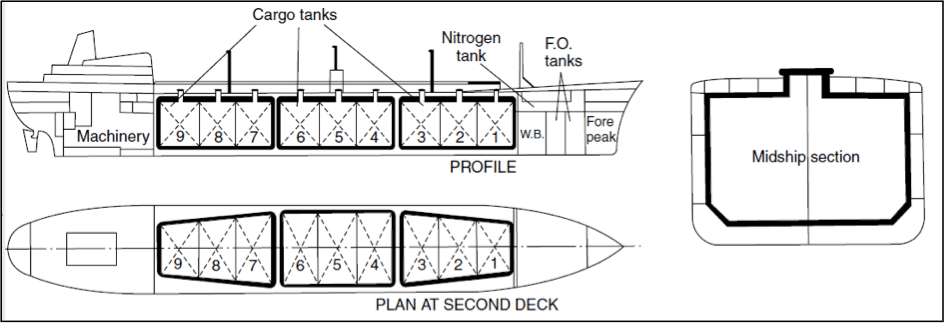
Type ‘A’ Tanks: These tanks are designed using the traditional method of ship structural design. LPG at near-atmospheric conditions or LNG can be carried in these tanks. The design pressure of Type A tanks is less than 700 mbar. The following figures show the general arrangement of a liquid methane carrier with Type ‘A’ tanks.

Liquefied Gas Carrier

Figure 1: General Arrangement of Methane Carrier with Type A Tanks.

The general arrangement of an LPG ship is almost same as that of an oil carrier, with the cargo tanks spread over a certain length forward and abaft the midship, the machinery and superstructure at the aft. A forecastle is fitted at the bow so as to prevent green waters on deck. Ballast water cannot be carried in the cargo tanks, hence spaces for ballast are provided by incorporating double hull spaces (note the double hull in the midship section), bilge and upper wing tanks.

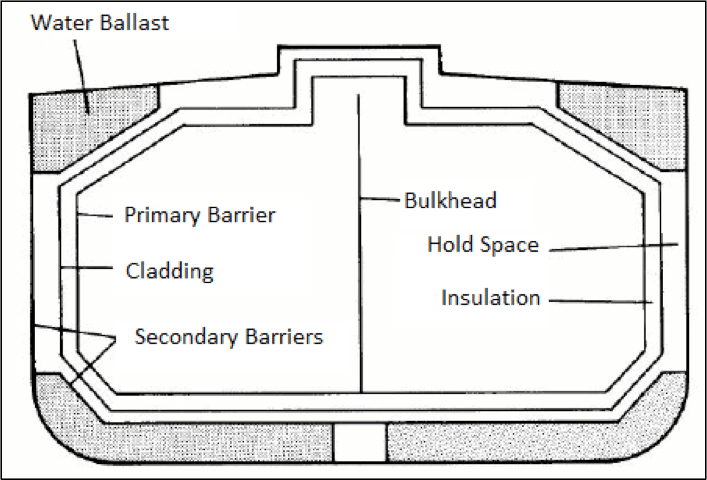
The most notable and distinguishing feature of Type ‘A’ tanks is that the IGC Code specifies that Type ‘A’ tanks must have a secondary barrier to contain any leakage for at least 15 days. The secondary barrier must be a complete barrier of such capacity that it is sufficient to contain the entire tank volume at any heel angle. Often, this secondary barrier comprises of the spaces in the ship’s hull as shown in the figure below.

Secondary Barrier for Type 'A' Tank.

Figure 2: Secondary Barrier for Type ‘A’ Tank.

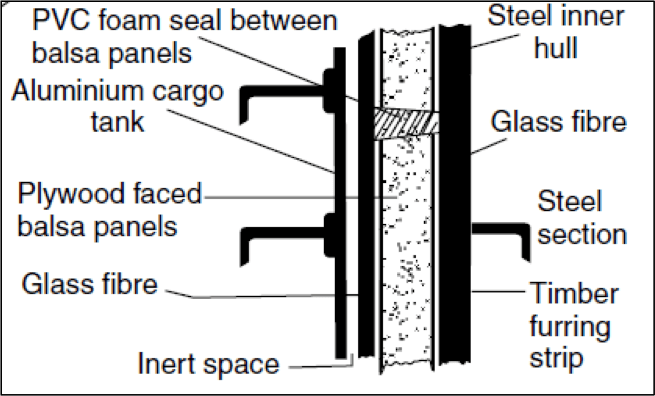
One important question that could arise, here, is that the tank in the midship section view seems to be an integral part of the hull. Why then, is this type of tanks categorised under Independent Tanks? To find the answer we need to have a closer look at how the tank is installed in the hull.
Integration of Type-A tank with hull structure.

Figure 3: Integration of Type-A tank with hull structure.

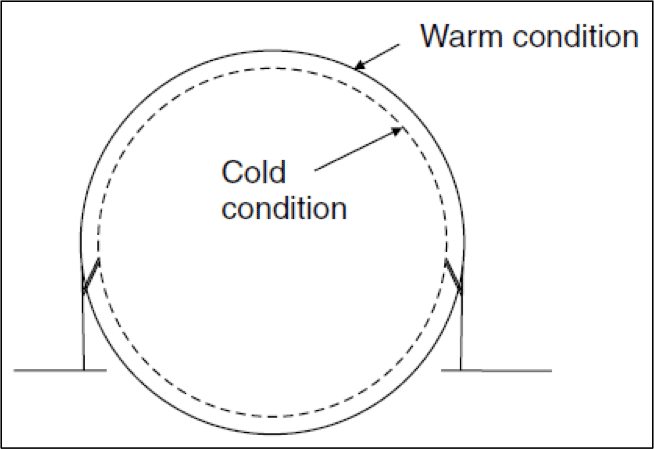
The above figure shows how the aluminum tank structure is not integrated to the inner hull of the methane carrier by means of any metal contact. The inner hull plating and aluminum tank plating are separated by layers consisting of timber, glass fibre, and balsa panels for insulation from external temperatures. The balsa panels are held together by plywood on both faces which are sealed using PVC foam seals. An inert space of 2 or 3 mm separates the inner glass fibre layer from the aluminum tank plate. This space is provided for insulation and also allows expansion and contraction of the tank structure. This type of non-welded integration makes this tank structurally independent in nature.

Type ‘B’ Tanks: The concept behind the design of such tanks is to have such a structure in which a crack can be detected long before the actual failure. This allows a time margin before the actual failure occurs. The methods used for design of such tanks include determination of stress levels at various temperatures and pressures by first principle analyses, determination of fatigue life of tank structure, and study of crack propagation characteristics. This enhanced design of such tanks requires on a partial barrier, that we will look into, soon.

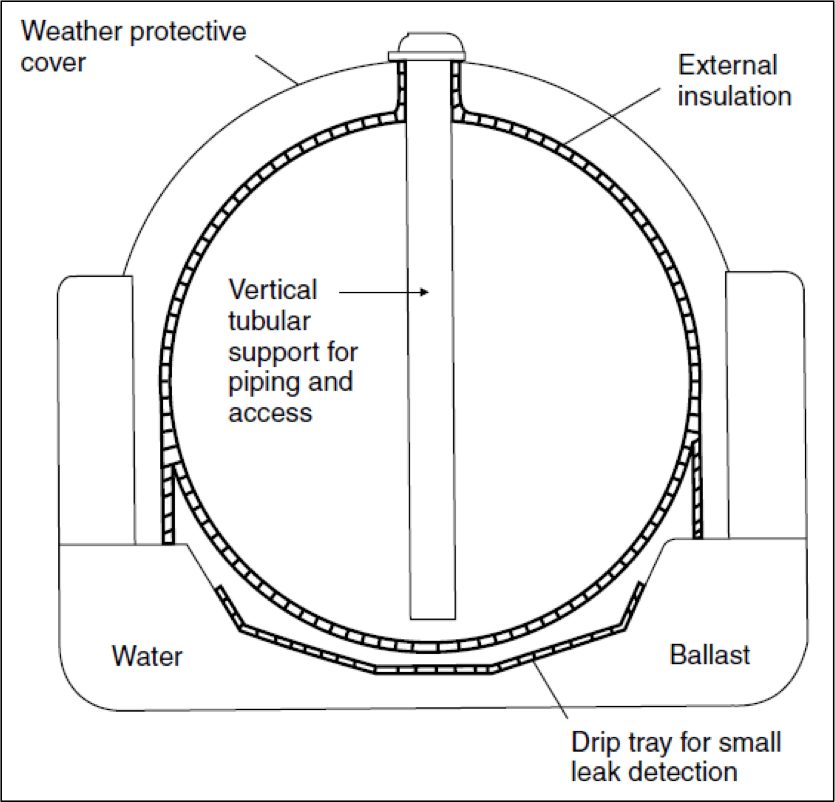
The most common arrangement of Type ‘B’ tank is Kvaerner-Moss Spherical Tank, as shown below in Figure 4.
gas carrier ship

Figure 4: Kvaerner-Moss Spherical Tank

The tank structure is spherical in shape, and it is so positioned in the ship’s hull that only half or a greater portion of the sphere is under the main deck level. The outer surface of the tank plating is provided with external insulation, and the portion of the tank above the main deck level is protected by a weather protective layer. A vertical tubular support is led from the top of the tank to the bottom, which houses the piping and the access rungs.

As evident from the layout, any leakage in the tank would cause the spill to accumulate on the drip tray below the tank. The drip pan and the equatorial region of the tank are equipped with temperature sensors to detect the presence of LNG. This acts as a partial secondary barrier for the tank.

LNG is usually carried in this type of tanks. A flexible foundation allows free expansion and contraction according to thermal conditions, and such dimensional changes do not interact with the primary hull structure, as shown in Figure 5.
Expansion and Contraction of Spherical Tanks.

Figure 5: Expansion and Contraction of Spherical Tanks.

The following are the advantages of Kvaerner-Moss Spherical tanks:
  • It enables space between the inner and outer hull (see Figure 4.) and this can be used for ballast and provided protection to cargo in case of side-ward collision damages.
  • The spherical shape allows even distribution of stress, therefore reducing the risk of fracture or failure.
  • Since ‘Leak before Failure’ concept is used in the design, it presumes and ensures that the primary barrier (tank shell) will fail progressively and not catastrophically. This allows crack generation to occur before it propagates and causes ultimate failure.

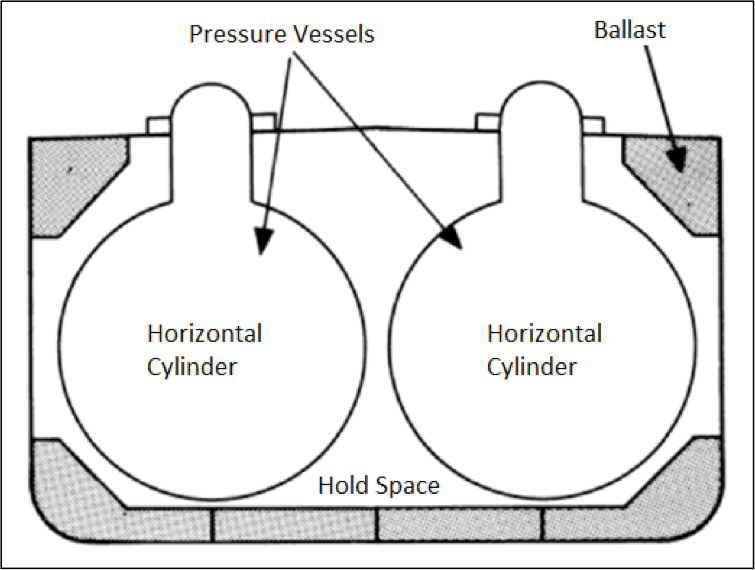
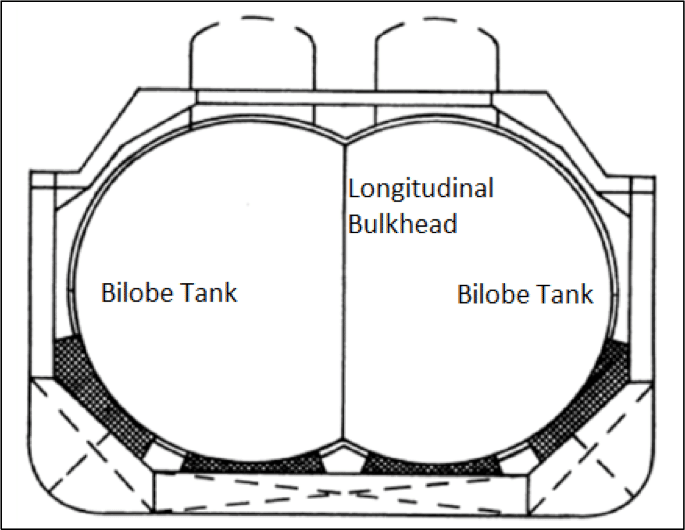
Type ‘C’ Tanks: These tanks are designed as cryogenic pressure vessels, using conventional pressure vessel codes, and the dominant design criteria is the vapour pressure. The design pressure for these tanks is in ranges above 2000 mbar. The most common shapes for these tanks are cylindrical and bi-lobe. Though Type ‘C’ tanks are used in both, LPG and LNG carriers, it is the dominant design in LNG carriers.

The following figures show the arrangements of cylindrical and bilobe tank arrangements in midship view. The cylinders can be either vertically or horizontally mounted, depending on the dimensions and spatial constraints of the ship. Note, in Figure 6, that the space between the two cylinders is rendered useless. Due to this, the use of cylindrical tanks is a poor use of the hull volume. In order to circumvent this, the pressure vessels are made to intersect, or bilobe tanks are used (Figure 7).
gas tanks

Figure 6: Horizontal Cylinder Tanks in LNG carrier.

Bilobe tank arrangement in LNG carrier.

Figure 7: Bilobe tank arrangement in LNG carrier.

These types of tanks do not require a secondary barrier. Rather, to detect the leakage of cargo from the tanks, the hold space (refer to Figure 6) is filled with inert gas or dry air. Sensors placed in the hold space can detect the change in composition of the inert gas or dry air due to fuel vapour, and leakages can hence be detected and prevented. Bilobe tanks at the forward end of the ship are tapered at the end.

Membrane Tanks:
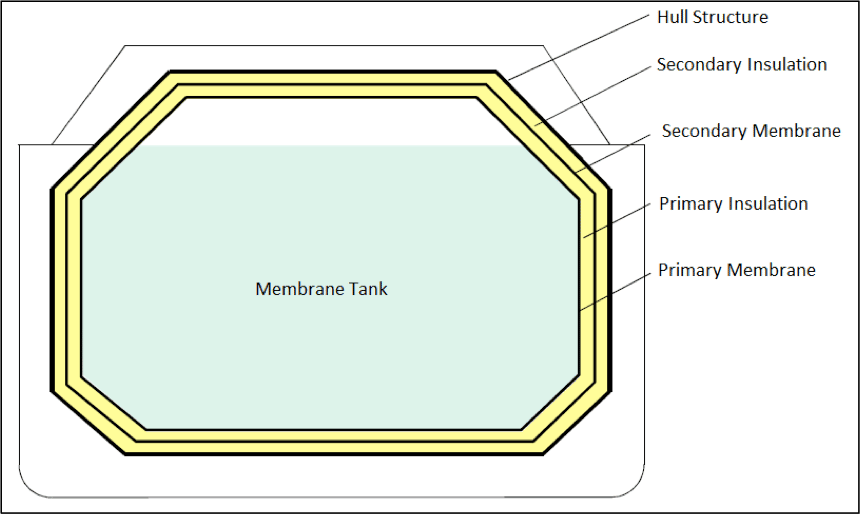
Unlike independent tanks, membrane tanks are non-self-supporting structures. Their primary barrier consists of a thin layer of membrane (0.7 to 1.5 mm thick). The membrane is supported to the inner hull structure through an insulation that can range upto 10 mm thickness as per IMO IGC Code. Due to their non-self-supporting nature, the inner hull bears the loads imparted onto the tank. This way, the expansions and contractions due to thermal fluctuations are compensated by not allowing the stress to be taken up by the membrane itself. Membrane tanks are primarily used for LNG cargo.

Often, there are two layers (primary and secondary) of insulation and membranes placed alternatively. The most common types of membtane tanks are the ones designed and developed by two French companies Technigaz and Gaz Transport.

The Tehnigaz system makes use of a stainless steel system that is constructed with corrugated sheets in such a way that one sheet is free to expand or contract independent of the adjacent sheet. The Gaz Transport system uses Invar as the primary and secondary membranes. Invar has low coefficient of thermal expansion, which makes corrugations unnecessary. The insulation is usually made of materials like Reinforced Polyurethane. In GTT membrane tanks, the primary membrane is made of Corrugated SUS 304, and the secondary membrane is made of Glued Triplex. Figure 8 illustrates the anatomy of twin-membrane tanks.

membrane tank

Figure 8: Parts of a membrane tank.

Primary membrane

Figure 9: Interior (Primary membrane) of a Membrane tank on an LNG carrier. (Source: Wikipedia)

Some of the advantages of membrane tanks are as follows:
  • They are generally of smaller gross tonnage, that is the space occupied within the hull is lower for a given cargo volume.
  • Due to the above reason, maximum space in the hold can be used for cargo containment.
  • Since the height of tanks above the main deck is significantly lesser compared to the cases of Moss tanks, membrane tanks provide allow visibility from the navigational bridge. This also allows a lower wheelhouse. This can be compared in Figures 10 and 11.
LNG Carrier

Figure 10: An LNG Carrier with Moss type tanks. (Source: Wikipedia)

membrane type LNG carrier

Figure 11: A membrane type LNG carrier under construction in a shipyard. Note the height of tanks above the main deck and the height of the wheelhouse. (Source: Wikipedia)

LPG Containment Systems:
Unlike LNG, LPG cargo requires storage at conditions that are different from atmospheric conditions. The LPG containment systems are classified into three types, and each LPG carrier is designed according to any one of them.

Fully Pressurized Tanks:
Propane, Butane and Anhydrous ammonia are carried in fully pressurized tanks. The capacity of these tanks is usually less than 2000 cubic meters. They are usually uninsulated cylindrical pressure vessels that are arranged partly below main deck level. Since these are Type C tanks, they often prevent complete utilization of under deck volume.

Semi Pressurized or Semi Refrigerated Tanks:
Though the cargo carried by semi-pressurized ships are same as that of fully-pressurized ships, the volume of semi-pressurized ships is about 5000 cubic meters. These use Independent Type C tanks, and are constructed with ordinary grades of steel. The outer surface of these tanks are insulated, and refrigeration or reliquefication plants are installed on these ships to maintain the working pressure of the cargo. The most ommon types of tanks used for this purpose are cylindrical and bi-lobe type.
Fully Refrigerated Tanks:
Fully Refrigerated gas carriers have a capacity of 10,000 to 1,00,000 cubic meters. The ships in the smaller size range are used to carry multiple types of cargo, whereas the larger ones are designed for a single type of cargo to be transported on a permanent route. The tanks used for this purpose is usually Type ‘A’ prismatic tanks that are sloped at the top end to reduce free surface effect, and sloped at the bottom to suit the shape of the bilge structure. They are usually divided longitudinally by a liquid-tight bulkhead, in order to reduce free surface effects further. These tanks are constructed with notch ductile steel, in order to be provided with maximum notch toughness at temperatures as low as -48 degrees Celsius, at which cargo like Propane is transported.

The number of gas carriers have increased drastically over the last ten years, owing to the increasing need for alternative fuel. These are usually high speed ships with fine hull-form, which makes it possible for extensive research opportunities to improve on hull efficiencies in order to achieve more power efficiency. A lot of research is also being carried out to design advanced cargo containment systems and concepts of adjoining bunkering systems are being developed by various countries that are opening themselves to extensive use of natural gas. Today, not all shipyards are equipped to design and build specialised ships like LPG and LNG carriers. This leaves a wide scope for designers and shipbuilders to develop skills and infrastructure to specialise in building these ships.

Disclaimer: The authors’ views expressed in this article do not necessarily reflect the views of Marine Insight. Data and charts, if used, in the article have been sourced from available information and have not been authenticated by any statutory authority. The author and Marine Insight do not claim it to be accurate nor accept any responsibility for the same. The views constitute only the opinions and do not constitute any guidelines or recommendation on any course of action to be followed by the reader.

The article or images cannot be reproduced, copied, shared or used in any form without the permission of the author and Marine Insight

Understanding The Design of Liquefied Gas Carriers.
 
Hivi unajua gesi inayoletwa na tankers Dar port hupadilishwa kuwa kwenye gas form kabla ya kuingizwa kwenye mitungi na kusambazwa kwa wateja?
Hapana sio hivyo, gas ili iweze kusafirishwa lazima iwe katika "Liquid form", na ili gas iweze kuwa katika liquid form, lazima volume yake ipunguzwe zaidi ya mara Elfu moja, yaani lita moja ya "liquid gas" inapatikana baada ya ku-compress 1000 litres of gas form.

Hii maana yake ni kwamba, liquid form ipo katika pressure kubwa sana, kwahiyo lazima iweze kuhifadhiwa katika containers za chuma imara na kigumu sana. Tankers za meli au magari yabayosafirisha gas, zile containers zimetengeza kwa chuma kizito sana ili kuimili hiyo pressure. Hii ndio maana haiwezikani "Liquid form" kusafirishwa katika bomba refu kwasababu hilo bomba lazima liwe imara kama mitungi ya gas au tankers.
 
Hapana sio hivyo, gas ili iweze kusafirishwa lazima iwe katika "Liquid form", na ili gas iweze kuwa katika liquid form, lazima volume yake ipunguzwe zaidi ya mara Elfu moja, yaani lita moja ya "liquid gas" inapatikana baada ya ku-compress 1000 litres of gas form.

Hii maana yake ni kwamba, liquid form ipo katika pressure kubwa sana, kwahiyo lazima iweze kuhifadhiwa katika containers za chuma imara na kigumu sana. Tankers za meli au magari yabayosafirisha gas, zile containers zimetengeza kwa chuma kizito sana ili kuimili hiyo pressure. Hii ndio maana haiwezikani "Liquid form" kusafirishwa katika bomba refu kwasababu hilo bomba lazima liwe imara kama mitungi ya gas au tankers.

Pitia hayo material niliyo-post kujua kwanini liquefication process for LNG n LPG inafanywa kabla ya ku-load kwenye LNG/LPG tankers halafu ufahamu kwanini kutoka Songosongo, Kiliwani North na Mnazi bay palipounganishwa na gas pipeline hatuhitaji LNG plant for tankers for local consumptions yani kutumia gesi yetu inayotumika already Dar majumbani, viwandani na Tanesco! Jomba, kuropoka hakusaidii!

TPDC wanajitahidi sana ku-push comercialization of that gas starting with local consumption kwanza kabla ya export kuepuka resources curse while building bargaining power against multinational companies kabla ya LNG plant haijaanzwa kujengwa! Na kama jamaa wa Ferrostaal (na other Petrochemical industries) wasingeleta kizungumkuti matumizi ya gas yangeongezeka sana maana bomba la kutoka kwanza visiwani (offshore/deep seas) mpaka Mtwara na la Mtwara-Dar lililenga pia petrochemical industries kwa kiasi kikubwa!

Ila Uganda watatu-boost saana na kama Kenya wakikubali hili deal itakuwa saafi kwa sababu haya yote hayahitaji that $30 bln LNG plant! Believe me it will be a blessing in disguise Hawa Exonnmobil, Shell na Equinor watasalimu amri tu! Subiri deal la Uganda lipite...! Hii maneno inahitaji patience na si kukurupuka!

Ninachoweza kukuambia tanker ya LPG ikifika Dar port kabla ya unloading kuna process hufanyika kuiyeyusha gesi iliyoganda kwenye tankers kabla ya kui-pump na kuiingiza kwenye storage tanks! Tunayotumia majumbani ni kwenye form ya gesi (hewa) na si vimiminika!
 
Pitia hayo material niliyo-post kujua kwanini liquidification process for LNG n LPG inafanywa kabla ya ku-load kwenye LNG/LPG tankers halafu ufahamu kwanini kutoka Songosongo, Kiliwani North na Mnazi bay hatuhitaji LNG plant for tankers for local consumptions yani kutumia gesi yetu inayotumika already Dar majumbani, viwandani na Tanesco! Jomba, kuropoka hakusaidii!

TPDC wanajitahidi sana ku-push comercialization of that gas starting with local consumption kwanza kabla ya export kuepuka resources curse while building bargaining power against multinational companies kabla ya LNG plant haijaanzwa kujengwa! Na kama jamaa wa Ferrostaal (na other Petrochemical industries) wasingeleta kizungumkuti matumizi ya gas yangeongezeka sana maana bomba la kutoka kwanza visiwani (offshore/deep seas) mpaka Mtwara na la Mtwara-Dar lililenga pia petrochemical industries kwa kiasi kikubwa!

Ila Uganda watatu-boost saana na kama Kenya wakikubali hili deal itakuwa saafi kwa sababu haya yote hayahitaji that $30 bln LNG plant! Believe me it will be a blessing in disguise Hawa Exonnmobil, Shell na Equinor watasalimu amri tu! Subiri deal la Uganda lipite...! Hii maneno inahitaji patience na si kukurupuka!

Ninachoweza kukuambia tanker ya LPG ikifika Dar port kabla ya unloading kuna process hufanyika kuiyeyusha gesi iliyoganda kwenye tankers kabla ya kui-pump na kuiingiza kwenye storage tanks! Tunayotumia majumbani ni kwenye form ya gesi (hewa) na si vimiminika!
Geza, usambazaji wa gesi na maji vinalingana sana, tofauti ni hatua moja tu, kwenye gas lazima igeuzwe kuwa liquid ili isafirishwe, hapo ndio panapoifanya ges kuwa ghali.

Maji yanatoka Mto Ruvu na kuingia katika kiwanda cha kuchakata na kusafisha (water treatment plant) pale Ruvu, baadae yanasukumwa ili kuwa na pressure kufika majumbani na viwandani yakiwa na pressure ya kutosha. Hicho ndio kinachofanyika huko Songosongo na Mnazi Bay hadi gesi inafika majumbani na viwandani.

Unapohitaji kuweka gasi katika mitungi, ni sawa na kuanzisha kiwanda cha maji, maji lazima yaandaliwe yajazwe kwenye chupa zenye ujazo tofauti. Hapa ndio kunatofauti kwasababu ili kupatikane faida, lazima ujazo wa gasi upunguzwe sana ili gasi nyingi iweze kuingia katika ujazo mdogo.

Kama ilivyovyo biashara ya maji katika chupa ilivyo na faida zaidi ya mara 100 ukilinganisha na kuuza maji yanayotoka ktk bomba, serikali inajihusisha zaidi katika kusambaza maji ya bomba sio ya chupa, hata katika gas, serikali inajihusisha na kusambaza gas ya bomba sio katika mitungi, hiyo ni kwa ajili ya wawekezaji zaidi, au kwa ubia ili nchi ipate mapato.
 
Geza, usambazaji wa gesi na maji vinalingana sana, tofauti ni hatua moja tu, kwenye gas lazima igeuzwe kuwa liquid ili isafirishwe, hapo ndio panapoifanya ges kuwa ghali.

Maji yanatoka Mto Ruvu na kuingia katika kiwanda cha kuchakata na kusafisha (water treatment plant) pale Ruvu, baadae yanasukumwa ili kuwa na pressure kufika majumbani na viwandani yakiwa na pressure ya kutosha. Hicho ndio kinachofanyika huko Songosongo na Mnazi Bay hadi gesi inafika majumbani na viwandani.

Unapohitaji kuweka gasi katika mitungi, ni sawa na kuanzisha kiwanda cha maji, maji lazima yaandaliwe yajazwe kwenye chupa zenye ujazo tofauti. Hapa ndio kunatofauti kwasababu ili kupatikane faida, lazima ujazo wa gasi upunguzwe sana ili gasi nyingi iweze kuingia katika ujazo mdogo.

Kama ilivyovyo biashara ya maji katika chupa ilivyo na faida zaidi ya mara 100 ukilinganisha na kuuza maji yanayotoka ktk bomba, serikali inajihusisha zaidi katika kusambaza maji ya bomba sio ya chupa, hata katika gas, serikali inajihusisha na kusambaza gas ya bomba sio katika mitungi, hiyo ni kwa ajili ya wawekezaji zaidi, au kwa ubia ili nchi ipate mapato.

Wacha ujinga sasa! Nimekwambia gesi inayoingizwa Dar toka Mtwara ni katika hali ya uyasi (gas) si kimiminika (liquid form) na hatuhitaji LNG plant for oil tankers kuileta Dar! TPDC na washirika wake wana natural gas processing plants na so far hawana LNG plants! labda unipe tofauti ya methane kwenye gas and liquid form!

Sasa ulivyokuwa unabisha gesi yetu haipo kwenye market? kubali ulikuwa huna ufahamu wa hii sector kwanza na ulikuwa unafanya uropokaji!? Au "keyboard knighthood" inakusumbua?
 
Pitia hayo material niliyo-post kujua kwanini liquidification process for LNG n LPG inafanywa kabla ya ku-load kwenye LNG/LPG tankers halafu ufahamu kwanini kutoka Songosongo, Kiliwani North na Mnazi bay palipounganishwa na gas pipeline hatuhitaji LNG plant for tankers for local consumptions yani kutumia gesi yetu inayotumika already Dar majumbani, viwandani na Tanesco! Jomba, kuropoka hakusaidii!

TPDC wanajitahidi sana ku-push comercialization of that gas starting with local consumption kwanza kabla ya export kuepuka resources curse while building bargaining power against multinational companies kabla ya LNG plant haijaanzwa kujengwa! Na kama jamaa wa Ferrostaal (na other Petrochemical industries) wasingeleta kizungumkuti matumizi ya gas yangeongezeka sana maana bomba la kutoka kwanza visiwani (offshore/deep seas) mpaka Mtwara na la Mtwara-Dar lililenga pia petrochemical industries kwa kiasi kikubwa!

Ila Uganda watatu-boost saana na kama Kenya wakikubali hili deal itakuwa saafi kwa sababu haya yote hayahitaji that $30 bln LNG plant! Believe me it will be a blessing in disguise Hawa Exonnmobil, Shell na Equinor watasalimu amri tu! Subiri deal la Uganda lipite...! Hii maneno inahitaji patience na si kukurupuka!

Ninachoweza kukuambia tanker ya LPG ikifika Dar port kabla ya unloading kuna process hufanyika kuiyeyusha gesi iliyoganda kwenye tankers kabla ya kui-pump na kuiingiza kwenye storage tanks! Tunayotumia majumbani ni kwenye form ya gesi (hewa) na si vimiminika!
Usambazaji wa maji nchini, lengo Lake kubwa ni kwa ajili ya huduma zaidi kuliko faida, hata usambazaji wa gas majumbani na viwandani pia lengo ni hilo hilo, ndio sababu wawekezaji hawana interest na kuwekeza, serikali inabidi itafute vyanzo vyake yenyewe.

Kama ilivyo kwa maji na umeme, zoezi la kusambaza gas nchini litachukua muda mrefu sana hadi tufike katika "universal gasification". Kuhusu kiwanda cha gas, hiyo ni biashara kama ilivyo migodi ya Dhahabu, kiasi kwamba serikali haiwezi kuwa na control ya kupanga bei na wapi hiyo gesi ipelekwe kuuzwa.
 
Usambazaji wa maji nchini, lengo Lake kubwa ni kwa ajili ya huduma zaidi kuliko faida, hata usambazaji wa gas majumbani na viwandani pia lengo ni hilo hilo, ndio sababu wawekezaji hawana interest na kuwekeza, serikali inabidi itafute vyanzo vyake yenyewe.

Kama ilivyo kwa maji na umeme, zoezi la kusambaza gas nchini litachukua muda mrefu sana hadi tufike katika "universal gasification". Kuhusu kiwanda cha gas, hiyo ni biashara kama ilivyo migodi ya Dhahabu, kiasi kwamba serikali haiwezi kuwa na control ya kupanga bei na wapi hiyo gesi ipelekwe kuuzwa.

Hii ni topic nyingine all together na believe me huna uelewa wa hii sector kujua kwanini TPDC ina-concentrate zaidi na local na regional commercialization kabla ya ku-commit na giant multinational companies.

Kwanza kubali uliropoka kusema gesi yetu methane haisambazwi majumbani kwa mitungi au pipeline kwa kutojua tofauti ya kati ya ile ya LPG (Butane and Propane) na yetu methane natural gas!

Basically ulikuwa unaongelea boiling point properties za LPG (Butane & Propane) to be specifically propane inayosambazwa majumbani ukichajinganya na properties za methane gas yetu.

Kukusaidia zaidi on our natural gas (methane) here is the breakdown of the process at our 3 natural gas plants! any sort of liquid to be extracted out before the "dry gas" is discharged into a pipeline ready to be transported to Dar!

Compressor Stations

As mentioned, natural gas is highly pressurized as it travels through an interstate pipeline. To ensure that the natural gas flowing through any one pipeline remains pressurized, compression of this natural gas is required periodically along the pipe. This is accomplished by compressor stations, usually placed at 40 to 100 mile intervals along the pipeline. The natural gas enters the compressor station, where it is compressed by either a turbine, motor, or engine.


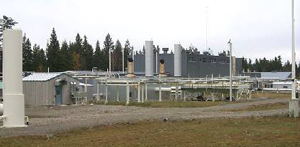
compressor_station
A Compressor Station
Source: Duke Energy Gas Transmission Canada​


Turbine compressors gain their energy by using up a small proportion of the natural gas that they compress. The turbine itself serves to operate a centrifugal compressor, which contains a type of fan that compresses and pumps the natural gas through the pipeline. Some compressor stations are operated by using an electric motor to turn the same type of centrifugal compressor. This type of compression does not require the use of any of the natural gas from the pipe, however it does require a reliable source of electricity nearby. Reciprocating natural gas engines are also used to power some compressor stations. These engines resemble a very large automobile engine, and are powered by natural gas from the pipeline. The combustion of the natural gas powers pistons on the outside of the engine, which serves to compress the natural gas.

In addition to compressing natural gas, compressor stations also usually contain some type of liquid separator, much like the ones used to dehydrate natural gas during its processing. Usually, these separators consist of scrubbers and filters that capture any liquids or other unwanted particles from the natural gas in the pipeline. Although natural gas in pipelines is considered ‘dry’ gas, it is not uncommon for a certain amount of water and hydrocarbons to condense out of the gas stream while in transit. The liquid separators at compressor stations ensure that the natural gas in the pipeline is as pure as possible, and usually filter the gas prior to compression.

» The Transportation of Natural Gas NaturalGas.org
 
Wacha ujinga sasa! Nimekwambia gesi inayoingizwa Dar toka Mtwara ni katika hali ya uyasi (gas) si kimiminika (liquid form) na hatuhitaji LNG plant for oil tankers kuileta Dar! TPDC na washirika wake wana natural gas processing plants na so far hawana LNG plants! labda unipe tofauti ya methane kwenye gas and liquid form!

Sasa ulivyokuwa unabisha gesi yetu haipo kwenye market? kubali ulikuwa huna ufahamu wa hii sector kwanza na ulikuwa unafanya uropokaji!? Au "keyboard knighthood" inakusumbua?
Hahahaha, Geza kichwa chako ni kibovu sana. Tony254 aliuliza kuhusu gas tunayotumia katika mitungu ya kupikia, nikamuambia kwamba Afrika nzima hakuna kiwanda cha kuweza kucompress gas na kuijaza katika mitungi, kwahiyo hiyo gas yote tunayopikia iliyojazwa katika mitungi inatoka nje ya Africa

Wewe ukarukia kwa kusema kwamba TPDC wanasambaza gas majumbani, ndio nimekuelewesha kwamba TPDC wanasambaza kwa kutumia bomba moja kwa moja kutoka katika visima vya gas baada ya kufanyiwa purification, kama yanavyifanyiwa maji ya Ruvu kwa ajili ya matumizi huko Dar

Bado Tanzania hatuna kiwanda cha kugeuza gesi kuwa katika Liquid form ili kuweka katika mitungu kwa ajili ya matumizi majumbani.

Geza, jaribu kubaki katika maeneo yako unayoyajua vizuri, usijaribu kuzungumza kwa utaalamu maeneo usiyoyajua. Sasa unaniuliza kuhusu "Methane" kwani hiyo sio gasi?, gas ni gas bila kujali idadi ya "Carbon atoms" zilizopo ndani yake. Muhimu gas lazima isafirishwe ama kwa bomba kama inakokwenda ni karibu, ama igeuzwe katika Liquid form kama ni mbali au bomba halifiki.

Kamwe isijaribu kuingia katika eneo la Chemistry ya mafuta, huko hutotoka, na kwasasa sio muhimu kwasabu halihusiki na usafirishaji wa gas. Sikiliza kwa makini hii video yako imerahisisha kila kitu.
 
more nondo onyesha wapi natural gas imebadilishwa kuwa liquid form...!

Metering Stations

In addition to compressing natural gas to reduce its volume and push it through the pipe, metering stations are placed periodically along interstate natural gas pipelines. These stations allow pipeline companies to monitor the natural gas in their pipes. Essentially, these metering stations measure the flow of gas along the pipeline, and allow pipeline companies to ‘track’ natural gas as it flows along the pipeline. These metering stations employ specialized meters to measure the natural gas as it flows through the pipeline, without impeding its movement.

Valves

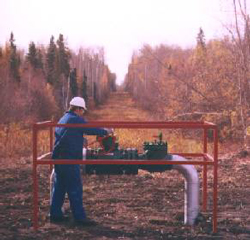
ground_valve
A Ground Valve
Source: Duke Energy Gas Transmission Canada​

Interstate pipelines include a great number of valves along their entire length. These valves work like gateways; they are usually open and allow natural gas to flow freely, or they can be used to stop gas flow along a certain section of pipe.

There are many reasons why a pipeline may need to restrict gas flow in certain areas. For example, if a section of pipe requires replacement or maintenance, valves on either end of that section of pipe can be closed to allow engineers and work crews safe access. These large valves can be placed every 5 to 20 miles along the pipeline, and are subject to regulation by safety codes.

Control Stations and SCADA Systems

Natural gas pipeline companies have customers on both ends of the pipeline – the producers and processors that input gas into the pipeline, and the consumers and local gas utilities that take gas out of the pipeline. In order to manage the natural gas that enters the pipeline, and to ensure that all customers receive timely delivery of their portion of this gas, sophisticated control systems are required to monitor the gas as it travels through all sections of what could be a very lengthy pipeline network. To accomplish this task of monitoring and controlling the natural gas that is traveling through the pipeline, centralized gas control stations collect, assimilate, and manage data received from monitoring and compressor stations all along the pipe.


pipeline_control_station
Pipeline Control Station
Source: Duke Energy Gas Transmission Canada​

Most of the data that is received by a control station is provided by Supervisory Control and Data Acquisition (SCADA) systems. These systems are essentially sophisticated communications systems that take measurements and collect data along the pipeline (usually in a metering or compressor stations and valves) and transmit it to the centralized control station. Flow rate through the pipeline, operational status, pressure, and temperature readings may all be used to assess the status of the pipeline at any one time. These systems also work in real time, meaning that there is little lag time between the measurements taken along the pipeline and their transmission to the control station.

The data is relayed to a centralized control station, allowing pipeline engineers to know exactly what is happening along the pipeline at all times. This enables quick reactions to equipment malfunctions, leaks, or any other unusual activity along the pipeline. Some SCADA systems also incorporate the ability to remotely operate certain equipment along the pipeline, including compressor stations, allowing engineers in a centralized control center to immediately and easily adjust flow rates in the pipeline.

Pipeline Construction

As natural gas use increases, so does the need to have transportation infrastructure in place to supply the increased demand. This means that pipeline companies are constantly assessing the flow of natural gas across the U.S., and building pipelines to allow transportation of natural gas to those areas that are underserved.

surveying_right_of_way
Surveying the Right-of-Way
Source: Duke Energy Gas Transmission Canada​

Constructing natural gas pipelines requires a great deal of planning and preparation. In addition to actually building the pipeline, several permitting and regulatory processes must be completed. In many cases, prior to beginning the permitting and land access processes, natural gas pipeline companies prepare a feasibility analysis to ensure that an acceptable route for the pipeline exists that provides the least impact to the environment and public infrastructure already in place.

Assuming a pipeline company obtains all the required permits and satisfies all of the regulatory requirements, construction of the pipe may begin. Extensive surveying of the intended route is completed, both aerial and land based, to ensure that no surprises pop up during actual assembly of the pipeline.

Installing a pipeline is much like an assembly line process, with sections of the pipeline being completed in stages. First, the path of the pipeline is cleared of all removable impediments, including trees, boulders, brush, and anything else that may prohibit the construction. Once the pipeline’s path has been cleared sufficiently to allow construction equipment to gain access, sections of pipes are laid out along the intended path, a process called ‘stringing’ the pipe. These pipe sections are commonly from 40 to 80 feet long, and are specific to their destination. That is, certain areas have different requirements for coating material and pipe thickness.


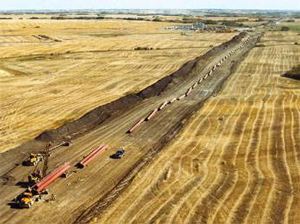
stringing_the_pipe
‘Stringing’ the Pipe
Source: Duke Energy Gas Transmission Canada​

Once the pipe is in place, trenches are dug alongside the laid out pipe. These trenches are typically five to six feet deep, as the regulations require the pipe to be at least 30 inches below the surface. In certain areas, however, including road crossings and bodies of water, the pipe is buried even deeper. Once the trenches are dug, the pipe is assembled and contoured. This includes welding the sections of pipe together into one continuous pipeline, and bending it slightly, if needed, to fit the contour of the pipeline’s path. Coating is applied to the ends of the pipes. The coating applied at a coating mill typically leaves the ends of the pipe clean, so as not to interfere with welding. Finally, the entire coating of the pipe is inspected to ensure that it is free from defects.

Once the pipe is welded, bent, coated, and inspected it can be lowered into the previously-dug trenches. This is done with specialized construction equipment acting to lift the pipe in a level manner and lower it into the trench. Once lowered into the ground, the trench is filled in carefully, to ensure that the pipe and its coating retain their integrity. The last step in pipeline construction is the hydrostatic test. This consists of running water, at pressures higher than will be needed for natural gas transportation, through the entire length of the pipe. This serves as a test to ensure that the pipeline is strong enough, and absent of any leaks of fissures, before natural gas is pumped through the pipeline.

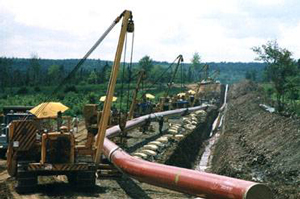
lowering_pipeline
Lowering Pipe
Source: Duke Energy Gas Transmission Canada​

Laying pipe across streams or rivers can be accomplished in one of two ways. Open cut crossing involves the digging of trenches on the floor of the river to house the pipe. When this is done, the pipe itself is usually fitted with a concrete casing, which both ensures that the pipe stays on the bottom of the river and adds an extra protective coating to prevent any natural gas leaks into the water.

Alternatively, a form of directional drilling may be employed, in which a ‘tunnel’ is drilled under the river through which the pipe may be passed. The same techniques are used for road crossings – either an open trench is excavated across the road and replaced once the pipe is installed, or a tunnel may be drilled underneath the road.

Once the pipeline has been installed and covered, extensive efforts are taken to restore the pipeline’s pathway to its original state, or to mitigate any environmental or other impacts that may have occurred during the construction process. These steps often include replacing topsoil, fences, irrigation canals, and anything else that may have been removed or upset during the construction process. For more information on natural gas pipeline construction, visit the website of theInterstate Natural Gas Association of America.

Pipeline Inspection and Safety


pipeline_inspection_tool
Pig – Pipeline Inspection Tool
Source: Duke Energy Gas Transmission Canada​

In order to ensure the efficient and safe operation of the extensive network of natural gas pipelines, pipeline companies routinely inspect their pipelines for corrosion and defects. This is done through the use of sophisticated pieces of equipment known as ‘smart pigs.’ Smart pigs are intelligent robotic devices that are propelled down pipelines to evaluate the interior of the pipe. Smart pigs can test pipe thickness, and roundness, check for signs of corrosion, detect minute leaks, and any other defect along the interior of the pipeline that may either impede the flow of gas, or pose a potential safety risk to the operation of the pipeline. Sending a smart pig down a pipeline is fittingly known as ‘pigging’ the pipeline.

In addition to inspection with smart pigs, there are a number of safety precautions and procedures in place to minimize the risk of accidents. In fact, the transportation of natural gas is one of the safest ways of transporting energy, mostly due to the fact that the infrastructure is fixed, and buried underground.

According to the Department of Transportation (DOT), pipelines are the safest method of transporting petroleum and natural gas. While there are in excess of 100 deaths per year associated with electric transmission lines, according to the DOT’s Office of Pipeline Safety in 2009, there were 0 deaths associated with transmission pipelines, and 10 deaths associated with distribution systems. To learn more about pipeline safety, visit the DOT’s Office of Pipeline Safety.

A few of the safety precautions associated with natural gas pipelines include:

  • Aerial Patrols – Planes are used to ensure no construction activities are taking place too close to the route of the pipeline, particularly in residential areas. Unauthorized construction and digging is the primary threat to pipeline safety, according to INGAA
  • Leak Detection – Natural gas detecting equipment is periodically used by pipeline personnel on the surface to check for leaks. This is especially important in areas where the natural gas is not odorized.
  • Pipeline Markers – Signs on the surface above natural gas pipelines indicate the presence of underground pipelines to the public, to reduce the chance of any interference with the pipeline.
  • Gas Sampling – Routine sampling of the natural gas in pipelines ensures its quality, and may also indicate corrosion of the interior of the pipeline, or the influx of contaminants.
  • Preventative Maintenance – This involves the testing of valves and the removal of surface impediments to pipeline inspection.
  • Emergency Response – Pipeline companies have extensive emergency response teams that train for the possibility of a wide range of potential accidents and emergencies.
  • The One Call Program – All 50 states have instituted what is known as a ‘one call’ program, which provides excavators, construction crews, and anyone interested in digging into the ground around a pipeline with a single phone number that may be called when any excavation activity is planned. This call alerts the pipeline company, which may flag the area, or even send representatives to monitor the digging. The national 3-digit number for one call is “811.”
While large interstate natural gas pipelines transport natural gas from the processing regions to the consuming regions and may serve large wholesale users such as industrial or power generation customers directly, it is the distribution system that actually delivers natural gas to most retail customers, including residential natural gas users.

» The Transportation of Natural Gas NaturalGas.org
 
Ndugu zangu nitangulize samahani kwanza kwa kuvamia mada, nafanya hivo sababu nashindwa kupost, Mimi biñafsi nasumbuliwa na vidonda vya tumbo kwa anayefahamu Tiba au ushauri madhubuti anifahamishe tafadhali
 
Hahahaha, Geza kichwa chako ni kibovu sana. Tony254 aliuliza kuhusu gas tunayotumia katika mitungu ya kupikia, nikamuambia kwamba Afrika nzima hakuna kiwanda cha kuweza kucompress gas na kuijaza katika mitungi, kwahiyo hiyo gas yote tunayopikia iliyojazwa katika mitungi inatoka nje ya Africa

Wewe ukarukia kwa kusema kwamba TPDC wanasambaza gas majumbani, ndio nimekuelewesha kwamba TPDC wanasambaza kwa kutumia bomba moja kwa moja kutoka katika visima vya gas baada ya kufanyiwa purification, kama yanavyifanyiwa maji ya Ruvu kwa ajili ya matumizi huko Dar

Bado Tanzania hatuna kiwanda cha kugeuza gesi kuwa katika Liquid form ili kuweka katika mitungu kwa ajili ya matumizi majumbani.

Geza, jaribu kubaki katika maeneo yako unayoyajua vizuri, usijaribu kuzungumza kwa utaalamu maeneo usiyoyajua. Sasa unaniuliza kuhusu "Methane" kwani hiyo sio gasi?, gas ni gas bila kujali idadi ya "Carbon atoms" zilizopo ndani yake. Muhimu gas lazima isafirishwe ama kwa bomba kama inakokwenda ni karibu, ama igeuzwe katika Liquid form kama ni mbali au bomba halifiki.

Kamwe isijaribu kuingia katika eneo la Chemistry ya mafuta, huko hutotoka, na kwasasa sio muhimu kwasabu halihusiki na usafirishaji wa gas. Sikiliza kwa makini hii video yako imerahisisha kila kitu.


so unamaanisha our compressed natural gas methane hapo Dar haiuzwi kwenye gas cylinders? hivi kwenye yale magari yanatumia CNG lile tank linalowekwa kwenye boot ya gari ni nn? Mind u it is compressed natural gas haibadiliki kuwa liquid! na pia majumbani inauzwa japokuwa market share yake bado ni ndogo! Uwache tabia ya uduvi, ur my friend but wakati mwingine una-bore!

BTW Kwanini inaitwa CNG na si LNG kwa natural gas methane hapo Dar maana kwa mantiki yako ni lazima iwe liquid kusafirishwa na mimi nakuambia hapana hatuna uo mtambo yaani LNG plant wa ku-liquify our gas so far!? na hatuhitaji ku-commercialize local consumption!

Ninachoweza kukushauri get the basics of gas properties from boiling points between methane, butane and propane! Then utapata kujua when is any of these gas called liquified! BTW naanza kuona kwanini Tony254 alikataa mjadala wa GERD! Huelimiki mzee!
 
so unamaanisha our compressed natural gas methane hapo Dar haiuzwi kwenye gas cylinders? hivi kwenye yale magari yanatumia CNG lile tank linalowekwa kwenye boot ya gari ni nn? Mind u it is compressed natural gas haibadiliki kuwa liquid! na pia majumbani inauzwa japokuwa market share yake bado ni ndogo! Uwache ufala ur my friend but wakati mwingine una-bore!
Geza wewe ni kichekesho sana[emoji23][emoji23][emoji23], fuatililia mambo kwa umakili vinginevyo utaanza kuwa kichekesho hapa jamvini, tulia nikuingize darasani.

TPDC wanatumia gas inayotoka moja kwa moja Katina "Purification plants" za Songosongo na Mnazi bay, hii gas inapita ndani ya bomba ikiwa na pressure kubwa sana, lakini bado haijafikia hata nusu ya pressure ya "Liquid form".

Ikifika Dar, TPDC wanachofanya ni kuisambaza katika maeneo na viwandani kwa kupunguza pressure kulingana na mahitaji ya mteja, hii ni muhimu ili bomba zisipasuke.

TPDC sasa hivi wanavyo vituo vichache sana vya kujaza gas katika magari, sasa hivi TPDC wapo katika mikakati ya kutafuta wawekezaji watakao wekeza katika kufungua hivi vituo. Hivi vituo ni ghali sana kwasaba kila kituo ni kama "section ya mwisho ya LNG plant". Hiki kituo lazima kiwe na mtambo mdogo utakaoweza kugeuza gas kuwa Liquid kabla ya kuijaza katika gari.
 
Ndugu zangu nitangulize samahani kwanza kwa kuvamia mada, nafanya hivo sababu nashindwa kupost, Mimi biñafsi nasumbuliwa na vidonda vya tumbo kwa anayefahamu Tiba au ushauri madhubuti anifahamishe tafadhali
Nicheki pm.
 
Geza wewe ni kichekesho sana[emoji23][emoji23][emoji23], fuatililia mambo kwa umakili vinginevyo utaanza kuwa kichekesho hapa jamvini, tulia nikuingize darasani.

TPDC wanatumia gas inayotoka moja kwa moja Katina "Purification plants" za Songosongo na Mnazi bay, hii gas inapita ndani ya bomba ikiwa na pressure kubwa sana, lakini bado haijafikia hata nusu ya pressure ya "Liquid form".

Ikifika Dar, TPDC wanachofanya ni kuisambaza katika maeneo na viwandani kwa kupunguza pressure kulingana na mahitaji ya mteja, hii ni muhimu ili bomba zisipasuke.

TPDC sasa hivi wanavyo vituo vichache sana vya kujaza gas katika magari, sasa hivi TPDC wapo katika mikakati ya kutafuta wawekezaji watakao wekeza katika kufungua hivi vituo. Hivi vituo ni ghali sana kwasaba kila kituo ni kama "section ya mwisho ya LNG plant". Hiki kituo lazima kiwe na mtambo mdogo utakaoweza kugeuza gas kuwa Liquid kabla ya kuijaza katika gari.

sasa unabadili msimamo polepole...
 
Nina swali. Yale mitungi ya gesi ambayo Kenya ilizuia kuingia kutoka TZ ilikuwa gesi yenu au ilikuwa imported?
both! Kuna makampuni ya gas supplying yaliyokuwa yanaingiza gas toka Dar port na pia kuna yaliyokuwa yananunua gas toka TPDC!
 
Africa nzima hakuna kiwanda cha gas, kwahiyo gas yoyote iliyojazwa katika mitungi ni kutoka nje ya Africa.

unaanza kujirudi polepole toka uropokaji huu! hapa ulikuwa unafikiri only LPG gas inawezwa kujazwa kwenye gas cylinders! ☝️
 
so unamaanisha our compressed natural gas methane hapo Dar haiuzwi kwenye gas cylinders? hivi kwenye yale magari yanatumia CNG lile tank linalowekwa kwenye boot ya gari ni nn? Mind u it is compressed natural gas haibadiliki kuwa liquid! na pia majumbani inauzwa japokuwa market share yake bado ni ndogo! Uwache tabia ya uduvi, ur my friend but wakati mwingine una-bore!

BTW Kwanini inaitwa CNG na si LNG kwa natural gas methane hapo Dar maana kwa mantiki yako ni lazima iwe liquid kusafirishwa na mimi nakuambia hapana hatuna uo mtambo yaani LNG plant wa ku-liquify our gas so far!? na hatuhitaji ku-commercialize local consumption!

Ninachoweza kukushauri get the basics of gas properties from boiling points between methane, butane and propane! Then utapata kujua when is any of these gas called liquified! BTW naanza kuona kwanini Tony254 alikataa mjadala wa GERD! Huelimiki mzee!
Sasa lengo la hicho kiwanda cha $30B ni nini kama sio kugeuza gas yetu kuwa katika liquid form ili iweze kusafirishwa na kujazwa katika mitungi ya size mbalimbali.

Hiyo unayosema wewe ni "Compressed Natural gas " CNG, hiyo haifai kutumika katika large commercial purpose kwasaba volume yake ni ndogo, kwamba inahitaji mtungu mkubwa zaidi ya mara tatu ili kupata ujazo uleule wa LIquid Natural gas (LNG).

Mitungi ya kupikia hujazwa "Liquid gas" ili kupata ujazo mkubwa, sio " Compressed Natural gas". Hapa Tanzania tunachofanya ni "Compression of Natural gas ili iweze kusafirishwa ili itumike viwandani na majumbani na kwenye magari.
 
Geza, usambazaji wa gesi na maji vinalingana sana, tofauti ni hatua moja tu, kwenye gas lazima igeuzwe kuwa liquid ili isafirishwe, hapo ndio panapoifanya ges kuwa ghali.

Maji yanatoka Mto Ruvu na kuingia katika kiwanda cha kuchakata na kusafisha (water treatment plant) pale Ruvu, baadae yanasukumwa ili kuwa na pressure kufika majumbani na viwandani yakiwa na pressure ya kutosha. Hicho ndio kinachofanyika huko Songosongo na Mnazi Bay hadi gesi inafika majumbani na viwandani.

Unapohitaji kuweka gasi katika mitungi, ni sawa na kuanzisha kiwanda cha maji, maji lazima yaandaliwe yajazwe kwenye chupa zenye ujazo tofauti. Hapa ndio kunatofauti kwasababu ili kupatikane faida, lazima ujazo wa gasi upunguzwe sana ili gasi nyingi iweze kuingia katika ujazo mdogo.

Kama ilivyovyo biashara ya maji katika chupa ilivyo na faida zaidi ya mara 100 ukilinganisha na kuuza maji yanayotoka ktk bomba, serikali inajihusisha zaidi katika kusambaza maji ya bomba sio ya chupa, hata katika gas, serikali inajihusisha na kusambaza gas ya bomba sio katika mitungi, hiyo ni kwa ajili ya wawekezaji zaidi, au kwa ubia ili nchi ipate mapato.

hapa ukaendelea kubisha ati gas ya kutoka Mtwara kuja Dar kwa pipeline ipo liquefied nikakuambia hapana!
 
Sasa lengo la hicho kiwanda cha $30B ni nini kama sio kugeuza gas yetu kuwa katika liquid form ili iweze kusafirishwa na kujazwa katika mitungi ya size mbalimbali.

Hiyo unayosema wewe ni "Compressed Natural gas " CNG, hiyo haifai kutumika katika large commercial purpose kwasaba volume yake ni ndogo, kwamba inahitaji mtungu mkubwa zaidi ya mara tatu ili kupata ujazo uleule wa LIquid Natural gas (LNG).

Mitungi ya kupikia hujazwa "Liquid gas" ili kupata ujazo mkubwa, sio " Compressed Natural gas". Hapa Tanzania tunachofanya ni "Compression of Natural gas ili iweze kusafirishwa ili itumike viwandani na majumbani na kwenye magari.

hapa unaamua ku-troll!

Nitakujibu!

LNG plant ni kwa ajili ya kuiandaa gas at compressed right pressure and temperature kujazwa kwenye LNG tankers ready for overseas markets! gesi tunayotumia Dar iliyopitia pipeline yetu haiihitaji LNG plant bali natural gas processing plant kuifanya iwe dry gas na ku-flow easily kwenye pipeline na later in same state i.e. dry but with sulfur-based odorous mercaptan additive for safety detection when leakege occurs or into CNG again with sulfur-based odorous mercaptan additive for safety detection when leakege occurs, ready for end use! compression doesn't mean liquification! u mix btn compression and condensation!
 
Back
Top Bottom