Mradi wa bomba la gesi asili toka Tanzania kwenda Kenya

Mradi wa bomba la gesi asili toka Tanzania kwenda Kenya

unaanza kujirudi polepole toka uropokaji huu! hapa ulikuwa unafikiri only LPG gas inawezwa kujazwa kwenye gas cylinders! [emoji3516]
Bado una mawenge kichwa yako sio nzuri, tulia nikuongeze dose kidogo, naona imeanza kuingia taratibu.

Afrika nzima hakuna kiwanda cha kugeuza gas kuwa Liquid form na kuijaza katika mitungi kwa ajili ya matumizi ya kupikia. Kila mtungi unaouona hapa Africa kwasasa hiyo gas inatoka nje ya nchi.

Hiyo ya TPDC unayozungumzia wewe imeandikwa CNG, hiyo haipo katika Liquid from, hiyo ni Compressed Natural Gas. Is not economical for commercial purpose, manly for trials and official uses.
 
Bado una mawenge kichwa yako sio nzuri, tulia nikuongeze dose kidogo, naona imeanza kuingia taratibu.

Afrika nzima hakuna kiwanda cha kugeuza gas kuwa Liquid form na kuijaza katika mitungi kwa ajili ya matumizi ya kupikia. Kila mtungi unaouona hapa Africa kwasasa hiyo gas inatoka nje ya nchi.

Hiyo ya TPDC unayozungumzia wewe imeandikwa CNG, hiyo haipo katika Liquid from, hiyo ni Compressed Natural Gas. Is not economical for commercial purpose, manly for trials and official uses.

bado unaendelea kuongea utopolo!

How Tanzania natural gas users are saving millions​

SUNDAY JULY 29 2018​

gas+pic.png


In Summary

The Citizen has established that Serena Hotel has been saving up to Sh39 million a year by switching its cooking and heating machines to natural gas systems. Previously it used diesel.
The hotel uses 0.03 million cubic feet of natural gas a day.

By Alfred Zacharia @TheCitizenTZ azacharia@tz.nationmedia.com

Dar es Salaam. Factories, hotels, households, cars and power generations that use natural gas have reduced their operational costs by an average of 40 per cent, it has been revealed.

A survey by The Citizen has established that has been the case unlike users of expensive fuel such as heavy furnace oil (HFO), diesel, petrol and jet fuel, which have been imported.

Serengeti Breweries Limited (SBL) is among 37 factories that use natural gas.
It was connected in 2007, switching from HFO and diesel. It consumes at least 0.09 million cubic feet of natural gas daily.

Since then, it has reduced its operational costs at between 15 and 20 per cent, according to SBL director John Wanyancha.
SBL uses natural gas for heating and power generation in the factory, according to him.

“We currently save a lot of money,” he said, without giving figures.

The Citizen has established that Serena Hotel has been saving up to Sh39 million a year by switching its cooking and heating machines to natural gas systems. Previously it used diesel.

The hotel uses 0.03 million cubic feet of natural gas a day.

The hotel’s assistant engineer, Mr Shaaban Seif, said some Sh60 million used to be spent annually on diesel, but the amount had fallen to Sh21-22 million.

“The operational burden was too high while the profit was little. But the situation has now changed as the hotel generates enough profits.”

The gas is friendly to the environment, according to him, as workers of his department no longer complain about smoke disturbances as it was before.

A recent report by the Tanzania Petroleum Development Corporation (TPDC) shows local factories that use natural gas as a source of energy saved up to Sh2.1 trillion between 2004 and 2017.

Until December 2017 according to TPDC, 37 factories consumed a total of 71.647 billion cubic feet of natural gas worth Sh1.23 trillion.

Such factories could consume 1.865 billion litres of imported liquid fuels during the period and would have to pay at least Sh2.6 trillion ($1.156 billion) as free on board fees.

They would also be required to pay Sh683.8 billion as insurance for freight and other local charges.

Additionally, TPDC acting managing director Kapuulya Musomba said they would have used dollars to import fuels.

By using gas, they simply used shillings, according to him.

Capital woes remain a nightmare for many industries to access natural gas although gas is less costly.

According to Mr Musomba, although Tanzania has 49,243 industries, only 37 use natural gas.

“Demand for industries to be connected with natural gas is too high, but we’re short of funds to do so,” he said.

According to him, currently companies provide funds for constructing infrastructure to their plants, and being refunded in operational returns.

The lack of specific industrial areas is a bottleneck for connecting natural gas.
“Factories are scattered! We find it difficult to construct infrastructure to every single plant,” he said.

He believes that, if factories were in a single area, it will be easy to provide them infrastructure.

Tanzania Electric Supply Company (Tanesco) is a major consumer and buyer of natural gas, taking an average of 90 million cubic standard feet every day, according to Mr Joseph Kavishe, an officer from Gas Supply Company Limited.

In 13 years, 337.58 billion cubic feet of gas worth Sh1.8 trillion were consumed to generate electricity, a TPDC report shows.

Has Tanesco, imported fuel it would have to pay at least Sh15.1 trillion ($6.65 billion) during the entire period to import 10.934 billion litres.
It would also have paid Sh8.7 trillion ($3.848 billion) for fuel insurance, freight and other local charges.

“So, Sh22.1 trillion, equivalent to $9.7 billion, was saved between 2004 and 2017,” the report reveals.

Ms Enerica Nyinje, is a resident at Mikocheni in Dar es Salaam. She uses natural gas cooking, after shifting from using liquefied petroleum gas (LPG) and charcoal.


With a family of five, she used to spend at least Sh20,000 to buy six kilos of LPG or Sh60,000 for charcoal a month.

Currently, she has been spending Sh10,000 a month since she started using natural gas in May this year.

“One unit of natural gas is sold at Sh1,000, which takes up to three days. Only 10 units are enough for a whole month,” she said.

Switching to natural gas, Ms Nyinje said, had reduced the amount of money she used to spend on LPG by a half and over 66 per cent for charcoal.

The TPDC report reveals that a household of 6-8 people can save up to Sh65,324.39 a month by using natural gas for cooking instead of charcoal.

This means the household can consume natural gas worth Sh30,000 a month.

The same family may also consume 90 kilos of charcoal worth Sh92,177 a month, according to the report.

The same family can save up to Sh55,086.6 by using locally sourced natural gas instead of imported LPG.

The report shows that one kilo of LPG costs beSh3,000-3,400 and such household may consume at least 0.8 kilos of LPG a day.

At the end the family is able to consume about 24 kilos a month costing Sh72,000-Sh81,600.

TPDC report shows that in 13 years, the government has saved $401,176 for using natural gas in institutions, households and vehicles.

The majority of Tanzanians still use charcoal and firewood for cooking although the country has more than 57 trillion cubic feet of natural gas.

According to data by Energy Access Situation Report (EASR 2016), 71.2 per cent of households still use firewood and charcoal for cooking.

The statistics also reveal that 7.2 per cent of Tanzanians use LPG while others use other sources of cooking energy such as electricity, kerosene and wind.

Tanzania has 9.36 million households, according to the national census of 2012, but only 32 households have been connected to the natural gas system.

Only two institutions use natural gas and only 70 cars which have been connected to natural gas.

Natural gas is the main and preferred raw material for urea fertiliser manufacturing, but there is no single such factory.

Three fertiliser companies have shown interest to establish plants due to high pricing of the commodity.They are Helm AG of Germany, Ferrostal Industries Project GmbH of Germany and Capital DW Fertiliser Company of Egypt.

Mr Musomba told The Citizen that the fertiliser plants cannot afford the existing price unless they get subsidy from the government.

“After prolonged discussions between government and the companies, agreement was to sell natural gas at $2.6 per cubic feet but manufacturers said they could not afford,” he said.
According to him, fertiliser plants demand huge amounts of natural gas during operations, making them difficult to operate if the price is high.

The gas will be used as electricity in factories and at the same time as raw materials to produce fertilisers especially Urea.

They are afraid that farmers could bear the burden at the end by purchasing fertilizers at exorbitant prices, according to him.

How Tanzania natural gas users are saving millions


Tanzania: Use of natural gas can boost economic growth​

Mar 21, 2018

AlgeriaFeatured image: Stock
The use of domestically produced natural gas in Tanzania between 2015 to 2017 has resulted in a Sh8 trillion ($4 billion) economic savings.

Researcher Aristides Katto at the Tanzania Petroleum Development Corporation (TPDC) underlined that the use of locally-produced natural gas has not only saved funds, it has also increased the country’s energy sources, and stimulated economic activities.

The country reduced its dependence on heavy furnace oil (HFO), diesel, petrol, jet fuel and other fuels in operating machineries.

Katto noted that Tanzania saved $6.7 billion in 2015 alone, after turning away from HFO and diesel to natural gas to generate electricity. Read more: Tanzania prepares master plan to extend natural gas supplies

It is reported that industries, which decided to use natural gas as a source of energy, saved about $653.48 million as a result in 2015, while other institutions that had also switched to using natural gas made savings amounting to $278,455 in the same year.

These savings are ample testimony to how the use of natural gas can boost economic growth for the country, Katto said, adding that “the figures also show that gas can promote the growth of other sectors of the economy”.

“As a country gearing up for industrialisation, Tanzania should bank on natural gas as one of the basic ingredients to making the industrialisation drive a success,” he added.

According to TPDC records, demand for natural gas has doubled from a total of 145 million standard cubic feet (mcf) per day in 2016 to 300mcf last year.

Extending natural gas supply​

Last year, TPDC announced plans to draft a master plan for setting up infrastructure to supply natural gas to industries and households in selected regions.

Tanzania has 57 trillion cubic feet (tcf) of proven but largely undeveloped natural gas reserves, and expects to reap close to $5 billion annually in gas exports revenue through the proposed liquefied natural gas (LNG) plant.

TPDC acting managing director, Kapuulya Musomba, noted: “At the moment, gas supply is ahead of demand. But, we are working to meet the needs as per the industrialisation plan.”

He said TPDC is currently carrying out a study to map out gas demands across the country.

So far, at least 42 industries have been connected to the natural gas supply system – although only 37 are fully using this energy source.

Also, two non-industry institutions are using natural gas at the moment, while 70 houses have already been connected to the natural gas pipeline, which runs from Ubungo to Mikocheni in Kinondoni District, Dar es Salaam.

Tanzania: Use of natural gas can boost economic growth


hapa unaamua ku-troll!

Nitakujibu!

LNG plant ni kwa ajili ya kuiandaa gas at compressed right pressure and temperature kujazwa kwenye LNG tankers ready for overseas markets! gesi tunayotumia Dar iliyopitia pipeline yetu haiihitaji LNG plant bali natural gas processing plant kuifanya iwe dry gas na ku-flow easily kwenye pipeline! compression doesn't mean liquification! u mix btn compression and condensation!
Kama tunasafirisha kwa bomba, hatuhitaji kiwanda cha LNG, ila kama tunataka kufikisha masoko ya mbali kwa ajili ya biashara, lazima tujenge kiwanda cha LNG.

Nimekupa mfano mzuri sana wa usambazaji wa maji toka mto Ruvu kwa kutumia mabomba, na biashara ya maji kwa kutumia chupa, hazina tofauti kubwa.

Serikali interest yake ni kufikisha gas viwandani na majumbani, hawahitaji LNG, wao wanachukua gas moja kwa moja toka katika "Gas plants".ila kama tutataka kuwauzia Kenya na nchi jirani lazima tujenge bomba au LNG plant ili tuwapelekee kwenye mitungi.
 
bado unaendelea kuongea utopolo!


Huyo dada hapo pembeni unaona kuna Pipe ya gas na koki ya kufunga na kufungua, huyo ameshaunganishwa moja kwa moja no Songosongo mtwara, huyo anatumi CNG(Compressed Natural Gas) toka mtwara, sio LNG kwasababu Africa nzima hatuna kiwanda cha LNG.[emoji23][emoji23][emoji23]
 
Huyo dada hapo pembeni unaona kuna Pipe ya gas na koki ya kufunga na kufungua, huyo ameshaunganishwa moja kwa moja no Songosongo mtwara, huyo anatumi CNG(Compressed Natural Gas) toka mtwara, sio LNG kwasababu Africa nzima hatuna kiwanda cha LNG.[emoji23][emoji23][emoji23]
na wa magari wako connected na pipeline sio? Usichotaka kujua ni kwamba our natural gas inaweza kuwa stored into CNG cylinders as CNG pia to be used for heating at room temperature aside as fuel in cars!

liquid-sulfur-dioxide-2--500x500.jpg


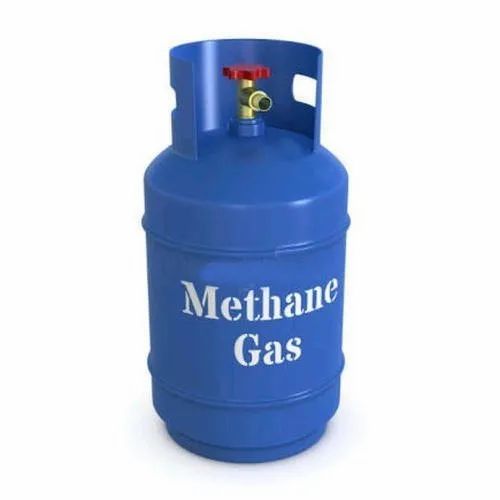
DOT-Tped-Ce-ISO-Certification-6kg-Gas-Cylinder-Methane-Gas-Storage-Tank-for-Restaurant-Cooking.jpg
 
na wa magari wako connected na pipeline sio? Usichotaka kujua ni kwamba our natural gas inaweza kuwa stored into cylinders pia!

liquid-sulfur-dioxide-2--500x500.jpg


DOT-Tped-Ce-ISO-Certification-6kg-Gas-Cylinder-Methane-Gas-Storage-Tank-for-Restaurant-Cooking.jpg
Geza, usichoelewa ni nini?, sasa hivi tunajaza "CNG katika Cylinders, hatujazi LNG. Tofauti ni kwamba, mtungi unaoingi Lita 100 ya LNG, uttaingiza Lita 30 tu za CNG, ndio sababu CNG cylinders haitumiki katika "Commercial purposes kwa sasa.

Huo mtungi wa Methane haina maana kwamba umejazwa na gas ya Tanzania, hiyo inawezakana ikawa ni imported. Kama hiyo Methane gas ipo katika "Liquid form, lazima itakua ni imported.

Kama ni kutoka hapa Tanzania, bus ni compressed form, na Mara nyingi hutumika katika laboratories mbalimbali nchini, sio kwa ajili ya matumizi ya nyumbani.
 
Geza, usichoelewa ni nini?, sasa hivi tunajaza "CNG katika Cylinders, hatujazi LNG. Tofauti ni kwamba, mtungi unaoingi Lita 100 ya LNG, uttaingiza Lita 30 tu za CNG, ndio sababu CNG cylinders haitumiki katika "Commercial purposes kwa sasa.

Huo mtungi wa Methane haina maana kwamba umejazwa na gas ya Tanzania, hiyo inawezakana ikawa ni imported. Kama hiyo Methane gas ipo katika "Liquid form, lazima itakua ni imported.

Kama ni kutoka hapa Tanzania, bus ni compressed form, na Mara nyingi hutumika katika laboratories mbalimbali nchini, sio kwa ajili ya matumizi ya nyumbani.
Ninaelewa usijaribu kunifundisha, its called volumetric energy density!


leta evidence basi ya bold highlighted ratio na si unapotea unaende ku-google unarudi kama mtaalam!
 
Huyo dada hapo pembeni unaona kuna Pipe ya gas na koki ya kufunga na kufungua, huyo ameshaunganishwa moja kwa moja no Songosongo mtwara, huyo anatumi CNG(Compressed Natural Gas) toka mtwara, sio LNG kwasababu Africa nzima hatuna kiwanda cha LNG.[emoji23][emoji23][emoji23]

Mimi ndo nakufungua macho toka kwa ujinga wa kutojua natural gas inaweza kuwa stored in special CNG cylinders kama zinazotumika kwenye magari! Ule ujinga wako wa kulazimisha lazma iwe liqufied LNG ili isafirishwe kwa pipeline nimeundoa! Nimekufuta tongotongo na kukata ngebe za uropokaji mzee ☝️!
 
Hivi unajua gesi inayoletwa na tankers Dar port hubadilishwa kutoka kuwa nzito iliyogandamizwa na kugandishwa kama nta na kuwa kwenye nyepesi (gas form aka thawing aka regasification) kabla ya kuingizwa kwenye mitungi na kusambazwa kwa wateja? Hivi unajua LPG gas ya magari ni tofauti (combustion-wise) na butane gas ya kupikia nyumbani?

Ngoja nikupe lecture kijana usiwe unaropokaropoka!

Pata insight ya kwanini compression kabla ya kubebwa kwenye LPG/LNG tankers


Understanding The Design of Liquefied Gas Carriers​

By Soumya Chakraborty | In: Naval Architecture | Last Updated on May 15, 2020


4.9KSHARES
Share
Tweet
Share
Pin
In our previous article we described design of different types of tankers. In this article we will understand types and design of liquified gas carrier vessels.

Ships that are designed to carry liquefied gas have become more significant and increased in number in the recent years, with the increasing need for alternative fuel.

The two main types of liquefied gas carriers are

  1. LPG (Liquefied Petroleum Gas) Carriers, and
  2. LNG (Liquefied Natural Gas) Carriers.
To understand the design characteristics of these two types of ships, we first need to know a few notable details about the composition and properties of LPG and LNG.

Liquefied Petroleum Gas (LPG):
Petroleum hydrocarbon products such as Propane and Butane, and mixtures of both have been categorised by the oil industry as LPG. It is widely used in domestic and industrial purposes today. The most important property of LPG is that it is suitable for being pressurised into liquid form and transported. But there are conditions related to pressure and temperature that need to be maintained for the above to be carried out without posing threat to life, environment, and cargo. At least one of the following conditions need to be complied with, for transportation of LPG:

  • The gas should be pressurised at ambient temperature.
  • The gas should be fully refrigerated at its boiling point. Boiling point of LPG rangers from -30 degree Celsius to -48 degree celsius. This condition is called fully-refrigerated condition.
  • The gas must be semi-refrigerated to a reduced temperature and pressurised.
We will see, at a later stage, how the above conditions affect the design of different types of LPG tankers.
Other gases such as ammonia, ethylene and propylene are also transported in liquefied form in LPG carriers. Ethylene, however, has a lower boiling point (-140 degree celsius) than other LPGs. Hence it must be carried in semi-refrigerated or fully-refrigerated conditions.

Liquefied Natural Gas (LNG):
Natural gas from which impurities like sulphur and carbon-dioxide have been removed, is called Liquefied Natural Gas. After removal of impurities, it is cooled to its boiling point (-165 degree Celsius), at or almost at atmospheric pressure. Note here, that unlike LPG, LNG is cooled to low temperatures but not pressurised much above atmospheric pressure. This is what makes the design of LNG carriers slightly different from LPG carriers. LNG, at this condition is transported as liquid methane.

Design of Different Types of Gas Carriers:
In this article, we will understand the general arrangement, and other design details of gas carriers as and when we look into the different types of vessels based on their functionality and type of cargo being carried. The most important feature of gas carriers is the cargo containment system. It is according to this criteria that LPG carriers are categorised into types.

Integral Tanks:
These are the tanks that form a primary structural part of the ship and are influenced by the loads coming onto the hull structure. They are mainly used for cases when LPG is to be carried at conditions close to atmospheric condition, for example – Butane. That is because, in this case, there are no requirements for expansion or contraction of the tank structure.

Independent Tanks:
These tanks are self-supporting in nature, and they do not form an integral part of the hull structure. Hence, they do not contribute to the overall strength of the hull girder. According to IGC Code, Chapter 4, independent tanks are categorised into three types:

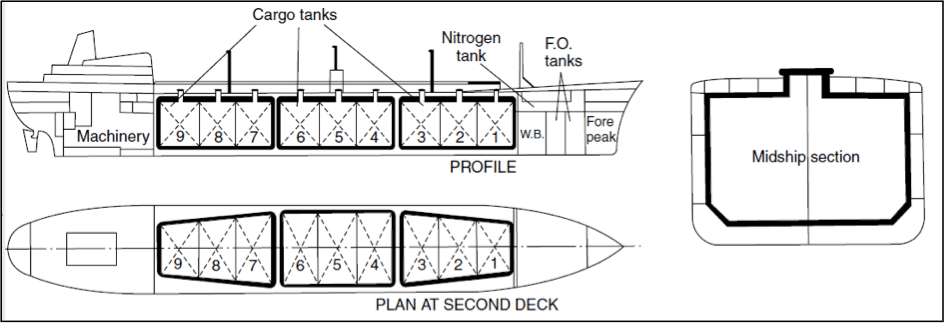
Type ‘A’ Tanks: These tanks are designed using the traditional method of ship structural design. LPG at near-atmospheric conditions or LNG can be carried in these tanks. The design pressure of Type A tanks is less than 700 mbar. The following figures show the general arrangement of a liquid methane carrier with Type ‘A’ tanks.

Liquefied Gas Carrier

Figure 1: General Arrangement of Methane Carrier with Type A Tanks.

The general arrangement of an LPG ship is almost same as that of an oil carrier, with the cargo tanks spread over a certain length forward and abaft the midship, the machinery and superstructure at the aft. A forecastle is fitted at the bow so as to prevent green waters on deck. Ballast water cannot be carried in the cargo tanks, hence spaces for ballast are provided by incorporating double hull spaces (note the double hull in the midship section), bilge and upper wing tanks.

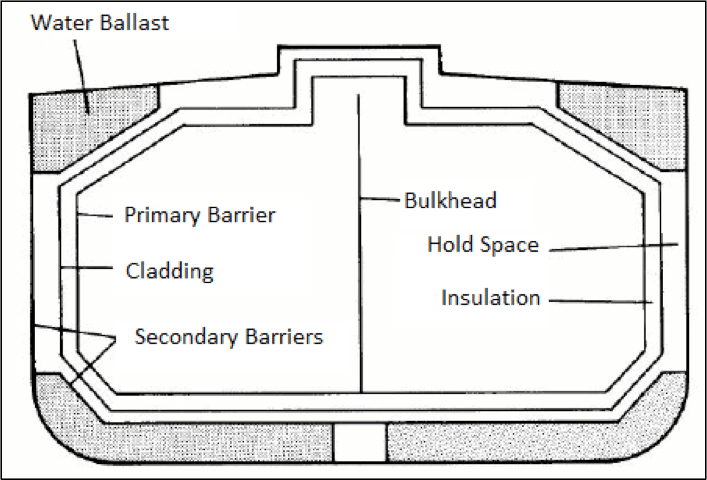
The most notable and distinguishing feature of Type ‘A’ tanks is that the IGC Code specifies that Type ‘A’ tanks must have a secondary barrier to contain any leakage for at least 15 days. The secondary barrier must be a complete barrier of such capacity that it is sufficient to contain the entire tank volume at any heel angle. Often, this secondary barrier comprises of the spaces in the ship’s hull as shown in the figure below.

Secondary Barrier for Type 'A' Tank.'A' Tank.

Figure 2: Secondary Barrier for Type ‘A’ Tank.

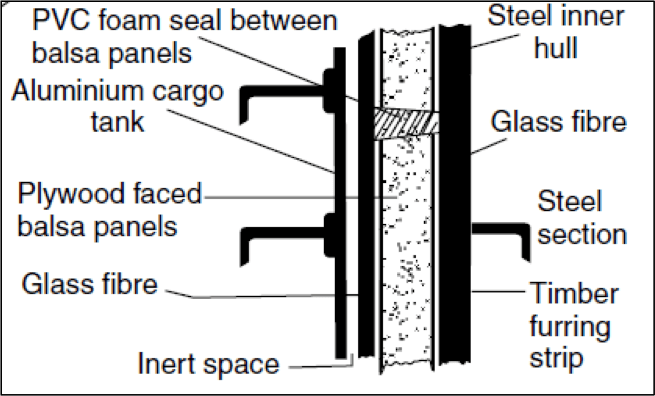
One important question that could arise, here, is that the tank in the midship section view seems to be an integral part of the hull. Why then, is this type of tanks categorised under Independent Tanks? To find the answer we need to have a closer look at how the tank is installed in the hull.
Integration of Type-A tank with hull structure.

Figure 3: Integration of Type-A tank with hull structure.

The above figure shows how the aluminum tank structure is not integrated to the inner hull of the methane carrier by means of any metal contact. The inner hull plating and aluminum tank plating are separated by layers consisting of timber, glass fibre, and balsa panels for insulation from external temperatures. The balsa panels are held together by plywood on both faces which are sealed using PVC foam seals. An inert space of 2 or 3 mm separates the inner glass fibre layer from the aluminum tank plate. This space is provided for insulation and also allows expansion and contraction of the tank structure. This type of non-welded integration makes this tank structurally independent in nature.

Type ‘B’ Tanks: The concept behind the design of such tanks is to have such a structure in which a crack can be detected long before the actual failure. This allows a time margin before the actual failure occurs. The methods used for design of such tanks include determination of stress levels at various temperatures and pressures by first principle analyses, determination of fatigue life of tank structure, and study of crack propagation characteristics. This enhanced design of such tanks requires on a partial barrier, that we will look into, soon.

The most common arrangement of Type ‘B’ tank is Kvaerner-Moss Spherical Tank, as shown below in Figure 4.
gas carrier ship

Figure 4: Kvaerner-Moss Spherical Tank

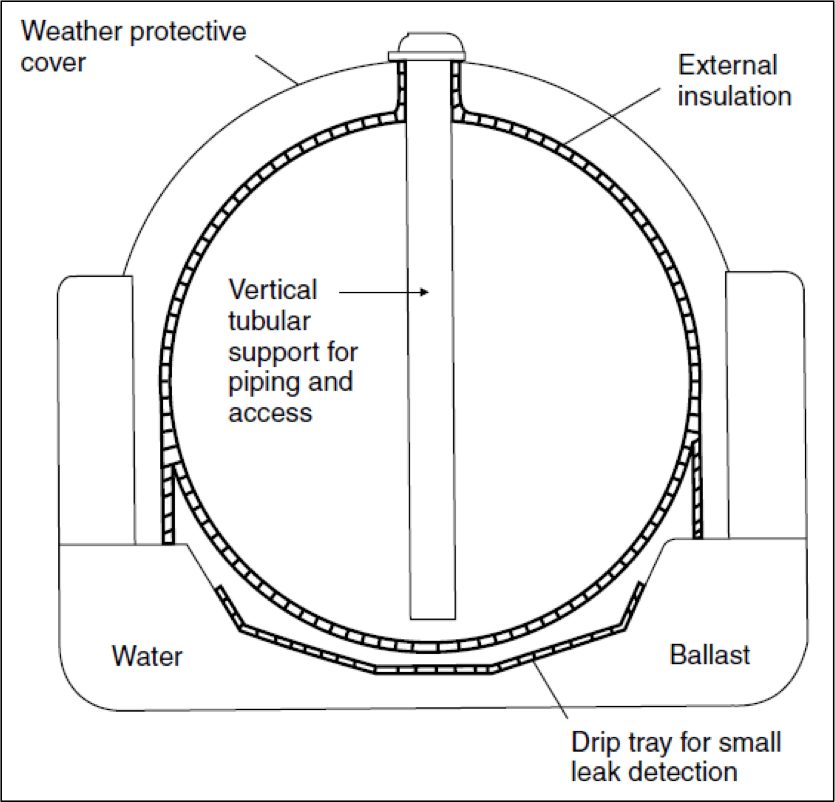
The tank structure is spherical in shape, and it is so positioned in the ship’s hull that only half or a greater portion of the sphere is under the main deck level. The outer surface of the tank plating is provided with external insulation, and the portion of the tank above the main deck level is protected by a weather protective layer. A vertical tubular support is led from the top of the tank to the bottom, which houses the piping and the access rungs.

As evident from the layout, any leakage in the tank would cause the spill to accumulate on the drip tray below the tank. The drip pan and the equatorial region of the tank are equipped with temperature sensors to detect the presence of LNG. This acts as a partial secondary barrier for the tank.

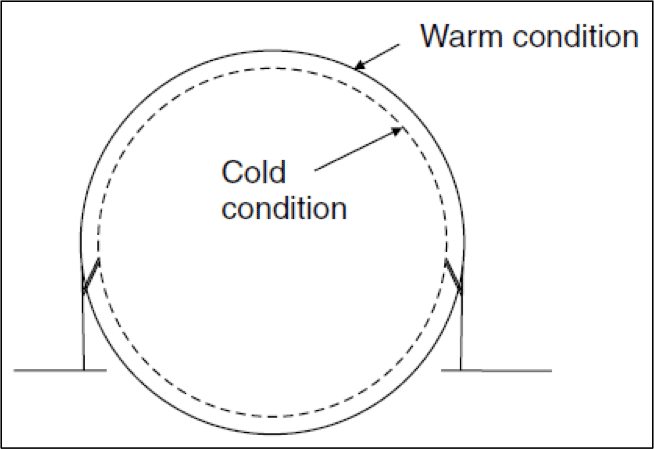
LNG is usually carried in this type of tanks. A flexible foundation allows free expansion and contraction according to thermal conditions, and such dimensional changes do not interact with the primary hull structure, as shown in Figure 5.
Expansion and Contraction of Spherical Tanks.

Figure 5: Expansion and Contraction of Spherical Tanks.

The following are the advantages of Kvaerner-Moss Spherical tanks:
  • It enables space between the inner and outer hull (see Figure 4.) and this can be used for ballast and provided protection to cargo in case of side-ward collision damages.
  • The spherical shape allows even distribution of stress, therefore reducing the risk of fracture or failure.
  • Since ‘Leak before Failure’ concept is used in the design, it presumes and ensures that the primary barrier (tank shell) will fail progressively and not catastrophically. This allows crack generation to occur before it propagates and causes ultimate failure.

Type ‘C’ Tanks: These tanks are designed as cryogenic pressure vessels, using conventional pressure vessel codes, and the dominant design criteria is the vapour pressure. The design pressure for these tanks is in ranges above 2000 mbar. The most common shapes for these tanks are cylindrical and bi-lobe. Though Type ‘C’ tanks are used in both, LPG and LNG carriers, it is the dominant design in LNG carriers.

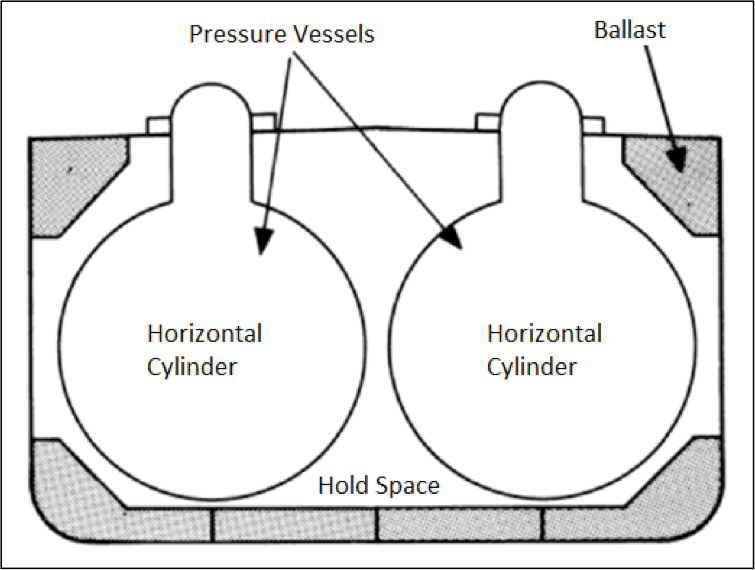
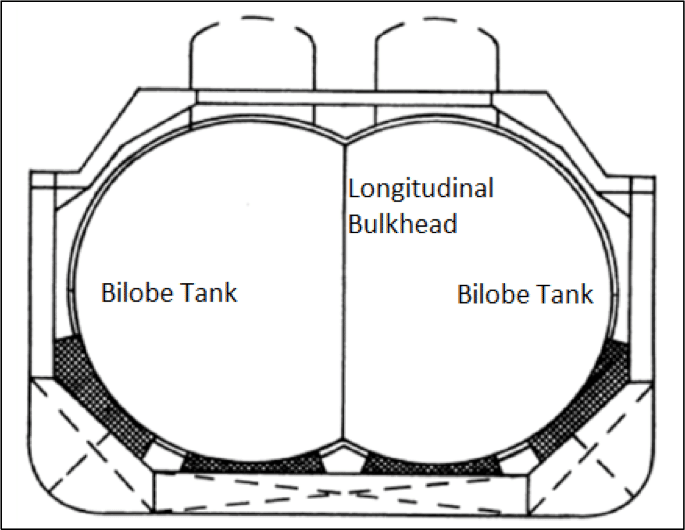
The following figures show the arrangements of cylindrical and bilobe tank arrangements in midship view. The cylinders can be either vertically or horizontally mounted, depending on the dimensions and spatial constraints of the ship. Note, in Figure 6, that the space between the two cylinders is rendered useless. Due to this, the use of cylindrical tanks is a poor use of the hull volume. In order to circumvent this, the pressure vessels are made to intersect, or bilobe tanks are used (Figure 7).
gas tanks

Figure 6: Horizontal Cylinder Tanks in LNG carrier.

Bilobe tank arrangement in LNG carrier.

Figure 7: Bilobe tank arrangement in LNG carrier.

These types of tanks do not require a secondary barrier. Rather, to detect the leakage of cargo from the tanks, the hold space (refer to Figure 6) is filled with inert gas or dry air. Sensors placed in the hold space can detect the change in composition of the inert gas or dry air due to fuel vapour, and leakages can hence be detected and prevented. Bilobe tanks at the forward end of the ship are tapered at the end.

Membrane Tanks:
Unlike independent tanks, membrane tanks are non-self-supporting structures. Their primary barrier consists of a thin layer of membrane (0.7 to 1.5 mm thick). The membrane is supported to the inner hull structure through an insulation that can range upto 10 mm thickness as per IMO IGC Code. Due to their non-self-supporting nature, the inner hull bears the loads imparted onto the tank. This way, the expansions and contractions due to thermal fluctuations are compensated by not allowing the stress to be taken up by the membrane itself. Membrane tanks are primarily used for LNG cargo.

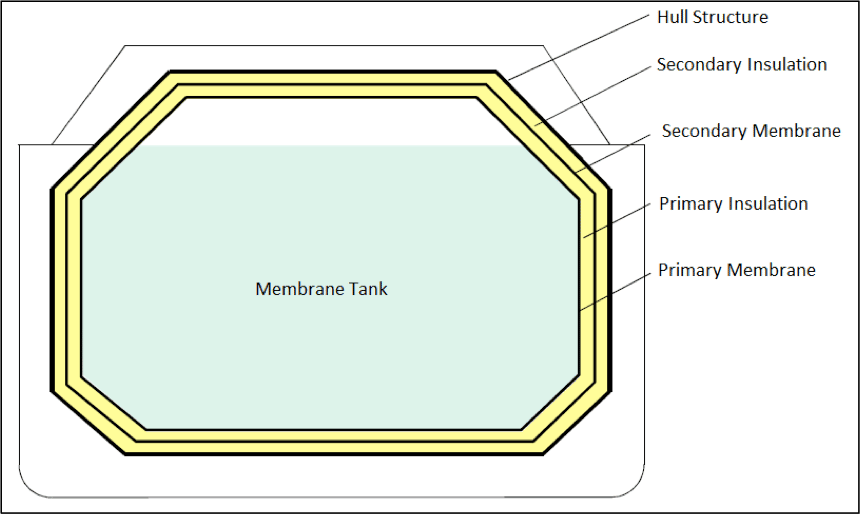
Often, there are two layers (primary and secondary) of insulation and membranes placed alternatively. The most common types of membtane tanks are the ones designed and developed by two French companies Technigaz and Gaz Transport.

The Tehnigaz system makes use of a stainless steel system that is constructed with corrugated sheets in such a way that one sheet is free to expand or contract independent of the adjacent sheet. The Gaz Transport system uses Invar as the primary and secondary membranes. Invar has low coefficient of thermal expansion, which makes corrugations unnecessary. The insulation is usually made of materials like Reinforced Polyurethane. In GTT membrane tanks, the primary membrane is made of Corrugated SUS 304, and the secondary membrane is made of Glued Triplex. Figure 8 illustrates the anatomy of twin-membrane tanks.

membrane tank

Figure 8: Parts of a membrane tank.

Primary membrane

Figure 9: Interior (Primary membrane) of a Membrane tank on an LNG carrier. (Source: Wikipedia)

Some of the advantages of membrane tanks are as follows:
  • They are generally of smaller gross tonnage, that is the space occupied within the hull is lower for a given cargo volume.
  • Due to the above reason, maximum space in the hold can be used for cargo containment.
  • Since the height of tanks above the main deck is significantly lesser compared to the cases of Moss tanks, membrane tanks provide allow visibility from the navigational bridge. This also allows a lower wheelhouse. This can be compared in Figures 10 and 11.
LNG Carrier

Figure 10: An LNG Carrier with Moss type tanks. (Source: Wikipedia)

membrane type LNG carrier

Figure 11: A membrane type LNG carrier under construction in a shipyard. Note the height of tanks above the main deck and the height of the wheelhouse. (Source: Wikipedia)

LPG Containment Systems:
Unlike LNG, LPG cargo requires storage at conditions that are different from atmospheric conditions. The LPG containment systems are classified into three types, and each LPG carrier is designed according to any one of them.

Fully Pressurized Tanks:
Propane, Butane and Anhydrous ammonia are carried in fully pressurized tanks. The capacity of these tanks is usually less than 2000 cubic meters. They are usually uninsulated cylindrical pressure vessels that are arranged partly below main deck level. Since these are Type C tanks, they often prevent complete utilization of under deck volume.

Semi Pressurized or Semi Refrigerated Tanks:
Though the cargo carried by semi-pressurized ships are same as that of fully-pressurized ships, the volume of semi-pressurized ships is about 5000 cubic meters. These use Independent Type C tanks, and are constructed with ordinary grades of steel. The outer surface of these tanks are insulated, and refrigeration or reliquefication plants are installed on these ships to maintain the working pressure of the cargo. The most ommon types of tanks used for this purpose are cylindrical and bi-lobe type.
Fully Refrigerated Tanks:
Fully Refrigerated gas carriers have a capacity of 10,000 to 1,00,000 cubic meters. The ships in the smaller size range are used to carry multiple types of cargo, whereas the larger ones are designed for a single type of cargo to be transported on a permanent route. The tanks used for this purpose is usually Type ‘A’ prismatic tanks that are sloped at the top end to reduce free surface effect, and sloped at the bottom to suit the shape of the bilge structure. They are usually divided longitudinally by a liquid-tight bulkhead, in order to reduce free surface effects further. These tanks are constructed with notch ductile steel, in order to be provided with maximum notch toughness at temperatures as low as -48 degrees Celsius, at which cargo like Propane is transported.

The number of gas carriers have increased drastically over the last ten years, owing to the increasing need for alternative fuel. These are usually high speed ships with fine hull-form, which makes it possible for extensive research opportunities to improve on hull efficiencies in order to achieve more power efficiency. A lot of research is also being carried out to design advanced cargo containment systems and concepts of adjoining bunkering systems are being developed by various countries that are opening themselves to extensive use of natural gas. Today, not all shipyards are equipped to design and build specialised ships like LPG and LNG carriers. This leaves a wide scope for designers and shipbuilders to develop skills and infrastructure to specialise in building these ships.

Disclaimer: The authors’ views expressed in this article do not necessarily reflect the views of Marine Insight. Data and charts, if used, in the article have been sourced from available information and have not been authenticated by any statutory authority. The author and Marine Insight do not claim it to be accurate nor accept any responsibility for the same. The views constitute only the opinions and do not constitute any guidelines or recommendation on any course of action to be followed by the reader.

The article or images cannot be reproduced, copied, shared or used in any form without the permission of the author and Marine Insight

Understanding The Design of Liquefied Gas Carriers.

Asante professor. Umenifunza mambo mengi kuhusu LNG.
 
Ninaelewa usijaribu kunifundisha, its called volumetric energy density! mimi ndo nakufungua macho! kwa ujinga wa kutojua natural gas inaweza kuwa stored in special CNG cylinders kama zinazotumika kwenye magari! Ule ujinga wako wa kulazimisha lazma iwe liqufied LNG ili isafirishwe kwa pipeline nimeundoa! Nimekufuta tongotongo na kukata ngebe za uropokaji mzee [emoji3516]!
Ninarudia tena, Africa hakuna kiwanda cha LNG, lengo la kugeuza gas iwe katika liquid form ni ili iweze kuingia nyingi katika nafasi ndogo iweze kuwa " Commercially viable. Kila mtungi wenye gas ya LNG hapa Africa ujue hiyo gas inatoka nje ya Africa.

Tanzania na Africa kwa ujumla, tunachoweza kufanya ni kujaza "Compressed Natural gas " ambayo inaingia kidogo sana katika containers kwasababu inachukua nafasi kubwa ukilinganisha na Liquid form

Kutokana na kuchukua nafasi kubwa kwa compressed Natural gas, utaitaji mitungi mikubwa zaidi ili kujaza ujazo uleule wa Liquid form.

Meli yenye nafasi ya kubeba 40millio kg of gas in LNG, zitahitajika meli 3 au 4 kubeba uzito huo huo kama hiyo gas ipo katika form ya CNG, kwasababu gas inachukua nafasi kubwa kuliko Liquid .

Kwa maana hiyo, CNG iliyojazwa katika mutungi, haitumiki Katika biashara, ili upate faida CNG ni lazima utumie moja kwa moja toka katika bomba.

Geza, huna fact katika hili eneo, naona pumzi zimeanza kukata [emoji23][emoji23][emoji23][emoji23]
 
Ninarudia tena, Africa hakuna kiwanda cha LNG, lengo la kugeuza gas iwe katika liquid form ni ili iweze kuingia nyingi katika nafasi ndogo iweze kuwa " Commercially viable. Kila mtungi wenye gas ya LNG hapa Africa ujue hiyo gas inatoka nje ya Africa.

Tanzania na Africa kwa ujumla, tunachoweza kufanya ni kujaza "Compressed Natural gas " ambayo inaingia kidogo sana katika containers kwasababu inachukua nafasi kubwa ukilinganisha na Liquid form

Kutokana na kuchukua nafasi kubwa kwa compressed Natural gas, utaitaji mitungi mikubwa zaidi ili kujaza ujazo uleule wa Liquid form.

Meli yenye nafasi ya kubeba 40millio kg of gas in LNG, zitahitajika meli 3 au 4 kubeba uzito huo huo kama hiyo gas ipo katika form ya CNG, kwasababu gas inachukua nafasi kubwa kuliko Liquid .

Kwa maana hiyo, CNG iliyojazwa katika mutungi, haitumiki Katika biashara, ili upate faida CNG ni lazima utumie moja kwa moja toka katika bomba.

Geza, huna fact katika hili eneo, naona pumzi zimeanza kukata [emoji23][emoji23][emoji23][emoji23]

Mie nimepewa asante na Tony254 of all the people kagundua ulikuwa unampeleka chaka na uropokaji na nafunga mjadala juu ya LPG vs LNG vs CNG rasmi!
 
Mie nimepewa asante na Tony254 of all the people kagundua ulikuwa unampeleka chaka na uropkaji!
[emoji23][emoji23][emoji23][emoji23], Huyo Tony254 ananichukia kwasababu mimi ninaunga mkono Egypt kulibomoa bwawa la Ethiopia, anaogopa ule mkopo wao wa WB waliokopa kujenga ile njia ya umeme kwenda Ethiopia itaingia katoka orodha ya "White elephant Projects "[emoji23][emoji23][emoji23][emoji23]
 
Hapana sio hivyo, gas ili iweze kusafirishwa lazima iwe katika "Liquid form", na ili gas iweze kuwa katika liquid form, lazima volume yake ipunguzwe zaidi ya mara Elfu moja, yaani lita moja ya "liquid gas" inapatikana baada ya ku-compress 1000 litres of gas form.

Hii maana yake ni kwamba, liquid form ipo katika pressure kubwa sana, kwahiyo lazima iweze kuhifadhiwa katika containers za chuma imara na kigumu sana. Tankers za meli au magari yabayosafirisha gas, zile containers zimetengeza kwa chuma kizito sana ili kuimili hiyo pressure. Hii ndio maana haiwezikani "Liquid form" kusafirishwa katika bomba refu kwasababu hilo bomba lazima liwe imara kama mitungi ya gas au tankers.
Nadhani Geza Ulole yuko sahihi. Soma post yake #163 vizuri utamuelewa zaidi.
 
Back
Top Bottom