NB:THIS ARTICLE IS FOR THOSE WHO LIKE READING.IF YOU ARE A POOR READER AND DO NOT LIKE LEARNING,DO NOT ATTEMPT TO READ THE ARTICLE,PLEASE PASS-OVER.
Despite the Khazarian Mafias' attempts to retake Ukraine,Russia will not let it go,despite the odds.This article explains why.
The Khazarian Mafia(a multi-century blood feud), is a vicious,malicious, repugnant,malevolent, vile,wicked, vengeful and vindictive tribe which has raped, pillaged and plundered the Earth and her peoples over the course of centuries.
Were the whole world to know the hidden history about “the Ukraine” (which translates to “borderland”), there would be no Ukraine War today. The true perpetrators of this barbaric Ukraine-Russia conflict would be found out and held fully responsible for all of their heinous crime sprees committed against the human race over the centuries. The many genocidal cataclysms perpetrated throughout the 20th century and right up to today would be properly laid at their feet. See the list that follows.
The Armenian Genocide,
World War I,
Bolshevik Revolution,
Spanish Flu Pandemic,
The Great Depression,
Holodomor Genocide,
Chinese Civil War,
World War II,
Korean War,
The Holocaust,
Chinese Cultural Revolution,
Vietnam War,
Cambodian Genocide,
Rwandan Genocide,
Iraq War,
9/11 Terrorist Attacks,
The War on Terror,
Afghanistan War,
Syrian War,
Libyan War,
Ukraine War,
& COVID-19 Pandemic
all have one hidden hand responsible:the Khazarian
As a matter of historical fact, each of these highly calculated genocides was carried out by the same Khazarian Tribe, which always stays carefully hidden in the background during the fastidiously engineered evolution of every calamity of the modern era.
With this correct understanding, the following accurate exposition of the true history of the long and complicated relationship between Russia and Ukraine can be much better comprehended. For the final outcome of the stealthily fabricated feud (by the Khazarian Tribe) between them will surely dictate the fate of humanity and future of the planet.
N.B. It’s of paramount importance as the reader peruses the excellent disquisition below to be aware of the common thread that runs through every century, every decade, every year, every phase of conflict between the Orthodox Christian Rus’ people and the Khazarian Jewish Zionists. That thread can be recognized by the relentless warmongering of the different elements within the Khazarian tribe variously known as the Ashkenazi banksters, Zionist warmongers and Khazarian mafia. The horrendous state of the Ukraine today is directly due to the incessant warmongering of the most recent generation of Khazarian tribals,the Neocon Zionists,who effectively dominate the Zio-Anglo-America Axis of power that dominates the world today.
The book,"Egor Kholmogorov: The intertwined roots of history," explains why Russia can’t let go of Ukraine!
Centuries of shared history mean that the fate of Kiev will always remain Moscow’s core interest.
In August 1948, the US National Security Council issued memorandum (NSC 20/1 1948), requested by then Defense Secretary James Forrestal. The document described American objectives with respect to the Soviet Union.
A significant part of the memorandum focused on Ukraine. American analysts were convinced that the territory was an integral part of greater Russia, and it was highly unlikely that Ukrainians could exist as an independent nation. Most importantly, it noted, any support given to separatists would be met with a strong negative reaction by Russians.
“The economy of the Ukraine is inextricably intertwined with that of Russia as a whole … To attempt to carve it out of the Russian economy and to set it up as something separate would be as artificial and as destructive as an attempt to separate the Corn Belt, including the Great Lakes industrial area, from the economy of the United States…
Finally, we cannot be indifferent to the feelings of the Great Russians themselves … They will continue to be the strongest national element in that general area, under any status … The Ukrainian territory is as much a part of their national heritage as the Middle West is of ours, and they are conscious of that fact. A solution which attempts to separate the Ukraine entirely from the rest of Russia is bound to incur their resentment and opposition, and can be maintained, in the last analysis, only by force,” read the report.
It seems like today’s American establishment and media have forgotten something that was obvious to US analysts and politicians at a time when America was the only superpower with nuclear weapons. It would appear that the White House and EU now believe they can make Russians think of Ukraine as a different country through force and sanctions threats.
If the West is successful in its attempts to
“deter” Russia, it will get its reward – long-lasting resentment from Russians, who will view the US-led West as a force that prevents them from managing a big chunk of their historic land.
Why do Russians think of Ukraine as part of Russia?
The first important factor is personal ties.
Many Russian citizens were born in Ukraine, but they don’t think of themselves as Ukrainians – especially not in the sense understood by the Kiev government today. Even more Russians have relatives in Ukraine. It would be almost impossible to find a Russian citizen without any family ties to Ukraine.
Russians see it as the land of their forefathers,quite literally, as they can show you the graves of their ancestors and the land where their houses stood.
When the administrative boundaries between the republics of the USSR turned into real borders in 1991, eight million ethnic Russians became ‘Ukrainians’ on paper. Kharkov in Ukraine and Belgorod in Russia, for example, are essentially twin cities that were founded by Russian tsars as frontier fortresses against the Crimean Tatars in the mid-17th century. After the Soviet Union’s collapse, they ended up on the opposite sides of the border. Country houses belonging to residents of the Russian city were now in Ukraine and vice versa. People from Kharkov would now have to travel to a different country to get to their dacha.
Today, Russians in Russia are puzzled – why does the regime in Kiev think it has the right to make decisions about their land?
As a result, many support the so-called separatists in what was the east of Ukraine. The term is a tricky one though, as a Russian may consider the regime in Kiev to be separatists, while activists in Crimea or in the Donbass have actually separated themselves from the separatists and, by that logic, could be considered unionists. Activism in Crimea, the movement in the Donbass, and the protests in Odessa that were brutally repressed, back in 2014, are part of unionism in the context of one greater Russia, not separatism.
Many Russians not only lived but also worked in Ukraine, which was a key industrial area in Russia. Its industrial development can’t be attributed to Ukrainian national character – it was the tsars and then the Soviet authorities that focused on this region’s growth. The industrial density of eastern Ukraine could only compare to that of Germany’s Ruhr.
There are a significant number of Russians who worked for Ukrainian plants and factories at one point or another – manufacturing aircraft carriers, helicopters, spacecraft components, etc. These were elements of the complex economic system of the huge Soviet superpower. Independent Ukraine didn’t need any of that.
The political and economic elites of independent Ukraine treated the industrial ‘dowry’ they inherited not as a complex system in need of maintenance, but as wild walnut trees that they should harvest while the nuts still hung on the branches.
The Ukrainian leaders’ attitude towards the powerful gas transportation system that had been left to them by the USSR was characteristic – they perceived it as a tool for blackmail. Unable to create or improve the system, they threatened to block or destroy it if they did not receive more money for the right to pump gas through ‘their’ territory.
Hence the hysterical reaction of the Ukrainian elites to the construction of the Nord Stream 2 gas pipeline, linking Russia directly to Germany. The fact that the Western powers have supported this view has led to the largest gas crisis in European history.
Russians living in Russia, as well as those living in Ukraine, cannot understand why Ukrainian land should be used by NATO. In Russia, Ukraine’s possible accession to the US-led military bloc is not construed as a free choice made by the country in its own security interests, but as a means for the West to build advance bases for launching a direct attack on Moscow.
Do the Russians have historical grounds for considering this land their own, and for seeing the Kiev regime and NATO as the actual occupiers of this land? Definitely, in my view.
Kiev in modern Ukraine, Polatsk in contemporary Belarus, and Novgorod, Smolensk, and Rostov in today’s Russia were one state in ancient times – Rus.
Though Kiev, the ‘Mother of Russian cities,’ was the capital of this state, Novgorod, which is now part of Russia, played no lesser a role. Amazingly, anthropologists in northern Russia’s Arkhangelsk Region have recorded epic ballads about Prince Vladimir and his warriors, who baptized Rus, which are similar in many ways to legends about King Arthur and the knights of the round table. It is therefore obvious that the local population retained a direct cultural connection with the population of ancient Kiev and Russia. At the same time, no similar ballads have been preserved in modern Ukraine.
Kiev was almost destroyed as the result of the Mongol invasion by Genghis Khan’s grandson, Batu Khan, in 1240, and the fate of the inhabitants in different parts of Rus was divided after that. The eastern regions became vassals of the Mongols (Tatars) but continued to be ruled by direct male descendants of Prince Vladimir. The city of Moscow, with princes from this house, gradually gained hegemony and created a state that managed to gain independence.
A different fate awaited the inhabitants of Western Russia. The cities there lost the power of Prince Vladimir’s descendants, as well as their historical connection to ancient Kiev. They were conquered by Lithuania, which soon merged with Poland to form a single state – the Polish-Lithuanian Commonwealth. Since these lands were cut in half by the practically impassable Polesie Marshes, two different groups of Russian origin emerged there during the Middle Ages: Belarusians to the north of the marshes, and ‘Little Russians’ to the south.
The Muscovite princes, who became tsars in 1549, always proclaimed their right to these lands and demanded their return from Poland, leading a slow kind of ‘Reconquista’. Poland lost the support of its Little Russian and Belarusian subjects in this struggle after it announced the religious Union of Brest in 1596 and began persecuting the Orthodox Church and its adherents. An Orthodox resistance movement emerged in the territories of Little Russia shortly thereafter.
The resistance’s strike force was the Cossacks – a community of free warriors that assembled in the steppe for battles with the Tatars and Turks. A Cossack could be a native of any country who professed Orthodox Christianity and was ready to fight for it. As Poland progressively persecuted the Orthodox religion, the Cossacks increasingly raised their sabers against it. One of the episodes in this struggle was described in a historical novella entitled ‘Taras Bulba’ by Nikolai Gogol. Although he was born in Poltava, which is now in modern Ukraine, the great author always wrote in Russian and criticized acquaintances who tried to create a separate ‘Ukrainian’ language.
In 1648, the leader (hetman) of the Cossacks, Bogdan Khmelnitsky, sparked a great uprising against Poland in defense of oppressed Orthodoxy. After winning a number of victories, he triumphantly entered Kiev and was met by church leaders. He then created a state – the Zaporozhian Host – which in many ways resembled the rebellious republics of the Donbass now recognized by Russia.
In 1654, after the resolutions of a Zemsky Sobor (a kind of parliament representing feudal classes) in Moscow and a Rada (a kind of people’s assembly) in Pereyaslavl near Kiev, Khmelnitsky’s state became part of Russia.
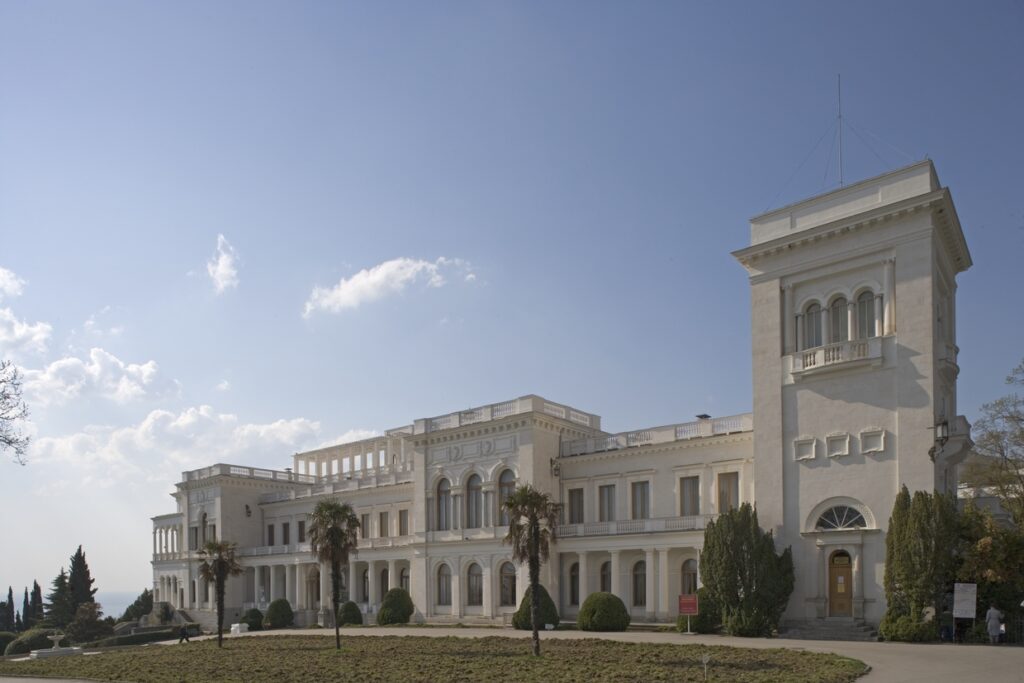
Livadia Palace created as a summer retreat for Tsar Nicholas II and served as the location for the Yalta Conference in 1945, Yalta, Crimea. © DeAgostini / Getty Images
Tsar Aleksey Mikhaylovich was declared ‘Tsar of All Great, Little, and White Russia’ and began a grueling 13-year war with Poland, which ended with a partial victory – the lands on the left bank of the Dnieper were ceded to Russia, and the Russian Tsardom bought Kiev, the ancient capital of Rus on the right, for 146,000 silver rubles and seven tons of silver, which the richest Polish families divided among themselves.
Subsequently, many Little Russians from the territory of modern Ukraine moved north and settled throughout the vast reaches of Russia, making careers both in the church and at court. The word ‘Ukraine’ was not used as a place name at all during this period – in both Russian and Polish it meant ‘borderland’ or ‘frontier’. Its use as a name referring to the territories around Kiev only began in the 18th century, when these lands really did become a borderland during the constant wars between Russia and Turkey.
The integration of Little Russians into Russia was not even disrupted by the adventure of Hetman Mazepa, who betrayed Peter the Great out of personal interests and sided with the Russian leader’s enemy King Charles XII of Sweden. Mazepa was abandoned by everyone except his personal guards, and a fierce guerrilla war began against the Swedish troops that entered the territory of modern Ukraine. The first attempt to exploit the concept of ‘Ukrainian separatism’ ended in disaster for the party that tried to employ it.
By the middle of the 18th century, the integration of Little Russians and Russia was extremely tight. Singer and musician Alexey Razumovsky, born near Chernigov, became the secret husband of Peter’s daughter, Empress Elizabeth Petrovna. Moreover, the brother of this ‘Night Emperor’, Kirill, was simultaneously the hetman of the Zaporozhian Host and president of the St. Petersburg Academy of Sciences. Later, his numerous legitimate and illegitimate descendants formed an influential clan in the aristocracy of the Russian Empire.
The new empress, Catherine II, abolished the Zaporozhian Host and relocated the remnants of the Cossacks to the Kuban, in the North Caucasus. She also decisively conquered the steppes of southern Russia from the Tatars and Turks and, along with her secret husband, Prince Potemkin, founded a new part of Russia there – Novorossiya. The population of this area was extremely diverse. First of all, there were peasant and ‘Great Russian’ parts of the country, but there were also Greeks, Serbs, and a lot of Germans invited by the Empress, who were born in a small German principality. In fact, Novorossiya bore little resemblance to old Little Russia.
Novorossiya was the Russian equivalent of the New World, except that it wasn’t separated by an ocean. In the 19th century, industry was actively developed in the city now called Donetsk, commerce blossomed in Odessa, which was founded by a Spanish nobleman in the Russian civil service named De Ribas, and resort areas began to sprout up in Sevastopol and Crimea, bizarrely mixed with naval bases.
During the three partitions of Poland, which Russia participated in along with Prussia and the Austrian Empire, Catherine II finally finished the work begun by Aleksey Mikhaylovich. Russia reunited almost all the lands belonging to ancient Rus, along with their peasant populations, which had preserved the Russian language and maintained Orthodox Christian traditions.
The inhabitants of these territories began to return to their Russian identity. The fate of the family of the great Russian writer Dostoevsky can be taken as an example. The writer’s grandfather was a ‘Uniate’ priest at a Catholic Church near Vinnytsia, which is located in modern Ukraine, but returned to Orthodoxy after Russia annexed the territory. The writer’s father went to Moscow and made a brilliant career as a military surgeon. And Dostoevsky himself became a great writer who once penned: “
The master of the Russian land is solely Russian (Great Russian, Little Russian, Belarusian – it’s all the same).”
In the partition of Poland, Russia did not go beyond the borders of ancient Rus and even ceded the Old Russian city of Lvov to Austria. However, all the members of the privileged classes on these lands considered themselves Poles, and the land to be Polish, so they waged a stubborn struggle against the Russian government, both openly and clandestinely. As part of this battle, they began to spread the idea that the peasant population of western Russia was not Russian, but ‘Ukrainian’, a separate people that was closer to the Poles. Therefore, Russia had no right to these territories, the propaganda claimed.
Some young Russian intellectuals embraced this idea during the ‘Springtime of the Peoples’, a series of revolutions that shook Europe in the mid-19th century, when original nationalities were discovered, and even sometimes invented. Ukrainophiles like the acclaimed genius of Ukrainian literature, Taras Shevchenko, collected Little Russian songs and wrote poems in a similar style.
Ukrainophile propaganda was met with hostility by both Russia’s imperial government and Russian society, which hadn’t felt any difference at all between the lands of Little Russia and the rest of Russia for a long time. The life of Little Russians did not seem to be anything extraordinary in light of the much more colorful lives of the Don, Kuban, and Terek Cossacks. And most importantly, the majority of those pushing this propaganda ended up disappointed in it themselves – when they realized that this idea primarily served the interests of the Poles, the enthusiasm for Ukrainophilism cooled considerably.
However, the Ukrainian idea survived thanks to Austria, which provided an academy dedicated to Ukrainian studies in the city of Lvov, as well as a generous subsidy to Ukrainophile historian Mikhail Grushevsky. Torn apart by ethnic conflicts, the Austrian Empire had two primary objectives. Firstly, to prove that those living in Galicia and its capital, Lvov, which belonged to it at the time, were not Russian, but Ukrainians, who were an entirely different people, because this would mean that Russia had no right to claim this land. Secondly, to prove to the Poles living in Lvov that they had no right to this city either. Grushevsky began to construct a Ukrainian historical myth revolving around Galicia. He also published a Ukrainian language newspaper, inventing several new ‘Ukrainian’ words for each issue.
The moment of truth came during the First World War, when Austria committed real acts of genocide against those in Galicia who displayed a political or cultural orientation towards Russia. More than 30,000 Galician ‘Muscovites’ and representatives of small ethnic groups who spoke their own Russian dialects – Rusyns and Lemkos – were thrown into the Thalerhof and Terezin concentration camps, the predecessors of Auschwitz. Thousands of people there were tortured by Austrian guards and died of hunger or disease.
The inhabitants of southern Russia captured by the Austrians during the war were placed in special camps where Grushevsky’s followers tried to inspire them with the belief that they were Ukrainians. This attempt ultimately failed, however. In a letter to his friend Inessa Armand, Vladimir Lenin, who himself maintained close contacts with Austrian and German special services, described an escaped prisoner’s account of this
“experiment,” in which 27,000 people forcibly participated, as follows:
“Ukrainians were sent clever lecturers from Galicia. Results? Only 2,000 were for ‘independence’ … after a month’s efforts by the propagandists!! Others flew into a rage at the thought of separating from Russia and going over to the Germans or Austrians. A significant fact! It’s undeniable that … the conditions for Galician propaganda are most opportune. And yet the proximity to the Great Russians prevailed!”
Nevertheless, after seizing power in Russia, Lenin recognized the self-proclaimed Ukrainian People’s Republic headed by Grushevsky in Kiev. Then, during the civil war against the White defenders of ‘a united and indivisible Russia’, he demanded that his comrades in arms emphasize – or at least pretend – that an
“independent communist Ukraine” existed.
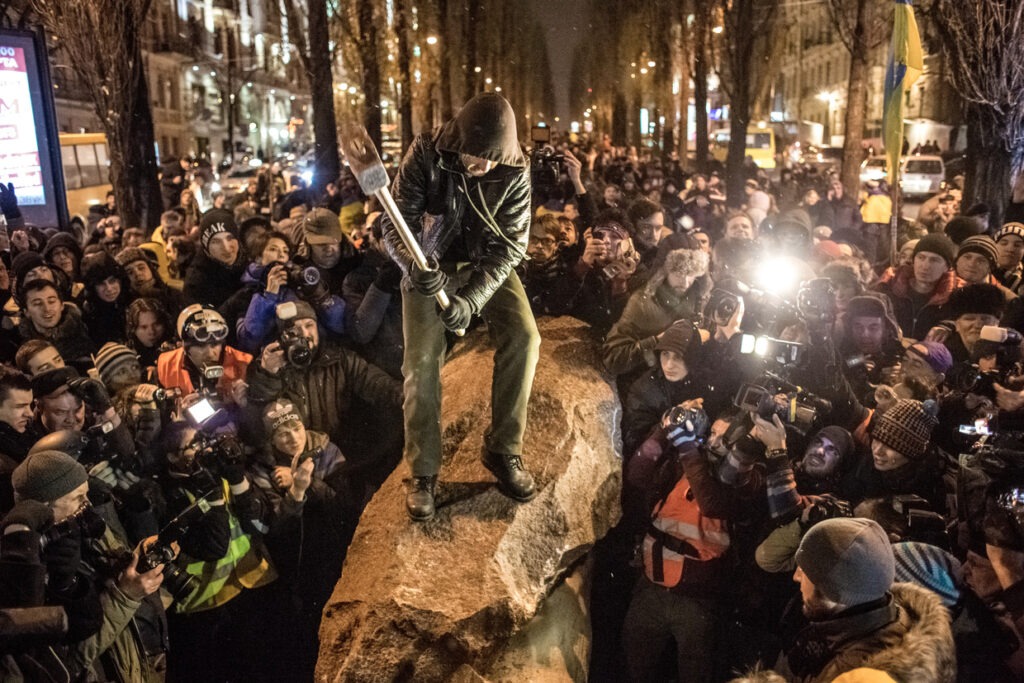
Protesters hammer at the toppled statue of Lenin on Kiev’s Bessarabska Square. © Sputnik / Andrey Stenin
Perfectly aware of how unacceptable Ukrainian propaganda was to the masses, Lenin, nevertheless, insisted on creating a ‘Ukraine’ in order to weaken
“the Great Russian oppressor,” as he called the Russian Empire’s leading ethnic group. It was to protect Ukraine from ultimately dissolving into Russia that Lenin rejected Stalin’s plan to turn peripheral areas into autonomous regions within Soviet Russia. Instead, he insisted on creating a Union of Soviet Socialist Republics, which is described in its statutory documents as a rather loose confederation with a right to exit. Current Ukraine dates back to the ‘Ukrainian Soviet Socialist Republic’ (Ukrainian SSR) that was created within the framework of this Leninist project.
The problem was, there were practically no Ukrainians in Soviet Ukraine, so the Soviet government took an unheard-of step – it invited its ideological enemy, Grushevsky, the former president of the Ukrainian People’s Republic, to the Ukrainian SSR and entrusted him with carrying out the ‘Ukrainization’ of public education. For a decade and a half, schoolchildren there could only receive a school education in Ukrainian, using Grushevsky’s textbooks.
The campaign in government ministries and departments was no less tough. Officials, including those with no ideological bent – who dealt with agriculture, for example – were required to study the Ukrainian language and use it at work. Moreover, they were dismissed from the service for displaying an ignorance of the language or an unwillingness to learn it. Interestingly, the number of those sacked was quite large, which demonstrates that many people were still resisting Ukrainization at the time.
But, of course, not everyone resisted. There were many ‘chameleon’ officials in the Communist Party. For example, the future leader of the USSR, Leonid Brezhnev, who led the nation during the Cold War, listed his ethnic origin as ‘Ukrainian’ in some forms, and ‘Russian’ in others. This goes to show that, in fact, there was no clear way to distinguish a ‘real Ukrainian’ from a ‘real Russian’.
Convinced that Ukrainization made it impossible for schools to produce literate people who were well-versed in technology (most of the USSR’s literature on science and technology always remained in Russian), Stalin began to limit the process. Subsequently, learning Russian became mandatory, and enthusiastic advocates of Ukrainism began to be persecuted as ‘bourgeois nationalists’.
However, even after this about face, the official Soviet regime diligently pretended that Ukraine was a ‘fraternal’ state, independent and separate from Russia. Ukraine was granted its own seat in the UN, separate from the USSR’s (the Russian Federation was not). The mosaics created in the Moscow Metro’s Kievskaya station presented a kind of iconography of the ‘history of Ukraine’.
However, Soviet Ukraine faced a new problem. In 1939, Stalin annexed the regions of Western Ukraine that had been captured by Poland after the collapse of the Russian Empire and assigned them to the Ukrainian SSR. And with them came Lvov and Galicia, which had never been part of Russia. As a result of Poland’s strict national policy, a radical political movement emerged in this area led by Stepan Bandera dubbed the ‘Ukrainian Insurgent Army’. This group’s political structure greatly resembled that of Pol Pot’s Khmer Rouge, only under a nationalist rather than communist banner. The Poles were the first object of Bandera’s hatred – in 1942, with support from Hitler, his group organized the terrifying Volhynia Massacre of the Polish population.
As German collaborators, Bandera and his comrades in arms committed many crimes against Jews, Poles, and Russians during the Second World War. While the Red Army advanced against the Germans, Bandera’s people increasingly turned their weapons against it and shifted the hatred they harbored against the Poles and Jews to Russians and Communists. The Banderists waged a fierce guerrilla-terrorist war in the western part of the Ukrainian SSR for many years after the Second World War ended. When the partisans were finally defeated, they went underground, but passed their radical ideology on to the younger generation of Ukrainian nationalists.
When the Soviet Union weakened and collapsed in 1991, three factors came together in Ukraine. Firstly, the official communist government in Kiev was given the opportunity to take advantage of the constitutional opportunities left by Lenin to create its own state. Secondly, amidst the complete ideological vacuum in this post-communist Ukraine, it was the heirs of Bandera, with their rabid racism directed at Russians, who took up the new country’s ideological banner.
At the same time, the majority of Ukraine’s population fell victim to this process, both those officially listed as ‘Ukrainians’ and ‘Russians’. Most had seen the USSR as a Greater Russia, and the Ukrainian SSR where they lived as one of the corners within it. They did not know and did not want to learn any language other than Russian. If their grandmothers had taught them to speak the rural Ukrainian dialect in childhood, they saw it as a way of making a joke. And suddenly, through schools, propaganda, and political speeches, these people were hit by powerful pressure to become ‘Ukrainian’ from what had recently been a totalitarian communist state.
The Russian Federation had been experiencing a long crisis with respect to national identity and сconsciousness, and it was Ukraine that pulled it out of this muddle. As predicted in 1948 by US National Security Council analysts, the Russians became enraged on learning that propaganda was being used to make some Russians see themselves as ‘non-Russian’.
The first wound to Russian pride was inflicted back in Soviet times, when Malenkov and Khrushchev transferred Crimea from the RSFSR (Russia) to the Ukrainian SSR (Ukraine) in 1954. Russians considered this peninsula to be their own land, steeped in the blood of two heroic defenses of Sevastopol (1854-55 and 1941-42). Though the outward manifestation of this transfer was limited to changing the color of Crimea on maps from pink to green, it was perceived as an ethnic insult by Russians in the USSR. Sevastopol was the ‘city of Russian sailors’ (as was sung in a famous song) and no one dared argue with this. Russian indignation reached a boiling point after the peninsula became part of an independent Ukraine in 1991, and the government began to ban the Russian language there. The phrase
“You will still answer for Sevastopol” from the popular movie ‘Brat 2’ became a nationwide meme.
Several waves of forced Ukrainization in the 20th century have convinced Russians that Ukrainian identity is not something stemming from ancient history and culture, but something that is instilled by propaganda. Like it or not, Russians in Russia see modern Ukraine’s hostility towards the Russian part of its population not as a free choice of ethnic identity, but as a disease that has arisen under the influence of propaganda that must be cured. The more assertively some Ukrainians declare that they are not brothers to Russians, but enemies, that they want to be with NATO, and not Russia, the greater the desire on the other side is to save and cure them, whatever that means.
The trick of the West – to appeal to the population of modern Ukraine’s sense of unique identity – is even more dangerous in terms of provoking conflict. The reaction of Russians to these appeals is similar to that of the parents of a kidnapped child who has been turned against them. It’s better not to get in their way.
To sum up: Russians have many vital and historical reasons to consider Ukraine their land, and to see Ukrainians, even those most hostile to Russia, as their own people, who are in need of protection (including from brainwashing). The West’s claims that it has a right to exercise hegemony over Ukraine because ‘Ukraine is not Russia’ is seen by Russians in Russia as false and predatory.
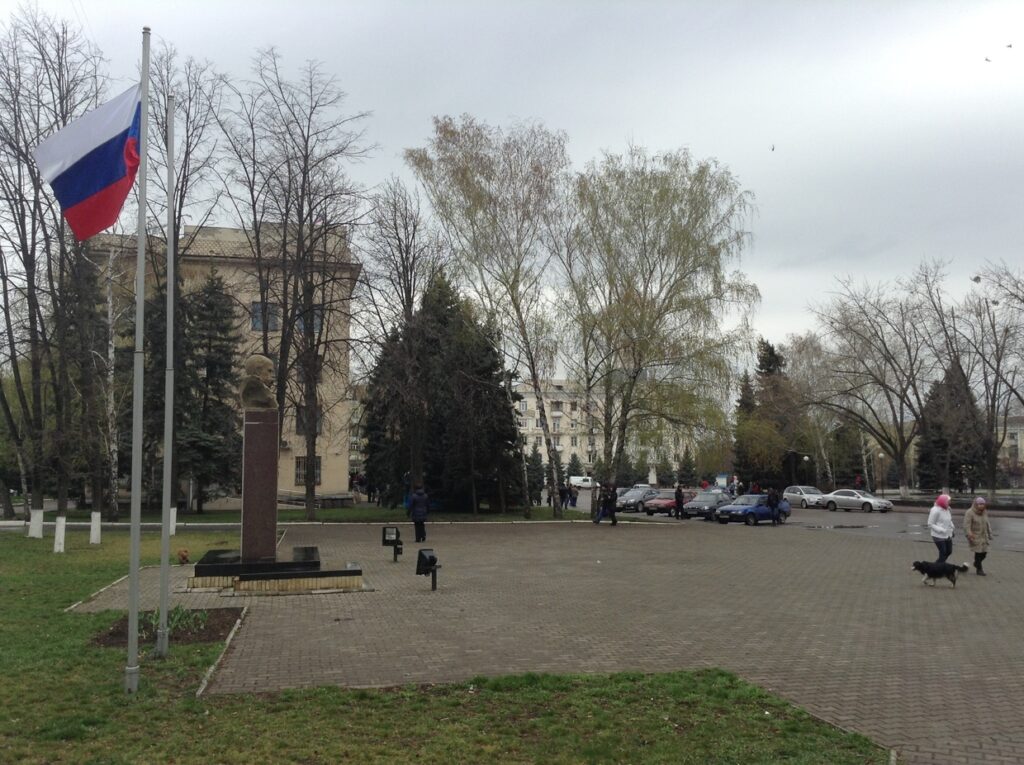
Lenin Square and the monument to Taras Shevchenko in the town of Kramatorsk, Donetsk Region. © Sputnik
Moreover, they consider this attitude a land grab directed at territory Russians consider their own. One of the decisive factors in Russians’ ethnic awakening during the Putin era has been the resistance to this attempt to tear Ukraine away. The president himself was not the initiator of this process but reflects the national mood.
There is no way to get Russians to accept that Ukraine is somehow separate, except by brutal force. Russians will always see any world order that involves the separation of Ukraine from Russia as hostile. By supporting an ‘independent Ukraine’, the West will always have a tireless and relentless enemy in Russia and the Russians.
The question is why does it need this, and who benefits?
By
Egor Kholmogorov, a Russian historian and journalist
___
The Most Important History of the Ukraine Never Seen in the West
Conclusion
At this late date, it’s crucial to apprehend these critical details of this untold Ukraine back story. If you are an American reader, it’s absolutely vital to understand that the deliberate balkanization of Ukraine will soon be coming to the 50 states for
The Same Barbarians Are Inside The Gate … unless righteous Patriots rise up everywhere to terminate the Khazarian vice grip on the U.S. Federal Government and
Corporate America.
For any American who doubts that
The Khazarian Barbarians Have Been Inside The Gate For Well Over A Century, all they have to do is consider who they cannot criticize or make jokes about—EVER! On the other hand, as the irrefutable exposé at the preceding hyperlink well delineates, the Khazarians have been making fun of US as long as they have been domiciled in the USA, and on our dime.
Lastly, if there’s one brief paper that does a deep dive into the particularly profound Ukrianian-Khazarian connection which has severely impacted the fate of Russia, the fate of the United States and the fate of Ukraine, it is this quite revelatory essay:
HIDDEN HISTORY: Rothschild & Schiff Banksters, Zionist Ukrainian Oligarchy & Satanic Khazarian Mafia
Revisionist Historians for World Peace