Yasitokee
Hapa umemalizia kuandika upuuzi tupu
Ujerumani mbali na katika somo la historia kufundisha utawala wa NAZI ya Adolf Hitler walifanya nini, magazeti na media kujadili kwa kina utawala wa Adolf Hitler pia wamefungua makumbusho maalum ili kusaidia kuondoa mabaki ya kifikra ya wafia-utawala wa Adolf Hitler wanaotaka kumfanya ni malaika, mwokozi, mzalendo
TOPICS
DENAZIFICATION
It was clear to the victorious Allies of World War II well before the German army capitulated in 1945 that the entirety of German society would need to be cleansed of Nazi influences and effects, and that the Germans would need to be “re-educated” in democratic values. It was relatively simple to repeal Nazi laws, remove symbols of the National Socialist regime from the public realm, cull unwanted books from the libraries, obliterate the swastikas on forms and paperwork, and change street names. A much greater problem was what to do with the some 8.5 million members of the Nazi Party (NSDAP), and the many more millions out of a German population of 70 million who had belonged to one or another Nazi organization – how to denazify them.
While legal proceedings such as the 1945/46 Nuremberg Trial of the major war criminals were judicial prosecutions of specific crimes, denazification took a different shape. Its goal was to politically cleanse German society and make sure that people who had been involved with the Nazi regime were excluded from important positions in society and the future state institutions.
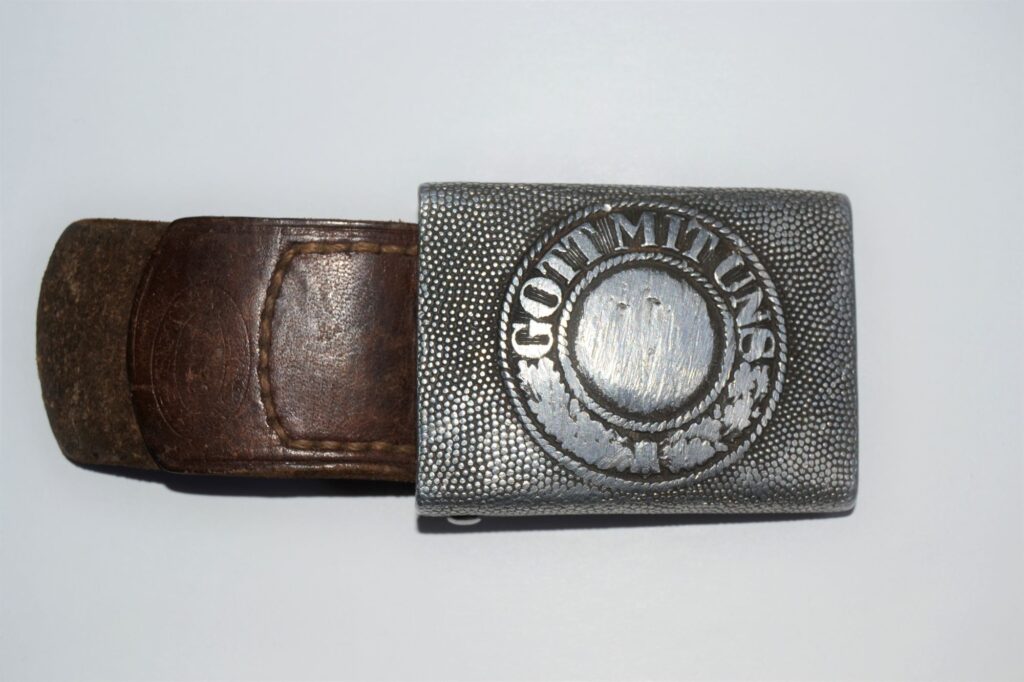
Belt with Wehrmacht buckle from the postwar period. The swastika on the visible front side has been removed, but the one on the inside of the buckle is still there. (AlliiertenMuseum/W. Chodan)
INTERNMENT AND DENAZIFICATION PROCEDURES
Immediately following the end of the war, active Nazis and functionaries – in particular, police, members of the SS, and civil servants – were removed from their posts by the Allies and subject to “automatic arrest.” Between 1945 and 1950, the Allies preemptively detained more than 400,000 Germans in internment camps without case-by-case reviews. In the Soviet occupation zone, it was not only former Nazis, but also many people the Soviets considered political opponents, who were detained in what were called special camps.
Submitting the denazification questionnaire in Berlin’s Steglitz district, 1946 (National Archives in Washington, D.C.)
There was disagreement among the four occupying powers about the specifics of how the political cleansing should be carried out; initially, there was neither a joint course of action nor a joint objective, and the denazification procedures differed accordingly. It was not until January 1946, after long discussion, that the Allied Control Council issued Directive no. 24 containing guidelines for a coordinated approach across Germany.
FURTHER READING
The occupying powers turned responsibility for denazification over to the Germans as early as 1945/46. In each occupation zone, various forms of commissions, committees, and denazification tribunals called spruchkammer, made up of former resistance fighters, unionists, professional and lay judges, and similar people, vetted individuals. In quadripartite Berlin, there was a joint procedure for the four powers – at least on paper. In all of the occupation zones and/or sectors, the classification and ruling by the spruchkammer, commissions, and committees was made on the basis of a comprehensive questionnaire. The respondents had to provide detailed and truthful information about their political biography, including membership in the Nazi Party or any other Nazi organization. The sanctions that might be imposed included fines, forced retirement, or even confinement to a labor camp. Many people produced exculpatory sworn statements. Since incriminating documents were often difficult to unearth, those written attestations – from friends or neighbors, say – contributed significantly to the fact that the overwhelming majority of cases were classified in the 4th category “Followers.” Only 1.4 percent of the people undergoing denazification ended up classified as “Major Offenders” or “Offenders.” An official ruling that a person had been classified as “Exonerated” or a “Follower” – and by association, the exculpatory sworn statements – were later to be known colloquially as “persil” certificates, a reference to a popular laundry detergent, meaning the document had “whitewashed” the possible guilt of its holder.
DIFFERENCES BETWEEN THE FOUR OCCUPATION ZONES
Although the Allies had all agreed on the five categories of culpability, the denazification process continued to be implemented to differing degrees in the individual occupation zones. The Americans carried out the most extensive bureaucratic operation.
FURTHER READING
Two soldiers look through documents at the Berlin Document Center, 1946 (AlliiertenMuseum/US Army Photograph)
Denazification in the British and French occupation zones was much smaller in scope than in the American zone and was handled in a far more pragmatic manner. The British prioritized the efficiency of the German administrative authorities, as well as the economy – taking into consideration the country’s level of destruction, along with housing and drastic food shortages – above any extensive cleansing of the ranks. Sometimes-contradictory guidelines were often implemented with long delays and the procedure was complicated. In the French occupation zone, denazification policies had a largely improvisational character, as well as being directed towards French national interests. The French focused their denazification on the civil service and large-scale industry; they made no effort to implement the kind of rigid political cleansing that was initially attempted in the U.S. occupation zone.
FURTHER READING
TIMELINE
1944
American Major Aldo Raffa develops a questionnaire for US forces in Italy aimed at identifying active Fascists in the Sicilian military regime. This “scheda personale” becomes the model for the questionnaire that will be used in the American and British occupation zones of Germany beginning in 1945.
March 11 1945
At the Yalta Conference, the U.S., Britain, and the Soviet Union all agree on the denazification of Germany as a goal after the end of World War II.
August 2
The Potsdam Declaration lays out plans for cleansing German society of any Nazi influences. This was part of the four political principals for the occupation, known as the four “D”s: Denazification, Demilitarization, Democratization, and Decentralization.
October 10
Control Council Law no. 2, issued by the Allied Control Council for the “Termination and Liquidation of the Nazi Organization” bans the Nazi Party and all of its affiliated organizations.
JanuarY 12 1946
Allied Control Council Directive no. 24 calls for the “Removal from Office and from Positions of Responsibility of Nazis and of Persons Hostile to Allied Purposes.”
FebruarY 5
A Christmas amnesty is declared in the American occupation zone, which benefited primarily “Followers” and those whose annual income before the end of the war had been less than 4,500 reichsmarks.
March 5 1946
The “Law 104 for the Liberation from National Socialism and Militarism” establishes five categories for classifying people, among other things. They were: 1. Major Offenders, 2. Offenders (activists, militarists, and beneficiaries), 3. Lesser Offenders (probation group), 4. Followers, and 5. Persons Exonerated.
August 6
The American occupation authorities declare a youth amnesty that covers anyone born after January 1, 1919, unless they were incriminated or charged as “Major Offenders” or “Offenders.” Taken together with the February 5 Christmas amnesty, the youth amnesty reduced by about one-third the number of people still to be processed.
OCtober 12
Allied Control Council Directive no. 38 takes effect, providing for the “Arrest and Punishment of War Criminals, Nazis, and Militarists and the Internment, Control, and Surveillance of Potentially Dangerous Germans.”
MaY 2 1947
The French military government issues Ordinance no. 92 for youth amnesty, which covered anyone born after January 1, 1919, excepting only high-ranking Nazi Party functionaries and former members of the SS or the Gestapo.
August 16
The Soviet military administration releases Order no. 201 on denazification and the complete political cleansing of all public office and industry of “active fascists, militarists, and war criminals,” creating uniform provisions for public denazification proceedings.
FebruarY 26 1948
With Order no. 35, the Soviet military administration announces that denazification in the Soviet occupation zone would end on March 10, 1948.
November 17 1949
The newly-established GDR (East Germany) proclaims a law that waives sanctions and grants civil rights to former members and supporters of the Nazi Party and “officers of the fascist armed forces,” which largely restores the civil rights of anyone incriminated in Nazi activities.
OCtober 15 1950
The West German parliament adopts a recommendation for a uniform completion of denazification.
MaY 11 1951
The law regulating the legal status of persons covered by Article 131 of the Basic Law (called the 131 law) is passed by the Bundestag with two abstentions; it marks the end of denazification in West Germany.
OCtober 6 1952
The law on the civil rights of former officers of the “fascist armed forces,” and former members and supporters of the Nazi Party is announced; with it, prejudicial treatment of people implicated in Nazi activities is legally abolished.
AlliiertenMuseum
Clayallee 135
14195 Berlin
Tuesday – Sunday
10 am – 6 pm
Entry is free